
As filed with the Securities and Exchange Commission on September 8, 2025.
Registration No. 333‑289695
UNITED STATES
SECURITIES AND EXCHANGE COMMISSION
Washington, D.C. 20549
Amendment No. 3
to
FORM S-1
REGISTRATION STATEMENT UNDER
THE SECURITIES ACT OF 1933
Figure Technology Solutions, Inc.
(Exact name of registrant as specified in its charter)
| Nevada | 7374 | 99-2556408 | ||||||
| (State or other jurisdiction of incorporation or organization) | (Primary Standard Industrial Classification Code Number) | (I.R.S. Employer Identification Number) | ||||||
100 West Liberty Street, Suite 600
Reno, NV 89501
(917) 789-8049
(Address, including zip code, and telephone number, including area code, of registrant’s principal executive offices)
Michael Tannenbaum
Chief Executive Officer
Figure Technology Solutions, Inc.
100 West Liberty Street, Suite 600
Reno, NV 89501
(917) 789-8049
(Name, address, including zip code, and telephone number, including area code, of agent for service)
Copies to:
Marc D. Jaffe Ian D. Schuman Adam J. Gelardi Latham & Watkins LLP 1271 Avenue of the Americas New York, NY 10020 (212) 906-1200 | Ronald Chillemi Chief Legal Officer and Corporate Secretary Figure Technology Solutions, Inc. 100 West Liberty Street, Suite 600 Reno, NV 89501 (917) 789-8049 | Byron B. Rooney Derek Dostal Davis Polk & Wardwell LLP 450 Lexington Avenue New York, NY 10017 (212) 450-4000 | ||||||
Approximate date of commencement of proposed sale to the public: As soon as practicable after this registration statement becomes effective.
If any of the securities being registered on this Form are to be offered on a delayed or continuous basis pursuant to Rule 415 under the Securities Act of 1933 check the following box: ☐
If this Form is filed to register additional securities for an offering pursuant to Rule 462(b) under the Securities Act, please check the following box and list the Securities Act registration statement number of the earlier effective registration statement for the same offering. ☐
If this Form is a post-effective amendment filed pursuant to Rule 462(c) under the Securities Act, check the following box and list the Securities Act registration statement number of the earlier effective registration statement for the same offering. ☐
If this Form is a post-effective amendment filed pursuant to Rule 462(d) under the Securities Act, check the following box and list the Securities Act registration statement number of the earlier effective registration statement for the same offering. ☐
Indicate by check mark whether the registrant is a large accelerated filer, an accelerated filer, a non-accelerated filer, a smaller reporting company, or an emerging growth company. See the definitions of “large accelerated filer,” “accelerated filer,” “smaller reporting company” and “emerging growth company” in Rule 12b-2 of the Exchange Act.
| Large accelerated filer | ☐ | Accelerated filer | ☐ | ||||||||
| Non-accelerated filer | ☒ | Smaller reporting company | ☐ | ||||||||
| Emerging growth company | ☒ | ||||||||||
If an emerging growth company, indicate by check mark if the registrant has elected not to use the extended transition period for complying with any new or revised financial accounting standards provided pursuant to Section 7(a)(2)(B) of the Securities Act. ☐
The registrant hereby amends this registration statement on such date or dates as may be necessary to delay its effective date until the registrant shall file a further amendment which specifically states that this registration statement shall thereafter become effective in accordance with Section 8(a) of the Securities Act of 1933 or until the registration statement shall become effective on such date as the Securities and Exchange Commission, acting pursuant to said Section 8(a), may determine.
The information contained in this preliminary prospectus is not complete and may be changed. We and the selling stockholders may not sell these securities until the registration statement filed with the Securities and Exchange Commission is effective. This preliminary prospectus is not an offer to sell these securities and neither we nor the selling stockholders are soliciting an offer to buy these securities in any jurisdiction where the offer or sale is not permitted.
Subject to Completion, Dated September 8, 2025
PRELIMINARY PROSPECTUS
26,315,789 Shares

Figure Technology Solutions, Inc.
Class A Common Stock
This is the initial public offering of Figure Technology Solutions, Inc. We are offering 21,461,085 shares of our Class A common stock and the selling stockholders identified in this prospectus are offering 4,854,704 shares of our Class A common stock. We will not receive any proceeds from the sale of shares of Class A common stock by the selling stockholders.
Prior to this offering, there has been no public market for our Class A common stock. It is currently estimated that the initial public offering price will be between $18.00 and $20.00 per share.
We have applied to list our Class A common stock on the Nasdaq Stock Market (“NASDAQ”) under the symbol “FIGR.”
Following this offering, we will have two classes of authorized common stock, Class A common stock and Class B common stock (collectively, our “common stock”). The rights of the holders of our Class A common stock and Class B common stock will be identical, except with respect to voting and conversion rights. Each share of Class A common stock will be entitled to one vote. Each share of Class B common stock will be entitled to ten votes and will be convertible into one share of Class A common stock, both at the option of the holder, and mandatorily upon the occurrence of certain events, including after Michael Cagney, our co-founder and a member of our board of directors, and his permitted transferees cease to hold at least 5% of the shares of our common stock (excluding unvested shares of Class B common stock) that are issued and outstanding as of the effectiveness of our amended and restated articles of incorporation. Immediately following the completion of this offering, Mr. Cagney and his permitted transferees, will hold 37,893,047 shares of Class B common stock representing approximately 69.2% of the voting power of our outstanding capital stock (or approximately 68.7% if the underwriters exercise their option to purchase additional shares in full), which will allow Mr. Cagney and his permitted transferees, as holders of the majority of the combined voting power of our common stock, to control all matters submitted to our stockholders for approval. As a result, following this offering we will be a “controlled company” within the meaning of the corporate governance rules of NASDAQ. For additional information, see the section titled “Management—Controlled Company.”
We are an “emerging growth company” as defined under the federal securities laws and, as such, have elected to comply with certain reduced public company reporting requirements in this prospectus and may elect to do so in future filings.
Investing in our Class A common stock involves risks. See the section titled “Risk Factors” beginning on page 36 to read about factors you should consider before deciding to invest in shares of our Class A common stock.
Neither the Securities and Exchange Commission nor any state securities commission has approved or disapproved of these securities or passed upon the accuracy or adequacy of this prospectus. Any representation to the contrary is a criminal offense.
| Per Share | Total | ||||||||||
Initial public offering price | $ | $ | |||||||||
Underwriting discounts and commissions(1) | $ | $ | |||||||||
Proceeds to us, before expenses | $ | $ | |||||||||
Proceeds to the selling stockholders, before expenses | $ | $ | |||||||||
______________
(1)See the section titled “Underwriting” for a description of the compensation payable to the underwriters.
We have granted the underwriters an option to purchase up to an additional 3,947,368 shares of our Class A common stock from us at the initial public offering price, less underwriting discounts and commissions.
Duquesne Family Office LLC has indicated an interest in purchasing up to an aggregate of $50 million of shares of Class A common stock in this offering at the initial public offering price. The shares to be purchased by Duquesne Family Office LLC in this offering will not be subject to a lock-up agreement with the underwriters or the Company. Because this indication of interest is not a binding agreement or commitment to purchase, Duquesne Family Office LLC may determine to purchase more, less or no shares in this offering or the underwriters may determine to sell more, less or no shares to Duquesne Family Office LLC. The underwriters will receive the same discount on any of our shares purchased by Duquesne Family Office LLC as they will from any other shares sold to the public in this offering.
At our request, the underwriters have reserved for sale, at the initial public offering price, up to 1,315,789 shares of Class A common stock, or up to 5% of the shares of Class A common stock offered by this prospectus, for sale to certain individuals associated with us, through a directed share program. See the section titled “Underwriting—Directed Share Program.”
The underwriters expect to deliver the shares against payment in New York, New York on or about , 2025.
Joint Lead Bookrunning Managers | ||||||||
Goldman Sachs & Co. LLC | Jefferies | BofA Securities | ||||||
Bookrunners | ||||||||
| SOCIETE GENERALE | Keefe, Bruyette & Woods A Stifel Company | Mizuho | ||||||
Co-Managers | ||||||||||||||||||||||||||||||||
| Texas Capital Securities | Needham & Company | Piper Sandler | FT Partners | KKR | Roberts & Ryan | |||||||||||||||||||||||||||
Prospectus dated , 2025
TABLE OF CONTENTS
| Page | |||||
i

About this Prospectus
Figure Technology Solutions, Inc. (“FTS”), the registrant whose name appears on the cover of this registration statement, is a corporation incorporated under the laws of the State of Nevada.
In March 2024, we separated our business through a series of transactions in which Figure Lending Corp. (“FLC”) and Figure Markets Holdings, Inc. (“FMH”) were separated and began operating as separate businesses (the “Separation”). In connection with and to effectuate the Separation, FT (as defined below) created each of FMH and FTS, then named FT Intermediate, Inc., as direct wholly-owned subsidiaries of FT. Following the formation of these entities, we completed the Separation through a series of steps, which resulted in, (i) FLC being the sole owner of certain lending-related intellectual property and commercial contracts that were previously owned by FT, (ii) FTS becoming a holding company whose principal assets were the shares it held in FLC, (iii) FMH becoming a separate company, and (iv) FT being a wholly-owned subsidiary of FMH. On March 19, 2024, Figure Technologies, Inc. converted into Figure Technologies, LLC. As used in this prospectus, unless the context otherwise indicates, any reference to “FT” refers to Figure Technologies, LLC (f/k/a Figure Technologies, Inc.).
The board of directors of each of FLC and FMH made a determination that it is in the best interests of both entities to recombine the businesses. On August 29, 2025, we recombined the businesses through a series of transactions (the “Recombination”), and FMH became a wholly-owned subsidiary of FTS. Upon the consummation of the Recombination, FTS changed its name to Figure Technology Solutions, Inc. For additional information, see the section titled “Prospectus Summary—Organizational History.”
As a result of the Recombination, (i) FTS is a holding company with its principal assets consisting of shares in FLC and FMH, (ii) FTS is the sole shareholder of FLC and FMH, (iii) FMH is a wholly-owned subsidiary of FTS, and (iv) FTS operates and controls all of the business and affairs of FLC, FMH, and their respective direct and indirect subsidiaries. Except as otherwise disclosed in the prospectus included in this registration statement, the historical consolidated financial statements, the summary historical consolidated financial data, and the other financial information included in this registration statement are those of FTS and its consolidated subsidiaries after giving effect to the Recombination.
As used in this prospectus, unless the context otherwise indicates, any reference to “Figure,” “our Company,” “us,” “we,” and “our” refers to FTS, which as a result of the Recombination includes FMH, a Nevada corporation and a wholly-owned subsidiary of FTS, together with its consolidated subsidiaries.
Neither we, the selling stockholders nor any of the underwriters have authorized anyone to provide you with information that is different from the information contained in this prospectus and any free writing prospectus prepared by or on behalf of us or to which we have referred you. Neither we, the selling stockholders nor the underwriters take any responsibility for, and cannot provide any assurance as to the reliability of, any other information that others may give you. The information contained in this prospectus or in any applicable free writing prospectus is accurate only as of the date of this prospectus or such free writing prospectus, as applicable, regardless of the time of delivery of this prospectus or any such free writing prospectus or of any sale of the securities offered hereby. Our business, results of operations, financial condition, and prospects may have changed since that date.
This prospectus is an offer to sell only the securities offered hereby and only under circumstances and in jurisdictions where it is lawful to do so. Neither we, the selling stockholders nor any of the underwriters have taken any action that would permit this offering or possession or distribution of this prospectus in any jurisdiction where action for that purpose is required, other than in the United States. Persons who have come into possession of this prospectus in a jurisdiction outside the United States are required to inform themselves about and to observe any restrictions relating to this offering and the distribution of this prospectus.
vii
Basis of Presentation
Except as otherwise disclosed in this prospectus, the historical consolidated financial statements, the summary historical consolidated financial data, and the other financial information included elsewhere in this prospectus have been prepared in U.S. dollars in accordance with accounting principles generally accepted in the United States (“GAAP”) and for the three months ended March 31, 2025, the three and six months ended June 30, 2025 and 2024, and the year ended December 31, 2024 reflect the combined consolidated statements of FTS and FMH, whereas the comparative information for the three months ended March 31, 2024, and the year ended December 31, 2023 reflects the consolidated financial statements of the previous parent company, FT, prior to the Separation. This historical financial information does not give effect to this offering.
The Recombination by which FMH became a wholly-owned subsidiary of FTS was accounted for as a reorganization of entities under the common control of Michael Cagney. As a result, the consolidated financial statements of FTS recognize the assets and liabilities received in connection with the Recombination at their historical carrying amounts. As required under GAAP, the financial statements of FTS reflect the retrospective consolidation of FMH to give effect to the Recombination.
Glossary
The following are abbreviations and definitions of certain consumer credit, digital asset, and other terms used in this prospectus.
DART—Digital Asset Registration Technologies, our lien and eNote registry platform that utilizes the Provenance Blockchain.
DeFi—Decentralized Finance.
DSCR loans—Our debt service coverage ratio loan product.
Digitally native assets—Assets that are created, issued, recorded, and kept in a digital system, typically a distributed ledger technology, such as a blockchain. They are created and exist purely within the digital realm.
Figure-branded—When loans are originated using our LOS under the Figure brand.
Homogeneous loan origination—Loan origination protocols and processes that are based on the same pre-defined standards and underwriting criteria, which generate loans with similar characteristics and are comparable for purposes of evaluation, documentation and transfer of ownership.
Layer 1 blockchain—The foundational base layer of a blockchain network. It provides the core infrastructure for transactions, data validation, and consensus, and forms the fundamental framework upon which all other layers and applications are built.
Loss rates—Total amount of the unpaid balance of (i) loans originated by us that have been charged-off, foreclosed, and dismissed in bankruptcy, and (ii) non-performing loans that have been sold divided by the total amount of unpaid principal balance of loans originated by us.
Partner—An organization in our Partner-branded strategy. Our partners are typically mortgage originators, servicers, banks, wholesale brokers, and credit unions.
Partner-branded—When loans are originated using our LOS under our partners’ brands.
Real-world assets—Tangible assets with clear economic value, such as loans, stocks, bonds and real estate.
viii
Smart contracts—a smart contract is a self-executing computer program that automatically enforces the terms of an agreement when predetermined conditions are met, without requiring intermediaries or manual intervention.
Standardized assets—Assets that have uniformity in characteristics, documentation, underwriting standards and processes. This standardization allows buyers and sellers of loans to streamline processes, improve efficiency and enhance transparency in the transacting of these assets.
Tokenized real-world assets—Physical or tangible assets that are represented on a blockchain through a digital token or marker. This token conveys ownership rights of the underlying asset to the holder and enables transfers of ownership to occur exclusively on the blockchain. If the owner wishes to remove the asset from the blockchain, they may do so by presenting the digital proof of ownership and reverting to traditional methods of asset transfer. To ensure there is no duplication of ownership records, the corresponding blockchain key is destroyed, eliminating blockchain-based access to the asset. All parties with interests in the underlying real-world asset will typically participate in the transfer of ownership unless their interests remain unaffected by the digital conveyance. We tokenize loans by representing the digital loan note on the Provenance Blockchain at the time the loan is originated, and then using the blockchain to represent the owner of the loan as the loan is bought and sold. The owner of this token has all of the rights, obligations and privileges with respect to ownership of the underlying loan promissory note. Any party involved in a transaction with the loan participates in the blockchain-based transfer of such loan. The blockchain tokenized real-world assets are "digital twins" of the real-world asset representations, as documented through traditional legal documents that record real-world assets pursuant to state law. The token itself has no additional rights or value other than those granted by the ownership of the real-world asset.
ix
PROSPECTUS SUMMARY
This summary highlights selected information that is presented in greater detail elsewhere in this prospectus. This summary does not contain all the information you should consider before investing in our Class A common stock. You should read this entire prospectus carefully, including the sections titled “Risk Factors,” “Management’s Discussion and Analysis of Financial Condition and Results of Operations,” and our consolidated financial statements and related notes included elsewhere in this prospectus, before making an investment decision.
Business Overview
Figure is building the future of capital markets using blockchain-based technology.
Figure’s proprietary technology powers next-generation lending, trading and investing activities in areas such as consumer credit and digital assets. Our application of the blockchain ledger allows us to better serve our end-customers, improve speed and efficiency, and enhance standardization and liquidity. Using our technology, we continue to develop dynamic, vertically-integrated marketplaces across the approximately $2 trillion consumer credit market and the rapidly growing approximately $4 trillion cryptocurrency and digital asset market. As a result, Figure has grown quickly and profitably, with net income of $29 million and Adjusted EBITDA of $83 million, for the six months ended June 30, 2025, and accumulated deficit of $292 million and total stockholders’ equity of $404 million, as of June 30, 2025, and net income of $20 million and Adjusted EBITDA of $101 million, for the year ended December 31, 2024, and accumulated deficit of $321 million and total stockholders’ equity of $363 million, as of December 31, 2024.
The infrastructure supporting capital markets today is fragmented and operates on legacy systems which employ antiquated processes for loan approvals and transaction processing. This creates process and cost inefficiencies in serving consumer credit markets and limits the development of alternative marketplaces. Furthermore, the manual elements underpinning the records of ownership and transfer of financial and real assets constrain liquidity, maintain elevated costs, and are error-prone.
Figure aims to address these challenges by using blockchain-based technology to innovate beyond legacy processes. We built a transformative, scaled and fast growing technology platform that displaces trust with truth in the financial ecosystem. Our platform also supports legacy systems, and our goal is to shift customer adoption towards blockchain-based solutions. Furthermore, our technology significantly reduces complexity and increases speed for market participants across the application, underwriting, funding and subsequent capital markets processes. Using our proprietary Loan Origination System (“LOS”), the time it takes to fund a home equity loan from application has been reduced to a median of 10 days from an industry median of approximately 42 days (based on data from industry sources) as of June 30, 2025. In comparison, for asset classes outside of mortgages, such as personal loans, there are many loan originators that utilize digitized, fast and automated processes that can fund as fast as same-day or often in as little as three to five days. Additionally, the average production cost per loan was reduced to approximately $730 for the year ended December 31, 2024 from a mortgage industry average of $11,230 for the quarter ended December 31, 2024, according to the Mortgage Bankers Association (“MBA”). This is a result of our entirely automated application process that takes as little as five minutes to complete and as few as five days to fund. Our platform automates income verification and offers customers the ability to redraw without incurring closing or out-of-pocket costs. Additionally, our platform employs an automatic valuation model, replacing the traditional, time-consuming appraisal process, and utilizes a digital lien matching process instead of the traditional analog title search. It also facilitates remote closings, including remote notaries, in jurisdictions where permitted by applicable laws. Importantly, we offer a liquid capital market for loans in connection with this low cost, automated and blockchain-based origination engine.
Our technology enables the immutable recording of all assets and their key information on Provenance Blockchain. Provenance Blockchain, an independent Layer 1 blockchain, provides the scale, security, speed and cost structure to facilitate activity across the broad financial services landscape as a
1
record of truth for assets. Using loans as an example, this authenticity record provides a validation mechanism to support the traditional, off-chain processes we use for tracking and monitoring loan transactions. This record provides verified information regarding the chain of ownership for all of the loans originated on our platform. Adoption of our technology has scaled significantly with every asset passing through Figure’s system being recorded on Provenance Blockchain and accumulating over $50 billion in both real-world and digital asset transactions from our launch in late 2018 to June 30, 2025. According to data from RWA.xyz, our real-world assets total value locked is approximately $11 billion as of August 1, 2025 and our share of tokenized private credit is approximately 75% based on the value of outstanding loans originated as of August 1, 2025. Further, 80% of loans originated through our LOS, which include loans originated by Figure as well as by our partners, for the six months ended June 30, 2025 utilized our DART platform, our lien and eNote registry that is built on Provenance Blockchain, compared to only 2% of loan originations for the year ended December 31, 2024. Loans originated by our partners utilizing DART accounted for 80% of Partner-branded loans and 62% of all loans originated by our LOS (including wholesale (brokered) transactions) for the six months ended June 30, 2025. We pay a minimal amount in the form of HASH for our use of the Provenance Blockchain. HASH is the utility token of the Provenance Blockchain and therefore gas fees (usage fees) are paid in HASH. A small amount of HASH is required to complete each transaction, and we pay these fees on behalf of all participants for any activity they complete with our assets. The average gas fee has been less than one HASH since 2018, which is equivalent to approximately $0.026.
We began addressing the consumer credit market in 2018 with our Figure-branded product, which catered to direct-to-consumer home equity loans. We then expanded further through Partner-branded strategies, in which a growing number of partners use our technology to independently originate home equity loans. For the last twelve months ended June 30, 2025, we facilitated approximately $6 billion of home equity lending, representing an increase of 29% compared to the twelve months ended June 30, 2024. For the year ended December 31, 2024, we facilitated approximately $5 billion of home equity lending, representing an increase of 51% compared to the year ended December 31, 2023, and a compound annual growth rate of 70% since June 30, 2021. As of June 30, 2025 we had 168 active partners.
Our relationship with our partners is based on our partners’ right to use our solutions. Once a partner is approved and onboarded, the partner enters into a contractual agreement with us for the right to use our LOS and Figure Connect marketplace in exchange for fees. These agreements typically have a fixed term with auto-renewals unless notice is given to terminate, are non-exclusive and do not obligate our partners to use our solutions.
In June 2024, we launched Figure Connect, an electronic marketplace that employs blockchain technology, to directly connect sellers and buyers of loans. During the short period of 12 months from launch in June 2024 to June 2025, approximately $1.3 billion in home equity line of credit (“HELOC“) volume was transacted on Figure Connect by third parties and 27 total marketplace participants (across loan originators, buyers and investors) were onboarded as of June 30, 2025.
With our technology applicable to the broader capital markets, we are expanding beyond our foundational solutions by developing trading and investing products. One example is Figure Exchange, a digital asset marketplace that provides customers advantages for crypto-trading, such as cross-asset collateralization for margin lending. Another example is YLDS, a groundbreaking interest-bearing peer-to-peer transferable stablecoin that is both native to a public blockchain and a security registered with the Securities and Exchange Commission (“SEC”). YLDS has many use cases resulting from its status as a security, including yielding collateral for institutions, cross-border payments and serving as the de-facto currency of Figure Exchange. For the six months ended June 30, 2025, we did not generate revenue from Figure Exchange and revenue generated from YLDS was less than $1 thousand.
We believe that we have established a regulatory and licensing apparatus which sets us apart from our competitors and enables us to continue expanding our diverse product offering. We currently have more than 180 lending and servicing licenses, 48 money transmitter licenses, and are an SEC-registered
2
broker-dealer with authority to operate an alternative trading system (“ATS”), which operations are conducted in accordance with SEC and Financial Industry Regulatory Authority (“FINRA”) rules and regulations.
We generate revenue from the volume transacted on our marketplaces and through the use of our proprietary technology. We earn volume-based fees from partners and users who utilize our technology solutions to transact in our ecosystem. Within this usage-based model, we target positive unit economics in each of our solutions. In addition to our growing stream of ecosystem and technology fees, we also earn origination, gain on sale, and servicing revenue from assets generated through our LOS. During the six months ended June 30, 2025, HELOCs comprised over 99% of our total loan originations.
For the year ended December 31, 2024, approximately 82% of our total net revenue was generated from origination fees, gain on sale of loans, servicing fees and interest income from assets generated through our LOS from both Figure and our network of partners. For the six months ended June 30, 2025, this represented approximately 76% of total net revenue, as revenue from Figure Connect and other new products grew faster than the solely LOS-driven revenue sources.
We have grown quickly in a capital-efficient manner since our founding, and more recently have achieved strong and growing profitability. For the six months ended June 30, 2025 and 2024, we generated net revenue of $191 million and $156 million, respectively, Adjusted Net Revenue of $201 million and $153 million, respectively, net income of $29 million and net loss of $13 million, respectively, and Adjusted EBITDA of $83 million and $37 million, respectively, and as of June 30, 2025, accumulated deficit of $292 million and total stockholders’ equity of $404 million. For the years ended December 31, 2024 and 2023, we generated net revenue of $341 million and $210 million, respectively, Adjusted Net Revenue of $339 million and $214 million, respectively, net income of $20 million and net loss of $52 million, respectively, and Adjusted EBITDA of $101 million and $(12) million, respectively, and as of December 31, 2024 and 2023, accumulated deficit of $321 million and $338 million, respectively, and total stockholders’ equity of $363 million and $222 million, respectively. See the section titled “Management’s Discussion and Analysis of Financial Condition and Results of Operations—Non-GAAP Financial Measures” for information regarding our use of Adjusted Net Revenue and Adjusted EBITDA and a reconciliation of such non-GAAP financial measures to certain directly comparable financial measures calculated in accordance with GAAP.
Current Industry Dynamics
There is a need for a vertically integrated capital markets infrastructure platform that provides one-stop digital technology solutions from asset origination to asset exchange. The industry currently operates via disparate, legacy approaches to consumer credit asset origination and funding and trading of those assets. These approaches are manual, time-consuming, expensive, error-prone and are unable to fully access market funding potential.
Friction in Access and Extension of Consumer Credit, with Challenging and Antiquated Funding Markets
There is significant friction in the process of accessing and extending consumer credit, which ultimately impacts even the highest quality borrowers. The vast majority of consumer credit today is extended by financial institutions that rely on manual, difficult-to-navigate processes burdened by dated technology.
Loan application processes that involve excessive paperwork, physical appraisals, expensive title processes and manual income verification result in slow timelines to approval and funding. For example, home equity loans can take approximately 42 days to complete, driving incremental costs for borrowers, according to industry sources.
Similarly, the legacy asset transfer process is paper-intensive, presents several burdens associated with manual assignments and document management, and relies heavily upon conventional loan-tracking
3
databases, which are error-prone. Digitizing this process increases safeguards, provides greater transparency, and improves efficiency.
Additionally, in order to access off-balance sheet sources of funding today, originators seek institutional funding partners bilaterally and one-by-one. Often due to the lack of information transparency around assets and funding sources, the liquidity potential to facilitate incremental asset origination growth has not been fully unlocked. As an example, and based on data from industry sources, while the quantum of private credit capital raised globally grew by a compound annual growth rate of approximately 17% over the five-year period ended December 31, 2023 to reach over $1 trillion, and is estimated to reach $3 trillion by 2028, access to private credit remains challenging for originators. Similarly, investors struggle to obtain expeditious and consistent access to reliable, quality assets.
Limited Real-World Success of Blockchain Technology
There are limited examples of real-world success using blockchain technology. We believe that on-chain digital real-world assets continue to represent a greenfield of opportunity of significant scale. According to data from RWA.xyz and other industry sources as of April 2025, less than 1% of real-world assets are currently on blockchain. Using a blockchain-native ecosystem would reduce costs, improve liquidity and expand access to capital.
Additionally, there is a scarcity of interest-bearing stablecoins. Stablecoins offer a digitally native way to hold fiat value on-chain. They are designed to maintain a stable value, typically $1.00 per token, and are generally backed by bank deposits or government securities such as U.S. Treasury bonds held in trust by the stablecoin issuer. However, unlike a bank account, money market account, U.S. Treasury bonds, or corporate debt, most stablecoins do not pay their holder any yield. As of June 30, 2025, only 4% of the $275 billion of stablecoins in circulation yielded interest, according to CoinGecko. Paying any type of yield could cause a stablecoin to be subject to securities laws, including being required to be registered as a security. Figure has created YLDS to solve this by designing a digitally native blockchain-based stablecoin that is registered as a security with the SEC and offers a yield to token holders, which we believe should result in an uptick in adoption as compared to non-yielding stablecoins.
Our Solutions
Figure has built a vertically integrated suite of blockchain-based solutions that powers our marketplaces, including lending, trading, and investing activities in areas such as consumer credit and digital assets. Our solutions produce greater efficiency and liquidity across asset classes and markets. Provenance Blockchain is the sole system of record for our major solutions across DART, Figure Connect, YLDS and, except for all personally identifiable information of the borrower, our LOS.
Our vision is to create a one-stop, vertically integrated capital markets trading platform for consumer assets. As a first step, we developed a next-generation, proprietary LOS that drives fast, transparent and homogeneous loan origination. We have since paired this LOS with a loan distribution marketplace, Figure Connect, to enable access to a broad and growing pool of capital markets partners. Additionally, we created DART, our registry technology built on Provenance Blockchain, to provide certainty and transparency in asset ownership.
Our foundation for our differentiated infrastructure has been in the HELOC market. We entered the market through our own Figure-branded strategy, which we utilize to originate loans directly to borrowers, and have subsequently developed a Partner-branded strategy through which mortgage originators, servicers, banks, wholesale brokers, and credit unions can use our technology to originate and distribute their own loans. We facilitated $5 billion in HELOCs in 2024, up 51% from 2023, accumulating more than $16 billion in cumulative originations since the product was launched in late 2018 to June 30, 2025 and achieving the #1 market share in the non-bank HELOC lending market in 2024, as reported by Home Equity Lending News.
4
For the six months ended June 30, 2025, HELOC originations through our LOS utilization of Figure Connect and sales of loans contributed to 75% of our revenue and 76% of Adjusted Net Revenue including 22% from transactions via Figure Connect, and Servicing and Interest Income Revenue contributed 24%. All of our loan originations are recorded on the Provenance Blockchain as a hashed record and, through our DART application, in county land records. Ownership of loans is updated on the Provenance Blockchain as loans are bought and sold in our marketplace.
We have since developed and extended our infrastructure into additional use cases, including launching Figure Exchange, developing an ATS, and issuing the YLDS stablecoin. YLDS is a SEC-registered face amount certificate and is freely transferable peer-to-peer to wallets that have gone through a Know Your Customer (“KYC”) and anti-money laundering onboarding process, consistent with applicable U.S. federal and state financial regulatory requirements. This process is administered directly by us or through a registered transfer agent and includes the collection of personally identifiable information such as name, date of birth, address, social security number, and contact information. Going forward, we believe our infrastructure is portable across a broad array of activities on our roadmap, ultimately allowing us to deliver powerful synergies across our vertically integrated platform. Our Ecosystem Volume experienced a compound annual growth rate of 86% from the year ended December 31, 2020 to the year ended December 31, 2024. See “Management’s Discussion and Analysis of Financial Condition and Results of Operations—Key Operating Metrics” for the definition of Ecosystem Volume and how we calculate it.
Proprietary Loan Origination System
In July 2018, we launched our proprietary LOS, which uses modern technology to help deliver efficiency, speed and lower costs at each stage of the loan origination process. Leveraging automated valuation models (“AVMs”), digital title and lien matching, and digital income verification via data aggregators, we are able to offer HELOC loan approval in as little as five minutes and funding in as few as five days (median of 10 days during the six months ended June 30, 2025). In the six months ended June 30, 2025, 88% of the loans we facilitated were fully automated from the start of the application to the underwriting stage of the loan process.
In contrast to legacy lending infrastructure, our LOS is built upon a differentiated technology stack that digitizes key aspects of underwriting, including credit, income, and property. Our underwriting process is streamlined through a fully digital and paperless user interface that is simple, fast, and offers a superior user experience. Our operational processes reduce the work effort and error rate of applications and provide greater transparency and functionality for end-customers and partners. By deploying our modern LOS, we believe we are the first company to develop and offer a consumer-friendly HELOC product that can compete with unsecured personal loan alternatives and cash-out mortgage refinance products.
Our LOS excels in handling secured asset classes, such as HELOCs and mortgages, due to its robust infrastructure for data capture and verification. These capabilities are enhanced by data immutability and process compliance, as all loans and related data (except for all personally identifiable information of the borrower) are recorded on a public blockchain, Provenance Blockchain. Our LOS also extends well to unsecured loans, such as personal loans and credit lines, given the automated underwriting that swiftly assesses borrower creditworthiness.
5
We have reduced the time from HELOC application to funding from an industry median of approximately 42 days, according to industry sources, to a median of 10 days for the six months ended June 30, 2025.
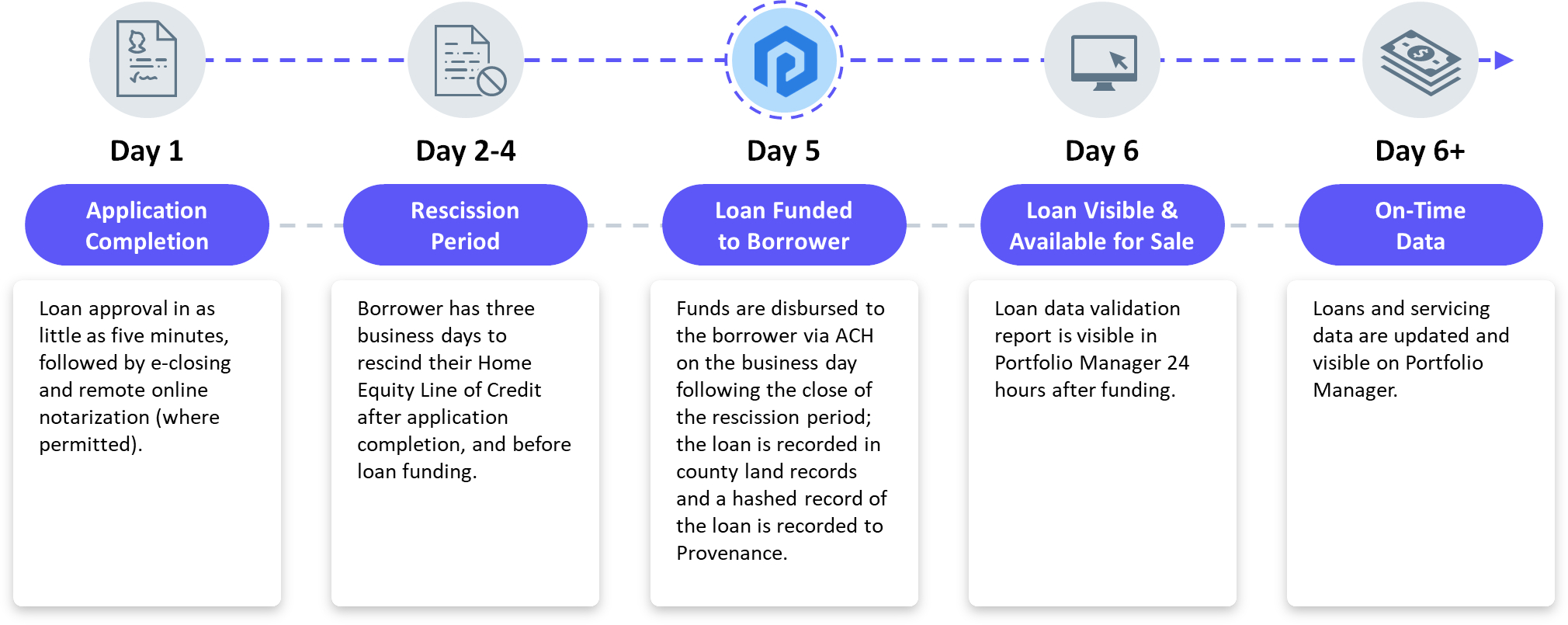
Our typical end-customers for HELOCs are homeowners with high creditworthiness, as seen through an average FICO score of 755 and average income of approximately $186,000 for originations during the six months ended June 30, 2025. Our customer base values financial products that reflect their strong financial standing. We provide a HELOC product that is fast and convenient to our end-customers, and is an alternative to taking out personal loans or holding credit card balances. During the six months ended June 30, 2025, 15% of the total principal amount of loans originated via our LOS were first-lien.
We deploy our LOS through two strategies:
•Partner-branded: Our partners are mortgage originators, servicers, banks, wholesale brokers, and credit unions. These partners use our consumer-facing application portal, which is branded in the partner’s name and provides homogeneous automated underwriting, loan-decisioning software, and loan closing tools. The offering is used by both retail and wholesale lenders. Our lending and distribution platform is designed to support the diverse business models of our network of lending partners.
Partner-branded loan originations have grown from $149 million for the last twelve months ended June 30, 2022 to approximately $4.3 billion for the last twelve months ended June 30, 2025. For the six months ended June 30, 2025, Partner-branded loans comprised 77% of our total loan originations.
Our network of partners has grown from three partners as of December 31, 2021, to 168 as of June 30, 2025, with our top 10 partners contributing 57% and 52% of our origination volume for the six months ended June 30, 2025 and the year ended December 31, 2024, respectively. Our top 10 partners are medium to large non-bank finance companies in the mortgage industry. They are concentrated in the United States, with some having a nationwide presence and others focusing on specific regional markets.
•Figure-branded: We utilize the Figure-branded strategy to launch new asset classes through our LOS, which enables us to prove demand and product efficacy and validate results of upgrades and modifications.
As we refined our HELOC product, we worked quickly to develop a proof of concept through Figure-branded loans, with origination volume for Figure-branded loans growing from approximately $310 million for the twelve months ended June 30, 2019, our first year of activity,
6
to approximately $750 million for the six months ended June 30, 2025 and approximately $2 billion for the last twelve months ended June 30, 2025. For the six months ended June 30, 2025, Figure-branded loans comprised 23% of our total loan originations.
A number of our partners are not licensed to originate mortgage loans in each state, and as such, rely on our Figure-branded strategy. Over time, as these partners generate sufficient Figure-branded volume, it becomes a worthwhile investment for them to obtain required lending licenses, which enables them to shift to Partner-branded strategies and take control over their origination funnel.
Our LOS ensures a uniform underwriting process that helps generate standardized assets with enhanced transparency around collateral composition. As a result, loans originated through our LOS, both Partner-branded and Figure-branded, are highly attractive for loan purchasers and investors. In comparison, with bespoke non-conforming loans, investors can pick and choose, which makes it a long process that is difficult for originators and investors. Figure maintains high quality through its disciplined underwriting process, which automates credit decisions across 28 different criteria. As of June 30, 2025, Figure’s originated loans had loss rates of less than 1% of volume.
Figure Connect
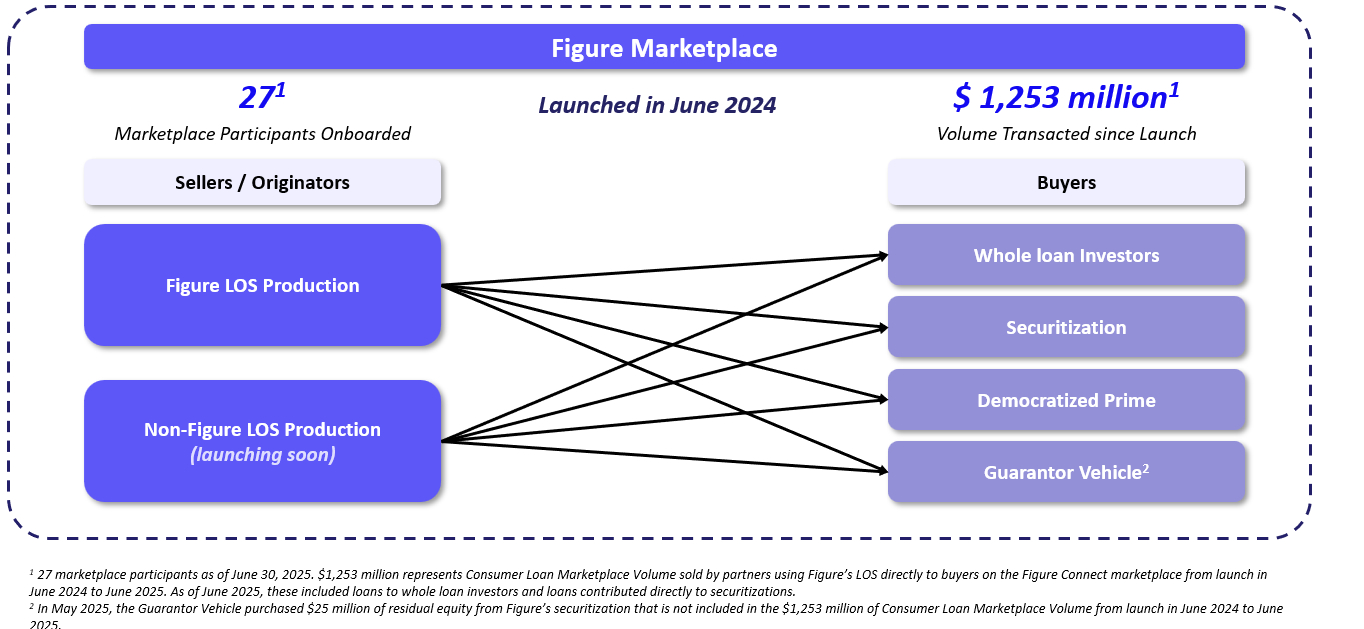
In June 2024, we launched Figure Connect. Figure Connect is our custom-built marketplace platform that facilitates buying and selling of standardized assets that are originated through our LOS. These transactions utilize uniform underwriting, common documentation (such as loan agreements and credit policies), standardized representations and warranties, and are automatically recorded on Provenance Blockchain. Figure Connect enhances liquidity for loans originated through our LOS. Additional tools such as Portfolio Manager, which provide private credit loan purchasers seamless visibility into the current performance of their loans, foster further adoption and participation in our ecosystem. For the first 12 months since we launched Figure Connect in June 2024 to June 2025, approximately $1.3 billion of loan volume was traded.
Sellers of loans transacted on Figure Connect pay a fee for utilizing our technology for origination, as well as a technology fee associated with the execution of loan sales on our platform. Our pricing structure and unit economics are designed to further incentivize customers to transact on Figure Connect, as revenue received has historically exceeded costs incurred by a margin of at least 2%. This margin calculation is comprised of target revenue to the originator (origination fees and gain on sale of loans) and fees that the originator pays for the utilization of the Figure Connect marketplace. Sellers of loans on Figure Connect typically pay a volume-based fee for utilizing our technology solution to originate loans and to place these loans for sale on Figure Connect, as well as a sale volume-based fee associated with the execution of loan sales to a buyer. We do not incur additional expenses to transact these loans on Figure Connect; however, we have built the technology that supports this marketplace and continue to incur technology-related costs to maintain the marketplace. For the years ended December 31, 2024 and 2023, net revenue generated from Figure Connect was $0.2 million and $0, respectively. For the six months ended June 30, 2025, net revenue generated from Figure Connect was $45 million.
Sellers are incentivized to transact on Figure Connect, as the average per loan net revenue they would generate on our marketplace (gain on sale of loans and origination fees to the sellers less fees paid to us for using Figure Connect) is higher than the per loan net revenue the sellers would earn from originating these loans and selling them to us as a loan intermediary buyer. Such difference was on average over 1% of the unpaid loan principal balance during the six months ended June 30, 2025.
In February 2025, we formed a joint venture with Sixth Street Partners, Fig SIX Mortgage LLC, to purchase HELOC loans originated through our LOS and sold through Figure Connect. Sixth Street Partners is a global investment firm that invests in credit products, among other strategies. Fig SIX Mortgage LLC is capitalized with 95% Sixth Street equity and 5% Figure equity. We refer to this joint venture and its activities as a “Guarantor Vehicle.” The Guarantor Vehicle is expected to wholly own the
7
loans it purchases and subsequently sell these loans into Figure HELOC securitizations. Both we and Sixth Street Partners expect to continue to contribute equity into the joint venture up to a total $210.5 million commitment. As of June 30, 2025, Figure had contributed $1 million of equity into the Guarantor Vehicle out of a total $10.5 million initial commitment, and Sixth Street Partners had contributed $24 million out of a total $200 million initial commitment. We do not consolidate the financial statements of the Guarantor Vehicle. Our aim with Figure Connect is to enhance liquidity for loans originated on our LOS, and we believe the Guarantor Vehicle will significantly advance this goal.
As of June 30, 2025, the Guarantor Vehicle has yet to purchase HELOCs via Figure Connect, but has instead purchased $25 million of residual equity from Figure’s securitization that was completed in May 2025. The Guarantor Vehicle is an entity that was established to purchase HELOCs sold on Figure Connect (which it then contributes to a securitization, retaining the residual equity). Once the Guarantor Vehicle begins purchasing HELOCs via Figure Connect, this will increase the amount of liquidity available to our network of partners selling their assets on Figure Connect by introducing a large, well-capitalized buyer that is specifically mandated to purchase and securitize assets sold via Figure Connect. While the Guarantor Vehicle does not directly provide a guarantee or backing of the loans, its presence as a dedicated buyer on the Figure Connect marketplace provides sellers on Figure Connect a greater degree of transaction execution than existed prior to its formation. The Guarantor Vehicle provides the first loss for each securitization by retaining the residual equity. In doing so, it assumes the risk for the loans and largely plays the role that we previously played as an intermediary between the originating partners and the capital markets. The Guarantor Vehicle offloads some of that risk via loan securitizations, often retaining most of the residual equity of the securitization for risk retention purposes. Although the Guarantor Vehicle does not completely replace the role of our balance sheet as intermediary, we believe that the migration of more of our business to the Figure Connect platform has provided the backdrop for a large, consistent buyer like the Guarantor Vehicle to thrive. See “Business—Our Solutions—Figure Connect” for a detailed explanation of the Guarantor Vehicle.
Digital Asset Registry Technologies
In April 2024, we launched DART, our lien and eNote registry technology that is built on Provenance Blockchain for originators and investors to manage and track the ownership of loans as they move throughout the capital markets. DART addresses a significant market pain point in the mortgage industry—the complexities associated with manual assignments and systems, such as the Mortgage Electronic Registration Systems (“MERS”). DART effectively “listens” to the immutable activity on Provenance Blockchain and automatically updates loan ownership information accordingly. Thus, by integrating this service into our proprietary technology platform, lenders can originate, pledge, and sell loans using
8
Figure's secure technological framework, which includes the on-chain DART monitoring service, to ensure the efficient transfer of assets.
For the six months ended June 30, 2025, 80% of loans originated through our LOS (including both Figure-branded and Partner-branded) were boarded onto DART, up from 2% for the year ended December 31, 2024.
Figure Exchange
In August 2024, we launched Figure Exchange, our real-time digital asset exchange that supports the efficient trading of various tokens including leading digital assets (e.g. BTC, ETH). Figure Exchange matches buyers and sellers, allowing for bilateral, self-settling and self-clearing trades that remove counterparty and settlement risk. Since launch, Figure Exchange has facilitated the trading of over $1 billion in volume without meaningful marketing efforts, of which $299 million was in the six months ended June 30, 2025.
The central tenet of Figure Exchange is to provide users with a one-stop shop for trading, lending, and borrowing across a wide variety of digital assets. With this goal in mind, our offering stands out from our competitors’ offerings due to:
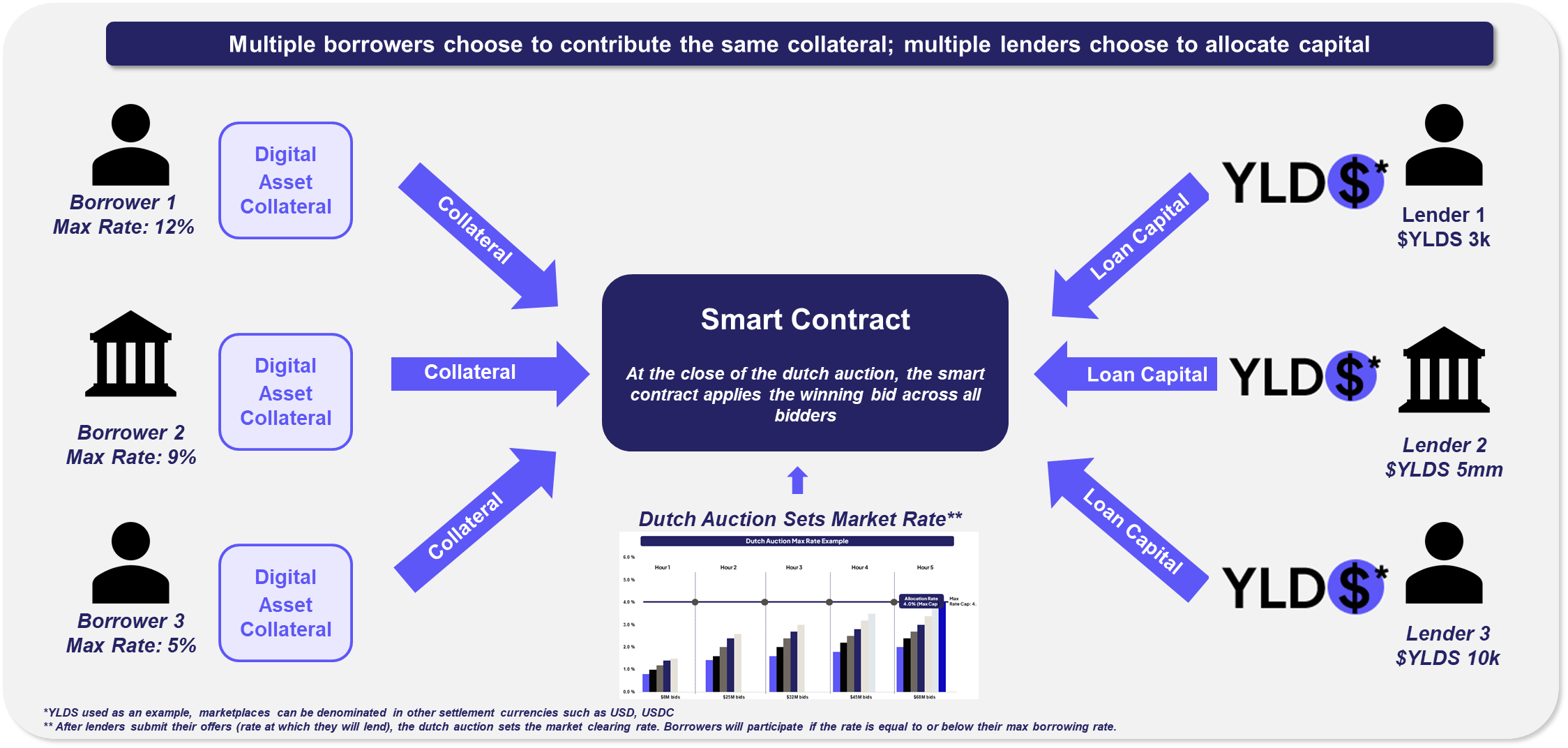
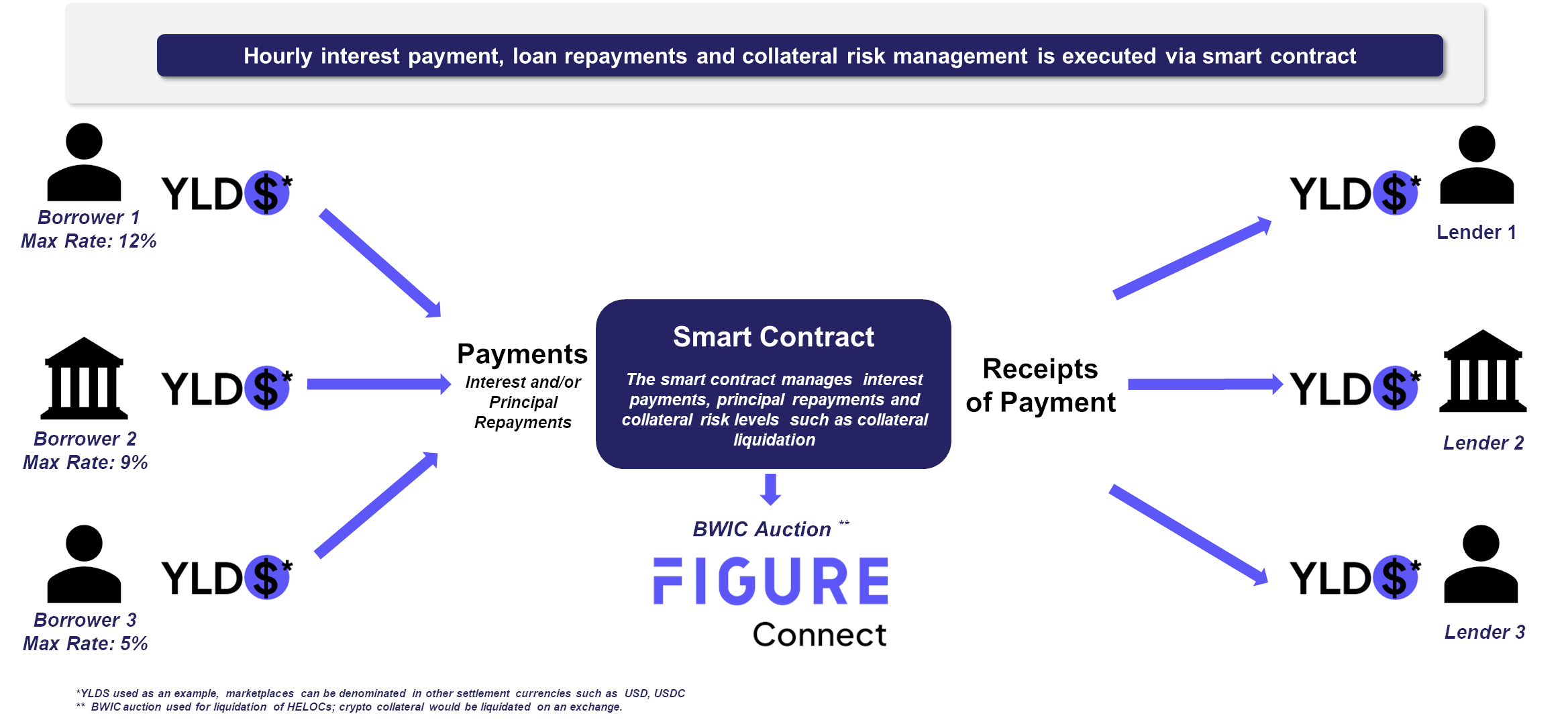
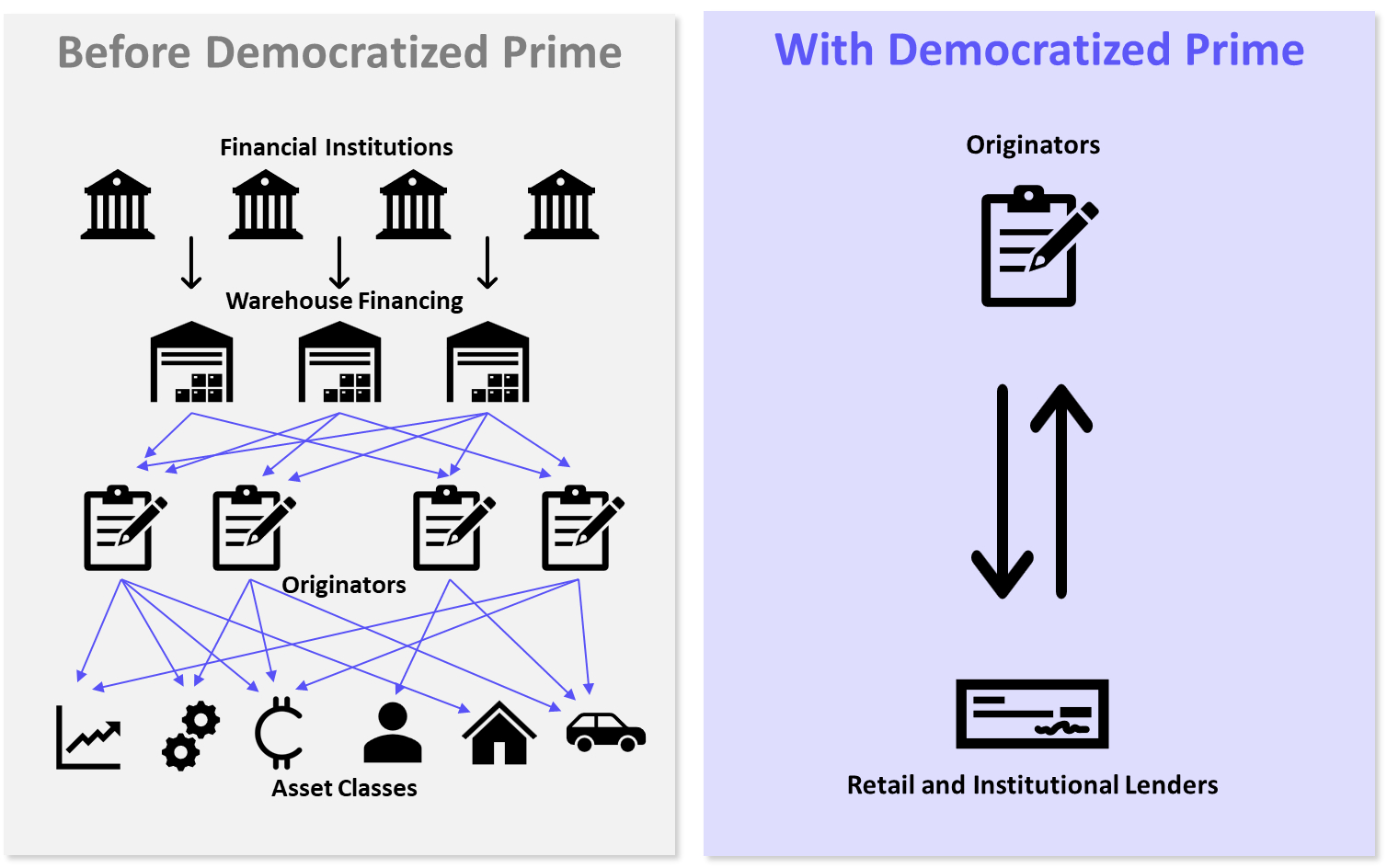
•Democratized Prime: A pillar of our value proposition is the Democratized Prime offering, which disrupts the traditional prime brokerage infrastructure by allowing users to lend their assets or excess cash into the ecosystem at a market-clearing rate. Democratized Prime is a DeFi marketplace connecting sources and uses of capital. Democratized Prime is a many-to-many marketplace, where common borrowers face off against common lenders. Lenders have pro-rata exposure to all borrowers. Lenders make their decision on participating and on the desired loan interest rate based on a combination of (i) the liquidity of the collateral, (ii) the volatility of the collateral, (iii) the over-collateralization amount, and (iv) the quality of the collateral. In the case of Figure HELOC loans, there is a weekly Bid Wanted In Competition (“BWIC”) for these loans that provides liquidity on Figure Connect. Should there be a breach of loan-to-value ratio, a smart contract moves the relevant loans to the BWIC process for liquidation.
The mechanics of Democratized Prime are as follows, using the HELOC marketplace as an example. Illustrative graphics are also presented below.
•A new Democratized Prime Marketplace for HELOC collateral is established:
•A smart contract holds the collateral
•Figure (as the first HELOC marketplace) establishes collateral terms that are reflected in the smart contract and visible to participants in the ecosystem
•Any borrower can contribute collateral and each borrower sets their maximum borrow rate
•Lenders decide if they will participate in the market, evaluating collateral based on:
•Liquidity and volatility
•Quality (e.g., through assessing the weighted average coupon of the HELOCs, weighted average debt-to-income ratio, and weighted average credit score across the specific marketplace)
•Over-collateralization and liquidation thresholds
•Lenders participate in an hourly dutch auction; winning bids earn interest over the next hour
9
•Interest and repayment is managed by the smart contract
•Interest accrues hourly
•Borrowers can pay down loan balances at any time
•Lenders can redeem at any time; if there is insufficient liquidity to meet redemptions, the hourly borrow rate goes to 30%
•Risk management is executed by the smart contract
•If the loan-to-value threshold is breached, the collateral is moved to the appropriate marketplace for liquidation
•Lenders’ principal is paid off, and any excess returns to the borrower
•The loan-to-value threshold for each marketplace is a function of the underlying collateral type and helps ensure that all Democratized Prime loans are over-collateralized at origination—currently 90% across active marketplaces, loan-to-value thresholds are subject to change after Figure sets the initial threshold for the first marketplace per collateral type but are generally expected to reflect the broader market (e.g., the current 90% threshold is reflective of advance rates of 90% that are commonly seen in warehouse financing, which the HELOC marketplace serves as an alternative to)
•Borrowers can prevent liquidation by adding collateral or reducing loan amounts
•Borrowers receive warnings as loan-to-value ratios rise so that they have sufficient time to take action and are not surprised when a liquidation event is triggered; for example, in the BTC margin marketplace, borrowers receive a notice when loan-to-value ratios climb to 85%, while liquidation would be triggered at 90%
10
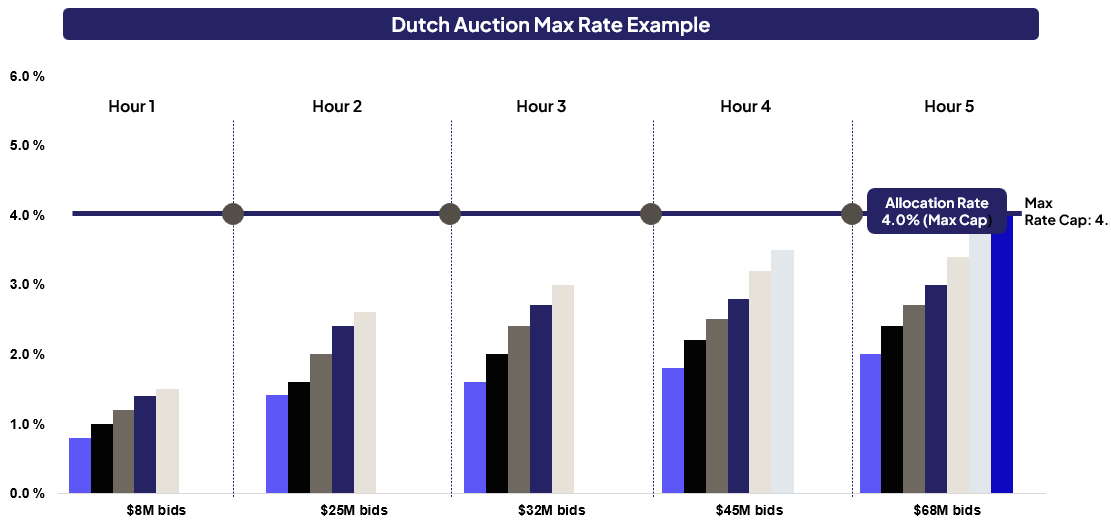
Democratized Prime hosts specific pools of assets, such as tokenized HELOCs and margin funding for digital asset trading activity on the Figure Exchange. Borrowers obtain financing at a market-clearing rate. There is no intermediary, and instead pricing is set every hour by a Dutch-style auction. Specifically, the interest rate is set by beginning at a predetermined maximum rate and successively lowering such rate until the aggregate principal amount of bids received equals or exceeds the offering amount sought by the borrower, with the lowest rate at which such amount is achieved becoming the interest rate applicable to all accepted bids. This is done for each collateral pool type, hourly. Prevailing rates for pools of assets on Democratized Prime ranged from 1% to 30% during the second quarter of 2025. The weighted average rate during the second quarter of 2025 was approximately 10%. Typical borrowers are institutions (such as loan originators or loan buyers) who will borrow against the loans they hold. Typical lenders are institutions with idle or excess cash that they are willing to lend, asset managers deploying capital and retail customers who are seeking yield, often because their liquidity is in stablecoins that do not offer yield and they are interested in earning yield while keeping their funds on a blockchain. We launched Democratized Prime in November 2024,
11
and as of June 30, 2025, it had approximately $1.5 million in assets on the platform. The applicable fees and associated revenue for Democratized Prime is 50 basis points of outstanding balance and are paid by the borrower. As of June 30, 2025, Democratized Prime had not generated revenue as we have provided the initial assets to support the platform while we build out funding distribution. Once Democratized Prime starts generating revenues, we expect them to be included in Ecosystem and Technology Fees. We expect Democratized Prime to grow as users begin to recognize its benefits. See “Prospectus Summary—Our Growth Strategy.”
•Digital Asset Cross-Collateralization: Inherently linked to our Democratized Prime offering is the ability our customers are expected to have to cross-collateralize their assets for their borrowing needs, as our on-chain platform allows for the streamlining of margin trading across multiple assets, reducing friction and minimizing each customer’s specific liquidity needs. This feature is not yet operational but we anticipate that it will be available to our users by the end of 2025.
•Access to Digital and Real-World Assets: The real world assets purchased by our deep and liquid capital marketplace can only be originated with our exclusive tokenization infrastructure. Our position as a leading HELOC originator and funding platform, coupled with our capabilities as a real-time digital asset exchange and yield-bearing stablecoin issuer, is difficult to replicate. We believe this unique combination will enable us to attract partner issuers, originators and asset owners who will use our solutions to tokenize and sell real-world assets in a manner that competitors may not be able to match. As our asset offering available for trading on Figure Exchange increases, the attractiveness of trading on our platform expands as we build towards the ultimate goal of becoming “the exchange for everything.”
We rely on Figure Exchange and our ATS as the technology and infrastructure that allow customers to trade digitally native securities and tokenized real-world assets. Figure Exchange and our ATS are designed to comply with all U.S. regulations relevant to them as a regulated Money Services Business that holds Money Transmission Licenses, and as a U.S. Broker Dealer with authority to operate an ATS, respectively. Outside of the United States, through our subsidiaries, Figure holds several crypto licenses,
12
including a virtual asset service provider (“VASP”) registration in both the Cayman Islands and Ireland, and a securities investment business license in the Cayman Islands.
YLDS
In February 2025, we launched YLDS, a groundbreaking interest-bearing transferable stablecoin that is both native to a public blockchain, Provenance Blockchain, and a security registered with the SEC. As of June 30, 2025, YLDS outstanding stood at approximately $4 million. While YLDS is currently fully operational and generates revenues, given it is a recently launched product, its revenue recorded in interest income for the six months ended June 30, 2025 was less than $1 thousand. Fee revenue recorded in interest income is earned by our subsidiary, Figure Certificate Company (“FCC”). This revenue is paid from the interest payments generated by the investment securities that FCC holds. We anticipate revenues from YLDS to grow as adoption increases. See “Prospectus Summary—Our Growth Strategy.”
FCC is registered with the SEC under the Investment Company Act of 1940, as amended (the “Investment Company Act”), as a face-amount certificate company. FCC’s interest-bearing debt securities (the "Figure Certificates") are registered with the SEC. YLDS are the Figure Certificates’ corresponding digital representation.
Built on Provenance Blockchain, YLDS offers investors a more stable and secure digital asset. It is backed by cash and cash equivalents, akin to prime money market funds. Since inception, YLDS has paid a constant interest rate of SOFR minus 0.50%. Transactions can be conducted 24 hours a day, seven days a week using U.S. dollars and other stablecoins on Figure Exchange, with the option to off-ramp to fiat during U.S. banking hours after a redemption has settled to cash.
YLDS has many use cases. Benefiting from its status as a security, YLDS can be used as yielding collateral for institutions, which can also be utilized for trade settlement or payments. Further, FCC's registration statement on Form S-1 that was declared effective by the SEC includes the minting of YLDS
13
on multiple Layer 1 blockchains, including Provenance, Solana, Ethereum and Avalanche. FCC may seek additional Layer 1 blockchains through amendments to such registration statement. Our goal is for YLDS to become the de-facto currency of Figure Exchange, to provide fiat currency off-ramps for YLDS during local banking hours and 24-hour conversion of YLDS to other stablecoins via transactions on Figure Exchange. While transactions were entirely in fiat currency for the six months ended June 30, 2025, our goal is to have an increasing number of these transactions settle in YLDS as we encourage warehouse lenders and loan buyers to utilize YLDS on Figure Connect and Figure Exchange. Furthermore, we believe that third-party interest in using YLDS has the potential to displace traditional money movement, particularly in DeFi, payments, and other applications such as exchange collateral.
Customers can buy YLDS from or sell it back to FCC. However, FCC is not permitted to hold digital assets like USDC and USDT. Consequently, purchases and redemptions of YLDS using USDC and USDT are facilitated by Figure Payments Corporation, which handles the sending and receiving of these digital currencies. In the meantime, Figure Exchange and Figure Payments Corporation make it possible to buy BTC with YLDS by first swapping USD for YLDS and then using YLDS to buy BTC. This process allows YLDS holders to use YLDS as a form of payment when purchasing BTC. No external third parties are involved when we facilitate these transactions. When a customer on Figure Exchange wishes to purchase BTC using YLDS as a payment mechanism, that customer enters a limit order to purchase BTC and denotes YLDS as the payment mechanism. In the background, an account owned by Figure Payments Corporation, which is responsible for the transfer, then mirrors this order in the BTC/USDC order book on Figure Exchange, where it is lifted by sellers wishing to receive USDC as payment for their BTC. Upon settlement, BTC first moves to the Figure Payments Corporation account on Figure Exchange from the seller, and then transfers to the buyer’s account on Figure Exchange. Inversely, YLDS is moved from the buyer’s account on Figure Exchange to Figure Payments Corporation’s account on Figure Exchange, and USDC is moved from Figure Payments Corporation’s account on Figure Exchange to the seller. Similar to if a person bought BTC with USDC or USD, the specific amount of YLDS in dollars that is needed to purchase the BTC is transferred and used for settlement (1 YLDS is equal to $0.01). This full process occurs within seconds.
Market Opportunity
Our technology solutions are applicable to a broad range of lending and capital markets activities that are experiencing important trends and market dynamics. We target specific focus areas where we can address friction points and improve efficiency and liquidity by leveraging blockchain-based technology solutions. We consider our addressable market to be the volume of loans that can be originated using our LOS as well as the volume that can be transacted on our marketplaces for loans and digital assets. When taken together, we estimate that our addressable market today represents an approximately $185 billion dollar opportunity, as described in further detail below.
Origination and Distribution Marketplace
Our LOS platform and marketplace are set to displace legacy loan origination and delivery technology across consumer asset classes. While the home equity market is where we demonstrated proof of concept, we see the ability to deliver more streamlined financing solutions across other consumer assets. Our Figure Connect marketplace provides the technology and processes that enable our origination partners to sell their loans directly to a network of whole loan buyers, including the Guarantor Vehicle, as well as directly into a securitization arranged by Figure. Similar to our LOS, our Figure Connect marketplace is expandable to broader consumer loan assets.
In the near future, we anticipate that Figure Connect will accommodate consumer loan asset sales from third-party originators, broadening the range of consumer loan assets available on our platform. Such sales are expected to include residential transition loan assets, sometimes known in the industry as “fix and flip” loans. We have active dialogue with a number of residential transition loan originators that are considering Figure Connect as a method to find additional investors for their loan origination. To facilitate this expansion, we are developing a layer to enable non-Figure LOS originators to integrate their
14
loans into our ecosystem and granting them access to Portfolio Manager. Additionally, our validator layer will ensure the integrity of third-party loans by verifying that they meet underwriting criteria, including validating the decision logic and the underlying input data used in credit decisions.
Our estimated total addressable market for our LOS and Figure Connect marketplace represents a $80 billion annual revenue opportunity. This is based on approximately $2 trillion of annual originations across consumer asset classes, including HELOCs, mortgage refinance, personal, credit card, and auto, according to the February 2025 - Equifax U.S. National Consumer Credit Trends Report - Originations and MBA, and an assumed take rate of approximately 4% based on our targeted pricing and our historical take rate revenue comprised of ecosystem and technology fees, origination fees, gain on sale, and capitalized servicing rights on a per volume basis. According to the Federal Reserve, the United States currently has approximately $35 trillion in outstanding home equity as of March 31, 2025.
Our take rate for the six months ended June 30, 2025 is derived from the sum of ecosystem and technology fees, origination fees, gain on sale of loans, net and gain on servicing asset, net from our consolidated statement of operations. These items represent revenue generated from Figure-branded and Partner-branded volume. Valuation changes in fair value of mortgage servicing rights, which we believe is not indicative of operating performance, and marketing expenses in our operating expenses are deducted. This net amount is divided by overall Consumer Loan Marketplace Volume for that period. For the year ended December 31, 2024 and for the six months ended June 30, 2025, our take rate was 4.2% and 3.9%, respectively. This take rate may decline in the future, subject to market conditions. We expect to maintain a take rate of approximately 4% even as our volume mix shifts to Figure Connect.
Tokenization and Trading
Tokenization is the process by which real-world assets are digitally represented on a blockchain, enabling ownership of an underlying asset through ownership of a token. Our platform’s technology and infrastructure, particularly through Figure Exchange, allows for the trading of native digital assets and tokens.
According to forecasts from industry sources, the asset tokenization opportunity is expected to expand to $16 trillion by 2030. These forecasts reveal a significant opportunity with tokenization, where Figure has a first-mover advantage. With an assumed take rate of 0.5%, based on our targeted pricing, this revenue opportunity could be over $80 billion.
Transactions involving loan assets represented by blockchain tokens are effected in the same way as transactions involving real-world assets represented traditionally or paper-based: there is an assignment of the debt instrument and the security instrument. The blockchain tokenized real-world assets are "digital twins" of the real-world asset representations, as documented through traditional legal documents that record real-world assets pursuant to state law. The token itself has no additional rights or value other than those granted by the ownership of the real-world asset. Thus, the transactions involving our tokenized real-world assets are subject to the same law and the same dispute resolution mechanisms as the transactions involving traditionally represented real-world assets, including how disagreements or disputes are resolved (e.g., foreclosure proceedings, collection issues). There is no situation in which a tokenized real-world asset holder and real-world asset holder would not receive the same rights and benefits. We contractually require all owners of tokenized real-world assets to reflect all asset transactions on the Provenance Blockchain and to pass the same obligation along to any subsequent owner. Furthermore, our systems are designed in a way that makes it impractical to effect a transfer of ownership without use of blockchain-based systems.
The owners of tokenized real-world assets own the real-world assets, as the assets are one and the same. The nature of a tokenized-real world asset is that its ownership is reflected on a blockchain, which facilitates the ease of transferability, but otherwise it is still one and the same. For example, in the case of a HELOC, it is still a consumer loan obligation.
15
An example of the reason it is inefficient to transfer ownership without the use of blockchain-based systems is a legal contract that can be lost, misplaced, updated incorrectly from human error or malfeasance. With blockchain technology, the ownership can be transferred instantaneously via possession of the token. If the token transfer fails, the ownership is not transferred as the transaction is not completed. In a traditional transaction using a database, it is frequent that transactions are not completed, or updated erroneously, requiring multiple checks before and after the completion to ensure accuracy. Using blockchain to memorialize ownership ensures a public, immutable record, which reduces fees to audit and validate ownership as well as the provenance of that ownership. It is important to note that perfection of assets is key to confidence of, as well as dispute over, ownership changes. We believe that the best way to create a more efficient financial asset marketplace is to create the truth of data and ownership and to maintain that truth through immutable blockchain technology.
The tokenized representation of the loans plays a very significant role in the elimination of the vast majority of disputes and in the quick resolution of any disputes that do arise. One, the Provenance Blockchain forces a common view of the facts on all parties involved in a transaction, and enables the parties to tentatively (i.e., before the contemplated transaction commits) preview the anticipated state of the world, which removes ambiguity about the results of a transaction. Two, the tokenized representation of the assets enables the highly automated execution of transactions, which often involve multiple steps, and thereby prevents human errors. For example, with DART it is not possible to transfer a loan file without assigning the corresponding security instrument. Three, the representation of assets on the Provenance Blockchain allows parties to review the results of transactions immediately upon execution. We have strong empirical evidence that our automated blockchain-based systems have allowed transacting parties to quickly and effectively catch and correct such errors that might have otherwise gone undetected or been disputed.
Peer to Peer Transferable Stablecoins
We view the market opportunity of stablecoins as encapsulating elements of the global monetary supply. By removing layers of the current legacy systems, we believe the market opportunity is large. According to forecasts from Citigroup, the stablecoin market could reach $5 trillion by 2030. With an assumed take rate of 0.5%, based on the pricing of the Figure Certificates issued by our subsidiary, FCC, this revenue opportunity could be over $25 billion.
Our Strengths
Our innovative blockchain-enabled technology platform provides meaningful value-add for our users, including consumers, origination partners and loan buyers, and securitization investors. We have several competitive advantages that have enabled our continued success and differentiate us from existing solutions.
Faster end-to-end solution with operational efficiencies that drive cost-savings
We believe that our technology innovation has revolutionized the loan origination process from application through approval to funding. Our 100% online application coupled with our 100% digital origination solution, leverages blockchain technology, AVMs, e-notaries, digital income/ID verification, artificial intelligence during document review and digital lien matching. Our differentiated technology has enabled us to reduce the median HELOC time from application to funding by approximately 76%. We fund as quickly as five days, with a median of 10 days, as compared to an industry median of approximately 42 days, according to industry sources as of June 30, 2025.
By streamlining and automating the loan origination process, we have drastically reduced the cost to originate. For the year ended December 31, 2024, we had an average cost per loan of $730. This represents cost-savings of over 93% compared to an industry average cost of $11,230 to originate a mortgage for the quarter ended December 31, 2024, according to MBA.
16
Our origination partners have validated our strong value proposition through recurring use. 93% of the number of origination partners who accounted for 97% of the Partner branded LOS volume in 2023 remained on the platform in 2024. Furthermore, we experienced 185% net volume retention in 2024. We are not only retaining our origination partners but also enabling them to continuously expand usage and volume.
Homogeneous underwriting with immutable, transparent access to asset ownership information
Our LOS employs fully automated pre-programmed rules, including the underwriting guidelines and credit policy embedded in our technology, to make lending decisions. Our LOS and technology mandate consistent underwriting criteria for HELOCs, including a minimum FICO score of 600, a maximum combined loan-to-value of 90% and a maximum debt to income ratio of 50%. For the six months ended June 30, 2025, less than 0.1% of our Consumer Loan Marketplace Volume has been to customers considered subprime by the Consumer Financial Protection Bureau or to those borrowers with FICO scores below 620. However, for other loan products within our ecosystem, such as USD loans backed by digital assets as collateral, we collect FICO scores as part of the digital assets-backed loans origination process, but we do not use FICO scores in our digital assets-backed loan underwriting. In addition, borrowers on our platform are required to draw at least $15 thousand at origination in our Figure-branded channel and at least $25 thousand in our Partner-branded channel. Further, Figure’s platform offers loan amounts as low as $25,000 (and lower in some limited instances) and a maximum of $1,000,000 (and higher in some limited instances). The criteria for non-mortgage asset classes has yet to be determined. Through our LOS, we have nearly fully eliminated the impact of human error from our origination processes and the quality of loans originated on our platform, which helps provide a high degree of certainty to the credit quality of the loans originated using our technology. We believe this results in a homogeneous population of loans that are underwritten to consistent, well-defined rules using the same scalable processes and technology. Credit losses of loans underwritten through our LOS have consistently remained approximately 1% or less, well below the 6% rating agencies typically assume for securitizations of similar loan products. Along with the Guarantor Vehicle, we believe that this homogeneity fuels the success of our marketplace.
Our third-party review expenses are also reduced by as much as 80% as compared to a sample of 2025 securitizations, which had 100% of their loan pool reviewed versus approximately 20% for Figure sponsored securitizations. While it is possible that other samples may have less than 100% of their loan pool reviewed, most prime jumbo, non-prime and re-performing loan transactions provide due diligence reviews on close to 100% of the loan pool. Third-party reviews are conducted by independent companies after origination but before securitization issuance for which they evaluate loan and borrower information to confirm that the underwriting criteria from the group of loans meet what the issuer describes. They are conducted during a securitization to determine a loan's underwriting principles and compliance with regulations. In most securitizations, all loans are reviewed prior to issuance. With Figure securitizations, a sample-based approach has been used in all of our sponsored securitizations in 2025 where approximately 20% of loans were reviewed. This percentage is based on the minimum number of loans needed to establish a statistically significant result. Rating agencies have accepted a sample-based review approach for Figure securitizations after performing due diligence on our operations and systems and seeing a track record of minimal findings from third-party review firms. As the broader industry continues to experience rising costs, the value proposition of Figure’s automated, cost-efficient solution will continue to differentiate us and attract new origination partners. Third-party review expenses consist of fees paid to independent firms engaged to perform quality control audits and loan-level due diligence on mortgage assets to assess compliance with underwriting guidelines, regulatory requirements, and investor eligibility criteria in connection with the sale of such loans in the secondary mortgage market. Our 2025 securitizations are unregistered transactions issued under Rule 144A and are composed solely of our HELOCs and no other assets.
Through Provenance Blockchain, we provide loan buyers and securitization investors access to an immutable source of information on ownership at origination and the subsequent transfer history of
17
assets. The use of blockchain enables diligence, monitoring and reporting of loan title, providing transparency of ownership in a matter of nanoseconds.
Facilitating access to incremental capital
Our LOS removes friction in the supply and demand of capital, connecting origination partners with several sources of funding capital. On one side, origination partners utilize our lending platform to fund homogeneous investor-appealing assets in a cost-efficient and transparent way. On the other side, Figure Connect enables origination partners to access multiple sources of institutional funding through a single-window system. This two-sided marketplace facilitates deeper liquidity, giving originators access to funding sources, and in turn increases their capacity to fund more origination growth. This ultimately unlocks access to incremental resources for the end-borrower and creates higher certainty and reliability of capital markets execution.
The liquidity in the marketplace is further enhanced by the presence of our Guarantor Vehicle, which with $200 million in recyclable equity and through the use of leverage, is expected to translate into billions of dollars of committed financing. In the last twelve months ended June 30, 2025, 16 institutional investors transacted approximately $4 billion in volume with loan originators through our LOS.
Modular tech stack expandable across asset classes
Our technology architecture is designed to support each of our solutions such that these solutions can scale and serve new use cases seamlessly and efficiently. Similarly, our digital platform is designed to scale efficiently by leveraging our existing solutions for the origination of other lending products.
For Figure Connect, our custom-built marketplace, we offer a streamlined experience for trading, hedging, forward sales and access to rated securitizations.
Proactive regulatory compliance as a source of competitive advantage
Strict regulatory compliance has always been at the forefront of our strategy in a nascent industry where some others have looked to exploit regulatory vagueness and ambiguity. This proactive approach to legal adherence has allowed Figure to build a regulatory and licensing infrastructure that is currently comprised of more than 180 lending and servicing licenses, 48 money transmitter licenses, a broker-dealer license, an ATS, VASP licenses in Ireland and the Cayman Islands, a virtual currency license in Louisiana, in addition to multiple additional license applications in our pipeline. We believe that our regulatory moat, which uniquely combines lending licenses, a number of digital asset-related licenses, and an ATS, with years in the making, delays the feasibility of potential new entrants to be able to compete in the full spectrum of solutions that we are able to offer.
Strong culture with visionary leadership team that has redefined the industry before
We believe our highly experienced leadership team and our culture of creativity and innovation give us a long-term, sustainable competitive advantage. We have been built since day one to address industry inefficiencies and challenges that our founders and leadership observed over decades in on-the-ground, decision-making roles at financial technology and financial services firms, including in the lending and mortgage value chain as well as in blockchain technology.
Our team has a demonstrated track record of re-inventing legacy financial products and services as technology-first, efficient, and low-cost platforms, in segments ranging from student and personal loans and traditional mortgages to the crypto economy. The expertise our team has built across markets and functional areas—with an average of over 20 years of experience at market leaders including SoFi, Blockchain.com, Brex, and OneMain Financial—empowers us in our daily pursuit of introducing more innovative and efficient technology and business models into our ecosystem. We are deeply committed to disrupting and driving efficiency in traditional financial services with proprietary technology, to create
18
value for consumers, our origination partners, loan buyers, and securitization investors across our ecosystem, and we believe our team is well positioned to deliver on this mission.
Our Growth Strategy
We firmly believe that developing cutting-edge technology is a core competency that allows for future growth. As such, we have made a significant investment in technology, engineering and modern processes to establish a flexible and expandable capital markets platform that supports end-to-end asset origination to trading. Our first line of code was written in 2018 and 28% of our headcount is in technology and product departments as of June 30, 2025.
We believe this will allow us to systematically expand transaction volume and enter different markets across the financial ecosystem where the application of blockchain technology can improve efficiency and liquidity.
Onboard New Origination Partners, Increase Penetration with Existing Partners and Increase On-Chain Loan Production
We believe that increasing the number of origination partners using our LOS and growing adoption of Figure Connect will significantly contribute to our future growth.
We have successfully added 168 partners since inception, with 78 of those added over the last twelve months ended June 30, 2025. We see a substantial opportunity to further grow our number of partners. In the six months period from January 1, 2025 to June 30, 2025, we onboarded seven origination partners to Figure Connect, evidencing growth of partnerships beyond Figure-branded originations. As of July 2025, our on-chain loan production was approximately $850 million, up from approximately $600 million in June 2025. We anticipate that on-chain loan production volume will continue to increase as we expand both the number of origination partners and the monthly volume that each origination partner conducts with us.
With the success we have shown to date, our marketing team will continue to target servicers, banks, credit unions, and other mortgage originators, offering them a turnkey solution to replace legacy offerings. Our technology is easily onboarded by partners and, once in place, enables them to bring a new offering to the market quickly. The end-applicant experience and efficiency of our LOS coupled with the liquidity access that Figure Connect provides will continue to attract new origination partners.
Add Incremental Products and Markets
We have a proven track record of innovating and delivering new products through our platform. From inception to the six months ended June 30, 2025, over $16 billion of loans were originated using our automated underwriting process on our LOS. Our technology was first used to originate 1st and 2nd lien HELOC products and has been expanded to underwrite and originate loans secured by digital assets. We believe our performance across different products within the home equity market serves as a testament to the quality of our platform, the diversity and depth of our acquisition strategies, and our ability to rapidly enter, innovate, and become a category leader in a market.
For example, our LOS has been adapted to originate DSCR loans to provide greater flexibility for borrowers seeking to finance rental properties. This caters to the growing demand for rental properties and the increased popularity of DSCR loans. Additionally, we have the infrastructure in place to originate personal loans and student loans, and we believe we can effectively scale in these markets. Adding new loan products will allow us to generate volume across different market and rate environments, as well as bolster our servicing portfolio. Furthermore, we anticipate that the introduction of additional products will enhance our trading offerings. As these products gain mass adoption, we expect an increase in both buyer demand and liquidity, contributing to the overall expansion of the market.
19
Expand Figure Connect Volume
Figure Connect enables the trading of assets originated via our LOS. Since launch in June 2024 to June 2025, approximately $1.3 billion of loans were traded on Figure Connect. With ample room for growth, we have identified the following initiatives as avenues for expanding Figure Connect transaction volume:
•Onboarding new loan buyers: With 15 new investors onboarded to the marketplace since launch in June 2024, we believe we can continue to increase the number of participants on Figure Connect, significantly contributing to the overall growth of transaction activity.
•Increase marketplace liquidity: We are looking to expand or replicate initiatives such as our joint venture with Sixth Street Partners, which grants our origination partners the option to sell their production to a Guarantor Vehicle, offering them consistent execution and improved pricing, which ultimately drives Figure Connect volume through increased liquidity.
•Inclusion of third-party homogeneous assets, enabled by artificial intelligence: We are introducing a Figure Certified program that employs proprietary technology and artificial intelligence to validate assets originated by third parties outside of our platform against our LOS underwriting guidelines, such that we can confidently tokenize the loans on the Provenance Blockchain and also support the sale of those assets via Figure Connect. Figure Certified loans would be allowed to transact in Figure Connect, increasing the scope of our marketplace beyond our LOS originated assets without losing the benefits of homogeneous collateral. We are targeting a launch of the Figure Certified program by the fourth quarter of 2025.
We expect Figure Connect to continue to grow in terms of volume and participants, as well as via the introduction of new assets, but we acknowledge that the environment may change, which could slow down such growth.
Drive YLDS Adoption
We plan to build out an institutional sales team that is focused on encouraging usage of YLDS by asset managers, fintechs, banks, market makers, exchanges, and other financial market participants. Additionally, we will target retail users via social media outreach, paid ads and other online marketing channels. We believe that the custody and settlement advantages provided by Provenance Blockchain, combined with the credit quality and yield-product nature of the underlying assets that back YLDS, will prove to be a compelling value proposition for users and accelerate adoption. To drive initial adoption, Figure offers lower prices to early institutional buyers.
Innovate on Technology Stack
Continuous innovation in our technology stack is a critical lever for our future growth. We expect to continue to introduce new products and services, and to develop new capabilities that will streamline underwriting, enhance loan registration, and optimize trading efficiency and portfolio monitoring.
20
Technology has allowed us to pursue multiple avenues of expansion today, and we want to continue to invest into it to drive future innovations, executing on what we see as a substantial runway for growth.
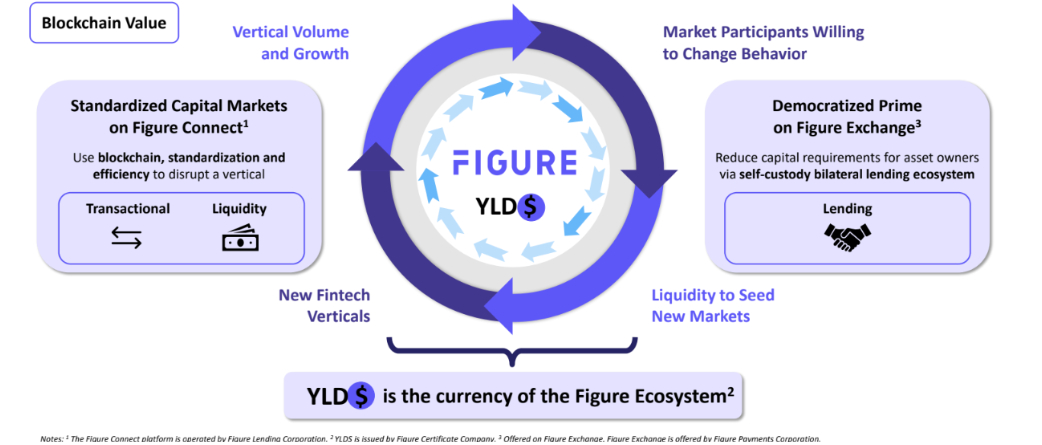
Risk Factors Summary
Our business is subject to numerous risks and uncertainties, including those highlighted in the section titled “Risk Factors” immediately following this prospectus summary. The following is a summary of the principal risks we face:
•We have a history of losses, we may not be able to maintain profitability in the future, and there is no assurance that our revenue and business model will be successful.
•If we fail to effectively manage our growth, our business, financial condition, and results of operations could be adversely affected.
•Substantially all of our revenue is derived from our HELOC product, and we are thus particularly susceptible to fluctuations in the HELOC market. Our current product offerings may also not be sufficiently broad to attract and retain partners.
•Our success and ability to develop our lending business depend on retaining and expanding our reach through both our Figure-branded and Partner-branded strategies. If we or our partners fail to add new borrowers or customers, as applicable, our business, financial condition, and results of operations could be adversely affected.
•If loans originated by us or through our platform and purchased by us do not perform, or significantly underperform, we may incur financial losses on the loans we hold on our balance sheet, which could adversely affect our business, financial condition, and results of operations, as well as result in the loss of confidence of our funding sources.
•Increases in borrower default rates on loans could make us and our loans less attractive to loan purchasers, lenders under warehouse credit facilities and investors in securitizations, which may adversely affect our access to financing and our business, financial condition, and results of operations.
•Our HELOCs and other loans we make, such as digital assets-secured personal loans, are subject to federal, state and local laws that regulate various aspects of lending, including disclosures, interest rates and other charges, and if we exceed applicable limitations on interest, loan charges, and other fees or fail to provide required disclosures, our business, financial condition, and results of operations could be significantly adversely affected, including but not
21
limited to, through litigation (including damages), investigation, enforcement and other regulatory and legal action and penalties.
•If a court or regulator determines that our HELOCs cannot be characterized as a fixed-rate extension of “open-end credit” under the Truth in Lending Act (“TILA”) or state law, we would be subject to the more prescriptive closed-end mortgage laws and rules, as well as laws and rules applicable to variable-rate HELOCs, which would have a material adverse effect on our business, financial condition, and results of operations.
•A particular digital asset, product or service’s status as a “security” in any relevant jurisdiction is subject to a high degree of uncertainty and if we are unable to properly characterize a digital asset or product offering, or if the regulatory framework with respect to digital assets changes, we may be subject to regulatory scrutiny, inquiries, investigations, fines, and other penalties, which may adversely affect our business, operating results, and financial condition.
•Depositing and withdrawing digital assets into and from Figure Exchange involve risks, which could result in loss of customer assets, customer disputes and other liabilities, and adversely impact our business, financial condition, and results of operations.
•Our business is significantly impacted by interest rates. Changes in prevailing interest rates or U.S. monetary policies that affect interest rates could adversely affect our business, financial condition, and results of operations.
•Technology disruptions or failures in, and cyberattacks or other breaches or incidents relating to, our operational, security or fraud-detection systems or infrastructure, or those of third parties with whom we do business, could disrupt our business, cause legal or reputational harm, and adversely affect our business, financial condition, and results of operations.
•Our business, financial condition, and results of operations could be adversely affected if we fail to adequately maintain, protect and enforce our intellectual property and proprietary rights or face allegations that our product offerings or conduct infringes on the intellectual property rights of third parties.
•We are subject to or facilitate compliance with a variety of federal, state, and local laws, including those related to lending and mortgages, money transmission, consumer protection, financial services and loan financings.
•Our marketing practices involving relationships with third parties may expose us to risks of alleged Real Estate Settlement Procedures Act (the “RESPA”) violations.
•We hold state licenses that result in substantial costs, including licensing fees and compliance costs, and our business, financial condition, and results of operations would be adversely affected if our licenses were impaired as a result of noncompliance with those requirements.
•Litigation, regulatory actions, and compliance issues could subject us to significant fines, penalties, judgments, remediation costs, negative publicity, changes to our business model, and requirements resulting in increased expenses.
•Our compliance and risk management policies, procedures and techniques may not be sufficient to identify all of the financial, legal, regulatory, and other risks to which we are exposed, and failure to identify and address such risks could adversely affect our business, financial condition, and results of operations.
•Changes in applicable laws and regulations, as well as changes in government enforcement policies and priorities, could materially increase our operating costs and negatively impact our ability to offer certain products or the terms and conditions upon which they are offered, and
22
ability to compete, which could have a material adverse effect on our business, financial condition, and results of operations.
•We have identified material weaknesses in our internal control over financial reporting. If we fail to remedy these material weaknesses, experience additional material weaknesses in the future or otherwise fail to continue to design, implement and maintain effective internal control over financial reporting, we may not be able to accurately report our financial condition or results of operations which may adversely affect investor confidence in us, and, as a result, the value of our Class A common stock.
•The dual-class structure of our common stock will have the effect of concentrating voting control with those stockholders who held our common stock prior to the completion of this offering, which will limit your ability to affect the outcome of key transactions, including a change in control, and it may depress the trading price of our Class A common stock.
•The market price of our Class A common stock may be volatile, and you could lose all or part of your investment.
Our Risk Factors are not guarantees that no such conditions exist as of the date of this prospectus and should not be interpreted as an affirmative statement that such risks or conditions have not materialized, in whole or in part.
Organizational History
The legacy business of the “Figure” group was conducted through FT and its subsidiaries. FT was formed in 2018 and FLC was a wholly-owned subsidiary of FT from its formation in 2018 until the Separation. On January 25, 2024 and March 18, 2024, respectively, in connection with and to effectuate the Separation, FT created each of FMH and FTS, then named FT Intermediate, Inc., as direct wholly-owned subsidiaries of FT. Following the formation of these entities, we completed the Separation through a series of steps, which resulted in, (i) FLC being the sole owner of certain lending-related intellectual property and commercial contracts that were previously owned by FT, (ii) FTS becoming a holding company whose principal assets were the shares it held in FLC, (iii) FMH becoming a separate company, and (iv) FT being a wholly-owned subsidiary of FMH.
In connection with the Separation, we also entered into certain other agreements to provide a framework for our relationship with FMH after the Separation. For additional information, see the section titled “Certain Relationships and Related Party Transactions.”
Additionally, in connection with the Separation, we assumed the 2018 Equity Incentive Plan, as amended, of FT (the “2018 Plan”), and all awards outstanding thereunder which we terminated as of one business day prior to the effectiveness of the registration statement of which this prospectus forms a part. However, each award outstanding under the 2018 Plan continues to be governed by the terms and conditions of the 2018 Plan following the effectiveness of the registration statement of which this prospectus forms a part. For additional information, see the section titled “Executive Compensation—2018 Equity Incentive Plan.”
On April 28, 2025, FTS converted from a Delaware corporation to a Nevada corporation.
On August 29, 2025, we completed a series of transactions to effectuate the Recombination, which included:
•FTS creating a new subsidiary named Figure Merger Sub, Inc., a Nevada corporation (“FMS”), as a wholly-owned subsidiary of FTS; and
•FMS merging with and into FMH, with FMH surviving the merger as a wholly-owned subsidiary of FTS.
23
Upon the consummation of the Recombination, FTS changed its name to Figure Technology Solutions, Inc. As a result of the Recombination, (i) FTS is a holding company with its principal assets consisting of shares in FLC and FMH, (ii) FTS is the sole shareholder of FLC and FMH, (iii) FMH is a wholly-owned subsidiary of FTS, and (iv) FTS operates and controls all of the business and affairs of FLC, FMH, and their direct and indirect subsidiaries.
The simplified diagram below depicts our organizational structure following the Recombination and after giving effect to this offering.
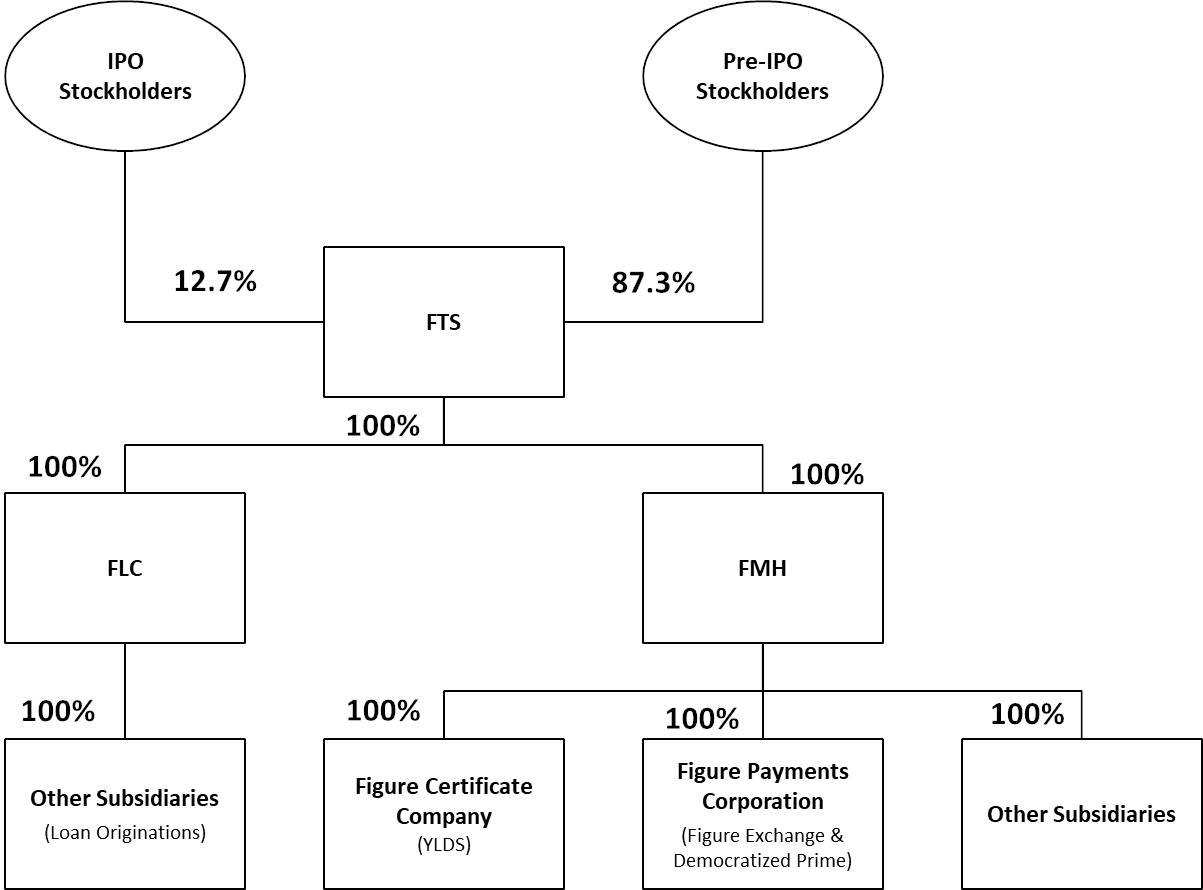
For additional information, see the sections titled “Risk Factors—Risks Related to the Recombination” and “Certain Relationships and Related Party Transactions.”
Channels for Disclosure of Information
Investors, the media, and others should note that, following the effectiveness of the registration statement of which this prospectus forms a part, we intend to announce material information to the public through filings with the SEC, the investor relations page on our website, press releases, public conference calls, and webcasts.
The information disclosed by the foregoing channels could be deemed to be material information. As such, we encourage investors, the media, and others to follow the channels listed above and to review the information disclosed through such channels. However, information disclosed through these channels does not constitute part of this prospectus and is not incorporated by reference herein.
24
We intend to post any updates to the list of disclosure channels through which we will announce information on the investor relations page on our website.
Corporate Information
FTS is the issuer of the Class A common stock offered by this prospectus. FTS was formed as FT Intermediate, Inc. and incorporated in the State of Delaware on March 18, 2024. On April 28, 2025, FTS converted to a Nevada corporation. On August 29, 2025, upon the consummation of the Recombination, FTS changed its name to Figure Technology Solutions, Inc. Our principal executive offices are located at 100 West Liberty Street, Suite 600, Reno, NV 89501. Our telephone number is (917) 789-8049. Our website is https://www.figure.com. Information contained on, or that can be accessed through, our website is not a part of, and is not incorporated into, this prospectus, and the inclusion of our website address in this prospectus is an inactive textual reference only.
We use Figure, the Figure logo, and other marks as trademarks in the United States and other countries. This prospectus contains references to our trademarks and service marks and to those belonging to other entities. Solely for convenience, trademarks and trade names referred to in this prospectus, including logos, artwork, and other visual displays, may appear without the ® or ™ symbols, but such references are not intended to indicate in any way that we will not assert, to the fullest extent under applicable law, our rights or the rights of the applicable licensor to these trademarks and trade names. We do not intend our use or display of other entities’ trade names, trademarks, or service marks to imply a relationship with, or an endorsement or sponsorship of, any other entity.
Implications of Being an Emerging Growth Company
We are an “emerging growth company” as defined in the Jumpstart Our Business Startups Act of 2012, as amended (the “JOBS Act”). As such, we may take advantage of reduced disclosure and other requirements otherwise generally applicable to public companies, including:
•presentation of only two years of audited financial statements and related financial disclosure;
•exemption from the requirement to have our registered independent public accounting firm attest to management’s assessment of our internal control over financial reporting;
•exemption from compliance with the requirement of the Public Company Accounting Oversight Board, regarding the communication of critical audit matters in the auditor’s report on the financial statements;
•reduced disclosure about our executive compensation arrangements; and
•exemption from the requirement to hold non-binding advisory votes on executive compensation or golden parachute arrangements.
We will remain an emerging growth company until the earliest to occur of: (i) the last day of the fiscal year in which we have at least $1.235 billion in annual revenue; (ii) the date we qualify as a “large accelerated filer,” with at least $700.0 million of equity securities held by non-affiliates as of the last business day of our most recently completed second fiscal quarter; (iii) the date on which we have issued more than $1.0 billion in non-convertible debt securities during the prior three-year period; and (iv) the last day of the fiscal year ending after the fifth anniversary of our initial public offering.
As a result of this status, we have taken advantage of reduced reporting requirements in this prospectus and may elect to take advantage of other reduced reporting requirements in our future filings with the SEC. In particular, in this prospectus, we have provided only two years of audited financial statements and only two years of related management’s discussion and analysis of financial condition and results of operations, and we have not included all of the executive compensation-related information that would be required if we were not an emerging growth company. In addition, the JOBS Act provides that an emerging growth company may take advantage of an extended transition period for complying
25
with new or revised accounting standards, delaying the adoption of these accounting standards until they would apply to private companies unless it otherwise irrevocably elects not to avail itself of this exemption. We have elected to use this extended transition period for complying with new or revised accounting standards until we are no longer an emerging growth company or until we affirmatively and irrevocably opt out of the extended transition period. As a result, our consolidated financial statements may not be comparable to the financial statements of companies that comply with new or revised accounting pronouncements as of public company effective dates.
For additional information, see the section titled “Risk Factors—Risks Related to Ownership of Our Securities—We are an ‘emerging growth company,’ and we cannot be certain if the reduced disclosure requirements applicable to emerging growth companies will make our Class A common stock less attractive to investors.”
26
THE OFFERING
| Class A common stock offered by us | 21,461,085 shares (or 25,408,453 shares if the underwriters exercise their option to purchase additional shares in full). | ||||
Class A common stock offered by the selling stockholders | 4,854,704 shares. | ||||
| Underwriters’ option to purchase additional shares of Class A common stock from us | 3,947,368 shares. | ||||
| Class A common stock to be outstanding immediately after this offering | 168,577,921 shares (or 172,525,289 shares if the underwriters exercise their option to purchase additional shares in full). | ||||
| Class B common stock to be outstanding immediately after this offering | 37,893,047 shares. | ||||
| Total Class A common stock and Class B common stock to be outstanding immediately after this offering | 206,470,968 shares (or 210,418,336 shares if the underwriters exercise their option to purchase additional shares in full). | ||||
Indication of interest | Duquesne Family Office LLC has indicated an interest in purchasing up to an aggregate of $50 million of shares of Class A common stock in this offering at the initial public offering price. The shares to be purchased by Duquesne Family Office LLC in this offering will not be subject to a lock-up agreement with the underwriters or the Company. Because this indication of interest is not a binding agreement or commitment to purchase, Duquesne Family Office LLC may determine to purchase more, less or no shares in this offering or the underwriters may determine to sell more, less or no shares to Duquesne Family Office LLC. The underwriters will receive the same discount on any of our shares purchased by Duquesne Family Office LLC as they will from any other shares sold to the public in this offering. | ||||
| Use of proceeds | We estimate that the net proceeds to us from the sale of shares of our Class A common stock in this offering will be approximately $376.4 million (or approximately $446.9 million if the underwriters exercise their option to purchase additional shares in full), based upon the assumed initial public offering price of $19.00 per share, which is the midpoint of the price range set forth on the cover page of this prospectus, and after deducting estimated underwriting discounts and commissions and estimated offering expenses payable by us. | ||||
27
The principal purposes of this offering are to increase our capitalization and financial flexibility, create a public market for our Class A common stock, facilitate future access to the public equity markets by us, our employees, and our stockholders, and increase our visibility in the marketplace. We intend to use the net proceeds from this offering for general corporate purposes, including working capital, operating expenses, and capital expenditures. Additionally, we may use a portion of the net proceeds to acquire or invest in businesses, products, services, or technologies. However, we do not have agreements or commitments for any material acquisitions or investments at this time. We will not receive any proceeds from the sale of shares of Class A common stock by the selling stockholders. For additional information, see the section titled “Use of Proceeds.” | |||||
| Voting rights | Each share of our Class A common stock will be entitled to one vote. | ||||
Each share of our Class B common stock will be entitled to ten votes. | |||||
| Holders of our Class A common stock and Class B common stock will generally vote together as a single class, unless otherwise required by law or our amended and restated articles of incorporation. Immediately following the completion of this offering, Michael Cagney, our co-founder and member of our board of directors, and his permitted transferees, will hold 37,893,047 shares of Class B common stock representing approximately 69.2% of the voting power of our outstanding capital stock, assuming no exercise of the underwriters’ option to purchase additional shares of Class A common stock. For additional information, see the section titled “Description of Capital Stock.” | |||||
Directed share program | At our request, the underwriters have reserved for sale, at the initial public offering price, up to 1,315,789 shares of Class A common stock, or up to 5% of the shares Class A common stock offered by this prospectus, for sale to certain individuals through a directed share program, including our directors, officers, certain of our other employees and other persons identified by us. The number of shares of our Class A common stock available for sale to the general public will be reduced to the extent these individuals purchase such reserved shares. Any reserved shares that are not so purchased will be offered by the underwriters to the general public on the same terms as the other shares of Class A common stock offered by this prospectus. See the section titled “Underwriting—Directed Share Program.” | ||||
| Risk factors | See the section titled “Risk Factors” beginning on page 36 and the other information included in this prospectus for a discussion of factors you should carefully consider before deciding to invest in our Class A common stock. | ||||
28
| Controlled Company | Following this offering, we will be a “controlled company” within the meaning of the corporate governance rules of NASDAQ. For additional information, see the section titled “Management—Controlled Company.” | ||||
| Proposed trading symbol | “FIGR” | ||||
The total number of shares of our Class A common stock and Class B common stock that will be outstanding immediately prior to this offering is based on 147,116,836 shares of our Class A common stock and 37,893,047 shares of our Class B common stock outstanding as of June 30, 2025, and reflects:
•the issuance of 20,384,209 shares of common stock and 7,325,385 shares of Series E preferred stock to former FMH stockholders in connection with the Recombination (the “Recombination Consideration Issuance”);
•the issuance of 2,010,410 shares of Series E preferred stock in connection with the Recombination upon the exercise of warrants to purchase shares of Series E preferred stock at an exercise price of $3.22 per share (the “Warrants Exercise”);
•the automatic conversion of 113,910,905 shares of redeemable convertible preferred stock (including the shares of Series E preferred stock issued in the Recombination Consideration Issuance and Warrants Exercise) into 113,910,905 shares of common stock immediately prior to the completion of this offering (the “Capital Stock Conversion”);
•the filing and effectiveness of our amended and restated articles of incorporation and the effectiveness of our amended and restated bylaws, each of which will occur immediately prior to the completion of this offering and will effect the reclassification of all outstanding shares of our common stock (including shares issued upon the Capital Stock Conversion) into 183,843,221 shares of Class A common stock (the “Reclassification”);
•the exchange of the 39,393,047 shares of our Class A common stock held by Mr. Cagney and his permitted transferees following the Reclassification for an equivalent number of shares of our Class B common stock immediately prior to the completion of this offering pursuant to the terms of an exchange agreement entered into with us (the “Class B Stock Exchange”);
•the conversion of 1,500,000 shares of our Class B common stock beneficially owned by Mr. Cagney following the Class B Exchange into 1,500,000 shares of our Class A common stock in connection with the sale of such shares of our Class A common stock in this offering as described in “Principal and Selling Stockholders” (the “Class B Conversion”);
•the exercise of stock options to purchase 207,135 shares of our Class A common stock at a weighted average exercise price of $3.63 per share, for total gross proceeds to us of approximately $0.8 million, by certain selling stockholders set forth in “Principal and Selling Stockholders” in connection with the sale of all or a portion of such shares by such selling stockholders in this offering (the “Option Exercise”);
•the net issuance of 959,527 shares of Class A common stock in connection with the vesting and settlement of certain restricted stock units (“RSUs”) outstanding as of June 30, 2025, for which the service-based vesting condition was satisfied as of August 31, 2025 and the liquidity-based vesting condition will be satisfied in connection with this offering, after withholding 639,686 shares of Class A common stock to satisfy the estimated tax withholding and remittance obligations (based on an assumed tax withholding rate of 40.0%) (the “RSU Net Settlement” and, together with the Recombination Consideration Issuance, the Warrants Exercise, the Capital Stock Conversion, the Reclassification, the Class B Stock Exchange, the Class B Conversion and the Option Exercise, the “Transactions”).
29
The total number of shares of Class A common stock and Class B common stock that will be outstanding immediately after this offering is based on 147,116,836 shares of our Class A common stock and 37,893,047 shares of our Class B common stock outstanding as of June 30, 2025, and after giving effect to the Transactions, excludes:
•24,741,717 shares of Class A common stock and 4,559,904 shares of Class B common stock issuable upon the exercise of outstanding options as of June 30, 2025, with a weighted-average exercise price of $4.16 and $4.82 per share, respectively (after giving effect to the Option Exercise);
•RSUs covering 4,305,637 shares of Class A common stock as of June 30, 2025, which are issuable upon satisfaction of service-based and liquidity-based vesting conditions (after giving effect to the RSU Net Settlement);
•up to 456,909 shares of Class A common stock issuable upon the exercise of a warrant to purchase shares of Class A common stock outstanding as of June 30, 2025, with an exercise price of $3.22 per share (after giving effect to the Capital Stock Conversion, the Reclassification, and the Warrants Exercise);
•2,957,941 shares of Class A common stock issuable upon the exercise of outstanding stock options, with a weighted-average exercise price of $5.08 per share, and 572,284 shares of Class A common stock issuable upon the vesting and settlement of outstanding RSUs, in each case, granted subsequent to June 30, 2025;
•9,514 shares of Class A common stock issuable upon the vesting and settlement of RSUs to be granted under our 2025 Plan (as defined below) immediately following the effectiveness of the applicable Form S-8 registration statement;
•3,099,384 shares of Class B common stock issuable upon the exercise of stock options to be granted in connection with this offering under our 2025 Incentive Award Plan (the “2025 Plan”), with an exercise price equal to the initial public offering price and 5,165,640 shares of Class B common stock issuable upon the vesting and settlement of RSUs to be granted under our 2025 Plan (as defined below) pursuant to the Founder Retention Award (as described below under “Management—Director Compensation–Founder Retention Award”);
•14,034,336 remaining shares of Class A common stock or Class B common stock reserved for future issuance under our 2025 Plan, which will become effective on the day immediately prior to the date of effectiveness of the registration statement of which this prospectus forms a part, as well as any shares of Class A common stock or Class B common stock that become available pursuant to provisions in the 2025 Plan that automatically increase the share reserve under the 2025 Plan; and
•2,066,256 shares of Class A common stock reserved for future issuance under our Employee Stock Purchase Plan (the “ESPP”), which will become effective on the day immediately prior to the date of effectiveness of the registration statement of which this prospectus forms a part, as well as any shares of Class A common stock that become available pursuant to provisions in the ESPP that automatically increase the share reserve under the ESPP.
The number of shares of our common stock reserved for future issuance under our 2025 Plan and ESPP or issuable pursuant to awards to be granted thereunder is estimated based on the number of
30
shares of our common stock expected to be outstanding upon the completion of this offering. For additional information, see the section titled “Executive Compensation—Equity Compensation Plans.”
Except as otherwise indicated, all information in this prospectus assumes or gives effect to the following:
•the completion of the Recombination;
•the Transactions, which will occur immediately prior to the completion of this offering;
•no exercise of outstanding options described above except for the Option Exercise; and
•no exercise of the underwriters’ option to purchase additional shares of our Class A common stock from us.
31
SUMMARY HISTORICAL CONSOLIDATED FINANCIAL AND OTHER DATA
The following tables set forth summary recast consolidated financial and other data for the six months ended June 30, 2025 and for the year ended December 31, 2024 reflect the combined consolidated statements of FTS and FMH, whereas the comparative information for the six months ended June 30, 2024 and for the year ended December 31, 2023, respectively, reflect the consolidated financial statements of the previous parent company, FT, prior to the Separation. The consolidated statements of operations and cash flows data for the six months ended June 30, 2025 and 2024, and the consolidated balance sheet data as of June 30, 2025, are derived from the unaudited consolidated financial statements and related notes included elsewhere in this prospectus. The consolidated statements of operations and cash flows data for the years ended December 31, 2024 and 2023, and the consolidated balance sheet data as of December 31, 2024, are derived from the audited consolidated financial statements and related notes included elsewhere in this prospectus.
The Recombination by which FMH became a wholly-owned subsidiary of FTS was accounted for as a reorganization of entities under the common control of Michael Cagney. As a result, the consolidated financial statements of FTS recognize the assets and liabilities received in connection with the transaction at their historical carrying amounts. As required under GAAP, the financial statements of FTS reflect the retrospective consolidation of FMH to give effect to the Recombination.
You should read this data together with the consolidated financial statements and related notes appearing elsewhere in this prospectus and the information in the section titled “Management’s Discussion and Analysis of Financial Condition and Results of Operations.” Our historical results are not necessarily indicative of our future results. The summary consolidated financial data in this section are not intended to replace, and are qualified in their entirety by, the consolidated financial statements and related notes included elsewhere in this prospectus.
32
Consolidated Statements of Operations Data:
For the Six Months Ended June 30, | For the Year Ended December 31, | ||||||||||||||||||||||
| ($ in thousands) | 2025 | 2024 | 2024 | 2023 | |||||||||||||||||||
| Net revenue: | |||||||||||||||||||||||
| Ecosystem and technology fees | $ | 43,754 | $ | 12,507 | $ | 28,314 | $ | 10,628 | |||||||||||||||
| Servicing fees | 14,655 | 11,906 | 25,245 | 18,620 | |||||||||||||||||||
| Interest income | 32,638 | 19,703 | 48,207 | 48,155 | |||||||||||||||||||
| Origination fees | 28,727 | 32,304 | 64,867 | 58,546 | |||||||||||||||||||
| Gain on sale of loans, net | 68,335 | 58,635 | 140,353 | 50,343 | |||||||||||||||||||
| Gain on servicing asset, net | 2,170 | 20,637 | 32,637 | 22,083 | |||||||||||||||||||
| Other revenue | 308 | 331 | 1,262 | 1,174 | |||||||||||||||||||
| Total net revenue | 190,587 | 156,023 | 340,885 | 209,549 | |||||||||||||||||||
| Expenses: | |||||||||||||||||||||||
| General and administrative | 35,237 | 62,538 | 104,251 | 58,794 | |||||||||||||||||||
| Technology and product development | 33,434 | 30,327 | 62,657 | 49,154 | |||||||||||||||||||
| Operations and processing | 27,126 | 21,942 | 44,452 | 38,930 | |||||||||||||||||||
| Sales and marketing | 31,933 | 25,948 | 55,657 | 52,761 | |||||||||||||||||||
| Interest expense | 23,348 | 27,190 | 56,415 | 49,200 | |||||||||||||||||||
| Other expense | 3,713 | 4,176 | 8,218 | 10,148 | |||||||||||||||||||
| Total expenses | 154,791 | 172,121 | 331,650 | 258,987 | |||||||||||||||||||
| Operating income (loss) | 35,796 | (16,098) | 9,235 | (49,438) | |||||||||||||||||||
| Other income (expense), net | (1,828) | 3,233 | 12,857 | (2,903) | |||||||||||||||||||
| Income (loss) before income taxes | 33,968 | (12,865) | 22,092 | (52,341) | |||||||||||||||||||
Income tax provision (benefit) | 4,587 | 535 | 2,177 | 102 | |||||||||||||||||||
| Net income (loss) | 29,381 | (13,400) | 19,915 | (52,443) | |||||||||||||||||||
| Net income (loss) attributable to noncontrolling interests in consolidated subsidiaries | 259 | 2,201 | 2,701 | (4,508) | |||||||||||||||||||
Net income (loss) attributable to FTS | $ | 29,122 | $ | (15,601) | $ | 17,214 | $ | (47,935) | |||||||||||||||
Pro forma net income (loss) attributable to FTS, per share(1) | |||||||||||||||||||||||
| Basic | $ | 0.16 | $ | (0.09) | $ | 0.10 | $ | (0.29) | |||||||||||||||
| Diluted | $ | 0.14 | $ | (0.09) | $ | 0.09 | $ | (0.29) | |||||||||||||||
Weighted-average shares used in computing pro forma net income (loss) attributable to FTS, per share(1) | |||||||||||||||||||||||
| Basic | 183,801,938 | 175,177,337 | 178,931,045 | 164,440,307 | |||||||||||||||||||
| Diluted | 202,416,206 | 175,177,337 | 189,142,235 | 164,440,307 | |||||||||||||||||||
________________
(1)The pro forma net income (loss) attributable to FTS, per share and the weighted-average shares used in computing pro forma net income (loss) attributable to FTS, per share give effect to the Capital Stock Conversion, the Reclassification, the Recombination Consideration Issuance, the Warrants Exercise, the Class B Stock Exchange, and the Class B Conversion as if each such event occurred at the beginning of the period. Additionally, the weighted average shares have been adjusted to give effect to the weighted average shares that would have been released under the RSU Net Settlement as if the liquidity condition had been satisfied. The proforma numerator has not been adjusted for the anticipated stock-based compensation expense of $3.5 million
33
and $0.6 million for the six months ended June 30, 2025, and 2024, respectively, and $3.6 million for the year ended December 31, 2024, which will be recognized under ASC 718 upon satisfaction of the liquidity-based vesting condition. There would be no anticipated stock-based compensation expense for the year ended December 31, 2023.
Consolidated Balance Sheet Data:
As of June 30, 2025 | |||||||||||||||||
| ($ in thousands) | Actual | Pro Forma(1) | Pro Forma As Adjusted(2)(3) | ||||||||||||||
| Cash and cash equivalents | $ | 395,345 | $ | 402,578 | $ | 778,962 | |||||||||||
| Loans held for sale, at fair value | 333,629 | 333,629 | 333,629 | ||||||||||||||
| Marketable securities, at fair value | 213,616 | 213,616 | 213,616 | ||||||||||||||
Digital assets, non-current | 5,688 | 5,688 | 5,688 | ||||||||||||||
| Loan servicing asset, at fair value | 90,667 | 90,667 | 90,667 | ||||||||||||||
| Total assets | 1,273,432 | 1,280,665 | 1,652,816 | ||||||||||||||
| Payables to third-party loan owners | 280,520 | 280,520 | 280,520 | ||||||||||||||
Debt, current ($404 and $- at fair value) | 278,400 | 278,400 | 278,400 | ||||||||||||||
Debt, non-current | 173,730 | 173,730 | 173,730 | ||||||||||||||
| Total liabilities | 868,972 | 868,972 | 865,728 | ||||||||||||||
| Total stockholder’s equity | 404,460 | 411,692 | 787,087 | ||||||||||||||
_______________
(1)The pro forma consolidated balance sheet data gives effect to (i) the Transactions and (ii) an increase to additional paid-in capital and accumulated deficit related to stock-based compensation expense of $7.1 million associated with RSUs for which the service-based vesting condition was satisfied as of June 30, 2025 and for which the liquidity event-related performance vesting condition will be satisfied in connection with this offering, as if each such event had occurred on June 30, 2025.
(2)Reflects, on a pro forma as adjusted basis, the pro forma adjustments described in footnote (1) above and the issuance and sale by us of 21,461,085 shares of Class A common stock in this offering at the assumed initial public offering price of $19.00 per share, which is the midpoint of the price range set forth on the cover page of this prospectus, and after deducting estimated underwriting discounts and commissions and estimated offering expenses payable by us, net of $1.0 million of offering expenses paid as of June 30, 2025.
(3)Each $1.00 increase or decrease in the assumed initial public offering price of $19.00 per share, which is the midpoint of the price range set forth on the cover page of this prospectus, would increase or decrease, as applicable, each of our pro forma as adjusted cash and cash equivalents, working capital, total assets and total stockholder’s equity by approximately $20.2 million, assuming that the number of shares offered by us, as set forth on the cover page of this prospectus, remains the same, and after deducting estimated underwriting discounts and commissions and estimated offering expenses payable by us. Similarly, each increase or decrease of 1.0 million in the number of shares offered by us would increase or decrease, as applicable, each of our pro forma as adjusted cash and cash equivalents, working capital, total assets and total stockholder’s equity by approximately $17.9 million, assuming that the assumed initial public offering price remains the same, and after deducting estimated underwriting discounts and commissions and estimated offering expenses payable by us. The pro forma as adjusted information discussed above is illustrative only and will adjust based on the actual initial public offering price and other terms of this offering.
Key Operating Metrics and Non-GAAP Financial Measures
We review a number of operating and financial metrics, including the following key metrics and non-GAAP financial measures to evaluate our business, measure our performance, identify trends affecting our business, formulate business plans, and make strategic decisions. The following table sets forth the
34
key performance measures that we use to evaluate our business for the six months ended June 30, 2025 and 2024 and for the years ended December 31, 2024 and 2023:
For the Six Months Ended June 30, | For the Years Ended December 31, | ||||||||||||||||||||||
($ in thousands) | 2025 | 2024 | 2024 | 2023 | |||||||||||||||||||
Ecosystem Volume(1) | $ | 3,501,918 | $ | 2,506,891 | $ | 5,879,147 | $ | 3,368,859 | |||||||||||||||
Consumer Loan Marketplace Volume(1) | 3,203,130 | 2,506,171 | 5,128,461 | 3,368,859 | |||||||||||||||||||
Partner Branded Volume(1) | 2,453,143 | 1,645,158 | 3,447,331 | 1,683,009 | |||||||||||||||||||
Figure Branded Volume(1) | 749,987 | 861,014 | 1,681,129 | 1,685,850 | |||||||||||||||||||
Digital Asset Marketplace Volume(1) | 298,788 | 720 | 750,687 | — | |||||||||||||||||||
Figure Connect Volume(1) | 1,244,566 | — | 8,144 | — | |||||||||||||||||||
| Net Revenue | 190,587 | 156,023 | 340,885 | 209,549 | |||||||||||||||||||
| Net Income (Loss) | 29,381 | (13,400) | 19,915 | (52,443) | |||||||||||||||||||
Adjusted Net Revenue(2) | 201,138 | 152,512 | 339,182 | 214,168 | |||||||||||||||||||
Adjusted EBITDA(2) | 83,441 | 36,542 | 101,443 | (11,899) | |||||||||||||||||||
_______________
(1)See the section titled “Management’s Discussion and Analysis of Financial Condition and Results of Operations—Key Operating Metrics” for definitions and further information about why and how we calculate Ecosystem Volume, Consumer Loan Marketplace Volume, Partner Branded Volume, Figure Branded Volume, Digital Asset Marketplace Volume, and Figure Connect Volume.
(2)See the section titled “Management’s Discussion and Analysis of Financial Condition and Results of Operations—Non-GAAP Financial Measures” for a description of Adjusted Net Revenue and Adjusted EBITDA and a reconciliation of such non-GAAP financial measures to certain directly comparable financial measures calculated in accordance with GAAP.
35
RISK FACTORS
Investing in our Class A common stock involves a high degree of risk. Before making an investment decision, you should carefully consider the risks and uncertainties described below, together with all of the other information in this prospectus, including the section titled “Management’s Discussion and Analysis of Financial Condition and Results of Operations” and our consolidated financial statements and related notes thereto included elsewhere in this prospectus. Our business, results of operations, financial condition, or prospects could also be harmed by risks and uncertainties not currently known to us or that we currently do not believe are material. If any of the risks actually occur, our business, results of operations, financial condition, and prospects could be adversely affected. In that event, the market price of our Class A common stock could decline, and you could lose part or all of your investment. The risks and uncertainties described below are not guarantees that no such conditions exist as of the date of this prospectus and should not be interpreted as an affirmative statement that such risks or conditions have not materialized, in whole or in part.
Business, Financial, and Operational Risks
We have a history of losses, we may not be able to maintain profitability in the future, and there is no assurance that our revenue and business model will be successful.
We have a history of net losses. We expect our costs will increase over time, and while we had net income of $20 million for the year ended December 31, 2024, we may continue to generate losses in the future as we invest significant additional funds towards growing our business and operating as a public company. Such losses may fluctuate significantly from quarter to quarter.
We have expended and expect to continue to expend substantial financial and other resources on product development, including investments in our product, engineering, data, and design teams and the development of new products and new functionality for our existing products and our platform; our technology infrastructure, including systems architecture, management tools, scalability, availability, performance, security, and disaster recovery measures; our sales, marketing, and partner management organizations; acquisitions or strategic investments; and general administration, including legal and accounting expenses. These efforts may be more costly than we expect and may not result in increased revenue or growth in our business.
Any failure to increase our revenue sufficiently to keep pace with our investments and other expenses could prevent us from achieving or maintaining profitability or positive cash flows on a consistent basis. If we are unable to successfully address these risks and challenges as we encounter them, our business, financial condition, and results of operations could be adversely affected.
If we fail to effectively manage our growth, our business, financial condition, and results of operations could be adversely affected.
We have grown rapidly since our inception and expect to continue to experience rapid growth in the future. This growth has placed, and may continue to place, significant demands on our management and our operational and financial infrastructure. We have made, and intend to continue to make, substantial investments in our technology, customer service, risk, sales, and marketing infrastructure. Our ability to manage our growth effectively and to integrate new technologies, personnel, and strategic acquisitions and priorities into our existing business will require us to continue to expand our operational and financial infrastructure and retain, attract, train, motivate, and manage key employees. Continued growth could strain our ability to develop and improve our operational, financial, and management controls, enhance our reporting systems and procedures, recruit, train, and retain highly skilled personnel, and maintain customer and brand satisfaction.
Additionally, if we do not effectively manage the growth of our business and operations, the quality of our platform and the efficiency of our operations could suffer, which could adversely affect our growth, business, financial condition, and results of operations.
36
Our revenue growth rate and financial performance in prior years may not be indicative of future performance.
We have grown rapidly in the past, and our historical revenue growth rate and financial performance may not be indicative of our future performance. Our revenue for any previous quarterly or annual periods should not be relied upon as an indication of our revenue or revenue growth in future periods. Our future growth will be impacted by, among other things: adverse macroeconomic conditions; changing interest rates; our ability to deploy alternative loan products, including in response to changing conditions in the HELOC market; market acceptance of our online lending products, including our HELOC product, digital assets-secured personal loan product, and new product offerings; our ability to meet demand for funding; sales of loans held on our balance sheet at a loss; our ability to successfully finance and sell our loans; growth in our network of partners; increasing competition; credit market volatility; increasing regulatory costs and challenges; prices of digital assets and volume of transactions conducted on Figure Exchange; and our failure to capitalize on growth opportunities.
Our limited operating history makes it difficult to evaluate our current business and prospects and may increase the risk of your investment.
We have experienced rapid growth in recent years. Our limited operating history may make it difficult to evaluate our business and prospects, including our ability to plan for and model future growth. We face numerous challenges to our success, including our ability to:
•accurately forecast our revenue or volume, and to plan our operating expenses;
•develop and maintain a scalable, high-performance technology infrastructure that can efficiently and reliably process an increased number of HELOC originations and other product offerings, as well as the deployment of new features and services;
•maintain or increase the volume of HELOC originations and other product offerings, such as our digital assets-secured personal loan product, enabled through our platform;
•enter into and maintain existing relationships with our network of partners;
•successfully attract new customers to our platform;
•successfully identify, negotiate, execute, and integrate strategic acquisitions and partnerships;
•successfully compete with current and future competitors;
•successfully build our brand and protect our reputation from negative publicity;
•increase the effectiveness of our marketing strategies;
•successfully adjust our proprietary technology, products, and services in a timely manner in response to changing macroeconomic conditions and fluctuations in the credit market;
•successfully introduce new products and services;
•adapt to rapidly evolving trends in the way our consumers and our network of partners interact with technology;
•comply with and successfully adapt to complex and evolving regulatory environments;
•protect against fraud and online theft;
•avoid interruptions or disruptions in our service;
37
•effectively secure and maintain the confidentiality of the information received, accessed, stored, provided, used, and otherwise processed across our systems and our third-party vendors;
•successfully obtain and maintain funding and liquidity to support continued growth and general corporate purposes;
•attract, integrate, and retain qualified employees; and
•effectively manage growth in our personnel and operations.
We also face risks from the underperformance of any assets we have originated and/or serviced to date, which include HELOCs, personal loans, student loans, and closed-end mortgages, as well as risks from the future underperformance of any assets we originate. In addition, the price of digital assets and associated demand for buying, selling, and trading digital assets have historically been subject to significant volatility. There is no assurance that any supported digital asset will maintain its value or that there will be meaningful levels of trading activity.
If we fail to address the risks and difficulties that we face, including those associated with the challenges listed above as well as those described elsewhere in this “Risk Factors” section, our business, financial condition, and results of operations could be adversely affected. Further, because we have limited historical financial data and operate in a rapidly evolving market, any predictions about our future revenue and expenses may not be as accurate as they would be if we had a longer operating history or operated in a more predictable market. Our inability to accurately evaluate our business and prospects could adversely affect our business, financial condition, and results of operations.
Substantially all of our revenue is derived from our HELOC product, and we are thus particularly susceptible to fluctuations in the HELOC market. Our current product offerings may also not be sufficiently broad to attract and retain partners.
While we plan to continue to invest in developing additional loan product offerings, the vast majority of our revenue is currently derived from our HELOC product. A wide variety of factors could impact the market for HELOCs, including macroeconomic conditions, competition, regulatory developments, and other developments in the credit market. Our success will depend in part on the continued demand for HELOCs, and if such demand does not experience further growth or grows more slowly than we expect, our business, financial condition, and results of operations could be adversely affected.
In addition, our partners may in the future seek commercial relationships with competitors that are able to offer them a broader array of credit products. Over time, in order to preserve and expand our relationships with our existing partners and expand our network of partners, it may become increasingly important for us to be able to offer a wider variety of products than we currently provide. We are also susceptible to competitors that may be able to provide more competitive pricing than we can, or intentionally underprice their loan products, even if such pricing practices lead to losses. Such practices by competitors would negatively affect the overall demand for HELOCs facilitated by our technology.
Failure to accurately predict demand or growth with respect to our existing and new product offerings could adversely affect our business, financial condition, and results of operations. Moreover, our existing or new product offerings may be less profitable than we expect, increase our costs, decrease our operating margins, or take longer than anticipated to achieve target margins. Further, our development efforts with respect to new product offerings could distract management from current operations and could divert capital and other resources from our existing business. In addition, the profile of potential borrowers using our new product offerings may not be as attractive as the profile of the borrowers that we currently serve, which may lead to higher levels of delinquencies or defaults than we have historically experienced. If we do not realize the expected benefits of our investments, our business, financial condition, and results of operations could be adversely affected.
38
Our success and ability to develop our lending business depend on retaining and expanding our reach through both our Figure-branded and Partner-branded strategies. If we or our partners fail to add new customers, our business, financial condition, and results of operations could be adversely affected.
The current model for our lending business is primarily based on our ability to enable our partners to originate, and our borrowers to obtain, HELOCs using our technology in a seamless, timely, and hassle-free transaction that funds quickly. We have experienced significant growth in recent years; however, we may not be able to continue to grow our business, and our network of partners and our consumer base could shrink over time.
Our ability to attract borrowers, and in turn attract partners to offer our products to their customers, depends, in large part, on our ability to continue to provide, and be perceived as providing, seamless and superior customer experiences and expeditious funding. In order to maintain this ability and perception, we may be required to incur costs related to improving our platform capabilities and customer service, increasing our marketing and advertising spend, as well as reducing the interest rates on our loan products either more or more quickly than our competitors, any of which could result in lower revenues or lower profitability.
We may not be able to promote awareness of our Figure-branded products and achieve widespread market acceptance of our business model to increase access to our platform. We have incurred significant expenses on and devoted considerable resources to branding and marketing activities and user traffic acquisition, and we may continue to do so in the future. If any of our marketing channels become less effective, or if the cost of these channels were to significantly increase, we may not be able to attract new borrowers in a cost-effective manner or convert prospective borrowers into borrowers. Additionally, changes in the way third-party platforms operate, including changes in our participation on such platforms, could make the maintenance and promotion of our products and services more expensive or more difficult. Further, there is no assurance that any of these actions will achieve their desired effect. If we fail to remain competitive on customer experience or pricing, our business, financial condition, and results of operations could be adversely affected.
Our business depends, in part, on the success of our Partner-branded strategies and our network of partners being able to deliver our products, and our ability to grow our business depends on our ability to continue our relationships with our network of partners.
We are dependent upon our partners and their use of our Partner-branded offerings. If we are not able to retain our existing partners or expand our network of partners in a cost-effective manner, or if our partners fail to maintain their utilization of our products and services, we will not be able to continue to grow our business. Our ability to retain and grow our relationships with our partners depends on their willingness to work with us. The attractiveness of our platform to partners depends upon, among other things: our brand and reputation, the amount of fees that we charge, our ability to adapt to our customers’ needs and implement technological changes, our ability to sustain our value proposition to our partners, products and services offered by competitors, and our ability to perform under and maintain our agreements with partners. Our partners do not have any long-term contractual financial commitments to us, and there are de minimis fixed fees in our contracts with partners. Therefore, our partners may cease their use of our platform at any time without incurring any material termination charges.
Further, any downturn in the financial services industry, a disruption or significant change in the capital markets, including government-sponsored enterprise involvement in the purchase and securitization of similar lending products, or change in interest rates may cause our partners to end or reduce their relationship with us. Our partners have no obligation to use our platform and generally only pay us when they use it. As a result, our partners may, at any time, seek to renegotiate pricing or other contract terms that are less favorable to us or otherwise ask to modify their agreement terms in a manner that is cost prohibitive to us. Our relationships with partners may decline or fluctuate as a result of a number of factors, including the attractiveness of our products to their customers, the value of originating
39
products on our platform compared to the origination of other similar products, their satisfaction with our pricing or our platform, or their ability to continue their operations or spending levels. In addition, our partners’ regulators may require that they terminate or otherwise limit their business with us, or impose regulatory pressure limiting their ability to do business with us. If any of our partners were to stop working with us, suspend, limit, or cease their operations, successfully renegotiate less favorable pricing terms with us, or otherwise terminate their relationships with us, the number of loans and other transactions enabled through our platform could decrease and our business, financial condition, and results of operations could be adversely affected.
We could in the future have disagreements or disputes with any of our partners, which could negatively impact or threaten our relationship with them. In our agreements with partners, we make representations, warranties, and covenants concerning our compliance with certain procedures and guidelines related to laws and regulations applicable to the services to be provided by us to our partners. If those representations and warranties are not accurate when made or if we fail to perform a covenant, we may be liable for any resulting damages, including potentially any losses associated with impacted transactions, and our reputation and ability to continue to attract partners could be adversely affected. Additionally, our partners may engage in mergers, acquisitions, or consolidations with each other, our competitors, or third parties, any of which could be disruptive to our existing and prospective partner relationships.
If we are unable to maintain existing relationships partners and develop new customer relationships with financial institutions to expand our network of partners for any reason, our business, financial condition, and results of operations could be adversely affected.
We have significant partner concentration, with a limited number of partners accounting for a substantial portion of our loan originations.
We derive a significant portion of our loan origination volume from our major partners. Our top 10 partners contributed 57% and 52% of our origination volume for the six months ended June 30, 2025, and the year ended December 31, 2024, respectively. Relying heavily on a limited number of partners for a large percentage of total loan origination presents inherent risks. We cannot predict the future volume of loan originations from these partners. If any of our largest partners reduce their loan origination volume or terminate their relationship with us, it could materially and negatively impact our revenues, results of operations, and financial condition. To mitigate these risks, we are actively working to expand our partner base and reduce reliance on a few significant partners. However, there is no assurance of success in these efforts, and our financial performance may continue to be significantly influenced by our major partners.
Our growth depends, in part, on the success of our strategic relationships to attract potential customers for our HELOC products on other products, and our ability to grow our business depends on our ability to continue these relationships.
We depend on a number of strategic relationships to attract additional customers to our products. For example, through a number of strategic relationships, we purchase leads or otherwise advertise (e.g., on the provider’s website and/or via e-mail, or in the provider’s retail stores), on a non-exclusive basis, to consumers who may view the content and/or be customers of the lead or advertising platform providers. In some cases, we may offer consumers incentives to obtain HELOCs from us based on the consumers’ status as an enrollee or customer of a particular advertising platform. These incentives include gift cards to major retailers, offered to consumers upon the completion of specific tasks, such as securing a funded loan or completing a survey. These gift cards have no cash value and are not redeemable for interests in our company or our affiliates. These incentives fall outside the scope of Section 8 of RESPA, which regulates payments in exchange for referrals. The gift cards are a benefit solely to the consumer and have the effect of reducing the cost of credit. Because we provide the gift cards unilaterally and not in exchange for or in anticipation of referrals, and no third party receives anything of value for influencing a consumer’s choice of settlement service provider, such practices do not constitute a violation of RESPA.
40
Identifying strategic partners, and negotiating and documenting relationships with them, requires significant time and resources. In addition, there is significant competition to develop relationships with these strategic partners, and our competitors may be effective in providing incentives to favor their products or platforms or to prevent or reduce our ability to advertise our offerings and our platform to consumers. If we are unsuccessful in maintaining our relationships with strategic partners and identifying new strategic partners and establishing relationships with them in a timely manner, our ability to compete in the marketplace or to grow our revenue could be impaired and our results of operations may be materially and adversely affected. Additionally, certain of our relationships may require extensive time and resources to establish and, once established, would require time and resources to terminate and unwind. To minimize any disruption associated with such a termination, certain of our relationships include transition service and wind-down periods. We cannot guarantee we will be successful in establishing these relationships or, if necessary, terminating and unwinding these relationships, and establishing or terminating these relationships could require substantial time and attention from our management team. Additionally, we cannot assure you that we will be able to successfully replace a terminated relationship with a new relationship. If we are unable to effectively manage our strategic partner relationships, this could materially and adversely affect our business, financial condition, and results of operations.
We are also subject to legal and regulatory risks associated with these relationships, including changes in law or interpretations of law that could result in increased scrutiny of these relationships, require restructuring of these relationships, and/or diminish the value of these relationships.
If we do not compete effectively in our target markets, our business, financial condition, and results of operations could be adversely affected.
The consumer lending market is highly competitive and increasingly dynamic as emerging technologies continue to enter into the lending ecosystem. With the introduction of new technologies and the influx of new entrants, competition may persist and intensify in the future, which could have an adverse effect on our business, financial condition, and results of operations.
Our inability to compete effectively could result in reduced loan volumes, reduced average size of loans facilitated on our platform, reduced fees, increased marketing and customer acquisition costs, or the failure of our platform to achieve or maintain more widespread market acceptance, any of which could adversely affect our business, financial condition, and results of operations.
Consumer lending is a vast and competitive market, and we compete to varying degrees with all other sources of consumer credit, which can include banks, non-bank lenders, including retail-based lenders, and other financial technology lending platforms. Although HELOCs often have more attractive interest rates than credit card debt, we compete with the convenience and ubiquity that credit cards represent. Many of our competitors operate with different business models, have different funding sources, have different cost structures or regulatory obligations, or participate selectively in different market segments. They may ultimately prove more successful or more adaptable to new regulatory, economic, technological, and other developments, including utilizing new data sources or credit models.
We may also face competition from banks or companies that have not previously competed in the consumer lending market, including companies with access to vast amounts of consumer-related information that could be used in the development of their own credit risk models. Our current or potential competitors may be better at developing new products due to their large and experienced data science and engineering teams, who are able to respond more quickly to new technologies. Many of our current or potential competitors have significantly more resources, such as financial, technical, and marketing resources, than we do and may be able to devote greater resources to the development, promotion, sale, and support of their platforms and distribution channels.
We face competition in areas such as compliance capabilities, commercial financing terms, costs of capital, interest rates, fees (and other financing terms) available to our partners’ customers, approval rates, model efficiency, speed, simplicity of loan origination, ease-of-use, marketing expertise, service
41
levels, products and services, technological capabilities and integration, customer experience, brand and reputation, and terms available to our base of loan purchasers on the secondary market. Our competitors may also have longer operating histories, lower commercial financing costs or costs of capital, more extensive customer bases, more diversified products and customer bases, operational efficiencies, more versatile or extensive technology platforms, greater brand recognition and brand loyalty, broader customer relationships in Figure-branded and Partner-branded channels, more extensive and/or more diversified base of loan purchasers on the secondary market than we have, greater capacity to fund loans through their balance sheets, and more products and services than we have. Furthermore, our existing and potential competitors may decide to modify their pricing and business models to compete more directly with us. Our ability to compete will also be affected by our ability to provide our partners with a commensurate or more extensive suite of loan technologies than those offered by our competitors. In addition, current or potential competitors, including financial technology lending platforms and existing or potential partners, may also acquire or form strategic alliances with one another, which could result in our competitors being able to offer more competitive loan terms due to their access to lower-cost capital. Such acquisitions or strategic alliances among our competitors or potential competitors could also make our competitors more adaptable to a rapidly evolving regulatory environment.
To remain competitive, we may need to increase our regulatory compliance expenditures or our ability to compete could be adversely affected.
In addition, the digital asset industry is highly innovative, rapidly evolving, and characterized by significant competition, experimentation, changing customer needs, frequent introductions of new products and services, and subject to uncertain and evolving industry and regulatory requirements. We expect competition for Figure Exchange to further intensify in the future as existing and new competitors introduce new products or enhance existing products. We compete against a number of companies operating both within the United States and abroad, and both those that focus on traditional financial services and those that focus on digital asset-based services. Our current and contemplated competitors fall into the following categories:
•companies focused on the digital asset market, including (i) direct competitors with Figure Exchange who are also required to adhere to the same or similar local regulations as us and (ii) competitors who are not subject to or do not adhere to the same local rules and regulations as us or who operate in jurisdictions with less stringent local rules and regulations. As a result, many of our competitors are potentially able to more quickly adapt to trends, support a greater number of digital assets, and develop new digital asset-based products and services due to their different standard of regulatory compliance or scrutiny;
•traditional financial technology and brokerage firms that have entered the digital asset market in recent years and offer overlapping features targeted at our customers; and
•digital asset-focused companies and traditional financial incumbents that offer point or siloed solutions specifically targeted at institutional customers.
Further, the recent change in administration may lead to a more favorable federal regulatory environment for digital assets, which may encourage more traditional financial institutions to enter the digital asset industry. Such financial institutions may have significantly greater financial, technical, marketing and other resources than we do, which may allow them to more efficiently identify and capitalize upon opportunities and trends, transition and adapt their products and services, and devote greater resources to marketing and advertising, all of which could adversely affect our ability to compete effectively.
As noted above, our competition to date for Figure Exchange includes companies, in particular those located outside the United States, who are not required to or do not comply with the same regulatory compliance standards as us or who are subject to significantly less stringent regulatory and compliance requirements in their local jurisdictions, as well as DeFi protocols, each of which also may be subject to
42
less stringent regulatory and compliance requirements, or none at all. The business models of such competitors rely on or benefit from being unregulated or only regulated in a small number of lower compliance jurisdictions, whilst also offering their products in highly regulated jurisdictions, including the United States, without necessarily complying with the relevant regulatory requirements in such jurisdictions.
To date, and although there have been a small number of enforcement actions by U.S. and foreign regulators against such offshore platforms, developers of DeFi protocols, many of these competitors have been able to operate from offshore while offering large numbers of products and services to consumers, including in the United States, Europe, and other highly regulated jurisdictions, without complying with the relevant licensing and other requirements in these jurisdictions, and seemingly without penalty. Due to our regulated status in several jurisdictions and our commitment to legal and regulatory compliance, we have not been able to offer many popular products and services, including products and services that our unregulated or less regulated competitors are able to offer to a group that includes many of our customers, or expand our offerings to new jurisdictions where we are currently not allowed to offer products, which may adversely impact our business, financial condition, and results of operations.
In recent years, we have also expended significant managerial, operational, and compliance costs to meet the legal and regulatory requirements applicable to us in the United States and other jurisdictions in which we operate. Such costs have increased as we expanded our products and services that we offer. We expect to continue to incur significant costs to satisfy our legal and compliance obligations, which our unregulated or less regulated competitors have not had to and will not incur.
Additionally, due to the broad nature of our products and services, we also compete with, and expect additional competition from, digital and mobile payment companies and other traditional financial services companies.
Many innovative start-up companies and larger companies have made, and continue to make, significant investments in research and development in digital asset markets, and we expect these companies to continue to develop similar or superior products and technologies that compete with Figure Exchange. Further, more traditional financial and non-financial services businesses may choose to offer digital asset-based services in the future as the industry gains adoption. Our current and potential competitors may establish cooperative relationships among themselves or with third parties that may further enhance their resources.
Our existing competitors for Figure Exchange have, and our potential competitors are expected to have, various competitive advantages over us, such as:
•the ability to offer products and services globally. Incumbents were able to operate while jurisdictions worked to develop local legislation and had the resources to pursue licenses around the global simultaneously;
•the ability to offer certain products and services that we do not support or offer on our platform (due to constraints from regulatory authorities, our banking partners, and other factors) such as tokens that constitute securities or derivative instruments under U.S. or foreign laws;
•greater name recognition, longer operating histories, larger customer bases, and larger market shares;
•larger sales and marketing budgets and organizations;
•more established marketing, banking, financial, and compliance relationships;
•greater customer support resources;
•greater resources to make acquisitions;
43
•larger and more mature intellectual property portfolios;
•greater number of applicable licenses or similar authorizations; and
•operations in certain jurisdictions with lower compliance costs and greater flexibility to explore new product offerings.
If we are unable to compete successfully, or if competing successfully requires us to take costly actions in response to the actions of our competitors, our business, financial condition, and results of operations could be adversely affected.
We expect to introduce and develop new products and services, and if these products or services are not successful or we are unable to manage the related risks, our business, financial condition, and results of operations could be adversely affected.
We are continuing to invest in the development of new products and services. For example, we launched Figure Exchange in March 2024, Figure Connect in June 2024, YLDS in February 2025, and Democratized Prime in June 2025. New initiatives are inherently unpredictable and risky, as each involves unproven business strategies, new regulatory requirements, and new financial products and services with which we, and in some cases our customers, may have limited or no prior development or operating experience.
We cannot be sure that we will be able to develop, commercially market, and achieve market acceptance of any new products and services, including Figure Exchange, Figure Connect, YLDS, and Democratized Prime. In addition, our investment of resources to develop new products and services may either be insufficient or result in expenses that are excessive in light of revenue actually derived from these new products and services. It is also possible that such investment of resources may need to be delayed or deferred.
Furthermore, failure to accurately predict demand or growth with respect to our new products and services could have an adverse impact on our reputation and business, and our new products and services may be less profitable than we expect, increase our costs, decrease our operating margins, or take longer than anticipated to achieve target margins. For example, if the profile of borrowers using any new products and services is different from that of those currently served by our HELOC product or other loan products, our proprietary algorithms may not be able to accurately evaluate the credit risk of such borrowers, and our partners and loan purchasers in our loan funding programs may in turn experience higher levels of delinquencies or defaults.
In addition, our recently launched products Figure Connect, Figure Exchange, YLDS, and Democratized Prime have increased our regulatory compliance obligations and increased our costs. Any new products or services may raise new and potentially complex regulatory compliance obligations, which would increase our costs and may cause us to change our business in unexpected ways. Further, our development efforts with respect to these initiatives could distract management from current operations and will divert capital and other resources from our existing business.
We may also have difficulty with securing adequate funding for any such new loan products and services originated on our platform, and if we are unable to do so, our ability to develop and grow these new offerings and services will be impaired. If we are unable to effectively manage the foregoing risks, our business, financial condition, and results of operations could be adversely affected.
44
If we cannot keep pace with rapid digital asset industry changes to provide new and innovative products and services, the use of our products and services, and consequently our net revenue, could decline, which could adversely impact our business, financial condition, and results of operations.
The digital asset industry has been characterized by many rapid, significant, and disruptive products and services in recent years. These include decentralized applications, DeFi, yield farming, non-fungible tokens, play-to-earn games, lending, staking, token wrapping, governance tokens, innovative programs to attract customers such as transaction fee mining programs, initiatives to attract traders such as trading competitions, airdrops and giveaways, staking reward programs, “layer 2” blockchain networks, and novel digital asset fundraising and distribution schemes, such as “initial exchange offerings.” We expect new digital asset products, services, and technologies to continue to emerge and evolve, which may be superior to, or render obsolete, the products and services that we currently provide or utilize. For example, disruptive technologies such as generative artificial intelligence (“AI”) may fundamentally alter the use of our products or services in unpredictable ways. We cannot predict the effects of new services and technologies on our business. However, our ability to grow our customer base and net revenue will depend heavily on our ability to innovate and create successful new products and services, both independently and in conjunction with third-party developers. In particular, developing and incorporating new products and services into our business may require substantial expenditures, take considerable time, and ultimately may not be successful. Any new products or services could fail to attract customers, generate revenue, or perform or integrate well with third-party applications and platforms. In addition, our ability to adapt and compete with new products and services may be inhibited by regulatory requirements and general uncertainty in the law and regulatory expectations, constraints by our banking partners and payment processors, third-party intellectual property rights, or other factors. Moreover, we must continue to enhance our technical infrastructure and other technology offerings to remain competitive and maintain a platform that has the required functionality, performance, capacity, security, and speed to attract and retain customers, including large, institutional, high-frequency, and high-volume traders. As a result, we expect to incur significant costs and expenses to develop and upgrade our technical infrastructure to meet the evolving needs of the industry. Our success will depend on our ability to develop and incorporate new offerings and adapt to technological changes and evolving industry practices. If we are unable to do so in a timely or cost-effective manner, our business and our ability to successfully compete, to retain existing customers, and to attract new customers may be adversely affected.
Negative publicity and unfavorable media coverage could adversely affect our business, financial condition, and results of operations.
Negative publicity about us, our partners, the financial services technology industry, or the digital assets industry, including with respect to the transparency, fairness, user experience, quality, reliability, and the security of our platform, effectiveness of our credit decisioning or scoring models, effectiveness of our collection efforts, changes to our platform, loss of access to data related to assets and trades recorded on Provenance Blockchain due to causes such as fraudulent or accidental transactions, technology failures or disruptions, security breaches or incidents, our ability to grow our customer base at a rate expected by the market, our ability to effectively manage and resolve customer complaints, our ability to manage customer accounts in compliance with regulatory requirements which may not be clear, our or our partners’ privacy, data and security practices, use of loan proceeds by certain borrowers or other companies in our industry for illegal purposes, litigation, regulatory activity, misconduct by our employees, partners or wholesale brokers, vendors, other service providers, or others in the financial services technology industry, and the experience of our customers or our partners and their customers with our platform or services, even if inaccurate, could adversely affect our reputation and the confidence in, and the use of, our platform, which could harm our reputation and cause disruptions to our platform. Any such reputational harm could further affect the behavior of our customers and partners, including their willingness to use our platform, which could adversely affect our business, financial condition, and results of operations.
45
We rely on our management team and will require additional key personnel to grow our business, and the loss of key management members or key employees, or an inability to hire key personnel, could adversely affect our business, financial condition, and results of operations.
We believe our success has depended, and continues to depend, on the efforts and talents of our senior management, who have significant experience in the financial services and technology industries, are responsible for our core competencies, and would be difficult to replace. Our future success depends on our continuing ability to attract, develop, motivate, and retain highly qualified and skilled employees. Qualified individuals are in high demand, and we may incur significant costs to attract and retain them. In connection with the Recombination, we plan to appoint additional members to our board of directors. Our future success will depend, in part, on the ability of our new executives and board members to quickly expand their knowledge of our operations, which will be critical to their ability to make informed decisions about our business and strategies, particularly given the competitive environment in which we operate. Certain of the companies against which we compete for experienced talent have greater financial and other resources, different risk profiles, longer histories in the industry, and greater ability to provide valuable cash or stock incentives to potential recruits than we do. Competition for this experienced talent is strong and our failure to attract, train, retain, and motivate such additional executives and board members could hinder or delay our strategic planning and execution, as well as adversely affect our ability to attract and retain other experienced and talented employees. The transition of our board of directors and senior management team as a result of the Recombination may compromise our ability to compete effectively.
In addition, the loss of any of our senior management or key employees could adversely affect our ability to execute our business plan and strategy, and we may not be able to find adequate replacements on a timely basis, or at all, and our other employees may be required to take on additional responsibilities. Furthermore, many candidates evaluate year-over-year stock growth trends for a sense of the potential long-term value of their proposed stock awards or have recently begun to discount the value of growth stocks on the whole. Volatility in the market price of our Class A common stock could harm our ability to attract and retain talent. Our executive officers and other employees are at-will employees, which means they may terminate their employment relationship with us at any time, and their knowledge of our business and industry would be extremely difficult to replace. We cannot ensure that we will be able to retain the services of any members of our senior management or other key employees. If we do not succeed in attracting well-qualified employees or retaining and motivating existing employees, our business, financial condition, and results of operations could be adversely affected.
Our business is subject to the risks of natural disasters, power outages, telecommunications failures, public health crises and similar events, and to interruptions by human-made problems such as war, terrorism, cyberattacks and other actions, which may impact the demand for our products or our customers’ ability to repay their loans.
Events beyond our control may damage our ability to maintain our platform and provide services to our customers. Such events include, but are not limited to, hurricanes, earthquakes, fires, floods, and other natural disasters, pandemics, power outages, telecommunications failures, and similar events. Despite any precautions we may take, system interruptions and delays could occur if there is a natural disaster, if a third-party provider closes a facility we use without adequate notice for financial or other reasons, or if there are other unanticipated problems at our leased facilities. Because we rely heavily on our servers, computer and communications systems, and the internet to conduct our business and provide high-quality service to our customers, disruptions could harm our ability to effectively run our business. Moreover, our customers, including partners, and other service providers face similar risks, which could directly or indirectly impact our business, financial condition, and results of operations. We currently use Google Cloud Platform (“GCP”). While other providers are available, we would be unable to switch instantly to another system in the event of failure to access GCP. This means that an outage of GCP could result in our system being unavailable for a significant period of time. Terrorism, cyberattacks, and other criminal, tortious, or unintentional actions could also give rise to significant disruptions to our operations. In addition, the long-term effects of climate change on the global economy and in particular
46
our industry are unclear; however, we recognize that there are inherent climate-related risks wherever business is conducted. For example, our offices may be vulnerable to the adverse effects of climate change. We are headquartered in New York, New York and have additional offices located in Charlotte, North Carolina, San Francisco, California, and Reno, Nevada, regions that are prone to events such as seismic activity and/or severe weather and that have experienced and may continue to experience climate-related events and at an increasing rate. Examples include drought and water scarcity, warmer temperatures, wildfires, and air quality impacts and power shutoffs associated with wildfire prevention. The increasing intensity of drought throughout California and annual periods of wildfire danger increase the probability of planned power outages. In addition, acts of war and other armed conflicts, disruptions in global trade, travel restrictions, quarantines, terrorism, and other civil, political, and geopolitical unrest could cause disruptions in our business and lead to interruptions, delays, or loss of critical data.
Although we maintain a disaster response plan and insurance, such events could disrupt our business, the business of our customers or third-party suppliers, and may cause us to experience losses and additional costs to maintain and resume operations. Our business interruption insurance may not be sufficient to compensate us for losses that may result from interruptions in our service as a result of system failures or other disruptions. Comparable natural and other risks may reduce demand for our products or cause our customers to suffer significant losses and/or incur significant disruption in their respective operations, which may affect their ability to satisfy their obligations to us. All of the foregoing could adversely affect our business, financial condition, and results of operations.
The use of blockchain technology in the primary and secondary loan markets is still in relatively early stages of growth, and if these markets do not continue to accept our blockchain-supported platform, or if these markets accept our platform more slowly than we expect, or if the markets for our platform fail to grow as large as we expect, our business, financial condition, and results of operations could be adversely affected.
Use of, and reliance on, blockchain technology in the lending industry is still at an early stage among participants, and we do not know whether financial services firms will continue to use our platform in the future, or whether the primary and secondary loan markets will change in ways we do not anticipate. Many financial services firms have invested substantial personnel and financial resources in legacy software, and these institutions may be reluctant, unwilling, or unable to adapt their existing systems to our platform. Furthermore, these financial services firms may be reluctant, unwilling, or unable to use our software due to various concerns, such as their familiarity with blockchain technology, the security of their data, the reliability of the delivery model, and uncertainty as to the regulatory treatment of blockchain technology. These concerns or other considerations may cause current and prospective counterparties to choose alternative products or firms, which could adversely affect our business, financial condition, and results of operations. Our future success also depends on our ability to sell additional products, services, and functionality to our current and prospective partners, as well as to facilitate distribution of those products effectively into the capital markets. As we create new products and services and enhance our existing products and services, these applications and enhancements may not be attractive to customers, partners, or counterparties, or we may encounter difficulties in achieving interoperability between our new products and services and our existing products and services. In addition, promoting and selling new and enhanced products and platform and processing functionality may require increasingly costly sales and marketing efforts, and if customers and our partners choose not to adopt this functionality, our business, financial condition, and results of operations could be adversely affected.
The future development and growth of the digital asset market is subject to a variety of factors that are difficult to predict and evaluate. If the digital asset market does not grow as we expect, our business, financial condition, and results of operations could be adversely affected.
Digital assets built on blockchain technology were only introduced in 2008 and remain in the early stages of development. Digital assets are a new asset class that, as of yet, have not been widely adopted, particularly by institutional investors and corporate securities issuers. Figure Exchange will rely on the acceptance and use by such investors and issuers of digital assets to create demand for our
47
products and services. Though we believe that the anticipated benefits of digital assets will create such demand, there can be no assurance that this will occur, or if it does occur, that it will be in the near term.
In addition, different digital assets and digital asset networks are designed for different purposes. Bitcoin, for instance, was designed to serve as a peer-to-peer electronic cash system, while the Ethereum network was designed to be a smart contract and decentralized application platform. Many other digital asset networks—ranging from cloud computing to tokenized securities networks—have only recently been established or begun to emerge. The further growth and development of any digital assets and their underlying networks and other cryptographic and algorithmic protocols governing the creation, transfer, and usage of digital assets represent a new and evolving paradigm that is subject to a variety of factors that are difficult to evaluate, including:
•many digital asset networks have limited operating histories and are still in the process of developing and making significant decisions that will affect the design, supply, issuance, functionality, and governance of their respective digital assets and underlying blockchain networks, any of which could adversely affect their respective digital assets;
•many digital asset networks are in the process of implementing software upgrades and other changes to their protocols, which could introduce software bugs, security risks, or adversely affect the respective digital asset networks;
•several large networks, including Bitcoin and Ethereum, are developing new features to address fundamental speed, scalability, and energy usage issues. If these issues are not successfully addressed, or are unable to receive widespread adoption, the underlying digital assets could be adversely affected;
•security issues, software bugs, and software errors have been identified with many digital assets and their underlying blockchain networks or protocols, some of which have been exploited by malicious actors. There are also inherent security weaknesses in some digital assets, such as when creators of certain digital asset networks use procedures that could allow hackers to counterfeit tokens. Any weaknesses identified with a digital asset could adversely affect its price, security, liquidity, and adoption. If a malicious actor or botnet (a volunteer or hacked collection of computers controlled by networked software coordinating the actions of the computers) obtains a majority of the compute or staking power on a digital asset network, as has happened in the past, it may be able to manipulate transactions, which could cause financial losses to holders, damage the network’s reputation and security, and adversely affect its value;
•the emergence of quantum computing and its potential for shortening the time required by governments, criminals, and unauthorized third parties to factor and derive the very large seed numbers (e.g., private keys) associated with current public key cryptography poses a future risk to current approaches to blockchain cryptography that protect many digital assets from theft or loss;
•the development of new technologies for mining, such as improved application-specific integrated circuits (commonly referred to as ASICs), or changes in industry patterns, such as the consolidation of mining power in a small number of large mining farms, could reduce the security of blockchain networks, lead to increased liquid supply of digital assets, and reduce a digital asset’s price and attractiveness;
•if rewards and transaction fees for miners or validators on any particular digital asset network are not sufficiently high to attract and retain miners or validators, a digital asset network’s security and speed may be adversely affected, increasing the likelihood of a malicious attack;
•if the costs of electricity, environmental restrictions, and regulations make it uneconomic for miners to operate or maintain blockchain networks, the overall security and efficiency of digital
48
asset networks may be adversely affected, potentially impacting their reliability and attractiveness to users and investors;
•many digital assets have concentrated ownership or an “admin key,” allowing a small group of holders to have significant or unilateral control and potentially collusive influence over key decisions relating to their digital asset networks, such as governance decision and protocol changes, which could impact the market price of such digital assets;
•the governance of many decentralized blockchain networks and protocols is by voluntary consensus and open competition, and many developers are not directly compensated for their contributions. As a result, there may be a lack of consensus or clarity on the governance of any particular digital asset network or protocols, a lack of incentives for developers to maintain or develop the network, and other unforeseen issues, any of which could result in unexpected or undesirable errors, bugs, or changes, or stymie such network or protocol’s utility and ability to respond to challenges and grow;
•many digital asset networks and protocols are in the early stages of developing partnerships and collaborations, all of which may not succeed and adversely affect the usability and adoption of the respective digital assets;
•digital assets have only recently become selectively accepted as a means of payment by retail and commercial outlets, and use of digital assets by consumers to pay such retail and commercial outlets remains limited. Banks and other established financial institutions may refuse to (i) process funds for digital asset transactions; (ii) process wire transfers to or from digital asset exchanges, digital asset-related companies, and service providers; or (iii) maintain accounts for persons or entities transacting in digital assets. As a result, the prices of various digital assets are largely determined by speculators, miners and validators, thus contributing to price volatility, which makes retailers less likely to accept digital assets as a form of payment in the future;
•banks may choose to not provide or cease providing banking services to businesses that provide digital asset-related services or that accept digital assets as payment, which could harm our banking infrastructure, limit us from operating in certain jurisdictions or limit product or service offerings, dampen liquidity in the market, and damage public perception of digital assets generally or any one digital asset in particular and their or our utility as a payment system. These actions could decrease the price of digital assets generally or individually;
•there is a lack of liquid markets in certain digital assets, and these markets are subject to possible manipulation;
•certain digital assets have concentrated ownership, and large sales or distributions by significant holders of such digital assets, or “whales,” could have an adverse effect on the market price of such digital assets;
•the characteristics of digital assets have been, and may in the future continue to be, exploited to facilitate illegal activity such as fraud, money laundering, tax evasion, and ransomware scams;
•governments, quasi-government and other regulatory bodies may impose additional regulation on digital assets and blockchain technology, and the regulatory environment for digital assets is changing and unpredictable;
•consumer demographics, public tastes and preferences, and general economic conditions may change and affect the acceptance and popularity of digital assets; and
•forks of digital assets may occur at any time. A fork can lead to a disruption of networks and our information and technology systems, cybersecurity attacks, replay attacks, or security
49
weaknesses, any of which can further lead to assets being unavailable for a period of time or temporary or even permanent loss of assets.
Various other technical issues have also been uncovered from time to time that have or could have resulted in disabled functionalities, exposure of certain users’ personal information, theft of users’ assets, and other negative consequences, and which required resolution with the attention and efforts of their global miner, user, and development communities. If any such risks or other risks materialize, and in particular if they are not resolved, the development and growth of digital assets may be significantly affected and, as a result, our business, financial condition, and results of operations could be adversely affected.
Many participants in the financial industry (including regulators) and other industries may oppose the development of products and services that utilize blockchain technology. The market participants who oppose such products and services may include entities with significantly greater resources, including financial resources and political influence, than we have. Our ability to operate and achieve our commercial goals could be adversely affected by any actions of any such market participants that result in additional regulatory requirements, legal challenges or other activities that make it more difficult for us to operate.
The blockchain industry as a whole has been characterized by rapid changes and innovations and is constantly evolving. Although it has experienced significant growth in recent years, the slowing or stopping of the development, general acceptance and adoption and usage of blockchain technology and digital assets may adversely impact our business, financial condition, and results of operations.
We may need additional capital, and we cannot be certain that additional financing will be available on favorable terms, or at all.
Historically, we have funded our operations and capital expenditures primarily through direct and indirect contributions from FT, cash generated from our operations, and debt financing for capital purchases. Although we currently anticipate that our existing cash and cash equivalents will be sufficient to meet our cash needs for at least the next 12 months, our anticipated cash needs may be greater than our resources and we may require additional financing. We evaluate financing opportunities from time to time, and our ability to obtain financing will depend, among other things, on our development efforts, business plans, operating performance, and the condition of the capital markets at the time we seek financing. We cannot assure you that additional financing will be available to us on favorable terms when required, or at all. If we raise additional funds through the issuance of equity or equity-linked securities, those securities may have rights, preferences, or privileges senior to the rights of our Class A common stock, and our stockholders may experience dilution. If we raise additional funds by incurring indebtedness, then we may be subject to increased fixed payment obligations and could be subject to restrictive covenants, such as limitations on our ability to incur additional debt, and other operating restrictions that could adversely affect our ability to conduct our business. Any future indebtedness we may incur may result in terms that could be unfavorable to our investors.
To the extent that we seek to grow through future acquisitions or other strategic investments or alliances, we may not be able to do so effectively.
We may in the future seek to grow our business by exploring potential acquisitions or other strategic investments or alliances. However, we may not be successful in identifying businesses or opportunities that meet our acquisition or expansion criteria. In addition, even if a potential acquisition target or other strategic investment opportunity is identified, we may not be successful in completing such acquisition or integrating such new business or other investment. We may face significant competition for acquisition and other strategic investment opportunities from other well-capitalized companies that have greater financial resources and access to debt and equity capital to secure such acquisitions or investments than we do. As a result of such competition, we may be unable to acquire certain assets or businesses or take advantage of other strategic investment opportunities that we deem attractive, the purchase price for a
50
given strategic opportunity may be significantly elevated, or certain other terms or circumstances may be substantially more onerous. Moreover, we are subject to regulatory risk in connection with potential acquisitions or other strategic investments or alliances, including changes in law or interpretations of law that could result in increased scrutiny, require restructuring, and/or diminish the value of these acquisitions, investments, or alliances. There can be no assurance that we will be able to manage our expanding operations, including from acquisitions, investments, or alliances, and any failure to do so could adversely affect our business, financial condition, and results of operations.
Loan Specific Risks
If loans originated by us or through our platform and purchased by us do not perform, or significantly underperform, we may incur financial losses on the loans we hold on our balance sheet, which could adversely affect our business, financial condition, and results of operations, as well as result in the loss of confidence of our funding sources.
We retain a significant amount of loans on our balance sheet funded through warehouse credit facilities. Of the $334 million of loans on our balance sheet as of June 30, 2025, $239 million, or 72%, of these loans were funded through our warehouse credit facilities. Of the $396 million of loans on our balance sheet as of December 31, 2024, $305 million, or 77%, of these loans were funded through our warehouse credit facilities. For these loans and any future loans originated by us or loans originated by our partners using our technology and purchased by us that may be held for investment on our balance sheet, we bear the entire credit risk in the event of customer default. An increase in customer defaults on the HELOCs held on our balance sheet could have an adverse effect on our business given that a substantial percentage of such loans have liens with greater priority than those we hold. As of June 30, 2025 and December 31, 2024, we did not hold the first lien on 85% and 91%, respectively, of the HELOCs on our balance sheet. In addition, non-performance, or even significant underperformance, of the loan receivables that we own could have an adverse effect on our business, financial condition, and results of operations.
Digital assets-secured personal loans are subject to the volatility of the digital assets markets. Significant fluctuations in the value of the digital assets securing the loans can trigger margin calls, requiring borrowers to provide additional collateral or make payments. Failure to meet margin calls can result in the liquidation of the borrower’s digital assets, potentially leading to financial losses and borrower dissatisfaction.
Additionally, our funding model relies on a variety of funding arrangements, including warehouse credit facilities, term securitizations, and whole loan sales. Any significant underperformance of the loans facilitated through our platform may adversely impact our relationship with such funding sources and result in their loss of confidence in us, which could lead to the termination of our existing funding arrangements and adversely affect our business, financial condition, and results of operations.
Increases in borrower default rates on loans could make us and our loans less attractive to loan purchasers, lenders under warehouse credit facilities and investors in securitizations, which may adversely affect our access to financing and our business, financial condition, and results of operations.
Increases in borrower default rates, due to deteriorating economic conditions or other factors, could make us and our loans less attractive to our existing or prospective funding sources, including loan purchasers on the secondary market, securitization investors and lenders under debt warehousing facilities. The volatility of digital assets markets could exacerbate default risks on digital assets-secured personal loans, as significant fluctuations in collateral value may lead to borrower defaults or margin calls that are unmet, resulting in forced liquidations. These factors could further impact the attractiveness of our loans to existing or prospective funding sources. If our existing funding sources do not achieve their desired financial returns or if they suffer losses, they or prospective funding sources may increase the
51
cost of providing future financing or refuse to provide future financing or purchase loans on terms acceptable to us or at all.
Our HELOC securitizations are non-recourse to us and are collateralized by the pool of HELOCs pledged to the relevant securitization issuer. While we are not obligated to support the performance of the loans once securitized and the related securitization entities are variable interest entities that are not consolidated in our financial statements, the performance of these loans may nonetheless impact the credit ratings assigned to the securities issued by our securitization trusts. For example, if the loans securing our securitizations underperform relative to expectations, rating agencies may place the related bonds on watch, downgrade their ratings on such bonds, or revise their rating methodologies in a manner that reflects negatively on the underlying loan quality. Although these rating actions pertain to the securitization trusts and not to our corporate credit directly, they may influence how rating agencies, warehouse lenders, institutional loan purchasers, or other market participants assess our loan origination and servicing practices. As a result, negative loan performance or adverse rating actions could increase the cost of, or reduce access to, future financing—including warehouse credit facilities and loan sales—or limit the ability of our securitization trusts to issue securities on terms acceptable to us or at all.
While we are able to temporarily hold loans on our balance sheet upon an increase in borrower default rates, a substantial increase in the volume of borrower defaults would negatively impact our financial condition. Consequently, if we were to be unable to arrange new or alternative methods of financing on favorable terms, we may have to curtail or cease our origination of loans, which would adversely affect our business, financial condition, and results of operations.
Our HELOCs and other loans we make, such as digital assets-secured personal loans, are subject to federal, state and local laws that regulate various aspects of lending, including disclosures, interest rates and other charges, and if we exceed applicable limitations on interest, loan charges, and other fees or fail to provide required disclosures, our business, financial condition, and results of operations could be significantly adversely affected, including but not limited to, through litigation (including damages), investigation, enforcement and other regulatory and legal action and penalties.
Our HELOCs and other loans we make, such as digital assets-secured personal loans, are subject to applicable federal, state and local laws that regulate, among other things, interest rates and other charges, require specific disclosures, regulate specific practices, and require licensing of various participants in the transaction. In addition, other federal, state and local laws, public policy, and general principles of equity relating to the protection of consumers, unfair, deceptive, and abusive practices, and debt collection practices apply to the origination, ownership, servicing, or collection of the HELOCs and other loans we make.
Title V of the Depository Institutions Deregulation and Monetary Control Act of 1980 (“Title V”, “DIDMCA”), section 501, generally preempts state usury limitations on certain loans, mortgages, credit sales, or advances secured by a first lien on residential real property made after March 31, 1980. The Office of the Comptroller of the Currency (the “OCC”), as successor to the Federal Home Loan Bank Board, was authorized to issue rules and regulations implementing Title V. While the statute authorized states to reimpose interest rate limits by adopting legislation or a constitutional provision before April 1, 1983, only fifteen states have done so. Even where Title V has not been so rejected, states retain the authority to limit certain other loan charges and other aspects of extending credit. Certain states have taken action to reimpose interest rate limits and/or limit these other loan charges or regulate other aspects of loans. Importantly, to the extent that a HELOC is secured by a subordinate lien on the related property, that HELOC will not qualify for preemption of state usury laws under Title V, as preemption under section 501 of Title V generally applies only to first liens. Further, as a non-depository lender, we do not directly qualify for the interest rate preemption authority available to federally chartered or state-chartered banks under federal banking law (e.g., under section 85 of the National Bank Act, which applies to national banks, or section 521 of DIDMCA, which applies to state-chartered banks and has been the subject to recent state opt-out legislation and court challenges). As a result, our HELOCs and other loans we make
52
may be subject to applicable state and local law limitations, including with respect to interest rates, loan charges, and other fees.
If we were to charge interest, fees, or other amounts that exceed applicable limitations, fail to deliver required disclosures to borrowers, or otherwise fail to comply with applicable federal, state, and local laws, the HELOCs or other loans we make, such as digital assets-secured personal loans, could be deemed unenforceable, in whole or in part. We might be unable to collect all or part of the principal, interest, or other amounts incurred by the customer, the customer could be entitled to refunds of amounts previously paid, and our securitization trusts and related entities, and any of their respective assignees, could be subject to litigation (including damages), investigation, enforcement and other regulatory and legal action and penalties. These consequences could adversely affect our business, financial condition, and results of operations. Unfavorable changes in state and local laws regulating lending, including interest rates and other charges, particularly in the states in which we have a high concentration of loan originations, could also adversely affect our business, financial condition, and results of operations.
If a court or regulator determines that our HELOCs cannot be characterized as a fixed-rate extension of “open-end credit” under the TILA or state law, we would be subject to the more prescriptive closed-end mortgage laws and rules, as well as laws and rules applicable to variable-rate HELOCs, which would have a material adverse effect on our business, financial condition, and results of operations.
Our HELOCs are characterized as “open-end credit” for purposes of the TILA because we contemplate that they will be used for repeated draws. However, it is possible that a court or regulator could recharacterize our HELOCs as closed-end credit. In such case, the HELOCs would be subject not only to TILA and Regulation Z’s ability to repay requirements, but also to a variety of other federal and state regulatory requirements that otherwise would not apply, including the TILA-RESPA Integrated Disclosure Rule, which was promulgated by the Consumer Financial Protection Bureau (the “CFPB”) and requires integrated loan estimate and closing disclosure forms to be provided to borrowers of closed-end mortgage loans, and the Loan Originator Compensation Rule, which was also promulgated by the CFPB and prohibits the payment to or receipt by loan originators of compensation that is based on a term of a closed-end consumer credit transaction secured by a dwelling or based on a proxy for such a term. In addition to TILA and Regulation Z, state laws may separately impose ability to repay requirements or other substantive restrictions, including under state licensing, mortgage lending, mortgage servicing, and usury laws, on closed-end mortgage loans that our HELOCs may not satisfy if they were to be re-characterized as extensions of closed-end credit.
The proceeds of each of our HELOCs are fully drawn at account opening, with borrowers having the ability to take additional draws as the initial and any subsequent draws are repaid. Draw periods on the HELOCs generally last between two and five years after origination. Additionally, each draw (including the initial draw) is amortized from the draw date to the maturity date, and the interest rate for each draw is fixed, with the rate for draws after the initial draw being set based on a designated index and margin. The foregoing characteristics could potentially lead to scrutiny regarding whether the HELOCs may be “closed-end” or variable-rate credit. Accordingly, there can be no guarantee that a court or regulator would not determine that the HELOCs constitute an extension of closed-end credit. To the extent that a HELOC is recharacterized as closed-end credit or the originator of such HELOC is found to have structured the HELOC as open-end credit for the purpose of evading otherwise applicable regulatory requirements, all or part of the principal of or interest on the HELOC may not be collectable, the HELOC may be able to be rescinded by the borrower, the borrower may be entitled to a refund of amounts previously paid and we, our securitization trusts and related entities, and any of their respective assignees could be subject to litigation (including damages), investigation, enforcement and other regulatory and legal action and penalties. In addition, each draw (including the initial draw) is amortized from the draw date to the maturity date, and the interest rate for each draw is fixed, with the rate for draws after the initial draw being set based on a designated index and margin. Because the rate applicable to each draw does not vary after the draw is made, we originate our HELOCs in compliance with legal requirements applicable to fixed-rate HELOCs, which, in certain cases, may differ from the legal requirements that
53
apply to variable-rate HELOCs. If a court or regulator were to recharacterize our HELOCs as a variable-rate HELOC, the HELOC may be able to be rescinded by the borrower, the borrower may be entitled to a refund of amounts previously paid and we, our securitization trusts and related entities, and any of their respective assignees could be subject to litigation (including damages), investigation, enforcement and other regulatory and legal action and penalties. Any such recharacterization of the HELOCs as either closed-end credit or variable-rate credit would affect all of the HELOCs that we have originated to date and would have a material adverse effect on our business, financial condition, and results of operations.
Borrowers may prepay a loan at any time without penalty, which could reduce our servicing fees and deter our partners and loan purchasers from investing in our loans.
A borrower may decide to prepay all or a portion of the remaining principal amount on a loan at any time without penalty. If the entire or a significant portion of the remaining unpaid principal amount of a loan is prepaid, we would not receive a servicing fee, or we would receive a significantly lower servicing fee associated with such prepaid loan. Prepayments may occur for a variety of reasons, including if interest rates decrease after a loan is made. If a significant volume of prepayments occurs, the amount of our servicing fees would decline, which could adversely affect our business, financial condition, and results of operations. Our models are designed to predict prepayment rates. However, if there is a significant volume of prepayments that our models do not accurately predict, returns targeted by our partners and loan purchasers in our loan funding programs would be adversely affected, and our ability to attract new partners and loan purchasers in our loan funding programs would be negatively affected.
The management and security of digital assets collateral presents risk of potential loss of the collateral and attendant legal and reputational consequences.
We rely on third-party custodial service providers to hold the digital asset collateral we receive in respect of digital asset-secured personal loans. At present, we entrust the collateral for digital asset-secured loans to Anchorage Digital Bank National Association (“Anchorage”), a qualified custodian. Anchorage is chartered and regulated by the Office of the Comptroller of the Currency. Our relationship with Anchorage is governed by a Master Custody Service Agreement. The material terms of the Master Custody Services Agreement and First Amendment thereto are summarized below. This summary is not a complete description of all provisions of the Master Custody Services Agreement and is qualified in its entirety by reference to the Master Custody Services Agreement, which is filed as an exhibit to the registration statement of which this prospectus is a part. When we issue a digital asset-secured personal loan to a customer, we establish a new order form with Anchorage to manage the collateral associated with the loan. These agreements generally have a fixed one-year term and automatically renew for additional one-year terms unless either party terminates the agreement at least 30 days before the end of the then current term. Anchorage is entitled to an annual fee of 0.35% of the market value of the collateral, which is assessed as a 0.0292% monthly fee based on the market value of the collateral. While Anchorage is a federally regulated entity, we remain exposed to various risks as a result of our reliance on a third-party custodian to manage and hold the collateral in respect of our digital asset-secured loans. There are inherent risks associated with the security and management of digital assets, and we are therefore exposed to risks of loss stemming from the operational and cybersecurity systems and controls of such custodians. For example, cybersecurity threats or operational errors experienced by such custodians could result in the loss or compromise of some or all of the digital asset collateral they hold on our behalf. Were such a loss to occur, there is no guarantee that we would have full recourse against such custodian for the value of the collateral lost and we could be left in an unsecured position with respect to our digital asset loans. Moreover, such an event may also result in us incurring liability to return equivalent collateral to our borrowers. Such incidents could expose us to significant legal disputes and damage our reputation, potentially leading to financial losses and a loss of trust from our customers and investors.
54
Declines in the value of the collateral for our digital assets-secured loans can lead to margin calls, affecting borrowers’ ability to manage their loans, exposes us to the financial, legal, and reputational risks associated with potential system failures, data inaccuracies, and cybersecurity threats, and potentially leading to financial losses for us.
Our digital assets-secured personal loans are structured with fixed interest rates and fees based on the loans’ initial loan-to-value ratios. If the value of the digital assets collateral decreases significantly, the loan-to-value ratio can rise, triggering a margin call, which requires borrowers to either add more collateral or make payments to restore the loan-to-value ratio to its original level. Failure to meet margin calls can result in the liquidation of the borrower’s digital assets, potentially leading to financial losses for us if the collateral is insufficient to repay the borrower’s debt and borrower dissatisfaction.
Reliance on technology for digital assets-secured loans exposes us to the financial, legal, and reputational risks associated with potential system failures, data inaccuracies, and cybersecurity threats.
Our management of digital assets-secured loans is heavily dependent on advanced technology systems, including real-time pricing of collateral. This reliance introduces several risks, such as system failures that could disrupt loan processing and management, data inaccuracies that might lead to incorrect assessments of collateral value or borrower status, and cybersecurity threats that could compromise sensitive information. These vulnerabilities could adversely affect our operations, lead to financial losses, and impact our reputation and ability to retain and attract customers.
Our loan underwriting processes rely on automation and on data from third-party vendors, and, if that data is inaccurate or if the technology supporting that automation fails or is deployed incorrectly, our business may suffer losses due to poor loan performance or loss of customers or loan purchasers on the secondary market.
Our origination platform relies on automation to process data we receive from third-party vendors in connection with the underwriting process. Third-party vendors provide the data used by our platform to verify the creditworthiness of potential borrowers. This data may include, but is not limited to, (i) certain applicant depository accounts, (ii) payroll information from providers, (iii) tax return information, when provided, or (iv) other documents uploaded by the applicant. For loans underwritten based on the borrower’s income, we underwrite each loan based on the lower of the stated income amount provided by the borrower and the verified income amount, but the third-party data may be inaccurate, or our algorithms may not account for certain scenarios, resulting in the overstatement of such applicant’s income during the underwriting process. If we fail to adequately predict the creditworthiness of borrowers due to the design of our models or programming or other errors, and we do not detect and account for such errors, or any of the other components of our credit decision process fails, we may experience higher than forecasted loan losses. We also rely on data we receive from third-party vendors about lien data and value of the collateral. If this information is incorrect, we may experience higher than forecasted loan losses and may not be able to attract and retain our partners. Any of the foregoing could result in sub-optimally priced loans, incorrect approvals or denials of loans, or higher than expected loan losses, which in turn could adversely affect our ability to attract new borrowers, partners and loan purchasers to our platform, increase the number of our loans or maintain or increase the average size of loans facilitated on our platform.
Our models also target and optimize other aspects of the lending process, such as customer acquisition, fraud detection, default timing, loan stacking, prepayment timing, and fee optimization, and our continued improvements to such models have allowed us to facilitate loans inexpensively and virtually instantly, with a high degree of borrower satisfaction and an insignificant impact on loan performance. However, such applications of our models may prove to be less predictive than we expect, or than they have been in the past, for a variety of reasons, including inaccurate assumptions or other errors made in constructing such models, incorrect interpretations of the results of such models, and failure to timely update model assumptions and parameters. Additionally, such models may not be able to effectively
55
account for matters that are inherently difficult to predict and beyond our control, such as macroeconomic conditions, credit market volatility, interest rate fluctuations, and digital assets market volatility, which often involve complex interactions between a number of dependent and independent variables and factors. Material errors or inaccuracies in our data and/or models could lead us to make inaccurate or sub-optimal operational or strategic decisions, which could adversely affect our business, financial condition, and results of operations.
If we do not make accurate credit and pricing decisions or effectively forecast our loss rates, our business, financial condition, and results of operations could be adversely affected.
In making a decision whether to extend credit to prospective customers, we rely upon data, including data obtained from third parties, to assess our ability to extend credit within our risk appetite and overall risk level to determine lending exposure and loan pricing. If the decision components, rapidly deteriorating macroeconomic conditions or analytics are either unstable, biased, or missing key pieces of information, the wrong decisions will be made, which will negatively affect our business. If our credit decisioning strategy fails to adequately predict the creditworthiness of our borrowers, including a failure to predict a borrower’s true credit risk profile and ability to repay their loan, higher than expected loss rates will impact the fair value of our loans. Additionally, if any portion of the information pertaining to the prospective borrower is false, inaccurate, or incomplete, and our systems did not detect such falsities, inaccuracies, or incompleteness, or any of the other components of our credit decision process fails, we may experience higher than forecasted losses, including losses attributable to fraud. Furthermore, we rely on credit reporting agencies to obtain credit reports and other information in making underwriting and pricing decisions. If one of these third parties experiences an outage, if we are unable to access the third-party data used in our decision strategy, or if our access to such data is limited for any reason, our ability to originate loans may be reduced and our volume may suffer. We may also be unable to accurately evaluate potential borrowers or effectively predict credit losses inherent in our loan portfolio, which could adversely affect our business, financial condition, and results of operations.
Additionally, if we make errors in the development, validation, or implementation of any of the underwriting models or tools that we use for the loans securing our debt warehouses or included in securitization transactions or whole loan sales, such loans may experience higher delinquencies and losses, which would negatively impact our debt warehouse financing terms and future securitization and whole loan sale transactions.
We rely upon the accuracy and completeness of information about borrowers, and any misrepresented information or fraud could adversely affect our financial condition and reputation.
We use a combination of our own proprietary technology and third-party systems to determine if a loan applicant is creditworthy, and to detect and prevent fraud, including borrower identity theft. We are unable, however, to prevent every instance of fraud that may be engaged in by our borrowers and any loan broker or originator that misrepresents facts about a loan, including the information contained in the loan application. If any of this information is intentionally or negligently misrepresented and such misrepresentation is not detected prior to the acquisition or closing of the loan, the value of the loan could be significantly lower than expected, resulting in a loan being approved in circumstances where it would not have been had we been provided with accurate data. A loan subject to a material misrepresentation is typically unsalable or subject to repurchase if it is sold before detection of the misrepresentation. In addition, it is often difficult to collect monetary losses that we may have suffered as a result of persons or entities making a misrepresentation.
The technology and other controls and processes we created to help us identify misrepresented information in our LOS were designed to obtain reasonable, not absolute, assurance that such information is identified and addressed appropriately. Accordingly, such controls may fail to detect all misrepresented information in our LOS.
56
High-profile fraudulent activity also could negatively impact our brand and reputation, which could impact our business. In addition, certain fraudulent activity could lead to regulatory intervention and/or increased oversight, which could increase our costs and adversely affect our business, financial condition, and results of operations.
While we take precautions to prevent borrower identity fraud, our borrowers have been, and may again be, subject to identity fraud, which may adversely affect the performance of the loans facilitated through our platform.
Identity theft and the related provision of false identifying information is the most prevalent form of fraud that we encounter. There is a risk of fraudulent activity associated with our platform, borrowers, partners, and third-party vendors that handle borrower information. While we take precautions to prevent borrower identity fraud, our resources, technologies, and fraud prevention tools may be insufficient to accurately detect and prevent fraud. We have been, and may again be, obligated to repurchase loans facilitated through our platform in certain cases of confirmed identity theft, and the level of fraud-related charge-offs on the loans facilitated through our platform could be adversely affected if fraudulent activity were to significantly increase. We bear the risk of borrower fraud in a transaction involving borrower identity fraud, and we generally have no recourse to collect the amount owed by the borrower. High-profile fraudulent activity or significant increases in fraudulent activity could also lead to regulatory intervention, negative publicity, and the erosion of trust from our borrowers and partners, and could materially and adversely affect our business, financial condition, and results of operations.
Our underwriting may not accurately predict the likelihood of default for all loans, which could result in substantial losses that adversely affect our business, financial condition, and results of operations.
We originate HELOCs and other loans according to our internal guidelines using our proprietary technology. Our underwriting guidelines may not always correlate with, or accurately predict, creditworthiness or the underlying loan defaults. A borrower’s ability to repay their loan could be adversely impacted by numerous factors, including a change in the borrower’s employment, financial condition, or other negative local or macroeconomic conditions. Deterioration in a borrower’s financial condition and prospects may be accompanied by deterioration in the value of the collateral for the loan.
In addition, some of the loans we originate have been, and in the future could be, made to self-employed borrowers, or to borrowers who do not live in the home subject to a HELOC. For example, during the six months ended June 30, 2025, 9% of the total principal amount of the loans we originated were made to borrowers who do not live in the home subject to the HELOC they obtained. Loans to such borrowers may be higher-risk because the borrower may be more likely to default on their loans, and/or abandon the property in a default, either of which could increase our financial exposure. Further, the volatility of digital assets markets could exacerbate default risks on our digital assets-secured personal loans, as significant fluctuations in collateral value may lead to borrower defaults or margin calls that are unmet, resulting in forced liquidations.
The above-referenced loans may be more expensive to service because they require more frequent interaction with borrowers and greater monitoring and oversight. Additionally, these higher-risk loans may be subject to increased scrutiny by state and federal regulators and lead to higher compliance and regulatory costs, which could result in a further increase in servicing costs. We may not be able to pass along any of the additional expenses we incur in servicing these higher-risk loans to investors. The greater cost of servicing higher-risk loans could adversely affect our business, financial condition, and results of operations.
57
The unique features of our LOS, including reliance on online notaries, AVMs, and lien data may expose us to a greater risk of loss, which could harm our partners and investor relationships and our business, financial condition, and results of operations.
Certain aspects of our LOS, including our reliance on remote online notaries (in place of in-person notaries), AVMs (in place of appraisals or other valuation methods), and lien data (in place of title searches and title insurance), may expose us to a greater risk of loss, which could harm our partners and investor relationships and our business, financial condition, and results of operations. For example, during the origination process in 2024, 59% of the security instruments associated with our loans were notarized by remote online notaries located in Nevada. In states and localities whose laws or recording processes do not support the use of our remote notaries, we use a traditional, in-person notary who notarizes electronically signed closing documents. Currently, the majority of states support the use of our remote online notaries for security instruments securing liens on real property, although not every county in those states accept for recording security instruments that are notarized by remote online notarization. As of December 31, 2024, we used our remote online notaries to notarize security instruments in 63% of all of the counties where we record security instruments, and 83% of all of the counties where we have recorded security instruments allow electronic recording of security instruments (whether we use a remote online notary or an in-person notary). Most often, the remote online notary is not located in the same state where the property being financed is located. The use of out-of-state remote online notaries to notarize security instruments is a new concept that, to our knowledge, has not been tested in court. If a court concluded that the out-of-state remote online notary was ineffective, this could result in the loss of the security interest in the related mortgaged property, or losses in respect of the related loan, and we could be required to alter our closing process, which would increase the cost and time to close a loan in such jurisdiction.
Our reliance on AVMs for valuations of the properties securing our HELOCs could result in loans being undercollateralized, which could increase the risk of default and reduce our recovery in the event of a foreclosure. In addition, our reliance on lien data in lieu of title searches and title insurance in our origination process also exposes us to a greater risk of loss in the event that we underestimate or do not account for liens on the loan collateral. If our partners or investors do not accept these aspects of our origination process, we may be required to alter our processes, which would increase the cost and reduce the speed of our product.
Additionally, errors or inaccuracies in our LOS could result in any person exposed to the credit risk of our HELOCs or other loans we make—whether it be us, our partners, or investors in our loan funding programs—experiencing higher than expected losses or lower than desired returns, which could impair our ability to retain existing or attract new partners and investors to participate in our loan funding programs, reduce the number, or limit the types, of loans that partners and investors are willing to fund, and limit our ability to increase commitments under our repurchase warehouses and other debt facilities. Any of these circumstances could reduce the number of our HELOCs and other loans we make, harm our ability to maintain a diverse and robust loan funding program, and adversely affect our business, financial condition, and results of operations.
We primarily utilize a gain-on-sale origination model and, consequently, our business is affected by the cost and availability of funding in the capital markets.
In addition to proceeds from the issuance of preferred stock, historically we have funded our operations and capital expenditures through sales of our loans, secured warehouse credit facilities, and securitizations. We primarily utilize a gain-on-sale origination model and, consequently, our earnings and financial condition are dependent on the price we can obtain for our HELOCs in the capital markets, which has been and may be negatively impacted by the combination of rising interest rates and longer periods during which we hold the loans on our balance sheet. These capital markets risks may be partially mitigated by the availability of other corporate cash to temporarily hold the loans on our balance sheet. However, corporate cash has not historically been our primary source of funding and can be impacted by a number of factors. Our ability to obtain financing in the capital markets depends, among other things, on
58
our development efforts, business plans, operating performance, lending activities, and the condition of the capital markets at the time we seek financing. The capital markets have recently and from time to time experienced periods of significant volatility, including volatility driven by the COVID-19 pandemic, rising inflation, the war in Ukraine, and the Israel-Hamas conflict, among other things. This volatility can dramatically and adversely affect financing costs when compared to historical norms or make funding unavailable. Additional factors that could make financing more expensive or unavailable to us include, but are not limited to, financial losses, events that have an adverse impact on our reputation, lawsuits challenging our business practices, adverse regulatory changes, changes in the activities of our business partners, loan performance, events that have an adverse impact on the financial services industry generally, counterparty availability, negative credit rating actions with respect to our rated securities, corporate and regulatory actions, interest rate changes, general economic conditions, including changing expectations for inflation and deflation, and the legal, regulatory and tax environments governing funding transactions, including existing or future securitization transactions. If financing is difficult, expensive, or unavailable, our business, financial condition, and results of operations could be adversely affected.
We rely on our warehouse credit facilities to fund loans, including HELOCs, and otherwise operate our business. If one or more of such facilities is terminated or otherwise becomes unavailable for us to use, we may be unable to find replacement financing at commercially favorable terms, or at all, which could adversely affect our business.
We require a significant amount of short-term funding capacity for HELOCs and other loans we originate, and our business model is to fund substantially all of the loans we close on a short-term basis primarily under our warehouse credit facilities (as well as from our operations for any amounts not advanced by warehouse lenders). As of December 31, 2024, the aggregate borrowing limit on our warehouse credit facilities, including REIT, was $1.4 billion. During the six months ended June 30, 2025, our average utilization rate of the warehouse credit facilities, excluding REIT, as each was available throughout the year was 21%.
Loan production activities generally require short-term liquidity in excess of amounts generated by our operations. The HELOCs we produce are typically financed through one of our warehouse credit facilities before being sold to a loan purchaser. We operate an originate-to-sell model and therefore sell the vast majority of the loans we originate. We originate all loans using cash on our balance sheet and then immediately finance each loan through our warehouse credit facilities, with the exception of a very small percentage of loans that are instead immediately sold to a third-party purchaser. For the years ended December 31, 2024 and 2023, we received proceeds from the sale of loans through whole loan sales with unpaid principal balances of $4 billion and $2 billion and from securitizations of loans we owned with unpaid principal balances of $456 million and $664 million, respectively. Our borrowings are generally repaid with the proceeds we receive from loan sales, and delays or failures in the loan sales could have a material adverse effect on our liquidity and our ability to repay existing borrowings or obtain additional funds. We are currently, and may in the future continue to be, dependent upon a handful of warehouse lenders to provide the primary funding facilities for our loans. While there are other lenders that participate in these types of warehouse facilities that could serve as future sources of warehouse borrowings, engaging with such other lenders and consummating new warehouse credit facilities may be time consuming, which could cause us to need to slow our origination activities if our current facilities were to become unavailable.
Consistent with industry practice, our existing warehouse credit facilities generally require periodic renewal. If any of our warehouse credit facilities are terminated or are not renewed or are not honored, we may be unable to find replacement financing on favorable terms, or at all, and we might not be able to originate an acceptable or sustainable volume of loans, which would have a material adverse effect on our business. Additionally, as our business continues to expand, we may need additional warehouse funding capacity for the loans we originate. There can be no assurance that we will be able to obtain additional warehouse funding capacity on favorable terms, on a timely basis, or at all.
59
If we fail to meet or satisfy any of the financial or other covenants included in our warehouse credit facilities, we would be in default under one or more of these facilities, and our lenders could elect to declare all amounts outstanding under the facilities to be immediately due and payable, enforce their interests against loans pledged under such facilities, and restrict our ability to make additional borrowings. Certain of these facilities also contain cross-default provisions. These restrictions may interfere with our ability to obtain financing or to engage in other business activities, which could adversely affect our business, financial condition, and results of operations. We have in the past not complied with, and in the future may be unable to comply with, certain financial and other covenants included in our warehouse credit facilities.
In addition, our agreements with our warehouse lenders may contain various concentration limits and triggers, including limits related to excess spread. A breach of such limits or other similar terms of such agreements could result in an inability to place loans in the relevant warehouse credit facilities and require us to pursue other forms of financing. If we are unable to find replacement financing on favorable terms, or at all, our operations could be adversely affected.
Our securitizations, whole loan sales, and warehouse credit facilities expose us to certain risks, and we can provide no assurance that we will be able to access the securitization markets, continue our whole loan sales, renew our existing warehouse credit facilities, or obtain new warehouse credit facilities in the future. This may result in a reduction in our HELOC funding capital or require us to seek more costly financing for our platform.
As of June 30, 2025, we have facilitated 15 securitizations of HELOCs for a total issuance of $4.5 billion. We may in the future facilitate or sponsor additional securitizations of HELOCs originated by us or our partners using our platform to allow certain of our partners, loan purchasers, and ourselves to liquidate such loans through the asset-backed securities markets.
In our sponsored or co-sponsored securitizations, we sell and convey pools of HELOCs to Variable Interest Entities (“VIEs”). Each securitization VIE issues notes and/or certificates pursuant to the terms of indentures and trust agreements, or in the case of the warehouse credit facilities, we or the applicable warehouse VIE borrows money from lenders pursuant to master repurchase agreements. The securities issued by the securitization VIEs in asset-backed securitization transactions are secured by static pools of HELOCs originated using our platform, including the underlying documentation with respect to such HELOCs and the security interest in the related encumbered property with respect to such HELOCs, and all proceeds thereof. These securitizations are not cross-collateralized with any other financing transaction. In exchange for the sale of a portion of a given pool of HELOCs to the securitization VIE, we and/or our loan purchasers and certain partners who contribute loans to the securitization receive cash and/or securities representing debt of and/or equity interests in such securitization VIE, which are the proceeds from the sale of the securities. The equity interests in the securitization VIEs are residual interests in that they entitle the equity owners of such securitization VIEs, including us if we are an equity owner in the relevant transaction, to a certain proportion of the residual cash flows, if any, from the loans and to any assets remaining in such securitization VIEs. As a result of challenging credit and liquidity conditions, the value of the subordinated securities we or other transaction participants retain in such securitization VIEs might be reduced or, in some cases, eliminated.
We also fund certain loans on our balance sheet with warehouse credit facilities from banks or non-bank lenders, or by selling loans to our warehouse credit facility VIEs, which loan sales are partially financed with associated warehouse credit facilities from banks or non-bank lenders. The warehouse credit facilities are each secured by pools of HELOCs originated using our platform and owned by the applicable VIE or us, including the underlying documentation with respect to such HELOCs and the security interest in the related encumbered property with respect to such HELOCs, and all proceeds thereof. The pools of HELOCs that secure our warehouse credit facilities are separate and independent from each other and none of our financing facilities are cross-collateralized. In addition, we have implemented and maintain an interest rate hedging program designed to reduce our exposure to changes in prevailing interest rates. However, there can be no assurance that the program will be successful in
60
eliminating all or some interest rate risks. See the sections titled “—Risks Related to Market and Interest Rates—Our loan financing and selling strategy exposes us to interest rate volatility risk” and “Management’s Discussion and Analysis of Financial Condition and Results of Operations—Liquidity and Capital Resources—Warehouse Credit Facilities” for more information.
During periods of financial disruption and economic uncertainty, such as the financial crisis that began in 2008, the beginning of the COVID-19 pandemic in early 2020, and periods of significant market volatility driven by rapidly rising interest and inflation rates and recessionary concerns in 2022 and 2023, the securitization market has been constrained. These conditions can limit access to capital and increase the cost of securitization. Given the potential for continued economic challenges, such as geopolitical tensions, supply chain disruptions, and evolving monetary policies, the securitization market could experience further constraints in the future. Notably, in times of economic distress, creditors may desire to reduce consumers’ credit limits and thereby their ability to continue making draws on their HELOCs, but the TILA’s implementing regulation, Regulation Z, limits their ability to do so unless certain specified circumstances are present, such as the value of the security property declining significantly below its appraised value for purposes of the HELOC. This limitation may further drive constraints in the securitization market. In addition, other matters, such as (i) accounting standards applicable to securitization transactions and (ii) capital and leverage requirements applicable to banks and other regulated financial institutions holding asset-backed securities, could result in decreased institutional investor demand for securities issued through our securitization transactions, or increased competition from other institutions that undertake securitization transactions. In addition, compliance with certain regulatory requirements, including the Dodd-Frank Act, the Investment Company Act, and the so-called “Volcker Rule,” may affect the type of securitizations that we are able to complete.
If it is not possible or economical for us to securitize loans in the future, we may need to seek alternative financing to support our loan funding programs and to meet our existing debt obligations. Such funding may not be available on commercially reasonable terms, or at all. If the cost of such loan funding mechanisms were to be higher than that of our securitizations, the fair value of the loans would likely be reduced, which would negatively impact our results of operations. If we are unable to access such financing, our ability to originate loans and our business, financial condition, and results of operations could be adversely affected.
The gain on sale and related servicing fees generated by our whole loan sales, and the servicing fees based on sales of asset-backed securities, represent a substantial portion of our earnings. For the year ended December 31, 2024, we recognized gain on sale of our whole loan sales of $103 million and servicing fees of $25 million for the same period. While we have in the past recognized losses on the sale of loan and asset-backed securities, excluding losses incurred on repurchases and charge-offs, such losses have historically been minimal and, as of December 31, 2024, represented 1% of all loans originated since inception. However, we cannot be certain that losses in the future will not materially and adversely impact our business. As we hold more loans on our balance sheet or hold loans for longer periods while interest rates rise, our business, financial condition, and results of operations could be adversely affected, including further reductions in revenue.
We cannot assure you that our loan purchasers will continue to purchase loans or securities, either through whole loan sales or asset-backed securities, or that loan purchasers will continue to purchase loans in transactions that generate the same spreads and/or fees that we have historically obtained. Factors that may affect loan purchaser demand for loans include:
•competition in the whole loan sales and securitization markets where we compete with loan originators and other issuers who can sell either larger loan portfolios or loans, or securitize or sell loan portfolios (which may include loans originated by us or our partners using our platform, on a commingled basis or otherwise) that have characteristics, pricing and terms that may be perceived to be more desirable to certain loan purchasers on the secondary market than those offered in loans originated by us or by our partners using our platform (and purchased by us and/or contributed to asset-based securitization transactions that we facilitate);
61
•the extent to which servicing fees and other expenses increase due to delinquencies or defaults may reduce overall net return on purchased pools of HELOCs;
•the actual or perceived credit performance and loan grade and term mix of the portfolios of loans offered for sale;
•the loan purchasers’ sector and company investment diversification requirements and strategies;
•higher-yield investment opportunities at a risk profile deemed similar to our sold loan portfolios;
•customer prepayment behavior within the underlying pools;
•regulatory or investment practices related to maintaining net asset value, mark-to-market and similar metrics surrounding pools of purchased HELOCs; and
•the ability of our loan purchasers to access funding and liquidity channels, including warehouse financing and securitization markets, on terms they find acceptable to deliver an appropriate return net of funding costs, as well as general economic conditions and market trends, such as increasing interest rates, that affect the appetite for loan financing investments.
Though certain of our current loan purchasers have committed to minimum purchase volumes, these commitments are generally for short periods of less than six months. We impose a breakage fee on certain of our loan purchasers in the event of failure to satisfy their commitment during the related commitment period, but the loan purchasers may choose to pay the breakage fee by purchasing HELOCs instead of satisfying their loan commitment volume.
Potential loan purchasers in our loan funding programs may also demand a lower price on our loans and loan financing products during periods of economic slowdown or recession to compensate for any increased risks. A reduction in the sale price of the loans and loan financing products we sell would negatively impact our revenues, operations, and returns. For example, as interest rates have increased, loan purchasers on the secondary market have reduced the prices they are willing to pay to purchase certain loans we hold, which had been originated during an earlier, lower interest rate environment, and which negatively impacted our revenue. Any sustained decline in demand for loans or loan financing products, or any increase in delinquencies, defaults or losses that result from economic downturns, may also reduce the price we receive on future loan sales.
In connection with our loan funding programs, we make representations and warranties concerning the loans sold, and if such representations and warranties are not accurate when made, we could be required to repurchase the applicable loans or indemnify the purchaser.
In connection with our loan funding programs, including direct sales, warehouse financings, and asset-backed securitizations, we make numerous representations and warranties concerning the characteristics of the HELOCs and other loans sold and transferred under such transactions, including, among other things, representations and warranties that the loans were originated and serviced in compliance with applicable law and with our credit risk origination policy and servicing guidelines and that each loan was originated by us without any fraud or misrepresentation on our part or, to our knowledge, on the part of the customer or any other person. If those representations and warranties are not accurate when made and are not timely cured or incurable, we may be required to repurchase the underlying loans, replace the affected loans with other loans or make a loss of value payment, as the case may be. Failure to repurchase such loans could constitute a default, an event of default, or a termination event under the agreements governing our various loan funding programs and could require us to indemnify certain financing parties. Through December 31, 2024, we repurchased an immaterial number of HELOCs that we or our partners originated as a result of inaccurate representations and warranties. While only a small number of HELOCs have been historically repurchased by us, there can be no assurance that we would have adequate cash or other qualifying assets available to make such repurchases if and when required. Such repurchases could be limited in scope, relating to small pools of
62
HELOCs, or significant in scope, across multiple pools of HELOCs. If we were required to make such repurchases and if we do not have adequate liquidity to fund such repurchases, our business, financial condition, and results of operations could be adversely affected.
In addition to loan level representations and warranties, our agreements with the lenders and investors on our securitizations and warehouse credit facilities contain a number of corporate financial covenants and early payment triggers and performance covenants. These facilities are the primary funding sources available to support the maintenance and growth of our business, and our liquidity would be adversely affected by our inability to comply with the various covenants and other specified requirements set forth in our agreements with our lenders and investors, which could result in the early amortization, default and/or acceleration of our existing facilities. Such covenants and requirements include financial covenants, and other events. For a description of these covenants, requirements, and events, see the section titled “Management’s Discussion and Analysis of Financial Condition and Results of Operations—Liquidity and Capital Resources—Debt Obligations.”
During an early amortization period or upon the occurrence of a termination event or an event of default, principal collections from the loans in our asset-backed facilities would be applied to repay principal under such facilities rather than be available to fund newly originated loans. Upon the occurrence of a termination event or an event of default under any of our warehouse facilities or indentures that govern our securitizations, the applicable lenders or noteholders could accelerate the related debt and, in the case of most of our warehouse lenders, terminate the related facility. If we were unable to repay the amounts due and payable under such facilities and securitizations, the applicable lenders and noteholders could seek remedies, including against the collateral pledged under such facilities and by the securitization trust. An acceleration of the debt under certain facilities could also lead to a default under other facilities due to cross-default and cross-acceleration provisions.
An early amortization event or event of default would negatively impact our liquidity, including our ability to originate new loans, and require us to rely on alternative funding sources, which might increase our funding costs or which might not be available when needed. If we were unable to arrange new or alternative methods of financing on favorable terms, we might have to hold loans on our balance sheet in an amount that may negatively impact our financial condition, or curtail or cease the origination of loans, which could impair our growth, and, in each case, adversely affect our business, financial condition, and results of operations, which in turn could adversely affect our ability to meet our obligations under our facilities.
Risks Related to Digital Assets
A particular digital asset, product or service’s status as a “security” in any relevant jurisdiction is subject to a high degree of uncertainty and if we are unable to properly characterize a digital asset or product offering, or if the regulatory framework with respect to digital assets changes, we may be subject to regulatory scrutiny, inquiries, investigations, fines, and other penalties, which may adversely affect our business, operating results, and financial condition.
The SEC and its staff have taken the position that a range of digital assets, products and services fall within the definition of a “security” under the U.S. federal securities laws. Despite the SEC being the principal federal securities law regulator in the United States, whether or not an asset, product or service is a security or the offering thereof constitutes a securities offering under federal securities laws currently depends on the application of various judicial precedents interpreting the definition of a “security” under the U.S. federal securities laws. To date, the principal legal test that has been applied in analyzing the application of the U.S. federal securities laws to a given digital asset, product or service is the test set forth in the 1946 Supreme Court case SEC v. W.J. Howey Co. for identifying an “investment contract” that constitutes a “security.” In certain contexts, especially in the context of digital asset yield and earn offerings, the SEC and private plaintiffs have also invoked the test in the 1990 Supreme Court case Reves v. Ernst & Young for identifying a “note” that constitutes a “security.” The application of these and other relevant judicial precedents requires a highly complex, fact-driven analysis. Accordingly, whether
63
any given digital asset, product or service may ultimately be deemed to be a security is uncertain and difficult to predict notwithstanding the conclusions of the SEC or any conclusions we may draw based on our risk-based assessment regarding the likelihood that a particular digital asset, product or service could be deemed a “security” or “securities offering” under applicable laws. Adding to the complexity, the SEC staff has indicated that the security status of a particular digital asset can change over time as the relevant facts evolve.
With limited exception, the SEC and its staff generally do not provide advance guidance of the status of any particular digital asset, product or service as a security or the offering or sale thereof as a securities offering. For example, the SEC’s Strategic Hub for Innovation and Financial Technology published a framework for analyzing whether any given digital asset is a security in April 2019. The SEC staff has also issued certain no-action letters and has brought various enforcement actions and entered into settlements with numerous digital asset economy participants alleging that certain digital assets or digital asset related products or services constituted a securities offering. However, these statements, framework and settled enforcement actions are not rules or regulations of the SEC, and are not binding on the SEC or courts. For instance, on April 5, 2025, then-acting SEC Chair Mark Uyeda announced that the SEC is conducting a review of the April 2019 digital asset security framework and other related guidance issued between 2019 and 2022 to determine whether to rescind or modify such guidance. There is therefore no certainty as to whether particular digital assets, products or services are securities or whether the offering of any such digital assets, products or services constitutes a securities offering or implicates a security offering, in each case under the U.S. federal securities laws. Moreover, the SEC and the Commodity Futures Trading Commission (the “CFTC”) and their senior officials have, at times, taken conflicting positions in public statements and enforcement actions as to whether a particular digital asset is a security. Furthermore, the views of the SEC and its staff in this area have evolved over time, and, at times, have appeared contradictory.
Additionally, the Securities Act does not preempt U.S. state law with respect to determining whether a digital asset, product or service is a security. Each state has the right to enforce its own securities laws and may ultimately determine that a digital asset, product or service is a security even if the SEC has elected not to pursue enforcement or it or its staff have given assurances that it would not do so, or a digital asset, product or service is otherwise excluded from the meaning of a security at the federal level.
It is also possible that the recent change in administration and the resulting composition of the SEC could substantially impact the views or approach to enforcement by the SEC and its staff. For example, on February 4, 2025, SEC Commissioner Hester Pierce further elaborated on some of the priorities for the SEC’s newly founded crypto task force, which include: determining the status of digital assets, as well as digital assets lending and staking products, under the federal securities laws; identifying the scope of the SEC’s jurisdiction through no-action relief; providing temporary prospective and retroactive relief for coin offerings for which the issuing entity provides certain information and agrees not to contest the SEC’s jurisdiction in the event of fraud allegations; modifying existing paths to registration, such as Regulation A and Regulation Crowdfunding; updating the special-purpose broker-dealer no-action statement to, among other things, cover broker-dealers that are custodians of digital asset securities alongside digital assets that are not securities; developing a framework within which investment advisers can have custody of client digital assets themselves or with a third party; approving self-regulatory organization proposed rule changes to list new types of digital assets exchange-traded products, including to allow for staking and in-kind creations and redemptions; revising clearing agency and transfer agent rules to allow for the tokenization of securities and other uses of blockchain technology; and facilitating cross-border experimentation. Additionally, in the first and second quarters of 2025, the SEC consented to the dismissal of certain ongoing civil enforcement actions and the closing of investigations into certain entities in the digital asset industry. During the same period, the SEC’s Division of Corporation Finance also issued a statement regarding meme coins and the circumstances under which the staff would not view such assets as securities, which was followed by additional statements at the end of the first quarter and in the second quarter of 2025 providing guidance surrounding the applicability of the securities laws with regard to topics such as Proof-of-Work (“PoW”) Mining Activities, certain stablecoins, Proof-of-Stake
64
(“PoS”) consensus mechanisms, and digital asset-related disclosures in securities offering and registration statements. The SEC also hosted a series of five roundtables between March and June of 2025 on topics relating to defining the security status of digital assets, tailoring regulation for digital asset trading, custody of digital assets, tokenization, and DeFi. Further, the U.S. Department of Justice issued a memorandum in April 2025 indicating that it will prioritize cases related to the use of digital assets in crimes of fraud, terrorism, drugs and human trafficking, organized crime, hacking and gang financing, and that other cases related to digital assets will have less priority.
The classification of a digital asset, product, or service as a security under applicable law has wide-ranging implications for the regulatory obligations that flow from the offer, sale, trading, and clearing, as applicable, of such assets, products, or services. For example, a digital asset, product, or service that is a security in the United States may generally only be offered or sold in the United States pursuant to a registration statement filed with the SEC or in an offering that qualifies for an exemption from registration. Persons that effect transactions in digital assets, products, or services that are securities in the United States may be subject to registration with the SEC as a “broker” or “dealer.” Platforms that bring together purchasers and sellers to trade digital assets that are securities in the United States are generally subject to registration as national securities exchanges, or must qualify for an exemption, such as by being operated by a registered broker-dealer as an ATS in compliance with the SEC’s rules for ATSs. Persons facilitating clearing and settlement of securities may be subject to registration with the SEC as a clearing agency. Subject to certain exceptions and exclusions, companies may be deemed investment companies, subject to registration as such, if: (a) they are engaged in the business of investing, reinvesting, or trading in securities; or (b) if the value of its investment securities is more than 40% of its total assets (exclusive of government securities and cash items) on a consolidated basis. Foreign jurisdictions may have similar licensing, registration, and qualification requirements.
We have policies and procedures to analyze whether each digital asset that we seek to facilitate trading of on Figure Exchange, as well as our products and services, could be deemed to be a “security” under applicable laws. Our policies and procedures do not constitute a legal standard, but rather represent our company-developed model, which we use to make a risk-based assessment regarding the likelihood that a particular digital asset, product, or service could be deemed a “security” under applicable laws. There is no guarantee that our application of these policies and procedures will be effective in assessing the regulatory categorization of any given digital asset, and the SEC, state regulatory authorities, private plaintiffs, or a court applying applicable securities laws may reach a conclusion at odds with our ultimate assessment.
Although we have an SEC-registered broker-dealer subsidiary, Figure Securities, Inc. (“Figure Securities”), we facilitate most trading activity in digital assets in the United States through our money transmitter subsidiary, Figure Payments Corporation. Because Figure Payments Corporation is not registered or licensed with the SEC or foreign authorities as a broker-dealer, national securities exchange, or ATS (or foreign equivalents), we only permit it to facilitate trading of those digital assets, and offer products and services, for which we determine there are reasonably strong arguments to conclude that the digital asset, product, or service should not be classified as a security. We believe that our process reflects a comprehensive and thoughtful analysis and is reasonably designed to facilitate consistent application of available legal guidance on digital assets, products, and services and to facilitate informed risk-based business judgment. We recognize that the application of securities laws to the specific facts and circumstances of digital assets, products, and services may be complex and subject to change, and that a listing determination does not guarantee any conclusion under the U.S. federal, state, or foreign securities laws. Regardless of our conclusions, we could in the future be subject to legal or regulatory action in the event the SEC or a state or foreign regulatory authority were to assert, or a court were to determine, that a supported digital asset, product, or service offered, sold, or traded on Figure Exchange or a product or service that we offer as a non-security is later deemed a “security” under applicable laws. There can be no assurance that we will properly characterize over time any given digital asset, product, or service offering as a security or non-security, or that the SEC, state, foreign regulatory authority, or a court having final determinative authority on the topic, if the question was presented to it,
65
would agree with our assessment. We expect our risk assessment policies and procedures to continuously evolve to take into account case law, legislative developments, facts, and developments in technology.
If an applicable regulatory authority or a court, in either case having final determinative authority on the topic, were to determine that a supported digital asset, product or service currently offered, sold, or traded on Figure Exchange is a security, we would not be able to offer such digital asset for trading, or product or service on Figure Exchange, until we are able to do so in a compliant manner. A determination by the SEC, a state or foreign regulatory authority, or a court that an asset that we currently support for trading on Figure Exchange, or product or service that we offer on Figure Exchange, constitutes a security may result in us removing that digital asset from or ceasing to offer that product or service on Figure Exchange, and may also result in us determining that it is advisable to remove assets from Figure Exchange, or to cease offering products and services on Figure Exchange, that have similar characteristics to the asset, product or service that was alleged or determined to be a security. Alternatively, we may determine not to remove a particular digital asset from Figure Exchange or to continue to offer a product or service on Figure Exchange even if the SEC or another regulator alleges that the digital asset, product or service is a security, pending a final judicial determination as to that digital asset, product or service’s proper characterization, and the fact that we waited for a final judicial determination would generally not preclude penalties or sanctions against us for our having previously made Figure Exchange available for trading that digital asset or offering that product or service on Figure Exchange without registering as a national securities exchange or ATS; as a broker-dealer or investment company; or the tokens that we may issue as securities. As such, we could be subject to judicial or administrative sanctions for failing to offer or sell the digital asset, product or service in compliance with the registration requirements, or for acting as a broker, dealer, national securities exchange, clearing agency, or investment company without appropriate registration or an available exemption or exclusion. Such an action could result in injunctions, cease and desist orders, as well as civil monetary penalties, fines, and disgorgement, criminal liability, and reputational harm. Customers that traded such supported digital asset on Figure Exchange and suffered trading losses could also seek to rescind a transaction that we facilitated on the basis that it was conducted in violation of applicable law, which could subject us to significant liability. We may also be required to cease facilitating transactions in the supported digital asset other than via our licensed subsidiaries, which could negatively impact our business, operating results, and financial condition. Additionally, the SEC has brought and may in the future bring enforcement actions against other digital asset market participants and their product offerings and services that may cause us to modify or discontinue a product offering or service on Figure Exchange. If we were to modify or discontinue any product offering or service or remove any assets from trading on Figure Exchange for any reason, our decision may be unpopular with users, may reduce our ability to attract and retain customers (especially if similar products, services or such assets continue to be offered or traded on unregulated exchanges, which includes many of our competitors), and may adversely affect our business, operating results, and financial condition.
Further, if Bitcoin, Ether, stablecoins or any other supported digital asset is deemed to be a security under any U.S. federal, state, or foreign jurisdiction, or in a proceeding in a court of law or otherwise, it may have adverse consequences for such supported digital asset. For instance, all transactions in such supported digital asset may have to be registered with the SEC or other foreign authority, or else be conducted in accordance with an exemption from registration, which could severely limit its liquidity, usability and transactability. Moreover, the network on which such supported digital asset is utilized may be required to be regulated or registered as a securities intermediary in one or more different capacities, and thus subject to applicable rules, which could effectively render the network impracticable or inoperable for its existing purposes. Further, it could draw negative publicity and a decline in the general acceptance of the digital asset. Also, it may make it difficult for such supported digital asset to be traded, cleared, settled, and custodied as compared to other digital assets that are not considered to be securities. Specifically, even if transactions in a digital asset were registered with the SEC or conducted in accordance with an exemption from registration, the current intermediary-based framework for securities trading, clearance and settlement is not consistent with the operations of the digital asset market. For
66
example, under current SEC guidance, digital assets that are securities cannot be held on behalf of customers by broker-dealers that also support activity in traditional securities, and the SEC has not permitted public permissionless blockchain-based clearance and settlement systems for securities. While we are not engaged in the business of investing, reinvesting, or trading in securities, if our holdings of digital assets that are deemed securities exceed 40% of our total assets (exclusive of government securities and cash items) on a consolidated basis, we could be deemed an investment company.
Beyond the United States, several foreign jurisdictions, including jurisdictions where our international operations are located, have taken a broad-based approach to classifying digital assets, products and services as “securities,” while other foreign jurisdictions, such as Switzerland, Malta, and Singapore, have adopted a narrower approach. As a result, certain digital assets, products or services may be deemed to be a “security” under the laws of some jurisdictions but not others. Various foreign jurisdictions may, in the future, adopt additional laws, regulations, or directives that affect the characterization of digital assets, products or services as “securities.”
Due to unfamiliarity and some negative publicity associated with digital asset platforms, confidence or interest in digital asset platforms may decline.
Digital asset platforms are relatively new. Some of our competitors are unlicensed, unregulated, operate without supervision by any governmental authorities, and do not provide the public with significant information regarding their ownership structure, management team, corporate practices, cybersecurity, and regulatory compliance. As a result, customers and the general public may lose confidence or interest in digital asset platforms, including regulated platforms like ours.
Since the inception of the digital asset economy, numerous digital asset platforms have been sued, investigated, or shut down due to fraud, manipulative practices, business failure, insolvency, and security breaches. In many of these instances, customers of these platforms were not compensated or made whole for their losses. Platforms like ours are appealing targets for hackers and malware, and may also be targets of regulatory enforcement actions. In addition, there have been reports that a significant amount of the apparent digital asset trading volume on digital asset platforms may be inflated or otherwise fabricated and false in nature, with a specific focus on unregulated platforms located outside the United States. Such reports may indicate that the market for digital asset platform activities is significantly smaller than otherwise understood.
Negative perception, a lack of stability and standardized regulation in the digital asset market, and the closure or temporary shutdown of digital asset platforms due to fraud, business failure, hackers or malware, or government mandated regulation, and associated losses suffered by customers, may continue to reduce confidence or interest in the digital asset economy and result in greater volatility of the prices of assets, including significant depreciation in value. Any of these events could have an adverse impact on our business and our customers’ perception of us, including decreased use of Figure Exchange and loss of customer demand for our products and services.
Depositing and withdrawing digital assets into and from Figure Exchange involve risks, which could result in loss of customer assets, customer disputes and other liabilities, and adversely impact our business, financial condition, and results of operations.
In order to own, transfer and use a digital asset on its underlying blockchain network, a person must have a private and public key pair associated with a network address, commonly referred to as a “wallet.” Each wallet is associated with a unique “public key” and “private key” pair, each of which is a string of alphanumerical characters. In addition, some digital asset networks require additional information to be provided in connection with any transfer of digital assets to or from Figure Exchange. A number of errors can occur in the process of depositing or withdrawing digital assets into or from Figure Exchange, such as typos, mistakes, or the failure to include the information required by the blockchain network. Alternatively, a user may unintentionally transfer digital assets to a wallet address that the user does not own, control or hold the private keys to. A malicious actor may also take over our customer’s account due to security
67
problems outside of our control, such as malware in the customer’s browser or other account theft/takeover scenarios on the customer side. In addition, each wallet address is generally only compatible with the underlying blockchain network on which it is created. For instance, a Bitcoin wallet address can only be used to send and receive Bitcoins. If any Ether or other digital assets are sent to a Bitcoin wallet address, or if any of the foregoing errors occur, all of the customer’s sent digital assets will be permanently and irretrievably lost with no means of recovery. We have encountered and expect to continue to encounter similar incidents with our customers. Such incidents could result in customer disputes, damage to our brand and reputation, legal claims against us, and financial liabilities, any of which could adversely affect our business, financial condition, and results of operations.
We have not experienced excessive redemptions or withdrawals, or prolonged suspended redemptions or withdrawals, of digital assets to date. However, similar to traditional financial institutions, we may experience temporary process-related withdrawal delays. For example, we, and traditional financial institutions, may experience such delays if there is a significant volume of withdrawal requests that is vastly beyond anticipated levels. This does not mean we cannot or will not satisfy withdrawals, but this may mean a temporary delay in satisfying withdrawal requests. To the extent we have process-related delays, even if brief or due to blockchain network congestion or heightened redemption activity, and even within the terms of an applicable user agreement or otherwise communicated by us, we may experience increased customer complaints and damage to our brand and reputation and face additional regulatory scrutiny, any of which could adversely affect our business.
Our failure to safeguard and manage our and our customers’ fiat currencies and digital assets could adversely impact our business, financial condition, and results of operations.
We hold fiat currencies on behalf of our customers and support digital assets via self custody. Our expanding number of regulated entities rely on hot wallets, as well as a small but increasing number of FBO (for the benefit of our customers) bank accounts, which heightens the complexity of our operations, including fiat and blockchain reconciliations and the maintenance of our internal ledger and related accounting procedures. With respect to digital assets, we also rely on MPC based wallets, which rely on cryptographic protocols which require the holders of multiple, partial private key shares to agree in order to sign and authorize wallet transactions and activities. Sub-custodial arrangements among our various regulated entities adds to the operational complexity of our international operations. Delays, errors, or failures in these operations could result in investigations, regulatory and enforcement actions, or litigation, and adversely impact our business, financial condition, and results of operations. Our subsidiary Figure Equity Solutions, Inc., which is registered with the SEC as a transfer agent, serves as the record keeper and the manager of the master policyholder record for YLDS and any digital securities traded on our ATS. For its private funds, Figure Markets has an agreement with a third-party fund administrator that handles the accounting for those funds. Figure Equity Solutions, Inc., maintains transaction information, such as wallet address, asset balance, ownership percentage, number of shares or units, and date of purchase, on the blockchain and personal information, such as the investor’s name, address and other contact information, tax identification number, and other identifying or non-public information, off-chain within Figure Equity Solutions Inc.’s proprietary systems. DART is part of a dual registry for real property records. DART Collateral Manager LLC acts as the trustee for platform-originated loans. DART Portfolio Manager LLC facilitates and documents subsequent transfers. DART monitors all DART Portfolio Manager LLC transactions and automatically updates the DART registry with real-time control changes. All DART records are stored on-chain and security interests reflected on the DART registry are recognized by Figure Connect participants via their assent to uniform DART Participation Rules. Our internal accounting team performs a fiat reconciliation, at a minimum, once quarterly to reconcile incoming wires, with automated checks also existing to reconcile security entitlements to digital assets held by customers Products that rely on off-chain systems or records include records of ownership filed with local recorder of deeds offices throughout the United States for real-estate secured loans, including HELOCs and DSCR loans, and the filing of UCC-1 financing statements with secretaries of state, where applicable, for digital assets-backed secured personal loans. All other records should be considered to be on-chain,
68
with reconciliation performed automatically, in real time based on changes made by the owner or controller of the asset in Portfolio Manager, impacting the information available on the blockchain.
Our ability to manage and accurately safeguard our customers’ assets requires a high level of internal controls. As our business continues to grow and we expand our product and service offerings, we must continue to strengthen our associated internal controls and ensure that our third-party service providers do the same. Our success and the success of our offerings requires significant public confidence in our ability to properly manage customers’ balances and handle large and growing transaction volumes and amounts of customer funds. Any failure by us to maintain the necessary controls or to manage customer digital assets and funds appropriately and in compliance with applicable regulatory requirements could result in reputational harm or significant financial losses, lead customers to discontinue or reduce their use of our products, and result in significant penalties and fines and additional restrictions, which could adversely impact our business, operating results, and financial condition. For example, on February 21, 2025, Bybit, a digital asset exchange based in Dubai, suffered an exploit resulting in the loss of over $1.4 billion in digital assets from cold wallets used by Bybit to hold digital assets on the Ethereum network. While understanding of the precise nature and cause of the exploit continues to evolve, current analyses suggest potential involvement of state actors, social engineering attacks, and sophisticated exploits of vulnerabilities in the web interface utilized by Bybit to initiate transactions out of multi-signature cold wallets operated by Bybit.
We deposit, transfer, and have custody of customer cash and digital assets in multiple jurisdictions. In each instance, we are required to safeguard customers’ assets using bank-level security standards applicable to our hot wallet and storage systems, as well as our financial management systems related to such custodial functions. Our security technology is designed to prevent, detect, and mitigate inappropriate access to our systems, by internal or external threats. We believe we have developed and maintained administrative, technical, and physical safeguards designed to comply with applicable legal requirements and industry standards. However, it is nevertheless possible that hackers, employees, service providers, or others acting contrary to our policies could circumvent these safeguards to improperly access our systems or documents, or the systems or documents of our business partners, agents, or service providers, and improperly access, obtain, or misuse customer digital assets and funds. The methods used to obtain unauthorized access, disable, or degrade service or sabotage systems are also constantly changing and evolving and may be difficult to anticipate or detect for long periods of time.
We also hold fiat currency and digital assets for administrative and operating purposes. While we take steps to segregate such assets from our user assets, any failure to properly safeguard, manage, or account for these funds could result in financial losses, regulatory scrutiny, reputational harm, or legal liability.
A temporary or permanent blockchain “fork” to any supported digital asset could adversely affect our business.
Blockchain protocols, including Bitcoin and Ethereum, are open source. Any user can download the software, modify it, and then propose that Bitcoin, Ethereum, or other blockchain protocol users and miners adopt the modification. When a modification is introduced and a substantial majority of users and miners or validators consent to the modification, the change is implemented and the Bitcoin, Ethereum or other blockchain networks, as applicable, remain uninterrupted. However, if less than a substantial majority of users and miners or validators consent to the proposed modification, and the modification is not compatible with the software prior to its modification, the consequence would be what is known as a “fork” (i.e., “split”) of the impacted blockchain protocol network and respective blockchain, with one prong running the pre-modified software and the other running the modified software. The effect of such a fork would be the existence of two parallel versions of the Bitcoin, Ethereum, or other blockchain protocol network, as applicable, running simultaneously, but with each split network’s digital asset lacking interchangeability.
69
Both Bitcoin and Ethereum protocols have been subject to “forks” that resulted in the creation of new networks, including Bitcoin Cash ABC, Bitcoin Cash SV, Bitcoin Diamond, Bitcoin Gold, Ethereum Classic, EthereumPoW, and others. Some of these forks have caused fragmentation among platforms as to the correct naming convention for forked digital assets. Due to the lack of a central registry or rulemaking body, no single entity has the ability to dictate the nomenclature of forked digital assets, causing disagreements and a lack of uniformity among platforms on the nomenclature of forked digital assets, and which results in further confusion to customers as to the nature of assets they hold on platforms. In addition, several of these forks were contentious and as a result, participants in certain communities may harbor ill will towards other communities. As a result, certain community members may take actions that adversely impact the use, adoption, and price of Bitcoin, Ether, or any of their forked alternatives. For example, in September 2022, the Ethereum Network successfully completed its Merge, moving from a PoW model to a Proof-of-Stake (“PoS”) model. EthereumPoW miners who disagreed with the new consensus mechanism forked the network, which resulted in the EthereumPoW network (“ETHW”). ETHW was driven by a small but vocal group of miners who wished to hold onto revenue as Ethereum switched to PoS. The vast majority of token holder votes preferred the new PoS consensus method. There was no material impact on the Ethereum network as a result of the fork. All Ether holders also became owners of ETHW tokens as a result of the fork. However, not all liquidity providers were able to trade the new token, and the ETHW token almost immediately lost most of its value.
Furthermore, forks can lead to new security concerns. For instance, when the Ethereum and Ethereum Classic networks split in July 2016, replay attacks, in which transactions from one network were rebroadcast on the other network to achieve “double-spending,” plagued platforms that traded Ether through at least October 2016, resulting in significant losses to some digital asset platforms. Similar replay attacks occurred in connection with the Bitcoin Cash and Bitcoin Cash SV network split in November 2018. Another possible result of a fork is an inherent decrease in the level of security due to the splitting of some mining power across networks, making it easier for a malicious actor to exceed 50% of the mining power of that network, and thereby making digital assets that rely on PoW more susceptible to attack, as has occurred with Ethereum Classic.
We do not believe we are required to support any fork or provide the benefit of any forked digital asset to our customers. However, we may in the future be subject to claims by customers arguing that they are entitled to receive certain forked digital assets by virtue of digital assets that they currently hold. If any customers succeed on a claim that they are entitled to receive the benefits of a forked digital asset that we do not or are unable to support, we may be required to pay significant damages, fines or other fees to compensate customers for their losses.
A fork can also divert investors from the supported digital asset to new assets on the fork that are not supported by Figure Exchange. We may not be able to support the forked digital assets for technical, legal, or other reasons. This can adversely impact the trading volume on Figure Exchange.
Future forks may occur at any time. A fork can lead to a disruption of networks and our information technology systems, cybersecurity attacks, replay attacks, or security weaknesses. Such disruption and loss could cause us to be exposed to liability, even in circumstances where we have no intention of supporting an asset compromised by a fork.
From time to time, we may encounter technical issues in connection with the integration of supported digital assets and changes and upgrades to their underlying networks, which could adversely affect our business.
In order to support a digital asset, a variety of front and back-end technical and development work is required to integrate such supported digital asset with our existing technical infrastructure. For certain digital assets, a significant amount of development work is required and there is no guarantee that we will be able to integrate successfully with any existing or future digital asset. In addition, such integration may introduce software errors or weaknesses into Figure Exchange, including our existing infrastructure. Even if such integration is initially successful, any number of technical changes, software upgrades, soft or hard
70
forks, cybersecurity incidents, or other changes to the underlying blockchain network may occur from time to time, causing incompatibility, technical issues, disruptions, or security weaknesses to Figure Exchange. If we are unable to identify, troubleshoot and resolve any such issues successfully, we may no longer be able to support such digital asset, and Figure Exchange and technical infrastructure may be affected, all of which could adversely impact our business.
If miners or validators of any supported digital asset demand high transaction fees, our business, financial condition, and results of operations may be adversely affected.
Customers incur transaction fees when they send certain digital assets from their FMH account to a non-FMH account. In addition, we pay transaction fees when we move digital assets for various operational purposes, for which we do not charge our customers. Such fees have been and may continue to be unpredictable, and may vary depending on a range of factors including activity levels on the relevant blockchain network and parameters specified by the governance processes of the relevant blockchain network. In addition, for PoW and PoS networks, if the block rewards for miners or validators on any blockchain network are not sufficiently high to incentivize miners or validators, miners or validators may demand higher transaction fees, or reject low transaction fees and force users to pay higher fees, which could adversely affect our business, financial condition and results of operations.
Future developments regarding the treatment of digital assets for U.S. and foreign tax purposes could adversely impact our business, financial condition, and results of operations.
Due to the new and evolving nature of digital assets and the absence of comprehensive legal and tax guidance with respect to digital asset products and transactions, many significant aspects of the U.S. and foreign tax treatment of transactions involving digital assets, such as the purchase and sale of digital assets on Figure Exchange, as well as the provision of staking rewards and other digital asset incentives and rewards products, are uncertain, and it is unclear whether, when and what guidance may be issued in the future on the treatment of digital asset transactions for U.S. and foreign tax purposes.
In 2014, the U.S. Internal Revenue Service (the “IRS”) released Notice 2014-21, discussing certain aspects of “virtual currency” for U.S. federal income tax purposes and, in particular, stating that such virtual currency is “property,” is not “currency” for purposes of the rules relating to foreign currency gain or loss, and may be held as a capital asset. From time to time, the IRS has released other notices and rulings relating to the tax treatment of virtual currency or digital assets reflecting the IRS’s position on certain issues. The IRS has not addressed many other significant aspects of the U.S. federal income tax treatment of digital assets and related transactions.
There continues to be uncertainty with respect to the timing, character and amount of income inclusions for various digital asset transactions including, but not limited to lending and borrowing digital assets, and other digital asset incentives and products that we offer. Although we believe our treatment of digital asset transactions for federal income tax purposes is consistent with existing positions from the IRS and/or existing U.S. federal income tax principles, because of the rapidly evolving nature of digital asset innovations and the increasing variety and complexity of digital asset transactions and products, it is possible the IRS and various U.S. states may disagree with our treatment of certain digital asset offerings for U.S. tax purposes, which could adversely affect our customers and the vitality of our business. Similar uncertainties exist in the foreign markets in which we operate with respect to direct and indirect taxes, and these uncertainties and potential adverse interpretations of tax law could impact the amount of tax we and our non-U.S. customers are required to pay, and the vitality of our platforms outside of the United States.
There can be no assurance that the IRS, the U.S. state revenue agencies, local U.S. tax authorities or foreign tax authorities, will not alter their respective positions with respect to digital assets in the future or that a court would uphold the treatment set forth in existing positions. It also is unclear what additional tax authority positions, regulations, or legislation may be issued in the future on the treatment of existing digital asset transactions and future digital asset innovations under U.S. federal, U.S. state or local, or foreign tax law. Any such developments could result in adverse tax consequences for holders of digital
71
assets and could have an adverse effect on the value of digital assets and the broader digital asset markets. Future technological and operational developments that may arise with respect to digital assets may increase the uncertainty with respect to the treatment of digital assets for U.S. and foreign tax purposes. The uncertainty regarding tax treatment of digital asset transactions impacts our customers, and could impact our business, both domestically and abroad.
Our tax information reporting obligations with respect to digital asset transactions are subject to change.
Although we believe we are compliant with U.S. tax reporting and withholding requirements with respect to our customers’ digital asset transactions, the exact scope and application of such requirements, including but not limited to U.S. onboarding requirements through IRS Forms W-9 and W-8, backup withholding, non-resident alien withholding, and IRS Form 1099 and IRS Form 1042-S reporting obligations, is not entirely clear for all of the digital asset transactions that we facilitate. In November 2021, the U.S. Congress passed the Infrastructure Investment and Jobs Act, providing that brokers (which appear to include exchanges such as Figure Exchange) would be responsible for reporting to the IRS the transactions of their customers in digital assets, including transfers to other exchanges or non-exchanges. In June 2024, the U.S. Treasury Department and the IRS released final regulations and issued other administrative guidance on tax information reporting for digital assets (the “Final Regulations”). The Final Regulations introduce new rules related to our tax reporting and withholding obligations on our customer transactions in ways that differ from our existing compliance protocols, and there can be no assurance that we will have proper records to ensure compliance for certain legacy customers or transactions. The Final Regulations will require us to invest substantially in new compliance measures. If the IRS determines that we are not in compliance with our tax reporting or withholding requirements with respect to customer digital asset transactions, we may be exposed to significant taxes and penalties, which could adversely affect our business, financial condition and results of operations. The Final Regulations will require us to invest substantially in new compliance measures and may require significant retroactive compliance efforts, which also could adversely affect our business, financial condition, and results of operations.
Similarly, it is likely that new rules for reporting digital assets under the global “common reporting standard” as well as the “crypto-asset reporting framework” will be implemented on our international operations, creating new obligations and a need to invest in new onboarding and reporting infrastructure. Such rules are under discussion by the member and observer states of the Organization for Economic Cooperation and Development and by the European Commission on behalf of the member states of the European Union. These new rules may give rise to potential liabilities or disclosure requirements for prior customer arrangements and new rules that affect how we onboard our customers and report their transactions to taxing authorities. Additionally, the European Union has issued directives, commonly referred to as the Central Electronic System of Payment information, requiring payment service providers in the European Union to report certain cross-border transactions to taxing authorities on a quarterly basis beginning in January 2024. Any actual or perceived failure by us to comply with the above or any other emerging tax regulations that apply to our operations could harm our business.
The nature of our business requires the application of complex financial accounting rules, and there is limited guidance from accounting standard setting bodies on certain topics. If financial accounting standards undergo significant changes, our results of operations could fluctuate.
The accounting rules and regulations that we must comply with are complex and subject to interpretation by the Financial Accounting Standards Board (the “FASB”), the SEC, and various other bodies formed to promulgate and interpret appropriate accounting principles. Recent actions and public comments from the FASB and the SEC have focused on the integrity of financial reporting and internal controls and many companies’ accounting policies are being subjected to heightened scrutiny by regulators and the public. Further, there has been limited precedent for the financial accounting of digital assets and related valuation and revenue recognition. Moreover, a change in these principles or interpretations could have a significant effect on our reported financial results, and may even affect the
72
reporting of transactions completed before the announcement or effectiveness of a change. For example, in December 2023, the FASB issued Accounting Standards Update No. 2023-08, Intangibles-Goodwill and Other-Crypto Assets (ASU 2023-08): Accounting for and Disclosure of Crypto Assets (“ASU 2023-08”), which represents a significant change in how entities that hold digital assets will account for certain of those holdings. Previously, digital assets held were accounted for as intangible assets with indefinite useful lives, which required us to measure digital assets at cost less impairment. Effective as of January 1, 2024, we adopted ASU 2023-08, which requires us to measure digital assets held at fair value at each reporting date, with fair value gains and losses recognized through net income. Fair value gains and losses can increase the volatility of our net income, especially if the underlying digital asset market is volatile. Additionally, on March 31, 2022, the staff of the SEC issued Staff Accounting Bulletin No. 121 (“SAB 121”), which represented a significant change regarding how a company safeguarding digital assets held for its platform users reports such digital assets on its balance sheet and required retrospective application as of January 1, 2022. In January 2025, the staff of the SEC issued SAB No. 122 (“SAB 122”), which rescinds the previously issued interpretive guidance included within SAB 121. We have adopted SAB 122 as of December 31, 2024 on a retrospective basis.
Uncertainties in or changes to regulatory or financial accounting standards could result in the need to change our accounting methods and may retroactively affect previously reported results and impair our ability to provide timely and accurate financial information, which could adversely affect our financial statements, result in a loss of investor confidence, and more generally impact our business, financial condition, and results of operations.
Our strategy and focus on delivering high-quality, compliant, easy-to-use, and secure digital assets-related financial services may not maximize short-term or medium-term financial results.
We have taken, and expect to continue to take, actions that we believe are in the best interests of our customers and the long-term interests of our business, even if those actions do not necessarily maximize short-term or medium-term results. These include expending significant managerial, technical, and legal efforts on complying with laws and regulations that are applicable to our products and services and ensuring that our products are secure. We also focus on driving long-term engagement with our customers through innovation and developing new products and technologies. These decisions may not be consistent with the short-term and medium-term expectations of our stockholders and may not produce the long-term benefits that we expect, which could have an adverse effect on our business, financial condition, and results of operations.
Banking relationships in the digital asset space have been difficult to obtain and maintain in the recent regulatory climate. Loss of a critical banking or insurance relationship could adversely impact our business, financial condition, and results of operations.
We rely on bank relationships to provide banking rails for our platform. Given the industry in which we operate, our banking partners may view us as a higher risk customer for purposes of their AML programs, notwithstanding the fact that the subsidiaries through which we operate hold all required licenses for their current activities.
We may face difficulty establishing or maintaining banking relationships due to instability in the global banking system, increasing regulatory uncertainty and scrutiny, or our banking partners’ policies. The loss of banking partners or the imposition of operational restrictions by banking partners and the inability for us to utilize other redundant financial institutions may result in a disruption of business activity as well as regulatory risks. In addition, as a result of the myriad of regulations, the risks of digital assets generally, the adverse reputational impact of widely publicized negative events (such as FTX Trading Ltd.’s collapse) on our industry, implicit or explicit pressure from banking regulators and supervisors, or in the event of an adverse outcome of any SEC litigation, financial institutions in the United States and globally may decide to not provide, or be prohibited from providing, account, custody, or other financial services to us or the digital asset industry generally.
73
If the financial institutions we rely on face bank resolution or failure, limit or stop their digital asset activities, or if banking access for digital asset participants is restricted in a certain country, it could lead to temporary delays or unavailability of critical services in that country. This may affect our operations, reduce the availability of vendors or quality of services available to us or our customers, and cause a general disruption in the digital asset industry, potentially reducing activity on our platform, which may adversely impact our business, financial condition, and results of operations. Furthermore, the interruption or termination of certain of our banking relationships may lead to non-compliance with regulatory licenses that we maintain and could subject us to litigation (including damages), investigation, enforcement and other regulatory and legal action and penalties.
We also rely on insurance carriers to insure customer losses resulting from a breach of our physical security, cybersecurity, or by employee or third-party theft. Our ability to maintain such insurance is subject to the insurance carriers’ ongoing underwriting criteria and our inability to obtain and maintain appropriate insurance coverage could cause a substantial business disruption, adverse reputational impact, inability to compete with our competitors, and regulatory scrutiny.
We currently support, and expect to continue to support, certain smart contract-based digital assets. If the underlying smart contracts for these digital assets do not operate as expected, or if the fundamental premise of smart contract acceptance or function shifts, our business, financial condition, and results of operations could be adversely affected.
We currently support, and expect to continue to support, various digital assets that represent units of value on smart contracts deployed on a third-party blockchain. Smart contracts are programs that can store, automatically execute and transfer value, or conduct other operations when certain conditions are met. Since smart contracts typically cannot be stopped or reversed, vulnerabilities in their programming and design can have damaging effects. For instance, in April 2018, a batch overflow bug was found in many Ethereum-based ERC-20-compatible smart contract tokens that allowed hackers to create a large number of smart contract tokens, causing multiple digital asset platforms worldwide to shut down ERC-20-compatible token trading. Similarly, in March 2020, a design flaw in the MakerDAO smart contract caused forced liquidations of digital assets at significantly discounted prices, resulting in millions of dollars of losses to users who had deposited digital assets into the smart contract. If any such vulnerabilities or flaws come to fruition, smart contract-based digital assets, including those held by our customers on Figure Exchange, may suffer negative publicity, be exposed to security vulnerabilities, decline significantly in value, or lose liquidity over a short period of time.
In some cases, smart contracts can be controlled by one or more admin keys or users with special privileges, or “super-users.” These users have the ability to unilaterally make changes to the smart contract, enable or disable features on the smart contract, change how the smart contract receives external inputs and data, and make other changes to the smart contract. For smart contracts that hold a pool of reserves, these users may also be able to extract funds from the pool, liquidate assets held in the pool, or take other actions that decrease the value of the assets held by the smart contract in reserves. Even for digital assets that have adopted a decentralized governance mechanism, such as smart contracts that are governed by the holders of a governance token, such governance tokens can be concentrated in the hands of a small group of core community members, who would be able to make similar changes unilaterally to the smart contract. If any such super-user or group of core members unilaterally makes adverse changes to a smart contract, the design, functionality, features and value of the smart contract and its related digital assets may be harmed.
In addition, digital assets held by the smart contract in reserves may be stolen, misused, burnt, locked up or otherwise become unusable or irrecoverable. Super-users that have control over these smart contracts can also become targets of hackers and malicious attackers. If an attacker is able to access or obtain the super-user privileges of a smart contract, or if a smart contract’s super users or core community members take actions that adversely affect the smart contract, our users who hold and transact in the affected digital assets may experience decreased functionality and value of the applicable digital assets, up to and including a total loss of the value of such digital assets. Although we do not
74
control these smart contracts, any such events could cause users to seek damages against us for their losses, result in reputational damage to us, or in other ways adversely impact our business, financial condition, and results of operations.
We rely on external financial and tax advisors to provide us with accurate advice, which may be wrong or inaccurate. We may not be able to onboard external financial or tax advisors with the right skill sets and experience in the blockchain technology and digital assets industry and may not be able to maintain the services of external auditors.
Due to the complexity and novelty of the law, regulations, and accounting standards relevant to blockchain technology and the digital assets industry, from time to time we rely on external financial and tax advisors to provide us with accurate advice. However, as the industry is relatively new, the interpretation of the applicable laws, regulations and accounting standards by our external advisors may be different from that of government authorities and may be wrong or inaccurate.
As there is a limited pool of suitably qualified financial and tax advisors with sufficient expertise in digital assets and blockchain technology, we may not be able to onboard external advisors with the right skill sets and experience. We may incur increased costs in obtaining external financial and tax advice from advisors with the appropriate level of quality and expertise.
The redemption risk, pricing risk, and regulatory risk associated with stablecoins may adversely affect our business, financial condition, and results of operations.
Stablecoins are digital assets designed to minimize price volatility. A stablecoin is designed to track the price of an underlying asset such as fiat currency or an exchange-traded commodity. We currently support and use certain stablecoins in our business lines, and our wholly-owned subsidiary, FCC, recently launched YLDS, an interest-bearing transferable stablecoin.
Stablecoins have a unique risk associated with redemption of the token for the underlying asset and divergence between the intended redemption rate of the stablecoin and secondary market trading prices. The underlying assets are often invested into perceived “safe” investments such as U.S. Treasury securities. However, there is no guarantee that the underlying assets are put into instruments that are as safe as they may be perceived to be. There is a risk that the assets may not be redeemable at the 1:1 redemption ratio (i.e., one U.S. dollar for one stablecoin) if an issue occurs with the underlying asset. The issuers of stablecoins may also not be able to provide sufficient underlying assets to back the stablecoins. Moreover, even if marketed or intended to be redeemable with the stablecoin issuer at a 1:1 ratio, there is no guarantee that a stablecoin will trade in the secondary market at or close to such redemption value. In this regard, various market factors, including factors including trade liquidity and sentiment and perception regarding a stablecoin and its backing with underlying assets, may result in a stablecoin trading in the secondary markets at a value other than (or “depegging” from) a 1:1 value with the U.S. dollar. For example, the USDC stablecoin issued by Circle temporarily depegged and traded at a secondary price below one U.S. dollar in March 2023 in the context of the collapse of Silicon Valley Bank due to concerns that some of the funds backing USDC were held in deposits with Silicon Valley Bank.
In addition, the regulatory treatment of fiat-backed stablecoins is highly uncertain. The resale of such stablecoins may implicate a variety of banking, deposit, money transmission, prepaid access and stored value, anti-money laundering, commodities, securities, sanctions, and other laws and regulations in the various jurisdictions relevant to our business. The risks associated with stablecoins may adversely affect interest in and demand for the products and services we seek to offer, and subject us to additional regulatory uncertainties, which may result in enforcement actions, litigation, significant costs being incurred, fines, and other penalties, as well as adversely affect our business, financial condition, and results of operations.
75
A significant amount of the trading volume on Figure Exchange is derived from a relatively small number of customers, and the loss of these customers, or a reduction in their trading volume, could have an adverse effect on our business, financial condition, and results of operations.
A relatively small number of institutional market makers and high-transaction volume customers account for a significant amount of the trading volume on Figure Exchange. For example, our top seven customers accounted for 95% and 99% of the trading volume on Figure Exchange during the six months ended June 30, 2025 and the year ended December 31, 2024, respectively. Further, through June 30, 2025, we had three large institutional customers that made up the majority of the volume on Figure Exchange. To facilitate their activities, we provided loans to two of these customers for a total of $1.4 million as of June 30, 2025. The key terms for these loans include an initial annual interest rate of 7.0% and a term of 30 days, which automatically renews each month until the loans are repaid by the customers or we call on such loans. The customers are required to maintain 20% collateral for the loans on Figure Exchange. Except for these loans and our customary terms of service that are entered into by all of our customers, we have not entered into any other agreements with such institutional investors. Figure Exchange did not charge transaction fees at such date but has since charged, and will continue to charge, transaction fees in the future. We expect significant trading volume and revenue attributable to these customers for the foreseeable future, including revenue attributable to transaction fees. A loss of these users, or a reduction in their trading volume, and our inability to replace these users with other users, could have an adverse effect on our business, financial condition, and results of operations.
Revenue from Figure Exchange is concentrated in a limited number of areas, particularly transactions in Bitcoin, Ether, and HASH. If revenue from these areas declines and is not replaced by new trading in other digital assets or demand for other products and services, our business, financial condition, and results of operations could be adversely affected.
While we support a diverse portfolio of products and services, our revenue from Figure Exchange is concentrated in transactions in Bitcoin, Ether, and HASH (the native digital asset of the Provenance Blockchain). During 2022 and 2023, the value of Bitcoin, Ether, and other digital assets declined steeply. While the value of many digital assets recovered in 2024, they fell significantly again during the first quarter of 2025. If the value of these digital assets does not continue to increase or declines in the future, our business, financial condition, and results of operations could be adversely affected. As such, in addition to the factors impacting the broader digital asset industry described herein, our revenue may be adversely affected if the markets for Bitcoin, Ether, or HASH deteriorate or if their prices decline, including because of the following factors:
•the reduction in mining rewards of Bitcoin, including block reward halving events, which are events that occur after a specific period of time and reduces the block reward earned by miners;
•public sentiment related to the actual or perceived environmental impact of blockchain technology and related activities, including environmental concerns raised by private individuals and governmental actors related to the energy resources consumed in the Bitcoin mining process;
•disruptions, hacks, forks, attacks by malicious actors who control a significant portion of the networks’ hash rate through double spend or 51% attacks, and similar incidents affecting the Bitcoin or Ethereum networks;
•forks resulting in the creation of and divergence into multiple separate networks, such as Bitcoin Cash and Ethereum Classic;
•informal governance led by Bitcoin and Ethereum core developers that leads to revisions to the underlying source code or inactions that prevent network scaling, and which evolves over time largely based on self-determined participation, which may result in new changes or updates that affect their speed, security, usability, or value;
76
•the ability for Bitcoin and Ethereum Networks to resolve significant scaling challenges and increase the volume and speed of transactions;
•transaction congestion and fees associated with processing transactions on the Bitcoin and Ethereum networks;
•the identification of Satoshi Nakamoto, the pseudonymous person or persons who developed Bitcoin, or the transfer of Nakamoto’s Bitcoin;
•developments in mathematics, technology, digital computing, algebraic geometry, and quantum computing that could result in the cryptography which is used by Bitcoin and Ethereum Networks becoming insecure or ineffective;
•adverse legal proceedings or regulatory enforcement actions, judgments, or settlements impacting digital asset industry participants;
•regulatory, legislative, or other compulsory or informal restrictions or limitations on Bitcoin and Ethereum lending, mining, or staking activities;
•liquidity and credit risk issues experienced by other digital asset platforms and other participants of the digital asset industry; and
•laws and regulations affecting the Bitcoin and Ethereum Networks or access to these networks, including a determination that either Bitcoin, Ether, or HASH constitutes a security or other regulated financial instrument under the laws of any jurisdiction.
Risks Related to Third Parties
We sell a significant percentage of our loans to a concentrated number of loan purchasers on the secondary market, and the loss of one or more significant purchasers could adversely affect our business, financial condition, and results of operations.
While we continue to diversify and add more loan purchasers, we currently sell a significant percentage of our loans to a concentrated number of loan purchasers. For example, our top three loan purchasers in 2024 collectively accounted for 38% of our loan sale volume, and individually accounted for 15%, 14%, and 10%, or $0.7 billion, $0.6 billion, and $0.4 billion, respectively. Our top three loan purchasers in 2023 collectively accounted for approximately 63% of our loan sale volume, and individually accounting for 29%, 22%, and 13% of our loan volume, or $0.9 billion, $0.7 billion, and $0.4 billion, respectively. These values do not include loans sold in Figure Securitizations, which totaled $456 million in 2024 and $664 million in 2023. We continue to diversify our loan purchaser ecosystem by adding new buyers in addition to securitizing loans. There are inherent risks whenever a large percentage of a business is concentrated with a limited number of parties. It is not possible for us to predict the future level of demand for our loans by these or other purchasers. In addition, purchases of our loans by these purchasers have historically fluctuated and may continue to fluctuate based on a number of factors, some of which may be outside of our control, including economic conditions, government-sponsored enterprise involvement in the purchase and securitization of similar lending products, the availability of alternative investments, changes in the terms of the loans, loans offered by competitors, prevailing interest rates, and a change in business plan, liquidity or strategy by the purchaser. If any of these purchasers significantly reduces the dollar amount of the loans it purchases from us, we may be unable to sell those loans to another purchaser on favorable terms or at all, which may require us to reduce originations or hold additional loans on our balance sheet and may reduce our flexibility in making financing decisions. In addition, the loss of one or more of our significant loan purchasers could increase the volatility of the mark-to-market methodology we use to determine the fair value of the loans we hold on our balance sheet, which could adversely affect our business, financial condition, and results of operations.
77
Our counterparties may terminate our servicing rights pursuant to servicing agreements under which we conduct servicing activities.
Our business depends in part on our ability to effectively service loans in accordance with the terms of our servicing agreements with third parties. Additionally, we contract with subservicers to service certain loans, while retaining ultimate responsibility and liability to our counterparties for the subservicer’s performance. Our servicing agreements generally include provisions that allow our counterparties to terminate our servicing rights under certain conditions, which may include non-compliance with financial obligations, breach of contractual terms, or failure to adhere to legal and regulatory requirements. Moreover, these agreements generally allow our counterparties to terminate and transfer our servicing rights at their discretion at any time, which they may choose to do based on preferential relationships with other servicers, changes to their operations, or general dissatisfaction with our or a subservicer’s performance. In the event of termination of our servicing rights, we may be required to transfer our servicing rights to a successor servicer on short notice and without compensation. A large number of requested transfers to a successor servicer could disrupt our operations. If we were to have our servicing rights terminated on a material portion of our servicing portfolio, this could adversely affect our business, financial condition, and results of operations.
Failure of vendors to perform their contractual agreements embedded in our products and services and our failure to effectively oversee vendor operations could adversely affect our business, financial condition, and results of operations.
We contract with vendors and service providers who perform services for us or to whom select functions are delegated and integrated into our processes. In some cases, third-party vendors are one of a limited number of sources. These service providers are critical to our maintaining a high level of automation on our platform; without certain vendors, we would experience disruption to our LOS that could prevent our platform from originating loans until we identify and integrate a replacement vendor. In addition to vendors that are integrated into our LOS, such as credit reporting agencies and residential property and consumer data providers, we rely on vendors for key information technology tasks, including maintenance of system availability, cybersecurity, and data integrity. For example, we use the following capabilities of GCP: infrastructure and scalability resources, security measures, a high-performance network that supports system availability by minimizing latency and providing reliable connectivity, and data storage, protection, privacy, and integrity. We utilize a variety of other vendors to detect and defend against malicious activity and threats. Our arrangements with vendors and service providers have in the past and may in the future disrupt or degrade our operations if they fail to satisfy their obligations to us or if they were to stop providing services to us either on a temporary or permanent basis. We may be unable to replace these vendors and service providers in a timely and efficient manner, on similar terms, or at all. In addition, our vendors and service providers may fail to operate in compliance with applicable laws, regulations, and rules. Despite our efforts to monitor our vendors and service providers with which we transact business, there is no guarantee that they will comply with their contractual obligations as agreed to or applicable laws and regulations. Failure to maintain an effective vendor oversight program and monitor our vendors’ compliance with applicable laws could result in fines, penalties or other liability for errors and omissions by these vendors and service providers, which could adversely affect our business, financial condition, and results of operations.
Risks Related to Market and Interest Rates
Our business is significantly impacted by interest rates. Changes in prevailing interest rates or U.S. monetary policies that affect interest rates could adversely affect our business, financial condition, and results of operations.
Interest rate fluctuations have a significant effect on our results of operations and cash flows. Our financial performance is directly affected by changes in prevailing interest rates, which may subject our financial performance to substantial volatility. We are particularly affected by the policies of the U.S. Federal Reserve, which influence interest rates and impact the size of the loan production market. In
78
2021, the U.S. Federal Reserve ended its quantitative easing program and started its balance sheet reduction plan. The U.S. Federal Reserve’s balance sheet consists of U.S. Treasury securities and mortgage-backed securities issued by Fannie Mae, Freddie Mac, and Ginnie Mae. Recently, the U.S. Federal Reserve has increased significantly its primary policy rate, which has and may continue to result in increased interest rates in the future. Since HELOC origination volumes tend to increase in rising interest rate environments and decrease in decreasing rate environments, we are exposed to cyclical changes as a result of shifts in interest rates. Fluctuations in interest rates significantly impact every aspect of our operations:
•Increases in interest rates beginning in April 2021 led to a sizable reduction of the refinance market as fewer customers are incentivized to refinance their loans, which has had a positive effect on revenues from our HELOCs, as this product has become more attractive to customers. While our borrowing costs have also risen as benchmark rates increased, this increase in costs has had a minimal effect on our business given we increase rates on our HELOCs as rates rise. In general, we benchmark our HELOC rates to spreads relative to alternative benchmarks in order to minimize the effect of interest rate moves, and we have been successful in passing those changes onto customers without affecting volume. We expect our borrowing costs to increase to the extent interest rates increase; at the same time, we expect our borrowing costs to come down over time relative to benchmark rates as our product matures and our financing partners become more comfortable with our HELOCs. If interest rates were to fall significantly from current levels, we would expect a compression in the market for HELOCs.
•The interest rates associated with our digital assets-secured personal loans are fixed based on initial loan-to-value ratios, but fluctuations in market interest rates can influence borrower demand and the attractiveness of these loans.
•The market value of a loan held for sale generally declines as interest rates rise. Changes in interest rates between origination and sale of the loan can expose us to loan losses.
•Changes in interest rates are also a key driver of the revenue we receive from the value of servicing rights. Historically, the value of servicing rights has increased when interest rates rise as higher interest rates lead to decreased prepayment rates, and has decreased when interest rates decline as lower interest rates lead to increased prepayment rates. As a result, decreases in interest rates could adversely affect our business, financial condition, and results of operations.
•Higher interest rates also lead to higher payment obligations by our borrowers to us and to their creditors under mortgage, credit card, and other consumer and merchant loans, which might reduce our borrowers’ ability to satisfy their obligations to us, including failing to pay for securities purchased, meet minimum credit card payments, deliver securities sold, or meet margin calls, and therefore lead to increased delinquencies, charge-offs, and allowances for loan and interest receivables, which could have an adverse effect on our net income. Fluctuations in interest rates could adversely impact our borrowers’ general spending levels and ability and willingness to invest and spend through our platform.
Our business, financial condition, and results of operations could be adversely affected by the financial markets, digital asset markets, fiscal, monetary, and regulatory policies, and economic conditions generally.
Our business, financial condition, and results of operations are directly affected by elements beyond our control, including general economic, political, social and health conditions in the United States and in countries abroad. These elements can arise suddenly, and the full impact can remain unknown or result in adverse effects, including, but not limited to, extreme volatility in credit, equity, foreign currency and digital asset markets, changes to buying patterns of our customers and prospective customers or reductions in the credit quality of our customers.
79
In particular, markets in the United States or abroad have been and may in the future be affected by the level and volatility of interest rates, availability and market conditions of financing, recessionary pressures, inflation, supply chain disruptions, consumer spending, employment levels, labor shortages, federal government shutdowns, developments related to the U.S. federal debt ceiling, energy prices, home prices, commercial property values, bankruptcies, a default by a significant market participant or class of counterparties, market volatility, liquidity of the global financial markets, the growth of global trade and commerce, exchange rates, trade policies, the availability and cost of capital and credit, disruption of communication, transportation, or energy infrastructure, and investor sentiment and confidence. Additionally, global markets have been and may in the future be adversely affected by the current or anticipated impact of climate change, extreme weather events or natural disasters, the emergence or continuation of widespread health emergencies or pandemics, cyberattacks or campaigns, military conflict, terrorism, or other geopolitical events which may affect our results of operations. For example, although we do not have operations in Ukraine, Russia, Israel, or Iran, the ongoing wars in Ukraine and Israel have led and could in the future lead to macroeconomic effects, including volatility in commodity prices and the supply of energy resources, instability in financial markets, supply chain interruptions, political and social instability, as well as an increase in cyberattacks and espionage. Also, any sudden or prolonged market downturn in the United States or abroad, as a result of the above factors or otherwise, could adversely affect our business, financial condition, and results of operations, including our capital and liquidity levels.
Significant downturns in the securities markets or in general economic and political conditions may also impair customers’ ability to refinance or sell their residential properties, which may contribute to higher delinquency and default rates. Customers seeking to avoid increased monthly payments by refinancing may no longer be able to find available replacement loans if prevailing underwriting standards are more stringent. Despite recent home price appreciation in certain markets, home price depreciation experienced to date, and any further price depreciation, may also leave customers with insufficient equity in their homes to permit them to refinance. These events could cause customers to default on their mortgage loans and other debts, including HELOCs and other loans we offer. In addition, such significant downturns may cause funding and liquidity concerns for our current and prospective partners, reducing their adoption and use of our Partner-branded products. Conversely, significant upturns in the securities markets or in general economic and political conditions may cause individuals to be less proactive in seeking ways to improve the returns on their trading or investment decisions and, thus, decrease the demand for our products and services. Any of these changes could cause our future performance to be uncertain or unpredictable, and could adversely affect our business, financial condition, and results of operations. In addition, a prolonged weakness in the U.S. equity markets or a general extended economic downturn could cause our customers or partners to incur losses, which in turn could cause our brand and reputation to suffer. If our reputation is harmed, the willingness of our existing customers or partners and potential new customers or partners to do business with us could be negatively impacted, which would adversely affect our business, financial condition, and results of operations.
Evolving laws, regulatory policies, and political priorities at the federal and state levels, both domestically and internationally, present ongoing risks to economic activity, our customers and partners, our counterparties and our earnings and operations. Evolving areas include, but are not limited to, financial and digital asset regulation, taxation, international trade, fiscal policy, climate change, health care, and data privacy. For example, changes, or proposed changes, to certain U.S. trade and international investment policies, particularly with important trading partners (including China and the European Union) have in recent years negatively impacted financial markets and could have negative implications in the future. Geopolitical instability, including actions taken by other countries, particularly China and Russia, to restrict the activities of businesses, or engage in acts of aggression, could also negatively affect financial markets. An escalation of these or other tensions could lead to further measures that adversely affect financial markets, disrupt world trade and commerce, and lead to trade retaliation, including through the use of duties and tariffs, foreign exchange measures or the large-scale sale of U.S. Treasury securities.
80
Any of these developments could adversely affect our business, financial condition, and results of operations, as well as our customers and partners, the value of our loan portfolios, our level of charge-offs and provision for credit losses, our capital levels, and our liquidity.
Figure Exchange’s results of operations have and will fluctuate, including due to the highly volatile nature of digital assets.
Figure Exchange’s results of operations are dependent on digital assets and the broader digital asset economy. Due to the highly volatile nature of the digital asset economy and the prices of digital assets, which have experienced and continue to experience significant volatility, our results of operations could fluctuate significantly from quarter to quarter in accordance with market sentiments and movements in the broader digital asset economy. Our results of operations may fluctuate as a result of a variety of factors, many of which are unpredictable and in certain instances are outside of our control, including:
•our dependence on offerings that are dependent on digital asset trading activity, including trading volume and the prevailing trading prices for digital assets, whose trading prices and volume can be highly volatile;
•our ability to attract, maintain, and grow our customer base and engage our customers;
•changes in the legislative or regulatory environment, or actions by U.S. or foreign governments or regulators, including fines, orders, or consent decrees;
•regulatory changes or scrutiny that impact our ability to offer certain products or services;
•increased regulatory certainty, which could lead to greater competition from traditional financial services firms and other competitors with broader access to financial resources;
•our ability to continue to diversify and grow our revenue;
•pricing for or temporary suspensions of our products and services;
•investments we make in the development of products and services as well as technology offered to our developers, international expansion, and sales and marketing;
•adding digital assets to, or removing digital assets from, our platform;
•our ability to establish and maintain partnerships, collaborations, joint ventures, or strategic alliances with third parties;
•market conditions of, and overall sentiment towards, the digital asset economy;
•macroeconomic conditions, including interest rates, inflation and instability in the global banking system;
•adverse legal proceedings or regulatory enforcement actions, judgments, settlements, or other legal proceeding and enforcement-related costs;
•the development and introduction of new products and services by our competitors;
•our ability to control costs, including our operating expenses incurred to grow and expand our operations and to remain competitive;
•system failure, outages or interruptions, including with respect to Figure Exchange and third-party digital asset networks;
81
•our lack of control over decentralized or third-party blockchains and networks that may experience downtime, cyberattacks, critical failures, errors, bugs, corrupted files, data losses, or other similar software failures, outages, breaches, and losses;
•real or perceived improper unauthorized use of, disclosure of, or access to confidential, proprietary, personal, or sensitive data;
•breaches of security or privacy; and
•our ability to attract and retain talent.
As a result of these factors, it is difficult for us to forecast growth trends accurately and our business and future prospects are difficult to evaluate, particularly in the short term. In view of the rapidly evolving nature of our business and the digital asset economy, period-to-period comparisons of our results of operations may not be meaningful, and you should not rely upon them as an indication of future performance. Quarterly and annual expenses reflected in our financial statements may be significantly different from historical or projected rates. Our results of operations in one or more future quarters may fall below the expectations of securities analysts and investors.
Our loan financing and selling strategy exposes us to interest rate volatility risk.
Borrowings under our warehouse credit facilities are at variable rates of interest, which exposes us to interest rate risk. Interest rates may fluctuate significantly during the period between loan origination and the securitization or sale of such loans, which can increase or decrease the spread between the rate at which we originated loans and the current market price for such loans. For the six months ended June 30, 2025, the weighted average time between the date of origination to the date of sale for our whole loan sales was approximately 22 business days. The weighted average number of days from origination to securitization was approximately 44 business days for the same period. Volatile interest rate environments can lead to volatility in our results of operations. As interest rates increase, we may need to sell our loans at a loss, and our debt service obligations on certain of our variable-rate indebtedness will also increase, which could adversely affect our business, financial condition, and results of operations.
We have implemented and maintain an interest rate hedging program designed to reduce our exposure to changes in prevailing interest rates. However, there can be no assurance that the program will be successful in eliminating all or some interest rate risks described above. If we fail to effectively manage this risk amidst competitive pressures and changing economic conditions, our business, financial condition, and results of operations could be adversely affected.
Information Technology and Data Risks
Technology disruptions or failures in, and cyberattacks or other breaches or incidents relating to, our operational, security or fraud-detection systems or infrastructure, or those of third parties with whom we do business, could disrupt our business, cause legal or reputational harm, and adversely affect our business, financial condition, and results of operations.
We are dependent on the secure, efficient, and uninterrupted operation of our technology infrastructure, including computer systems, related software applications, data centers, and Provenance Blockchain, as well as those of certain third parties.
Our websites and computer/telecommunication networks must accommodate a high volume of traffic and deliver frequently updated information, the accuracy and timeliness of which is critical to our business. Our technology must provide a loan application experience and product offerings that equal or exceed the experience provided by our competitors. We have in the past and may in the future experience service disruptions and failures caused by system, network or software failures, fire, power loss, telecommunications failures, including those of internet service providers, team member misconduct or other malfeasance, human error, denial of service or information, security breaches or incidents,
82
cyberattacks, including computer hackers, ransomware, computer viruses and disabling devices, malicious or destructive code, acts of terrorism or war, physical or electronic break-ins, or other events, disruptions, or intrusions, as well as natural disasters, health pandemics, and other similar events.
In particular, cybersecurity risks for lenders have significantly increased in recent years. We, our clients, loan applicants, third-party service providers, regulators, and other third parties have been subject to, and are likely to continue to be the target of, cyberattacks and other means of perpetuating security breaches and incidents that threaten the confidentiality, integrity and availability of our IT systems and Confidential Information (as defined below). These cyberattacks and other means could include computer viruses, malicious or destructive code, phishing and other social engineering attacks, credential stuffing and other brute force attacks, ransomware, denial of service or information, and improper access by team members or third-party vendors or other security breaches that could result in the loss, unavailability, destruction or unauthorized release, access to, gathering, monitoring, use, or other processing of our or our customers’ data, our intellectual property, or confidential, proprietary, or sensitive business information (collectively, “Confidential Information”), or otherwise materially disrupt our or our clients’ and loan applicants’ or other third parties’ network or systems access or use, or other business operations. We and our third-party service providers have experienced certain security breaches and incidents, and have previously experienced service disruptions, and we cannot be sure that we will not experience interruptions or delays in our service, or cyberattacks or other security breaches or incidents, in the future. Although we have developed systems and processes that are designed to protect our data and user data, to prevent data loss, and to prevent or detect security breaches and incidents, we cannot assure you that such measures will be successful, that we will be able to anticipate or detect all cyberattacks or compromises, breaches, or incidents, that we will be able to react to cyberattacks or compromises, breaches, or incidents in a timely manner, or that our remediation efforts will be successful. While we generally perform cybersecurity due diligence on our key third-party service providers, we do not control our service providers and our ability to monitor their cybersecurity practices is limited. We face evolving cybersecurity risks that threaten the confidentiality, integrity, and availability of our IT systems and Confidential Information, including from diverse threat actors, such as state-sponsored organizations, opportunistic hackers and hacktivists, as well as through diverse attack vectors, such as social engineering/phishing, malware (including ransomware), malfeasance by insiders, human or technological error, and as a result of bugs, misconfigurations or exploited vulnerabilities in software or hardware. Cyberattacks are expected to evolve and accelerate on a global basis in frequency and magnitude as threat actors are becoming increasingly sophisticated in using techniques and tools—including artificial intelligence—that circumvent security controls, evade detection and remove forensic evidence. As a result, we may be unable to detect, investigate, remediate or recover from future attacks or incidents, or to avoid a material adverse impact to our systems, confidential information or business. Additionally, geopolitical tensions and events such as the wars in Ukraine and Israel may increase the risk of cyberattacks. Any failure to prevent or mitigate security breaches and incidents and unauthorized access to or disclosure or other processing of data, including personal information, content, or payment information from our customers, could result in the loss, destruction, unavailability, modification, disclosure, or other unauthorized use or other processing of such data. There can also be no assurance that our cybersecurity risk management program and processes, including our policies, controls or procedures, will be fully implemented, complied with or effective in protecting our systems and confidential information. Furthermore, given the nature of complex systems, software and services like ours, and the scanning tools that we deploy across our networks and products, we regularly identify and track security vulnerabilities. We are unable to comprehensively apply patches or confirm that measures are in place to mitigate all such vulnerabilities, or that patches will be applied before vulnerabilities are exploited by a threat actor. We may incur significant costs in connection with remediation efforts and other actions in connection with actual or suspected compromises, breaches, or incidents, including the costs of notifying applicable regulators and affected users, offering credit monitoring services, or upgrading or replacing our cybersecurity systems, frameworks, and protocols. We may also incur negative publicity or significant legal and financial exposure, including regulatory investigations and other proceedings, private claims, demands, litigation, and other proceedings, higher transaction fees, and damages, fines, penalties, and other liabilities as a result of any actual or perceived cyberattack, compromise or breach of,
83
or incident impacting, our systems or cybersecurity, or the systems and cybersecurity of our third-party providers. Any of the foregoing could adversely affect our business, financial condition, and results of operations.
Although we may have contractual protections with our third-party service providers that process personal information or other confidential information on our behalf, these provisions may not be sufficient to adequately protect us from any liabilities and losses relating to any cyberattack, compromise, or other security breach or incident these service providers may suffer, and we may be unable to enforce any such contractual protections. Further, with respect to any security breach suffered by a third-party service provider, we may not receive timely notice of or sufficient information about the breach or be able to exert any meaningful control or influence over how and when the breach is addressed.
While our insurance policies include liability coverage for certain of these matters, subject to retention amounts that could be substantial, if we experience a significant security breach or incident, we could be subject to liability or other damages that exceed our insurance coverage, and we cannot be certain that such insurance policies will continue to be available to us on economically reasonable and acceptable terms, or at all, or that any insurer will not deny coverage as to any future claim. The successful assertion of one or more large claims against us that exceed available insurance coverage, or the occurrence of changes in our insurance policies, including premium increases or the imposition of large deductible or co-insurance requirements, could adversely affect our business, financial condition, and results of operations.
We may also incur significant costs for using alternative equipment or taking other actions in preparation for, or in reaction to, events that damage, interrupt, or otherwise disrupt the third-party resources or services we use. Any prolonged service degradation or disruption affecting our platform could damage our reputation with current and potential customers, expose us to liability, cause us to lose customers, or otherwise adversely affect our business, financial condition, and results of operations.
Our platform is accessed by many customers and prospective customers, often at the same time. As our customer base and range of product offerings continue to expand, we may not be able to scale our technology to accommodate the increased capacity requirements, which may result in interruptions or delays in service. In addition, the failure of third-party service providers to meet our capacity requirements could result in interruptions or delays in access to our platform or impede our ability to grow our business and scale our operations. If our third-party service agreements are terminated, or there is a lapse of service, interruption of internet service provider connectivity, or damage to data centers, we could experience interruptions in access to our platform as well as delays and additional expense in arranging new facilities and services. Any service disruption affecting our platform could damage our reputation with current and potential customers, expose us to liability, cause us to lose customers, or otherwise adversely affect our business, financial condition, and results of operations.
Additionally, the technology and other controls and processes we have created to help us identify misrepresented information in our loan production operations were designed to obtain reasonable, not absolute, assurance that such information is identified and addressed appropriately. Accordingly, such controls may not have detected, and may fail in the future to detect, all misrepresented information in our operations.
If our operations are disrupted or otherwise negatively affected by a technology disruption or failure, this could result in customer dissatisfaction and damage to our reputation and brand, and adversely affect our business, financial condition, and results of operations. We do not carry business interruption insurance sufficient to compensate us for all losses that may result from interruptions in our service as a result of systems disruptions, failures, or similar events.
84
The collection, processing, use, storage, sharing, disclosure, and transmission of personal information could give rise to liabilities as a result of federal, state and international laws and regulations, as well as our failure to adhere to the privacy and data security practices that we articulate to our customers.
We collect, store, use, share, disclose, transmit, and otherwise process a large volume of personal and other non-public data, including from and about current, past, and prospective customers, as well as our employees and business contacts. We also depend on a number of third-party vendors in relation to the operation of our business, a number of which process such personal information and other non-public data on our behalf. There are federal, state, and foreign laws, rules and regulations regarding privacy, data security and the collection, use, storage, protection, sharing, disclosure, transmission, and other processing of personal information and non-public data, many of which currently and may in the future apply to our business. These requirements, and their application, interpretation and amendment are constantly evolving. It is also possible that new laws, regulations and other requirements, or amendments to or changes in interpretations of existing laws, regulations and other requirements, may require us to incur significant costs, implement new processes, or change our handling of information and business operations, which could ultimately hinder our ability to grow our business by extracting value from our data assets. Additionally, many states continue to enact legislation on matters of data privacy, information security, cybersecurity, security breaches, and security breach notification requirements.
For example, the California Consumer Privacy Act, as amended by the California Privacy Rights Act (as amended, the “CCPA”), grants comprehensive rights to consumers with respect to data privacy in California. The CCPA, among other things, entitles California residents to several rights, including the right to know how their personal information is being collected, used, disclosed, sold or shared, to access or request the deletion or correction of their personal information, to opt out of the sharing or sale of their personal information, and to limit the use of their sensitive personal information. The CCPA also established the California Privacy Protection Agency to oversee and enforce these requirements. Most of the personal information collected, processed, and disclosed by us is subject to the Gramm-Leach-Bliley Act (the “GLBA”) (and certain state analogs in California, Vermont, and North Dakota) and thus is exempt from the CCPA, except for consumers’ private right of action in the event of a data breach. However, personal information that falls outside the purview of the GLBA, such as business-to-business data, employee information, and web analytics, is subject to the CCPA and its regulations.
The CCPA has prompted several proposals for new federal and state-level privacy legislation. Numerous states have enacted privacy laws similar to but distinct from the CCPA that have gone or are going into effect, which creates a patchwork of overlapping but different state laws. For example, Virginia, Colorado, Utah, and Connecticut each passed laws similar to but different from the CCPA that took effect in 2023; Florida, Montana, Oregon, and Texas enacted similar laws that went into effect in 2024; Tennessee, Delaware, New Jersey, Iowa, Maryland, Minnesota, Nebraska and New Hampshire have enacted similar laws that have gone or are anticipated to go into effect in 2025; and Indiana, Kentucky, and Rhode Island have enacted similar laws that are anticipated to go into effect in 2026. In addition, all 50 states have laws that require the provision of notification for security breaches of personal information to affected individuals, state officers or others. We cannot predict the full impact of the CCPA and other evolving legislation relating to privacy or cybersecurity on our business, financial condition, and results of operations, but such impact is potentially significant and may require us to modify our data collection or processing practices and policies and to incur substantial costs and expenses in an effort to comply and increase our potential exposure to regulatory enforcement and/or litigation.
Moreover, we are subject to certain U.S. State laws regarding the processing of biometric identifiers, including the Illinois Biometric Information Privacy Act (“BIPA”), which applies to the collection and use of “biometric identifiers” and “biometric information” which include finger and face prints. A business required to comply with BIPA is not permitted to sell, lease, trade or otherwise profit from biometric identifiers or biometric information it collects, and is also under obligations to have a written policy with respect to the retention and destruction of all biometric identifiers and biometric information; ensure that it informs the subject of the collection and the purpose of the collection and obtains consent for such collection; and
85
obtain consent for any disclosure of biometric identifiers or biometric information. Individuals are afforded a private right of action under BIPA and may recover statutory damages and reasonable attorneys’ fees and costs. Several class action lawsuits have been brought under BIPA, as the statute is broad and still being interpreted by the courts.
In the United States, at the federal level, we are subject to various rules and regulations with respect to privacy, data protection and cybersecurity, including the GLBA, the FCRA (as defined below), the GLBA Safeguards Rule, and those promulgated under the authority of the Federal Trade Commission (the “FTC”), which regulates unfair or deceptive acts or practices, and the CFPB, which enforces federal consumer financial laws. The GLBA, together with related regulations issued by the CFPB, restrict the collection, storage, use, disclosure, and other processing of certain personal information by financial services providers. Such regulations also require lenders and other financial institutions to provide notice to individuals of privacy practices and provide individuals with certain rights to prevent the use and disclosure of certain non-public or otherwise legally protected information. Among other obligations, the FCRA, along with its implementing regulations, limit the use and disclosure of consumer report information, which is broadly defined. CFPB guidance also imposes requirements for the safeguarding and proper destruction of personal information through the issuance of data security expectations. Pursuant to its rulemaking authority under the GLBA, in 2023, the FTC updated its Standards for Safeguarding Customer Information, setting new, minimum standards for certain financial institutions’ information security programs. These rules impose prescriptive requirements on lenders and other financial institutions relating to such programs, including in relation to accountability and oversight, performing risk assessments, encryption standards, and access controls. Additionally, in October 2024, the CFPB finalized a new rule relating to the use and storage of data by lenders and other financial service providers, including regarding data portability, which became effective in January 2025, but which may be subject to reconsideration by the CFPB under the current administration. The U.S. Congress also has considered, and may in the future consider, various proposals for privacy, data protection, and cybersecurity legislation. Additionally, in July 2023, the SEC adopted new cybersecurity disclosure rules for public companies that require the disclosure of certain information about cybersecurity risk management (including the corporate board’s role in overseeing cybersecurity risks, management’s role and expertise in assessing and managing cybersecurity risks, and processes for assessing, identifying and managing cybersecurity risks) in annual reports. These cybersecurity disclosure rules also require the disclosure of material cybersecurity incidents in a Current Report on Form 8-K, generally within four days of determining an incident is material. We will be subject to such annual report disclosure requirements starting with our Annual Report on Form 10-K for the fiscal year ended December 31, 2025, and we will be subject to such Form 8-K after the consummation of this offering.
Additionally, we are considered a “user” of consumer reports provided by consumer reporting agencies (“CRAs”) under the Fair Credit Reporting Act, as amended by the Fair and Accurate Credit Transactions Act (as amended, the “FCRA”). The FCRA regulates the use and sharing of consumer information collected by CRAs that bear on a consumer's credit worthiness, credit standing, credit capacity, character, general reputation, personal characteristics, or mode of living which is used or expected to be used or collected in whole or in part for the purpose of serving as a factor in establishing the consumer's eligibility for certain benefits (e.g., credit, employment, etc.), and imposes specific obligations on CRAs, “furnishers” of information to CRAs, and “users” of consumer reports. Such obligations may include restricting the sharing of information contained in a consumer report, providing consumers with an adverse action notice when such reports (or information therein) are used to make an adverse decision or take an adverse action against a consumer, and, in the context of completing employee background checks, providing a notice containing certain disclosures to the consumer and obtaining their consent. As a “user,” we must have a permissible purpose to access a consumer report, such as for credit evaluation or employment background checks. The FCRA also grants consumers specific rights, including the right to know what is in their file, request a credit score (linked to certain types of consumer reports), dispute incomplete or inaccurate information, limit prescreened offers of credit and insurance, place a fraud alert, and obtain a security freeze. Noncompliance with the FCRA can
86
lead to civil and criminal penalties, and the FCRA permits consumers to bring a private right of action for certain violations of the FCRA.
Laws, regulations, and standards covering marketing, advertising, and other activities conducted by telephone, email, mobile devices, and the internet may be or become applicable to our business, such as the Federal Communications Act, the Federal Wiretap Act, the Electronic Communications Privacy Act, the Telephone Consumer Protection Act (the “TCPA”), the Controlling the Assault of Non-Solicited Pornography and Marketing Act of 2003 (the “CAN-SPAM Act”), and similar state consumer protection and communication privacy laws, such as California’s Invasion of Privacy Act.
We send short message service, or SMS, text messages to customers. The actual or perceived improper sending of text messages may subject us to potential risks, including liabilities or claims relating to consumer protection laws such as the TCPA, which imposes significant restrictions on the ability to make telephone calls or send text messages to mobile telephone numbers without the prior consent of the person being contacted. Federal or state regulatory authorities or private litigants may claim that the notices and disclosures we provide, form of consents we obtain, or our SMS texting practices are not adequate or violate applicable law. This may in the future result in civil claims against us, which could be costly to litigate, whether or not they have merit, and could expose us to substantial statutory damages, costly settlements, or reputational risk.
We also send marketing messages via email and are subject to the CAN-SPAM Act. The CAN-SPAM Act imposes certain obligations regarding the content of emails and providing opt-outs (with the corresponding requirement to honor such opt-outs promptly). While we strive to ensure that all of our marketing communications comply with the requirements set forth in the CAN-SPAM Act, any violations could result in the FTC and/or state regulators/attorneys general seeking civil penalties against us.
Outside of the United States, certain foreign jurisdictions, including the European Union, have adopted onerous laws and regulations relating to data protection and cybersecurity, including the General Data Protection Regulation (”GDPR”), which may apply to our collection, use, transfer and other processing of personal information and impose significant security related obligations. The GDPR is wide-ranging in scope and imposes numerous obligations on companies that process personal data regarding individuals who are located in the European Economic Area (“EEA”) or conduct certain other processing activities connected to the EEA, including requiring that data controllers and processors maintain a record of their data processing and policies and requiring that certain measures (including contractual requirements) are put in place when engaging third-party processors. The GDPR also grants certain individuals various rights in respect of their personal data, including rights of access, erasure, portability, rectification, restriction, and objection. In addition, following the withdrawal of the United Kingdom from the European Union, the U.K. Data Protection Act 2018 (“UK GDPR”) applies to the processing of personal data that takes place in the United Kingdom and includes broadly parallel obligations to those set forth in the GDPR. Any violation of data or security laws, including the GDPR and UK GDPR, or other legal obligations could have an adverse effect on our business and result in substantial fines and penalties. Actual or perceived contraventions may also lead to civil claims including representative actions and other class action type litigation, potentially amounting to significant compensation or damages liabilities, as well as associated costs and reputational harm.
We may also be subject to complex and evolving requirements with respect to cross-border transfers of personal data out of foreign jurisdictions. The GDPR and UK GDPR place restrictions on the transfer of personal data from the European Union and the United Kingdom, as applicable, to certain third countries (including the United States), and the mechanisms to comply with such obligations are also in considerable flux and may lead to greater operational burdens, costs and compliance risks. Certain legal developments in Europe have created complexity and uncertainty regarding transfers of personal data from the EEA to the United States, which will affect us if we begin to transfer personal data from the EEA to other jurisdictions. In July 2023, the European Commission adopted an adequacy decision in relation to the new EU-U.S. Data Privacy Framework (“EU-U.S. DPF”), rendering the EU-U.S. DPF effective as a GDPR transfer mechanism for personal data transferred from the EEA to the United States by
87
participating United States entities. However, the EU-U.S. DPF adequacy decisions do not foreclose future legal challenges and the ongoing legal uncertainty with respect to international data transfers may increase our costs and our ability to efficiently process personal data from the EEA. Other data transfer mechanisms such as the standard contractual clauses approved by the European Commission have faced challenges in European courts, may require additional risk analysis and supplemental measures to be used, and may be challenged, suspended or invalidated. Additionally, in October 2023, a UK-U.S. Data Bridge came into force to facilitate transfers of personal data from the United Kingdom to the United States; however, this too may in the future be challenged, suspended or invalidated. Loss of our ability to lawfully transfer personal data out of the EEA and United Kingdom to the United States or any other jurisdictions may require us to increase our data processing capabilities in the EEA and/or United Kingdom at significant expense. If we are otherwise unable to transfer personal data between and among countries and regions in which we operate, it could affect the manner in which we perform our operations or provide our services, the geographical location or segregation of our relevant systems and operations and adversely affect our financial results. These international laws, rules and regulations may apply not only to us, but also to our partners, vendors or other third-party service providers that store or otherwise process personal data on our behalf, such as information technology vendors, and any of the foregoing limitations could impact our ability to work with such partners, vendors or other third-party service providers in certain jurisdictions. The regulatory framework for privacy and data protection, both in the United States and worldwide, is rapidly evolving and, as a result, implementation standards and enforcement practices are likely to continue to evolve for the foreseeable future. We anticipate additional states and foreign jurisdictions continuing to propose, and in certain cases, to enact, laws relating to privacy, information security, and cybersecurity. The U.S. federal government also has proposed federal privacy legislation. Such proposed legislation or U.S. federal privacy legislation, if enacted, may add additional complexity, variation in requirements, restrictions, and potential legal risk, require additional investment of resources in compliance programs, impact strategies and the availability of previously useful data and could result in increased compliance costs and/or changes in business practices and policies.
Additionally, we may be bound by contractual requirements applicable to our collection, use, storage, sharing, disclosure, transmission, and other processing of various types of data, including personal information, and may be bound or asserted to be bound by, or voluntarily comply with, self-regulatory or other industry standards relating to these matters. Furthermore, we make and have made statements, including in our online privacy policy and website, regarding our privacy, information security, and data security practices, which must accurately describe our privacy and cybersecurity practices and procedures.
Any failure or perceived failure by us or any third parties we engage or do business with to comply with laws, rules, regulations, industry standards, contractual requirements, our public or other statements, or other actual or asserted obligations to which we or such third parties are or may become subject, relating to privacy, information security and cybersecurity, may result in significant liability, adverse publicity, inability to process data and investigations, proceedings and other legal actions against us by governmental entities, and private claims, demands, and litigation. Any such action or other matter could be expensive to defend, may require the expenditure of substantial legal and other costs and substantial time and resources, may result in fines, penalties, or other liabilities, and likely would damage our reputation and adversely affect our business, financial condition, and results of operations. If either we, or the third-party service providers with which we share customer data or that otherwise process personal information on our behalf, are unable to address privacy concerns, even if unfounded, or to comply with applicable laws and regulations, such conditions could result in additional costs and liability, harm our reputation, and adversely affect our business, financial condition, and results of operations.
Further, in view of new or modified laws or regulations, as well as industry standards, contractual obligations or other obligations, or any changes in their interpretation, we may find it necessary or desirable to fundamentally change our business activities and practices or to expend significant resources to modify our services, and otherwise adapt to these changes. We may be unable to make such changes
88
and modifications in a commercially reasonable manner or at all, and our ability to develop new features could be limited. Privacy and cybersecurity concerns, whether valid or invalid, may inhibit the use and growth of our platform.
Any significant system interruption or delays could result in a potential loss of customers and adversely affect us and our ability to provide services, which could adversely affect our business, financial condition, and results of operations.
We rely on affiliate and third-party computer systems, broadband, and other communications systems and service providers in connection with the provision of services generally. In addition, we also rely on third-party service providers, including credit bureaus, to obtain the data used by our platform to verify the creditworthiness of potential customers. Any failures, interruptions, outages, or delays in our or our affiliates’ systems and infrastructures, or the systems and infrastructures of the third-party service providers we use, or deterioration in the performance of these systems and infrastructures, including as a result of inadequate or failed technology or processes, unplanned or unsuccessful updates to technology, sudden increases in transaction volume, human errors, fraud or other misconduct, energy or similar infrastructure outages, disruptions in communications networks or systems, natural disasters, catastrophic events, pandemics, acts of terrorism, political or social unrest, external or internal security breaches, acts of vandalism, cyberattacks such as computer viruses and malware, misplaced or lost data or breakdowns in business continuity plans, could impair our ability to provide services and process transactions. We may in the future experience system interruptions caused by outages or other deterioration in service that make some or all systems or data unavailable or prevent us from efficiently providing services.
We outsource our cloud infrastructure to GCP, which hosts our products and software, and therefore are vulnerable to service interruptions at GCP, which could impact the ability of customers to access our services at any time, without interruption or degradation of performance. We do not have control over the operations of the facilities of GCP that we use. GCP may terminate its service agreements with us at its convenience at any time. In the event that the GCP service agreements are terminated, or there is a lapse of service, interruption of internet service provider connectivity or damage to such facilities, we could experience interruptions in access or lose access to our facilities and services, as well as delays and additional expense in arranging new facilities and services. Further, to the extent that the systems or infrastructure of third-party service providers are involved, we may have little or no knowledge, control or influence over how and when failures or delays are addressed, if at all. We may also incur significant costs for using an alternative cloud infrastructure provider or taking other actions in preparation for, or in reaction to, events that damage the GCP services it uses. We primarily rely on GCP for cloud infrastructure, and any disruption of or interference with our use of GCP could adversely affect our business, financial condition, and results of operations. Additionally, if we fail to comply with our obligations under the GCP service agreements or other agreements with our third-party service providers or if we are unable to renew such agreements on reasonable terms (or at all), our operations could be disrupted, which could adversely affect our business, financial condition, and results of operations. Any negative publicity arising from these disruptions could harm our reputation and brand and adversely affect our business, financial condition, and results of operations.
If our technology suffers from errors or attacks, our business operations could be negatively affected, which may have an adverse effect on our business, financial condition, and results of operations.
We rely on software that is highly complex; and it may contain undetected errors or vulnerabilities and may not function properly. The software underlying the services offered by our platform may contain undetected errors or vulnerabilities, some of which may only be discovered after the code has been used in a production environment to deliver products and services. This technology may malfunction because of internal problems, cyberattacks or security breaches or incidents, or our inability to successfully develop the technology. Any real or perceived errors, failures, bugs, or other vulnerabilities discovered in
89
the relevant computer code could adversely affect our business, financial condition, and results of operations.
Any significant system interruption or delays could result in a potential loss of customers and adversely impact our ability to provide our products and services to customers. We rely on affiliate and third-party computer systems, broadband, and other communications systems and service providers in connection with the provision of services generally. Any interruptions, outages, or delays in any of these systems and infrastructure and third-party systems that we use, or deterioration in the performance of these systems and infrastructure, could impair our ability to provide services and process transactions. We may in the future experience system interruptions caused by outages that make some or all systems or data unavailable or prevent us from efficiently providing services. Any of these events could adversely affect our business, financial condition, and results of operations.
Our use of blockchain technology, artificial intelligence, machine learning and other similar tools could adversely affect our products and services, harm our reputation, or cause us to incur liability resulting from harm to individuals or violation of laws and regulations or contracts to which we are a party.
We use blockchain technology, machine learning, and artificial intelligence throughout our business. For example, we use machine learning to help us with data analysis, marketing, and customer support. The use of such tools may enhance legal, operational, regulatory, technological, and related contractual risks as the technologies underlying such tools and their use cases are subject to a variety of laws and regulations, and in recent years, use of these technologies has come under increased regulatory scrutiny. These include intellectual property, privacy, data protection and cybersecurity, consumer protection, competition and equal opportunity laws, with significant uncertainty regarding many of these laws’ and regulations’ interpretation and enforcement. For example, our use of machine learning and artificial intelligence in decision-making processes, such as credit assessments, could pose risks of non-compliance with fair lending laws at both the federal and state levels. At the federal level, this includes the Equal Credit Opportunity Act (the “ECOA”) and the Fair Housing Act, which prohibit creditors and other persons from engaging in lending practices that discriminate against individuals based on certain prohibited bases. Additionally, there is an increasing movement toward states regulating artificial intelligence, which may create a patchwork of potentially conflicting compliance obligations that can be difficult to manage for companies that operate on a nationwide basis. Any failure to comply with laws such as these could result in significant legal and financial consequences.
As with many technological innovations, there are significant risks involved in developing, maintaining and deploying these technologies, and there can be no assurance that the usage of or our investments in such technologies will always enhance our products or services or be beneficial to our business, including our efficiency or profitability. In particular, if we do not have sufficient rights to use the data or intellectual property on which our blockchain technology, machine learning, and artificial intelligence tools rely, or if such technologies are trained or reliant on inaccurate, incomplete, biased or otherwise poor quality data, we may incur liability through the violation of applicable laws or third-party privacy, intellectual property or other rights or the breach of contracts to which we are a party, or the performance of our products and services could suffer. Additionally, our reliance on machine learning and artificial intelligence tools could pose ethical concerns, which could have negative implications for our organization and could harm our reputation. Moreover, any content created by us using generative artificial intelligence tools, including software, may not be subject to copyright protection, which may adversely affect our intellectual property rights in, or ability to commercialize or use, any such content. We also may voluntarily comply with, or have it asserted that we must comply with, industry standards, codes of conduct, or other actual or asserted obligations relating to these tools and their use cases. Any failure or perceived failure by us to comply with laws, rules, regulations, industry standards, contractual requirements, or other actual or asserted obligations to which we are or may become subject, may result in significant liability, adverse publicity, inability to process data, investigations, proceedings and other legal actions against us by governmental entities, and private claims, demands, and litigation. Any such action or other matter could be expensive to defend, may require the expenditure of substantial legal and other costs and substantial
90
time and resources, may result in fines, penalties, or other liabilities, and could damage our reputation and adversely affect our business, financial condition, and results of operations.
As the regulatory framework for blockchain technology, machine learning technology, artificial intelligence and online platforms evolves, our business, financial condition, and results of operations may be adversely affected. The regulatory framework for blockchain technology, machine learning technology, artificial intelligence, and automated decision-making is evolving, including with respect to the financial services sector. It is possible that new laws and regulations will be adopted in the United States or applicable non-U.S. jurisdictions, or that existing laws and regulations may be interpreted in ways that would affect the operation of our platform and the way in which we use blockchain technology, artificial intelligence, and machine learning technology. For example, the European Union has passed laws and regulations regulating digital services such as certain online platforms and marketplaces, and similarly, the European Union’s Artificial Intelligence Act, which establishes broad obligations for the development and use of AI-based technologies made available in the European Union based on their potential risks and level of impact, came into force on August 1, 2024. In addition, in the United States, the Trump administration rescinded an executive order relating to the safe and secure development of AI technologies that was previously implemented by the Biden administration. The Trump administration then issued a new executive order that, among other things, requires certain agencies to develop and submit to the president action plans to “sustain and enhance America’s global AI dominance,” and to specifically review and, if possible, rescind rulemaking taken pursuant to the rescinded Biden executive order. Thus, the Trump administration may continue to rescind other existing federal orders and/or administrative policies relating to AI technologies, or may implement new executive orders and/or other rule-making relating to AI technologies in the future. Any such changes at the federal level, together with state-level laws regulating AI technologies that entered into force or are expected to enter into force in 2025, could require us to expend significant resources to modify our products, services, or operations to ensure compliance or remain competitive. Further, the cost to comply with such laws or regulations could be significant and would increase our operating expenses, which could adversely affect our business, financial condition, and results of operations.
Risks Related to Our Intellectual Property
Our business, financial condition, and results of operations could be adversely affected if we fail to adequately maintain, protect and enforce our intellectual property and proprietary rights or face allegations that our product offerings or conduct infringes on the intellectual property rights of third parties.
Trademarks, trade secrets, and other intellectual property and proprietary rights are important to our success and our competitive position. We rely on, or may rely on in the future, a combination of trademark, trade secret, patent, and other intellectual property laws, as well as confidentiality procedures and contractual provisions, to establish and protect our intellectual property and proprietary rights. Such means may afford only limited protection of our intellectual property and may not prevent our competitors or other third parties from independently developing products, services, and technology similar to or duplicative of our products and services. These measures may also not prevent misappropriation, infringement, reverse engineering or other violation of intellectual property or proprietary rights owned or licensed by us, particularly in foreign countries where laws or enforcement practices may not protect our proprietary rights as fully as in the United States. In addition, current or departing employees may attempt to misappropriate trade secrets or other proprietary or confidential information in a manner that may be difficult to detect, or to prove in a court action undertaken to remedy the misappropriation. Furthermore, confidentiality procedures and contractual provisions can be difficult or costly to enforce and, even if successfully enforced, may not be entirely effective. In addition, we cannot guarantee that we have entered into confidentiality agreements or intellectual property assignment agreements with all employees, partners, independent contractors, consultants, or other third parties that have or may have had access to our trade secrets or other proprietary or confidential information, or developed intellectual property on our behalf. Additionally, such agreements may be breached or adequate remedies may not
91
be available in the event of an unauthorized access, use or disclosure of our trade secrets, other proprietary or confidential information, or other intellectual property.
Our success depends in large part on the strength of our brands. We rely on our trademarks, service marks, domain names, and logos to protect and market our brands, to build and maintain brand loyalty and recognition, and to generate goodwill. In addition to relying on common law protections, we have registered or applied to register many of these trademarks. While we have registered our material trademarks in many of our significant markets, we have not registered all of our trademarks in all of the jurisdictions in which we currently conduct or intend to conduct business. Further, if we seek to register these trademarks, we cannot be sure that our attempts will be successful, and any applications for trademark registration could be challenged or opposed by third parties. In the event that our trademarks are successfully challenged and we fail to register or lose the rights to use those trademarks, our ability to protect such trademarks may be diminished and we could be forced to rebrand our products and services, requiring us to devote resources to advertising and marketing new brands.
In order to protect our intellectual property rights, we may be required to spend significant resources. Monitoring for unauthorized use of our intellectual property rights is difficult and costly. Even in cases where we seek patent protection, there is no assurance that our patent application(s) will be successful, or that any resulting patents will effectively protect every significant feature of our technology. In addition, any patents issued to us may be challenged, invalidated, held unenforceable or circumvented in litigation or other proceedings, including re-examination, inter partes review, post-grant review, covered business method review, interference and derivation proceedings and equivalent proceedings in foreign jurisdictions, and such intellectual property rights may be lost or no longer provide us meaningful competitive advantages. Further, we may not be able to timely or successfully apply for a patent or otherwise secure our intellectual property. Any litigation brought to protect and enforce our intellectual property rights could be costly and time consuming, result in the diversion of time and attention of our management team, and may not be successful or could result in the impairment or loss of portions of our intellectual property. Furthermore, attempts to enforce our intellectual property rights against third parties could also provoke these third parties to assert their own intellectual property or other rights against us, or result in a holding that invalidates, or narrows the scope of, our rights, in whole or in part. Our failure to secure, maintain, protect, and/or enforce our intellectual property rights could adversely affect our business, financial condition, and results of operations.
Our success and ability to compete also depends in part on our ability to operate without infringing, misappropriating, or otherwise violating the intellectual property or proprietary rights of third parties. We may, in the future, encounter disputes from time to time concerning intellectual property rights of others, including our competitors, and we may not prevail in these disputes. Third parties may raise claims against us alleging infringement, misappropriation, or other violations of their intellectual property rights, including trademarks, copyrights, patents, or trade secrets. We may not be aware of whether our products or services, or products and services we license from third parties, infringe or will infringe existing or future patents or other intellectual property rights of others. In addition, there can be no assurance that one or more of our competitors who have developed competing technologies or our other competitors will not be granted patents for their technology and allege that we have infringed such patents. Some third-party intellectual property rights may be broad, and it may not be possible for us to conduct our operations in such a way as to avoid all alleged infringements, misappropriations, or other violations of such intellectual property rights. In addition, former employers of our current, former, or future employees or contractors may assert claims that such employees or contractors have improperly disclosed to us or misappropriated the confidential or proprietary information of these former employers. Litigation may be necessary to defend against alleged infringement or misappropriation of proprietary rights, or determine the validity and scope of proprietary rights claimed by others. Such disputes or litigation could be costly, time consuming and could result in the diversion of time and attention of our management team, and the resolution of any such disputes or litigation is difficult to predict.
Future litigation may also involve non-practicing entities or other intellectual property owners who have no relevant product offerings or revenue and against whom our ownership of intellectual property
92
may therefore provide little or no deterrence or protection. An assertion of an intellectual property infringement, misappropriation or other claim against us, regardless of the merit or resolution of such claim, may be costly, result in adverse judgments, result in settlement on unfavorable terms or cause us to spend significant amounts of time and attention of our management team and technical personnel to defend, even if we ultimately prevail, and we may have to pay significant monetary damages, lose significant revenues, be prohibited from using the relevant systems, processes, technologies or other intellectual property (temporarily or permanently), cease providing certain product offerings or incur significant license, royalty or technology development expense, or suffer harm to our brand, any of which could adversely affect our business, financial condition, and results of operations. In addition, although in some cases a third party may have agreed to indemnify us for such infringement, misappropriation or other violation, such indemnifying party may refuse or be unable to uphold its contractual obligations, or such indemnification may not sufficiently cover the potential claims, which may be significant. In other cases, our insurance may not cover potential claims of this type adequately or at all.
An adverse determination in any intellectual property claim could require us to pay damages (compensatory or punitive) and/or temporarily or permanently stop using our technologies, trademarks, copyrighted works and other material found to be in violation of another party’s rights and could prevent us from licensing our technologies to others unless we enter into royalty or licensing arrangements with the prevailing party or are able to redesign our product offerings and processes to avoid infringement. Any such license may not be available on reasonable terms, if at all, and there can be no assurance that we would be able to redesign our product offerings in a way that would avoid any such limitation. In addition, such claims, or resulting damages or injunctions, may result in negative publicity about us, which could adversely affect our reputation.
Any successful infringement or other intellectual property claim made against us or our failure to develop non-infringing technology or obtain a license to the rights to the intellectual property of others on commercially reasonable terms could adversely affect our reputation and business, financial condition, and results of operations.
One or more of our competitors, or other third parties, may obtain patents or other protections covering technology competitive with or critical to the operation of our products, services, and technology.
A number of organizations are or may be working to develop systems using technologies that may be competitive with our technology, including blockchain-related technologies. Some or all of these organizations, including organizations that may have technology similar to ours, may have greater technological expertise, experience with blockchain technologies and financial resources than we have, and many of them may have been or may be attempting to patent technologies that may be competitive with or similar to our technology, or attempting to reverse engineer our technology. For example, various applications of blockchain technologies may individually or in combination be the subject of a U.S. or foreign patent application.
We may ultimately compete with other companies or organizations, which could negatively impact our products and technology, including our loan servicing and information management software, and may prevent the further development of our products and technology entirely. For example, if one or more other persons, companies or organizations has or obtains a valid patent covering technology critical to our products or technology, we may be unwilling or unable to license the patent on commercially reasonable terms or at all. As a result, it could become difficult for our products or technology to operate, which could adversely affect our business, financial condition, and results of operations.
93
Our software contains third-party open source software components, which could subject our proprietary software to general release, restrict our ability to sell our products and subject us to possible litigation, claims or proceedings.
Our software contains software modules licensed to us by third-party authors under “open source” licenses, including in connection with Provenance Blockchain. Open source software, such as Apache Kafka (event store and stream-processing) and Google Protocol Buffers (structured data serialization), is critical to the operation of our system and is foundational to our system’s code base. Some open source licenses contain requirements that users who distribute proprietary software containing or linked to open source software publicly make available all or part of the source code for such proprietary software (or modifications or derivative works it creates of the open source code) under the same open source license, which could include proprietary source code. In such cases, the open source software license may also restrict us from charging fees to licensees for their use of our software. If we combine our proprietary software with such open source software in a certain manner or if the license terms for the open source software that we incorporate change, we could, under certain open source licenses, be required to release the source code of our proprietary software to the public. This would allow our competitors to create similar products with lower development effort and time and ultimately could result in a loss of product sales for our business. In addition, failure to comply with our company policies on information technology and intellectual property may create a risk of public disclosure of our confidential, proprietary, or sensitive information, such as source code or business plans, when using certain publicly available or open source software programs that train their models with information provided by users, such as generative artificial intelligence or other software utilizing learning models. In addition to risks related to license requirements, the use of open source software can lead to greater technical and legal risks than the use of third-party commercial software, as open source licensors generally do not provide warranties or contractual protections regarding infringement or controls on the origin of the software or quality of the code, including the existence of security vulnerabilities. Many of the risks associated with the use of open source software cannot be eliminated and could adversely affect our business.
Although we monitor our use of open source software to avoid subjecting our software to conditions we do not intend, such use could inadvertently occur, or could be claimed to have occurred, in part because open source license terms are often ambiguous. The terms of many open source licenses have not been interpreted by U.S. courts or foreign courts, and there is a risk that these licenses could be construed in a way that could impose unanticipated conditions or restrictions on our ability to commercialize our products. Moreover, we cannot assure you that our processes for controlling our use of open source software in our products will be effective. Additionally, we could face claims from third parties claiming ownership of, or demanding release of, any open source software or derivative works that we have developed using such software, which could include proprietary source code, or otherwise seeking to enforce the terms of the applicable open source license. These claims could result in litigation and, if we are found to have breached the terms of an open source software license, we could be required to seek licenses from third parties to continue offering our products on terms that are not economically feasible, to re-engineer our products, to discontinue the sale of our products if re-engineering could not be accomplished on a timely basis, or to make generally available, in source code form, our proprietary code, any of which could adversely affect our business, financial condition, and results of operations.
Regulatory, Tax and Other Legal Risks
We are subject to or facilitate compliance with a variety of federal, state, and local laws, including those related to lending and mortgages, money transmission, consumer protection and loan financings.
We must comply with regulatory regimes or facilitate compliance with regulatory regimes on our own behalf and on behalf of our partners, which are independently subject to federal and/or state oversight by financial services regulators. These regimes include, but are not limited to, those applicable to the marketing of services, consumer credit transactions, mortgage lending, loan servicing and collection activities, money transmission and virtual currency transactions, the purchase and sale of whole loans
94
and other related transactions, and data privacy. It is possible that regulators or governmental authorities could promulgate rulemakings and bring enforcement actions that adversely affect our business and the business of our partners. These regulators and governmental authorities may augment requirements that apply to lending or other transactions facilitated by our platform, or impose new programs and restrictions, or otherwise revise or create new regulatory requirements that apply to us or our partners, impacting our business, financial condition, and results of operations. The evolving regulatory landscape around financial services and financial technology providers, including the use of artificial intelligence in financial services, also presents potential challenges.
At the federal level, there remains considerable uncertainty as to the current status and future plans for regulations and enforcement activities that may apply to us or our partners. In particular, the status of the CFPB, and the areas of focus or priorities of the CFPB under current or future leadership, are uncertain. On February 7, 2025, the Acting Director of the CFPB instructed all CFPB staff to pause new rulemaking, enforcement investigations, public communications, litigation efforts, and other work, unless such activities are expressly approved by the Acting Director or required by law. However, there is no guarantee that the activities of the CFPB, in whole or in part, will remain suspended, for example because several cases have been brought to challenge various aspects of the suspension and the administration has nominated a new Director whose appointment is subject to Senate confirmation. In addition, even if the activities of the CFPB remain suspended or significantly restrained, some or all state and local regulators or other agencies with authority to administer and enforce laws that apply to us may increase or enhance their regulation, supervision, and enforcement activities with respect to us and other providers of financial services.
Certain federal and state laws generally regulate interest rates and other charges on loans, including mortgage loans, and require specific disclosures. In addition, other federal and state laws may apply to the origination, servicing and collection of loans originated on our platform, money transmission and virtual currency transactions, and the purchase and sale of whole loans or asset-backed securitizations. In particular, certain laws, regulations, and rules that may be applicable to us and/or our partners include:
•state lending laws and regulations that require certain parties to hold licenses or other government approvals or make filings regarding the loans we originate or service, or impose requirements related to loan disclosures and terms, fees and interest rates, credit discrimination, credit reporting, servicemember relief, debt collection, repossession, unfair or deceptive business practices and consumer protection, as well as other state laws relating to privacy, information security, and conduct in connection with data breaches;
•TILA, including the Home Equity and Ownership Protection Act, and Regulation Z promulgated thereunder and similar state laws, which require certain disclosures to borrowers regarding the terms and conditions of their loans and credit transactions, require creditors to comply with certain lending practice restrictions, and may limit the ability of a creditor to impose certain loan terms, take certain actions, or change the terms of a HELOC or other loans we make after origination;
•the RESPA and Regulation X promulgated thereunder, which require certain disclosures to be made to the borrower at application and closing, prohibit giving or accepting any fee, kickback, or other thing of value for the referral of real estate settlement services or accepting a portion or split of a settlement fee other than as fair market value for services actually provided, place limitations on affiliated business arrangements, and require mortgage servicers to comply with certain servicing practice obligations, including with respect to escrow account administration and maintenance;
•the Fair Housing Act (the “FHA”), the ECOA and Regulation B promulgated thereunder, and similar state fair lending laws, which prohibit creditors from discouraging or discriminating against credit applicants on a prohibited basis, including race, color, sex, age, religion, national origin, family status, disability, and marital status, the fact that all or part of the applicant’s income
95
derives from any public assistance program or the fact that the applicant has in good faith exercised any right under the federal Consumer Credit Protection Act;
•the Home Mortgage Disclosure Act (the “HMDA”) and Regulation C promulgated thereunder, which require financial institutions to maintain, report, and publicly disclose loan-level information about their mortgage lending activity in order to help determine whether financial institutions are serving the housing needs of their communities, assist public officials in distributing public-sector investment so as to attract private investment to areas where it is needed, and assist in the enforcement of fair lending and anti-discrimination laws;
•the Fair Credit Reporting Act (the “FCRA”) and Regulation V promulgated thereunder, which impose certain obligations on users of consumer reports and those that furnish information to consumer reporting agencies, including obligations relating to obtaining consumer reports, marketing using consumer reports, taking adverse action based on consumer report information, addressing risks of identity theft and fraud and protecting the privacy and security of consumer reports and consumer report information;
•the Fair Debt Collection Practices Act (the “FDCPA”), which provides guidelines and limitations on the conduct of certain debt collectors in connection with the collection of consumer debts, including limits on certain communications with third parties, notice and debt validation requirements, and prohibitions on threatening, harassing, or abusive conduct in the course of debt collection, as well as similar state laws that may apply more broadly to both third-party debt collectors and creditors who collect their own debts;
•the Consumer Financial Protection Act, enacted as part of the Dodd-Frank Wall Street Reform and Consumer Protection Act, which (among other things) created the CFPB and gave it broad rulemaking authority over certain enumerated consumer financial laws and supervisory and enforcement jurisdiction over mortgage originators and servicers, and prohibits any unfair, deceptive or abusive acts or practices in connection with any consumer financial product or service;
•Section 5 of the Federal Trade Commission Act (the “FTC Act”), which prohibits unfair and deceptive acts or practices in or affecting commerce, and Section 1031 of the Dodd-Frank Act, which prohibits unfair, deceptive, or abusive acts or practices in connection with any consumer financial product or service, as well as analogous state laws prohibiting unfair, deceptive, or abusive acts or practices;
•state and federal laws and regulations relating to privacy and cybersecurity, including the GLBA and Regulation P promulgated thereunder, which limit financial institutions’ disclosure of non-public personal information, require certain privacy notices, and mandate safeguarding personal borrower information;
•Secure and Fair Enforcement for Mortgage Licensing Act, which imposes state licensing requirements on mortgage loan originators.
•the federal bankruptcy code, which limits the extent to which creditors may seek to enforce debts against parties who have filed for bankruptcy protection;
•the Servicemembers Civil Relief Act (the “SCRA”), which allows military members to suspend or postpone certain civil obligations, requires creditors to reduce the interest rate to 6.0% on loans incurred before a servicemember entered active duty, and imposes certain obligations and restrictions on the enforcement of loans to servicemembers, including limitations on foreclosure or repossession of property securing certain loans, so that military members can focus on their duties;
96
•the Military Lending Act (the “MLA”), which provides disclosure requirements, limits the rate of interest and non-interest charges, imposes substantive conduct obligations and prohibitions on certain behavior and contractual terms relating to loans made to covered borrowers, which include both servicemembers and their dependents;
•the Electronic Fund Transfer Act and Regulation E promulgated thereunder, which provide guidelines and restrictions on the electronic transfer of funds from consumers’ bank accounts, including disclosure and authorization requirements in connection with preauthorized (recurring) electronic fund transfers for loan payments;
•the Controlling the Assault of Non-Solicited Pornography and Marketing Act, the Telemarketing Sales Rule and analogous state laws, which impose various restrictions on marketing conducted through the use of email, telephone, fax, or text message;
•the Bank Secrecy Act (the “BSA”), as amended by the USA PATRIOT Act, and the regulations promulgated thereunder, relate to compliance with anti-money laundering and counter-terrorist financing laws. They require us, as a money services business, broker-dealer, loan or finance company, and/or other regulated entity, to, among other things, develop, implement and maintain an anti-money laundering program, report suspicious activities and transactions to the Financial Crimes Enforcement Network (the “FinCEN”), comply with certain reporting and recordkeeping requirements, and collect and maintain information about customers. Additionally, state laws and regulations govern money transmission, money services, and virtual currency activity, some of which require certain parties to hold licenses or other government approvals and may otherwise place restrictions or obligations on the operation of our business;
•the regulations promulgated by the Office of Foreign Assets Control (the “OFAC”) under the U.S. Department of the U.S. Treasury related to the administration and enforcement of sanctions against foreign jurisdictions and persons that threaten U.S. foreign policy and national security goals, primarily to prevent targeted jurisdictions and persons from accessing the U.S. financial system;
•federal, state, and self-regulatory organization securities rules and laws, including, among others, the Securities Act, the Securities Exchange Act of 1934, as amended (the “Exchange Act”), the Investment Advisers Act of 1940, as amended (the “Advisers Act”), and the Investment Company Act, the rules and regulations adopted under those laws, including those adopted by FINRA, and similar state laws and regulations, which govern how we offer, sell, and transact in our loan financing products;
•other federal, state and local laws and regulations covering areas similar to the laws and regulations discussed above, including many state and local laws and regulations that cover similar areas as the federal laws discussed above; and
•the other laws and regulatory regimes described in the section titled “Business—Government Regulation.”
In addition, various federal, state, and local laws have been enacted to discourage predatory lending practices. The federal Home Ownership and Equity Protection Act amends TILA to prohibit certain provisions in mortgage loans with rates or origination costs exceeding prescribed levels, and requires certain disclosures prior to origination. Some states have enacted similar laws or regulations, which in some cases impose restrictions and requirements greater than those in HOEPA. Failure to comply with these laws, to the extent applicable to any of the HELOCs, could subject us to monetary penalties and could result in the voiding or rescission of the affected HELOCs.
We may not always have been, and may not always be, in compliance with these and other applicable laws, regulations, and rules. Compliance with these requirements is costly, time consuming and limits our operational flexibility. Additionally, the U.S. Congress, states, regulatory agencies, and local
97
municipalities, could further regulate the consumer financial services industry (and other financial services, including services provided to small businesses) in ways that make it more difficult or costly for us to offer our platform and related services or facilitate the origination of loans for our partners. The laws and regulations applicable to our activities are often subject to changes that could severely limit the operations of our business model. Further, changes in the regulatory application or judicial interpretation of the laws and regulations applicable to financial institutions or financial services providers could impact the manner in which we conduct our business. The regulatory environment in which financial institutions and financial services providers operate has become increasingly complex, and following the financial crisis that began in 2008, supervisory efforts to apply relevant laws, regulations, and policies have become more intense. Additionally, states are increasingly introducing and, in some cases, passing laws that restrict interest rates and annual percentage rates (the “APR”) on loans similar to those made on our platform. For example, in late 2020, California created a “mini-CFPB,” which could increase its oversight over consumer financial services providers and strengthen the consumer protection authority of state regulators to enforce laws related to debt collection and unfair, deceptive, or abusive acts and practices. Voter referendums on restrictions on interest rates and/or APRs also have been introduced and, in some cases, passed. If such legislation or bills were to be propagated, or state or federal regulators seek to restrict regulated financial institutions such as our partners from engaging in business with us in certain ways, our partners’ ability to originate loans in certain states could be greatly reduced, and as a result, our business, financial condition, and results of operations could be adversely affected.
Where applicable, we seek to comply with state mortgage originator, loan broker, credit service organization, small loan, finance lender, servicing, collection, money transmission, money services, virtual currency, and similar laws and regulations. Nevertheless, if we are found not to comply with applicable laws, we could lose one or more of our licenses or authorizations, become subject to greater scrutiny by state regulatory agencies, face other sanctions or be required to obtain a license, which may adversely affect our ability to continue to facilitate loans, perform our servicing obligations, or make our platform available to customers in particular states, potentially harming our business. Further, failure to comply with the laws and regulatory requirements applicable to our business and operations may, among other things, limit our ability to collect all or part of the principal of or interest on loans originated by us or our partners using our platform that we purchase, and may limit our ability to foreclose on properties securing such loans or otherwise limit our recovery. In addition, non-compliance could subject us to, for example, loan repurchase obligations, rescission rights held either by customers or by investors in securities offerings, litigation (including class action lawsuits, civil and criminal liability, and damages), and investigation, enforcement and other regulatory and legal action and penalties, such as revocation of required licenses, administrative enforcement actions, and regulatory sanctions, all of which could adversely affect our business, financial condition, and results of operations.
We generally represent to our partners that our platform for these purposes, including documents, calculations, and disclosures generated therein, and our partners’ use of the platform, complies with applicable law and regulations, including, but not limited to, TILA, RESPA, and the regulations promulgated thereunder. However, these laws and regulations are subject to interpretation by various regulators and courts and interpretations may change or evolve over time. If a regulator or court determines that some significant aspect of our platform does not comply with applicable law, our partners may cease use of our platform, which would adversely affect our business. For example, if a regulator determines that compensation paid to a wholesale broker that brokers loans to us via our Partner-branded solutions is not reasonably related to the value of the goods or services actually provided by the wholesale broker, as required by RESPA, or if a court determines that a loan sale by a partner to us is not a bona fide secondary market transaction under RESPA, partners may perceive use of our platform as noncompliant with applicable law and discontinue such use, or we could be required to cease offering or change the nature of our Partner-branded offerings. We charge partners an implementation fee, which we may delay charging or which we may waive if the partner originates a minimum number of loans through our platform. If a court or regulator determines that waiving or delaying charging the implementation fee does not represent the fair market value of using the platform, as required by RESPA, we could be required to cease offering or change the nature of our Partner-branded offerings. Further, we could be
98
required to repurchase non-compliant loans or indemnify partners for losses related to regulatory compliance, or be required to pay regulatory fines or be subject to litigation (including damages), investigation, enforcement and other regulatory and legal action and penalties, all of which could adversely affect our business, financial condition, and results of operations.
The SEC oversees the activities of Figure Investment Advisors, LLC (“FIA”), as a registered investment adviser under the Advisers Act, and FCC, as a registered investment company under the Investment Company Act. FCC received an exemptive order from the SEC pursuant to Section 28(c) of the Investment Company Act that allows FCC to custody reserves maintained with respect to the face-amount certificates that FCC issues with one or more banks as defined in Section 2(a)(5) of the Investment Company Act, subject to various conditions, including among others that any such custodian will maintain such reserves in compliance with Section 17(f) of the Investment Company Act and is authorized to cure any default by FCC with respect to the face-amount certificates by liquidating all or a portion of such reserves. In addition, private funds managed by FIA rely on one or more exemptions from registration under the Investment Company Act and are subject to various requirements under such exemptions. Failure to comply with the SEC’s exemptive order or the Investment Company Act could expose FCC, any other fund managed by FIA and/or FIA to various legal and regulatory consequences, including investigations, fines or other regulatory sanctions, any of which could have a material adverse effect on our business and harm our reputation. In particular, non-compliance with the conditions of the SEC’s exemptive order could negate the ability of FCC to continue to rely thereon, rendering FCC to be out of compliance with Section 28(c) of the Investment Company Act, which could materially limit or effectively terminate FCC’s ability to conduct its business operations. Furthermore, non-compliance with the SEC’s exemptive order could result in the SEC bringing an enforcement action against FCC or FIA and/or expose FCC or FIA to claims, proceedings or actions for failure to comply with applicable federal securities laws.
Moreover, each of the regulatory bodies with jurisdiction over us has regulatory powers dealing with many aspects of financial services, including the authority to grant, and in specific circumstances to cancel or restrict, permissions to carry on particular activities. A failure to comply with the obligations imposed by the Advisers Act could result in investigations, sanctions, restrictions on our activities or the activities of our personnel and in reputational damage. We are involved regularly in trading activities that implicate a broad number of U.S. and foreign securities and tax law regimes, including laws governing trading on inside information, market manipulation and a broad number of technical trading requirements that implicate fundamental market regulation policies. Violation of these laws could result in severe restrictions on our activities and damage to our reputation and as a result, impact our funds and our funds’ investments. There can be no assurance that any form of regulation or market constraints would prevent certain other market actors from engaging in fraud, market manipulation, market abuse or improper influence in the future. In these situations, any such fraud, market manipulation, market abuse or improper influence by such market actors could have a material adverse effect on our funds and their investments. Moreover, there can be no assurance that any redress would be available to, or would be practical for, the funds to pursue with respect to any such fraud, market manipulation, market abuse or improper influence.
Compliance with existing and new regulations subjects us to significant costs, and our failure to comply with applicable laws or regulations, including labor and employment laws, could result in fines, censure, suspensions of personnel or other sanctions, including revocation of the registration of our relevant subsidiaries under applicable regulatory regimes. Most of the regulations to which our businesses are subject are designed primarily to protect investors in our funds and their investments and to ensure the integrity of the financial markets. They are not designed to protect our stockholders. If a sanction is imposed against us, one of our subsidiaries or our personnel by a regulator, even for a small monetary amount, the costs incurred in responding to such matters could be material, and adverse publicity related to the sanction could harm our reputation, which in turn could have a material adverse effect on our businesses in a number of ways and which could make it harder for us to raise new funds and could discourage others from doing business with us.
99
Our marketing practices involving relationships with third parties may expose us to risks of alleged RESPA violations.
Because our business relies on strategic relationships with third parties, it is particularly important that we comply with RESPA. RESPA prohibits the giving or accepting of any “thing of value” in exchange for referrals of settlement service business related to federally related mortgage loans. Historically, the CFPB has interpreted “thing of value” broadly, including payments, commissions, gifts, and other benefits, though the current administration has issued no RESPA interpretations or guidance to date.
Our marketing practices involving relationships with third parties have the potential to expose us to risks of non-compliance with RESPA and its implementing Regulation X, which could result in significant legal and financial consequences. For example, placing signage or advertising in third parties’ retail locations, or having e-mails sent to third parties’ customers, to promote our HELOC offerings, depending on the circumstances, could generate scrutiny. A regulator or private litigant potentially could assert that these activities involve the third parties referring settlement service business (HELOC business) to us and, if referrals are determined to exist and we are determined to pay any “thing of value” in exchange for such referrals, a RESPA violation could be found. Failure to comply with RESPA could result in substantial penalties, including fines and reputational damage, which could adversely affect our business, financial condition, and results of operations.
Our acceptance of various payment methods exposes us to evolving rules, regulations, and compliance requirements. Non-compliance may adversely affect our business, financial condition and results of operations.
We accept payments using a variety of methods, including debit cards, ACH, wires, PayPal, Apple Pay, Google Pay, Cubix, Plaid Direct Payments, bank transfers, and FAST transfers. Acceptance of these payment options subjects us to rules, regulations, contractual obligations, and compliance requirements, including payment card association operating rules, certification requirements and operations guidelines, data security standards, and rules governing electronic funds transfers. These requirements may change over time or be reinterpreted, making compliance more difficult or costly. Although no system can completely prevent theft, we have security countermeasures in place to reduce the potential for fraud and theft by criminals. If we fail to comply with applicable rules and regulations, we may be subject to fines or higher transaction fees and may lose our ability to accept online payments or other payment card transactions. If any of these events were to occur, our business, financial condition, and results of operations could be adversely affected.
Our failure to comply with financial services regulatory obligations could damage our reputation, result in regulatory action against us, and adversely affect our business.
The securities industry is heavily regulated. Our subsidiary FIA is registered with the SEC as an investment adviser and is subject to the requirements and regulations of the Advisers Act. FIA in turn manages FCC, which is registered as an investment company under the Investment Company Act. Our subsidiary Figure Securities is registered with the SEC and 53 U.S. states and jurisdictions as a broker-dealer, is a member of FINRA and operates an ATS under the brand “Figure ATS,” which is subject to the requirements and regulations of the Exchange Act and FINRA rules. Our subsidiary Figure Equity Solutions, Inc. is registered with the SEC as a transfer agent and is subject to the requirements and regulations of the Exchange Act. The regulations to which broker-dealers, ATSs, transfer agents, and registered investment advisers are subject are extensive and evolving over time and subject us to periodic examination by such regulators. The level of financial regulation by the SEC, FINRA, and state securities commissions has generally increased in recent years. In light of this, we expect increased compliance costs and to be subject to additional potential liabilities. Failure to comply with the obligations imposed by the Advisers Act, Investment Company Act, Exchange Act, FINRA, or state rules, including recordkeeping, advertising and operating requirements, disclosure obligations and prohibitions on fraudulent activities, could result in examinations, investigations, sanctions, and reputational damage, and could have a material adverse effect on our business, financial condition, and results of operations. Our
100
ability to comply with all applicable laws and rules is largely dependent on our internal systems to ensure compliance, as well as our ability to attract and retain qualified compliance personnel. Further, each of the regulatory bodies with jurisdiction over us has regulatory powers dealing with many aspects of the services we provide, including the authority to grant, and in specific circumstances to cancel or restrict, permissions to carry on such activities. The termination or material limitation of any such permit would likely have a material adverse effect on our ability to carry out our business operations. In addition, some of the restrictions and rules applicable to our subsidiaries could adversely affect and limit some of our business plans of other parts of our business.
In addition, many other aspects of our businesses involve financial services that are heavily regulated. Among other entities in our structure, our subsidiary Figure Payments Corporation (which offers a stored value product and facilitates transactions involving digital assets) is a registered money services business at the federal level and licensed money transmitter and virtual currency business in various states and other jurisdictions, our subsidiary Figure Lending LLC (“FL LLC”) is licensed to engage in lending (including mortgages and personal loans), servicing, brokering, debt collection, and other related activities in various states and other jurisdictions, our subsidiary Figure Markets Credit, Inc. (which offers digital asset-backed personal loans and facilitates digital asset trading) is licensed to engage in lending and other related activities in various states and other jurisdictions, and each is subject to significant regulatory and legal requirements in connection therewith. These requirements include, among others, compliance with anti-money laundering laws, consumer protection laws, and data privacy regulations. As such, we expect increased compliance costs and to be subject to additional potential liabilities. Failure to comply with the obligations imposed by the foregoing regulatory regimes, including licensing, recordkeeping, advertising, disclosure, and operating requirements (including interest and fee limitations), could result in examinations, investigations, litigation, enforcement actions, sanctions, and reputational damage, and could have a material adverse effect on our business, financial condition, and results of operations. The legal and regulatory landscape for our products is particularly complex, and our ability to comply with all applicable laws and rules is largely dependent on our internal systems to ensure compliance, as well as our ability to attract and retain qualified compliance personnel with specialized knowledge. Furthermore, evolving regulations and increased scrutiny from regulators may require us to adapt our practices continuously. In addition, some of the restrictions and rules applicable to our subsidiaries could adversely affect and limit some of our business plans of other parts of our business.
If we were deemed to be an “investment company” under the Investment Company Act, applicable restrictions could make it impractical for us to continue our businesses as contemplated and could have a material adverse effect on our businesses.
An issuer will generally be deemed to be an “investment company” for purposes of the Investment Company Act if, absent an applicable exception or exemption:
•it is or holds itself out as being engaged primarily, or proposes to engage primarily, in the business of investing, reinvesting or trading in securities;
•it is engaged or proposes to engage in the business of issuing face-amount certificates of the installment type, or has been engaged in such business and has any such certificate outstanding; or
•it owns or proposes to acquire investment securities having a value exceeding 40% of the value of its total assets (exclusive of U.S. government securities and cash items) on an unconsolidated basis.
We believe that we are engaged primarily in the business of building and operating a technology platform that applies blockchain technology to support vertically-integrated marketplaces across the consumer credit and cryptocurrency and digital asset markets and not primarily in the business of investing, reinvesting or trading in securities. We hold ourselves out as a firm that is building and operating a technology platform that applies blockchain technology to support vertically-integrated
101
marketplaces across the consumer credit and cryptocurrency and digital asset markets and do not propose to engage primarily in the business of investing, reinvesting or trading in securities. Accordingly, we do not believe that we are an “orthodox” investment company as defined in Section 3(a)(1)(A) of the Investment Company Act and described in the first bullet point above. Further, although our managed investment company, FCC, engages in the business of issuing face-amount certificates of the installment type, we do not ourselves engage in such activities or have any such certificates outstanding. However, our subsidiaries could acquire a significant number of investment securities, and we expect to make investments in other investment securities from time to time. We monitor these holdings regularly to confirm our continued compliance with the 40% test described in the third bullet point above. The need to comply with this 40% test may cause us to (i) restrict our business and subsidiaries with respect to the assets in which we can invest and/or the types of securities we may issue, (ii) sell investment securities, including on unfavorable terms, (iii) acquire assets or businesses that could change the nature of our business, or (iv) potentially take other actions that may be viewed as adverse by the holders of our common stock, in order to ensure conformity with exceptions provided by, and rules and regulations promulgated under, the Investment Company Act.
We own, indirectly through wholly-owned subsidiaries, general partner or similar interests (collectively, “general partner interests”) in our funds which entitle us to receive performance fees in the form of incentive allocations. In addition, FIA is entitled to receive management fees pursuant to investment management agreements with our funds. We believe that these general partner interests and investment management agreement receivables are neither securities nor investment securities. Accordingly, we do not believe that we are an inadvertent investment company by virtue of the 40% test in Section 3(a)(1)(C) of the Investment Company Act as described in the third bullet point above. In addition, we believe we are not an investment company under Section 3(b)(1) of the Investment Company Act because we are primarily engaged in a non-investment company business.
The Investment Company Act and the rules thereunder contain detailed parameters for the organization and operation of investment companies. Among other things, the Investment Company Act and the rules thereunder limit or prohibit transactions with affiliates, impose limitations on the issuance of debt and equity securities, generally prohibit the issuance of options and impose certain governance requirements. We intend to conduct our operations so that we will not be deemed to be an investment company under the Investment Company Act. If anything were to happen that would cause us to be deemed to be an investment company under the Investment Company Act, requirements imposed by the Investment Company Act, including limitations on capital structure, the ability to transact business with affiliates and the ability to compensate senior employees, could make it impractical for us to continue our businesses as currently conducted, impair the agreements and arrangements between and among us, our affiliates and subsidiaries, our funds and our senior managers, or any combination thereof, and have a material adverse effect on our businesses, financial condition and results of operations. In addition, we may be required to limit the amount of investments that we make as a principal, potentially divest of our investments or otherwise conduct our businesses in a manner that does not subject us to the registration and other requirements of the Investment Company Act.
Our business model and structure give rise to certain conflicts of interest, which if not appropriately addressed, could result in violations of fiduciary duties to our clients.
We have adopted policies, processes and practices reasonably designed to address and manage conflicts of interest relating to the operation of our business, such as our compliance manual and code of ethics that we have adopted pursuant to the Advisers Act, which include our policies and guidelines relating to allocation of investments and expenses. Many of our policies and guidelines are set forth and/or summarized in our Form ADV, which is available to our investors. If we determine in good faith judgment that a matter constitutes an actual conflict of interest, these policies, practices and processes guide us to take such actions as we determine in good faith may be necessary or appropriate to ameliorate the conflict. These procedures may include, by way of example: obtaining written client consent for effecting principal transactions, specific procedures for handling cross transactions among advisory clients, including disclosures required to be made to such clients, and procedures for handling
102
conflicts of interest arising in connection with proxy voting. Furthermore, the Investment Company Act, and the rules thereunder and the interpretations of such provisions, by the SEC and its staff place significant limitations on joint transactions between a registered investment company and certain affiliates of the adviser. FIA and FCC have adopted policies and procedures to address such conflicts of interest.
The digital asset economy is novel. As a result, policymakers are just beginning to consider what a regulatory regime for digital assets would look like and the elements that would serve as the foundation for such a regime. This less developed consideration of digital assets may harm our ability to effectively react to proposed legislation and regulation of digital assets or digital asset platforms adverse to our business.
As digital assets have grown in both popularity and market size, various U.S. federal, state, and local and foreign governmental organizations, consumer agencies, and public advocacy groups have been examining the operations of digital asset networks, users, and platforms, with a focus on how digital assets can be used to launder the proceeds of illegal activities, fund criminal or terrorist enterprises, and the safety and soundness of platforms and other service providers that hold digital assets for users. Many of these entities have called for heightened regulatory oversight and have issued consumer advisories describing the risks posed by digital assets to users and investors. For instance, in September 2022, the White House published a fact sheet described as the first-ever “Comprehensive Framework for Responsible Development of Digital Assets,” which encouraged “agencies to issue guidance and rules to address current and emergent risks in the digital asset ecosystem.”
More recently, in January 2025, President Trump issued an executive order on “Strengthening American Leadership in Digital Financial Technology.” Among other things, this executive order establishes a President’s Working Group on Digital Asset Markets, which is required to propose a federal regulatory framework governing the issuance and operation of digital assets in the United States. In addition, there are various legislative proposals under consideration by the U.S. Congress, including digital asset market structure bills and bills with respect to stablecoin issuance. For example, the Guiding and Establishing National Innovation for U.S. Stablecoins Act (or “GENIUS Act”). At this time, YLDS is not subject to the GENIUS Act, but other digital assets that trade on the Figure Exchange, such as BTC and ETH, for which we have no jurisdiction over, may be subject to the GENIUS Act. We cannot predict whether or in what form such legislative or regulatory proposals will be enacted, nor can we fully assess or predict in advance the ultimate impact of any proposed legislation, implementing regulations, or regulatory actions on our business, financial condition, and results of operations.
Competitors, including traditional financial services industry members, have spent years cultivating professional relationships with relevant policymakers on behalf of their industry so that those policymakers may understand that industry, the current legal landscape affecting that industry, and the specific policy proposals that could be implemented in order to responsibly develop that industry. The lobbyists working for these competitors have similarly spent years developing and working to implement strategies to advance these industries. Members of the digital asset economy have started to engage policymakers directly and with the help of external advisors and lobbyists. However, this work is in a relatively nascent stage. As a result, new laws and regulations may be proposed and adopted in the United States and internationally, or existing laws and regulations may be interpreted in new ways, that harm the digital asset economy or digital asset platforms, which could adversely impact our business.
Our failure to comply with trade compliance and economic sanctions laws and regulations of the United States and applicable international jurisdictions could materially adversely affect our reputation and results of operations.
Our business must be conducted in compliance with applicable economic and trade sanctions laws and regulations, such as those administered and enforced by the U.S. Department of Treasury’s Office of Foreign Assets Control, the U.S. Department of State, the U.S. Department of Commerce, the United Nations Security Council and other relevant sanctions authorities. Our global operations expose us to the risk of violating, or being accused of violating, economic and trade sanctions laws and regulations. Our
103
failure to comply with these laws and regulations may expose us to reputational harm as well as significant penalties, including criminal fines, imprisonment, civil fines, disgorgement of profits, injunctions and debarment from government contracts, as well as other remedial measures. Investigations of alleged violations can be expensive and disruptive. Despite our compliance efforts and activities, we cannot assure compliance by our employees or representatives for which we may be held responsible, and any such violation could materially adversely affect our reputation, business, financial condition, and results of operations. Our interactions with the digital assets and the blockchain may expose us to entities on OFAC’s Specially Designated Nationals and Blocked Persons (“SDN”) list. However, because of the pseudonymous nature of blockchain transactions, we may inadvertently and without our knowledge engage in transactions with persons named on OFAC’s SDN list. We also may not be adequately capable of determining the ultimate identity of the persons with whom we transact.
If we do not obtain and maintain the appropriate state licenses, we will not be allowed to produce or service loans or provide other services in some states, which could materially and adversely affect our business, financial condition, results of operations, and prospects.
Our operations are subject to regulation, supervision and licensing under various U.S. federal, state and local statutes, ordinances and regulations. In most states in which we operate, a regulatory agency regulates and enforces laws relating to companies, such as us, engaged in loan origination and servicing, money transmission, virtual currency activities, and other related activities. These rules and regulations, which vary from state-to-state, generally provide for entity-level licensing, including as a mortgage or consumer lender, loan or mortgage broker, loan or mortgage servicer, debt collector or collection agency, third-party default specialist, money transmitter, or virtual currency business, as applicable, as well as licensure for certain individuals involved in the foregoing businesses. They also may include requirements as to the form and content of contracts and other documentation, team member hiring and background checks requirements, restrictions on origination, brokering and collection practices, limitations on fees and charges, disclosure and record-keeping requirements, and requirements related to protection of borrowers’ or customers’ rights. The existing regulations to which we are subject may be challenging and costly to comply with, and future legislation and changes in existing regulation may significantly increase our compliance costs or reduce the amount of fees we may charge. The rapidly evolving legal and regulatory environment for digital assets poses additional challenges, as new legislation and regulations or changes in enforcement priorities could impact our operations and business model. Our failure to obtain and maintain required regulatory licenses and our failure to comply with such licenses and related regulations could materially and adversely affect our business. Changes in law or regulatory or enforcement frameworks could make our business cost-prohibitive in the affected state or states and could materially and adversely affect our business.
We must comply with requirements to report to the state regulators certain changes to our business; for instance, the maintenance of certain state licenses requires the submission of information regarding and the approval of control persons of the licensed entity which, depending on applicable state law, may include, for example, persons with a direct or indirect ownership interest of 10% or more of the outstanding interests or voting power of our company or a particular entity within our structure. A failure to provide timely notice of, and obtain prior approval for, certain business changes (such as changes in control) can raise significant risks in certain states, such as suspension or revocation of licenses in such states, prevention from engaging in the applicable regulated activity covered by such licenses (including, for example, originating and servicing loans) in such states, imposition of administrative fines, penalties, or enforcement actions or civil and/or criminal penalties, and negative impact to our operations and growth prospects. Any of the foregoing consequences could adversely impact our business in such state, be reportable to other regulatory authorities or contract counterparties, and negatively impact our business, relationship, eligibility, or standing with such other regulatory authorities or counterparties. While we endeavor at all times to maintain all licenses and registrations applicable to the activities in which we engage, there is a risk that the state licensing agencies may require advance notifications or approvals for business changes that we cannot provide or satisfy, or that they may interpret the licensing
104
requirements in a manner that differs from the published statutes, regulations, or guidance or our interpretation of such.
If we enter new markets or engage in new business activities, we may be required to comply with new laws, regulations and licensing requirements. As part of licensing requirements, we are typically required to designate individual licensees of record. We cannot ensure that we are, and will always remain, in full compliance with all relevant licensing laws and regulations, including because interpretation of those laws and regulations may change over time, and we may be subject to fines or penalties, including license suspension or revocation, for any non-compliance. If in the future a state agency were to determine that we are required to obtain additional licenses in that state in order to transact business, or if we lose an existing license or are otherwise found to be in violation of a law or regulation, our business operations in that state may be suspended, enjoined, or restricted until we obtain the license or otherwise remedy the compliance issue. Such findings also could subject us to reputational risks.
We hold state licenses that result in substantial costs, including licensing fees and compliance costs, and our business, financial condition, and results of operations would be adversely affected if our licenses were impaired as a result of noncompliance with those requirements.
We currently hold state licenses in connection with our lending and servicing, money transmission, virtual currency, and other related activities. For as long as we engage in such regulated activities, we must comply with certain state licensing requirements, pay applicable licensing fees, and comply with varying compliance obligations that may be applicable in all the states and territories in which we operate, as well as the District of Columbia. Changes in licensing laws may result in increased disclosure requirements, higher fees, or the imposition of other conditions to licensing that we may be unable to meet. In most, if not all, of the states in which we operate, regulatory agencies regulate and enforce laws relating to loan originators, brokers, servicers, collection agencies, money transmitters, virtual currency businesses, and similar financial services activities. We are subject to periodic examinations by state and other regulators in the jurisdictions in which we conduct business, which can result in increased administrative costs, obligations to issue refunds to customers for certain fees collected by us, substantial penalties due to compliance errors, revocations of licenses, or other impairments in our ability to do business. Fines and penalties incurred in one jurisdiction may trigger investigations or other actions by regulators in other jurisdictions.
As a result of the Recombination, we re-applied for our licenses that are required to engage in lending and servicing, money transmission, virtual currency, and other related activities, and have obtained all such approvals. If we change or expand our business activities, we may be required to obtain additional licenses before engaging in those activities. If we apply for a new license, a regulator may impose penalties or refuse to issue the license, which could require us to modify or limit our activities in the relevant state. In addition, obtaining the required new license will subject us to additional licensing fees, which may be substantial.
States may also expand or otherwise modify their current laws or regulations, and we may not be able to comply with such updated laws or regulations or maintain all requisite licenses and permits in such states or our costs of compliance with and maintenance of such licenses or permits may materially increase.
In addition, states that currently do not extensively regulate our business may later choose to do so in the future and, if such states so act, we may not be able to obtain or maintain all requisite licenses and permits, which could require us to modify or limit our activities in the relevant state or states.
Failure to satisfy these and other regulatory requirements could result in a default under our warehouse credit facilities, other financial arrangements and/or servicing agreements and, thereby, adversely affect our business, financial condition, and results of operations.
105
Litigation, regulatory actions, and compliance issues could subject us to significant fines, penalties, judgments, remediation costs, negative publicity, changes to our business model, and requirements resulting in increased expenses.
Our business is subject to increased risks of litigation and regulatory actions due to several factors and from various sources, including the highly regulated nature of the financial services industry and the focus of state and federal enforcement agencies on this sector. The evolving regulatory landscape, with heightened scrutiny and enforcement, further exacerbates these risks.
From time to time, we are involved in, or the subject of, reviews, requests for information, investigations and proceedings (both formal and informal) by state and federal governmental agencies and other self-regulatory organizations, regarding our business activities and our qualifications to conduct our business in certain jurisdictions, which could subject us to significant fines, penalties, obligations to change our business practices and other requirements resulting in increased expenses and diminished earnings, in the event of negative findings arising from these reviews. Our involvement in any such matter also could cause significant harm to our reputation and divert management attention from the operation of our business, even if the matters are ultimately determined in our favor. Moreover, any settlement, or any consent order or adverse judgment in connection with any formal or informal proceeding or investigation by a government agency, may prompt litigation or additional investigations or proceedings as other litigants or other government agencies begin independent reviews of the same activities.
In addition, a number of participants in the financial services industry have been the subject of: (i) putative class action lawsuits; (ii) state attorney general actions and other state regulatory actions; (iii) federal regulatory enforcement actions, including, among others, actions relating to alleged unfair, deceptive or abusive acts or practices; (iv) violations of state licensing, money transmission, and lending laws, including, for example, state laws limiting interest rates and fees; (v) actions alleging discrimination on the basis of race, ethnicity, gender or other prohibited bases; and (vi) allegations of noncompliance with various state and federal laws and regulations relating to originating and servicing mortgage and other consumer loans, money transmission, money services and virtual currency, and other similar financial services. In addition, as a financial services company, errors in performing settlement functions, including clerical, technological, and other errors related to the handling of funds could lead to censures, fines, or other sanctions imposed by applicable regulatory authorities as well as losses and liabilities in related lawsuits and proceedings brought by transaction counterparties and others.
The regulatory environment, increased regulatory compliance efforts, and enhanced regulatory enforcement result in significant operational and compliance costs and may prevent us from providing certain products and services. There can be no assurance that these regulatory matters or other factors will not, in the future, affect how we conduct our business and, in turn, may have a material adverse effect on our business. In particular, legal proceedings brought under state consumer protection statutes or under federal consumer financial services statutes may result in a separate fine for each violation of the statute, which, particularly in the case of class action lawsuits, could result in damages substantially in excess of the amounts we earned from the underlying activities. Even if certain regulatory requirements are reduced or eliminated, there can be no assurance that the uncertainty created by such changes will not affect how we conduct our business and, in turn, have a material adverse effect on our business.
In addition, from time to time, through our operational and compliance controls, we identify compliance and other issues that require us to make operational changes and, depending on the nature of the issue, may result in financial remediation to impacted customers. These self-identified issues and voluntary remediation payments could be significant, depending on the issue and the number of customers impacted, and could generate litigation or regulatory investigations that subject us to additional risk. For additional information, see the section titled “Business—Legal Proceedings.”
106
Our compliance and risk management policies, procedures and techniques may not be sufficient to identify all of the financial, legal, regulatory, and other risks to which we are exposed, and failure to identify and address such risks could adversely affect our business, financial condition, and results of operations.
We are exposed to a wide range of financial, legal, regulatory, and other risks, and our compliance and risk management policies, procedures, and techniques may be insufficient to identify and address all such risks. For example, the majority of our revenues are generated from the recognition of gain on sale from our HELOC product sold into the secondary market, which involves financial risk. If we are unable to effectively identify, manage, monitor, and mitigate financial risks, such as credit risk, interest rate risk, prepayment risk, liquidity risk, and other market-related risks, as well as, through our compliance management system, operational, legal, and regulatory risks related to our business, assets, and liabilities, we could incur substantial losses and our business operations could be materially disrupted. We are also subject to repurchase liabilities for loans sold into the secondary market to the extent the loans are non-compliant, which require us to remediate the loans once repurchased and incur additional costs through remediation. These repurchase liabilities can create more risk on our balance sheet and increase our exposure to losses.
We also are subject to various laws, regulations, and rules that are not industry-specific, including employment laws, health and safety laws, environmental laws and other federal, state, and local laws, regulations, and rules in the jurisdictions in which we operate. Our risk management policies, procedures, and techniques may not be sufficient to identify all of the risks to which we are exposed, mitigate the risks we have identified or identify additional risks to which we may become subject in the future. Development of our business operations may also result in exposure to risks to which we have not previously been exposed or may increase our exposure to certain types of risks, and we may not effectively identify, manage, monitor, and mitigate these risks as our business activities change or increase.
Changes in applicable laws and regulations, as well as changes in government enforcement policies and priorities, could materially increase our operating costs and negatively impact our ability to offer certain products or the terms and conditions upon which they are offered, and ability to compete, which could have a material adverse effect on our business, financial condition, and results of operations.
Financial services regulation is constantly evolving, and changes in laws, regulations, their interpretations and regulator’s enforcement priorities may have a materially adverse impact on our ability to operate as currently planned, and cause us to incur significant expense in order to ensure compliance. Federal and state financial services regulators actively enforce existing laws, regulations, and rules and are increasing their scrutiny of legal and regulatory compliance risk management. This dynamic regulatory environment complicates business planning and may require adjustments to our business model, potentially adversely impacting our business, financial condition, and results of operations.
Legislative proposals impacting financial services companies are frequently introduced in the U.S. Congress and state legislatures. Enactment of such proposals could substantially and unpredictably alter our operating environment. In addition, federal and state regulators have the authority to promulgate or change regulations with comparable effects. We cannot predict whether any such legislative or regulatory proposals will be enacted , nor can we fully assess the ultimate impact of any enacted legislation, implementing regulations, or regulatory actions on our business, financial condition, and results of operations.
In recent periods, there have been a number of enforcement actions within the financial services industry. In addition, the current U.S. administration has enacted, and is expected to continue seeking to enact, changes to numerous areas of law and regulations currently in effect. Any such changes could significantly impact our business. Specific legislative and regulatory proposals discussed during election campaigns and recent public statements that might have a material impact include, without limitation, changes to trade agreements, immigration policy, import and export regulations, tariffs and customs
107
duties, energy regulations, income tax regulations and the federal tax code, public company reporting requirements, and antitrust enforcement. Changes in federal policy are subject to further uncertainty, as changes may be implemented at regulatory agencies over time through policy and personnel changes, which lead to changes involving the level of oversight and focus on the financial services industry or the tax rates paid by corporate entities. The nature, timing and economic effects of potential changes to the current legal and regulatory framework affecting financial institutions under the current presidential administration remain highly uncertain.
New laws, regulations, policy changes, shifts in enforcement priorities, or reassessments of existing practices applicable to our business could adversely impact our profitability, limit our ability to continue existing or pursuit of new business activities, necessitate changes to our business practices, affect retention of key personnel, or expose us to additional costs (including increased compliance costs and/or customer remediation expenses). Adapting to these changes may require us to invest significant resources and devote significant management attention to make any necessary changes, and could adversely affect our business, financial condition, and results of operations.
The CFPB historically has been active in its monitoring of the loan production and servicing sectors. New or revised rules and regulations and more stringent enforcement of existing rules and regulations by the CFPB could result in increased compliance costs, enforcement actions, fines, penalties, and the inherent reputational harm that results from such actions. Additionally, a pause in CFPB rulemaking and enforcement activity also could result in uncertainty regarding the risk of certain business activities and the potential for future liability arising out of such activities, along with the potential for heightened state-level activity.
The CFPB, which commenced operations in July 2011, has broad authority to create and modify regulations under certain enumerated federal consumer financial protection laws and regulations, such as the TILA and Regulation Z, the RESPA and Regulation X, the ECOA and Regulation B, the FCRA and Regulation V, the Electronic Funds Transfer Act and Regulation E, among other laws and regulations, and to enforce compliance with those laws. The CFPB supervises non-depository mortgage brokers, mortgage originators, and mortgage servicers, as well as banks, thrifts, and credit unions with assets over $10 billion, and it supervises and examines certain of our partners. Further, the CFPB is charged with the examination and supervision of certain participants in the consumer financial services market, including non-depository mortgage originators and servicers, and larger participants in other areas of financial services. The fact that we are subject to the CFPB’s supervisory authority as a non-depository mortgage originator and servicer generally increases the level of regulatory scrutiny over our business practices. The CFPB is also authorized to prohibit unfair, deceptive, or abusive acts or practices through its rulemaking, supervisory and enforcement authority. To assist in its enforcement, the CFPB has maintained an online complaint system that allows consumers to log complaints with respect to various consumer finance products, including our loan products. This system could inform future CFPB decisions with respect to its regulatory, enforcement or examination focus. The CFPB may also request reports concerning our organization, business conduct, markets and activities and conduct on-site examinations of our business on a periodic basis if the CFPB were to determine, through its complaint system, that we were engaging in activities that pose risks to our customers.
There has been uncertainty about the future of the CFPB and how its strategies and priorities, including in both its examination and enforcement processes, would impact our business, financial condition, and our results of operations going forward. In recent years, this uncertainty has included the examination and enforcement priorities of the previous director of the CFPB under the Biden administration, which included safeguarding against algorithmic bias. In addition, evolving views regarding the use of alternative variables and machine learning in assessing credit risk, which the CFPB identified previously as a regulatory focus, could result in the CFPB taking actions that result in requirements to alter or cease offering affected financial products and services, making them less attractive and restricting our ability to offer them. The CFPB could also implement rules that restrict our effectiveness in servicing our financial products.
108
With the current administration, the CFPB’s influence is continuing to evolve, with uncertainty regarding the agency’s role going forward. Current CFPB leadership recently indicated that the agency will not draw additional funds from the Federal Reserve, instructed CFPB employees to cease all enforcement, investigations, supervision, rulemaking, and other activities that are not either expressly approved by the Acting Director or are expressly required by law, and proposed significant workforce reductions. While some executive branch staff and lawmakers have called for the complete elimination of the CFPB, the leadership slated to head the CFPB (subject to Senate confirmation) suggests the possibility of the agency continuing to exist with, perhaps, reduced or modified supervision and enforcement priorities. While there is the potential for a reduction in CFPB enforcement over the term of the current administration, this is not certain, and the laws and regulations the agency is charged with implementing will not be eliminated absent legislative or agency action, and in many cases have long limitations periods, meaning that the risks associated with non-compliance or alleged non-compliance may continue to exist after the current administration’s term has ended.
The current administration also has appointed or is expected to nominate or appoint leadership at other federal agencies such as the FTC, the OCC, and the Federal Deposit Insurance Corporation (“FDIC”). It is possible that these regulators could promulgate rulemakings and bring enforcement actions that adversely affect our business and/or the business of our partners. An actual or perceived reduction in federal oversight has the potential to lead to a more fragmented regulatory environment, with state financial regulators and attorneys general—particularly in “blue” states (e.g., California with its Department of Financial Protection and Innovation), but likely also in at least some “red” states—potentially becoming more strident in response to retrenchment at the federal level. Federal retrenchment also carries the risk of the various states interpreting federal consumer financial protection laws differently, while also enforcing their unique state law regimes (including, in some cases, state laws that deem federal law violations to be state law violations, as well), further complicating the compliance burden for regulated entities. Additionally, the long statutes of limitation contained in some federal laws and regulations mean that past conduct may still be subject to enforcement by governmental agencies or litigation involving private plaintiffs in the future, particularly to the extent existing laws and regulations continue to be in effect, notwithstanding any pauses or reduction in federal enforcement that may occur during the Trump administration. Although we have committed resources to enhancing our compliance programs, future actions by the CFPB or other regulators against us, our partners or our competitors could discourage the use of our services or those of our partners, which could result in reputational harm, a loss of customers, or loan purchasers in our loan funding programs, or discourage the use of our or their services and adversely affect our business, financial condition, and results of operations. If the CFPB changes regulations that were adopted in the past by other regulators and transferred to the CFPB by the Dodd-Frank Act, or modifies through supervision or enforcement past regulatory guidance or interprets existing regulations in a different or stricter manner than they have been interpreted in the past by us, the industry or other regulators, our compliance costs and litigation exposure could increase materially, or we may be unable to offer our products in their current form without significant changes to our underwriting, loan origination, or other practices. This is particularly true with respect to the application of the Equal Credit Opportunity Act and Regulation B to credit risk models that rely upon alternative variables and machine learning, an area of law where regulatory guidance is currently uncertain and still evolving, and for which there are not well-established regulatory norms for establishing compliance.
Our compliance and operational costs and litigation exposure could increase if and when the CFPB or another federal or state agency amends or finalizes any proposed regulations, or if the CFPB or other federal or state regulators enact new regulations, change regulations that were previously adopted, modify, through supervision or enforcement, past regulatory guidance, or interpret existing regulations in a manner that is different or stricter than previous interpretations. Further, if future federal or state regulatory or legislative restrictions or prohibitions are imposed that affect our ability to offer certain of our products or that require us to make significant changes to our business practices, and if we are unable to develop compliant alternatives with acceptable returns, these restrictions or prohibitions could have a material adverse effect on our business. Our business, financial condition, and results of operations
109
could also be affected if the CFPB, or another regulator, were to issue a consent decree or other similar order against us.
Our origination and servicing policies and procedures, as well as other policies and procedures covering certain aspects of our business, are subject to examination by our regulators, and the results of these examinations may require substantial financial resources to remediate or make changes to our business practices.
We are examined by numerous regulatory agencies, including in connection with our activities as a non-depository loan originator and servicer, money transmitter, broker-dealer and ATS, investment adviser, and transfer agent, for compliance with federal, state and local laws, rules, and guidelines. It is possible that any of these regulators will inquire about our practices, policies, or procedures relating to our regulated activities and require us to revise them in the future. The occurrence of one or more of the foregoing events or a determination by any court or regulatory agency that our practices, policies and procedures do not comply with applicable law could lead to downgrades by one or more rating agencies of the bonds issued by our securitization trusts, a transfer of our servicing responsibilities, increased delinquencies on the loans we service, other adverse impacts, or any combination of these events. Such a determination could also require us to modify our servicing standards or our practices, policies, or procedures relating to our regulated activities.
We are also supervised by regulatory agencies under state law. State attorneys general, state licensing regulators, and state and local consumer protection offices have authority to investigate consumer complaints and commence investigations and other formal and informal proceedings regarding our operations and activities. In addition, we are subject to periodic reviews and audits by state financial regulators, various investors, non-agency securitization trustees, repurchase warehouse facility providers, and others. A determination of our failure to comply with applicable law or other relevant requirements could lead to enforcement action, administrative fines and penalties, or other administrative action, which may adversely affect our business, financial condition, and results of operations.
The regulatory regime governing blockchain technologies is uncertain, and new regulations or policies may alter our business practices with respect to blockchain or could adversely impact our business.
The use of blockchain technology, including in the primary and secondary loan markets, is still in relatively early stages of growth. Regulation of blockchain-related activities remains uncertain and will continue to evolve. As blockchain technology has grown in popularity, federal and state agencies are increasingly taking an interest in, and in certain cases regulating or commencing litigation or enforcement actions based on, its use and operation, and our activities with respect to blockchain may be restricted or curtailed.
The laws and regulations to which we are subject, including those pertaining to blockchain-related activities, are rapidly evolving and increasing in scope. There has been guidance, reports, and public statements issued by federal and state financial regulators regarding the legal permissibility of, and supervisory considerations relating to, financial institutions engaging in blockchain-related activities. We continue to monitor these developments closely and seek to ensure that our blockchain-related activities conform with applicable requirements. However, if we are found to not comply with such requirements, we could be subject to administrative enforcement actions, lawsuits, civil and criminal penalties, and other legal and reputational harm, which could adversely affect our business, financial condition, and results of operations.
The characterization of HASH as a security may subject us to operational changes, litigation, and significant liability under applicable securities laws, which could have a material adverse effect on our business, financial condition, and results of operations.
In May 2021, FT launched Provenance Blockchain 2.0 and concurrently created and sold HASH to facilitate the creation of the blockchain. Because we operate our business and use Provenance
110
Blockchain on the basis that HASH is not characterized as a “security” for purposes of U.S. federal or state securities laws, the classification of HASH as a security would have wide-ranging implications for the regulatory obligations that flow from the offer, sale and trading of HASH. A digital asset that is deemed to be a security in the United States may only be offered or sold pursuant to a registration statement filed with the SEC or in an offering that qualifies for an exemption from registration under the Securities Act, and persons that effect transactions in, that record or match transactions, or provide a trading venue for, digital assets that are securities in the United States may be subject to registration with the SEC as a “broker,” “dealer,” “exchange,” “transfer agent” or “clearing agency,” as applicable.
We utilize Provenance Blockchain as a recordkeeping source, and Provenance Blockchain relies on HASH to function. Participants incur certain “gas” fees in connection with their use of Provenance Blockchain, which are paid in the form of HASH. If HASH were characterized as a security, Provenance Blockchain in its current form would be inoperable or impracticable for our purposes. As a result, the characterization of HASH as a security would likely require us to move our blockchain-related activities to a new blockchain or continue to rely entirely on traditional documentary processes to record asset originations and transfers of ownership, as complying with applicable securities regulations may render the Provenance Blockchain in its current form inoperable or impracticable for the purposes for which we use it. While we currently maintain traditional documentary processes to record asset originations and transfers, the additional recording of such originations and transfers on Provenance Blockchain is expected to present significant operational advantages in the future that we believe will contribute to our growth and improve our results of operations over time. If HASH were to be deemed a security and Provenance Blockchain were to become inoperable or impractical for our purposes, we may be required to move our blockchain-related activities to a new blockchain, which would require additional resources and costs.
As a result of the failure to comply with applicable securities law requirements if HASH were deemed a security, FT could also face regulatory fines, enforcement actions and litigation. FLC, as an affiliate of FT at the time HASH was created and sold, could become a party to such litigation and enforcement actions and may be subject to liability as a successor to FT. FT may also be subject to claims that it violated U.S. federal or state securities laws, including but not limited to Section 5 of the Securities Act, and may be obligated to pay rescissionary payments or damages in connection with such claims (including to holders of HASH). As an entity that was formerly affiliated with the founder and promoter of Provenance Blockchain, FLC could also become subject to claims of aiding and abetting violations of U.S. federal or state securities laws in furtherance of the blockchain-related activities conducted by FT. Any such operational changes, litigation, enforcement actions, or securities law liability could have a material adverse effect on our business, financial condition, and results of operations.
Our use of Provenance Blockchain subjects us to reputational risk that could adversely affect our business, and the failure to maintain blockchain-related activities in our operations could have a significant adverse effect on our growth, the operational and cost efficiencies anticipated from the use of our platform, and the marketability of our platform.
If Provenance Blockchain is associated with any illicit activity, our reputation, as a prominent user of the blockchain, could be adversely affected, which could adversely affect our business, financial condition, and results of operations. Because Provenance Blockchain is a public and permissionless blockchain, users can interact directly with a market-making smart contract or on-chain trading mechanism to exchange one type of asset for another without any centralized intermediary. Due to this lack of centralized control or governing bodies, and considering other factors, including the speed with which transactions can be conducted on a blockchain, the ability to engage in transactions across multiple jurisdictions, the irreversible nature of certain transactions, the encryption technology that anonymizes these transactions, and the fact that blockchain-based assets have no physical form, blockchain-based assets are potentially susceptible to use in illegal activity such as fraud, money laundering, tax evasion, and other types of cybercrime. Digital asset platforms have been shut down or experienced losses of assets placed on the platform as a result of cybercrime, and any such event is likely to result in the complete loss of assets placed on such a platform. Any negative news or regulatory
111
events associated with Provenance Blockchain could raise questions from our investors and cause reputational harm to us.
If we are unable to use the Provenance Blockchain or if we believe that reputational harm may result from our use of Provenance Blockchain, we may also be required to move our blockchain-related activities to a new blockchain. While Figure Connect, DART, Figure Exchange, YLDS, and Democratized Prime rely on the use of blockchain technology, our LOS does not rely on the use of blockchain technology, and all asset originations and transfers of ownership in our LOS are recorded through traditional documentary processes in accordance with state and local requirements. In addition to such processes, the information associated with the origination of an asset and any subsequent transfers of such asset are recorded with a unique hash value on Provenance Blockchain, which is generated by using a cryptographic algorithm and provides a secure, immutable record of data provenance, as any alteration in the data would result in a different hash, signaling tampering. While we maintain traditional documentation to record asset ownership and transfer, we believe that the additional recording of assets using blockchain technology presents significant operational advantages that will contribute to our growth and the improvement of our results of operations over time. If we experience reputational issues with Provenance Blockchain and are unable to move our blockchain-related activities to a new blockchain, the failure to implement such activities on a new blockchain could have a significant adverse effect on our growth, the operational and cost efficiencies anticipated from the use of our platform, and the marketability of our platform.
Challenges to DART could materially and adversely affect our business, financial condition, and results of operations.
DART, which we developed, is an electronic registry that tracks servicing rights and ownership of loans in the United States. We have used in the past, and currently use, DART as a lien and eNote registry system. As of June 30, 2025, 75 entities have executed agreements to participate in DART as an originator, secured party/financier, loan buyer, servicer, and/or custodian. In March 2024, we began making DART available for use by select partners, and, as of June 30, 2025, there were 29,751 loans that relied on DART as a registry. DART is part of a dual registry for real property records. DART Collateral Manager LLC acts as the trustee for platform-originated loans. DART Portfolio Manager LLC facilitates and documents subsequent transfers. DART monitors all DART Portfolio Manager LLC transactions and automatically updates the DART registry with real-time control changes. All DART records are stored on-chain and security interests reflected on the DART registry are recognized by Figure Connect participants via their assent to uniform DART Participation Rules. Although we have conducted analyses and surveys of applicable state and federal statutory law, case law, regulations, and regulatory guidance to determine that DART, in conjunction with the dual registry process explained above, constitutes a valid and effective lien and electronic note registry, if the use of DART were found not valid or effective, we could be obligated, or choose, to take remedial actions and may be subject to additional costs or losses. If this were to occur, as well as any failures to apply prudent and effective process controls in our use of DART and to comply with legal and other requirements in the foreclosure process, it could pose operational, reputational, and legal risks that could materially and adversely affect our business, financial condition, and results of operations.
Regulatory agencies and consumer advocacy groups have been aggressive in asserting claims that the practices of lenders and loan servicers result in a disparate impact on or unfair treatment of protected classes. We could suffer reputational damage and could be fined or otherwise penalized if our practices are found to have a discriminatory effect or to be unfair.
Anti-discrimination statutes, such as the Fair Housing Act and the Equal Credit Opportunity Act, prohibit creditors from discriminating against loan applicants and borrowers based on certain characteristics, such as race, religion, and national origin. Various U.S. federal regulatory agencies and departments, including the U.S. Department of Justice and the CFPB, have previously taken the position that these laws apply not only to intentional discrimination, but also to neutral practices that have a disparate impact on a group that shares a characteristic that a creditor is not permitted to consider in
112
making credit decisions (i.e., creditor or servicing practices that have a disproportionate negative effect on a protected class of individuals).
These regulatory agencies, as well as consumer advocacy groups and plaintiffs’ attorneys have focused on “disparate impact” claims, and the U.S. Supreme Court confirmed that the “disparate impact” theory applies to cases brought under the Fair Housing Act. Although it is still unclear whether the “disparate impact” theory applies under the Equal Credit Opportunity Act, some regulatory agencies and private plaintiffs may continue to apply it to both the Fair Housing Act and the Equal Credit Opportunity Act in the context of mortgage lending and servicing. To the extent that the “disparate impact” theory continues to apply, we may be faced with significant administrative burdens in attempting to comply and potential liability for failures to comply.
Additionally, in March 2022, the CFPB announced that, in the course of examining companies’ compliance with consumer protection rules, the CFPB will scrutinize discriminatory conduct that violates the federal prohibition against unfair practices, indicating that certain discriminatory practices may trigger liability under the Consumer Financial Protection Act, which prohibits unfair, deceptive and abusive acts and practices, regardless of whether liability is triggered under the Equal Credit Opportunity Act. The CFPB stated that discrimination may meet the standard for “unfairness” regardless of whether it was intentional. Although a federal court subsequently vacated the CFPB’s updates to its examination manual that directed examiners to cite discriminatory conduct as a potential unfair practice, the CFPB appealed this ruling under the previous administration. On April 30, 2025, the CFPB and the plaintiffs in the litigation regarding the CFPB’s updates to its examination manual filed a joint stipulation to dismiss the appeal with the United States Court of Appeals for the Fifth Circuit.
Under the current administration, the CFPB’s and other federal agencies’ influence and emphasis on fair lending matters can be expected to evolve. Nevertheless, to the extent the Equal Credit Opportunity Act and the Fair Housing Act remain law, even if there is reduced rulemaking and enforcement of these laws, we will continue to be subject to their limitations, meaning that the risks associated with non-compliance or alleged non-compliance will continue to exist.
In addition to reputational harm, violations of the Equal Credit Opportunity Act and the Fair Housing Act can result in actual damages, punitive damages, injunctive or equitable relief, attorneys’ fees, and civil money penalties. The CFPB can seek several remedies under the Consumer Financial Protection Act including, but not limited to, rescission or reformation of contracts, refunds of money, restitution, disgorgement, payment of damages, and civil money penalties.
Further, the previous administration was focused on preventing discrimination in the residential home valuation process. For example, in February 2022, the CFPB and seven other federal agencies sent a joint letter to The Appraisal Foundation (“TAF”) emphasizing that discrimination prohibitions under the Fair Housing Act and the Equal Credit Opportunity Act extend to appraisals, and the CFPB released an outline of possible options for future rulemaking to prevent algorithmic bias in automated home valuation models. In March 2022, HUD delivered to President Biden an Interagency Task Force on Property Appraisal and Valuation Equity Action Plan (“PAVE”), which, among other things, describes efforts the task force—which includes 13 federal agencies—plans to take to reduce racial bias in home appraisals. In February 2023, the CFPB, HUD, and other federal regulators submitted a joint letter to TAF urging TAF to further revise its draft Ethics Rule for appraisers to include a detailed statement of federal prohibitions against discrimination under the Fair Housing Act and the Equal Credit Opportunity Act. In March 2023, the U.S. Department of Justice and the CFPB filed a statement of interest in a federal court appraisal bias case, asserting that a lender violates both the Fair Housing Act and the Equal Credit Opportunity Act “if it relies on an appraisal that it knows or should know to be discriminatory.” However, with the current administration, the PAVE task force’s website recently was taken down, apparently in connection with the administration’s efforts to end government Diversity, Equity, and Inclusion (“DEI”) initiatives, which may signal, but does not confirm, the potential for reduced or differing focus on preventing discrimination in the residential home valuation process. However, even if the federal agency emphasis on these issues changes, state regulatory authorities could become more strident in response to the federal-level
113
retrenchment, potentially by implementing new legislation, regulations, or guidance, or initiating enforcement aimed at preventing discrimination in the residential home valuation process. Changes to home valuation rules and expectations could obligate us to modify our valuation-related processes and practices. If we are unable to make the necessary adjustments, our reputation could be harmed, our business could be adversely affected, and we could be subject to liability under various laws, such as the Fair Housing Act, Equal Credit Opportunity Act, the Consumer Financial Protection Act, and similar state laws.
Certain transactions in digital assets may constitute “retail commodity transactions” subject to regulation by the CFTC as futures contracts. If digital asset transactions we facilitate are deemed to be such retail commodity transactions, we would be subject to additional regulatory requirements, licenses and approvals, and potentially face regulatory enforcement, civil liability, and significant increased compliance and operational costs.
Any transaction in a commodity, including a digital asset commodity, entered into with or offered to retail investors using leverage, margin, or other financing arrangements (a “retail commodity transaction”) is subject to CFTC regulation as a futures contract unless such transaction results in actual delivery within 28 days. For these purposes, a retail investor means a person who is not an “eligible contract participant” for CFTC regulatory purposes. The meaning of “actual delivery” has been the subject of commentary and litigation, and in 2020, the CFTC adopted interpretive guidance addressing the “actual delivery” of a digital asset. In addition to trading in existing digital assets such as Bitcoin or Ether on a leveraged or financed basis, based on recent CFTC enforcement actions, these retail commodity transaction rules may also be implicated by certain digital assets, such as “leverage tokens,” that feature or are designed to offer inherent leveraged exposure to some other digital asset.
We currently and have previously offered leveraged or margined trading in digital assets as part of our Figure Markets business, but such offering is limited to (i) U.S. customers who are “eligible contract participants” and (ii) international customers. However, there is no guarantee that the steps we take to verify U.S. customer “eligible contract participant” status and exclude U.S. retail customers from accessing this offering will be effective. In the event such steps are not effective, or other digital asset transactions that we facilitate or facilitated are deemed retail commodity transactions, including pursuant to current or subsequent rulemaking or guidance by the CFTC, we may be subject to additional regulatory requirements and oversight, and we could be subject to judicial or administrative sanctions if we do not or did not at a relevant time possess appropriate registrations. The CFTC has previously brought enforcement actions against entities engaged in retail commodity transactions without appropriate registrations, as well as recent enforcement settled orders against developers of decentralized platforms.
Particular digital assets or transactions therein could be deemed “commodity interests” (e.g., futures, options, swaps) or security-based swaps subject to regulation by the CFTC or SEC, respectively. If a digital asset that we facilitate trading in is deemed a commodity interest or a security-based swap, we would be subject to additional regulatory requirements, registrations and approvals, and potentially face regulatory enforcement, civil liability, and significant increased compliance and operational costs.
As noted above, commodity interests transactions, as such term is defined by CFTC rules and regulations, include futures, options, swaps, and other derivatives on an underlying commodity, are subject to plenary regulation and supervisory oversight by the CFTC, including rules requiring the registration of entities engaged in, and platforms offering, certain exchange and intermediary functions in respect of commodity interest transactions. This CFTC regulatory and supervisory authority extends to commodity interest transactions involving any digital asset commodity, such as digital asset futures contracts and swaps and other transactions that are based on current and future prices of digital assets and indices of digital assets. To the extent that a digital asset in which we facilitate or facilitated trading or transactions in a digital asset which we facilitate or facilitated are deemed to fall within the definition of a commodity interest, including pursuant to subsequent rulemaking or guidance by the CFTC, we may be subject to additional regulatory requirements and oversight and could be subject to judicial or
114
administrative sanctions if we do not or did not at a relevant time possess appropriate registrations as an exchange (for example, as a designated contract market for trading futures or options on futures, or as a swaps execution facility for trading swaps) or as a registered intermediary (for example, as a futures commission merchant or introducing broker). Such actions could result in injunctions, cease and desist orders, civil monetary penalties, fines, disgorgement, and reputational harm. The CFTC has previously brought enforcement actions against entities engaged in digital asset activities for failure to obtain appropriate exchange, execution facility and intermediary registrations.
Furthermore, the CFTC and the SEC have jointly adopted regulations defining “swaps” and “security-based swaps.” Security-based swaps include swaps based on single securities and narrow-based indices of securities. If a digital asset is deemed to be a security, certain transactions referencing that digital asset could constitute a security-based swap. A digital asset or transaction therein that is based on or references a security or index of securities, whether or not such securities are themselves digital assets, could also constitute a security-based swap. To the extent that a digital asset in which we facilitate or have facilitated trading or transactions in a digital asset which we facilitate or have facilitated are deemed to fall within the definition of a security-based swap, including pursuant to subsequent rulemaking or guidance by the CFTC or SEC, we may be subject to additional regulatory requirements and oversight by the SEC and could be subject to judicial or administrative sanctions if we do not or did not a relevant time possess appropriate registrations as an exchange (for example, as a security-based swaps execution facility) or as a registered intermediary (for example, as a security-based swap dealer or broker-dealer). This could result in injunctions, cease and desist orders, civil monetary penalties, fines, disgorgement, and reputational harm.
The requirements of being a public company may strain our resources, divert management’s attention, and affect our ability to attract and retain qualified board members.
As a public company, we will be subject to the reporting requirements of the Exchange Act, the Sarbanes-Oxley Act of 2002 (the “Sarbanes-Oxley Act”), the Dodd-Frank Act, the listing requirements of and other applicable securities rules and regulations. Compliance with these rules and regulations will increase our legal and financial compliance costs, make some activities more difficult, time consuming, or costly, and increase demand on our systems and resources, especially once we are no longer an “emerging growth company,” as defined in the JOBS Act. For additional information, see the section titled “—Risks Related to Ownership of Our Securities —We are an ‘emerging growth company,’ and we cannot be certain if the reduced disclosure requirements applicable to emerging growth companies will make our Class A common stock less attractive to investors.” The Exchange Act requires, among other things, that we file annual, quarterly, and current reports with respect to our business and results of operations. In addition, we expect that our management and other personnel will need to divert attention from operational and other business matters to devote substantial time to these public company requirements. We cannot predict or estimate the amount of additional costs we may incur as a result of becoming a public company or the timing of such costs.
Our executive officers have limited experience in dealing with the increasingly complex laws pertaining to public companies, which may increase the amount of their time devoted to these activities and result in less time being devoted to the management and growth of the business. We continue to evaluate whether we have adequate personnel with the appropriate level of knowledge, experience and training in the accounting policies, practices or internal control over financial reporting required of public companies. We may expand our employee base and hire additional employees to support our operations as a public company, which may in the future cause our operating costs to increase. For additional information, see the section titled “—Regulatory, Tax and Other Legal Risks—If we fail to establish and maintain proper and effective internal control over financial reporting, our ability to produce accurate and timely financial statements could be impaired, investors may lose confidence in our financial reporting and the trading price of our Class A common stock may decline.”
Being a public company will also make it more expensive for us to obtain director and officer liability insurance, and we may be required to accept reduced coverage, incur substantially higher costs to obtain
115
coverage or only obtain coverage with a significant deductible. These factors could also make it more difficult for us to attract and retain qualified executive officers and qualified members of our board of directors, particularly to serve on our audit committee and compensation committee.
In addition, changing laws, regulations, and standards relating to corporate governance and public disclosure are creating uncertainty for public companies, increasing legal and financial compliance costs, and making some activities more time consuming. These laws, regulations, and standards are subject to varying interpretations in many cases due to their lack of specificity, and as a result, their application in practice may evolve over time as new guidance is provided by regulatory and governing bodies. Evolving laws, regulations, and standards could result in continuing uncertainty regarding compliance matters and higher costs necessitated by ongoing revisions to disclosure and governance practices. We invest resources to comply with evolving laws, regulations and standards, and this investment may result in increased general and administrative expenses and a diversion of management’s time and attention from revenue-generating activities to compliance activities. If, notwithstanding our efforts, we fail to comply with new laws, regulations and standards or our efforts differ from the activities intended by regulatory or governing bodies due to ambiguities related to their application and practice, regulatory authorities may initiate legal proceedings against us, and our business, financial condition, and results of operations could be adversely affected.
We have identified material weaknesses in our internal control over financial reporting. If we fail to remedy these material weaknesses, experience additional material weaknesses in the future or otherwise fail to continue to design, implement and maintain effective internal control over financial reporting, we may not be able to accurately report our financial condition or results of operations which may adversely affect investor confidence in us and, as a result, the value of our Class A common stock.
As a result of becoming a public company, we will be required, under the rules and regulations of the SEC regarding compliance with Section 404 of the Sarbanes-Oxley Act (“Section 404”), to furnish a report by management on, among other things, the effectiveness of our internal control over financial reporting beginning with our second Annual Report on Form 10-K. This assessment will need to include disclosure of any material weaknesses identified by our management in our internal control over financial reporting. A material weakness is a deficiency, or combination of deficiencies, in internal control over financial reporting, such that there is a reasonable possibility that a material misstatement of our annual or interim consolidated financial statements will not be prevented or detected on a timely basis.
To comply with the requirements of being a reporting company under the Exchange Act, including performing the evaluation needed to comply with Section 404, we will need to implement additional internal control over financial reporting, including but not limited to controls over relevant information systems, and hire additional accounting and finance staff. This will require that we incur substantial additional professional fees and internal costs to expand our accounting and finance functions and that we expend significant management efforts. We have spent and expect to continue to spend significant time and resources designing, evaluating and testing our accounting procedures and internal controls. Prior to this offering, we have never been required to test our internal control over financial reporting within a specified period. We may not be able to complete our evaluation, testing and any required remediation in a timely fashion. During the evaluation and testing process, if we identify one or more material weaknesses in our internal control over financial reporting, we will be unable to assert that our internal control over financial reporting is effective.
As of December 31, 2024, the following material weaknesses existed:
•we did not design or maintain an effective control environment commensurate with our financial reporting requirements; specifically, we did not maintain adequate resources in the accounting and finance functions with requisite knowledge, skills, and experience to accurately apply GAAP; and
116
•we did not design and maintain effective risk assessment and monitoring; specifically, we did not maintain adequate accounting function personnel to perform appropriate identification of risk points, and to design, implement, and monitor the effectiveness of internal controls addressing the risk points identified.
These material weaknesses contributed to several additional material weaknesses. Specifically, we did not (i) design and maintain controls over technical accounting transactions to achieve adequate and timely analysis, (ii) effectively review manual aspects of recording loan assets to ensure that they were properly reflected on our balance sheet, or (iii) adequately review deliverables from management’s valuation specialists.
We have not identified a material misstatement to our financial statements resulting from the material weaknesses described above. Nevertheless, we recognize that each of the material weaknesses described above could result in misstatements to substantially all financial statement accounts and disclosures that would result in a material misstatement to the annual or interim consolidated financial statements that would not be prevented or detected on a timely basis.
We are in the process of implementing a plan to remediate the material weaknesses described above. Our remediation plan includes the hiring of additional accounting and financial reporting personnel and implementing additional policies, procedures and controls, all of which have and will continue to cause us to incur additional costs. When we are satisfied the internal control over financial reporting associated with the material weaknesses has been effectively designed and operated within our Company for a sufficient period of time, we will determine if we have remediated our material weaknesses. We have not been required to provide a management assessment of internal control over financial reporting under the rules and regulations of the SEC regarding compliance with Section 404(a) of the Sarbanes-Oxley Act (“Section 404(a)”). It is possible that if we had a Section 404(a) assessment, additional material weaknesses may have been identified. Additionally, our registered independent public accounting firm has not been engaged to perform an audit of our internal control over financial reporting.
In the future, it is possible that additional material weaknesses may be identified that we may be unable to remedy before the requisite deadline for those reports. Our ability to comply with the annual internal control over financial reporting requirements will depend on the effectiveness of our financial reporting and relevant information systems and controls across our Company. Any weaknesses or deficiencies or any failure to implement required new or improved controls, or difficulties encountered in the implementation or operation of these controls, could harm our results of operations and cause us to fail to meet our financial reporting obligations or result in material misstatements in our consolidated financial statements, which could adversely affect our business and reduce our stock price.
If we are unable to conclude that our internal control over financial reporting is effective, or if our independent registered public accounting firm determines we have a material weakness in our internal control over financial reporting, investors may lose confidence in the accuracy and completeness of our financial reports, the market price of our Class A common stock could decline, and we could be subject to sanctions or investigations by the SEC or other regulatory authorities. Failure to remedy any material weakness in our internal control over financial reporting, or to implement or maintain other effective control systems required of public companies, could also restrict our future access to the capital markets.
Changes in tax laws and examinations by tax authorities could have a material adverse effect on our business, financial condition, and results of operations.
We are subject to taxes in the United States under federal, state, and local jurisdictions in which we operate. The governing tax laws and applicable tax rates vary by jurisdiction and are subject to change and interpretation.
We may be subject to examination in the future, by U.S. federal, state and local, and non-U.S. authorities on income, employment, sales, and other tax matters. While we regularly assess the likelihood of adverse outcomes from such examinations and the adequacy of our provision for taxes, there can be
117
no assurance that such provision is sufficient and that a determination by a tax authority would not have a material adverse effect on our business, financial condition, and results of operations. Various tax authorities may disagree with tax positions we take, and if any such tax authorities were to successfully challenge one or more of our tax positions, the results could materially adversely affect our business, financial condition, and results of operations. Further, the ultimate amount of tax payable in a given financial statement period may be impacted by sudden or unforeseen changes in tax laws, changes in the mix and level of earnings by taxing jurisdictions, or changes to existing accounting rules or regulations. The determination of our overall provision for income and other taxes is inherently uncertain as it requires significant judgment around complex transactions and calculations. As a result, fluctuations in our ultimate tax obligations may differ materially from amounts recorded in our financial statements and could materially adversely affect our business, financial condition, and results of operations in the periods for which such determination is made.
Our ability to use our deferred tax assets to offset future taxable income may be subject to certain limitations, which could adversely affect our result of operations.
As of December 31, 2024, a full valuation allowance has been recorded against our deferred tax assets to reflect the amount of such assets that is not more likely than not to be realized. Our net deferred tax assets are primarily related to net operating loss carryforwards (“NOLs”). We assess the available positive and negative evidence to estimate if sufficient future taxable income will be generated to utilize the existing deferred tax assets. Certain of our deferred tax assets may expire unutilized or underutilized, which could prevent us from offsetting future taxable income.
We may also be limited in the portion of NOLs that we can use in the future to offset taxable income for U.S. federal and state income tax purposes. For the year ended December 31, 2024, we had accumulated NOLs for U.S. federal and state tax purposes of approximately $221.9 million. Under current law, U.S. federal NOLs arising in tax years beginning after December 31, 2017 can be carried forward indefinitely, but the deductibility of such NOLs is limited to 80.0% of current year taxable income beginning after December 31, 2020. Therefore, a lack or insufficiency of future taxable income would adversely affect our ability to utilize NOLs. In addition, under Section 382 of the U.S. Internal Revenue Code of 1986, as amended (the “Code”), a corporation that undergoes an “ownership change” is generally subject to limitations on its ability to utilize its pre-change NOLs and certain credit and capital loss carryforwards to offset future taxable income. A Section 382 ownership change generally occurs if one or more stockholders or groups of stockholders who own at least 5.0% of our capital stock increase their ownership by more than 50 percentage points over their lowest ownership percentage within a rolling three-year period. Future changes in our stock ownership, including changes as a result of this offering and future offerings, as well as other changes that may be outside of our control, could result in additional ownership changes under Section 382 of the Code.
We will continue to assess the realizability of our deferred tax assets in the future. Future adjustments in our valuation allowance may be required, which may have a material impact on our quarterly and annual results of operations.
Tax authorities may successfully assert that we should have collected or in the future should collect sales and use, gross receipts, value added, digital services or similar taxes and may successfully impose additional obligations on us, and any such assessments or obligations could adversely affect our business, financial condition, and results of operations.
The application of indirect taxes, such as sales and use tax, value-added tax, goods and services tax, digital services tax, business tax, gross receipts tax, and other similar taxes, to businesses such as ours is a complex and evolving issue. Many of the fundamental statutes and regulations that impose these taxes were established before the adoption and growth of the internet and e-commerce. Significant judgment is required on an ongoing basis to evaluate applicable tax obligations. In many cases, the ultimate tax determination is uncertain because it is not clear how new and existing statutes might apply to our business.
118
We may face various indirect tax audits in various U.S. jurisdictions, and tax authorities may raise questions about or challenge or disagree with our calculation, reporting, or collection of taxes and may require us to collect taxes in jurisdictions in which we do not currently do so or to remit taxes and interest, and could impose associated penalties and fees. For example, following the U.S. Supreme Court decision in South Dakota v. Wayfair Inc., certain states have adopted, or begun to enforce, laws that may require the calculation, collection and remittance of taxes on sales in their jurisdictions, even if we do not have a physical presence in such jurisdictions. A successful assertion by one or more tax authorities requiring us to collect taxes in jurisdictions in which we do not currently do so could result in substantial tax liabilities, including taxes on past sales, as well as penalties and interest, and could harm our business, financial condition, and results of operations. If these liabilities exceed such reserves, our financial condition will be harmed.
As a result of these and other factors, the ultimate amount of tax obligations owed may differ from the amounts recorded in our financial statements, and any such difference may adversely impact our results of operations in future periods in which we change our estimates of our tax obligations or in which the ultimate tax outcome is determined.
Significant changes or developments in U.S. laws or policies, including changes in U.S. trade policies and tariffs and the reaction of other countries thereto, may have a material adverse effect on our business, financial condition, and results of operations.
Significant changes or developments in U.S. laws and policies, such as laws and policies surrounding international trade, foreign affairs, manufacturing and development and investment in the territories and countries where we or our customers operate, can materially adversely affect our business, financial condition, and results of operations. The Trump administration has stated its intention to impose new or increased tariff rates on goods imported into the United States, which could lead to corresponding punitive actions by the countries with which the U.S. trades. Any changes or potential changes in trade policies in the United States and the potential corresponding actions by other countries in which we do business could adversely and materially affect our business, financial condition, and results of operations.
If our estimates or judgments relating to our critical accounting policies are based on assumptions that change or prove to be incorrect, our business, financial condition, and results of operations could be adversely affected.
The preparation of financial statements in conformity with GAAP requires management to make estimates and assumptions that affect the amounts reported in our consolidated financial statements and accompanying notes. We base our estimates on historical experience and on various other assumptions that we believe to be reasonable under the circumstances, the results of which form the basis for making judgments about the carrying values of assets, liabilities, equity, revenue, and expenses that are not readily apparent from other sources. Our business, financial condition, and results of operations could be adversely affected if our assumptions change or if actual circumstances differ from those in our assumptions. Significant assumptions and estimates used in preparing our consolidated financial statements include those related to the determination of the prepayment rates, discount rates, default rates, and servicing rates (as applicable) used in determining the fair value adjustments for loans held for sale, held for investment and servicing assets, to the valuation allowance for deferred tax assets, fair value of warrants, and stock-based compensation, including the fair value of the related common stock and employee awards determined by dividend rate, interest rate, market volatility, and expected term of the respective awards, employee-related costs and other inputs for capitalized internal use software and the related useful life for amortization, and whether or not to consolidate a variable interest entity.
Changes in accounting principles generally accepted in the United States may cause financial reporting fluctuations and could adversely affect our results of operations.
Generally accepted accounting principles in the United States are subject to interpretation by the FASB, the SEC, and various bodies formed to promulgate and interpret appropriate accounting principles.
119
A change in these principles or interpretations could have a significant impact on our reported results of operations. Additionally, the adoption of new or revised accounting principles may require that we make significant changes to our systems, processes, and controls, which could negatively affect our results of operations.
Failure to comply with anti-bribery, anti-corruption and other similar laws could subject us to penalties and other adverse consequences.
We are subject to the Foreign Corrupt Practices Act (the “FCPA”), the U.S. domestic bribery statute contained in 18 U.S.C. § 201 and other anti-bribery and anti-corruption laws in the United States, and in the future, countries outside of the United States where we may conduct our activities. Anti-corruption and anti-bribery laws prohibit companies, their employees, agents, representatives, business partners, and third-party intermediaries from authorizing, offering, or providing, directly or indirectly, improper payments or benefits to foreign government officials, political parties, and private-sector recipients for the purpose of obtaining or retaining business, directing business to any person, or securing any advantage.
We, our employees, agents, representatives, business partners and third-party intermediaries may have direct or indirect interactions with officials and employees of government agencies or state-owned or affiliated entities, and we may be held liable for the corrupt or other illegal activities of these employees, agents, representatives, business partners or third-party intermediaries even if we do not explicitly authorize such activities. We cannot assure you that all of our employees, agents, representatives, business partners or third-party intermediaries will not take actions in violation of applicable law for which we may be ultimately held responsible.
These laws also require that we keep accurate books and records and maintain internal controls and compliance procedures designed to prevent any such actions. While we have policies and procedures to address compliance with such laws, we cannot assure you that none of our employees, agents, representatives, business partners or third-party intermediaries will take actions in violation of our policies and applicable law, for which we may be ultimately held responsible.
Any allegations or violations of the FCPA or other applicable anti-bribery and anti-corruption laws could result in whistleblower complaints, sanctions, settlements, prosecution, enforcement actions, fines, damages, adverse media coverage, investigations, severe criminal or civil sanctions, or suspension or debarment from government contracts, all of which may have an adverse effect on our reputation, business, and results of operations. Responding to any investigation or action will likely result in a material diversion of management’s attention and resources and significant defense costs and other professional fees.
Figure is required to comply with laws related to anti-money laundering and counter-terrorist financing.
We are subject to various anti-money laundering and counter-terrorist financing laws, including the BSA in the United States, and similar laws and regulations abroad, which can vary greatly. In the United States, the BSA requires us to, among other things, develop, implement, and maintain a risk-based anti-money laundering program, provide an anti-money laundering-related training program, report suspicious activities and transactions to FinCEN, comply with certain reporting and recordkeeping requirements, and collect and maintain information about our customers. In addition, the BSA requires us to comply with certain customer due diligence requirements as part of our anti-money laundering obligations, including developing risk-based policies, procedures, and internal controls reasonably designed to verify a customer’s identity. Many states and other countries impose similar and, in some cases, more stringent requirements related to anti-money laundering and counter-terrorist financing. Anti-money laundering regulations are constantly evolving and vary from jurisdiction-to-jurisdiction. We strive to continuously monitor our compliance with anti-money laundering and counter-terrorist financing regulations and industry standards and implement policies, procedures, and controls in light of the most current legal requirements. Any violation of applicable anti-money laundering or counter-terrorist financing laws could
120
result in whistleblower complaints, adverse media coverage, investigations, and severe criminal or civil sanctions, any of which could have a materially adverse effect on our reputation, business, financial performance, and results of operations. In addition, responding to any enforcement action may result in a significant diversion of management’s attention and resources and significant defense costs and other professional fees.
Risks Related to the Recombination
Federal and state fraudulent transfer laws and Nevada corporate law may permit a court to void the Recombination, which would adversely affect our financial condition and our results of operations.
In connection with the Recombination, we are undertaking several restructuring transactions, which may be subject to challenge under federal and state fraudulent conveyance and transfer laws as well as under Nevada corporate law, even after the Recombination has been completed. Under applicable laws, any transaction, contribution, or distribution contemplated as part of the Recombination could be voided as a fraudulent transfer or conveyance if, among other things, the transferor received less than reasonably equivalent value or fair consideration in return for, and was insolvent or rendered insolvent by reason of, the transfer.
We cannot be certain as to the standards a court would use to determine whether any entity involved in the Recombination was insolvent at the relevant time. In general, however, a court would look at various facts and circumstances related to the entity in question, including evaluation of whether:
•the sum of its debts, including contingent and unliquidated liabilities, was greater than the fair market value of all of its assets;
•the present fair market value of its assets was less than the amount that would be required to pay its probable liability on its existing debts, including contingent liabilities, as they become absolute and mature; or
•it could pay its debts as they become due in the usual course of business.
If a court were to find that any transaction, contribution, or distribution involved in the Recombination was a fraudulent transfer or conveyance, the court could void the transaction, contribution, or distribution. In addition, the distribution could also be voided if a court were to find that it is not a lawful distribution under Nevada corporate law. The resulting complications, costs, and expenses of either finding would materially adversely affect our business, financial condition, and results of operations.
We may experience difficulties in reintegrating the operations of FMH back into our business or we may experience challenges in realizing expected benefits of the Recombination.
On August 29, 2025, we recombined with FMH through a series of transactions and FMH became a wholly-owned subsidiary of FTS. The success of the Recombination will depend in part on our ability to realize the anticipated business opportunities from recombining the operations of FMH with our business in an efficient and effective manner. The reintegration process could take longer than anticipated and could result in the loss of key employees, the disruption of each company’s ongoing businesses, tax costs or inefficiencies or inconsistencies in standards, controls, IT systems, procedures and policies, any of which could adversely affect our ability to maintain relationships with customers, employees or other third parties, or our ability to achieve the anticipated benefits of the Recombination, and could harm our financial performance. If we are unable to successfully or timely reintegrate the operations of FMH with our business, we may incur unanticipated liabilities and be unable to realize the revenue growth, synergies and other anticipated benefits resulting from the Recombination, and our business, results of operations and financial condition could be materially and adversely affected.
Furthermore, the reintegration of FMH may divert management’s time and resources from our core business and disrupt our operations. We may incur significant costs in the reintegration of FMH and may
121
not achieve cost synergies and other benefits sufficient to offset the costs of the Recombination. Moreover, even if we were successful in reintegrating FMH, expected synergies or cost savings may not materialize, resulting in lower-than-expected benefits to us from the Recombination. We may spend time and money on projects that do not increase our revenue. All of the above risks could have a material adverse effect on our business, prospects, liquidity, financial condition, and results of operations.
We may be subject to notice and approval requirements that are implicated by the Recombination and with which we may not be able to comply with.
We must comply with requirements to report to, and in some circumstances obtain advance approval from, our regulators for certain changes to our business; for instance, the maintenance of certain state licenses requires the submission of information regarding and the approval of direct or indirect owners, or other control persons, of the licensed entity which, depending on applicable state law, may include, for example, persons with a direct or indirect ownership interest of 10% or more of the outstanding interests or voting power of our company or a particular entity within our structure. Undergoing a qualifying change in control also may, in certain circumstances, require one or more of our licensed entities to re-apply for a license from a state regulator. Moreover, our subsidiary Figure Securities is a member of FINRA and is subject to change in ownership or control regulations as a result. FINRA’s Rule 1017 generally requires that any member of FINRA file a continuing membership application (“CMA”) for approval of any change in ownership that would result in one person or entity directly or indirectly owning or controlling 25% or more of member firm’s equity capital. Such a CMA must be filed at least 30 days prior to effecting a change and the full approval process under Rule 1017 can take six months or more to complete. In the event FINRA requires a CMA in connection with the Recombination, there can be no assurance that FINRA will ultimately approve the CMA. A denial of the CMA could prevent or delay the completion of the Recombination or result in an unwinding of the Recombination or Figure Securities withdrawing its broker-dealer registration.
The Recombination may implicate such requirements, adding another layer of complexity and potential delay to the Recombination, and there is a risk that some of our regulators may require advance notifications or approvals in connection with the Recombination that we cannot provide or satisfy. A failure to provide timely notice of, or obtain prior approval for, certain business changes (such as the Recombination) can raise significant risks in certain jurisdictions, such as suspension or revocation of licenses in such jurisdictions, prevention from engaging in the applicable regulated activity covered by such licenses (including, for example, originating and servicing loans) in such jurisdictions, imposition of administrative fines, penalties, or enforcement actions or civil and/or criminal penalties, and negative impact to our operations and growth prospects. Any of the foregoing consequences could adversely impact our business in such jurisdiction, be reportable to other regulatory authorities or contract counterparties, and negatively impact our business, relationship, eligibility, or standing with such other regulatory authorities or counterparties.
Risks Related to Ownership of Our Securities
The dual-class structure of our common stock will have the effect of concentrating voting control with those stockholders who held our common stock prior to the completion of this offering, which will limit your ability to affect the outcome of key transactions, including a change in control, and it may depress the trading price of our Class A common stock.
Immediately prior to the completion of this offering, we will effect the Transactions. As a result, our Class B common stock will have ten votes per share and our Class A common stock, which is the stock we are offering by means of this prospectus, will have one vote per share, and shares of our Class A common stock held by Mr. Cagney and his permitted transferees will be exchanged for an equivalent number of shares of our Class B common stock. Immediately following the completion of this offering, Michael Cagney, our co-founder and member of our board of directors, and his permitted transferees, will hold 37,893,047 shares of Class B common stock representing approximately 69.2% of the voting power of our outstanding capital stock, assuming no exercise of the underwriters’ option to purchase additional
122
shares of Class A common stock. Because of the ten-to-one voting ratio between our Class B common stock and Class A common stock, Mr. Cagney and Ms. Ou will control a majority of the combined voting power of our common stock and therefore be able to control all matters submitted to our stockholders for approval. This concentrated control will limit or preclude your ability to influence corporate matters for the foreseeable future, including the election of directors, amendments of our organizational documents, and any merger, consolidation, sale of all of our assets or other major corporate transaction requiring stockholder approval. In addition, this may prevent or discourage unsolicited acquisition proposals or offers for our capital stock that you may feel are in your best interest as one of our stockholders.
This control may also adversely affect the market price of our Class A common stock. For example, certain index providers have in the past imposed restrictions on including companies with multiple-class share structures in certain of their indexes. Because of our dual-class structure, we will likely be excluded from certain of these indexes, where applicable, and we cannot assure you that other stock indexes will not take similar actions. Under these policies, our dual-class capital structure would make us ineligible for inclusion in certain indexes, and as a result, mutual funds, exchange-traded funds, and other investment vehicles that attempt to passively track those indexes would not invest in our stock. Given the sustained flow of investment funds into passive strategies that seek to track certain indexes, exclusion from stock indexes would likely preclude investment by many of these funds and could make our Class A common stock less attractive to other investors. As a result, the market price of our Class A common stock could be adversely affected.
We do not know whether an active market will develop for our Class A common stock or what the market price of our Class A common stock will be, and, as a result, it may be difficult for you to sell your shares of our Class A common stock.
We have applied to list our Class A common stock on NASDAQ under the symbol “FIGR.” However, prior to this offering, there has been no prior public trading market for our Class A common stock. We cannot assure you that an active trading market for our Class A common stock will develop on that exchange or elsewhere or, if developed, that any market will be sustained. Accordingly, we cannot assure you of the liquidity of any trading market, your ability to sell your shares of our Class A common stock when desired or the prices that you may obtain for your shares.
In addition, we anticipate that a portion of the shares of Class A common stock offered in this offering will, at our request, be offered to retail investors through certain online brokerage platforms, as selling group members. These platforms are not affiliated with us. There may be risks associated with the use of these platforms that we cannot foresee, including risks related to the technology and operation of the platforms, and the publicity and the use of social media by users of the platforms that we cannot control.
Participation in this offering by Duquesne Family Office LLC could reduce the public float for our shares of Class A common stock.
Duquesne Family Office LLC has indicated an interest in purchasing up to an aggregate of $50 million of shares of Class A common stock in this offering at the initial public offering price. The shares to be purchased by Duquesne Family Office LLC in this offering will not be subject to a lock-up agreement with the underwriters or the Company. Because this indication of interest is not a binding agreement or commitment to purchase, Duquesne Family Office LLC may determine to purchase more, less or no shares in this offering or the underwriters may determine to sell more, less or no shares to Duquesne Family Office LLC. The underwriters will receive the same discount on any of our shares purchased by Duquesne Family Office LLC as they will from any other shares sold to the public in this offering. If Duquesne Family Office LLC is allocated all or a portion (or more) of the shares of Class A common stock for which it has indicated an interest in purchasing in this offering, and purchases any such shares, such purchase could reduce the available public float for our shares of Class A common stock if Duquesne holds such shares of Class A common stock long term.
123
The market price of our Class A common stock may be volatile, and you could lose all or part of your investment.
The initial public offering price of our Class A common stock will be determined through negotiation among us, the selling stockholders and the underwriters. This price does not necessarily reflect the price at which investors in the market will be willing to buy and sell shares of our Class A common stock following this offering. In addition, the trading price of our Class A common stock following this offering is likely to be volatile and could be subject to fluctuations in response to various factors, some of which are beyond our control. These fluctuations could cause you to lose all or part of your investment in our Class A common stock since you might be unable to sell your shares at or above the price you paid in this offering. Factors that could cause fluctuations in the trading price of our Class A common stock include the following:
•price and volume fluctuations in the overall stock market from time to time;
•volatility in the trading prices and trading volumes of technology stocks;
•a reduction in the availability of HELOC funding and liquidity from loan purchasers on the secondary market and the capital markets;
•volatility in prices of digital assets and volume of transactions conducted on Figure Exchange;
•quarterly fluctuations in demand for the loans we facilitate through our platform;
•changes in operating performance and stock market valuations of other technology companies generally, or those in our industry in particular;
•announcements by us or our competitors of new products, features or services;
•actual or perceived security breaches or other security incidents;
•developments or disputes concerning our intellectual property or other proprietary rights;
•announced or completed acquisitions of businesses, services, or technologies by us or our competitors;
•any actual or anticipated changes in the financial projections we may provide to the public or our failure to meet those projections;
•sales of shares of our Class A common stock by us or our stockholders;
•the recruitment or departure of key personnel;
•the public’s reaction to our press releases, other public announcements, and filings with the SEC;
•rumors and market speculation involving us or other companies in our industry;
•changes in prevailing interest rates and other macroeconomic conditions;
•fluctuations in the trading volume of our shares or the size of our public float;
•actual or anticipated changes or fluctuations in our results of operations;
•actual or anticipated developments in our business, our competitors’ businesses, or the competitive landscape generally;
•failure of securities analysts to maintain coverage of us, changes in actual or future expectations of investors or securities analysts or our failure to meet these estimates or the expectations of investors;
124
•litigation involving us, our industry or both;
•governmental or regulatory actions or audits;
•regulatory or legal developments in the United States and other countries;
•general economic conditions and trends;
•announcement or expectation of additional financing efforts;
•expiration of market stand-off or lock-up agreements; and
•changes in accounting standards, policies, guidelines, interpretations, or principles.
The realization of any of the above risks or any of a broad range of other risks, including those described in this “Risk Factors” section, could have an adverse impact on the market price of our Class A common stock.
In addition, in the past, following periods of volatility in the overall market and the market price of a particular company’s securities, securities class action litigation has often been instituted. This litigation, if instituted against us, could result in substantial costs and a diversion of our management’s attention and resources.
Our quarterly results are likely to fluctuate and as a result may adversely affect the trading price of our Class A common stock.
Our quarterly results of operations have historically varied from period to period, and we expect that our results of operations will continue to vary significantly in the future, and period-to-period comparisons of our results of operations may not be meaningful. Accordingly, the results for any one quarter are not necessarily an accurate indication of future performance. Our quarterly financial results may fluctuate due to a variety of factors, many of which are outside of our control. Factors that may cause fluctuations in our quarterly financial results include:
•general economic conditions, including economic slowdowns, recessions, interest rate changes, inflation, and the tightening of credit markets;
•our ability to attract and retain partners in a cost-effective manner;
•our cost of borrowing money and access to loan funding sources;
•our ability to attract new partners and loan purchasers of our loan funding programs;
•our ability to maintain relationships with existing partners and loan purchasers of our loan funding programs;
•our ability to maintain or increase loan volumes, and the channels through which the loans, partners and loan funding are sourced;
•our ability to maintain effective relationships with market affiliates or drive volume from other marketing sources from which prospective customers access our website;
•changes in financial services firms’ behavior with respect to blockchain technology;
•our ability to identify and prevent fraudulent activity and the impact of fraud prevention measures;
•changes in the fair value of assets and liabilities on our balance sheet;
•the timing and success of new products and services;
125
•the effectiveness of our direct marketing and other marketing channels;
•the amount and timing of operating expenses related to maintaining and expanding our business, operations, and infrastructure, including acquiring new and maintaining existing partners and loan purchasers on the secondary market and attracting customers to our platform;
•the number and extent of prepayments of loans facilitated on our platform;
•network outages or actual or perceived security breaches or incidents;
•our involvement in litigation or regulatory enforcement efforts (or the threat thereof) or those that impact our industry generally;
•the length of the onboarding process related to acquisitions of new partners;
•changes in laws and regulations that impact our business;
•our ability to protect, maintain and enforce our intellectual property; and
•changes in the competitive dynamics of our industry, including consolidation among competitors or the development of competitive products by larger, well-funded incumbents.
If securities or industry analysts either do not publish research about us or publish inaccurate or unfavorable research about us, our business, or our market, or if they adversely change their recommendations regarding our Class A common stock, the trading price or trading volume of our Class A common stock could decline.
The trading market for our Class A common stock will be influenced in part by the research and reports that securities or industry analysts may publish about us, our business, our market, or our competitors. If one or more securities analysts initiate research with an unfavorable rating or downgrade our Class A common stock, provide a more favorable recommendation about our competitors, or publish inaccurate or unfavorable research about our business, our Class A common stock price would likely decline. If few securities analysts commence coverage of us, or if one or more of these analysts cease coverage of us or fail to publish reports on us regularly, we could lose visibility in the financial markets and demand for our securities could decrease, which in turn could cause the price and trading volume of our Class A common stock to decline.
We have broad discretion in the use of the net proceeds from this offering and may not use them effectively.
Our management will have broad discretion in the application of the net proceeds, including for any of the purposes described in the section of this prospectus titled “Use of Proceeds,” and you will not have the opportunity as part of your investment decision to assess whether the net proceeds are being used appropriately. Because of the number and variability of factors that will determine our use of the net proceeds from this offering, their ultimate use may vary substantially from their currently intended use. The failure by our management to apply these proceeds effectively could adversely affect our business, financial condition, and results of operations. Pending their use, we may invest our net proceeds in a manner that does not produce income or that loses value. Our investments may not yield a favorable return to our investors and may negatively impact the price of our Class A common stock.
We are an “emerging growth company,” and we cannot be certain if the reduced disclosure requirements applicable to emerging growth companies will make our Class A common stock less attractive to investors.
We are an “emerging growth company,” as defined in the JOBS Act, and have the option to utilize certain exemptions from various reporting requirements that are applicable to other public companies that are not emerging growth companies including, but not limited to, not being required to comply with the
126
auditor attestation requirements of Section 404 of the Sarbanes-Oxley Act, reduced disclosure obligations regarding executive compensation in our periodic reports and proxy statements, and exemptions from the requirements of holding a nonbinding advisory vote on executive compensation and stockholder approval of any golden parachute payments not previously approved. We may take advantage of these reporting exemptions until we are no longer an emerging growth company. We will remain an emerging growth company until the earlier of: (i) the last day of the fiscal year in which we have at least $1.235 billion in annual revenue; (ii) the date we qualify as a “large accelerated filer,” with at least $700.0 million of equity securities held by non-affiliates as of the last business day of our most recently completed second fiscal quarter; (iii) the date on which we have issued more than $1.0 billion in non-convertible debt securities during the prior three-year period; and (iv) the last day of the fiscal year ending after the fifth anniversary of our initial public offering.
Under the JOBS Act, emerging growth companies can also delay adopting new or revised accounting standards until such time as those standards apply to private companies. We intend to use this extended transition period for complying with new or revised accounting standards that have different effective dates for public and private companies until the earlier of the date we (i) are no longer an emerging growth company or (ii) affirmatively and irrevocably opt out of the extended transition period provided in the JOBS Act. As a result, our financial statements may not be comparable to companies that comply with new or revised accounting pronouncements as of public company effective dates. While we have not made such an irrevocable election, we have not delayed the adoption of any applicable accounting standards. Further, we may take advantage of some of the other reduced regulatory and reporting requirements that will be available to us so long as we qualify as an emerging growth company.
Among other things, our reliance on the extended transition period means that our independent registered public accounting firm will not be required to provide an attestation report on the effectiveness of our internal control over financial reporting so long as we qualify as an emerging growth company, which may increase the risk that weaknesses or deficiencies in our internal control over financial reporting go undetected. Likewise, so long as we qualify as an emerging growth company, we may elect to not provide you with certain information, including certain financial information and certain information regarding the compensation of our executive officers, that we would otherwise be required to provide in filings we make with the SEC, which may make it more difficult for investors, and securities analysts to evaluate our company. As a result, investor confidence in our company and the market price of our Class A common stock could be adversely affected. Further, we cannot predict if investors will find our Class A common stock less attractive if we rely on these exemptions. If some investors find our Class A common stock less attractive as a result, there may be a less-active trading market for our Class A common stock and our stock price may be more volatile.
We have elected to take advantage of the “controlled company” exemption to the corporate governance rules for NASDAQ-listed companies, which could make our Class A common stock less attractive to some investors or otherwise adversely affect our stock price.
As long as Mr. Cagney continues to control a majority of the voting power of our outstanding voting stock, we will be a controlled company within the meaning of the listing rules of NASDAQ. Because we qualify as a “controlled company,” we are not required to have a majority of our board of directors be independent, nor are we required to have a compensation committee or an independent nominating function. In light of our status as a controlled company, in the future we could elect not to have a majority of our board of directors be independent or not to have a compensation committee or nominating and corporate governance committee. Accordingly, should the interests of our management and Mr. Cagney differ from those of other stockholders, the other stockholders may not have the same protections afforded to stockholders of companies that are subject to all of the corporate governance rules for NASDAQ-listed companies. Our status as a controlled company could make our Class A common stock less attractive to some investors or otherwise adversely affect our stock price.
127
Future sales of our common stock, or the perception in the public markets that these sales may occur, may depress the price of our Class A common stock.
Sales of a substantial number of shares of our common stock in the public market, or the perception that such sales may occur, could have an adverse effect on our stock price and could impair our ability to raise capital through the sale of additional stock. In the future, we may attempt to obtain financing or to further increase our capital resources by issuing additional shares of our common stock. Issuing additional shares of our Class A common stock, Class B common stock or other equity securities or securities convertible into equity may dilute the economic and voting rights of our existing stockholders or reduce the market price of our Class A common stock or both.
Based on 147,116,836 shares of our Class A common stock outstanding and 37,893,047 shares of our Class B common stock outstanding (after giving effect to the Transactions) as of June 30, 2025, we will have 168,577,921 shares of our Class A common stock and 37,893,047 shares of our Class B common stock outstanding after this offering. Of the 168,577,921 shares of Class A common stock outstanding, 147,116,836 are “restricted securities,” as that term is defined under Rule 144 of the Securities Act. The holders of these “restricted securities” are entitled to dispose of their shares pursuant to (i) the applicable holding period, volume, and other restrictions of Rule 144 or (ii) another exemption from registration under the Securities Act. Additional sales of a substantial number of our shares of Class A common stock in the public market, or the perception that sales could occur, could have a material adverse effect on the price of our Class A common stock. We intend to file a registration statement under the Securities Act registering 24,375,131 shares of our Class A common stock reserved for issuance under the 2025 Plan and our ESPP, as well as all shares issuable upon the exercise of stock options outstanding under our existing equity plans prior to this offering. On August 29, 2025, in connection with the Recombination, we entered into the Investors’ Rights Agreement (as defined herein), pursuant to which certain holders of our redeemable convertible preferred stock and common stock are entitled to demand the registration of certain or all of our Class A common stock that such persons beneficially own or their convertible preferred stock is convertible into. See the section titled “Certain Relationships and Related Party Transactions—Investors’ Rights Agreement.”
We do not intend to pay cash dividends on our common stock for the foreseeable future.
We currently intend to retain our future earnings, if any, to finance the further development and expansion of our business and do not intend to pay cash dividends on our common stock in the foreseeable future. Any future determination to pay dividends on our common stock will be at the discretion of our board of directors and will depend on obtaining regulatory approvals, if required, our financial condition, results of operations, capital requirements, restrictions contained in future agreements and financing instruments, business prospects and such other factors as our board of directors deems relevant.
Our amended and restated articles of incorporation and amended and restated bylaws will designate a state or federal court located within the State of Nevada as the exclusive forum for substantially all disputes between us and our stockholders, and also provide that the federal district courts will be the exclusive forum for resolving any complaint asserting a cause of action arising under the Securities Act, each of which could limit our stockholders’ ability to choose the judicial forum for disputes with us or our directors, officers, stockholders or employees.
Our articles of incorporation and bylaws will provide that, to the fullest extent permitted by law, and unless we consent in writing to the selection of an alternative forum, the Eighth Judicial District Court of Clark County, Nevada, will be the sole and exclusive forum for any actions, suits or proceedings, whether civil, administrative or investigative, including: (i) any derivative action or proceeding brought on our behalf; (ii) any action asserting a claim of breach of a fiduciary duty owed by any of our directors, stockholders, officers or other employees to us or our stockholders; (iii) any action arising pursuant to any provision of Nevada Revised Statutes (“NRS”) Chapters 78 or 92A or any provision of our articles of incorporation or bylaws; (iv) to interpret, apply, enforce or determine the validity of our articles of
128
incorporation and bylaws; or (v) asserting a claim governed by the internal affairs doctrine; provided that the exclusive forum provisions will not apply to suits brought to enforce any liability or duty created by the Securities Act or the Exchange Act, or to any claim for which the federal courts have exclusive jurisdiction. Our articles of incorporation and bylaws will further provide that, in the event that the Eighth Judicial District Court of Clark County, Nevada does not have jurisdiction over any such action, suit or proceeding, then any other state district court located in the State of Nevada will be the sole and exclusive forum therefor and in the event that no state district court in the State of Nevada has jurisdiction over any such action, suit or proceeding, then a federal court located within the State of Nevada will be the sole and exclusive forum therefor.
Section 22 of the Securities Act establishes concurrent jurisdiction for federal and state courts over Securities Act claims. Accordingly, both state and federal courts have jurisdiction to hear such claims. To prevent having to litigate claims in multiple jurisdictions and the threat of inconsistent or contrary rulings by different courts, among other considerations, our bylaws will also provide that, unless we consent in writing to the selection of an alternative forum, the federal district courts of the United States will be the sole and exclusive forum for resolving any complaint asserting a cause of action arising under the Securities Act.
Any person or entity purchasing or otherwise acquiring, holding, or owning (or continuing to hold or own) any interest in any of our securities shall be deemed to have notice of and consented to the foregoing bylaw provisions. Although we believe these exclusive forum provisions benefit us by providing increased consistency in the application of Nevada law and federal securities laws in the types of lawsuits to which each applies, the exclusive forum provisions may limit a stockholder’s ability to bring a claim in a judicial forum of its choosing for disputes with us or our current or former directors, officers, stockholders or other employees, which may discourage such lawsuits against us or our current or former directors, officers, stockholders or other employees. Our stockholders will not be deemed to have waived our compliance with the federal securities laws and the rules and regulations promulgated thereunder as a result of our exclusive forum provisions.
Although NRS 78.046 permits the articles of incorporation or bylaws of a Nevada corporation to require, to the extent not inconsistent with any applicable jurisdictional requirements and the laws of the United States, that any, all or certain actions must be brought solely or exclusively in a specified court, it is possible that a court of law could rule that this provision is inapplicable or unenforceable if it is challenged in a proceeding or otherwise. If a court were to find either exclusive forum provision contained in our amended and restated articles of incorporation or amended and restated bylaws to be inapplicable or unenforceable in an action, we may incur significant additional costs associated with resolving such action in other jurisdictions, all of which could harm our business, financial condition, and results of operations.
Nevada law and provisions in our amended and restated articles of incorporation and bylaws might delay, discourage, or prevent a change of control of our company or changes in our management, thereby depressing the market price of our Class A common stock.
Our status as a Nevada corporation and the anti-takeover provisions of the NRS may discourage, delay or prevent a change of control by prohibiting us from engaging in a business combination with an interested stockholder for a period of two years after the date of the transaction in which the person became an interested stockholder, even if a change of control would be beneficial to our existing stockholders. In addition, our amended and restated articles of incorporation and bylaws will contain provisions that may make the acquisition of our company more difficult or delay or prevent a change of control or changes in our management. Among other things, these provisions will:
•establish a dual-class common stock structure, with differing voting rights;
129
•authorize our board of directors to issue shares of preferred stock or blockchain common stock and determine the price and other terms of those shares, including preferences and voting rights, without stockholder approval;
•from and after such time as Mr. Cagney, our co-founder and member of our board of directors, no longer beneficially owns more than 50% of the voting power of our capital stock, permit only the board of directors to establish the number of directors and fill vacancies on the board;
•from and after such time as Mr. Cagney, our co-founder and member of our board of directors, no longer beneficially owns more than 50% of the voting power of our capital stock, establish that our board of directors will be divided into three classes, with the classes as nearly equal in number as possible and each class serving three-year staggered terms;
•provide that our directors may only be removed for cause;
•from and after such time as Mr. Cagney, our co-founder and member of our board of directors, no longer beneficially owns more than 50% of the voting power of our capital stock, permit stockholders to only take actions at a duly called annual or special meeting and not by written consent;
•require that stockholders give advance notice to nominate directors or submit proposals for consideration at stockholder meetings;
•not elect to have cumulative voting in the election of directors;
•from and after such time as Mr. Cagney, our co-founder and member of our board of directors, no longer beneficially owns more than 50% of the voting power of our capital stock, prohibit stockholders from calling a special meeting of stockholders; and
•from and after such time as Mr. Cagney, our co-founder and member of our board of directors, no longer beneficially owns more than 50% of the voting power of our capital stock, require a super-majority vote of stockholders to amend some of the provisions described above.
These provisions, alone or together, could delay, discourage, or prevent a transaction involving a change in control of our company. These provisions could also discourage proxy contests, make it more difficult for stockholders to elect directors of their choosing and cause us to take other corporate actions they desire, any of which, under certain circumstances, could limit the opportunity for our stockholders to receive a premium for their shares of our Class A common stock, and could also affect the price that some investors are willing to pay for our Class A common stock.
A change of control of our company could result in an assignment of our investment advisory agreements and the termination of the investment management agreement in place with FCC.
Under the Advisers Act, each of the investment advisory agreements for the private funds we manage must provide that it may not be assigned without the consent of the particular fund or other client, and each investment advisory agreement in place between FIA and any registered investment companies we manage will automatically terminate upon an assignment thereof by FIA. An assignment occurs for purposes of the Advisers Act if, among other things, the current control parties transfer a controlling stake or a third party otherwise acquires a controlling stake in the investment adviser. For example, if a third party acquired a sufficient number of shares to be able, alone or with others, to control the appointment of directors and other matters submitted to our stockholders for a vote, there could be deemed an indirect change of control of FIA, and thus an assignment (within the meaning of the Advisers Act) of the investment advisory agreements for the private funds we manage and automatic termination of the investment management agreement with FCC. If such an assignment occurs, we cannot be certain that we will be able to obtain the necessary consents from our private funds or enter into a new agreement
130
with our registered funds, which could cause us to lose the management fees and performance fees we earn from such funds.
You may be diluted by the future issuance of additional common stock in connection with our equity incentive plans, acquisitions or otherwise.
Under Nevada law and our amended and restated articles of incorporation, our board of directors will have the authority to issue up to 831,469,597 shares of authorized but unissued Class A common stock and 37,893,047 shares of authorized but unissued Class B common stock, as well as rights relating to such common stock, for the consideration and on the terms and conditions established by our board of directors in its sole discretion, whether in connection with acquisitions or otherwise. We have reserved 22,137,178 shares of Class A common stock for issuance under our 2025 Plan subject to adjustment in certain events. Any Class A common stock that we issue, including under our 2025 Plan or other equity incentive plans that we may adopt in the future, could dilute the percentage ownership held by the investors in our Class A common stock.
131
SPECIAL NOTE REGARDING FORWARD-LOOKING STATEMENTS
This prospectus contains forward-looking statements, which statements involve substantial risks and uncertainties. Forward-looking statements generally relate to future events or our future financial or operating performance. In some cases, you can identify forward-looking statements because they contain words such as “may,” “will,” “should,” “expect,” “plan,” “anticipate,” “could,” “intend,” “target,” “project,” “contemplate,” “believe,” “estimate,” “predict,” “potential” or “continue” or the negative of these words or other similar terms or expressions that concern our expectations, strategy, plans or intentions. Forward-looking statements contained in this prospectus include statements about:
•our future financial performance, including our expectations regarding our revenue, cost of revenue, operating expenses, ability to determine reserves, and ability to remain profitable;
•the risks associated with our business, including the risks associated with loan repurchases, customer loan defaults, prepayments, and underwriting, originating, and servicing loans;
•our ability to maintain, expand, and enter into new relationships with partners and loan purchasers on the secondary market, and our ability to broaden our network of partners;
•our ability to successfully execute our business and growth strategy;
•the demand for our products and services and our ability to expand our product offerings;
•partners, customer and loan purchaser acceptance of our blockchain-supported platform;
•anticipated trends, growth rates, and challenges in our business, the cryptoeconomy, the price, and market capitalization of digital assets and in the markets in which we operate;
•the impact of changes in prevailing interest rates or U.S. monetary policies on our business, financial condition and results of operations;
•the impact of natural disasters, power outages, telecommunications failures, public health crises, and similar events, and interruptions by human-made problems such as war, terrorism, cyberattacks, and other actions, on global capital and financial markets, general economic conditions in the United States, and our business, financial conditions and results of operations;
•our ability to successfully compete with companies that are currently in, or may in the future enter, the markets in which we operate;
•our ability to design, maintain, and refine our models to timely and accurately process data with respect to creditworthiness, prepayment rates, customer acquisition, fraud detection, customer default, loan stacking, prepayment timing, and fee optimization, among other things;
•our expectations regarding the effects of, and our ability to successfully adapt to and comply with, complex and evolving regulatory and legal environments, including those related to lending and mortgages, money transmission, consumer protection and loan financings, digital assets, tax, privacy, data protection, information security, blockchain technology, machine learning, and artificial intelligence;
•the impact of and our ability to protect against increasingly sophisticated fraudulent borrowing and online theft;
•our and our third parties’ abilities to maintain the security and availability of our platforms, and the impacts of potential information technology, cybersecurity, or data security breaches;
•our ability to maintain, protect and enforce our intellectual property;
132
•the sufficiency of our cash, cash equivalents, and marketable securities to meet our liquidity needs;
•our ability to successfully obtain and maintain funding and liquidity to support our operations, including through our warehouse credit facilities, for loan originations, continued growth, and general corporate purposes;
•our ability to attract, integrate, and retain key personnel and qualified employees;
•loss of our key management;
•Mr. Cagney’s control over us;
•our ability to successfully build our brand and protect our reputation from negative publicity;
•the increased expenses associated with being a public company;
•our ability to remediate material weaknesses in our internal controls over financial reporting;
•our ability to operate effectively as an independent, publicly traded company and achieve the benefits we expect from the Recombination;
•risks associated with ownership of our securities; and
•our anticipated uses of the net proceeds from this offering.
We caution you that the foregoing list may not contain all of the forward-looking statements made in this prospectus.
You should not rely upon forward-looking statements as predictions of future events. We have based the forward-looking statements contained in this prospectus primarily on our current expectations and projections about future events and trends that we believe may affect our business, results of operations, financial condition, and prospects. The outcome of the events described in these forward-looking statements is subject to risks, uncertainties, and other factors, including those described in the section titled “Risk Factors” and elsewhere in this prospectus. Moreover, we operate in a very competitive and rapidly changing environment. New risks and uncertainties emerge from time to time, and it is not possible for us to predict all risks and uncertainties that could have an impact on the forward-looking statements contained in this prospectus. We cannot assure you that the results, events, and circumstances reflected in the forward-looking statements will be achieved or occur, and actual results, events or circumstances could differ materially from those described in the forward-looking statements.
The forward-looking statements made in this prospectus relate only to events as of the date on which the statements are made. We undertake no obligation to update any forward-looking statements made in this prospectus to reflect events or circumstances after the date of this prospectus or to reflect new information or the occurrence of unanticipated events, except as required by law. You should not place undue reliance on our forward-looking statements. Our forward-looking statements do not reflect the potential impact of any future acquisitions, mergers, dispositions, joint ventures, or investments we may make.
In addition, statements that “we believe” and similar statements reflect our beliefs and opinions on the relevant subject. These statements are based upon information available to us as of the date of this prospectus, and while we believe such information forms a reasonable basis for such statements, such information may be limited or incomplete, and our statements should not be read to indicate that we have conducted an exhaustive inquiry into, or review of, all potentially available relevant information. These statements are inherently uncertain, and investors are cautioned not to unduly rely upon these statements.
133
MARKET, INDUSTRY, AND OTHER DATA
This prospectus contains estimates and information concerning our industry, including the size of the markets in which we participate, that are based on various third-party sources, industry publications and reports, as well as our own internal information. This information involves a number of assumptions and limitations, and you are cautioned not to give undue weight to such estimates and information. The markets in which we operate are subject to a high degree of uncertainty and risk due to a variety of factors, including those described in the section titled “Risk Factors.” These and other factors could cause results to differ materially from those expressed in these sources, publications, and reports.
Certain information in the text of this prospectus is contained in an independent industry publication and publicly-available reports, as well as third-party sources, including:
•Citigroup Global Markets Inc, “Money, Tokens, and Games: Blockchain’s Next Billion Users and Trillions in Value,” March 2023.
•CoinGecko, “2024 Annual Crypto Industry Report,” January 23, 2025.
•CoinGecko, “Crypto Trading Volumes Reached $18.83T in 2024, Still Below 2021’s $25.21T Peak,” February 12, 2025.
•CoinGecko, “Stablecoins by Market Capitalization.”
•CoinGecko, “Yield-Bearing Stablecoins by Market Capitalization.”
•Equifax Inc., “U.S. National Consumer Credit Trends Report - Originations,” February 2025, data as of January 2025.
•Home Equity Lending News LLC, “Biggest U.S. HELOC Lenders See Non-Bank Ascension,” April 14, 2025.
•Mortgage Bankers Association, “IMBs Report Production Losses in Fourth Quarter of 2024,” March 2025.
•Mortgage Bankers Association, “MBA Mortgage Finance Forecast,” March 20, 2025.
•RWA.xyz, “Global Market Overview,” April 2025.
•RWA.xyz, “Tokenized Private Credit,” June 2025.
134
USE OF PROCEEDS
We estimate that the net proceeds to us from this offering will be approximately $376.4 million, based upon the assumed initial public offering price of $19.00 per share, which is the midpoint of the price range set forth on the cover page of this prospectus, and after deducting estimated underwriting discounts and commissions and estimated offering expenses payable by us. If the underwriters exercise their option to purchase additional shares of our Class A common stock in this offering from us in full, we estimate that the net proceeds to us will be approximately $446.9 million, after deducting estimated underwriting discounts and commissions and estimated offering expenses payable by us. We will not receive any proceeds from the sale of shares of Class A common stock by the selling stockholders. We will, however, bear the costs associated with the sale of shares of Class A common stock by the selling stockholders, other than underwriting discounts and commissions. See "Principal and Selling Stockholders" and "Underwriting."
Each $1.00 increase or decrease in the assumed initial public offering price of $19.00 per share, which is the midpoint of the price range set forth on the cover page of this prospectus, would increase or decrease, as applicable, the net proceeds to us from this offering by approximately $20.2 million, assuming the number of shares offered by us, as set forth on the cover page of this prospectus, remains the same and after deducting estimated underwriting discounts and commissions and estimated offering expenses payable by us. We may also increase or decrease the number of shares we are offering. Each increase or decrease of 1.0 million shares in the number of shares offered by us would increase or decrease, as applicable, the net proceeds to us from this offering by approximately $17.9 million, assuming that the assumed initial public offering price remains the same and after deducting estimated underwriting discounts and commissions and estimated offering expenses payable by us. We do not expect that a change in the initial public offering price or the number of shares by these amounts would have a material effect on our use of the proceeds from this offering, although it may accelerate the time when we need to seek additional capital.
The principal purposes of this offering are to increase our capitalization and financial flexibility, facilitate an orderly distribution of shares for the selling stockholders, and create a public market for our Class A common stock, facilitate future access to the public equity markets by us, our employees, and our stockholders, and increase our visibility in the lending ecosystem. We intend to use the net proceeds from this offering for general corporate purposes, including working capital, operating expenses, and capital expenditures. Additionally, we may use a portion of the net proceeds to acquire or invest in businesses, products, services, or technologies. However, we do not have agreements or commitments for any material acquisitions or investments at this time.
Because we expect to use the net proceeds to us from this offering for working capital and other general corporate purposes, our management will have broad discretion over the use of the net proceeds from this offering. As of the date of this prospectus, we intend to invest the net proceeds that are not used as described above in capital-preservation investments, including short-term interest-bearing debt instruments or bank deposits.
135
DIVIDEND POLICY
FTS has never declared or paid any cash dividends on our capital stock, and we do not currently intend to pay any cash dividends on our capital stock in the foreseeable future. We currently intend to retain all available funds and any future earnings to support operations and to finance the growth and development of our business. Any future determination to pay dividends or make other distributions will be made at the discretion of our board of directors, subject to applicable laws, and will depend upon, among other factors that our board of directors may deem relevant, our results of operations, financial condition, contractual restrictions, and capital requirements. Our future ability to pay cash dividends and make other distributions on our capital stock may be limited by any future debt instruments or preferred securities.
136
CAPITALIZATION
The following table summarizes our cash and cash equivalents, as well as our capitalization, as of June 30, 2025:
•on an actual basis;
•on a pro forma basis to give effect to (i) the filing and effectiveness of our amended and restated articles of incorporation and the effectiveness of our amended and restated bylaws and (ii) the Transactions, including the receipt by us of gross proceeds of approximately $6.5 million in connection with the Warrants Exercise and gross proceeds of approximately $0.8 million in connection with the Option Exercise, as if each such event had occurred on June 30, 2025; and
•on a pro forma as adjusted basis to reflect (i) the pro forma adjustments set forth above and (ii) the issuance and sale by us of 21,461,085 shares of Class A common stock in this offering at the assumed initial public offering price of $19.00 per share, which is the midpoint of the price range set forth on the cover page of this prospectus, and after deducting estimated underwriting discounts and commissions and estimated offering expenses payable by us, net of $1.0 million of offering expenses paid as of June 30, 2025.
The pro forma as adjusted information set forth in the table below is illustrative only and will be adjusted based on the actual initial public offering price and other terms of this offering determined at pricing. You should read this table together with our consolidated financial statements and the related
137
notes included elsewhere in this prospectus and the section titled “Management’s Discussion and Analysis of Financial Condition and Results of Operations.”
As of June 30, 2025 | ||||||||||||||||||||
(in thousands, except share data) | Actual | Pro Forma | Pro Forma As Adjusted(1) | |||||||||||||||||
Cash and cash equivalents | $ | 395,345 | $ | 402,578 | $ | 778,962 | ||||||||||||||
Secured borrowings | 214,926 | 214,926 | 214,926 | |||||||||||||||||
Funding debt, net of unamortized issuance costs | 236,800 | 236,800 | 236,800 | |||||||||||||||||
Stockholders’ equity (deficit): | ||||||||||||||||||||
Convertible preferred stock, par value $0.00001 per share, 161,148,472 shares authorized, 140,901,246 shares issued and outstanding, actual; no shares authorized, issued and outstanding, pro forma and pro forma as adjusted | 2 | — | — | |||||||||||||||||
Common stock, par value $0.00001 per share, 391,340,000 shares authorized, 150,666,287 shares issued and outstanding, actual; no shares authorized, issued and outstanding, pro forma and pro forma as adjusted | 2 | — | — | |||||||||||||||||
Preferred stock, par value $0.0001 per share, no shares authorized, issued and outstanding, actual; 100,000,000 shares authorized, no shares issued and outstanding, pro forma and pro forma as adjusted | — | — | — | |||||||||||||||||
Blockchain common stock, par value $0.0001 per share, no shares authorized, issued, or outstanding, actual; 500,000,000 shares authorized, no shares issued and outstanding, pro forma and pro forma as adjusted | — | — | — | |||||||||||||||||
Class A common stock, $0.0001 par value per share, no shares authorized, issued and outstanding, actual; 1,000,000,000 shares authorized, 147,116,836 shares issued and outstanding, pro forma; 1,000,000,000 shares authorized, 168,577,921 shares issued and outstanding, pro forma as adjusted | — | 15 | 17 | |||||||||||||||||
Class B common stock, $0.0001 par value per share, no shares authorized, issued and outstanding, actual; 200,000,000 shares authorized, 37,893,047 shares issued and outstanding, pro forma and pro forma as adjusted | — | 4 | 4 | |||||||||||||||||
Additional paid-in capital | 687,655 | 701,957 | 1,077,350 | |||||||||||||||||
Accumulated deficit | (291,729) | (298,813) | (298,813) | |||||||||||||||||
Noncontrolling interests in consolidated subsidiaries | 8,530 | 8,530 | 8,530 | |||||||||||||||||
Total stockholders’ equity | 404,460 | 411,692 | 787,087 | |||||||||||||||||
Total capitalization | $ | 856,186 | $ | 863,418 | $ | 1,238,813 | ||||||||||||||
_______________
(1)Each $1.00 increase or decrease in the assumed initial public offering price of $19.00 per share, which is the midpoint of the price range set forth on the cover page of this prospectus, would increase or decrease, as applicable, the amount of our pro forma as adjusted cash and cash equivalents, additional paid-in capital, accumulated deficit, total stockholders’ equity, and total capitalization by approximately $20.2 million, assuming that the number of shares offered by us, as set forth on the cover page of this prospectus, remains the same, and after deducting estimated underwriting discounts and commissions and estimated offering expenses payable by us. Similarly, each increase or decrease of 1.0 million in the number of shares offered by us would increase or decrease, as applicable, each of our cash and cash equivalents, additional paid-in capital, accumulated deficit,
138
total stockholders’ equity, and total capitalization by approximately $17.9 million, assuming that the assumed initial public offering price remains the same, and after deducting estimated underwriting discounts and commissions and estimated offering expenses payable by us. The pro forma as adjusted information discussed above is illustrative only and will adjust based on the actual initial public offering price and other terms of this offering determined at pricing.
If the underwriters’ option to purchase additional shares is exercised in full, pro forma as adjusted cash and cash equivalents, additional paid-in capital, accumulated deficit, total stockholders’ equity, and total capitalization and shares outstanding as of June 30, 2025 would be $849.5 million, $1,147.9 million, $298.8 million, $1,309.3 million and 210,418,336, respectively.
The pro forma and pro forma as adjusted columns in the table above are based on 147,116,836 shares of our Class A common stock and 37,893,047 shares of our Class B common stock outstanding as of June 30, 2025, and after giving effect to the Transactions, excludes:
•24,741,717 shares of Class A common stock and 4,559,904 shares of Class B common stock issuable upon the exercise of outstanding options as of June 30, 2025, with a weighted-average exercise price of $4.16 and $4.82 per share, respectively (after giving effect to the Option Exercise);
•RSUs covering 4,305,637 shares of Class A common stock as of June 30, 2025, which are issuable upon satisfaction of service-based and liquidity-based vesting conditions (after giving effect to the RSU Net Settlement);
•up to 456,909 shares of Class A common stock issuable upon the exercise of a warrant to purchase shares of Class A common stock outstanding as of June 30, 2025, with an exercise price of $3.22 per share (after giving effect to the Capital Stock Conversion, the Reclassification, and the Warrants Exercise);
•2,957,941 shares of Class A common stock issuable upon the exercise of outstanding stock options, with a weighted-average exercise price of $5.08 per share, and 572,284 shares of Class A common stock issuable upon the vesting and settlement of outstanding RSUs, in each case, granted subsequent to June 30, 2025;
•9,514 shares of Class A common stock issuable upon the vesting and settlement of RSUs to be granted under our 2025 Plan (as defined below) immediately following the effectiveness of the applicable Form S-8 registration statement;
•3,099,384 shares of Class B common stock issuable upon the exercise of stock options to be granted in connection with this offering with an exercise price equal to the initial public offering price and 5,165,640 shares of Class B common stock issuable upon the vesting and settlement of RSUs to be granted under our 2025 Plan (as defined below) pursuant to the Founder Retention Award (as described below under “Management—Director Compensation—Founder Retention Award”;
•14,034,336 remaining shares of Class A common stock or Class B common stock reserved for future issuance under our 2025 Plan, which will become effective on the day immediately prior to the date of effectiveness of the registration statement of which this prospectus forms a part, as well as any shares of Class A common stock or Class B common stock that become available pursuant to provisions in the 2025 Plan that automatically increase the share reserve under the 2025 Plan; and
•2,066,256 shares of Class A common stock reserved for future issuance under our ESPP, which will become effective on the day immediately prior to the date of effectiveness of the registration statement of which this prospectus forms a part, as well as any shares of Class A common stock that become available pursuant to provisions in the ESPP that automatically increase the share reserve under the ESPP.
139
For additional information, see the section titled “Executive Compensation—Equity Compensation Plans.”
140
DILUTION
If you invest in our Class A common stock in this offering, your ownership interest will be diluted to the extent of the difference between the initial public offering price per share of our Class A common stock and the pro forma as adjusted net tangible book value per share of our common stock immediately after this offering. Net tangible book value dilution per share to new investors represents the difference between the amount per share paid by purchasers of shares of our Class A common stock in this offering and the pro forma as adjusted net tangible book value per share of our common stock immediately after this offering.
Net tangible book value (deficit) per share is determined by dividing our total tangible assets (which represents our total assets less capitalized internally developed software (net) and deferred IPO costs) less total liabilities and noncontrolling interests by the number of shares of our common stock outstanding. Our historical net tangible book value (deficit) as of June 30, 2025 was $366.7 million, or $5.24 per share, based on 69,932,316 shares of common stock outstanding after the Recombination.
Our pro forma net tangible book value as of June 30, 2025 was $374.0 million, or $2.02 per share, based on the total number of shares of our common stock outstanding as of June 30, 2025 after giving effect to (i) the Warrants Exercise, (ii) the automatic conversion of all shares of our redeemable convertible preferred stock (including shares issued in the Recombination and the Warrants Exercise) into 113,910,905 shares of common stock pursuant to the Capital Stock Conversion, (iii) the net issuance of 959,527 shares of Class A common stock pursuant to the RSU Net Settlement and (iv) the issuance of 207,135 shares of our Class A common stock pursuant to the Option Exercise.
After giving further effect to our sale of 21,461,085 shares of Class A common stock and the selling stockholders’ sale of 4,854,704 shares Class A common stock in this offering at the assumed initial public offering price of $19.00 per share, which is the midpoint of the price range set forth on the cover page of this prospectus, and after deducting estimated underwriting discounts and commissions and estimated offering expenses payable by us of approximately $7.9 million, net of $1.0 million of offering expenses paid as of June 30, 2025, our pro forma as adjusted net tangible book value to give effect to this offering as of June 30, 2025 would have been $753.6 million, or $3.65 per share. This represents an immediate dilution in pro forma net tangible book value of $1.63 per share to our existing stockholders and an immediate dilution in pro forma as adjusted net tangible book value of $15.35 per share to investors purchasing shares of our Class A common stock in this offering at the assumed initial public offering price. The following table illustrates this dilution:
Assumed initial public offering price per share | $ | 19.00 | |||||||||
Historical net tangible book value (deficit) per share as of June 30, 2025 | $ | 5.24 | |||||||||
Decrease per share attributable to the pro forma adjustments described above | (3.22) | ||||||||||
Pro forma net tangible book value per share as of June 30, 2025 | 2.02 | ||||||||||
Increase in pro forma net tangible book value per share attributable to investors purchasing shares of Class A common stock in this offering | 1.63 | ||||||||||
Pro forma as adjusted net tangible book value per share immediately after this offering | 3.65 | ||||||||||
Dilution in pro forma net tangible book value per share to investors in this offering | $ | 15.35 | |||||||||
Each $1.00 increase or decrease in the assumed initial public offering price of $19.00 per share, which is the midpoint of the price range set forth on the cover page of this prospectus, would increase or decrease, as applicable, our pro forma as adjusted net tangible book value per share immediately after this offering by approximately $0.10, and would increase or decrease, as applicable, dilution per share to new investors purchasing shares of Class A common stock in this offering by $0.90, assuming that the
141
number of shares offered by us and the selling stockholders, as set forth on the cover page of this prospectus, remains the same and after deducting estimated underwriting discounts and commissions and estimated offering expenses payable by us. Similarly, each increase or decrease of 1.0 million shares in the number of shares of our Class A common stock offered by us would increase or decrease, as applicable, our pro forma as adjusted net tangible book value immediately after this offering by approximately $0.07 per share and increase or decrease, as applicable, the dilution to new investors purchasing shares of Class A common stock in this offering by $0.07 per share, assuming the assumed initial public offering price remains the same, and after deducting estimated underwriting discounts and commissions and estimated offering expenses payable by us.
If the underwriters exercise their option in full to purchase 3,947,368 additional shares of Class A common stock from us in this offering, the pro forma as adjusted net tangible book value per share after the offering would be $3.92 per share, the dilution in the pro forma net tangible book value per share to existing stockholders would be $1.90 per share and the dilution in pro forma net tangible book value to new investors purchasing Class A common stock in this offering would be $15.08 per share.
The following table presents, on a pro forma as adjusted basis to give effect to the Transactions, and this offering, as of June 30, 2025, the differences between the existing stockholders and the investors purchasing shares of our Class A common stock in this offering with respect to the number of shares purchased from us, the total consideration paid or to be paid to us and the average price per share paid or to be paid to us at the assumed initial public offering price of $19.00 per share, which is the midpoint of the price range set forth on the cover page of this prospectus, before deducting estimated underwriting discounts and commissions and estimated offering expenses payable by us:
| Shares Purchased | Total Consideration | Average Price Per Share | ||||||||||||||||||||||||||||||
| Number | Percent | Amount | Percent | |||||||||||||||||||||||||||||
Existing stockholders before this offering | 185,009,883 | 89.6 | % | 581,784,667 | 58.8 | % | $ | 3.14 | ||||||||||||||||||||||||
Investors participating in this offering | 21,461,085 | 10.4% | 407,760,615 | 41.2% | $ | 19.00 | ||||||||||||||||||||||||||
Total | 206,470,968 | 100 | % | 989,545,282 | 100 | % | ||||||||||||||||||||||||||
Sales by the selling stockholders in this offering will cause the number of shares held by existing stockholders before this offering to be reduced to 180,155,179 shares, or 87.3% of the total number of shares of our common stock outstanding immediately after the completion of this offering, and will increase the number of shares held by investors participating in this offering to 26,315,789 shares, or 12.7% of the total number of shares of our common stock outstanding immediately after the completion of this offering.
Each $1.00 increase or decrease in the assumed initial public offering price of $19.00 per share, which is the midpoint of the price range set forth on the cover page of this prospectus, would increase or decrease, as applicable, the total consideration paid by investors participating in this offering and the total consideration paid by all stockholders by approximately $21.5 million, assuming that the number of shares offered by us, as set forth on the cover page of this prospectus, remains the same and after deducting estimated underwriting discounts and commissions and estimated offering expenses payable by us. Similarly, each increase or decrease of 1.0 million in the number of shares offered by us would increase or decrease, as applicable, total consideration paid by investors participating in this offering and total consideration paid by all stockholders, by approximately $19.0 million, assuming that the assumed initial public offering price remains the same, and after deducting estimated underwriting discounts and commissions and estimated offering expenses payable by us.
The table above assumes no exercise of the underwriters’ option to purchase 3,947,368 additional shares in this offering. If the underwriters’ option to purchase additional shares of our Class A common stock from us is exercised in full, the total number of shares of our common stock held by existing
142
stockholders would be reduced to 87.9% of the total number of shares of our common stock outstanding after this offering, and the total number of shares of common stock held by investors participating in this offering would be increased to 12.1% of the total number of shares outstanding after this offering.
We will not receive any proceeds from the sale of shares of Class A common stock by the selling stockholders in this offering. Accordingly, there will be no dilutive impact as a result of such sales.
The total number of shares of Class A common stock and Class B common stock that will be outstanding immediately after this offering is based on 147,116,836 shares of our Class A common stock and 37,893,047 shares of our Class B common stock outstanding as of June 30, 2025, and after giving effect to the Transactions, excludes:
•24,741,717 shares of Class A common stock and 4,559,904 shares of Class B common stock issuable upon the exercise of outstanding options as of June 30, 2025, with a weighted-average exercise price of $4.16 and $4.82 per share, respectively (after giving effect to the Option Exercise);
•RSUs covering 4,305,637 shares of Class A common stock as of June 30, 2025, which are issuable upon satisfaction of service-based and liquidity-based vesting conditions (after giving effect to the RSU Net Settlement);
•up to 456,909 shares of Class A common stock issuable upon the exercise of a warrant to purchase shares of Class A common stock outstanding as of June 30, 2025, with an exercise price of $3.22 per share (after giving effect to the Capital Stock Conversion, the Reclassification, and the Warrants Exercise);
•2,957,941 shares of Class A common stock issuable upon the exercise of outstanding stock options, with a weighted-average exercise price of $5.08 per share, and 572,284 shares of Class A common stock issuable upon the vesting and settlement of outstanding RSUs, in each case, granted subsequent to June 30, 2025;
•9,514 shares of Class A common stock issuable upon the vesting and settlement of RSUs to be granted under our 2025 Plan (as defined below) immediately following the effectiveness of the applicable Form S-8 registration statement;
•3,099,384 shares of Class B common stock issuable upon the exercise of stock options to be granted in connection with this offering with an exercise price equal to the initial public offering price and 5,165,640 shares of Class B common stock issuable upon the vesting and settlement of RSUs to be granted under our 2025 Plan (as defined below) pursuant to the Founder Retention Award (as described below under “Management—Director Compensation—Founder Retention Award”;
•14,034,336 remaining shares of Class A common stock or Class B common stock reserved for future issuance under our 2025 Plan, which will become effective on the day immediately prior to the date of effectiveness of the registration statement of which this prospectus forms a part, as well as any shares of Class A common stock or Class B common stock that become available pursuant to provisions in the 2025 Plan that automatically increase the share reserve under the 2025 Plan; and
•2,066,256 shares of Class A common stock reserved for future issuance under our ESPP, which will become effective on the day immediately prior to the date of effectiveness of the registration statement of which this prospectus forms a part, as well as any shares of Class A common stock that become available pursuant to provisions in the ESPP that automatically increase the share reserve under the ESPP.
143
For additional information, see the section titled “Executive Compensation—Equity Compensation Plans.”
144
MANAGEMENT’S DISCUSSION AND ANALYSIS OF FINANCIAL CONDITION AND RESULTS OF OPERATIONS
You should read the following discussion and analysis of our financial condition and results of operations together with our consolidated financial statements and the related notes appearing elsewhere in this prospectus. Some of the information contained in this discussion and analysis or set forth elsewhere in this prospectus, including information with respect to our plans and strategy for our business, includes forward-looking statements that involve risks and uncertainties. You should read the sections titled “Risk Factors” and “Special Note Regarding Forward-Looking Statements” for a discussion of important factors that could cause actual results to differ materially from the results described in or implied by the forward-looking statements contained in the following discussion and analysis. U.S. Dollars appearing in tables are presented in thousands unless otherwise indicated.
Business Overview
Figure is building the future of capital markets using blockchain-based technology.
Figure’s proprietary technology powers next-generation lending, trading and investing activities in areas such as consumer credit and digital assets. Our application of the blockchain ledger allows us to better serve our end-customers, improve speed and efficiency, and enhance standardization and liquidity. Using our technology, we continue to develop dynamic, vertically-integrated marketplaces across the approximately $2 trillion consumer credit market and the rapidly growing approximately $4 trillion cryptocurrency and digital asset market. As a result, Figure has grown quickly and profitably, with net income of $29 million and Adjusted EBITDA of $83 million, for the six months ended June 30, 2025, and accumulated deficit of $292 million and total stockholders’ equity of $404 million, as of June 30, 2025, and net income of $20 million and Adjusted EBITDA of $101 million, for the year ended December 31, 2024, and accumulated deficit of $321 million and total stockholders’ equity of $363 million, as of December 31, 2024.
The infrastructure supporting capital markets today is fragmented and operates on legacy systems which employ antiquated processes for loan approvals and transaction processing. This creates process and cost inefficiencies in serving consumer credit markets and limits the development of alternative marketplaces. Furthermore, the manual elements underpinning the records of ownership and transfer of financial and real assets constrain liquidity, maintain elevated costs, and are error-prone.
Figure aims to address these challenges by using blockchain-based technology to innovate beyond legacy processes. We built a transformative, scaled and fast growing technology platform that displaces trust with truth in the financial ecosystem. Our platform also supports legacy systems, and our goal is to shift customer adoption towards blockchain-based solutions. Furthermore, our technology significantly reduces complexity and increases speed for market participants across the application, underwriting, funding and subsequent capital markets processes. Using our LOS, the time it takes to fund a home equity loan from application has been reduced to a median of 10 days from an industry median of approximately 42 days (based on data from industry sources) as of June 30, 2025. In comparison, for asset classes outside of mortgages, such as personal loans, there are many loan originators that utilize digitized, fast and automated processes that can fund as fast as same-day or often in as little as three to five days. Additionally, the average production cost per loan was reduced to approximately $730 for the year ended December 31, 2024 from a mortgage industry average of $11,230 for the quarter ended December 31, 2024, according to the MBA. This is a result of our entirely automated application process that takes as little as five minutes to complete and as few as five days to fund. Our platform automates income verification and offers customers the ability to redraw without incurring closing or out-of-pocket costs. Additionally, our platform employs an automatic valuation model, replacing the traditional, time-consuming appraisal process, and utilizes a digital lien matching process instead of the traditional analog title search. It also facilitates remote closings, including remote notaries, in jurisdictions where permitted by applicable laws. Importantly, we have brought a liquid capital market for loans behind this low cost, automated and blockchain-based origination engine.
145
Our technology enables the immutable recording of all assets and their key information on Provenance Blockchain. Provenance Blockchain, an independent Layer 1 blockchain, provides the scale, security, speed and cost structure to facilitate activity across the broad financial services landscape as a record of truth for assets. Using loans as an example, this authenticity record provides a validation mechanism to support the traditional, off-chain processes we use for tracking and monitoring loan transactions. This record provides verified information regarding the chain of ownership for all of the loans originated on our platform. Adoption of our technology has scaled significantly with every asset passing through Figure’s system being recorded on Provenance Blockchain and accumulating over $50 billion in both real-world and digital asset transactions from our launch in late 2018 to June 30, 2025. According to data from RWA.xyz, our real-world assets total value locked is approximately $11 billion as of August 1, 2025 and our share of tokenized private credit is approximately 75% based on the value of outstanding loans originated as of August 1, 2025. Further, 80% of loans originated through our LOS, which include loans originated by Figure as well as by our partners, for the six months ended June 30, 2025 utilized our DART platform, our lien and eNote registry that is built on Provenance Blockchain, compared to only 2% of loan originations for the year ended December 31, 2024. Loans originated by our partners utilizing DART accounted for 80% of Partner-branded loans and 62% of all loans originated by our LOS (including wholesale (brokered) transactions) for the six months ended June 30, 2025. We pay a minimal amount in the form of HASH for our use of the Provenance Blockchain. HASH is the utility token of the Provenance Blockchain and therefore gas fees (usage fees) are paid in HASH. A small amount of HASH is required to complete each transaction, and we pay these fees on behalf of all participants for any activity they complete with our assets. The average gas fee has been less than one HASH since 2018, which is equivalent to approximately $0.026.
We began addressing the consumer credit market in 2018 with our Figure-branded product, which catered to direct-to-consumer home equity loans. We then expanded further through Partner-branded strategies, in which a growing number of partners use our technology to independently originate home equity loans. For the last twelve months ended June 30, 2025, we facilitated approximately $6 billion of home equity lending, representing an increase of 29% compared to the twelve months ended June 30, 2024. For the year ended December 31, 2024, we facilitated approximately $5 billion of home equity lending, representing an increase of 51% compared to the year ended December 31, 2023, and a compound annual growth rate of 70% since June 30, 2021. As of June 30, 2025 we had 168 active partners.
Our relationship with our partners is based on our partners’ right to use our solutions. Once a partner is approved and onboarded, the partner enters into a contractual agreement with us for the right to use our LOS and Figure Connect marketplace in exchange for fees. These agreements typically have a fixed term with auto-renewals unless notice is given to terminate, are non-exclusive and do not obligate our partners to use our solutions.
In June 2024, we launched Figure Connect, an electronic marketplace that employs blockchain technology, to directly connect sellers and buyers of loans. During the 12 months from launch in June 2024 to June 2025, approximately $1.3 billion in HELOC volume was transacted on Figure Connect by third parties and 27 total marketplace participants (across loan originators, buyers and investors) were onboarded as of June 30, 2025.
With our technology applicable to the broader capital markets, we are expanding beyond our foundational solutions by developing trading and investing products. One example is Figure Exchange, a digital asset marketplace that provides customers advantages for crypto-trading, such as cross-asset collateralization for margin lending. Another example is YLDS, a groundbreaking interest-bearing peer-to-peer transferable stablecoin that is both native to a public blockchain and a security registered with the SEC. YLDS has many use cases resulting from its status as a security, including yielding collateral for institutions, cross-border payments and serving as the de-facto currency of Figure Exchange. For the six months ended June 30, 2025, we did not generate revenue from Figure Exchange and revenue generated from YLDS was less than $1 thousand.
146
We believe that we have established a regulatory and licensing apparatus which sets us apart from our competitors and enables us to continue expanding our diverse product offering. We currently have more than 180 lending and servicing licenses, 48 money transmitter licenses, and are an SEC-registered broker-dealer with authority to operate an ATS, which operations are conducted in accordance with SEC and FINRA rules and regulations.
We generate revenue from the volume transacted on our marketplaces and through the use of our proprietary technology. We earn volume-based fees from partners and users who utilize our technology solutions to transact in our ecosystem. Within this usage-based model, we target positive unit economics in each of our solutions. In addition to our growing stream of ecosystem and technology fees, we also earn origination, gain on sale, and servicing revenue from assets generated through our LOS. During the six months ended June 30, 2025, HELOCs comprised over 99% of our total loan originations.
For the year ended December 31, 2024, approximately 82% of our total net revenue was generated from origination fees, gain on sale of loans, servicing fees and interest income from assets generated through our LOS from both Figure and our network of partners. For the six months ended June 30, 2025, this represented approximately 76% of total net revenue, as revenue from Figure Connect and other new products grew faster than the solely LOS-driven revenue sources.
We have grown quickly in a capital-efficient manner since our founding, and more recently have achieved strong and growing profitability. For the six months ended June 30, 2025 and 2024, we generated net revenue of $191 million and $156 million, respectively, Adjusted Net Revenue of $201 million and $153 million, respectively, net income of $29 million and net loss of $13 million, respectively, and Adjusted EBITDA of $83 million and $37 million, respectively. As of June 30, 2025, we had accumulated deficit of $292 million and total stockholders’ equity of $404 million. For the years ended December 31, 2024 and 2023, we generated net revenue of $340.9 million and $209.5 million, respectively, Adjusted Net Revenue of $339.1 million and $214.2 million, respectively, net income of $19.9 million and net loss of $52.4 million, respectively, and Adjusted EBITDA of $101.4 million and $(11.9) million, respectively. As of December 31, 2024 and 2023, we had accumulated deficit of $320.9 million and $338.1 million, respectively, and total stockholders’ equity of $363.4 million and $222.4 million. See the section titled “Management’s Discussion and Analysis of Financial Condition and Results of Operations—Non-GAAP Financial Measures” for information regarding our use of Adjusted Net Revenue and Adjusted EBITDA and a reconciliation of such non-GAAP financial measures to our most directly comparable financial measures calculated and presented in accordance with GAAP.
147
Key Operating Metrics
We review several key performance measures, discussed below, to evaluate our business and results, measure performance, identify trends, formulate plans, and make strategic decisions. We believe that the presentation of such metrics is useful to our investors and counterparties because they are used to measure and model the performance of companies similar to us using similar metrics.
The following table sets forth key performance measures that we use to evaluate our business for the six months ended June 30, 2025 and 2024 and the years ended December 31, 2024 and 2023:
For the Six Months Ended June 30, | For the Years Ended December 31, | ||||||||||||||||||||||
($ in thousands) | 2025 | 2024 | 2024 | 2023 | |||||||||||||||||||
Ecosystem Volume(1) | $ | 3,501,918 | $ | 2,506,891 | $ | 5,879,147 | $ | 3,368,859 | |||||||||||||||
Consumer Loan Marketplace Volume(2) | 3,203,130 | 2,506,171 | 5,128,461 | 3,368,859 | |||||||||||||||||||
Partner Branded Volume(3) | 2,453,143 | 1,645,158 | 3,447,331 | 1,683,009 | |||||||||||||||||||
Figure Branded Volume(4) | 749,987 | 861,014 | 1,681,129 | 1,685,850 | |||||||||||||||||||
Digital Asset Marketplace Volume(5) | 298,788 | 720 | 750,687 | — | |||||||||||||||||||
Figure Connect Volume(6) | 1,244,566 | — | 8,144 | — | |||||||||||||||||||
| Net Revenue | 190,587 | 156,023 | 340,885 | 209,549 | |||||||||||||||||||
| Net Income (Loss) | 29,381 | (13,400) | 19,915 | (52,443) | |||||||||||||||||||
Adjusted Net Revenue(7) | 201,138 | 152,512 | 339,182 | 214,168 | |||||||||||||||||||
Adjusted EBITDA(7) | 83,441 | 36,542 | 101,443 | (11,899) | |||||||||||||||||||
_______________
(1)Ecosystem Volume consists of Consumer Loan Marketplace Volume and Digital Asset Marketplace Volume.
(2)We define Consumer Loan Marketplace Volume as the total U.S. dollar equivalent value of originations of HELOCs, DSCR, and personal loans on our LOS. We believe this measure is an indication of our scale and represents a potential revenue opportunity from the technology used for consumer credit loan originations.
(3)We define Partner Branded Volume as the total U.S. dollar equivalent value of loans originated using our LOS under our partners’ brands. Partner Branded volume is inclusive of Figure Connect Volume.
(4)We define Figure Branded Volume as the total U.S. dollar equivalent value of loans originated using our LOS under our brand.
(5)We define Digital Asset Marketplace Volume as the total U.S. dollar equivalent value of matched trades transacted between a buyer and seller through Figure Exchange. We believe this measure is an indication of our scale and represents a potential opportunity for our digital asset offering.
(6)We define Figure Connect Volume as the total U.S. dollar equivalent value of Consumer Loan Marketplace Volume originated by third-party sellers through our Figure Connect marketplace. We believe this measure is a reflection of the underlying growth of our Figure Connect ecosystem.
(7)For definitions of Adjusted Net Revenue and Adjusted EBITDA and reconciliations to our most directly comparable financial measures calculated and presented in accordance with GAAP, see “—Non-GAAP Financial Measures.”
Trends and Other Factors Affecting Our Performance
Market and Competitive Factors
Currently, our revenue is substantially derived from our HELOC product offering and from our LOS technology offering. The HELOC market is supported by positive trends across the housing market, largely from growing home equity balances and a mortgage borrower population that is characterized by low fixed-rate first lien mortgages, for which a cash-out refinancing is a less attractive alternative. Historically, consumers have primarily accessed home equity lending products primarily through banks and other depository institutions, but in 2023, positive trends in the market landscape emerged as banks began to de-emphasize the product. Additionally, leading non-depository lenders that specialized in traditional mortgage products lacked the ability to effectively offer a consumer-friendly HELOC product to meet the demand of potential borrowers seeking to leverage their increased home equity value as a
148
potential financing alternative. We believe the HELOC market will remain strong, as historically high housing values coupled with a historically low sales market have led consumers to search for ways to utilize the untapped equity in their homes. Figure continues to develop technology to provide its partners with solutions for any interest rate environment, and we expect the impact of rates on our business to decrease.
We expect to continue to see new entrants in the market because of the significant size of the potential market opportunity and a broadly underserved universe of potential borrowers in the HELOC market. This trend has continued recently, most notably with originators of agency mortgages entering the market as mortgage refinance activity slowed. However, many of these entrants have struggled to gain traction, which we believe is due to their lack of technology, product expertise and capital markets capabilities necessary to effectively participate. With our suite of products and solutions centered around the vision of promoting efficiency and liquidity in financial markets we feel we are uniquely positioned to provide the infrastructure to support an efficiently functioning HELOC market. This has been evidenced by our performance to date: in 2024, we were the leading originator of HELOCs among non-depository lenders, in addition to providing the technology to power other originators through our Partner-branded strategies.
Continued Expansion of our Ecosystem and Product Offerings
We continue to expand our product offerings through the release of new consumer lending products centered around the proven technology utilized in HELOC origination and entrance into the broader capital markets, including a marketplace that allows partners to trade and invest in products across multiple asset classes. In addition to our HELOC product, we provide technology platforms giving consumers exposure to a variety of assets in an efficient and secure way. We intend to continue broadening our network of partners that originate with Figure’s technology. While our current roster of partners includes many of the largest mortgage originators across the country, we believe that we have significant room to grow those relationships as we drive adoption across their salesforce and engrain our technology in their core offerings. Additionally, we see a substantial opportunity to further expand the group of companies that we partner with as our technology offering would benefit a diverse constituency (including mortgage originators, banks, credit unions, mortgage servicers and other consumer lenders). Our relationship with our partners is based on our partners’ right to use our solutions. Once a partner is approved and onboarded, the partner enters into a contractual agreement with us for the right to use our LOS and Figure Connect marketplace in exchange for fees. These agreements typically have a fixed term with auto-renewals unless notice is given to terminate, are non-exclusive and do not obligate our partners to use our solutions. As we launch new products, we expect to generate significant momentum by capitalizing on our proven track record, reputation and to our established network of partners to support our ability to quickly scale in adjacent products.
Regulatory Environment
Our business is subject to regulations, which may expose us to significant regulatory risk and cause additional legal costs to ensure compliance. The existing legal framework that governs the financial markets is continuously reviewed and regularly amended, resulting in enforcement of new laws and regulations that apply to our business. The current regulatory environment in the United States may be subject to future legislative and regulatory changes driven by U.S. and global issues and priorities, including the recent change in U.S. administration and Congress, which may lead to material changes to existing laws, rules and regulations, guidance and enforcement stances. The impact of any changes in the legal or regulatory landscape on us and our operations remains uncertain. Compliance with regulations both now and in the future may require us to dedicate additional financial and operational resources, which may adversely affect our profitability. In addition, compliance with regulations may require our clients to dedicate significant financial and operational resources, which may negatively affect their ability to pay our fees and use our platforms and, as a result, our profitability. However, under certain circumstances regulation may increase demand for our platforms and solutions, and we believe we are well positioned to benefit from any potential increased digital transformation needs due to regulatory
149
changes as market participants seek platforms that meet regulatory requirements and solutions that help them comply with their regulatory obligations. In recent years, we have also expended significant managerial, operational, and compliance costs to meet the legal and regulatory requirements applicable to us in the United States and other jurisdictions in which we operate. We expect to continue to incur costs to satisfy our legal and compliance obligations, which our unregulated or less regulated competitors have not had to and will not incur.
Technology and Cybersecurity Environment
Offering a secure, efficient technology platform is essential to maintaining our level of competitiveness in the market and attracting new partners and marketplace participants. We believe that the demand for our platform and services will increase with the introduction of new products. We plan to continue to focus on and invest in technology infrastructure initiatives and continually improve and expand our platform to further enhance our market position. We experience cyber-threats and attempted security breaches. If these were successful, these cybersecurity incidents could impact revenue and operating income and increase costs. We therefore continue to make investments to strengthen our cybersecurity infrastructure, which may result in increased costs.
Impact of Macroeconomic Cycles
Macroeconomic cycles can impact our financial performance and demand for our products. Consumer demand for loans, our partners’ willingness to originate new loans using our technology, investor appetite for credit-oriented investment opportunities, and credit performance can fluctuate in an economic slowdown. However, we believe the flexibility inherent in our platform will allow us to align our strategy with the market opportunity through cycles. Further, our technology-driven underwriting approach has proven effective, and our loans have demonstrated strong credit performance since inception.
Seasonality
We experience seasonal fluctuations in our business as a result of consumer spending patterns which we expect to mimic the seasonality of our general business in the near term. Historically, our origination volume has been the strongest during the second and third quarter due to increases in home improvements and our origination volume is at its lowest during the first and fourth quarter. Adverse events that occur during our second and third quarters could have a disproportionate effect on our financial results for the fiscal year.
Effects of Inflation
While inflation may impact our revenues and operating expenses, we believe the effects of inflation, if any, on our results of operations and financial condition have not been significant during the six months ended June 30, 2025 and 2024 and the years ended December 31, 2024 and 2023. However, there can be no assurance that our results of operations will not be materially impacted by inflation in the future.
150
Loan Characteristics
The following table sets forth the LOS Volume and the weighted-average characteristics of loans we originated or purchased for the six months ended June 30, 2025 and 2024 and for the years ended December 31, 2024 and 2023:
| For the Six Months Ended June 30, | For the Years Ended December 31, | ||||||||||||||||||||||
| ($ in thousands) | 2025 | 2024 | 2024 | 2023 | |||||||||||||||||||
HELOC Loans(1) | |||||||||||||||||||||||
| Partner-branded | |||||||||||||||||||||||
| Loan Term (in months) | 309 | 329 | 325 | 318 | |||||||||||||||||||
| Customer Interest Rate | 9.6 | % | 11.2 | % | 10.8 | % | 11.4 | % | |||||||||||||||
| Customer FICO Score | 756 | 753 | 753 | 753 | |||||||||||||||||||
| Loan Balance | $ | 91 | $ | 93 | $ | 92 | $ | 89 | |||||||||||||||
| Figure-branded | |||||||||||||||||||||||
| Loan Term (in months) | 295 | 288 | 290 | 280 | |||||||||||||||||||
| Customer Interest Rate | 9.5 | % | 10.8 | % | 10.5 | % | 10.7 | % | |||||||||||||||
| Customer FICO Score | 749 | 737 | 740 | 738 | |||||||||||||||||||
| Loan Balance | $ | 87 | $ | 68 | $ | 71 | $ | 71 | |||||||||||||||
(1)HELOC loans subject to monthly, amortizing borrower payments and may be prepaid and redrawn within a limited period of time. Personal, mortgage, and other loans are not considered significant.
Basis of Presentation
The accompanying combined consolidated financial statements have been prepared in accordance with GAAP and include the accounts of our company and our subsidiaries. Our subsidiaries are entities in which our company holds, directly or indirectly, more than 50% of the voting rights or where it exercises control. For the purposes of the consolidated financial statements, the basis of presentation of such subsidiaries is converted to GAAP. All intercompany accounts and transactions have been eliminated. We conduct our business through two operating segments. See Notes 1 and 2 of the accompanying combined consolidated financial statements of FTS and FMH and their subsidiaries for more information.
Components of Results of Operation
Net Revenue
Our net revenue is primarily derived from ecosystem and technology fees, loan originations and sales, including interest income earned thereon, and loan servicing.
Ecosystem and Technology Fees
Through our Partner-branded channel, we earn volume-based technology and processing fees, based on the principal balance of each loan originated on our LOS and the principal balance of loans transacted on Figure Connect. Such fees arise from contracts entered into with partners to provide access to a cloud-based lending marketplace platform that is developed by us. Our platform enables partners, who are retail and wholesale lenders, to originate loans branded under the partners’ name, by having access to a suite of services such as submission of loan applications, verifying information provided within submitted applications, risk underwriting, delivery of electronic loan offers, and electronic loan documentation signed by the borrower.
151
We also earn a fee for arranging and facilitating the securitization of HELOCs based on the outstanding principal balance of the transferred HELOCs, which is fully earned on the securitization closing date. Program fees are paid by the trust and as the fees are earned and paid upon closing.
Origination Fees
Origination fees consist of the fees that we earn from originating loans upon the customer’s initial loan draw. Origination fees include loan origination fees and other fees collected from the customer at the time a loan is funded. Origination fees are currently calculated as a percentage of the customer’s initial loan balance and are recognized as revenue at a specified point in time, once a customer’s loan application has been approved, a credit decision has been reached, and the loan has been funded and processed. These fees are earned through both our Figure-branded channel as well as our Partner-branded channel through wholesale brokers.
Servicing Fees and Other Revenue
Servicing fees and other revenue consist of the fees that we earn from managing loan portfolios on behalf of the owners of those portfolios. Servicing fees are calculated based on a contractual percentage of the outstanding principal under servicing arrangements and are charged monthly pursuant to our servicing agreements for activities we perform throughout the loan term, including collection, processing and reconciliations of payments received, investor reporting, and customer support. We act as servicer for the majority of the loans facilitated through our platform.
Gain on Sale of Loans
Gain on sale of loans consists of the net proceeds from the difference between the proceeds received at the sale of loans to third-party buyers, and the unpaid principal balance of such loans, including adjustments for changes in fair value for loans sold during the period. These realized and unrealized gains or losses and fair value adjustments are recognized through both our Figure-branded and Partner-branded channels based on the fair value of the loan originated by us, or purchased from partners, generally represented by the consideration paid relative to the loans’ estimated fair value at each quarter end or consideration received upon sale.
We have elected the fair value option for both the Figure-branded loans we originate as well as the Partner-branded loans we purchase from our partners that we hold for sale. Loans held for sale consist of loans we intend to sell, including HELOCs, personal loan products, and mortgage loans we previously originated or purchased. HELOCs and mortgage loans are secured by first or junior liens on customers’ real property. Any changes in fair value relating to loans held for sale are included in our results of operations as net fair value adjustments.
Interest Income
We earn interest income primarily from three sources:
•Loans — We accrue interest income on loans we hold based on the unpaid principal balance (“UPB”) outstanding at contractual interest rates. We place loans on nonaccrual status when they become 90 days past due (30 days past due for collateralized personal loans) or when we doubt full recovery of interest and principal. Loans are considered past due when contractually required principal or interest payments have not been made on the due dates. When a loan is placed on nonaccrual status, the accrued and unpaid interest is reversed as a reduction of interest income and accrued interest receivable. Interest income is subsequently recognized only to the extent cash payments are received or when the loan has been placed back in accrual status. Loans are restored to accrual status when the loan becomes current and we expect repayment of the remaining contractual principal and interest. We also recognize cash received on non-accrual loans as interest income after all contractual principal is repaid.
152
•Marketable Securities — We recognize interest income on the debt securities we hold where we expect to collect all contractual cash flows, and the debt security cannot be contractually prepaid in such a way that we would not recover substantially all of our recorded investment, based on the stated coupon rate and the outstanding principal amount of the debt security. We recognize interest income on beneficial interests based on the investment’s accretable yield, which represents the difference between the expected undiscounted cash flows and the carrying value of the investment. We recognize the accretable yield as interest income on a prospective level yield basis over the life of the expected cash flows. Changes in the amount or timing of actual or expected cash flows may change the accretable yield, and we adjust interest income recognized in future periods using a recalculated level yield applied to the then-current carrying value. Increases (decreases) in the amount of cash flows or acceleration (deceleration) of cash flows, in isolation, generally increase (decrease) the interest income recognized in future periods.
•YLDS — We accrue interest income monthly for cash equivalents held by Figure Certificate Corp. for which we pay SOFR less 50 basis points to certificates held in the form of YLDS.
•Cash and Cash Equivalents — We accrue interest income monthly for cash held at depository institutions and investments in short-term instruments such as money-market funds.
Gain on Servicing Asset
We routinely sell HELOCs, and in the past we have also sold personal loans, mortgage loans and Figure Pay credit loans, with servicing rights retained. During the six months ended June 30, 2025, HELOCs comprised over 99% of our total loan originations. Figure Pay credit loans are short duration, installment loans that consumers can use at their discretion. Loan servicing activities include account maintenance, collections, processing payments from customers, and distributions to third-party loan owners. During each reporting period, a servicing asset is recognized when the benefits of servicing are determined to be greater than adequate compensation for the servicing activities that we perform, and conversely, a servicing liability is recognized if the benefits of servicing are determined to be less than adequate compensation for the servicing activities that we perform. We carry servicing assets at fair value. Any changes in the fair value are included in our results of operations as net fair value adjustments. These gains are recognized through both our Figure-branded and Partner-branded channels.
Operating Expenses
Operating expenses consist of general and administrative, technology and product development, operations and processing, sales and marketing and interest expenses.
General and Administrative
General and administrative expenses primarily consist of payroll and other personnel-related costs, including stock-based compensation, legal and compliance, finance and accounting, human resources and facilities teams, professional services fees, facilities, and travel expenses. We expect general and administrative expenses to increase in the near-term as we continue to grow our business as well as a result of our transition to being a public reporting company.
Technology and Product Development
Technology and product development expenses primarily consist of payroll and other personnel-related costs, including stock-based compensation, for our product, engineering, and design team, which is responsible for maintenance, bug fixes and software updates among others, as well as the costs of systems and tools used by these personnel. We expect technology and product development expenses to increase as we continue to grow our business and expand our product, engineering, and design teams as we continue to enhance and expand our technology and product offerings.
153
Operations and Processing
Operations and processing expenses primarily consist of payroll and other personnel-related costs, including stock-based compensation for personnel engaged in onboarding, loan servicing, customer support and other related operational teams. These expenses also include the costs of third-party systems and tools we use as part of the loan origination process, including information verification, fraud detection, and payment processing activities. We expect operations and processing expenses to increase as we continue to grow our business and expand our product offerings.
Sales and Marketing
Sales and marketing expenses primarily consist of costs incurred across various advertising channels, including expenses associated with advertising campaigns, and building overall brand awareness. Sales and marketing expenses also include payroll and other personnel-related costs, including stock-based compensation expense, for our sales and marketing personnel.
Interest Expense
Interest expense consists of the costs we incur on our borrowings, amortization of fees, and other costs associated with our debt obligations.
Other Expense
We have contractual agreements with loan buyers to repurchase loans under certain circumstances, including in the event of borrower delinquencies within the first 30 to 90 days of loan origination. We record a loss on those loans based on the fair value at the date on which we identify the repurchase obligation.
Other Income (Expense)
Other income (expense) contains unrealized and realized gains (losses) resulting from transactions of certain digital assets, litigation settlements, adjustments to non-equity method investments, foreign exchange rate gains (losses) and other non-income based state and local taxes.
154
Results of Operations
Three and six months ended June 30, 2025, compared to three and six months ended June 30, 2024
Consolidated Statements of Operations
The following table sets forth our combined consolidated statements of operations for the periods presented:
| Three Months Ended June 30, | Change | Six Months Ended June 30, | Change | ||||||||||||||||||||||||||||||||||||||||||||
| ($ in thousands) | 2025 | 2024 | $ | % | 2025 | 2024 | $ | % | |||||||||||||||||||||||||||||||||||||||
| Net Revenue | |||||||||||||||||||||||||||||||||||||||||||||||
| Ecosystem and technology fees | $ | 28,141 | $ | 6,452 | $ | 21,689 | 336.2 | % | $ | 43,754 | $ | 12,507 | $ | 31,247 | 249.8 | % | |||||||||||||||||||||||||||||||
| Servicing fees | 7,464 | 6,212 | 1,252 | 20.2 | 14,655 | 11,906 | 2,749 | 23.1 | |||||||||||||||||||||||||||||||||||||||
| Interest income | 16,032 | 10,125 | 5,907 | 58.3 | 32,638 | 19,703 | 12,935 | 65.6 | |||||||||||||||||||||||||||||||||||||||
| Origination fees | 16,250 | 16,507 | (257) | (1.6) | 28,727 | 32,304 | (3,577) | (11.1) | |||||||||||||||||||||||||||||||||||||||
| Gain on sale of loans, net | 36,312 | 34,169 | 2,143 | 6.3 | 68,335 | 58,635 | 9,700 | 16.5 | |||||||||||||||||||||||||||||||||||||||
| Gain on servicing asset, net | 1,844 | 7,098 | (5,254) | (74.0) | 2,170 | 20,637 | (18,467) | (89.5) | |||||||||||||||||||||||||||||||||||||||
| Other revenue | 34 | 196 | (162) | (82.7) | 308 | 331 | (23) | (6.9) | |||||||||||||||||||||||||||||||||||||||
| Total net revenue | 106,077 | 80,759 | 25,318 | 31.4 | 190,587 | 156,023 | 34,564 | 22.2 | |||||||||||||||||||||||||||||||||||||||
| Expenses | |||||||||||||||||||||||||||||||||||||||||||||||
| General and administrative | 16,397 | 17,816 | (1,419) | (8.0) | % | 35,237 | 62,538 | (27,301) | (43.7) | % | |||||||||||||||||||||||||||||||||||||
| Technology and product development | 16,018 | 15,296 | 722 | 4.7 | % | 33,434 | 30,327 | 3,107 | 10.2 | % | |||||||||||||||||||||||||||||||||||||
| Operations and processing | 14,448 | 11,064 | 3,384 | 30.6 | % | 27,126 | 21,942 | 5,184 | 23.6 | % | |||||||||||||||||||||||||||||||||||||
| Sales and marketing | 16,966 | 13,594 | 3,372 | 24.8 | % | 31,933 | 25,948 | 5,985 | 23.1 | % | |||||||||||||||||||||||||||||||||||||
| Interest expense | 12,376 | 12,486 | (110) | (0.9) | % | 23,348 | 27,190 | (3,842) | (14.1) | % | |||||||||||||||||||||||||||||||||||||
| Other expense | 2,148 | 2,756 | (608) | (22.1) | % | 3,713 | 4,176 | (463) | (11.1) | % | |||||||||||||||||||||||||||||||||||||
| Total expenses | 78,353 | 73,012 | 5,341 | 7.3 | % | 154,791 | 172,121 | (17,330) | (10.1) | % | |||||||||||||||||||||||||||||||||||||
| Operating income (loss) | 27,724 | 7,747 | 19,977 | 257.9 | % | 35,796 | (16,098) | 51,894 | n.m. | ||||||||||||||||||||||||||||||||||||||
| Other income (expense), net | |||||||||||||||||||||||||||||||||||||||||||||||
| Other income (expense), net | 5,627 | 7,873 | (2,246) | (28.5) | % | (1,828) | 3,233 | (5,061) | n.m. | ||||||||||||||||||||||||||||||||||||||
| Total other income (expense), net | 5,627 | 7,873 | (2,246) | (28.5) | % | (1,828) | 3,233 | (5,061) | n.m. | ||||||||||||||||||||||||||||||||||||||
| Income (loss) before income taxes | 33,351 | 15,620 | 17,731 | 113.5 | % | 33,968 | (12,865) | 46,833 | n.m. | ||||||||||||||||||||||||||||||||||||||
Income tax provision (benefit) | 3,357 | 559 | 2,798 | 500.5 | % | 4,587 | 535 | 4,052 | 757.4 | % | |||||||||||||||||||||||||||||||||||||
Net income (loss) | 29,994 | 15,061 | 14,933 | 99.2 | % | 29,381 | (13,400) | 42,781 | n.m. | ||||||||||||||||||||||||||||||||||||||
| Net income attributable to noncontrolling interests in consolidated subsidiaries | 52 | 719 | (667) | (92.8) | % | 259 | 2,201 | (1,942) | (88.2) | % | |||||||||||||||||||||||||||||||||||||
Net income (loss) attributable to Figure Technology Group | $ | 29,942 | $ | 14,342 | $ | 15,600 | 108.8 | % | $ | 29,122 | $ | (15,601) | $ | 44,723 | n.m. | ||||||||||||||||||||||||||||||||
155
Comparison of the Three and Six Months Ended June 30, 2025 and 2024
Net Revenue
| Three Months Ended June 30, | Change | Six Months Ended June 30, | Change | ||||||||||||||||||||||||||||||||||||||||||||
| ($ in thousands) | 2025 | 2024 | $ | % | 2025 | 2024 | $ | % | |||||||||||||||||||||||||||||||||||||||
| Technology offering fees | $ | 10,855 | $ | 5,036 | $ | 5,819 | 115.5 | % | $ | 18,750 | $ | 10,153 | $ | 8,597 | 84.7 | % | |||||||||||||||||||||||||||||||
| Ecosystem fees | 14,938 | — | 14,938 | n.m. | 20,150 | — | 20,150 | n.m. | |||||||||||||||||||||||||||||||||||||||
| Program fees | 2,348 | 1,416 | 932 | 65.8 | 4,854 | 2,354 | 2,500 | 106.2 | |||||||||||||||||||||||||||||||||||||||
| Total ecosystem and technology fees | $ | 28,141 | $ | 6,452 | $ | 21,689 | 336.2 | % | $ | 43,754 | $ | 12,507 | $ | 31,247 | 249.8 | % | |||||||||||||||||||||||||||||||
Ecosystem and technology fees
Three months ended June 30, 2025 compared to the three months ended June 30, 2024
Ecosystem and technology fees increased $21.7 million, or 336.2%, primarily due to $14.9 million of ecosystem fees related to our Partner-branded products for loans transacted on our Connect platform that we did not offer during the three months ended June 30, 2024. The increase was also driven by $10.9 million of technology offering fees from the use of our LOS of $1.2 billion and $595.9 million of Partner-branded loan originations, excluding wholesale, from which we earned weighted-average technology offering fees of 1.0% and 0.8% of loan principal sold during the three months ended June 30, 2025 and 2024, respectively. Additionally, there was an increase in program fees from $1.4 million in the three months ended June 30, 2024 to $2.3 million in the three months ended June 30, 2025 due to higher volume securitizations. Such services for which we earn program fees include loan securitization services whereby our loan buyers sponsor loans they originate into securitizations that we facilitate and in which we may also contribute loans we originate.
Six months ended June 30, 2025 compared to the six months ended June 30, 2024
Ecosystem and technology fees increased $31.2 million, or 249.8%, primarily due to $20.2 million of ecosystem fees related to our Partner-branded products for loans transacted on our Connect platform that we did not offer during the six months ended June 30, 2025. The increase was also driven by $8.6 million of technology offering fees from the use of our LOS of $2.0 billion and $1.2 billion of Partner-branded loan originations, excluding wholesale, from which we earned weighted-average technology offering fees of 1.0% and 0.8% of loan principal sold during the six months ended June 30, 2025 and 2024, respectively. Additionally, we generated $2.4 million of program fees during the six months ended June 30, 2024, compared with $4.9 million earned during the six months ended June 30, 2025 due to higher volume securitizations.
Servicing fees
Three months ended June 30, 2025 compared to the three months ended June 30, 2024
Servicing fees increased $1.3 million, or 20.2%, which corresponds to a $3.1 billion, or 47.6%, increase in the servicing portfolio unpaid principal HELOC loan balance of $9.6 billion at June 30, 2025, compared to $6.6 billion at June 30, 2024, partially offset by a decrease of 6 basis points in the weighted average servicing fee rate from 37 basis points to 31 basis points.
Six months ended June 30, 2025 compared to the six months ended June 30, 2024
Servicing fees increased $2.7 million, or 23.1%, which corresponds to a $3.1 billion, or 47.6%, increase in the servicing portfolio unpaid principal HELOC loan balance of $9.6 billion at June 30, 2025, compared to $6.6 billion at June 30, 2024, partially offset by a decrease of 6 basis points in the weighted average servicing fee rate from 38 basis points to 32 basis points.
156
Interest income
Three months ended June 30, 2025 compared to the three months ended June 30, 2024
Interest income increased $5.9 million, or 58.3%, when comparing the three months ended June 30, 2025 to the three months ended June 30, 2024, primarily due to a $3.3 million increase in interest earned on marketable securities held as we have progressively securitized loans on our platform and retained certain interests therein, in addition to a $1.8 million increase in interest earned on HELOC loans we hold as we have originated or purchased progressively more loans.
Six months ended June 30, 2025 compared to the six months ended June 30, 2024
Interest income increased $12.9 million, or 65.6%, when comparing the six months ended June 30, 2025 to the six months ended June 30, 2024, primarily due to a $10.3 million increase in interest earned on marketable securities held as we have progressively securitized loans on our platform and retained certain interests, in addition to a $2.1 million increase as a result of the growth of digital asset-secured personal loans, which were introduced in April 2024.
Origination fees
Three months ended June 30, 2025 compared to the three months ended June 30, 2024
Net origination fees decreased $0.3 million or 1.6%, primarily due to a $38.0 million decrease in Figure-branded volume and wholesale volume (a subset of Partner-branded volume). This was partially offset by an increase in average origination fee rates from 3.3% to 3.4%.
Six months ended June 30, 2025 compared to the six months ended June 30, 2024
Net origination fees decreased $3.6 million or 11.1%, primarily due to a $122.8 million decrease in Figure-branded volume, partially offset by an increase of $46.2 million in wholesale volume (a subset of Partner-branded volume).
Gain on sale of loans, net
| Three Months Ended June 30, | Change | Six Months Ended June 30, | Change | ||||||||||||||||||||||||||||||||||||||||||||
| ($ in thousands) | 2025 | 2024 | $ | % | 2025 | 2024 | $ | % | |||||||||||||||||||||||||||||||||||||||
| Realized gain (loss) | |||||||||||||||||||||||||||||||||||||||||||||||
| Whole loan sales | $ | 29,421 | $ | 29,092 | $ | 329 | 1.1 | % | $ | 47,601 | $ | 43,260 | $ | 4,341 | 10.0 | % | |||||||||||||||||||||||||||||||
| Securitized loans | 13,431 | 2,585 | 10,846 | 419.6 | 19,454 | 5,481 | 13,973 | 254.9 | |||||||||||||||||||||||||||||||||||||||
| Derivatives | (1,829) | — | (1,829) | n.m. | (3,127) | — | (3,127) | n.m. | |||||||||||||||||||||||||||||||||||||||
| $ | 41,023 | $ | 31,677 | $ | 9,346 | 29.5 | $ | 63,928 | $ | 48,741 | $ | 15,187 | 31.2 | ||||||||||||||||||||||||||||||||||
| Unrealized gain (loss) | |||||||||||||||||||||||||||||||||||||||||||||||
| Loans | (5,039) | 2,328 | (7,367) | n.m. | 5,224 | 8,198 | (2,974) | (36.3) | |||||||||||||||||||||||||||||||||||||||
| Marketable securities | — | 164 | (164) | n.m. | 2,231 | 1,696 | 535 | 31.5 | |||||||||||||||||||||||||||||||||||||||
| Derivatives | 328 | — | 328 | n.m. | (3,048) | — | (3,048) | n.m. | |||||||||||||||||||||||||||||||||||||||
| $ | (4,711) | $ | 2,492 | $ | (7,203) | n.m. | $ | 4,407 | $ | 9,894 | $ | (5,487) | (55.5) | ||||||||||||||||||||||||||||||||||
| $ | 36,312 | $ | 34,169 | $ | 2,143 | 6.3 | $ | 68,335 | $ | 58,635 | $ | 9,700 | 16.5 | ||||||||||||||||||||||||||||||||||
Three months ended June 30, 2025 compared to the three months ended June 30, 2024
The gain on sale of loans we earned increased $2.1 million, or 6.3%, as a result of an increase of $11.1 million in realized gain on loan sales and securitizations resulting from an increase in the unpaid principal balance sold from $1.1 billion to $1.6 billion for the three months ended June 30, 2024 and 2025, respectively. Changes in unrealized gains were primarily due to a $7.4 million decrease in the fair value of loans not yet sold as a result of less HELOC loans held in our portfolio for the three months ended June 30, 2025, slightly offset by an increase in fair value due to assumed lower prepayment speeds. We
157
recognized realized and unrealized gains (losses) on derivatives of $(1.8) million and $0.3 million, respectively, during the three months ended June 30, 2025, while we did not have any derivatives during the three and six months ended June 30, 2024.
Six months ended June 30, 2025 compared to the six months ended June 30, 2024
The gain on sale of loans we earned increased $9.7 million, or 16.5%, as a result of an increase of $18.3 million in the realized gains on loan sales and securitizations resulting from a 0.5% increase in the weighted average price of loans sold, and an increase in the unpaid principal balance sold from $2.1 billion to $2.4 billion for the six months ended June 30, 2024 and 2025, respectively. Changes in unrealized gains were primarily due to a $3.0 million decrease in the fair value of loans not yet sold as a result of less HELOC loans held in our portfolio for the six months ended June 30, 2025, slightly offset by an increase in fair value due to assumed lower prepayment speeds. We recognized realized and unrealized losses on derivatives of $3.1 million and $3.0 million, respectively, during the six months ended June 30, 2025. We did not have any derivatives during the six months ended June 30, 2024.
Gain on servicing asset, net
| Three Months Ended June 30, | Change | Six Months Ended June 30, | Change | ||||||||||||||||||||||||||||||||||||||||||||
| ($ in thousands) | 2025 | 2024 | $ | % | 2025 | 2024 | $ | % | |||||||||||||||||||||||||||||||||||||||
| Additions | $ | 14,811 | $ | 13,770 | $ | 1,041 | 7.6 | % | $ | 25,080 | $ | 26,012 | $ | (932) | (3.6) | % | |||||||||||||||||||||||||||||||
| Realization of cash flows | (7,120) | (4,891) | (2,229) | 45.6 | (12,359) | (8,886) | (3,473) | 39.1 | |||||||||||||||||||||||||||||||||||||||
| Change in valuation inputs and assumptions | (5,847) | (1,781) | (4,066) | 228.3 | (10,551) | 3,511 | (14,062) | n.m. | |||||||||||||||||||||||||||||||||||||||
| $ | 1,844 | $ | 7,098 | $ | (5,254) | (74.0) | $ | 2,170 | $ | 20,637 | $ | (18,467) | (89.5) | ||||||||||||||||||||||||||||||||||
Three months ended June 30, 2025 compared to the three months ended June 30, 2024
The gain on servicing asset, net decreased $5.3 million, or 74.0%, resulting from a $4.1 million decrease in the change in fair value of existing servicing assets due to a decrease in the weighted average servicing fee rate from 37 to 31 basis points during the three months ended June 30, 2024, compared to the three months ended June 30, 2025. Additionally, the decrease is further driven by a $2.2 million increase in the realization of cash flows offset by a $1.0 million increase in new servicing assets retained on loans sold for the three months ended June 30, 2025 compared to the three months ended June 30, 2024.
Six months ended June 30, 2025 compared to the six months ended June 30, 2024
The gain on servicing asset, net decreased $18.5 million, or 89.5%, primarily as result of a $14.1 million decrease in the change in fair value of existing servicing assets from a decrease in the weighted average servicing fee rate from 38 to 32 basis points during the six months ended June 30, 2024 compared to the six months ended June 30, 2025. The decrease is further driven by a $3.5 million increase in the realization of cash flows and a $0.9 million decrease in new servicing assets retained on loans sold for the six months ended June 30, 2025 compared to the six months ended June 30, 2024.
Other revenue
Components of other revenue did not materially change as fees, and the net assets on which we charge those fees, were consistent during the three and six months ended June 30, 2025 and 2024.
158
Figure-branded
| Three Months Ended June 30, | Change | Six Months Ended June 30, | Change | ||||||||||||||||||||||||||||||||||||||||||||
| ($ in thousands) | 2025 | 2024 | $ | % | 2025 | 2024 | $ | % | |||||||||||||||||||||||||||||||||||||||
Ecosystem and technology fees | $ | 542 | $ | 440 | $ | 102 | 23.2 | % | $ | 1,120 | $ | 758 | $ | 362 | 47.8 | % | |||||||||||||||||||||||||||||||
| Origination fees | 14,129 | 14,402 | (273) | (1.9) | 24,656 | 29,052 | (4,396) | (15.1) | |||||||||||||||||||||||||||||||||||||||
| Gain on sale of loans, net | 12,508 | 11,243 | 1,265 | 11.3 | 23,395 | 20,040 | 3,355 | 16.7 | |||||||||||||||||||||||||||||||||||||||
| $ | 27,179 | $ | 26,085 | $ | 1,094 | 4.2 | $ | 49,171 | $ | 49,850 | $ | (679) | (1.4) | ||||||||||||||||||||||||||||||||||
Three months ended June 30, 2025 compared to the three months ended June 30, 2024
Figure-branded ecosystem and technology fees increased by $0.1 million, or 23.2%, to $0.5 million during the three months ended June 30, 2025, compared to $0.4 million during the three months ended June 30, 2024 as a result of a 9.6% increase in the volume of securitizations that Figure administered. Figure-branded origination fees decreased by $0.3 million, or 1.9%, to $14.1 million during the three months ended June 30, 2025, compared to $14.4 million during the three months ended June 30, 2024, as a result of a decrease in Figure-branded volume of $2.6 million. Figure-branded gain on sale of loans, net increased by $1.3 million, or 11.3%, to $12.5 million during the three months ended June 30, 2025, compared to $11.2 million during the three months ended June 30, 2024, as a result of an increase in unpaid principal balance sold.
Six months ended June 30, 2025 compared to the six months ended June 30, 2024
Figure-branded ecosystem and technology fees increased by $0.4 million, or 47.8%, to $1.1 million during the six months ended June 30, 2025, compared to $0.8 million during the six months ended June 30, 2024, as a result of a 68.8% increase in the volume of securitizations that Figure administered. Figure-branded origination fees decreased by $4.4 million, or 15.1%, to $24.7 million during the six months ended June 30, 2025, compared to $29.1 million during the six months ended June 30, 2024, as a result of a decrease in Figure-branded volume of $111.0 million. Figure-branded gain on sale of loans, net increased by $3.4 million, or 16.7%, to $23.4 million during the six months ended June 30, 2025, compared to $20.0 million during the six months ended June 30, 2024, as a result of an increase in the weighted average price of loans sold of 0.5% and an increase in unpaid principal balance sold.
Partner-branded
| Three Months Ended June 30, | Change | Six Months Ended June 30, | Change | ||||||||||||||||||||||||||||||||||||||||||||
| ($ in thousands) | 2025 | 2024 | $ | % | 2025 | 2024 | $ | % | |||||||||||||||||||||||||||||||||||||||
Ecosystem and technology fees | $ | 27,600 | $ | 5,970 | $ | 21,630 | 362.3 | % | $ | 42,634 | $ | 11,687 | $ | 30,947 | 264.8 | % | |||||||||||||||||||||||||||||||
| Origination fees | 2,160 | 2,098 | 62 | 3.0 | 3,955 | 3,246 | 709 | 21.8 | |||||||||||||||||||||||||||||||||||||||
| Gain on sale of loans, net | 23,804 | 22,926 | 878 | 3.8 | 44,940 | 38,595 | 6,345 | 16.4 | |||||||||||||||||||||||||||||||||||||||
| $ | 53,564 | $ | 30,994 | $ | 22,570 | 72.8 | $ | 91,529 | $ | 53,528 | $ | 38,001 | 71.0 | ||||||||||||||||||||||||||||||||||
Three months ended June 30, 2025 compared to the three months ended June 30, 2024
Changes in Partner-branded revenue are driven by changes in Partner-branded volume. Partner-branded ecosystem and technology fees increased by $21.6 million, or 362.3%, to $27.6 million during the three months ended June 30, 2025, compared to $6.0 million during the three months ended June 30, 2024 due to an increase in the volume of Partner-branded originations of $526.3 million and a 9.6% increase in the volume of securitizations that Figure administered. Partner-branded origination fees increased by $0.1 million, or 3.0%, to $2.2 million during the three months ended June 30, 2025 compared to $2.1 million during the three months ended June 30, 2024, due to a 0.1% increase in the net fees earned from wholesale brokers within the Partner-branded channel. Partner-branded gain on sale of
159
loans, net increased by $0.9 million, or 3.8%, to $23.8 million during the three months ended June 30, 2025, compared to $22.9 million during the three months ended June 30, 2024 as a result of an increase in unpaid principal balance sold, partially offset by a decrease in Partner-branded volume not on Figure Connect of $242.9 million.
Six months ended June 30, 2025 compared to the six months ended June 30, 2024
Changes in Partner-branded revenue are driven by changes in Partner-branded volume. Partner-branded ecosystem and technology fees increased by $30.9 million, or 264.8%, to $42.6 million during the six months ended June 30, 2025, compared to $11.7 million during the six months ended June 30, 2024 due to an increase of $808.0 million of Partner-branded originations and a 68.8% increase in the volume of securitizations that Figure administered. Partner-branded origination fees increased by $0.7 million, or 21.8%, to $4.0 million during the six months ended June 30, 2025, compared to $3.2 million during the six months ended June 30, 2024 due to increased volume from wholesale brokers within the Partner-branded channel of $46.7 million. Partner-branded gain on sale of loans, net increased by $6.3 million, or 16.4%, to $44.9 million during the six months ended June 30, 2025, compared to $38.6 million during the six months ended June 30, 2024 as a result of an increase in the weighted average price of loans sold of 0.5% and an increase in unpaid principal balance sold, partially offset by a decrease in Partner-branded volume not on Figure Connect of $547.6 million.
Operating Expenses
General and administrative
| Three Months Ended June 30, | Change | Six Months Ended June 30, | Change | ||||||||||||||||||||||||||||||||||||||||||||
| ($ in thousands) | 2025 | 2024 | $ | % | 2025 | 2024 | $ | % | |||||||||||||||||||||||||||||||||||||||
| Compensation and benefits | $ | 6,558 | $ | 4,702 | $ | 1,856 | 39.5 | % | $ | 13,058 | $ | 9,686 | $ | 3,372 | 34.8 | % | |||||||||||||||||||||||||||||||
| Equity-based compensation | 1,795 | 5,831 | (4,036) | (69.2) | 3,521 | 28,030 | (24,509) | (87.4) | |||||||||||||||||||||||||||||||||||||||
| Professional services | 3,649 | 3,311 | 338 | 10.2 | 9,610 | 8,297 | 1,313 | 15.8 | |||||||||||||||||||||||||||||||||||||||
| Impairment of capitalized software | — | — | — | n.m. | — | 8,591 | (8,591) | n.m. | |||||||||||||||||||||||||||||||||||||||
| Other expenses | 4,395 | 3,972 | 423 | 10.6 | 9,048 | 7,934 | 1,114 | 14.0 | |||||||||||||||||||||||||||||||||||||||
| $ | 16,397 | $ | 17,816 | $ | (1,419) | (8.0) | $ | 35,237 | $ | 62,538 | $ | (27,301) | (43.7) | ||||||||||||||||||||||||||||||||||
Three months ended June 30, 2025 compared to the three months ended June 30, 2024
Our general and administrative expenses decreased $1.4 million, or 8.0%, primarily consisting of a reduction in equity-based compensation expense of $4.0 million in the three months ended June 30, 2025, due to award modifications resulting from the Separation during the three months ended June 30, 2024. This decrease was partially offset by increased compensation and benefits expenses of $1.9 million due to increased headcount.
Six months ended June 30, 2025 compared to the six months ended June 30, 2024
Our general and administrative expenses decreased $27.3 million, or 43.7%. This primarily consisted of a reduction in stock-based compensation expense of $24.5 million due to award modifications resulting from the Separation in the six months ended June 30, 2024. The decrease is partially offset by increased compensation and benefits expense of $3.4 million due to increased headcount. Further, we impaired capitalized software costs of $8.6 million during the six months ended June 30, 2024 that we no longer intended to use for its intended purpose or that became obsolete.
160
Technology and product development
| Three Months Ended June 30, | Change | Six Months Ended June 30, | Change | ||||||||||||||||||||||||||||||||||||||||||||
| ($ in thousands) | 2025 | 2024 | $ | % | 2025 | 2024 | $ | % | |||||||||||||||||||||||||||||||||||||||
| Compensation and benefits | $ | 5,889 | $ | 6,203 | $ | (314) | (5.1) | % | $ | 13,195 | $ | 12,666 | $ | 529 | 4.2 | % | |||||||||||||||||||||||||||||||
| Equity-based compensation | 3,278 | 2,183 | 1,095 | 50.2 | 6,737 | 3,246 | 3,491 | 107.5 | |||||||||||||||||||||||||||||||||||||||
| Software | 2,678 | 2,514 | 164 | 6.5 | 5,260 | 4,654 | 606 | 13.0 | |||||||||||||||||||||||||||||||||||||||
| Amortization | 4,107 | 4,339 | (232) | (5.3) | 8,077 | 9,435 | (1,358) | (14.4) | |||||||||||||||||||||||||||||||||||||||
| Other expenses | 66 | 57 | 9 | 15.8 | 165 | 326 | (161) | (49.4) | |||||||||||||||||||||||||||||||||||||||
| $ | 16,018 | $ | 15,296 | $ | 722 | 4.7 | % | $ | 33,434 | $ | 30,327 | $ | 3,107 | 10.2 | % | ||||||||||||||||||||||||||||||||
Three months ended June 30, 2025 compared to the three months ended June 30, 2024
The $0.7 million, or 4.7%, increase in technology and product development expenses primarily reflects a $1.1 million increase in equity-based compensation expense primarily related to warrants granted to a convertible preferred shareholder in exchange for services related to FMH in the three months ended June 30, 2025.
Six months ended June 30, 2025 compared to the six months ended June 30, 2024
The $3.1 million, or 10.2%, increase in technology and product development expenses reflects a $3.5 million increase in equity-based compensation expense primarily representing warrants granted to a convertible preferred shareholder in exchange for services related to FMH, a $0.5 million increase in compensation and benefits due to increased headcount. These increases were partially offset by a decrease of $1.4 million in amortization expense primarily resulting from less software capitalized during the six months ended June 30, 2025.
Operations and processing
Three months ended June 30, 2025 compared to the three months ended June 30, 2024
Operations and processing expenses increased $3.4 million, or 30.6%, primarily due to an increase in operating expenses of $1.9 million attributable to increased recording service fees due to higher originations from Partner-branded loans. Additionally, there was an increase of $0.7 million in compensation and benefits expense due to increased headcount and $0.3 million increase in outsourced customer service costs as a result of our use of outsourced customer service starting in June 2024.
Six months ended June 30, 2025 compared to the six months ended June 30, 2024
Operations and processing expenses increased $5.2 million, or 23.6%, primarily due to an increase in recording service fees of $2.7 million as a result of higher originations, and $0.6 million for increase in outsourced customer service costs as a result of our use of outsourced customer service starting in June 2024. Additionally, there was a $0.9 million increase in compensation and benefits expenses due to increased headcount.
Sales and marketing
Three months ended June 30, 2025 compared to the three months ended June 30, 2024
Sales and marketing expenses increased $3.4 million, or 24.8%, primarily due to an increase of $1.9 million in product advertising cost to drive an increase in loan originations and brand exposure, and a $1.1 million increase in compensation and benefits due to increased headcount.
161
Six months ended June 30, 2025 compared to the six months ended June 30, 2024
Our sales and marketing expenses increased $6.0 million, or 23.1%, primarily due to an increase of $2.9 million in product advertising expense to drive an increase in loan originations, and a $2.1 million increase in compensation and benefits due to increased headcount.
Interest expense
Three months ended June 30, 2025 compared to the three months ended June 30, 2024
Interest expense decreased $0.1 million, or 0.9%, primarily due to lower average SOFR rates on warehouse facilities during the three months ended June 30, 2025 compared to the three months ended June 30, 2024,
Six months ended June 30, 2025 compared to the six months ended June 30, 2024
Interest expense decreased $3.8 million, or 14.1%, primarily due to a decrease in exit fees paid to warehouse facilities of $9.0 million, and decreased warehouse facility costs of $2.0 million primarily due to lower average SOFR rates during the six months ended June 30, 2025 compared to the six months ended June 30, 2024. These decreases are offset by increased retained interest financing of $3.7 million due to increased securitization volume in the six months ended June 30, 2025, and a $3.1 million increase in interest expense related to a facility agreement for out-servicing asset financing and funding debt that we entered into during the second half of 2024.
Other income (expense), net
| Three Months Ended June 30, | Change | Six Months Ended June 30, | Change | ||||||||||||||||||||||||||||||||||||||||||||
| 2025 | 2024 | $ | % | 2025 | 2024 | $ | % | ||||||||||||||||||||||||||||||||||||||||
| Change in fair value of digital assets held for sale | $ | 2,064 | $ | 5,216 | $ | (3,152) | (60.4) | % | $ | (5,718) | $ | 5,216 | $ | (10,934) | n.m. | ||||||||||||||||||||||||||||||||
| Digital asset impairment | — | — | — | n.m. | — | (5,850) | 5,850 | n.m. | |||||||||||||||||||||||||||||||||||||||
| Staking rewards | 2,554 | — | 2,554 | n.m. | 4,446 | — | 4,446 | n.m. | |||||||||||||||||||||||||||||||||||||||
| Other | 1,009 | 2,657 | (1,648) | (62.0) | (556) | 3,867 | (4,423) | n.m. | |||||||||||||||||||||||||||||||||||||||
| $ | 5,627 | $ | 7,873 | $ | (2,246) | (28.5) | $ | (1,828) | $ | 3,233 | $ | (5,061) | n.m. | ||||||||||||||||||||||||||||||||||
Three months ended June 30, 2025 compared to the three months ended June 30, 2024
Other income (expense), net decreased $2.2 million, primarily driven by a decrease of $3.2 million in the change in fair value of digital assets during the three months ended June 30, 2025 compared to the three months ended June 30, 2024, primarily due to a smaller increase in the price of Solana tokens in the three months ended June 30, 2025 relative to the three months ended June 30, 2024, and a decrease in other income primarily due to the change in ratable value of the related fund of $1.6 million. This was partially offset by $2.6 million in staking rewards that we earned thereon, whereas we did not earn any staking rewards during the three months ended June 30, 2024.
Six months ended June 30, 2025 compared to the six months ended June 30, 2024
Other income (expense), net decreased $5.1 million, primarily driven by a $10.9 million decrease in the change in fair value of Solana tokens. Other income decreased $4.4 million primarily due to a change in the ratable value of the related fund of $2.6 million and the write off of other accounts receivable of $0.5 million for the six months ended June 30, 2025 that was not present for the six months ended June 30, 2024. These decreases were partially offset by an impairment of $5.9 million of HASH held for sale during the six months ended June 30, 2024 due to a decline in the observable fair value of HASH transacted at the time of the Separation, that did not occur in the six months ended June 30, 2025, and an increase of
162
$4.4 million in staking rewards that we earned during the six months ended June 30, 2025, whereas we did not earn any staking rewards during the six months ended June 30, 2024.
Income Tax Provision
Three months ended June 30, 2025 compared to the three months ended June 30, 2024
Income tax expense increased by $2.8 million for the three months ended June 30, 2025 compared to the three months ended June 30, 2024. The provision for income taxes includes U.S. federal, state and local taxes. The effective tax rate for the three months ended June 30, 2025 was approximately 10.1%, compared to 3.6% for the three months ended June 30, 2024. The effective tax rate differed from the U.S. federal statutory rate of 21.0% primarily due to utilization of net operating losses, tax credits related to our research and development activities as well as differences related to equity-based compensation and other temporary items. As of June 30, 2025, we recorded a full valuation allowance against our net deferred tax assets that primarily consist of cumulative net operating losses.
Six months ended June 30, 2025 compared to the six months ended June 30, 2024
Income tax expense increased by $4.1 million for the six months ended June 30, 2025 compared to the six months ended June 30, 2024. The provision for income taxes includes U.S. federal, state and local taxes. The effective tax rate for the six months ended June 30, 2025 was approximately 13.5%, compared to 3.6% for the six months ended June 30, 2024. The effective tax rate differed from the U.S. federal statutory rate of 21.0% primarily due to utilization of net operating losses, tax credits related to our research and development activities as well as differences related to equity-based compensation and other temporary items.
Noncontrolling Interests in Consolidated Subsidiaries
Third-party investors hold interests in entities that we consolidate, and to whom we allocate the net income or loss of those entities. During the three and six months ended June 30, 2025 and 2024, we allocated aggregate net income or loss to those third-party investors.
163
Year ended December 31, 2024, compared to year ended December 31, 2023
Consolidated Statements of Operations
The following table sets forth our combined consolidated statements of operations for the periods presented:
| For the Year Ended December 31, | Change | ||||||||||||||||||||||
($ in thousands) | 2024 | 2023 | $ | % | |||||||||||||||||||
| Net Revenue | |||||||||||||||||||||||
| Ecosystem and technology fees | $ | 28,314 | $ | 10,628 | $ | 17,686 | 166.4 | % | |||||||||||||||
| Servicing fees | 25,245 | 18,620 | 6,625 | 35.6 | |||||||||||||||||||
| Interest income | 48,207 | 48,155 | 52 | 0.1 | |||||||||||||||||||
| Origination fees | 64,867 | 58,546 | 6,321 | 10.8 | |||||||||||||||||||
| Gain on sale of loans, net | 140,353 | 50,343 | 90,010 | 178.8 | |||||||||||||||||||
| Gain on servicing asset, net | 32,637 | 22,083 | 10,554 | 47.8 | |||||||||||||||||||
| Other revenue | 1,262 | 1,174 | 88 | 7.5 | |||||||||||||||||||
| Total net revenue | 340,885 | 209,549 | 131,336 | 62.7 | |||||||||||||||||||
| Expenses | |||||||||||||||||||||||
| General and administrative | 104,251 | 58,794 | 45,457 | 77.3 | |||||||||||||||||||
| Technology and product development | 62,657 | 49,154 | 13,503 | 27.5 | |||||||||||||||||||
| Operations and processing | 44,452 | 38,930 | 5,522 | 14.2 | |||||||||||||||||||
| Sales and marketing | 55,657 | 52,761 | 2,896 | 5.5 | |||||||||||||||||||
| Interest expense | 56,415 | 49,200 | 7,215 | 14.7 | |||||||||||||||||||
| Other expense | 8,218 | 10,148 | (1,930) | (19.0) | |||||||||||||||||||
| Total expenses | 331,650 | 258,987 | 72,663 | 28.1 | |||||||||||||||||||
Operating income (loss) | 9,235 | (49,438) | 58,673 | n.m. | |||||||||||||||||||
| Other income (expense), net | |||||||||||||||||||||||
| Other income (expense), net | 12,857 | (2,903) | 15,760 | n.m. | |||||||||||||||||||
| Total other income (expense), net | 12,857 | (2,903) | 15,760 | n.m. | |||||||||||||||||||
Income (loss) before income taxes | 22,092 | (52,341) | 74,433 | n.m. | |||||||||||||||||||
| Income tax provision | 2,177 | 102 | 2,075 | n.m. | |||||||||||||||||||
Net income (loss) | 19,915 | (52,443) | 72,358 | n.m. | |||||||||||||||||||
| Net income (loss) attributable to noncontrolling interests in consolidated subsidiaries | 2,701 | (4,508) | 7,209 | n.m. | |||||||||||||||||||
Net income (loss) attributable to Figure Technology Group | $ | 17,214 | $ | (47,935) | $ | 65,149 | n.m. | ||||||||||||||||
164
Comparison of the Years Ended December 31, 2024 and 2023
Net Revenue
Ecosystem and technology fees
| For the Year Ended December 31, | Change | |||||||||||||||||||||||||
($ in thousands) | 2024 | 2023 | $ | % | ||||||||||||||||||||||
| Technology offering fees | $ | 20,188 | $ | 10,215 | $ | 9,973 | 97.6 | % | ||||||||||||||||||
| Ecosystem fees | 122 | — | 122 | n.m. | ||||||||||||||||||||||
| Program fees | 8,004 | 413 | 7,591 | 1,838.0 | ||||||||||||||||||||||
| Total ecosystem and technology fees | $ | 28,314 | $ | 10,628 | $ | 17,686 | 166.4 | % | ||||||||||||||||||
Ecosystem and technology fees increased $17.7 million, or 166.4%, as we started offering services in the fourth fiscal quarter of 2023 that generated $0.4 million of program fees during the year ended December 31, 2023, compared with $8.0 million earned during the year ended December 31, 2024. Such services for which we earn program fees include loan securitization services whereby our loan buyers sponsor loans they originate into securitizations that we facilitate and in which we may also contribute loans we originate. We earned an additional $10.0 million of technology offering fees from the use of our LOS of $2.3 billion and $1.6 billion of Partner-branded loan originations, excluding wholesale transactions, from which we earned weighted-average technology offering fees of 0.8% and 0.6% of loan principal sold during the years ended December 31, 2024 and 2023, respectively.
Servicing fees
Our servicing fees increased $6.6 million, or 35.6%, which corresponds to a $2.9 billion, or 55.8%, increase in the $8.1 billion and $5.2 billion unpaid principal balance of loans serviced during the years ended December 31, 2024 and 2023, respectively, partially offset by a decrease of 7 basis points in the weighted average servicing fee rate from 41 basis points to 34 basis points.
Interest income
Interest income remained flat year over year. Interest income earned from cash, cash equivalents, and restricted cash increased $2.7 million due to an increase in the weighted-average interest rates on cash deposits, offset by declines in interest earned from our loans of $2.6 million due to higher weighted average interest rates for the year ended December 31, 2023 compared to December 31, 2024.
Origination fees
Net origination fees increased $6.3 million or 10.8%, as a result of gross origination fees increasing $25.8 million, or 42.7%, which corresponds with increased principal balances of loans originated by us of $1.2 billion, or 60.0%, offset by an increase of wholesale broker fees of $19.5 million, which corresponds with a $1.0 billion increase in the principal balances of loans originated on which we pay such fees.
165
Gain on sale of loans, net
| For the Year Ended December 31, | Change | |||||||||||||||||||||||||
($ in thousands) | 2024 | 2023 | $ | % | ||||||||||||||||||||||
| Realized gains | ||||||||||||||||||||||||||
| Whole loan sales | $ | 105,470 | $ | 46,457 | $ | 59,013 | 127.0 | % | ||||||||||||||||||
| Securitized loans | 21,128 | 9,384 | 11,744 | 125.1 | ||||||||||||||||||||||
| Derivatives | 52 | — | 52 | n.m. | ||||||||||||||||||||||
| 126,650 | 55,841 | 70,809 | 126.8 | |||||||||||||||||||||||
| Unrealized gain (loss) | ||||||||||||||||||||||||||
| Loans | 10,665 | (3,137) | 13,802 | n.m. | ||||||||||||||||||||||
Marketable securities | 2,708 | (2,361) | 5,069 | n.m. | ||||||||||||||||||||||
| Derivatives | 330 | — | 330 | n.m. | ||||||||||||||||||||||
| 13,703 | (5,498) | 19,201 | n.m. | |||||||||||||||||||||||
| $ | 140,353 | $ | 50,343 | $ | 90,010 | 178.8 | % | |||||||||||||||||||
The gain on sale of loans we earned increased $90.0 million, or 178.8%, as a result of an increase of $70.8 million in the realized gains on loan sales resulting from a 1.0% increase in the weighted average price of loans sold, and by an increase in the unpaid principal balance of loans sold from $3.3 billion to $4.8 billion for the years ended December 31, 2024 and 2023. There was also a $13.8 million increase in the fair value of loans not yet sold resulting from an increase in the discount rates and a decrease in the prepayment speeds and default rates for the year ended December 31, 2023, compared to a decrease in the discount rates and an increase in the prepayment speeds for the year ended December 31, 2024. Additionally, there was a $5.1 million increase in the unrealized gain in marketable securities.
Gain on servicing asset, net
| For the Year Ended December 31, | Change | |||||||||||||||||||||||||
($ in thousands) | 2024 | 2023 | $ | % | ||||||||||||||||||||||
| Additions | $ | 50,557 | $ | 36,386 | $ | 14,171 | 38.9 | % | ||||||||||||||||||
| Realization of cash flows | (19,623) | (9,684) | (9,939) | 102.6 | ||||||||||||||||||||||
| Change in valuation inputs and assumptions | 1,703 | (4,619) | 6,322 | n.m. | ||||||||||||||||||||||
| $ | 32,637 | $ | 22,083 | $ | 10,554 | 47.8 | % | |||||||||||||||||||
The fair value of our retained servicing rights increased $10.6 million, or 47.8%, resulting from a $6.3 million increase in the change in fair value of existing servicing assets due to a greater decrease in the prepayment speeds and lesser increase in the discount rates during the year ended December 31, 2023, compared to the year ended December 31, 2024. Additionally, there was a $14.2 million increase in new servicing assets retained upon a $2.9 billion increase in the unpaid principal balance of loans serviced, partially offset by a $9.9 million increase in servicing fees collected.
Other revenue
Components of other revenue did not materially change as fees, and the net assets on which we charge those fees, were consistent during the years ended December 31, 2024 and 2023.
Figure-branded
Figure-branded ecosystem and technology fees were $2.5 million during the year ended December 31, 2024, compared to $0.2 million during the year ended December 31, 2023; the increase year over year is due to a 1,183% increase in the volume of securitizations that Figure administered year over year.
166
Figure-branded origination fees decreased by $0.6 million, or 1.0%, to $57.0 million during the year ended December 31, 2024, as a result of a decrease in Figure-branded volume of $4.7 million, compared to $57.6 million during the year ended December 31, 2023. Figure-branded gain on sale of loans, net increased by $21.1 million, or 83.7%, to $46.3 million during the year ended December 31, 2024, compared to $25.2 million during the year ended December 31, 2023, as a result of an increase in the weighted average price of loans sold of 1.0%.
Partner-branded
Changes in Partner-branded revenue are driven by changes in Partner-branded volume. Partner-branded ecosystem and technology fees increased by $15.2 million, or 146.3%, to $25.7 million during the year ended December 31, 2024, compared to $10.4 million during the year ended December 31, 2023, due to a $1.8 billion increase in the volume of Partner-branded originations and a 1,183% increase in the volume of securitizations that Figure administered. Partner-branded origination fees were $7.8 million during the year ended December 31, 2024, compared to $0.7 million during the year ended December 31, 2023. The increase year over year is due to an increase of $990.7 million of volume from wholesale brokers within the Partner-branded channel. Partner-branded gain on sale of loans, net increased by $68.9 million, or 274.1%, to $94.1 million during the year ended December 31, 2024, compared to $25.2 million during the year ended December 31, 2023, as a result of an increase in the weighted average price of loans sold of 1.0% and an increase in the volume of Partner-branded originations.
Operating Expenses
General and administrative
| For the Year Ended December 31, | Change | |||||||||||||||||||||||||
| ($ in thousands) | 2024 | 2023 | $ | % | ||||||||||||||||||||||
Compensation and benefits | $ | 21,568 | $ | 18,723 | $ | 2,845 | 15.2 | % | ||||||||||||||||||
Stock-based compensation | 35,423 | 8,855 | 26,568 | 300.0 | ||||||||||||||||||||||
| Amortization | 26 | 10,410 | (10,384) | (99.8) | ||||||||||||||||||||||
Professional services | 19,314 | 9,585 | 9,729 | 101.5 | ||||||||||||||||||||||
Impairment of capitalized software | 8,591 | — | 8,591 | n.m. | ||||||||||||||||||||||
| Other expenses | 19,329 | 11,221 | 8,108 | 72.3 | ||||||||||||||||||||||
| $ | 104,251 | $ | 58,794 | $ | 45,457 | 77.3 | % | |||||||||||||||||||
Our general and administrative expenses increased $45.5 million, or 77.3%, consisting of a $2.8 million increase in non-equity compensation expense due to headcount increases; a $26.6 million increase in equity-based compensation, primarily comprised of a $24.4 million increase due to award modifications resulting from the Separation and $2.6 million due to other award modifications; a $9.7 million increase in legal and accounting professional service expenses; an $8.6 million increase due to the write-off of capitalized software impairment costs during the year ended December 31, 2024 that we no longer intended to use for its intended purpose or that became obsolete. Additionally, there was a $10.4 million decrease in amortization expense as a result of a change in classification from general and administrative for the year ended December 31, 2023 to technology and product development expense during the year ended December 31, 2024.
167
Technology and product development
| For the Year Ended December 31, | Change | |||||||||||||||||||||||||
| ($ in thousands) | 2024 | 2023 | $ | % | ||||||||||||||||||||||
Compensation and benefits | $ | 25,690 | $ | 28,574 | $ | (2,884) | (10.1) | % | ||||||||||||||||||
Stock-based compensation | 9,363 | 3,434 | 5,929 | 172.7 | ||||||||||||||||||||||
| Software | 9,688 | 7,333 | 2,355 | 32.1 | ||||||||||||||||||||||
| Amortization | 17,087 | 8,974 | 8,113 | 90.4 | ||||||||||||||||||||||
Other expenses | 829 | 839 | (296) | (35.3) | ||||||||||||||||||||||
| $ | 62,657 | $ | 49,154 | $ | 13,217 | 26.9 | % | |||||||||||||||||||
The $13.2 million, or 26.9%, increase in technology and product development expenses reflects a $5.9 million increase in stock-based compensation expense primarily due to $6.6 million additional expense for warrants granted to a convertible preferred shareholder in exchange for services related to Figure Markets, partially offset by a decrease in other stock-based compensation of $1.2 million; a $2.4 million increase in licensing costs of third-party software; and an $8.1 million increase primarily due to a $10.4 million increase in costs as a result of a change in classification from general and administrative expense during the year ended December 31, 2023 to technology and product expense during the year ended December 31, 2024, partially offset by a decrease of $1.7 million in amortization expense as a result of lower capitalized costs due to software impairment in the year ended December 31, 2024. These increases were partially offset by lower compensation and benefits costs of $2.9 million due to reduced headcount costs.
Operations and processing
Operations and processing expenses increased $5.5 million, or 14.2%, which corresponds to a $3.8 million increase in operating vendor expenses to originate loans under FTS and a $1.2 million increase in compensation expense.
Sales and marketing
Our sales and marketing expenses increased $2.9 million, or 5.5%, primarily resulting from an increase of $3.6 million spent for advertising of products in FTS to drive an increase in loan originations.
Interest expense
Interest expense increased $7.2 million, or 14.7%, as we entered into new facility agreements for MSR financing and funding debt totaling an incremental $3.9 million of interest expense. There was also an increase in the amount financed for retained interests of $103.1 million, partially offset by a 33 basis point decrease in weighted average financing costs, resulting in an additional $3.5 million of expense.
Other income (expense), net
| For the Year Ended December 31, | Change | |||||||||||||||||||||||||
| ($ in thousands) | 2024 | 2023 | $ | % | ||||||||||||||||||||||
| Change in fair value of digital assets | $ | 7,910 | $ | 215 | $ | 7,695 | 3579.1 | % | ||||||||||||||||||
Investment impairment | — | (4,917) | 4,917 | n.m. | ||||||||||||||||||||||
| Settlement income | 2,750 | 1,000 | 1,750 | 175.0 | ||||||||||||||||||||||
Digital asset impairment | (5,859) | (572) | (5,287) | 924.3 | ||||||||||||||||||||||
| Other | 8,056 | 1,371 | 6,685 | 487.6 | % | |||||||||||||||||||||
| $ | 12,857 | $ | (2,903) | $ | 15,760 | n.m. | ||||||||||||||||||||
168
Other income (expense), net increased $15.8 million, primarily driven by a $7.7 million increase in the change in fair value of digital assets during the year ended December 31, 2024 primarily due to a smaller increase in the price of Solana tokens, an increase in other income primarily due to the change in ratable value of the related fund of $2.8 million and staking rewards of $0.8 million that we did not own during the year ended December 31, 2023, and a $1.8 million increase in settlement income from the year ended December 31, 2024 compared to December 31, 2023. We also recognized gains in the fair value of our distressed asset claims of $1.7 million during the year ended December 31, 2024. Additionally, we impaired our investment in JAM FINTOP by $4.9 million during the year ended December 31, 2023 in connection with the fair value of the returned HASH initially contributed to the fund being lower than the value of the reduced ownership interest in the fund. During the year ended December 31, 2024, we impaired $5.9 million of HASH held for sale as a result of a decline in the observable fair value of HASH transacted at the time of the Separation, an increase of $5.3 million over the year ended December 31, 2023.
Income Tax Provision
Income tax expense increased by $2.1 million. The provision for income taxes includes U.S. federal, state and local taxes. The effective tax rate for the year ended December 31, 2024 was approximately 9.7%, compared with (0.2)% for the year ended December 31, 2023. The effective tax rate for the years ended December 31, 2024 and 2023 differed from the U.S. federal statutory rate of 21.0% primarily due to tax credits related to our research and development activities as well as differences related to equity-based compensation and other temporary items. As of December 31, 2024, we recorded a full valuation allowance against our net deferred tax assets that primarily consist of cumulative net operating losses.
Noncontrolling Interests in Consolidated Subsidiaries
Third-party investors hold interests in entities that we consolidate, and to whom we allocate the net income or loss of those entities. During the year ended December 31, 2024, we allocated aggregate net income to those third-party investors whereas we allocated net loss during the year ended December 31, 2023.
Changes in financial position
The following table sets forth a summary of selected line items from our combined consolidated balance sheets for the periods indicated, and the changes between such periods. These selected line items have been prepared on the same basis as our combined consolidated financial statements included elsewhere in this prospectus. In the opinion of management, the financial information set forth in the table below reflects all normal recurring adjustments necessary for the fair statement of changes in the selected line items for these periods. The following selected line items should be read together with our consolidated financial statements and related notes, included elsewhere in this prospectus.
169
June 30, 2025 compared to December, 31, 2024
| June 30, 2025 | December 31, 2024 | $ Change | % Change | ||||||||||||||||||||
| Assets | |||||||||||||||||||||||
| Current assets: | |||||||||||||||||||||||
| Cash and cash equivalents | $ | 395,345 | $ | 287,256 | $ | 108,089 | 37.6 | % | |||||||||||||||
| Restricted cash | 46,579 | 57,777 | (11,198) | (19.4) | |||||||||||||||||||
| Loans held for sale, at fair value | 333,629 | 395,922 | (62,293) | (15.7) | |||||||||||||||||||
| Digital assets | 89,616 | 77,862 | 11,754 | 15.1 | |||||||||||||||||||
| Loan servicing asset, at fair value | 90,667 | 88,497 | 2,170 | 2.5 | |||||||||||||||||||
| Marketable securities, at fair value | 213,616 | 163,489 | 50,127 | 30.7 | |||||||||||||||||||
| Digital assets, non-current | 5,688 | 9,704 | (4,016) | (41.4) | |||||||||||||||||||
| Liabilities | |||||||||||||||||||||||
| Current liabilities: | |||||||||||||||||||||||
| Payables to third-party loan owners | 280,520 | 212,619 | 67,901 | 31.9 | |||||||||||||||||||
| Debt, current | 278,400 | 305,294 | (26,894) | (8.8) | |||||||||||||||||||
| Debt, non-current | 173,730 | 167,882 | 5,848 | 3.5 | |||||||||||||||||||
Assets
Cash and cash equivalents and restricted cash
Cash and cash equivalents increased by $108.1 million, or 37.6%, as of June 30, 2025, compared to December 31, 2024, and restricted cash decreased $11.2 million, or 19.4%. Refer to “—Liquidity and Capital Resources—Cash Flows” for the drivers in the change of net cash, cash and cash equivalents, and restricted cash provided by operating activities, investing activities and financing activities during the period.
Loans held for sale, at fair value
Loans held for sale, at fair value decreased by $62.3 million, or 15.7%, as of June 30, 2025, compared to December 31, 2024, primarily as a result of loan sales of $2.6 billion along with principal payments and retirements of $209.5 million. This impact was offset by loan purchases of $1.3 billion and originations of $1.5 billion. We generally hold loans for a short period of time and the timing of loan sales and securitizations may impact the amounts carried at each period-end. Typically, the loan volumes we experience include seasonal variation that impact the growth of loans on our balance sheet during a fiscal year. Additionally, we anticipate increased activity on our Connect platform, which may reduce the quantity of loans that we carry on our balance sheet over time.
Digital assets, current and non-current
Digital assets, current and non-current, increased $7.7 million, or 8.8%, as of June 30, 2025, compared to December 31, 2024, which represents the change in digital assets we hold for sale and the gross change of digital assets we hold as collateral. We recognize offsetting liabilities and changes thereon for digital assets held as collateral and do not record any net assets, gains, or losses thereon unless we are unable to liquidate collateral timely and are otherwise unable to collect amounts owed. We have not experienced any such losses to date.
Digital assets held as collateral, gross of offsetting liabilities, increased $16.1 million during the six months ended June 30, 2025 from an increase in both the quantity and price of Bitcoin holdings, partially offset by a $7.3 million decrease in both the quantity and price of Ethereum holdings.
170
Digital assets held for sale decreased $1.0 million during the six months ended June 30, 2025 primarily due to a $1.5 million decrease in the value of Solana tokens held and a $0.5 million decrease in other digital assets from due to changes in fair value, partially offset by a $1.0 million increase in USDT held. Non-current digital assets consist of locked Solana tokens that will unlock on a predefined schedule.
See Note 3 in the condensed combined consolidated financial statements for further discussion on digital assets.
Loan servicing asset, at fair value
Loan servicing asset, at fair value, increased by $2.2 million, or 2.5%, as of June 30, 2025 compared to December 31, 2024, reflecting a $25.1 million increase from a $1.7 billion, or 20.7%, increase in the unpaid principal balance of loans serviced during the six months ended June 30, 2025, partially offset by $12.4 million of servicing fee collections and a $10.6 million reduction in the estimated fair value of servicing assets held based upon lower servicing rate assumptions. See Note 4 in the condensed combined consolidated financial statements for further discussion on loan servicing assets.
Marketable securities, at fair value
Marketable securities, at fair value increased by $50.1 million, or 30.7%, as of June 30, 2025, compared to December 31, 2024, primarily due to new securitizations that closed during the year in which the Company generally retained 5% of the total fair value contributed into securitizations, or $68.6 million, in the form of marketable securities. The newly retained marketable securities are partially offset by the scheduled paydown of existing marketable securities.
Liabilities
Payables to third-party loan owners
Payables to third-party loan owners increased by $67.9 million, or 31.9%, as of June 30, 2025, compared to December 31, 2024, primarily due to a net increase in scheduled loan collections from a corresponding $1.7 billion, or 20.7%, increase in the unpaid principal balance of loans within our servicing portfolio. Additionally, we typically collect prepayments in the first half of the fiscal year, which contributed to a $28.3 million increase in collections. Lastly, we recorded $11.9 million owed from third parties under arrangements at December 31, 2024 that did not exist at June 30, 2025.
Debt, current and non-current
Debt, current decreased by $26.9 million or 8.8%, primarily due to the decrease in loans held for sale, at fair value as a result of loan sales outpacing originations. Debt, non-current increased by $5.8 million, or 3.5%, primarily due to the increase in retained interests primarily as a result of new securitizations that closed during the quarter.
171
December 31, 2024 compared to December 31, 2023
| December 31, | |||||||||||||||||||||||
| 2024 | 2023 | $ Change | % Change | ||||||||||||||||||||
| Assets | |||||||||||||||||||||||
| Current assets | |||||||||||||||||||||||
| Cash and cash equivalents | $ | 287,256 | $ | 116,548 | $ | 170,708 | 146.5 | % | |||||||||||||||
| Loans held for sale, at fair value | 395,922 | 255,516 | 140,406 | 54.9 | |||||||||||||||||||
| Digital assets | 77,862 | 5,865 | 71,997 | 1227.6 | |||||||||||||||||||
| Loan servicing asset, at fair value | 88,497 | 55,860 | 32,637 | 58.4 | |||||||||||||||||||
| Loans held for investment, at fair value | — | 61,337 | (61,337) | (100.0) | |||||||||||||||||||
| Marketable securities, at fair value | 163,489 | 37,066 | 126,423 | 341.1 | |||||||||||||||||||
| Digital assets, non-current | 9,704 | — | 9,704 | 100.0 | |||||||||||||||||||
| Liabilities | |||||||||||||||||||||||
| Current liabilities | |||||||||||||||||||||||
| Payables to third-party loan owners | 212,619 | 120,075 | 92,544 | 77.1 | |||||||||||||||||||
| Debt, current | 305,294 | 264,143 | 41,151 | 15.6 | |||||||||||||||||||
| Other current liabilities | 70,401 | 2,518 | 67,883 | 2695.9 | |||||||||||||||||||
| Debt, non-current | 167,882 | 25,048 | 142,834 | 570.2 | |||||||||||||||||||
Assets
Cash and cash equivalents
Cash and cash equivalents increased by $170.7 million, or 146.5%, as of December 31, 2024, compared to December 31, 2023, primarily due to cash flows generated from remittances received on a larger servicing portfolio, and proceeds from issuance of preferred stock during the year ended December 31, 2024. Refer to “—Liquidity and Capital Resources—Cash Flows” for further discussion on the net cash provided by operating activities, investing activities and financing activities during the period.
Loans held for sale, at fair value
Loans held for sale, at fair value increased by $140.4 million, or 54.9%, as of December 31, 2024, compared to December 31, 2023, primarily due to originations of $3.2 billion, purchases of $2.0 billion, along with the transfer of loans held for investment to held for sale of $58.8 million and increase in the fair value of loans held on book of $4.8 million offset by loan sales of $4.7 billion and principal payments of $411.3 million. We generally hold loans for a short period of time and the timing of loan sales and securitizations may impact the amounts carried at each period-end. Typically, the loan volumes we experience include seasonal variation that impact the growth of loans on our balance sheet during a fiscal year. Additionally, we anticipate increased activity on our Connect platform, which reduces the quantity of loans that we carry on our balance sheet over time.
Digital assets, current and non-current
Digital assets, current and non-current increased by $72.0 million, or 1,227.6%, and $9.7 million, or 100.0%, respectively as of December 31, 2024 compared to December 31, 2023, primarily due to our acquisition of Bitcoin, Ethereum, Solana, and USDC, in the aggregate amount of $84.9 million, partially offset by the impairment in HASH of $5.9 million, during the year ended December 31, 2024. The Bitcoin and Ethereum held as collateral, totaling a $64.4 million increase during the year ended December 31, 2024, represents the digital assets we hold as collateral against loans made to borrowers. We recognize offsetting liabilities and changes thereon for digital assets held as collateral and do not record any net
172
assets, gains, or losses thereon unless we are unable to liquidate collateral timely and are otherwise unable to collect amounts owed. We have not experienced any such losses to date.
Loan servicing asset, at fair value
Loan servicing asset, at fair value increased by $32.6 million, or 58.4%, as of December 31, 2024, compared to December 31, 2023, which was primarily due to an increase of $2.9 billion, or 55.8%, in the unpaid principal balance of loans serviced during the year ended December 31, 2024. See Note 4 in the condensed combined consolidated financial statements for further discussion on loan servicing assets.
Loans held for investment, at fair value
Loans held for investment, at fair value decreased by $61.3 million, or 100.0%, as of December 31, 2024, compared to December 31, 2023, as a result of our strategic decision to hold loans for sale, rather than for investment, during the year ended December 31, 2024.
Marketable securities, at fair value
Marketable securities, at fair value increased by $126.4 million, or 341.1%, as of December 31, 2024, compared to December 31, 2023, primarily due to new securitizations that closed during the year ended December 31, 2024 compared to the year ended December 31. 2023, in which we retained 5% of the total fair value contributed, or $141.6 million, in the form of marketable securities. The newly retained marketable securities are partially offset by the scheduled paydown of existing marketable securities.
Liabilities
Payables to third-party loan owners
Payables to third-party loan owners increased by $92.5 million, or 77.1%, as of December 31, 2024, compared to December 31, 2023, primarily due to a net increase in scheduled loan collections from a corresponding $2.9 billion increase in the unpaid principal balance of loans within our servicing portfolio.
Debt, current and non-current
Debt, current increased by $41.2, or 15.6%, primarily due to the increase in HELOC loans held for sale, at fair value that increased by $121.5 million, or 49.7%, partially offset by the decrease in loans held for investment of $61.3 million. Debt, non-current increased by $142.8 million, or 570.2%, as of December 31, 2024, compared to December 31, 2023, primarily due to the increase in financed residuals as a result of new securitizations that closed during the year, in addition to the MSR Financing that was entered into in June 2024 for $40.0 million.
Other current liabilities
Other current liabilities increased by $67.9 million, or 2,695.9%, as of December 31, 2024, compared to December 31, 2023, primarily due to the increase in the digital assets collateralized for personal loans of $64.4 million, which we started to offer during the year ended December 31, 2024.
Liquidity and Capital Resources
Sources and Uses of Funds
We maintain a capital-efficient model by utilizing a diverse set of funding sources. When we originate a loan directly or purchase a loan originated by our origination partners, we often utilize warehouse credit facilities with certain lenders to finance our lending activities or loan purchases. We sell the loans we originate or purchase from our origination partners to whole loan buyers and securitization investors, and earn servicing fees from continuing to act as the servicer on the loans. We proactively manage the allocation of loans on our platform across various funding channels based on several factors including, but not limited to, internal risk limits and policies, capital market conditions and channel economics. Our
173
excess funding capacity and long-term relationships with a diverse group of existing funding partners help provide flexibility as we optimize our funding to support the growth in loan volume. For those loans sold through Figure Connect, we also collect fees as a source of funds. Our principal sources of liquidity are cash and cash equivalents, digital assets, available for sale securities, available capacity from warehouse and revolving credit facilities, securitization trusts, forward flow loan sale arrangements, and certain cash flows from our operations.
As of June 30, 2025, we had $441.9 million in cash and cash equivalents, which included $46.6 million in restricted cash, $22.1 million in digital assets held for sale at fair value, excluding digital assets held as collateral, and approximately $1.5 billion in available funding debt capacity, excluding purchase commitments from third-party loan buyers. As of December 31, 2024, we had $345.0 million in cash and cash equivalents, which included $57.8 million in restricted cash, $23.1 million in digital assets held for sale at fair value, excluding digital assets held as collateral, and $1.3 billion in available funding debt capacity, excluding purchase commitments from third-party loan buyers. We believe our principal sources of liquidity are sufficient to meet both our existing operating, working capital, and capital expenditure requirements and our currently planned growth for at least the next 12 months.
Other Funding Sources
In connection with asset-backed securitizations, we sponsor and establish trusts (deemed to be VIEs) to ultimately purchase loans facilitated by our platform. Securities issued from our asset-backed securitizations are senior or subordinated, based on the waterfall criteria of loan payments to each security class. The subordinated residual interests issued from these transactions are first to absorb credit losses in accordance with the waterfall criteria. We consolidate securitization VIEs when we are deemed to be the primary beneficiary and therefore have the power to direct the activities that most significantly affect the VIEs’ economic performance and a variable interest that could potentially be significant to the VIE. Where we consolidate the securitization trusts, if any, the loans held in the securitization trusts are included in loans held for investment, and the notes sold to third-party investors are recorded in notes issued by securitization trusts in the consolidated balance sheets. We did not consolidate any securitization VIEs at June 30, 2025 or December 31, 2024. Refer to Note 8 in the notes to the consolidated financial statements for further details.
Debt Obligations
Warehouse Credit Facilities
We fund substantially all of the loans we close on a short-term basis primarily through our warehouse credit facilities and from our operations. Loan production activities generally require short-term liquidity in excess of amounts generated by our operations. The loans we originate are financed through several warehouse credit facilities. Our borrowings are in turn generally repaid with the proceeds we receive from loan sales. We maintain warehouse credit facilities with separate third-party lenders through FL LLC, Figure REIT, Figure Markets Credit LLC, and their subsidiaries. Our warehouse credit facilities are primarily in the form of master repurchase agreements and loan participation agreements. Loans financed under these facilities are generally financed at approximately 80% to 100% of the principal balance of the loan (although certain types of loans are financed at lower percentages of the principal balance of the loan). Loans financed at less than 100% of the principal balance require us to fund the balance from cash generated from our operations. Once closed, the underlying loan that is held for sale is pledged as collateral for the borrowing or advance that was made under our warehouse credit facilities. In most cases, the loans will remain in one of the warehouse credit facilities for only a short time, generally less than 21 days, until the loans are sold. During the time the loans are held for sale, we earn interest income
174
from the customer on the underlying loan. This income is partially offset by the interest and fees we pay due to borrowings from the warehouse credit facilities.
Our outstanding warehouse credit facilities as of June 30, 2025 include the following:
| June 30, 2025 | ||||||||||||||||||||||||||
| Debt | Final Stated Maturity | Borrowing Capacity | Balance Outstanding | Available Financing | ||||||||||||||||||||||
| Funding Debt | ||||||||||||||||||||||||||
| Warehouse Facility 1 | November 2025 | $ | 250,000 | $ | 4,530 | $ | 245,470 | |||||||||||||||||||
| Warehouse Facility 2 | May 2026 | 150,000 | 100,691 | 49,309 | ||||||||||||||||||||||
| Warehouse Facility 3 | October 2025 | 100,000 | 6,766 | 93,234 | ||||||||||||||||||||||
| Warehouse Facility 4 | January 2026 | 335,300 | 55,791 | 279,509 | ||||||||||||||||||||||
| REIT Warehouse | October 2025 | 150,000 | 18,733 | 131,267 | ||||||||||||||||||||||
| Warehouse Facility 6 | May 2026 | 250,000 | — | 250,000 | ||||||||||||||||||||||
| Warehouse Facility 7 | August 2025 | 1,000 | — | 1,000 | ||||||||||||||||||||||
| Warehouse Facility 8 | n.a. | — | — | — | ||||||||||||||||||||||
| Warehouse Facility 9 | March 2025 | — | — | — | ||||||||||||||||||||||
| Warehouse Facility 10 | April 2026 | 300,000 | 36,135 | 263,865 | ||||||||||||||||||||||
| Warehouse Facility 11 | June 2027 | 100,000 | — | 100,000 | ||||||||||||||||||||||
| Digital Asset Loan Facility | October 2026 | 30,000 | 16,820 | 13,180 | ||||||||||||||||||||||
| MSR Financing | ||||||||||||||||||||||||||
| Lender 1 | June 2026 | 40,000 | 40,000 | — | ||||||||||||||||||||||
| Financed Retained Interests | ||||||||||||||||||||||||||
| Retained Interest Facility | Various | 250,000 | 174,926 | 75,074 | ||||||||||||||||||||||
| $ | 1,956,300 | $ | 454,392 | $ | 1,501,908 | |||||||||||||||||||||
175
Our outstanding warehouse credit facilities as of December 31, 2024 include the following:
($ in thousands) | December 31, 2024 | |||||||||||||||||||||||||
| Debt | Final Stated Maturity | Borrowing Capacity | Balance Outstanding | Available Financing | ||||||||||||||||||||||
| Funding Debt | ||||||||||||||||||||||||||
| Warehouse Facility 1 | November 2025 | $ | 250,000 | $ | 28,286 | $ | 221,714 | |||||||||||||||||||
| Warehouse Facility 2 | May 2025 | 350,000 | 61,007 | 288,993 | ||||||||||||||||||||||
| Warehouse Facility 3 | October 2025 | 100,000 | 26,227 | 73,773 | ||||||||||||||||||||||
| Warehouse Facility 4 | January 2026 | 335,300 | 68,568 | 266,732 | ||||||||||||||||||||||
| Warehouse Facility 5 | n.a. | — | 21,697 | — | ||||||||||||||||||||||
| REIT | October 2025 | 150,000 | 99,204 | 50,796 | ||||||||||||||||||||||
| Warehouse Facility 6 | May 2026 | 250,000 | — | 250,000 | ||||||||||||||||||||||
| Warehouse Facility 7 | August 2025 | 1,000 | — | 1,000 | ||||||||||||||||||||||
| Warehouse Facility 8 | December 2024 | — | — | — | ||||||||||||||||||||||
| Warehouse Facility 9 | March 2025 | 10,550 | 861 | 9,689 | ||||||||||||||||||||||
| MSR Financing | ||||||||||||||||||||||||||
| Lender 1 | June 2026 | 40,000 | 40,000 | — | ||||||||||||||||||||||
| Financed Retained Interests | ||||||||||||||||||||||||||
| Retained Interest Facility | Various | 250,000 | 129,005 | 120,995 | ||||||||||||||||||||||
| $ | 1,736,850 | $ | 474,855 | $ | 1,283,692 | |||||||||||||||||||||
Warehouse Facility 8 was closed in December 2024 and Warehouse Facility 2 was extended to May 2026. Warehouse Facilities 1, 3, and 7 and REIT will also be maturing in 2025, and we expect to let Warehouse Facilities 1, 3, and 7 mature and to extend the maturity of REIT. In April 2025, we entered into Warehouse Facility 10 and the Digital Asset Loan Facility, both of which mature in April 2026. We also entered into Warehouse Facility 11 in June 2025 that matures in June 2027, and Warehouse Facility 2 was extended to May 2026. Refer to Note 6 in the condensed combined consolidated financial statements for further details.
Other than as noted above, our warehouse credit facilities bear floating interest rates, are payable on a monthly basis, and contain certain financial covenants, such as minimum tangible net worth, minimum liquidity, maximum leverage ratios, required ranges of net income or loss during specified periods, and periodic financial reporting requirements. Failure to comply with these covenants may result in an acceleration of payment on outstanding principal and accrued interest. In the past we have not complied with certain of these covenants, which were subsequently waived by the applicable warehouse lender. Specifically, in the quarter ended December 31, 2022, we were not in compliance with the non-HELOC net income covenant under a closed end mortgage warehouse credit facility. We received a waiver for this breach and this warehouse credit facility was subsequently terminated in the quarter ended March 31, 2023. As of June 30, 2025, as of December 31, 2024, and as of the date of the filing of this registration statement, we were in compliance with the applicable covenants under each of our warehouse credit facilities. Our future capital requirements will depend on many factors, including, but not limited to, our continued access to debt facilities on terms that are favorable to us, our growth, our ability to attract and retain customers, the continuing market acceptance of our offerings, the timing and extent of spending to support our efforts to develop our platform and the expansion of sales and marketing activities. Further, we may in the future enter into arrangements to acquire or invest in businesses, products, services, and technologies. From time to time, we may explore additional financing sources and means to lower our cost of capital, which could include equity, equity-linked and debt financing. We cannot assure you that
176
any additional financing will be available to us on acceptable terms, or at all. If we raise additional funds by issuing equity or equity-linked securities, the ownership of our existing stockholders will be diluted.
Cash Flows
The following table summarizes our consolidated cash flows for the periods indicated:
| Six Months Ended June 30, | Year Ended December 31, | ||||||||||||||||||||||
| ($ in thousands) | 2025 | 2024 | 2024 | 2023 | |||||||||||||||||||
| Net cash provided by (used in) operating activities | $ | 62,210 | $ | (51,394) | $ | (136,015) | $ | (28,868) | |||||||||||||||
| Net cash used in investing activities | (12,838) | (30,267) | (30,856) | (22,107) | |||||||||||||||||||
| Net cash provided by financing activities | 47,519 | 169,705 | 336,124 | 65,788 | |||||||||||||||||||
Net Cash from Operating Activities
Comparison of the Six Months Ended June 30, 2025 and 2024
Net cash provided by operating activities was $62.2 million for the six months ended June 30, 2025. Our main sources of cash provided by operating activities for the six months ended June 30, 2025 were $2.7 billion of proceeds from loan sales, gross of interests retained in securitized loans and net of loan repurchases, $209.5 million of principal repayments on loans held for sale, $14.5 million in servicing fee receipts, $6.2 million in payments from loan originators in the Partner-branded channel, $19.1 million in principal repayments of marketable securities, and $4.9 million paid in administrative fees for securitizations. Our main uses of cash in our operating activities included $1.5 billion paid to originate loans held for sale, $1.3 billion of loans purchased and held for sale, $68.6 million to purchase interests retained in securitized loans as marketable securities, $32.5 million paid for employee compensation, and $22.8 million of marketing costs.
Net cash used in operating activities was $51.4 million for the six months ended June 30, 2024. Our main sources of cash provided by operating activities for the six months ended June 30, 2024 were $2.3 billion of proceeds from loan sales, gross of interests retained in securitized loans and net of loan repurchases, $217.6 million of principal repayments on loans held for sale, and $11.1 million of servicing fee receipts. Our main uses of cash in our operating activities included $1.5 billion paid to originate loans held for sale, $1.0 billion of loans purchased and held for sale, $35.8 million paid for employee compensation, $38.4 million to purchase interests retained in securitized loans as marketable securities, and $19.5 million of marketing costs.
Comparison of the Years Ended December 31, 2024 and 2023
Net cash used in operating activities was $136.0 million for the year ended December 31, 2024. Our main sources of cash provided by operating activities for the year ended December 31, 2024 were $4.8 billion of proceeds from loan sales, gross of interests retained in securitized loans and net of loan repurchases, $422.9 million principal repayments on loans held for sale, $24.7 million of receipts of servicing fees received, $19.9 million of loan originator fee receipts, and $15.3 million of payments on marketable securities. Our main uses of cash in our operating activities included $3.2 billion paid to originate loans held for sale, $2.0 billion of loans purchased and held for sale, $141.6 million to purchase interests retained in securitized loans as marketable securities, $75.6 million paid for employee compensation, and $42.6 million of marketing costs.
Net cash used in operating activities was $28.9 million for the year ended December 31, 2023. Our main sources of cash provided by operating activities for the year ended December 31, 2023 were $3.3 billion proceeds from loan sales, gross of interests retained in securitized loans and net of loan repurchases, $315.3 million principal repayments on loans held for sale, $19.0 million of servicing fee receipts, $4.6 million received from loan originator fees, $3.9 million of payments on marketable
177
securities, and $1.2 million received from other receivables. Our main uses of cash in our operating activities included $2.0 billion paid to originate loans held for sale, $1.5 billion of loans purchased and held for sale, $70.8 million paid for employee compensation, $42.1 million to purchase interests retained in securitized loans as marketable securities, and $39.8 million of marketing costs.
Net Cash from Investing Activities
Comparison of the Six Months Ended June 30, 2025 and 2024
Net cash used in investing activities was $12.8 million for the six months ended June 30, 2025, during which we primarily used $5.8 million to purchase digital assets, $9.9 million to develop software that we capitalized, and $1.3 million invested in Fig SIX Mortgage LLC, partially offset by $6.4 million of proceeds from digital asset sales. In addition, we paid $3.1 million for treasury note futures.
Net cash used in investing activities was $30.3 million for the six months ended June 30, 2024, during which we primarily used $18.5 million to purchase digital assets, $8.5 million to develop software that we capitalized, and $3.8 million investment in fund, partially offset by by $1.4 million of proceeds from digital asset sales.
Comparison of the Years Ended December 31, 2024 and 2023
Net cash used in investing activities was $30.9 million for the year ended December 31, 2024, during which we primarily used $26.8 million to purchase digital assets, $16.6 million to develop software that we capitalized, and invested $3.3 million in a nonconsolidated fund, partially offset by $16.1 million of proceeds from digital asset sales.
Net cash used in investing activities was $22.1 million for the year ended December 31, 2023, during which we used $17.3 million to develop software that we capitalized, lent $4.0 million to the Provenance Blockchain Foundation Inc. (the “Provenance Foundation”), and purchased $0.8 million of digital assets.
Net Cash from Financing Activities
Comparison of the Six Months Ended June 30, 2025 and 2024
Net cash provided by financing activities was $47.5 million for the six months ended June 30, 2025, during which we borrowed $2.5 billion, gross of $2.5 billion repaid, and increased the amount outstanding to third-party loan owners by $67.9 million.
Net cash provided by financing activities was $169.7 million for the six months ended June 30, 2024, during which we borrowed $2.2 billion, gross of $2.1 billion repaid, increased the amount outstanding to third-party loan owners by $39.5 million, and raised $59.4 million from the issuance of preferred stock.
Comparison of the Years Ended December 31, 2024 and 2023
Net cash provided by financing activities was $336.1 million for the year ended December 31, 2024, during which we borrowed $4.6 billion, gross of $4.4 billion repaid, increased the amount outstanding to third-party loan owners by $81.9 million, and raised $71.8 million in proceeds from the issuance of preferred stock, net of offering costs.
Net cash provided by financing activities was $65.8 million for the year ended December 31, 2023, during which we borrowed $2.8 billion, gross of $2.8 billion repaid, increased the amount outstanding to third-party loan owners by $53.0 million, and borrowed $10.0 million from a related party that we repaid in full during the period.
178
Other Changes in Financial Position
Comparison of the Six Months Ended June 30, 2025 and 2024
Noncontrolling interests were $8.5 million at June 30, 2025, an increase of $0.3 million from December 31, 2024, primarily due to an increase in net income attributable to noncontrolling interests.
Comparison of the Years Ended December 31, 2024 and 2023
Noncontrolling interests were $8.3 million for the year ended December 31, 2024, an increase of $2.9 million from the year ended December 31, 2023, primarily due to an increase in net income attributable to noncontrolling interests.
Other Factors Affecting Liquidity and Capital Resources
Operating Lease Obligations
Our operating lease obligations consist of our lease of real property from third parties under noncancellable operating leases, including the lease of its current office spaces. Operating lease expense for our office space was $1.3 million and $1.4 million for the six months ended June 30, 2025 and 2024 respectively, and $2.8 million and $2.9 million for the years ended December 31, 2024 and 2023, respectively. Our office leases are scheduled to expire between 2025 and 2028.
Available Liquidity and Capital Resources
As of June 30, 2025, our cash, cash equivalents, and restricted cash was $441.9 million, which included $268.5 million of cash held for the benefit of third parties. As of December 31, 2024, our cash, cash equivalents, and restricted cash was $345.0 million, which included $198.8 million of cash held for the benefit of third parties. The restricted cash held by us primarily relates to cash held by us on behalf of third-party loan sellers or buyers that represent collection of principal and interest from loan borrowers that we remit to those third parties as servicer of those loans.
Non-GAAP Financial Measures
In order to better help understand our financial performance, we use several key performance metrics that should be viewed independently of GAAP items, as these metrics are not intended to be combined with those items. Our determination and presentation of these metrics may differ from that of other companies. The presentation of these metrics is meant to be considered in addition to, not as a substitute for or in isolation from, our financial measures prepared in accordance with GAAP.
Adjusted Net Revenue
Adjusted Net Revenue is a non-GAAP financial measure used by our management to evaluate operating performance. Accordingly, we believe this measure provides useful information to investors and others in understanding and evaluating our operating results in the same manner as our management and board of directors. In addition, Adjusted Net Revenue provides a useful measure for period-to-period comparisons of our business, as it removes the effect of a non-cash, non-realized adjustment that is included in net revenue. Adjusted Net Revenue is defined as net revenue excluding the change in fair value of MSR associated with changes in our estimates that management has determined are not reflective of our operating performance.
Adjusted EBITDA
Adjusted EBITDA is a non-GAAP financial measure used by our management to evaluate operating performance, generate future operating plans, and make strategic decisions, including those relating to operating expenses and the allocation of internal resources. Accordingly, we believe this measure provides useful information to investors and others in understanding and evaluating our operating results
179
in the same manner as our management and board of directors. In addition, Adjusted EBITDA provides a useful measure for period-to-period comparisons of our business, as it removes the effect of certain non-cash items, variable charges, non-recurring items, unrealized gains or losses or other similar non-cash items that are included in net income or expenses associated with the early stages of the business that are expected to ultimately terminate, pursuant to the terms of certain existing contractual arrangements or expected to continue at levels materially below the historical level, or that otherwise do not contribute directly to management’s evaluation of its operating results. Adjusted EBITDA is defined as net income excluding interest expense incurred in connection with our debt obligations other than debt associated with our funding of loans held for sale, income taxes, amortization and depreciation expense, stock-based compensation expense, non-cash changes in certain financial instruments, and other items that management has determined are not reflective of our operating performance.
The following table presents a reconciliation of net revenue to Adjusted Net Revenue and net income to Adjusted EBITDA for the three and six months ended June 30, 2025 and 2024:
| Three Months Ended June 30, | Six Months Ended June 30, | |||||||||||||||||||||||||
($ in thousands) | 2025 | 2024 | 2025 | 2024 | ||||||||||||||||||||||
Total Net Revenue | $ | 106,077 | $ | 80,759 | $ | 190,587 | $ | 156,023 | ||||||||||||||||||
| Plus: Valuation Changes in Fair Value of MSRs | 5,848 | 1,781 | 10,551 | (3,511) | ||||||||||||||||||||||
Adjusted Net Revenue | $ | 111,925 | $ | 82,540 | $ | 201,138 | $ | 152,512 | ||||||||||||||||||
Net Income (Loss) | $ | 29,994 | $ | 15,061 | $ | 29,381 | $ | (13,400) | ||||||||||||||||||
| Plus: Valuation Changes in Fair Value of MSRs | 5,848 | 1,781 | 10,551 | (3,511) | ||||||||||||||||||||||
Plus: Change in Fair Value of Digital Assets and Related Investments(A) | (2,671) | (6,330) | 7,291 | (6,330) | ||||||||||||||||||||||
| Plus: Impairment of Capitalized Software | — | — | — | 8,591 | ||||||||||||||||||||||
| Plus: Impairment of Digital Assets | — | — | — | 5,850 | ||||||||||||||||||||||
| Plus: Services Exchanged for Issuance of Warrants | 2,477 | 1,366 | 5,404 | 1,447 | ||||||||||||||||||||||
Plus: Registration Costs | 328 | — | 1,847 | — | ||||||||||||||||||||||
| Plus: Restructuring Costs | 2,225 | 463 | 2,983 | 2,497 | ||||||||||||||||||||||
| Plus: Stock-Based Compensation Expense | 2,847 | 6,784 | 5,261 | 29,993 | ||||||||||||||||||||||
| Plus: Amortization of Internally Developed Software Costs | 4,134 | 4,349 | 8,077 | 9,434 | ||||||||||||||||||||||
| Plus: Non-Funding Interest Expense | 4,327 | 997 | 8,059 | 1,436 | ||||||||||||||||||||||
| Plus: Income Tax Provision | 3,357 | 559 | 4,587 | 535 | ||||||||||||||||||||||
Adjusted EBITDA | $ | 52,866 | $ | 25,030 | $ | 83,441 | $ | 36,542 | ||||||||||||||||||
Adjusted EBITDA Margin | 47.2 | % | 30.3 | % | 41.5 | % | 24.0 | % | ||||||||||||||||||
(A)For the six months ended June 30, 2025 and 2024, the change in fair value of digital assets and related investments consists of (i) a $5.7 million and $5.2 million change, respectively, in the fair value of digital assets, as disclosed in Note 3 of the accompanying combined consolidated financial statements, and (ii) a $1.6 million and $1.1 million change, respectively, in our ratable investment in the Domestic Solana Fund, which is included within the share of investee earnings in the summary of changes in equity investments in Note 3 of the accompanying combined consolidated financial statements. For the three months ended June 30, 2025 and 2024, the change in fair value of digital assets and related investments consists of (i) a $2.1 million and $5.2 million, respectively, change in the fair value of digital assets, and (ii) a $0.6 million and $1.1 million, respectively, change in our ratable investment in the Domestic Solana Fund.
180
The following table presents a reconciliation of net revenue to Adjusted Net Revenue and net income to Adjusted EBITDA for the years ended December 31, 2024 and 2023:
| For the Years Ended December 31, | |||||||||||
($ in thousands) | 2024 | 2023 | |||||||||
Total Net Revenue | $ | 340,885 | $ | 209,549 | |||||||
| Plus: Valuation Changes in Fair Value of MSRs | (1,703) | 4,619 | |||||||||
Adjusted Net Revenue | $ | 339,182 | $ | 214,168 | |||||||
Net Income (Loss) | $ | 19,915 | $ | (52,443) | |||||||
| Plus: Valuation Changes in Fair Value of MSRs | (1,703) | 4,619 | |||||||||
Plus: Change in Fair Value of Digital Assets and Related Investments(A) | (10,674) | — | |||||||||
| Plus: Impairment of Capitalized Software | 8,591 | — | |||||||||
| Plus: Impairment of Digital Assets | 5,859 | 572 | |||||||||
| Plus: Other Asset Impairment Charge | 4,970 | — | |||||||||
| Plus: Services Exchanged for Issuance of Warrants | 6,584 | — | |||||||||
| Plus: Restructuring Costs | 2,498 | 1,721 | |||||||||
| Plus: Stock-Based Compensation Expense | 38,726 | 13,450 | |||||||||
| Plus: Amortization of Internally Developed Software Costs | 17,113 | 19,384 | |||||||||
| Plus: Non-Funding Interest Expense | 7,387 | 696 | |||||||||
| Plus: Income Tax Provision | 2,177 | 102 | |||||||||
Adjusted EBITDA | $ | 101,443 | $ | (11,899) | |||||||
Adjusted EBITDA Margin | 29.9 | % | (5.6) | % | |||||||
(A)The change in fair value of digital assets and related investments for the year ended December 31, 2024 consists of (i) a $7.9 million change in the fair value of digital assets, as disclosed in Note 3 of the accompanying combined consolidated financial statements, and (ii) a $2.8 million change in our ratable investment in the Domestic Solana Fund.
Critical Accounting Policies and Estimates
Our combined financial statements and the related notes included elsewhere in this prospectus are prepared in accordance with GAAP. The preparation of combined financial statements also requires us to make estimates and assumptions that affect the reported amounts of assets, liabilities, revenue, costs, and expenses and related disclosures. We base our estimates on historical experience and on various other assumptions that we believe to be reasonable under the circumstances. Actual results could differ significantly from our estimates. To the extent that there are differences between our estimates and actual results, our future financial statement presentation, financial condition, operating results, and cash flows will be affected.
We believe that the accounting policies described below involve a significant degree of judgment and complexity. Accordingly, we believe these are the most critical to aid in fully understanding and evaluating our consolidated financial condition and results of operations. For more information, see Note 2 to our combined, consolidated financial statements included elsewhere in this prospectus.
Valuation of Loans, Securities, and Servicing Assets
Details of our processes for determining fair value are set out in Note 2 of our combined, consolidated financial statements included elsewhere in this prospectus. Estimating fair value requires the application of significant judgment. The type and level of judgment required is largely dependent on the amount of observable market information available to us. Assets and liabilities valued using internally developed
181
valuation models and other valuation techniques that use significant unobservable inputs are classified at level 3, the lowest level in the fair value hierarchy defined under GAAP, and judgments used to estimate fair value of those assets and liabilities are more significant than those required when estimating the fair value of assets and liabilities classified within levels 1 and 2.
In arriving at an estimate of fair value for an asset or liability within level 3, we must first determine the appropriate valuation model or other valuation technique to use. Second, the lack of observability of certain significant inputs requires us to assess relevant empirical data in deriving valuation inputs including, for example, prepayment speeds, default rates, loss severities, discount rates, and valuations of comparable assets and liabilities. The methods used to estimate fair value may not result in an amount that is indicative of net realizable value or reflective of future fair values. Changes in market conditions, as well as changes in the assumptions or methodology used to determine fair value, could result in a significant increase or decrease in fair value.
Refer to Note 2 of our combined, consolidated financial statements for a further discussion of the valuation of level 3 instruments, including unobservable inputs used, and Note 11 of our combined, consolidated financial statements for quantification of the significant inputs used to value level 3 assets and liabilities, as well as sensitivities of their effects on fair value.
Interest Income
We recognize interest income on certain assets, including certain interests retained in securitizations, using the prospective effective yield method in accordance with GAAP. This method requires we estimate the future expected cash flows over the life of the asset and to compute an effective yield that amortizes any purchase discount or premium into interest income over the expected term. Estimating future cash flows involves significant judgment and is inherently uncertain, including assumptions of prepayment rates, default rates, loss severity, and timing of cash flows, all of which can be influenced by changes in economic conditions, interest rates, and borrower behavior. We regularly review and, if necessary, update our cash flow projections to reflect changes in these assumptions. When such updates occur, we adjust the effective yield prospectively, which affects the amount of interest income recognized in future periods. Changes in our estimates of future cash flows can have a material impact on our financial results. For example, an increase in expected prepayment speeds would generally accelerate the recognition of any purchase discount into interest income, while an increase in expected credit losses would reduce the expected cash flows and thus lower the effective yield, decreasing interest income in future periods.
Internally Developed Software
We capitalize software development costs based on the intended use of the software. Costs for software developed for external-use are expensed during the research and development phase until technological feasibility has been established, which requires judgment and is typically when all high-risk development issues have been resolved through coding and testing, which generally occurs shortly before release to production. After that point, qualifying costs are capitalized until the product is ready for its intended use and amortized to cost of revenue over the estimated useful life, which estimate is subjective and dependent upon our expectations regarding the continued use of the software for its intended purpose. For internal-use software, costs are capitalized during the application development stage and expensed during preliminary project and post-implementation phases. Once the software is ready for use, capitalized costs are amortized on a straight-line basis over the estimated useful life and presented within technology and product development expenses. Capitalized software costs are evaluated for impairment at least quarterly or sooner if indicators of impairment arise.
Estimates of Our Equity Value
Our equity has not historically traded on active markets and the value of our equity relies upon significant judgement and estimates based on unobservable inputs. We estimate the fair value of our equity, with assistance from independent third-party valuation consultants, as determined in accordance with the guidelines outlined by the American Institute of Certified Public Accountants. The valuation of our
182
equity involves estimates based on (a) the expectation of future cash flows that we will generate, discounted to the present using a rate based on rates of return available from alternative investments of similar type, quality, and risk and (b) application of a valuation multiple derived from a comparison of us to publicly traded comparable entities’ valuation (as adjusted for observable differences in growth, profitability, risk, and operations).
Equity-Based Compensation
We grant equity-based compensation awards that vest contingent upon time-based service and/ or performance conditions based upon a qualifying sale of our equity or achieving certain contractual thresholds. We generally expense the grant-date fair value of these equity-based compensation awards over the required service period, but not before we deem applicable performance conditions probable.
Income Taxes
We are subject to income taxes in the United States. The evaluation of our uncertain tax positions involves significant judgment in the interpretation and application of GAAP and complex laws, including the realizable portions of our net operating loss deductions and research and development tax credits. Although we believe our reserves are reasonable, no assurance can be given that the final outcome of these uncertainties will not be different from that which is reflected in our reserves. Reserves are adjusted considering changing facts and circumstances, such as the closing of a tax examination. Resolution of these uncertainties in a manner inconsistent with our expectations could have a material impact on our financial condition and operating results.
Consolidation of Variable Interest Entities
The determination of whether or not to consolidate a VIE under GAAP requires a significant amount of judgment concerning the degree of control over an entity by its holders of variable interests. To make these judgments, we conduct an analysis, on a case-by-case basis, of whether we are the primary beneficiary, the party who has the power to direct the activities of a VIE that most significantly impact its economic performance and who has the obligation to absorb losses or the right to receive benefits from the VIE that could potentially be significant to the VIE, and are therefore required to consolidate the entity. Management continually reconsiders whether we should consolidate a variable interest entity. Upon the occurrence of certain events, management will reconsider its conclusion regarding the status of an entity as a variable interest entity.
Legal and Other Contingencies
The outcomes of legal proceedings and claims brought against us are subject to significant uncertainty. An estimated loss from a loss contingency such as a legal proceeding or claim is accrued by a charge to income if it is probable that an asset has been impaired or a liability has been incurred and the amount of the loss can be reasonably estimated. In determining whether a loss should be accrued, we evaluate, among other factors, the degree of probability of an unfavorable outcome and the ability to make a reasonable estimate of the amount of loss. Changes in these factors could materially impact our consolidated financial statements.
Emerging Growth Company Status
As an “emerging growth company,” the JOBS Act allows us to delay adoption of new or revised accounting pronouncements applicable to public companies until such pronouncements are made applicable to private companies. We have elected to use this extended transition period under the JOBS Act. As a result, our consolidated financial statements may not be comparable to the financial statements of issuers who are required to comply with the effective dates for new or revised accounting standards that are applicable to public companies, which may make our Class A common stock less attractive to investors.
183
Recent Accounting Pronouncements
See Note 2 to our combined, consolidated financial statements included elsewhere in this prospectus for recently adopted accounting pronouncements and recently issued accounting pronouncements not yet adopted as of the dates of the statement of financial position included in this prospectus.
Quantitative and Qualitative Disclosures About Market Risk
Market risk is the exposure to loss resulting from changes in interest rates, credit spreads, foreign currency exchange rates, commodity prices, equity prices, and other market-based risks. The primary market risks that we are exposed to are interest rate risk, prepayment speed risk, credit spread risk and credit risk through loans and securities held on our consolidated balance sheets, access to the securitization markets, investor demand for loans facilitated through our platform, and availability of funding under our current credit facilities. These risks are highly sensitive to many factors, including governmental monetary and tax policies, domestic and international economic and political considerations and other factors beyond our control. All of our market risk sensitive assets, liabilities and derivative positions are for non-trading purposes only. Our inability or failure to manage market risks could harm our business, financial condition, or results of operations. For a further understanding of how market risk may affect our financial position or results of operations, please refer to “—Critical Accounting Policies and Estimates.”
Credit Risk
Credit risk refers to the risk of loss arising from individual customer default due to inability or unwillingness to meet their financial obligations during the period that we own the loans. The performance of certain financial instruments, including loans, on our combined, consolidated balance sheets are dependent on the credit performance of loans facilitated by us. To manage this risk, we use software technology to actively monitor customer payment performance and upon delinquency or signs of a delinquency, troubleshoot payment issues and engage in customer communication to encourage timely payments. We actively monitor the payments made by borrowers on our loans, and via third-party data we also monitor the payment and delinquency activity of loans in the first-lien position on the properties for which our loans are in the second- or third-lien position. We also monitor the balances of the loans in the first-lien position to determine the amount of equity available in the home, which impacts our credit risk management strategy. Many of our origination partners have their loans serviced by us, and therefore these loans benefit from the same credit risk monitoring technology and procedures.
The fair values of these loans are estimated based on a discounted cash flow model which involves the use of significant unobservable inputs and assumptions. These instruments are sensitive to changes in credit risk.
Interest Rate Risk
Changes in interest rates, including changes in expected interest rates, affect (a) our net interest income, which is the difference between the interest income earned on assets and the interest expense incurred in connection with our debt obligations, and (b) the price of our investments and loans as impacted by yields required by the marketplace participants on interest rate instruments. Interest rates are highly sensitive to many factors, including fiscal and monetary policies and domestic and international economic and political considerations, as well as other factors beyond our control.
The interest rates charged on the loans that we and our partners originate are determined based upon a margin above a market benchmark at the time of onboarding. Increases in the market benchmark would result in increases in the interest rates on new loans. Increased interest rates may adversely impact the spending levels of our individual customers and their ability and willingness to borrow money. Higher interest rates lead to higher payment obligations, which may reduce the ability of individual customers to remain current on their obligations and, therefore, lead to increased delinquencies, defaults,
184
customer bankruptcies and charge-offs, and decreasing recoveries, all of which could have a material adverse effect on our business.
We are subject to margin calls on our repurchase agreements, and changes in interest rates may impact our cost of borrowing. Future funding activities under the revolving credit facilities may increase our exposure to interest rate risk, as the interest rates payable on such funding are tied to short-term market rates. Furthermore, we may, from time to time, be a party to derivative agreements or financing arrangements that are subject to margin calls based on the value of such instruments. We seek to maintain adequate cash reserves and other sources of available liquidity to meet any margin calls resulting from decreases in value related to, in management's opinion, a reasonably possible change in interest rates.
Crypto Risk
Volatility in digital assets could significantly impact our business. Negative market sentiment towards digital assets could decrease demand for our products and services, including the utilization of Figure Exchange, and impact our revenue. Changes in regulations regarding crypto and digital assets could cause us to modify our business practices or cease offering certain services leading to increased costs or loss of revenue. Security breaches or technological vulnerabilities in the underlying blockchain networks could erode customer trust and negatively impact our reputation and business operations in the event of potential loss of digital assets due to hacking, theft or loss of private keys. Fluctuations in the liquidity of digital assets could affect our ability to execute transactions and manage our holdings effectively, potentially leading to financial losses.
Liquidity Risk
We may not be able to timely trade our servicing assets, retained interests in securitized loans, and certain digital assets restricted from sale as they are not generally traded on public, liquid markets and may be subject to legal and other restrictions on resale and/ or otherwise less liquid than publicly-traded securities. The illiquidity of our assets may make it difficult for us to sell such assets if the need or desire arises, including in response to changes in economic and other conditions.
185
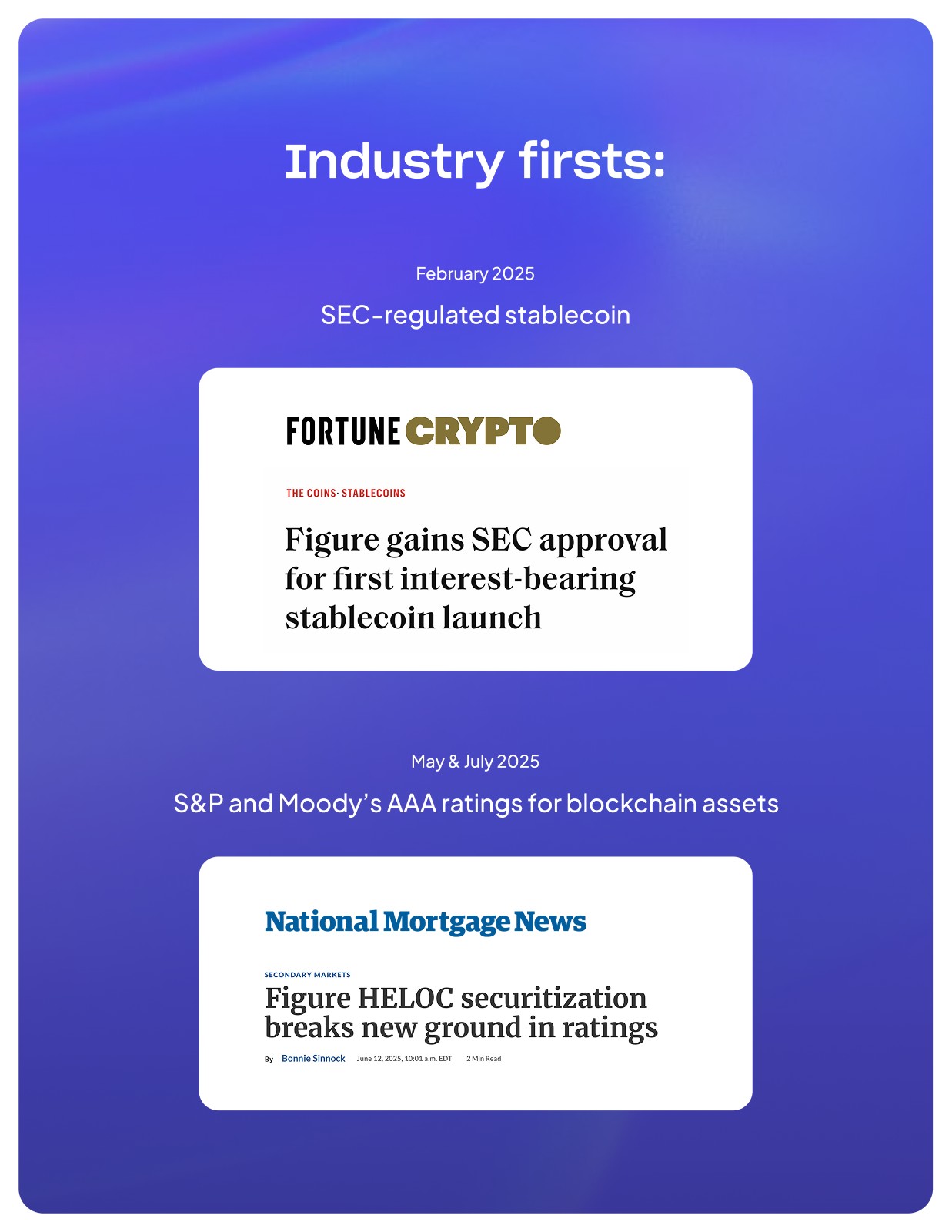
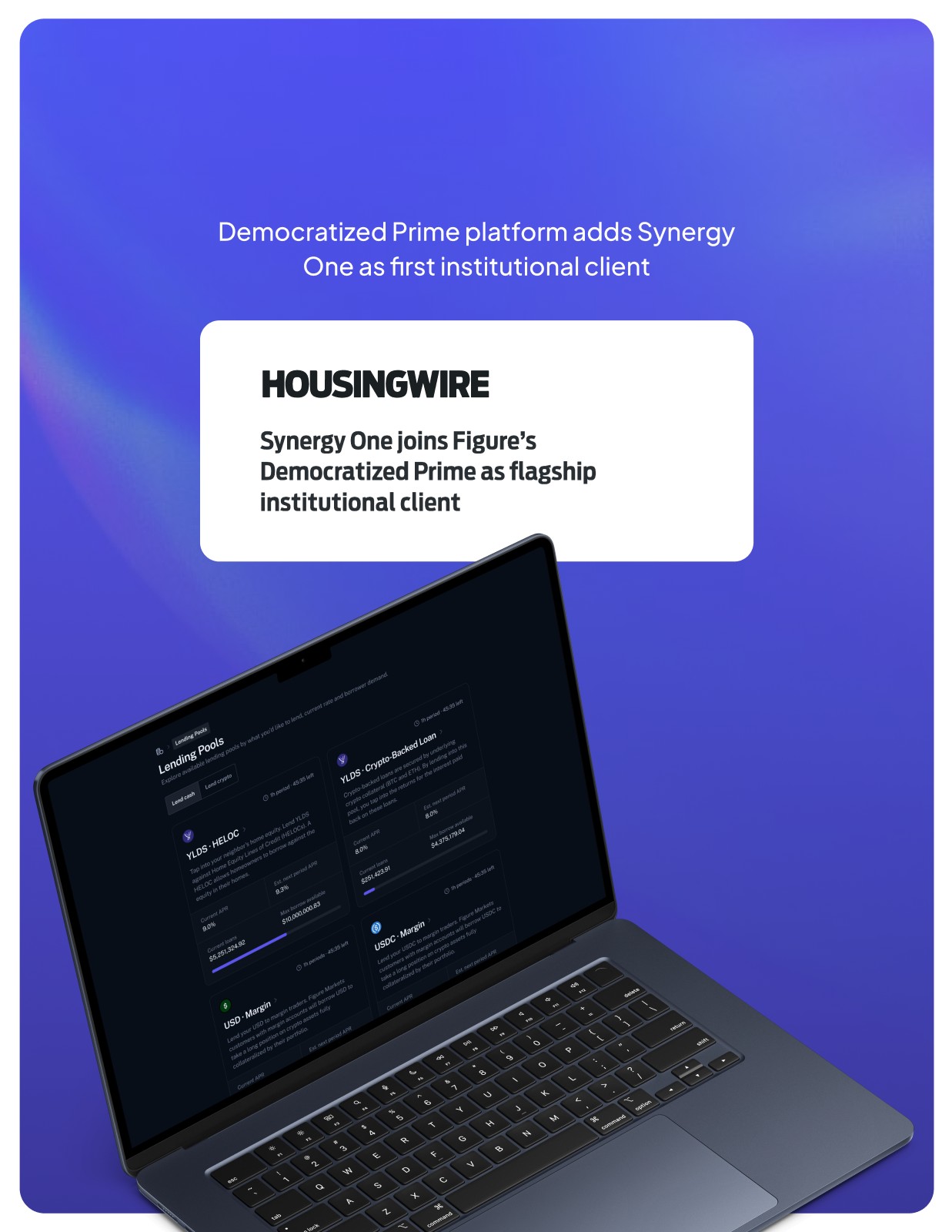
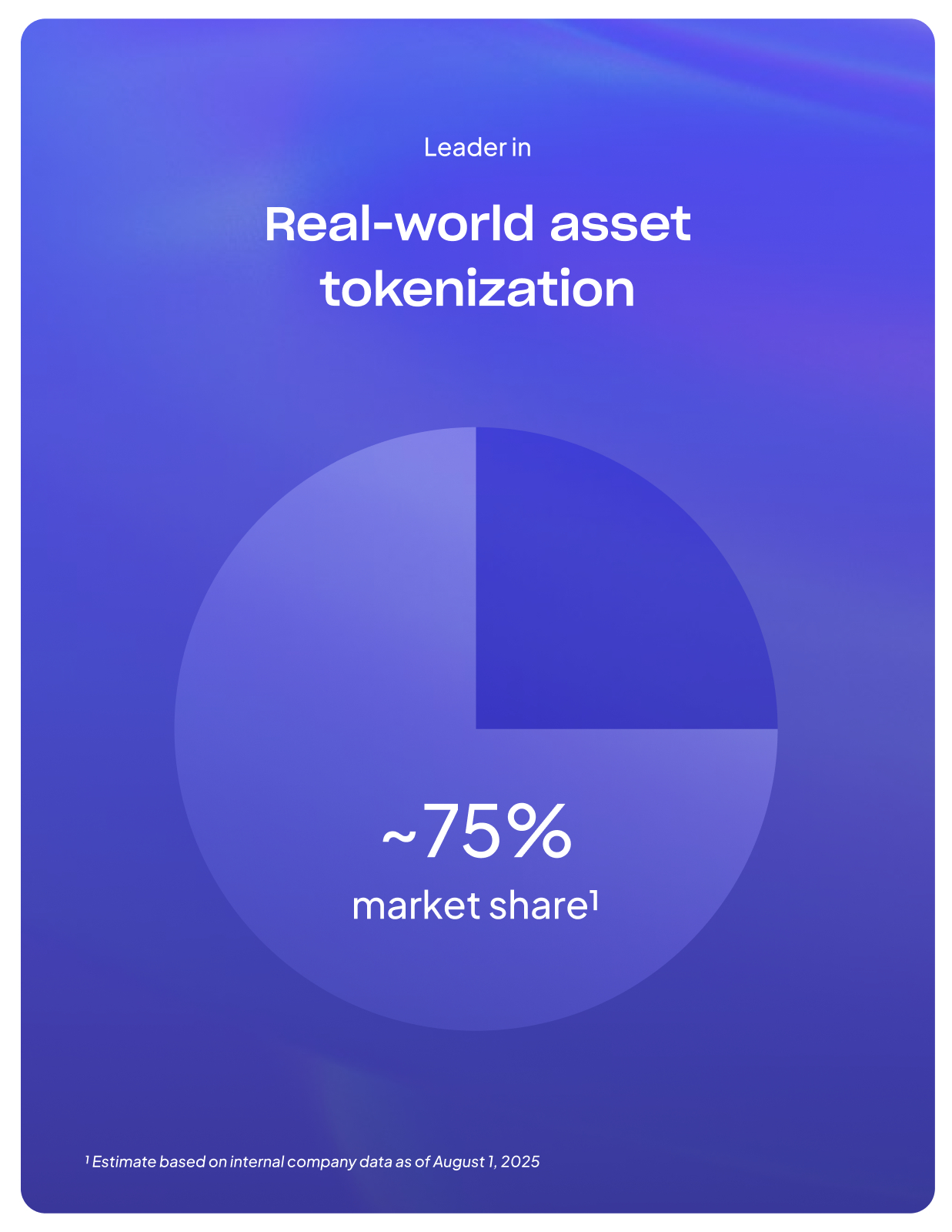
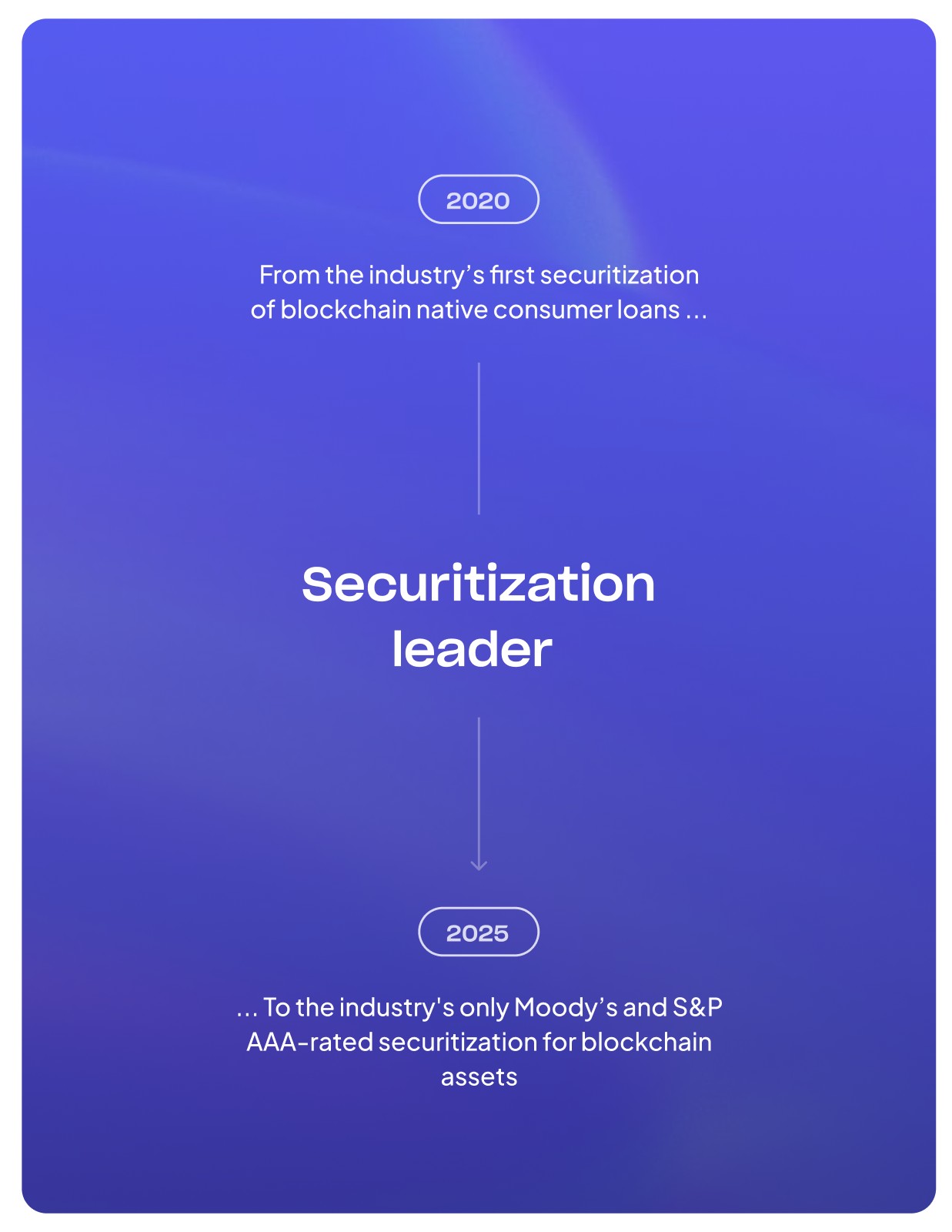
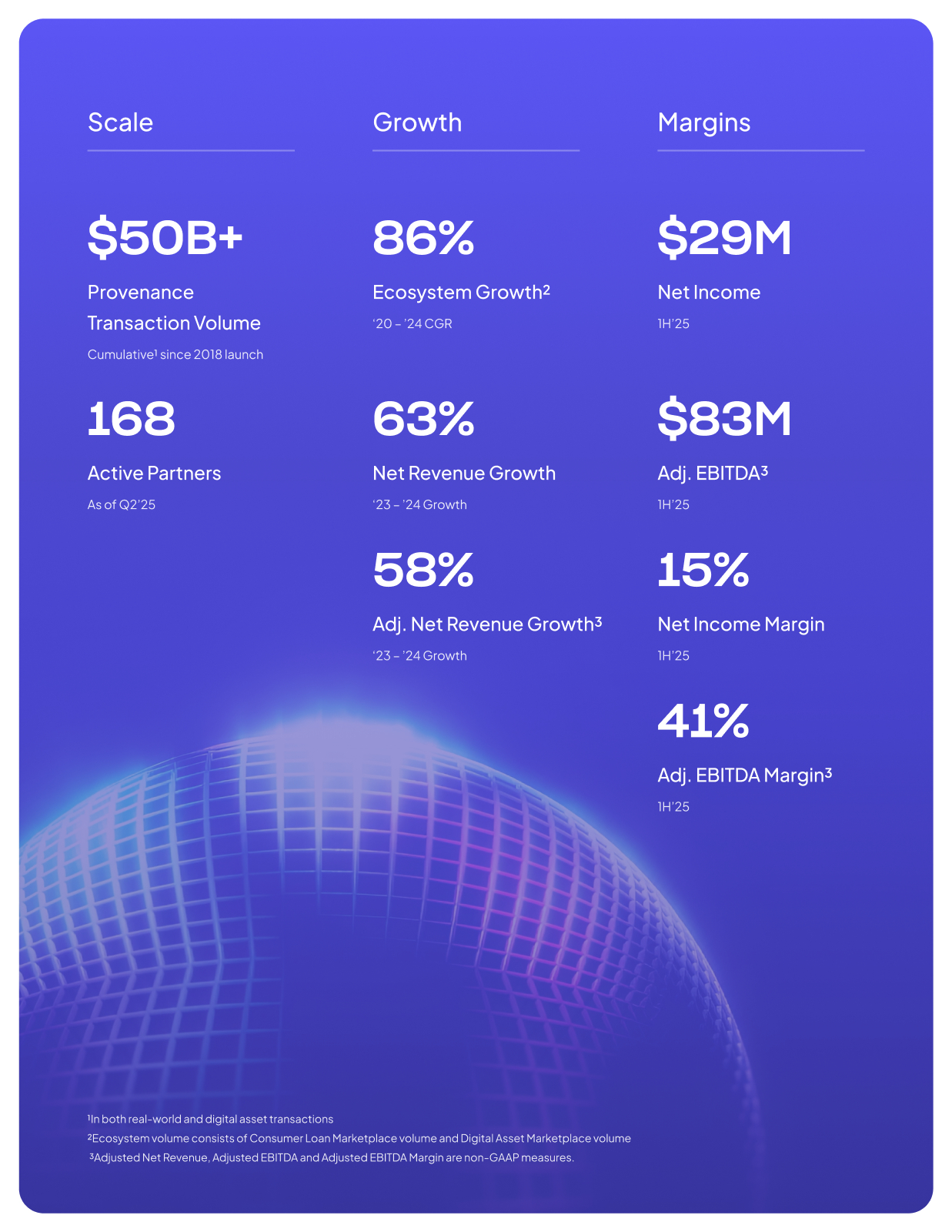
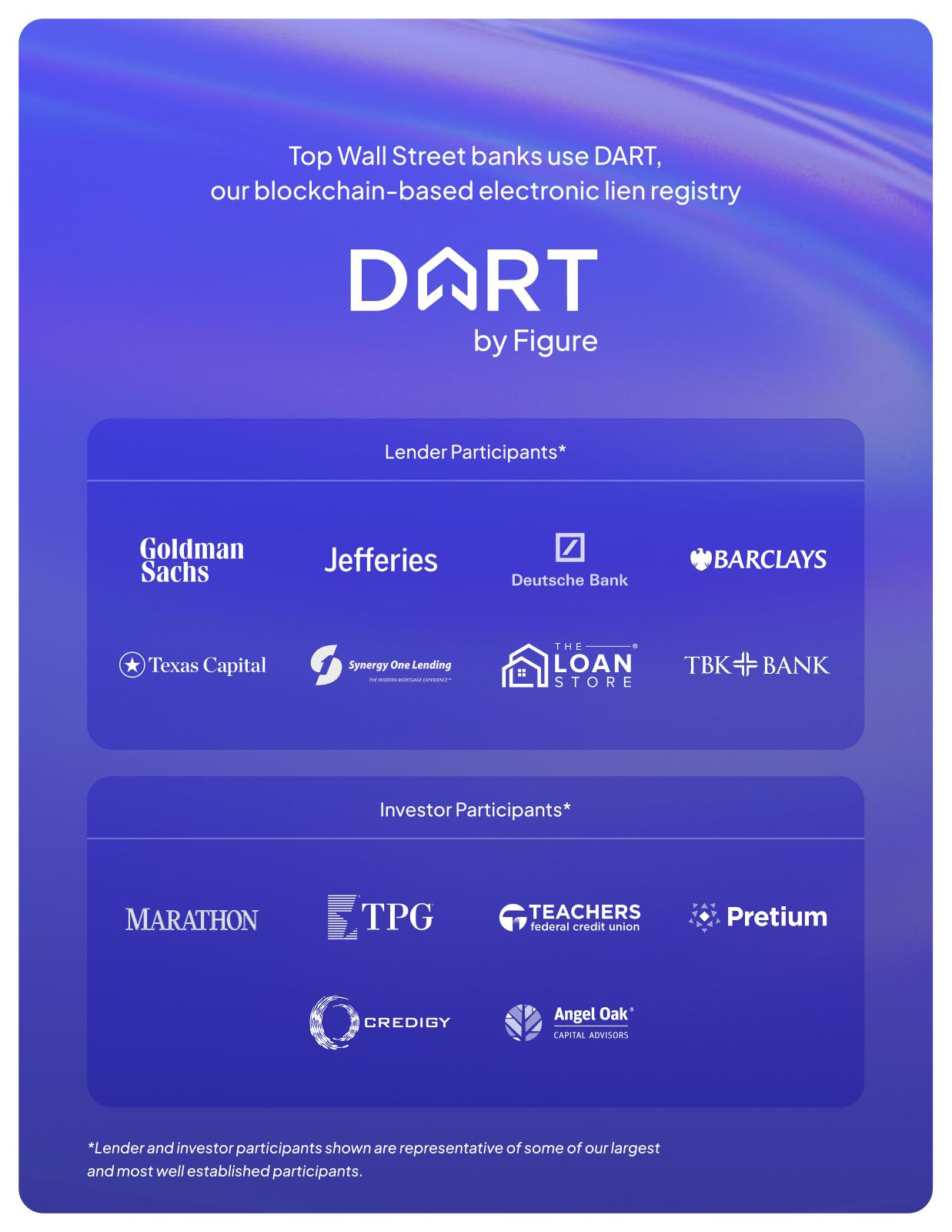
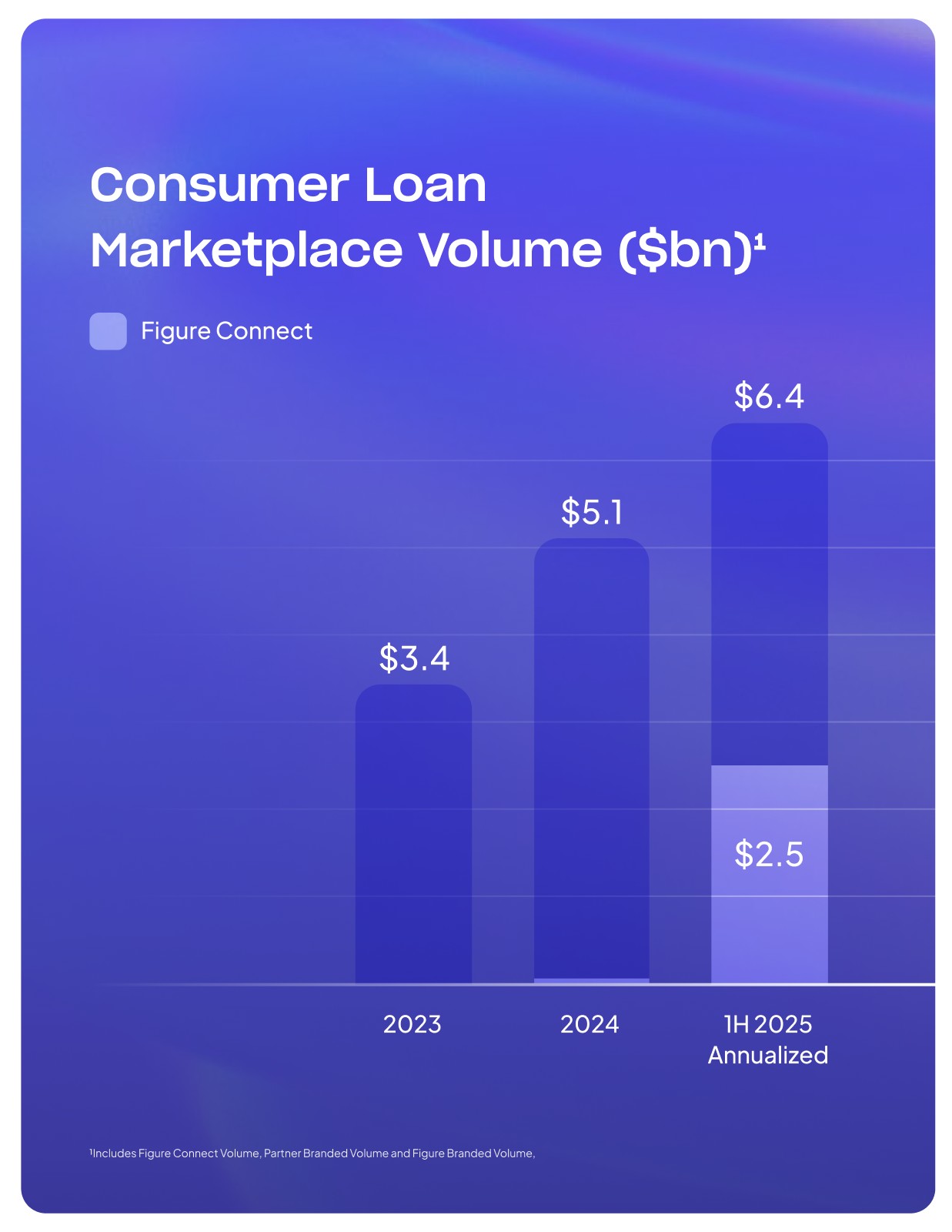
BUSINESS
Business Overview
Figure is building the future of capital markets using blockchain-based technology.
Figure’s proprietary technology powers next-generation lending, trading and investing activities in areas such as consumer credit and digital assets. Our application of the blockchain ledger allows us to better serve our end-customers, improve speed and efficiency, and enhance standardization and liquidity. Using our technology, we continue to develop dynamic, vertically-integrated marketplaces across the approximately $2 trillion consumer credit market and the rapidly growing approximately $4 trillion cryptocurrency and digital asset market. As a result, Figure has grown quickly and profitably, with net income of $29 million and Adjusted EBITDA of $83 million, for the six months ended June 30, 2025, and accumulated deficit of $292 million and total stockholders’ equity of $404 million, as of June 30, 2025, and net income of $20 million and Adjusted EBITDA of $101 million, for the year ended December 31, 2024, and accumulated deficit of $321 million and total stockholders’ equity of $363 million, as of December 31, 2024.
The infrastructure supporting capital markets today is fragmented and operates on legacy systems which employ antiquated processes for loan approvals and transaction processing. This creates process and cost inefficiencies in serving consumer credit markets and limits the development of alternative marketplaces. Furthermore, the manual elements underpinning the records of ownership and transfer of financial and real assets constrain liquidity, maintain elevated costs, and are error-prone.
Figure aims to address these challenges by using blockchain-based technology to innovate beyond legacy processes. We built a transformative, scaled and fast growing technology platform that displaces trust with truth in the financial ecosystem. Our platform also supports legacy systems, and our goal is to shift customer adoption towards blockchain-based solutions. Furthermore, our technology significantly reduces complexity and increases speed for market participants across the application, underwriting, funding and subsequent capital markets processes. Using our LOS, the time it takes to fund a home equity loan from application has been reduced to a median of 10 days from an industry median of approximately 42 days (based on data from industry sources) as of June 30, 2025. In comparison, for asset classes outside of mortgages, such as personal loans, there are many loan originators that utilize digitized, fast and automated processes that can fund as fast as same-day or often in as little as three to five days. Additionally, the average production cost per loan was reduced to approximately $730 for the year ended December 31, 2024 from a mortgage industry average of $11,230 for the quarter ended December 31, 2024, according to the MBA. This is a result of our entirely automated application process that takes as little as five minutes to complete and as few as five days to fund. Our platform automates income verification and offers customers the ability to redraw without incurring closing or out-of-pocket costs. Additionally, our platform employs an automatic valuation model, replacing the traditional, time-consuming appraisal process, and utilizes a digital lien matching process instead of the traditional analog title search. It also facilitates remote closings, including remote notaries, in jurisdictions where permitted by applicable laws. Importantly, we offer a liquid capital market for loans in connection with this low cost, automated and blockchain-based origination engine.
Our technology enables the immutable recording of all assets and their key information on Provenance Blockchain. Provenance Blockchain, an independent Layer 1 blockchain, provides the scale, security, speed and cost structure to facilitate activity across the broad financial services landscape as a record of truth for assets. Using loans as an example, this authenticity record provides a validation mechanism to support the traditional, off-chain processes we use for tracking and monitoring loan transactions. This record provides verified information regarding the chain of ownership for all of the loans originated on our platform. Adoption of our technology has scaled significantly with every asset passing through Figure’s system being recorded on Provenance Blockchain and accumulating over $50 billion in both real-world and digital asset transactions from our launch in late 2018 to June 30, 2025. According to data from RWA.xyz, our real-world assets total value locked is approximately $11 billion as
186
of August 1, 2025 and our share of tokenized private credit is approximately 75% based on the value of outstanding loans originated as of August 1, 2025. Further, 80% of loans originated through our LOS, which include loans originated by Figure as well as by our partners, for the six months ended June 30, 2025 utilized our DART platform, our lien and eNote registry that is built on Provenance Blockchain, compared to only 2% of loan originations for the year ended December 31, 2024. Loans originated by our partners utilizing DART accounted for 80% of Partner-branded loans and 62% of all loans originated by our LOS (including wholesale (brokered) transactions) for the six months ended June 30, 2025. We pay a minimal amount in the form of HASH for our use of the Provenance Blockchain. HASH is the utility token of the Provenance Blockchain and therefore gas fees (usage fees) are paid in HASH. A small amount of HASH is required to complete each transaction, and we pay these fees on behalf of all participants for any activity they complete with our assets. The average gas fee has been less than one HASH since 2018, which is equivalent to approximately $0.026.
The Provenance Blockchain is a public Layer 1 blockchain that is the underlying infrastructure for our solutions such as DART, YLDS, Figure Exchange, and Democratized Prime. HASH is the utility token used for gas fees to effect transactions and staking on the Provenance Blockchain. The Provenance Blockchain uses a proof of stake consensus mechanism using CometBFT, the maximum blocksize is 0.5 gigabytes, and the transaction speed is approximately 4.4 seconds per block. The validator network is typical of any proof-of-stake network, where validator nodes are responsible for verifying and adding new transactions to the blockchain. Validators ensure network security and consensus by confirming transactions, earning HASH rewards for good behavior and potentially losing their stake for malicious behavior. HASH is currently not minted nor burned. All of our products use the Provenance Blockchain through application programming interfaces.
As with many blockchain foundations, the Provenance Foundation coordinates governance, advocacy, and development for the core Provenance Blockchain. The Provenance Foundation’s responsibilities include but are not limited to: network oversight, technical management (protocol upgrades and enhancements) and ecosystem development (expanding use cases, incentives for new users, and technology and business partnerships).
We began addressing the consumer credit market in 2018 with our Figure-branded product, which catered to direct-to-consumer home equity loans. We then expanded further through Partner-branded strategies, in which a growing number of partners use our technology to independently originate home equity loans. For the last twelve months ended June 30, 2025, we facilitated approximately $6 billion of home equity lending, representing an increase of 29% compared to the twelve months ended June 30, 2024. For the year ended December 31, 2024, we facilitated approximately $5 billion of home equity lending, representing an increase of 51% compared to the year ended December 31, 2023, and a compound annual growth rate of 70% since June 30, 2021. As of June 30, 2025 we had 168 active partners.
Our relationship with our partners is based on our partners’ right to use our solutions. Once a partner is approved and onboarded, the partner enters into a contractual agreement with us for the right to use our LOS and Figure Connect marketplace in exchange for fees. These agreements typically have a fixed term with auto-renewals unless notice is given to terminate, are non-exclusive and do not obligate our partners to use our solutions.
We earn percentage fees from our partners as part of our revenue model. For partners utilizing Figure Connect, we receive a percentage fee on the Consumer Loan Marketplace, based on the loan origination volume and the volume associated with facilitating loan sales. Similarly, for partners not using Figure Connect, we earn a percentage fee on the Consumer Loan Marketplace, also based on loan origination volume and the volume for facilitating loan sales. Additionally, for partners engaged on Democratized Prime, we earn a percentage fee based on the asset balance.
In June 2024, we launched Figure Connect, an electronic marketplace that employs blockchain technology, to directly connect sellers and buyers of loans. During the short period of 12 months from
187
launch in June 2024 to June 2025, approximately $1.3 billion in HELOC volume was transacted on Figure Connect by third parties and 27 total marketplace participants (across loan originators, buyers and investors) were onboarded as of June 30, 2025.
With our technology applicable to the broader capital markets, we are expanding beyond our foundational solutions by developing trading and investing products. One example is Figure Exchange, a digital asset marketplace that provides customers advantages for crypto-trading, such as cross-asset collateralization for margin lending. Another example is YLDS, a groundbreaking interest-bearing peer-to-peer transferable stablecoin that is both native to a public blockchain and a security registered with the SEC. YLDS has many use cases resulting from its status as a security, including yielding collateral for institutions, cross-border payments and serving as the de-facto currency of Figure Exchange. For the six months ended June 30, 2025, we did not generate revenue from Figure Exchange and revenue generated from YLDS was less than $1 thousand.
We believe that we have established a regulatory and licensing apparatus which sets us apart from our competitors and enables us to continue expanding our diverse product offering. We currently have more than 180 lending and servicing licenses, 48 money transmitter licenses, and are an SEC-registered broker-dealer with authority to operate an ATS, which operations are conducted in accordance with SEC and FINRA rules and regulations.
We generate revenue from the volume transacted on our marketplaces and through the use of our proprietary technology. We earn volume-based fees from partners and users who utilize our technology solutions to transact in our ecosystem. Within this usage-based model, we target positive unit economics in each of our solutions. In addition to our growing stream of ecosystem and technology fees, we also earn origination, gain on sale, and servicing revenue from assets generated through our LOS. During the six months ended June 30, 2025, HELOCs comprised over 99% of our total loan originations.
For the year ended December 31, 2024, approximately 82% of our total net revenue was generated from origination fees, gain on sale of loans, servicing fees and interest income from assets generated through our LOS from both Figure and our network of partners. For the six months ended June 30, 2025, this represented approximately 76% of total net revenue, as revenue from Figure Connect and other new products grew faster than the solely LOS-driven revenue sources.
We have grown quickly in a capital-efficient manner since our founding, and more recently have achieved strong and growing profitability. For the six months ended June 30, 2025 and 2024, we generated net revenue of $191 million and $156 million, respectively, Adjusted Net Revenue of $201 million and $153 million, respectively, net income of $29 million and net loss of $13 million, respectively, and Adjusted EBITDA of $83 million and $37 million, respectively, and as of June 30, 2025, accumulated deficit of $292 million and total stockholders’ equity of $404 million. For the years ended December 31, 2024 and 2023, we generated net revenue of $341 million and $210 million, respectively, Adjusted Net Revenue of $339 million and $214 million, respectively, net income of $20 million and net loss of $52 million, respectively, and Adjusted EBITDA of $101 million and $(12) million, respectively, and as of December 31, 2024 and 2023, accumulated deficit of $321 million and $338 million, respectively, and total stockholders’ equity of $363 million and $222 million, respectively. See the section titled “Management’s Discussion and Analysis of Financial Condition and Results of Operations—Non-GAAP Financial Measures” for information regarding our use of Adjusted Net Revenue and Adjusted EBITDA and a reconciliation of such non-GAAP financial measures to certain directly comparable financial measures calculated in accordance with GAAP.
Current Industry Dynamics
There is a need for a vertically integrated capital markets infrastructure platform that provides one-stop digital technology solutions from asset origination to asset exchange. The industry currently operates via disparate, legacy approaches to consumer credit asset origination and funding and trading of those
188
assets. These approaches are manual, time-consuming, expensive, error-prone and are unable to fully access market funding potential.
Friction in Access and Extension of Consumer Credit, with Challenging and Antiquated Funding Markets
There is significant friction in the process of accessing and extending consumer credit, which ultimately impacts even the highest quality borrowers. The vast majority of consumer credit today is extended by financial institutions that rely on manual, difficult-to-navigate processes burdened by dated technology.
Loan application processes that involve excessive paperwork, physical appraisals, expensive title processes and manual income verification result in slow timelines to approval and funding. For example, home equity loans can take approximately 42 days to complete, driving incremental costs for borrowers, according to industry sources.
Similarly, the legacy asset transfer process is paper-intensive, presents several burdens associated with manual assignments and document management, and relies heavily upon conventional loan-tracking databases, which are error-prone. Digitizing this process increases safeguards, provides greater transparency, and improves efficiency.
Additionally, in order to access off-balance sheet sources of funding today, originators seek institutional funding partners bilaterally and one-by-one. Often due to the lack of information transparency around assets and funding sources, the liquidity potential to facilitate incremental asset origination growth has not been fully unlocked. As an example, and based on data from industry sources, while the quantum of private credit capital raised globally grew by a compound annual growth rate of approximately 17% over the five-year period ended December 31, 2023 to reach over $1 trillion, and is estimated to reach $3 trillion by 2028, access to private credit remains challenging for originators. Similarly, investors struggle to obtain expeditious and consistent access to reliable, quality assets.
Limited Real-World Success of Blockchain Technology
There are limited examples of real-world success using blockchain technology. We believe that on-chain digital real-world assets continue to represent a greenfield of opportunity of significant scale. According to data from RWA.xyz and other industry sources as of April 2025, less than 1% of real-world assets are currently on blockchain. Using a blockchain-native ecosystem would reduce costs, improve liquidity and expand access to capital.
Additionally, there is a scarcity of interest-bearing stablecoins. Stablecoins offer a digitally native way to hold fiat value on-chain. They are designed to maintain a stable value, typically $1.00 per token, and are generally backed by bank deposits or government securities such as U.S. Treasury bonds held in trust by the stablecoin issuer. However, unlike a bank account, money market account, U.S. Treasury bonds, or corporate debt, most stablecoins do not pay their holder any yield. As of June 30, 2025, only 4% of the $275 billion of stablecoins in circulation yielded interest, according to CoinGecko. Paying any type of yield could cause a stablecoin to be subject to securities laws, including being required to be registered as a security. Figure has created YLDS to solve this by designing a digitally native blockchain-based stablecoin that is registered as a security with the SEC and offers a yield to token holders, which we believe should result in an uptick in adoption as compared to non-yielding stablecoins.
Our Solutions
Figure has built a vertically integrated suite of blockchain-based solutions that powers our marketplaces, including lending, trading, and investing activities in areas such as consumer credit and digital assets. Our solutions produce greater efficiency and liquidity across asset classes and markets. Provenance Blockchain is the sole system of record for our major solutions across DART, Figure Connect, YLDS and, except for all personally identifiable information of the borrower, our LOS.
189
Our vision is to create a one-stop, vertically integrated capital markets trading platform for consumer assets. As a first step, we developed a next-generation, proprietary LOS that drives fast, transparent and homogeneous loan origination. We have since paired this LOS with a loan distribution marketplace, Figure Connect, to enable access to a broad and growing pool of capital markets partners. Additionally, we created DART, our registry technology built on Provenance Blockchain, to provide certainty and transparency in asset ownership.
Our foundation for our differentiated infrastructure has been in the HELOC market. We entered the market through our own Figure-branded strategy, which we utilize to originate loans directly to borrowers, and have subsequently developed a Partner-branded strategy through which mortgage originators, servicers, banks, wholesale brokers, and credit unions can use our technology to originate and distribute their own loans. We facilitated $5 billion in HELOCs in 2024, up 51% from 2023, accumulating more than $16 billion in cumulative originations since the product was launched in late 2018 to June 30, 2025 and achieving the #1 market share in the non-bank HELOC lending market in 2024, as reported by Home Equity Lending News.
For the six months ended June 30, 2025, HELOC originations through our LOS utilization of Figure Connect and sales of loans contributed to 75% of our revenue and 76% of Adjusted Net Revenue including 22% from transactions via Figure Connect, and Servicing and Interest Income Revenue contributed 24%. All of our loan originations are recorded on the Provenance Blockchain as a hashed record and, through our DART application, in county land records. Ownership of loans is updated on the Provenance Blockchain as loans are bought and sold in our marketplace.
We have since developed and extended our infrastructure into additional use cases, including launching Figure Exchange, developing an ATS, and issuing the YLDS stablecoin. YLDS is a SEC-registered face amount certificate and is freely transferable peer-to-peer to wallets that have gone through a KYC and anti-money laundering onboarding process, consistent with applicable U.S. federal and state financial regulatory requirements. This process is administered directly by us or through a registered transfer agent and includes the collection of personally identifiable information such as name, date of birth, address, social security number, and contact information. Going forward, we believe our infrastructure is portable across a broad array of activities on our roadmap, ultimately allowing us to deliver powerful synergies across our vertically integrated platform. Our Ecosystem Volume experienced a compound annual growth rate of 86% from the year ended December 31, 2020 to the year ended December 31, 2024. See “Management’s Discussion and Analysis of Financial Condition and Results of Operations—Key Operating Metrics” for the definition of Ecosystem Volume and how we calculate it.
Proprietary Loan Origination System
In July 2018, we launched our proprietary LOS, which uses modern technology to help deliver efficiency, speed and lower costs at each stage of the loan origination process. Leveraging AVMs, digital title and lien matching, and digital income verification via data aggregators, we are able to offer HELOC loan approval in as little as five minutes and funding in as few as five days (median of 10 days during the six months ended June 30, 2025). In the six months ended June 30, 2025, 88% of the loans we facilitated were fully automated from the start of the application to the underwriting stage of the loan process.
In contrast to legacy lending infrastructure, our LOS is built upon a differentiated technology stack that digitizes key aspects of underwriting, including credit, income, and property. Our underwriting process is streamlined through a fully digital and paperless user interface that is simple, fast, and offers a superior user experience. Our operational processes reduce the work effort and error rate of applications and provide greater transparency and functionality for end-customers and partners. By deploying our modern LOS, we believe we are the first company to develop and offer a consumer-friendly HELOC product that can compete with unsecured personal loan alternatives and cash-out mortgage refinance products.
190
Our LOS excels in handling secured asset classes, such as HELOCs and mortgages, due to its robust infrastructure for data capture and verification. These capabilities are enhanced by data immutability and process compliance, as all loans and related data (except for all personally identifiable information of the borrower) are recorded on a public blockchain, Provenance Blockchain. Our LOS also extends well to unsecured loans, such as personal loans and credit lines, given the automated underwriting that swiftly assesses borrower creditworthiness.
AVMs, digital title and lien matching, and digital income verification via data aggregators are used to satisfy credit policy, as well as consumer protection requirements. AVMs provide a reasonable estimation of value of the subject property, digital title and lien matching provide confirmation of title ownership, vesting language and the existence of any liens on the subject property, and digital income verification confirms the borrower’s income based on actual data. These tools are provided at arm's length by third-party service providers who regularly monitor data for accuracy. The traditional mortgage origination model uses full Uniform Residential Appraisal Reports interior / exterior field appraisals, full title abstracts and policies of insurance, and manual income verification through the use of pay stubs and phone calls made to the borrower’s place of employment. Substantial evidence exists that these are not always necessary.
Furthermore, we and our service providers work closely with record offices in counties around the United States to ensure all recordings are properly submitted. We use in-person notaries residing in the property state or county when remote notary services are not accepted by such state or county to mitigate the risk that a remote online notary session may be deemed invalid. We regularly update our policy to require in-person notaries in particular counties when such county rejects security instruments based upon improper notarization by a notary located in another state. In states and counties whose laws or recording processes do not support the use of our remote notaries, we use traditional, in-person notaries who notarize electronically signed closing documents. Currently, the majority of states allow the use of remote online notaries for security instruments securing liens on real property, although not every county in those states allows this practice. As of December 31, 2024, we used our remote online notaries to notarize security instruments in 63% of all of the counties where we recorded security instruments and 83% of all of the counties where we have recorded security instruments allow electronic recording of security instruments.
While there are other fintech and online platforms that may leverage some aspects of our LOS, including similar third-party services to determine property value, lien position and income, to our knowledge there is no other platform using these services that simultaneously offers an integrated, diversified, liquid capital marketplace with loan sale execution and takeout. Similarly, there are jurisdictions where county lien registries do not allow remote notary services or otherwise allow digital verification and our lien registry approach is therefore less differentiated. However, because the vast majority of our origination partners originate loans nationally, the fact that we offer a highly automated process in as many jurisdictions as we do is a differentiating factor for them to use our LOS.
When a loan is originated, a token representing the loan is created on the Provenance Blockchain. When a loan is originated, the data and documents collected in the origination process are digitally stored in a secure electronic data store off chain; industry standard encryption is used to generate a HASH from that secured loan file that creates the loan genesis block on the Provenance Blockchain. This process protects any personal information or other information that should not be exposed on a public blockchain. If any change is made by the loan owner or any other authorized party, such as the service provider, to the loan data or documents in the electronic data store, they must have the change appended to the blockchain or the change will be invalid as it will not match the record on the Provenance Blockchain. This creates a system of record on Provenance Blockchain that is enforced by the combination of digital signatures by authorized parties and the data’s encryption hash. This system of record does not require two-way reconciliation as the Provenance Blockchain record is the truth. Servicing agreements are clear as to the requirement to append updates to the Provenance Blockchain for the loans they are servicing. Agreements with third-party servicers have the same requirement. If third-party servicers do not want to integrate into the software or fail to sign for appending updates to the Provenance Blockchain, they can
191
opt to remove the loans from the blockchain in order to revert back to the previous process of database and paper for the system of record, and audits for verification. Our terms dictate that users of our Portfolio Manager and Figure Connect must agree to outline conditions for transferring HELOCs, stating that any transfer not recorded on the Provenance Blockchain will be void ab initio (meaning "void from the beginning"). The purchaser must ensure that changes in ownership or pledges of HELOCs are reflected in the asset ledger on the Provenance Blockchain. Any successor owner must agree to similar provisions, including the requirement for transfers to be reflected on the Provenance Blockchain to be valid. The purchaser is not liable for successor owners' non-compliance as long as they fulfill their obligation to require these terms. At any time, the purchaser can choose to remove HELOCs from the Provenance Blockchain. They can do so by notifying the marketplace operator and servicer, in which case the transfer restrictions will no longer apply.
When a payment is received from a borrower, the payment is reflected in a loan servicer’s software which is connected to the Provenance Blockchain, allowing the loan’s balance to be updated. This is true of both our proprietary servicing software and third-party servicing software. Provenance Blockchain’s ability to track payments allows it to prove delinquencies and defaults. For corrections or modifications to the loan balance, the calculations are performed off-chain by the servicer and are reflected on the blockchain immediately thereafter.
We have reduced the time from HELOC application to funding from an industry median of approximately 42 days, according to industry sources, to a median of 10 days for the six months ended June 30, 2025.
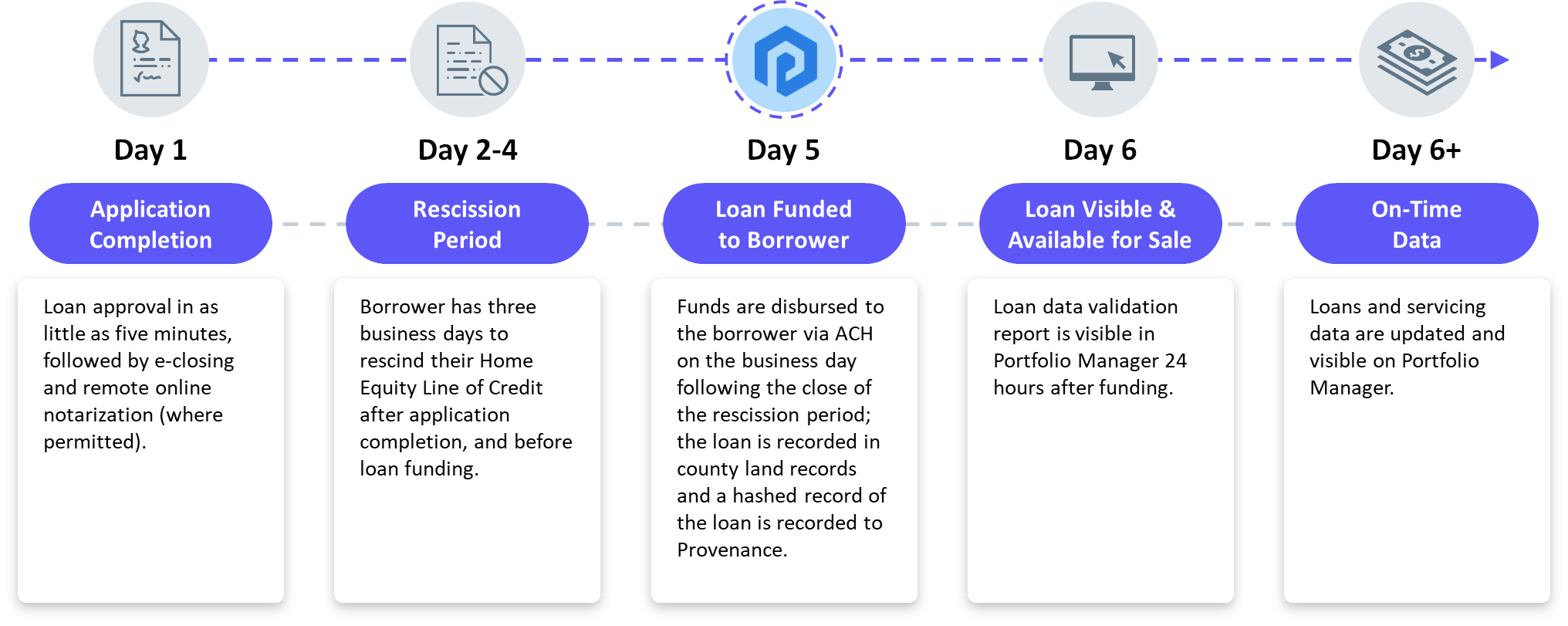
Our typical end-customers for HELOCs are homeowners with high creditworthiness, as seen through an average FICO score of 755 and average income of approximately $186,000 for originations during the six months ended June 30, 2025. Our customer base values financial products that reflect their strong financial standing. We provide a HELOC product that is fast and convenient to our end-customers, and is an alternative to taking out personal loans or holding credit card balances. During the six months ended June 30, 2025, 15% of the total principal amount of loans originated via our LOS were first-lien.
We deploy our LOS through two strategies:
•Partner-branded: Our partners are mortgage originators, servicers, banks, wholesale brokers, and credit unions. These partners use our consumer-facing application portal, which is branded in the partner’s name and provides homogeneous automated underwriting, loan-decisioning software, and loan closing tools. The offering is used by both retail and wholesale lenders. Our lending and distribution platform is designed to support the diverse business models of our network of lending partners.
192
Partner-branded loan originations have grown from $149 million for the last twelve months ended June 30, 2022 to approximately $4.3 billion for the last twelve months ended June 30, 2025. For the six months ended June 30, 2025, Partner-branded loans comprised 77% of our total loan originations.
Our network of partners has grown from three partners as of December 31, 2021, to 168 as of June 30, 2025, with our top 10 partners contributing 57% and 52% of our origination volume for the six months ended June 30, 2025 and the year ended December 31, 2024, respectively. Our top 10 partners are medium to large non-bank finance companies in the mortgage industry. They are concentrated in the United States, with some having a nationwide presence and others focusing on specific regional markets.
•Figure-branded: We utilize the Figure-branded strategy to launch new asset classes through our LOS, which enables us to prove demand and product efficacy and validate results of upgrades and modifications.
As we refined our HELOC product, we worked quickly to develop a proof of concept through Figure-branded loans, with origination volume for Figure-branded loans growing from approximately $310 million for the twelve months ended June 30, 2019, our first year of activity, to approximately $750 million for the six months ended June 30, 2025 and approximately $2 billion for the last twelve months ended June 30, 2025. For the six months ended June 30, 2025, Figure-branded loans comprised 23% of our total loan originations.
A number of our partners are not licensed to originate mortgage loans in each state, and as such, rely on our Figure-branded strategy. Over time, as these partners generate sufficient Figure-branded volume, it becomes a worthwhile investment for them to obtain required lending licenses, which enables them to shift to Partner-branded strategies and take control over their origination funnel.
Our LOS ensures a uniform underwriting process that helps generate standardized assets with enhanced transparency around collateral composition. As a result, loans originated through our LOS, both Partner-branded and Figure-branded, are highly attractive for loan purchasers and investors. In comparison, with bespoke non-conforming loans, investors can pick and choose, which makes it a long process that is difficult for originators and investors. Figure maintains high quality through its disciplined underwriting process, which automates credit decisions across 28 different criteria. As of June 30, 2025, Figure’s originated loans had loss rates of less than 1% of volume.
Figure Connect
In June 2024, we launched Figure Connect. Figure Connect is our custom-built marketplace platform that facilitates buying and selling of standardized assets that are originated through our LOS. These transactions utilize uniform underwriting, common documentation (such as loan agreements and credit policies), standardized representations and warranties, and are automatically recorded on Provenance Blockchain. Figure Connect enhances liquidity for loans originated through our LOS. Additional tools such as Portfolio Manager, which provide private credit loan purchasers seamless visibility into the current performance of their loans, foster further adoption and participation in our ecosystem. For the first 12 months since we launched Figure Connect in June 2024 to June 2025, approximately $1.3 billion of loan volume was traded.
Sellers of loans transacted on Figure Connect pay a fee for utilizing our technology for origination, as well as a technology fee associated with the execution of loan sales on our platform. Our pricing structure and unit economics are designed to further incentivize customers to transact on Figure Connect, as revenue received has historically exceeded costs incurred by a margin of at least 2%. This margin calculation is comprised of target revenue to the originator (origination fees and gain on sale of loans) and fees that the originator pays for the utilization of the Figure Connect marketplace. Sellers of loans on Figure Connect typically pay a volume-based fee for utilizing our technology solution to originate loans
193
and to place these loans for sale on Figure Connect, as well as a sale volume-based fee associated with the execution of loan sales to a buyer. We do not incur additional expenses to transact these loans on Figure Connect; however, we have built the technology that supports this marketplace and continue to incur technology-related costs to maintain the marketplace. For the years ended December 31, 2024 and 2023, net revenue generated from Figure Connect was $0.2 million and $0, respectively. For the six months ended June 30, 2025, net revenue generated from Figure Connect was $45 million.
Sellers are incentivized to transact on Figure Connect, as the average per loan net revenue they would generate on our marketplace (gain on sale of loans and origination fees to the sellers less fees paid to us for using Figure Connect) is higher than the per loan net revenue the sellers would earn from originating these loans and selling them to us as a loan intermediary buyer. Such difference was on average over 1% of the unpaid loan principal balance during the six months ended June 30, 2025.
In February 2025, we formed a joint venture with Sixth Street Partners, Fig SIX Mortgage LLC, to purchase HELOC loans originated through our LOS and sold through Figure Connect. Sixth Street Partners is a global investment firm that invests in credit products, among other strategies. Fig SIX Mortgage LLC is capitalized with 95% Sixth Street equity and 5% Figure equity. We refer to this joint venture and its activities as a “Guarantor Vehicle.” The Guarantor Vehicle is expected to wholly own the loans it purchases and subsequently sell these loans into Figure HELOC securitizations. Both we and Sixth Street Partners expect to continue to contribute equity into the joint venture up to a total $210.5 million commitment. As of June 30, 2025, Figure had contributed $1 million of equity into the Guarantor Vehicle out of a total $10.5 million initial commitment, and Sixth Street Partners had contributed $24 million out of a total $200 million initial commitment. We do not consolidate the financial statements of the Guarantor Vehicle. Our aim with Figure Connect is to enhance liquidity for loans originated on our LOS, and we believe the Guarantor Vehicle will significantly advance this goal.
As Figure Connect has grown, and we are intermediating fewer transactions in the marketplace, the goal of the Guarantor Vehicle is to step in and purchase loans on Figure Connect. The Guarantor Vehicle is expected to purchase the loans and subsequently securitize them, retaining the residual, or first loss piece of the securitization. The first loss or equity position of a securitization is structurally mandated by the securitization documents to absorb the initial loan losses from the pool of loans. The equity bond of a securitization is sized such that it must pass a rating agency’s applicable stresses for pool level losses and cash flow structural composition. In this way the Guarantor Vehicle acts as a de facto first loss guarantor of Figure Connect. The Guarantor Vehicle was established solely to buy Figure HELOCs and it is mandated to do so according to a return on equity target that it maintains, which includes assumptions about expected Figure HELOC credit loss and prepayments. While the Guarantor Vehicle has a minimum monthly loan commitment, it is not required to buy HELOCs beyond that loan amount. The Guarantor Vehicle may, however, choose to do so in line with its return on equity target, which at the current market is approximately 16%. Specifically, in the event the Guarantor Vehicle believes it can earn returns that meet this hurdle, which can be earned across interest income and gain on sale from securitizations, it will continue to bid on HELOCs in the marketplace. The return on equity target acts as a stabilizing factor for the Guarantor Vehicle, encouraging it to buy assets when prices are more attractive, typically in times of less liquidity or demand for assets. In the event that the clearing price for assets on Figure Connect does not meet the Guarantor Vehicle’s return on equity thresholds based on its credit loss and prepayment speed forecast, the Guarantor Vehicle is not obligated to buy Figure HELOCs.
As of June 30, 2025, the Guarantor Vehicle has yet to purchase HELOCs via Figure Connect, but has instead purchased $25 million of residual equity from Figure’s securitization that was completed in May 2025. The Guarantor Vehicle is an entity that was established to purchase HELOCs sold on Figure Connect (which it then contributes to a securitization, retaining the residual equity). Once the Guarantor Vehicle begins purchasing HELOCs via Figure Connect, this will increase the amount of liquidity available to our network of partners selling their assets on Figure Connect by introducing a large, well-capitalized buyer that is specifically mandated to purchase and securitize assets sold via Figure Connect. While the Guarantor Vehicle does not directly provide a guarantee or backing of the loans, its presence as a
194
dedicated buyer on the Figure Connect marketplace provides sellers on Figure Connect a greater degree of transaction execution than existed prior to its formation.
The Guarantor Vehicle provides the first loss for each securitization by retaining the residual equity. In doing so, it assumes the risk for the loans and largely plays the role that we previously played as an intermediary between the originating partners and the capital markets. The Guarantor Vehicle offloads some of that risk via loan securitizations, often retaining most of the residual equity of the securitization for risk retention purposes. Although the Guarantor Vehicle does not completely replace the role of our balance sheet as intermediary, we believe that the migration of more of our business to the Figure Connect platform has provided the backdrop for a large, consistent buyer like the Guarantor Vehicle to thrive.
When determining which HELOCs to purchase and which transactions to sponsor, the Guarantor Vehicle will purchase standardized pools of HELOCs on Figure Connect just like any other buyer on the Figure Connect platform under the BWIC process. The Guarantor Vehicle is mandated to purchase a minimum monthly dollar volume of HELOCs at the market clearing rate, which is expected in the near term. Any HELOCs purchased by the Guarantor Vehicle will ultimately be securitized in transactions for which it is the sponsor, and as a result, the Guarantor Vehicle is automatically the sponsor of those transactions. The Guarantor Vehicle initiates the securitization of the loans it purchases via Figure Connect and as the seller of the loans into the securitization vehicle, is at risk for the losses in those loans, which we refer to as first loss. First loss is the equity capital interest of the securitization vehicle. Effectively, in the event the loans in the securitization vehicle do not perform well, it is the first tranche of the capital structure to absorb a credit loss, before any of the bond tranches, which is why it is described as first loss. There are no prescriptive limitations on the first loss and the first loss is only applicable to the equity tranche of securitizations retained by the Guarantor Vehicle for securitizations it sponsors. Owners of the debt tranches of a securitization are initially shielded by the first loss losses absorbed by the equity tranche. The Guarantor Vehicle is exposed to the risk that the underlying loans do not perform as expected and therefore erode the equity portion of the securitization. If the underlying loans prepay faster than expected, the residual portion of the securitization is also less valuable because it earns its excess spread for less time. It is also known as the residual because this is the piece of the capital structure that is not sold into rated bonds and is typically retained by the sponsor for the securitization vehicle. Typically, the bond portion is structured from AAA down to single B-rated tranches.
After the securitization of the loans where the various bond tranches of the securitization vehicle are sold to investors, the Guarantor Vehicle continues to own the first loss. The Guarantor Vehicle may also sell this risk if the pricing is attractive. However, as the Dodd-Frank Act requires securitization sponsors to retain at least 5% of the credit risk of the assets they securitize, for regulatory risk-retention purposes, the Guarantor Vehicle is required to maintain such portion of the risk on its balance sheet regardless. The Guarantor Vehicle is obligated to purchase the equity portion of a securitization where it sponsors the
195
securitization. When the Guarantor Vehicle is not the sponsor, it is not obligated to purchase the equity portion.
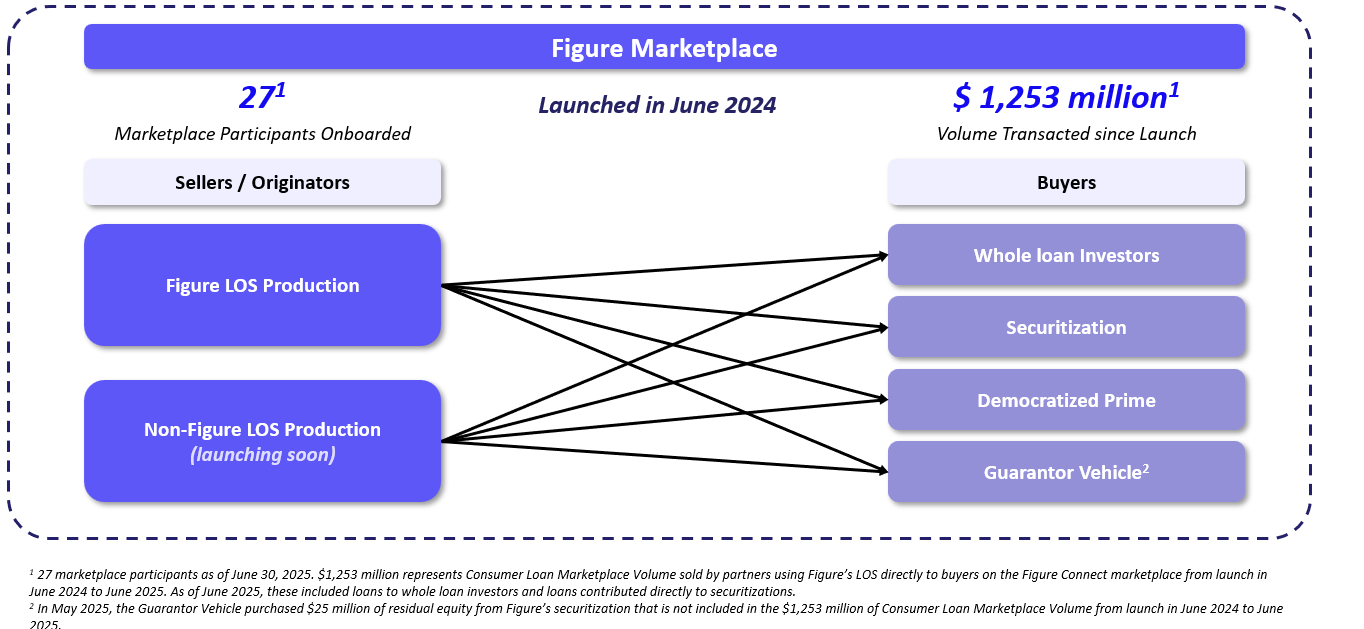
Digital Asset Registry Technologies
In April 2024, we launched DART, our lien and eNote registry technology that is built on Provenance Blockchain for originators and investors to manage and track the ownership of loans as they move throughout the capital markets. DART addresses a significant market pain point in the mortgage industry—the complexities associated with manual assignments and systems, such as MERS. DART effectively “listens” to the immutable activity on Provenance Blockchain and automatically updates loan ownership information accordingly. Thus, by integrating this service into our proprietary technology platform, lenders can originate, pledge, and sell loans using Figure's secure technological framework, which includes the on-chain DART monitoring service, to ensure the efficient transfer of assets.
For the six months ended June 30, 2025, 80% of loans originated through our LOS (including both Figure-branded and Partner-branded) were boarded onto DART, up from 2% for the year ended December 31, 2024.
Figure Exchange
In August 2024, we launched Figure Exchange, our real-time digital asset exchange that supports the efficient trading of various tokens including leading digital assets (e.g. BTC, ETH). Figure Exchange matches buyers and sellers, allowing for bilateral, self-settling and self-clearing trades that remove counterparty and settlement risk. Since launch, Figure Exchange has facilitated the trading of over $1 billion in volume without meaningful marketing efforts, of which $299 million was in the six months ended June 30, 2025.
The central tenet of Figure Exchange is to provide users with a one-stop shop for trading, lending, and borrowing across a wide variety of digital assets. With this goal in mind, our offering stands out from our competitors’ offerings due to:
•Democratized Prime: A pillar of our value proposition is the Democratized Prime offering, which disrupts the traditional prime brokerage infrastructure by allowing users to lend their assets or excess cash into the ecosystem at a market-clearing rate. Democratized Prime is a DeFi marketplace connecting sources and uses of capital. Democratized Prime is a many-to-many marketplace, where common borrowers face off against common lenders. Lenders have pro-rata exposure to all borrowers. Lenders make their decision on participating and on the desired loan
196
interest rate based on a combination of (i) the liquidity of the collateral, (ii) the volatility of the collateral, (iii) the over-collateralization amount, and (iv) the quality of the collateral. In the case of Figure HELOC loans, there is a weekly BWIC for these loans that provides liquidity on Figure Connect. Should there be a breach of loan-to-value ratio, a smart contract moves the relevant loans to the BWIC process for liquidation.
The mechanics of Democratized Prime are as follows, using the HELOC marketplace as an example. Illustrative graphics are also presented below.
•A new Democratized Prime Marketplace for HELOC collateral is established:
•A smart contract holds the collateral
•Figure (as the first HELOC marketplace) establishes collateral terms that are reflected in the smart contract and visible to participants in the ecosystem
•Any borrower can contribute collateral and each borrower sets their maximum borrow rate
•Lenders decide if they will participate in the market, evaluating collateral based on:
•Liquidity and volatility
•Quality (e.g., through assessing the weighted average coupon of the HELOCs, weighted average debt-to-income ratio, and weighted average credit score across the specific marketplace)
•Over-collateralization and liquidation thresholds
•Lenders participate in an hourly dutch auction; winning bids earn interest over the next hour
•Interest and repayment is managed by the smart contract
◦Interest accrues hourly
•Borrowers can pay down loan balances at any time
•Lenders can redeem at any time; if there is insufficient liquidity to meet redemptions, the hourly borrow rate goes to 30%
•Risk management is executed by the smart contract
•If the loan-to-value threshold is breached, the collateral is moved to the appropriate marketplace for liquidation
•Lenders’ principal is paid off, and any excess returns to the borrower
•The loan-to-value threshold for each marketplace is a function of the underlying collateral type and helps ensure that all Democratized Prime loans are over-collateralized at origination—currently 90% across active marketplaces, loan-to-value thresholds are subject to change after Figure sets the initial threshold for the first marketplace per collateral type but are generally expected to reflect the broader market (e.g., the current 90% threshold is reflective of advance rates of 90% that are commonly seen in warehouse financing, which the HELOC marketplace serves as an alternative to)
•Borrowers can prevent liquidation by adding collateral or reducing loan amounts
•Borrowers receive warnings as loan-to-value ratios rise so that they have sufficient time to take action and are not surprised when a liquidation event is triggered; for
197
example, in the BTC margin marketplace, borrowers receive a notice when loan-to-value ratios climb to 85%, while liquidation would be triggered at 90%
198
Democratized Prime hosts specific pools of assets, such as tokenized HELOCs and margin funding for digital asset trading activity on the Figure Exchange. Borrowers obtain financing at a market-clearing rate. There is no intermediary, and instead pricing is set every hour by a Dutch-style auction. Specifically, the interest rate is set by beginning at a predetermined maximum rate and successively lowering such rate until the aggregate principal amount of bids received equals or exceeds the offering amount sought by the borrower, with the lowest rate at which such amount is achieved becoming the interest rate applicable to all accepted bids. This is done for each collateral pool type, hourly. Prevailing rates for pools of assets on Democratized Prime ranged from 1% to 30% during the second quarter of 2025. The weighted average rate during the second quarter of 2025 was approximately 10%. Typical borrowers are institutions (such as loan originators or loan buyers) who will borrow against the loans they hold. Typical lenders are institutions with idle or excess cash that they are willing to lend, asset managers deploying capital and retail customers who are seeking yield, often because their liquidity is in stablecoins that do not offer yield and they are interested in earning yield while keeping their funds on a blockchain. We launched Democratized Prime in November 2024, and as of June 30, 2025, it had approximately $1.5 million in assets on the platform. The applicable fees and associated revenue for Democratized Prime is 50 basis points of outstanding balance and are paid by the borrower. As of June 30, 2025, Democratized Prime had not generated revenue as we have provided the initial assets to support the platform while we build out funding distribution. Once Democratized Prime starts generating revenues, we expect them to be included in Ecosystem and Technology Fees. We expect Democratized Prime to grow as users begin to recognize its benefits. See “Prospectus Summary—Our Growth Strategy.”
•Digital Asset Cross-Collateralization: Inherently linked to our Democratized Prime offering is the ability our customers are expected to have to cross-collateralize their assets for their borrowing needs, as our on-chain platform allows for the streamlining of margin trading across multiple assets, reducing friction and minimizing each customer’s specific liquidity needs. This feature is not yet operational but we anticipate that it will be available to our users by the end of 2025.
•Access to Digital and Real-World Assets: The real world assets purchased by our deep and liquid capital marketplace can only be originated with our exclusive tokenization infrastructure. Our position as a leading HELOC originator and funding platform, coupled with our capabilities as a real-time digital asset exchange and yield-bearing stablecoin issuer, is difficult to replicate. We believe this unique combination will enable us to attract partner issuers, originators and asset
199
owners who will use our solutions to tokenize and sell real-world assets in a manner that competitors may not be able to match. As our asset offering available for trading on Figure Exchange increases, the attractiveness of trading on our platform expands as we build towards the ultimate goal of becoming “the exchange for everything.”
We rely on Figure Exchange and our ATS as the technology and infrastructure that allow customers to trade digitally native securities and tokenized real-world assets. Figure Exchange and our ATS are designed to comply with all U.S. regulations relevant to them as a regulated Money Services Business that holds Money Transmission Licenses, and as a U.S. Broker Dealer with authority to operate an ATS, respectively. Outside of the United States, through our subsidiaries, Figure holds several crypto licenses, including a VASP registration in both the Cayman Islands and Ireland, and a securities investment business license in the Cayman Islands.
YLDS
In February 2025, we launched YLDS, a groundbreaking interest-bearing transferable stablecoin that is both native to a public blockchain, Provenance Blockchain, and a security registered with the SEC. As of June 30, 2025, YLDS outstanding stood at approximately $4 million. While YLDS is currently fully operational and generates revenues, given it is a recently launched product, its revenue recorded in interest income for the six months ended June 30, 2025 was less than $1 thousand. Fee revenue recorded in interest income is earned by our subsidiary, Figure Certificate Company (“FCC”). This revenue is paid from the interest payments generated by the investment securities that FCC holds. We anticipate revenues from YLDS to grow as adoption increases. See “Prospectus Summary—Our Growth Strategy.”
FCC is registered with the SEC under the Investment Company Act as a face-amount certificate company. FCC’s Figure Certificates are registered with the SEC. YLDS are the Figure Certificates’ corresponding digital representation.
200
Built on Provenance Blockchain, YLDS offers investors a more stable and secure digital asset. It is backed by cash and cash equivalents, akin to prime money market funds. Since inception, YLDS has paid a constant interest rate of SOFR minus 0.50%. Transactions can be conducted 24 hours a day, seven days a week using U.S. dollars and other stablecoins on Figure Exchange, with the option to off-ramp to fiat during U.S. banking hours after a redemption has settled to cash.
YLDS has many use cases. Benefiting from its status as a security, YLDS can be used as yielding collateral for institutions, which can also be utilized for trade settlement or payments. Further, FCC's registration statement on Form S-1 that was declared effective by the SEC includes the minting of YLDS on multiple Layer 1 blockchains, including Provenance, Solana, Ethereum and Avalanche. FCC may seek additional Layer 1 blockchains through amendments to such registration statement. Our goal is for YLDS to become the de-facto currency of Figure Exchange, to provide fiat currency off-ramps for YLDS during local banking hours and 24-hour conversion of YLDS to other stablecoins via transactions on Figure Exchange. While transactions were entirely in fiat currency for the six months ended June 30, 2025, our goal is to have an increasing number of these transactions settle in YLDS as we encourage warehouse lenders and loan buyers to utilize YLDS on Figure Connect and Figure Exchange. Furthermore, we believe that third-party interest in using YLDS has the potential to displace traditional money movement, particularly in DeFi, payments, and other applications such as exchange collateral.
Customers can buy YLDS from or sell it back to FCC. However, FCC is not permitted to hold digital assets like USDC and USDT. Consequently, purchases and redemptions of YLDS using USDC and USDT are facilitated by Figure Payments Corporation, which handles the sending and receiving of these digital currencies. In the meantime, Figure Exchange and Figure Payments Corporation make it possible to buy BTC with YLDS by first swapping USD for YLDS and then using YLDS to buy BTC. This process allows YLDS holders to use YLDS as a form of payment when purchasing BTC. No external third parties are involved when we facilitate these transactions. When a customer on Figure Exchange wishes to purchase BTC using YLDS as a payment mechanism, that customer enters a limit order to purchase BTC and denotes YLDS as the payment mechanism. In the background, an account owned by Figure Payments Corporation, which is responsible for the transfer, then mirrors this order in the BTC/USDC order book on Figure Exchange, where it is lifted by sellers wishing to receive USDC as payment for their BTC. Upon settlement, BTC first moves to the Figure Payments Corporation account on Figure Exchange from the seller, and then transfers to the buyer’s account on Figure Exchange. Inversely, YLDS is moved from the buyer’s account on Figure Exchange to Figure Payments Corporation’s account on Figure Exchange, and USDC is moved from Figure Payments Corporation’s account on Figure Exchange to the seller. Similar to if a person bought BTC with USDC or USD, the specific amount of YLDS in dollars that is needed to purchase the BTC is transferred and used for settlement (1 YLDS is equal to $0.01). This full process occurs within seconds.
Our Ecosystem’s Value Proposition
Our technology platform is designed to power our ecosystem of lending, trading and investing activities in areas such as consumer credit and digital assets. Embedded in our ecosystem’s value proposition is our use of blockchain-based technology to innovate beyond legacy processes. By enabling the immutable recording of all assets and their key information on Provenance Blockchain, our platform is able to displace trust with truth in the financial system, offering a reliable registry and source of asset ownership records.
Value Proposition to Partners
Digital Loan Origination System and Capital Markets Capabilities with Minimal Upfront Investment — We offer partners a turnkey LOS so they can provide fully automated and end-to-end solutions to their customers. Through our digital application, underwriting, and closing process, we have significantly reduced processing times for new originations and dramatically simplified the entire application process for end customers. We believe that our platform allows our partners to efficiently enter consumer credit markets, expanding their origination capabilities with minimal investments in technology, operations,
201
resources, or ongoing maintenance support. Partners have the ability to offer their originated loans for sale directly through Figure Connect, accessing committed liquidity with transparent pricing, further mitigating their balance sheet and liquidity constraints.
Direct Access to Figure’s Broad and Deep Capital Markets Buyer Universe — Through Figure Connect, our partners have greater capital markets execution certainty on the sale of their originated loans. Partners can sell their loans directly to investors or deliver pools of loans into securitization vehicles without the need to find their counterparties bilaterally. The liquidity of our marketplace is further enhanced by the presence of our Guarantor Vehicle as a consistent loan buyer.
Ease of Onboarding — Our flexible platform was built to easily and quickly onboard partners, typically taking as little as one week from signing to launch. This flexibility enables partners to take advantage of market opportunities as they emerge, particularly those partners that do not have robust lending infrastructure or technology budgets. Our platform provides a fully packaged solution that allows our partners to launch with minimal technology spend and limited dedicated resources from their business.
Deepen Relationships with Existing Customers and Expand Target Market — Our platforms enable our partners to deepen relationships with their existing customers and reach a broader market through the use of a Partner-branded product. Our partners and their lending officers are able to capture additional revenue sources while incurring only a minimal increase in overhead costs. This can help transform our partners’ product-based sales teams, which have historically been dependent on infrequent transactions, into advisors with multi-product and more frequent sales opportunities based on customer needs.
Seamlessly Introduce New Products with Additional Revenue Sources — The modular and flexible nature of our technology can enable partners to more easily deploy new products. We believe the success of our foundational HELOC product is indicative of our ability to capture a larger opportunity as we seek to expand our product offering into new areas such as DSCR loans, personal loans, and student loans. We believe our infrastructure will effectively fulfill the product development function for our partners across lending markets in the future.
Value Proposition to Loan Purchasers and Securitization Investors
Enhanced Investor Reporting and Distribution — Our loan purchasers and securitization investors benefit from increased transparency, on-time asset performance, and enhanced distribution capabilities. We standardize our funded loans into homogeneous pools that can be efficiently distributed to loan purchasers on the private credit market and securitization investors. Utilizing Portfolio Manager to manage ledgers for our loans, we are able to provide faster and more accurate performance reporting to loan purchasers using the tool.
Access to our Marketplace of Homogeneous, Standardized Collateral — Investors onboarded to Figure Connect have the opportunity to purchase loans from multiple origination partners without the need for bilateral sourcing. Access to our marketplace, fully composed of loans originated through our LOS, increases the certainty of collateral composition to loan buyers and provides them with extended visibility for capital deployment.
Attractive Risk Adjusted Returns — Our current loan products offer a sophisticated asset diversification strategy for investors with strong relative value compared to personal loans and mortgages. Investors prefer our loan products because it has a yield similar to a personal loan plus a collateral benefit. Our loans have attractive underlying borrower profiles, characterized by high credit scores and stable credit performance. Credit losses of loans underwritten through our LOS have consistently remained approximately 1% or less, as of June 30, 2025.
History of Issuing Rated HELOC Securitizations — The HELOCs originated on our platform have been contributed into 15 securitizations sponsored or co-sponsored by FL LLC or other HELOC investors since April 2023 to date. All securitizations were rated and had tranches that received a AAA rating. Our ability to issue rated HELOC securitizations enables loan purchasers with specific ratings requirements to
202
invest in our products, while also providing a vehicle by which loan purchasers can contribute owned HELOC assets into our securitizations. Our ability to issue rated securitizations also improves the liquidity and marketability of our HELOCs in the secondary market.
Value Proposition to Exchange Customers
Full Asset Ownership and Control — Our MPC wallets protect cryptographic keys, allowing investors to maintain custody of their assets with the added reassurance that their keys are not easily misplaced. This differs from a traditional cryptocurrency wallet, where the complete private key required to authorize a transaction is either stored with a trusted custodian/exchange or held by the investor.
Access to Exclusive Tokenized Real-World Assets — Through our platform, Figure has the capacity to generate investable digital representations of real-world assets, in many instances creating liquidity for otherwise illiquid assets. Many of these now investable assets will be exclusively offered through Figure Exchange, increasing the benefit to users of participating in our product.
Disintermediated Lending and Borrowing — Anchored on our MPC-enabled self-custody technology, users are able to directly lend assets to borrowers within the ecosystem, effectively allowing for the monetization of assets set directly by a marketplace rather than based on pre-determined rates.
Digital Asset Cross-Collateralization — Through our use of MPC wallets, users of our platform are enabled to borrow against any assets held in their self-custody wallet. To obtain a loan, investors simply need to specify the asset and amounts they would like to offer as collateral. The collateral remains visible in the investor’s self-custody account, with a control hold placed on the assets while the loan proceeds are deposited into their account.
Value Proposition to YLDS Holders
SEC Registered Security — YLDS’ status as a security registered with the SEC enables institutional investors to incorporate it into their holdings. We believe SEC registration differentiates YLDS from competitors in a market where achieving mass adoption is critical for long term success.
Interest-Bearing Stablecoin — Most stablecoins offered by our competitors do not directly pay their holder any yield from the underlying assets backing the stablecoin’s value, as paying a yield would require a stablecoin to be registered as a security. YLDS is a solution that offers yield to token holders, which we believe should accelerate adoption.
Fully Transferable 24/7 Means of Payment — Contrary to legacy alternatives and fiat payment infrastructure, YLDS is transferable 24 hours a day, every day of the year, with instant settlement.
Sales and Marketing
Partner-Branded Strategy
We view our Partner-branded strategy as the engine for our future growth and they are the focus of our long-term customer acquisition strategy. We focus on developing new partner relationships and growing engagement with our existing partners, including supporting their training and marketing efforts. We have a dedicated Partnerships team to drive our Partner-branded strategy. This team is focused on expanding our partner network, onboarding new partners, and assisting our partners in supporting their own customers and loan originators.
We work closely with our partners to help them deploy quickly to begin realizing benefits from our platform. By investing in the success of our partners, we believe we are building a strong foundation for long-term relationships. Partners are supported by onboarding specialists that work to complete partner deployments. Depending on the type of relationship, onboarding can take as little as one week, including integrations to ensure funding and data flows are developed for each specific partner. To reduce friction during the sales process, there are no upfront costs charged to our partners to onboard or test.
203
Deployment services are free to all partners and they are only assessed a delayed implementation fee if they fail to meet a minimum number of loans originated through the platform. Once onboarded, our customer success team remains connected to our partners to track partner performance, resolve customer or platform issues, solicit feedback, communicate changes, and drive future improvements. We also provide training services and maintain an online knowledge base with best practices and training information to help our partners educate their loan originators and market to their customers.
The Figure Connect platform enables loan originators to obtain forward commitments from buyers, secure active bids, and manage loan pricing. This system allows for the delivery of loan pools into commitments using standardized sale terms and documentation. The platform is designed to provide loan origination partners with control over their operations, supported by liquidity and transparent loan pricing management.
Figure Connect utilizes the Provenance Blockchain, a distributed proof-of-stake blockchain, to improve efficiencies for loan buyers and sellers. This integration reduces the settlement process from months to days. By standardizing key characteristics of loan pools and sale terms, Figure Connect aims to provide price certainty before loan origination, contributing to market liquidity by ensuring funding certainty for loan originators and clarity in collateral composition for loan buyers.
Partner retention is very high. 93% of the number of origination partners who accounted for 97% of the Partner branded LOS volume in 2023 remained on the platform in 2024. Furthermore, we experienced a 185% net volume retention in 2024. We are not only retaining our origination partners but also enabling them to continuously expand usage and volume.
Figure-Branded Strategy
Our Figure-branded growth and marketing initiatives are primarily focused on bringing customers to our platform, where they can learn if they qualify for one of our loan products, namely a HELOC, and obtain approval in as little as five minutes and funding in as little as five days. Our Figure-branded products utilize a combination of online and offline, as well as paid and unpaid, marketing strategies. We continue to expand and enhance our customer acquisition strategies, and our largest Figure-branded customer acquisition channels include:
•Marketing affiliates — We advertise our products on the websites of a variety of online media partners, such as digital mortgage comparison shopping platforms and other marketing websites. We have worked with 11 such online media partners as of June 30, 2025.
•Direct mail — We direct mail based on customer credit data that is matched to housing data to identify individuals who both qualify for and may have a need for a HELOC. Our approach employs proprietary AI attributes, strengthened by our six-year operating history. This enables us to send precisely targeted, prescreened credit offers that are customized for each recipient. These offers include tailored messaging and creative positioning, resulting in a significant performance edge compared to other marketing channels.
•Paid marketing—We have extensive campaigns in paid search on both brand and non-brand, accounting for approximately 29% of our Figure-branded monthly volume for the six months ended June 30, 2025.
•Organic social media—As our brand recognition and reputation grow, an increasing number of potential customers come to our platform through our social media presence.
•Email marketing—We have an automated email program that sends customized messages and reminders to potential customers once they have created accounts to encourage them to complete their HELOC application.
204
•Online advertising—Search engines and social media channels enable targeted outreach to potential customers with specific messages.
We utilize these customer acquisition channels to launch Figure-branded products, test demand and product efficacy. We leverage diversified sales and lead channels, machine learning, and customer propensity data to ensure we have the broadest, most economical access to high-quality customers, and we invest in sales and customer success teams to support the partners that utilize our platform. Our Figure-branded products accounted for approximately 23% of our originations for the six months ended June 30, 2025.
Exchange Customers and YLDS
Our growth and user adoption in Figure Exchange has been, from a marketing standpoint, fully organic and product-led without investing in customer acquisition, evidencing the value add of our solutions. Going forward, we anticipate ramping up our adoption strategy as we undertake a two-pronged approach for sales and marketing. On one end, we plan to build out an institutional sales team set to target asset managers, fintechs, banks, market makers, exchanges, and other financial market participants that are set to benefit from our Figure Exchange offering and the multiple use cases of YLDS. On the retail side, we plan to target potential users through different online channels including social media and paid advertisement.
Market Opportunity
Our technology solutions are applicable to a broad range of lending and capital markets activities that are experiencing important trends and market dynamics. We target specific focus areas where we can address friction points and improve efficiency and liquidity by leveraging blockchain-based technology solutions. We consider our addressable market to be the volume of loans that can be originated using our LOS as well as the volume that can be transacted on our marketplaces for loans and digital assets. When taken together, we estimate that our addressable market today represents an approximately $185 billion dollar opportunity, as described in further detail below.
Origination and Distribution Marketplace
Our LOS platform and marketplace are set to displace legacy loan origination and delivery technology across consumer asset classes. While the home equity market is where we demonstrated proof of concept, we see the ability to deliver more streamlined financing solutions across other consumer assets. Our Figure Connect marketplace provides the technology and processes that enable our origination partners to sell their loans directly to a network of whole loan buyers, including the Guarantor Vehicle, as well as directly into a securitization arranged by Figure. Similar to our LOS, our Figure Connect marketplace is expandable to broader consumer loan assets.
For example, Figure Connect currently supports assets originating within the Figure ecosystem, including DSCR and digital asset-backed loans, with potential expansion to auto loans, personal loans and student loans. Figure’s DSCR LOS is integrated with Figure Connect and supports the origination of “Debt Service Covenant Ratio” or DSCR loans, which are business-purpose loans made to borrowers against rental properties. Our DSCR LOS requires similar borrower information as does our HELOC LOS, with the additional requirement to provide proof of rental income, often in the form of a lease. Our DSCR LOS offers loans up to $1 million in size and the average loan balance of recent DSCR originations was $174,000 as of June 30, 2025. Total Figure LOS DSCR origination was $347,000 in the six months ended June 30, 2025. For the three months ended June 30, 2025, DSCR volume was 0.02% of our Consumer Loan Marketplace Volume.
In the near future, we anticipate that Figure Connect will accommodate consumer loan asset sales from third-party originators, broadening the range of consumer loan assets available on our platform. Such sales are expected to include residential transition loan assets, sometimes known in the industry as “fix and flip” loans. We have active dialogue with a number of residential transition loan originators that
205
are considering Figure Connect as a method to find additional investors for their loan origination. To facilitate this expansion, we are developing a layer to enable non-Figure LOS originators to integrate their loans into our ecosystem and granting them access to Portfolio Manager. Additionally, our validator layer will ensure the integrity of third-party loans by verifying that they meet underwriting criteria, including validating the decision logic and the underlying input data used in credit decisions.
Our estimated total addressable market for our LOS and Figure Connect marketplace represents a $80 billion annual revenue opportunity. This is based on approximately $2 trillion of annual originations across consumer asset classes, including HELOCs, mortgage refinance, personal, credit card, and auto, according to the February 2025 - Equifax U.S. National Consumer Credit Trends Report - Originations and MBA, and an assumed take rate of approximately 4% based on our targeted pricing and our historical take rate revenue comprised of ecosystem and technology fees, origination fees, gain on sale, and capitalized servicing rights on a per volume basis. According to the Federal Reserve, the United States currently has approximately $35 trillion in outstanding home equity as of March 31, 2025.
Our take rate for the six months ended June 30, 2025 is derived from the sum of ecosystem and technology fees, origination fees, gain on sale of loans, net and gain on servicing asset, net from our consolidated statement of operations. These items represent revenue generated from Figure-branded and Partner-branded volume. Valuation changes in fair value of mortgage servicing rights, which we believe is not indicative of operating performance, and marketing expenses in our operating expenses are deducted. This net amount is divided by overall Consumer Loan Marketplace Volume for that period. For the year ended December 31, 2024 and for the six months ended June 30, 2025, our take rate was 4.2% and 3.9%, respectively. This take rate may decline in the future, subject to market conditions. We expect to maintain a take rate of approximately 4% even as our volume mix shifts to Figure Connect.
Tokenization and Trading
Tokenization is the process by which real-world assets are digitally represented on a blockchain, enabling ownership of an underlying asset through ownership of a token. Our platform’s technology and infrastructure, particularly through Figure Exchange, allows for the trading of native digital assets and tokens. According to forecasts from industry sources, the asset tokenization opportunity is expected to expand to $16 trillion by 2030. These forecasts reveal a significant opportunity with tokenization, where Figure has a first-mover advantage. With an assumed take rate of 0.5%, based on our targeted pricing, this revenue opportunity could be over $80 billion.
Transactions involving loan assets represented by blockchain tokens are effected in the same way as transactions involving real-world assets represented traditionally or paper-based: there is an assignment of the debt instrument and the security instrument. The blockchain tokenized real-world assets are "digital twins" of the real-world asset representations, as documented through traditional legal documents that record real-world assets pursuant to state law. The token itself has no additional rights or value other than those granted by the ownership of the real-world asset. Thus, the transactions involving our tokenized real-world assets are subject to the same law and the same dispute resolution mechanisms as the transactions involving traditionally represented real-world assets, including how disagreements or disputes are resolved (e.g., foreclosure proceedings, collection issues). There is no situation in which a tokenized real-world asset holder and real-world asset holder would not receive the same rights and benefits. We contractually require all owners of tokenized real-world assets to reflect all asset transactions on the Provenance Blockchain and to pass the same obligation along to any subsequent owner. Furthermore, our systems are designed in a way that makes it impractical to effect a transfer of ownership without use of blockchain-based systems.
The owners of tokenized real-world assets own the real-world assets, as the assets are one and the same. The nature of a tokenized-real world asset is that its ownership is reflected on a blockchain, which facilitates the ease of transferability, but otherwise it is still one and the same. For example, in the case of a HELOC, it is still a consumer loan obligation.
206
An example of the reason it is inefficient to transfer ownership without the use of blockchain-based systems is a legal contract that can be lost, misplaced, updated incorrectly from human error or malfeasance. With blockchain technology, the ownership can be transferred instantaneously via possession of the token. If the token transfer fails, the ownership is not transferred as the transaction is not completed. In a traditional transaction using a database, it is frequent that transactions are not completed, or updated erroneously, requiring multiple checks before and after the completion to ensure accuracy. Using blockchain to memorialize ownership ensures a public, immutable record, which reduces fees to audit and validate ownership as well as the provenance of that ownership. It is important to note that perfection of assets is key to confidence of, as well as dispute over, ownership changes. We believe that the best way to create a more efficient financial asset marketplace is to create the truth of data and ownership and to maintain that truth through immutable blockchain technology.
The tokenized representation of the loans plays a very significant role in the elimination of the vast majority of disputes and in the quick resolution of any disputes that do arise. One, the Provenance Blockchain forces a common view of the facts on all parties involved in a transaction, and enables the parties to tentatively (i.e., before the contemplated transaction commits) preview the anticipated state of the world, which removes ambiguity about the results of a transaction. Two, the tokenized representation of the assets enables the highly automated execution of transactions, which often involve multiple steps, and thereby prevents human errors. For example, with DART it is not possible to transfer a loan file without assigning the corresponding security instrument. Three, the representation of assets on the Provenance Blockchain allows parties to review the results of transactions immediately upon execution. We have strong empirical evidence that our automated blockchain-based systems have allowed transacting parties to quickly and effectively catch and correct such errors that might have otherwise gone undetected or been disputed.
Peer to Peer Transferable Stablecoins
We view the market opportunity of stablecoins as encapsulating elements of the global monetary supply. By removing layers of the current legacy systems, we believe the market opportunity is large. According to forecasts from Citigroup, the stablecoin market could reach $5 trillion by 2030. With an assumed take rate of 0.5%, based on the pricing of the Figure Certificates issued by our subsidiary, FCC, this revenue opportunity could be over $25 billion.
Competition
Our integrated loan origination and distribution technology solution faces competition from other originators’ proprietary systems and from third-party digital origination technology solutions providers. In particular, we compete with a variety of technology companies that aim to help legacy financial institutions with the digital transformation of their businesses, particularly with respect to originating, servicing, financing, and selling loans. This includes new products from legacy bank technology providers as well as newer companies focused entirely on lending software infrastructure for financial institutions. Within consumer loans, the extension of credit is highly competitive and increasingly dynamic as emerging technologies continue to enter into the marketplace. Our Partner-branded and Figure-branded originated loans compete in varying degrees with all other sources of secured and unsecured consumer credit, including depository and non-depository lenders (including retail and wholesale-based lenders) as well as other financial technology lending platforms.
We may also face competition from companies that have not previously competed in the consumer lending or financial services market, including companies with significant resources, large and experienced data science teams, and access to vast amounts of consumer-related information, including to information to which we do not have access, that could be used in the development of competing platforms and credit risk models.
We believe none of our competitors provide an offering equivalent to our platform, which we believe displaces legacy infrastructure at each stage of the loan lifecycle based on the principles of efficiency,
207
customer experience, transparency, scalability, and flexibility. Specifically, we believe we distinguish ourselves from our competition through our technology and automation, streamlined originations, partner-accessible platform, and digitally native underwriting, which allows us and our partners to offer loan approvals in as little as five minutes and funding in as little as five days (subject to regulatory waiting periods), a fully electronic closing process, where allowed, a broad distribution network, and our embedded servicing and capital markets technology delivered via our blockchain-based ecosystem.
We believe we compete favorably based on the following competitive factors:
•speed and ease of use enabled through our blockchain-based technology;
•overall customer experience, including convenient access, product functionality, and transparency throughout the transaction;
•partner satisfaction, including ease of onboarding, scope of offering, and value-add to all parties in our ecosystem;
•flexibility, scalability, and the ability to innovate and improve rapidly;
•ability to competitively price loan products for customers, partners, and loan purchasers on the secondary market;
•ability to offer and sell loans efficiently and transparently in the capital markets; and
•brand awareness and reputation across the ecosystem.
As a still relatively nascent industry, the digital asset landscape continues to be shaped by evolving regulation, a shift in the composition of major players and expanding avenues for growth and business lines. For Figure Exchange, the closest competitors are incumbent centralized cryptocurrency and digital asset exchanges. YLDS faces direct competition from other stablecoin issuers, although the scope of YLDS is set to broaden as we aim to displace legacy fiat payment rails and traditional stores of value like money market funds. Furthermore, as regulatory sentiment is increasingly perceived as more favorable in the United States, we anticipate heightened competitive tension on the back of new entrants.
Exchange firms focused on digital assets are expanding their business latitude, evolving beyond basic cryptocurrency trading platforms to offer bundled services and products that aim to capture incremental portions of the value chain. At the same time, the collapse and retreat of major participants has left market vacuums to be occupied by new players, altering pre-established competitive dynamics.
Stablecoin issuance has seen a marked increase as regulatory sentiment towards cryptocurrencies has become more favorable in the United States. With the inherent volatility in cryptocurrencies, there is a demand for coins that can act as a reliable store of value, a first step if their ultimate goal is to displace fiat currency payments infrastructure and, effectively, decentralize finance. As such, participants are focused on achieving mass adoption and boosting activity as the market presents significant network effects that could suggest partial winner-takes-all dynamics.
Under this context, we believe Figure Exchange and YLDS offers differentiated solutions based on the following factors:
•decentralized custody where investors remain in full control of their assets;
•unique tokenized real-world assets that will be exclusive to Figure Exchange;
•disintermediated monetization of user assets via our Democratized Prime offering;
•platform infrastructure that allows users to cross collateralize assets, efficiently reducing margin requirements, the implied drag on returns, and increasing their overall access to secured credit;
208
•regulatory and licensing moat that limits our competitors capacity to offer our full comprehensive suite of products;
•YLDS status as a registered security permits institutional investors to hold it, with the increased attractiveness of receiving interest payments; and
•YLDS use cases for trade settlement and payments with transferability 24 hours, 7 days a week.
Research and Development
Our technology platform operates as the interface that drives efficiency, transparency, and certainty into the end-to-end loan origination and distribution process for our customers, partners, and our loan purchasers. We invest substantial resources in research and development to expand our platform by developing new components, features, and product offerings. Our product, engineering, and design teams build our platform and products in light of direct customer feedback, partner dialogue, market opportunity, and investor requirements. In addition, we continuously monitor our funnel to gain a deep understanding of the tasks and workflows we can make more efficient and user-friendly. We analyze the data from tens of thousands of applications flowing through our system to understand opportunities for driving further automation and improvements. We expect costs related to our research and development activities to increase in absolute dollars but decline as a percentage of total revenue as we continue to grow our business. We intend to leverage our existing platform in addition to hiring product, engineering, and design teams to expand our technology and launch products.
Intellectual Property
We believe that our success depends in part on our ability to obtain, establish, enforce, and defend intellectual property rights in our core technology and innovations. We rely on a combination of trademark, service mark, trade secret, patent, and copyright laws in the United States and other jurisdictions, as well as license agreements, contractual restrictions, non‑disclosure agreements, employee confidentiality, and intellectual property assignment agreements, and other contractual protections and confidentiality procedures, to obtain, establish, enforce, and defend our intellectual property rights. We seek to control access to our proprietary technology by entering into confidentiality and invention assignment agreements with our employees and contractors, and confidentiality agreements with third parties. Though we rely in part upon these legal, contractual, and procedural protections, we believe that factors such as the technological and creative skills of our personnel, creation of new services, features, and functionality, and frequent enhancements to our software platform are more essential to establishing and maintaining our technology leadership position. In addition, we use open source software in certain aspects of our platform. The terms of various open source licenses have not been interpreted by U.S. or foreign courts, and there is a risk that such licenses could be construed in a manner that imposes unanticipated conditions or restrictions on our services. For additional information, see the section titled “Risk Factors—Risks Related to Intellectual Property—Our software contains third-party open source software components, which could subject our proprietary software to general release, restrict our ability to sell our products and subject us to possible litigation, claims or proceedings.”
As of December 31, 2024, we had pending patent applications for certain aspects of our proprietary technology in the U.S. and various other countries. We filed these applications through two international patent applications under the Patent Cooperation Treaty, which allows the applicant to seek patent protection for an invention in a large number of countries simultaneously. These patent applications are pending, and we do not yet have patent protection for the inventions that they cover. The examination of the patent application in any particular jurisdiction may not be successful. We may, in the future, seek patent protection for additional technology that we develop. As of December 31, 2024, we had registered the term FIGURE as a trademark in Australia, Canada, the European Union, Hong Kong, India, Japan, the United Kingdom, and the United States, and also registered the FIGURE logo as a trademark in China. We have also obtained trademark registrations for certain of our other business names and trademarks and may in the future seek additional trademark registrations in jurisdictions where we
209
operate. In addition, we have registered domain names used in, or related to, our business, most importantly figure.com.
We intend to pursue additional intellectual property protection to the extent we believe it would be beneficial and cost‑effective. Intellectual property laws, procedures, and restrictions provide only limited protection, and despite our commercially reasonable efforts to protect our current and future intellectual property rights, they may not be respected in the future or may be invalidated, circumvented, challenged, infringed, misappropriated, or otherwise violated. Further, the laws of certain countries do not protect proprietary rights to the same extent as the laws of the United States, and, therefore, in certain jurisdictions, we may be unable to protect our proprietary technology, brand, or other intellectual property rights. We cannot guarantee that our existing and future patents, copyrights, trademarks, service marks, trade secrets, know‑how, domain names, and other intellectual property rights will provide us with competitive advantages, distinguish our products from those of our competitors, or prevent competitors from launching comparable products. Further, we may not be able to prevent third parties from infringing, diluting, misappropriating, or otherwise violating our intellectual property rights, and we may face challenges to the validity or enforceability of our intellectual property rights. Although we are not presently involved in intellectual property lawsuits, we may face allegations from third parties, including our competitors and “non‑practicing entities,” that we have infringed, misappropriated, or otherwise violated their intellectual property rights. For additional information, see the section titled “Risk Factors—Risks Related to Our Intellectual Property.”
Regulatory Environment
We, the loans facilitated through our platform, whether by us or our partners, and the other products and services we offer, are subject to a wide array of extensive and complex laws and regulations. Compliance with these laws and regulations may be subject to examination by various federal, state, and local government authorities. Failure to comply with applicable laws and regulations can lead to severe consequences, such as the revocation of necessary licenses or registration, loss of approved status, nullification or rescission of the loan contracts, class action lawsuits and other litigation, investigations, enforcement actions, and other regulatory and legal action and penalties, including civil and criminal liability. Moreover, we, along with our partners, vendors, and other service providers must comply with laws and regulatory frameworks that apply both directly to us and indirectly to our service providers. This includes compliance in areas such as privacy, data security, and data protection, especially given our role as a technology provider to financial services firms. Our contractual relationships with our customers also necessitate strict adherence to these legal and regulatory standards to ensure the integrity and security of our operations and services.
We hold licenses and currently offer (i) HELOCs directly to consumers through our Figure-branded solutions in Washington D.C. and all states other than Hawaii, and (ii) digital assets-secured personal loans in all states other than Idaho, Illinois, Kentucky, Maryland, Mississippi, South Dakota, Texas, Vermont, and Virginia. Our partners offer HELOCs and other loans directly to consumers using our technology in all states where they are appropriately licensed. In addition, we hold various licenses and registrations for the other financial services we offer at the federal and state level, including those related to consumer credit transactions, mortgage lending, loan servicing and collection activities, money transmission and digital assets transactions, the purchase and sale of whole loans, and other related transactions.
Below, we summarize several of the material federal and state lending, servicing, financial services, consumer protection, and related laws applicable to our business. Many states have laws and regulations that are similar to the federal laws referred to below, but the degree and nature of such laws and regulations vary from state to state:
•TILA, including the Home Equity and Ownership Protection Act, and Regulation Z promulgated thereunder and similar state laws, which require certain disclosures to borrowers regarding the terms and conditions of their loans and credit transactions, require creditors to comply with
210
certain lending practice restrictions, and limit the ability of a creditor to impose certain loan terms, take certain actions, or change the terms of a HELOC or other loans we make after origination.
•FDCPA, which provides guidelines and limitations on the conduct of certain debt collectors in connection with the collection of consumer debts. The FDCPA limits certain communications with third parties, imposes notice and debt validation requirements, and prohibits threatening, harassing, or abusive conduct in the course of debt collection. While the FDCPA primarily applies to third‑party debt collectors, debt collection laws of certain states impose similar requirements more broadly on creditors who collect their own debts. In addition, the CFPB prohibits unfair, deceptive, or abusive acts or practices (“UDAAPs”) in debt collection, including first‑party debt collection.
•RESPA and Regulation X promulgated thereunder, which require certain disclosures to be made to the borrower at application and closing, prohibit giving or accepting any fee, kickback, or other thing of value for the referral of real estate settlement services or accepting a portion or split of a settlement fee other than as fair market value for services actually provided, place limitations on affiliated business arrangements, and require mortgage servicers to comply with certain servicing practice obligations, including with respect to escrow account administration and maintenance.
•ECOA and Regulation B promulgated thereunder, and similar state fair lending laws, which prohibit creditors from discouraging or discriminating against credit applicants on the basis of race, color, sex, age, religion, national origin, marital status, the fact that all or part of the applicant’s income derives from any public assistance program or the fact that the applicant has in good faith exercised any right under the federal Consumer Credit Protection Act.
•FCRA and Regulation V promulgated thereunder, which impose certain obligations on consumer reporting agencies, users of consumer reports and those that furnish information to consumer reporting agencies, including obligations relating to obtaining consumer reports, marketing using consumer reports, taking adverse action based on consumer report information, addressing risks of identity theft and fraud, and protecting the privacy and security of consumer reports and consumer report information.
•Section 5 of the FTC Act, which prohibits unfair and deceptive acts or practices in or affecting commerce, and Section 1031 of the Dodd‑Frank Act, which prohibits UDAAPs in connection with any consumer financial product or service, and analogous state laws prohibiting unfair, deceptive, or abusive acts or practices.
•GLBA and Regulation P promulgated thereunder, which include limitations on financial services firms’ disclosure of nonpublic personal information about a consumer to nonaffiliated third parties, in certain circumstances require financial services firms to limit the use and further disclosure of nonpublic personal information by nonaffiliated third parties to whom they disclose such information and require financial services firms to disclose certain privacy notices and practices with respect to information sharing with affiliated and unaffiliated entities as well as to safeguard personal borrower information, and other state and federal laws and regulations relating to privacy and cybersecurity.
•SCRA, which allows military members to suspend or postpone certain civil obligations, requires creditors to reduce the interest rate to 6.0% on loans incurred before a servicemember entered active duty, and imposes certain obligations and restrictions on the enforcement of loans to servicemembers, including limitations on foreclosure or repossession of property securing certain loans, so that military members can focus on their duties.
•MLA, which provides disclosure requirements, interest rate limitations, substantive conduct obligations and prohibitions on certain behavior relating to loans made to covered borrowers, which include both servicemembers and their dependents.
211
•FHA and similar state fair lending laws, which prohibit discrimination in housing on the basis of race, sex, national origin, and certain other characteristics.
•Secure and Fair Enforcement for Mortgage Licensing Act, which imposes state licensing requirements on mortgage loan originators.
•The HMDA and Regulation C promulgated thereunder, which require financial institutions to maintain, report, and publicly disclose loan‑level information about their mortgage lending activity in order to help determine whether financial institutions are serving the housing needs of their communities, assist public officials in distributing public‑sector investment so as to attract private investment to areas where it is needed, and assist in the enforcement of fair lending and anti‑discrimination laws.
•State laws and regulations that impose requirements related to unfair or deceptive business practices and consumer protection, as well as other state laws relating to privacy, information security, cybersecurity, and conduct in connection with data breaches.
•State laws and regulations that impose licensing and other requirements related to money transmission, money services, and virtual currency activity, including with respect to the money transmitter licenses that we hold in most U.S. states and territories.
•The Flood Disaster Protection Act, which provides that a regulated lending institution may not make, increase, extend, or renew any loan secured by improved real property that is located in a designated special flood hazard area unless the improved real property is covered by a sufficient flood insurance policy.
•TCPA, and the regulations promulgated thereunder, which impose various consumer consent requirements and other restrictions in connection with telemarketing activity and other communication with consumers by phone, fax, or text message, and which provide guidelines designed to safeguard consumer privacy in connection with such communications.
•Electronic Signatures in Global and National Commerce Act, and similar state laws, particularly the Uniform Electronic Transactions Act, which authorize the creation of legally binding and enforceable agreements utilizing electronic records and signatures and which require financial services firms to obtain a consumer’s consent to electronically receive disclosures required under federal and state laws and regulations.
•Americans with Disabilities Act, which has been interpreted to include websites as “places of public accommodations” that must meet certain federal requirements related to access and use.
•Right to Financial Privacy Act and similar state laws that were enacted to provide the financial records of financial services firms’ customers a reasonable amount of privacy from government scrutiny.
•BSA, as amended by the USA PATRIOT Act, and regulations promulgated thereunder, which relate to compliance with anti‑money laundering, and counter‑terrorist financing laws and require us, as a money services business, broker-dealer, loan or finance company, and/or other regulated entity, to, among other things, develop, implement, and maintain an anti‑money laundering program, report suspicious activities and transactions to FinCEN, comply with certain reporting and recordkeeping requirements, and collect and maintain information about customers.
•The FCPA and other applicable laws concerning or relating to public sector or private sector bribery or corruption.
•The regulations promulgated by OFAC under the U.S. Department of the Treasury related to the administration and enforcement of trade and economic sanctions against foreign jurisdictions and
212
persons that threaten U.S. foreign policy and national security goals, primarily to prevent targeted jurisdictions and persons from accessing the U.S. financial system.
•Federal, state, and self-regulatory organization securities rules and laws, including, among others, the Securities Act, the Exchange Act, the Advisers Act, and the Investment Company Act, the rules and regulations adopted under those laws, including those adopted by FINRA, and similar state laws and regulations, which govern how we offer, sell, and transact in our loan financing products.
We are also subject to a variety of additional laws and regulations, such as those related to real estate, property and casualty insurance, title insurance, settlement services, mobile‑ and internet-based businesses, data security, privacy, and consumer protection. Further, in connection with the issuance and transfer of YLDS, we require all participants to complete a KYC and anti-money laundering onboarding process, consistent with applicable U.S. federal and state financial regulatory requirements. This process is administered directly by us or through a registered transfer agent and includes the collection of personally identifiable information such as name, date of birth, address, social security number, and contact information. See the section titled “Risk Factors—Regulatory, Tax and Other Legal Risks” for additional information and a discussion of our regulatory risks.
Data Privacy and Security
The data we collect, store, use, share, disclose, transmit, and otherwise process is integral to our business, serving as a key input to our operations and providing us with insights to improve our software platform and products. Our collection, use, receipt, and other processing or handling of data subjects us to numerous U.S. federal, state, and foreign laws and regulations regarding privacy, information security, and the collection, storage, sharing, use, transfer, disclosure, transmission, protection, and processing of certain types of data, including personal information and other non‑public data. These regulations include, for example, the GLBA, TCPA, FCRA, CCPA, the FTC Act, and New York’s Cybersecurity Law. We work to comply with, and to provide a platform and products that comply with, applicable laws, rules, and regulations relating to privacy, data protection, and information security. This commitment underpins our aim to build trust and provide a strong experience to customers.
Despite our efforts to comply with applicable laws, rules, regulations, and other obligations relating to privacy, data protection, and information security, it is possible that our interpretations of such laws, rules, regulations, or other actual or asserted obligations, or our practices or software platform, could be inconsistent with, or fail or be alleged to fail to meet all requirements of, such laws, rules, regulations, or obligations. Our failure, or the failure by our partners, vendors, service providers, or customers, to comply with applicable laws, rules, or regulations or any other actual or asserted obligations relating to privacy, data protection, or information security, or any compromise of security that results in unauthorized access to, use, disclosure or other processing of, personal information or other data relating to customers or other individuals, or the perception that any of the foregoing types of failure or compromise has occurred, could damage our reputation, discourage new and existing customers from using our software platform, or result in investigations or other proceedings by governmental agencies, private claims and litigation, and fines, penalties, and other liabilities. Such outcomes could adversely affect our business, financial condition, and results of operations. For additional information, see the section titled “Risk Factors—Information Technology and Data Risks.”
Employees and Human Capital
Our strong corporate culture is built upon respect for, and promotes the well‑being of, our employees, empowering them to rise to their full potential and deliver their top performance. We create this environment by placing a focus on training, developing strong teams, and creating an organized efficient workplace. We focus on the continuous education of our employees by providing opportunities for real‑time learning. We also strive to develop strong teams through our recruiting efforts, which focus on attracting hardworking individuals of diverse backgrounds and experiences. We also believe that the
213
retention of employees who contribute to our success in measurable ways is key to sustaining our growth. We drive employee retention through our market‑based compensation philosophy and the adoption of unique employee benefits, such as mental health initiatives and financial wellness resources. We achieve workplace organization through the implementation of consistent policies and procedures that are widely communicated and reinforced regularly through training and executive leadership. In addition, our strong commitment to promoting diversity and inclusion has fostered a highly collaborative and motivated workforce. We intend to continue to evaluate our human capital resources in managing our business, including the measures we employ to maintain diversity in our workforce.
As of June 30, 2025, we had approximately 530 full‑time employees. We also engage contractors and consultants. None of our employees are represented by a labor union or covered under a collective bargaining agreement. We have not experienced any work stoppages due to employee disputes, and we consider our relationship with our employees to be good.
Facilities
Our corporate headquarters are located in New York, New York, and consists of 7,558 square feet of office space pursuant to a lease held by FT that expires in September 2025. We have additional office space in San Francisco, California pursuant to a lease held by FT, in Charlotte, North Carolina pursuant to a lease held by FL LLC, and in Reno, Nevada pursuant to a lease held by FT and FL LLC.
All of our facilities are leased, and we do not own any real property. We believe that our existing facilities are adequate and suitable for our current needs and that, should it be needed, suitable additional or alternative space will be available.
Legal Proceedings
From time to time, we are, and from time to time in the future may be, subject to legal proceedings and claims arising in the ordinary course of our business. We are not currently a party to or aware of any proceedings that we believe will have, individually or in the aggregate, a material adverse effect on our business, financial condition, or results of operations.
214
MANAGEMENT
Executive Officers and Directors
The following table sets forth information regarding our executive officers and the current members of our board of directors as of the date of this prospectus:
| Name | Age | Position(s) | ||||||||||||
Executive Officers | ||||||||||||||
Michael Tannenbaum | 37 | Chief Executive Officer and Director | ||||||||||||
Macrina Kgil | 50 | Chief Financial Officer | ||||||||||||
Todd Stevens | 52 | Chief Capital Officer | ||||||||||||
Directors | ||||||||||||||
Adam Boyden | 56 | Director | ||||||||||||
Michael Cagney | 54 | Director | ||||||||||||
David Katsujin Chao | 58 | Director | ||||||||||||
Lesley Goldwasser | 64 | Director | ||||||||||||
Sachin Jaitly | 44 | Director | ||||||||||||
Daniel Morehead | 60 | Director | ||||||||||||
June Ou | 60 | Director | ||||||||||||
Executive Officers
Michael Tannenbaum. Mr. Tannenbaum has served as our Chief Executive Officer since April 2024, and as a member of our board of directors since July 2024. Prior to joining Figure, Mr. Tannenbaum served as an executive at Brex, Inc., a technology and financial services company. Mr. Tannenbaum served as Brex's Chief Operating Officer from November 2021 to January 2024, and as its Chief Financial Officer and Chief Business Officer from July 2017 to November 2021. Earlier in his career, Mr. Tannenbaum held significant leadership roles at SoFi Technologies, Inc. (NASDAQ: SOFI) (“SoFi”), a financial services company, from July 2014 to July 2017, including as Chief Revenue Officer. Mr. Tannenbaum also worked at Hellman & Friedman, a private equity firm, and in the investment banking division at JPMorgan Chase, a multinational investment bank and financial services company. Mr. Tannenbaum graduated summa cum laude from Columbia University with a B.A. in Economics and Urban Studies.
We believe that Mr. Tannenbaum is well-qualified to serve on our board of directors because of his experience in the financial technology industry, as well as his transactional and strategic planning experience and financial acumen.
Macrina Kgil. Ms. Kgil has served as our Chief Financial Officer since December 2024. Prior to joining Figure, Ms. Kgil served as the Head of Finance at Flow.life, a real estate technology company, which is a position she held from July 2023 to November 2024. From November 2018 to November 2022, Ms. Kgil was also the Chief Financial Officer of Blockchain.com, a digital asset financial technology company. Concurrently, from November 2018 to June 2023, Ms. Kgil served as the Chief Financial Officer of Blockchain Venture Fund, a digital asset investment fund. Ms. Kgil’s career began at PricewaterhouseCoopers, followed by leadership roles at a variety of financial services firms, including Fortress Investment Group and OneMain Financial. Ms. Kgil holds a bachelor’s degree in Mineral and Petroleum Engineering from Seoul National University.
Todd Stevens. Mr. Stevens has served as our Chief Capital Officer since November 2023. Prior to joining Figure, Mr. Stevens served as Head of Capital Markets at Inveniam Capital Partners, a web3 software infrastructure company, from April 2021 to November 2023. From June 2004 to March 2020, Mr. Stevens served at Deutsche Bank in various roles, most recently as Global Head of Key Client Partners.
215
At Deutsche Bank, Mr. Stevens was a member of the Global Wealth Management Executive Committee and oversaw a team of more than 70 people across seven countries. Mr. Stevens began his career at PricewaterhouseCoopers. Mr. Stevens graduated magna cum laude with general honors from the University of Georgia with a B.B.A. in accounting.
Directors
Adam Boyden. Mr. Boyden has served as a member of our board of directors since March 2024. Mr. Boyden also previously served as a member of the board of directors of FT. Since September 2014, Mr. Boyden has also served as a general partner of RPM Ventures, a venture capital firm. From 2012 to 2013, Mr. Boyden served as the Chief Operating Officer of SoFi. From 2008 to 2012, he served as the President of Conduit Ltd., a cloud-based user engagement platform based in Israel. From 2006 to 2008, he served as the General Manager at Xfire, Inc., an instant messaging service and server browser for video games, and from 2004 to 2006 he served as their Vice President of Marketing and Business Development. From 2002 to 2004, Mr. Boyden was the founder and CEO of Openlane, Inc., an internet-based business-to-business automotive remarketing company. Mr. Boyden also currently serves on the boards of directors of Coterie Applications, Inc., an embedded insurance company, DailyPay Holdings, Inc., an on-demand pay solution, Family First, Inc., a caregiving software platform, Overalls Inc., a concierge benefits technology platform, Ao1 Holdings Inc. (d/b/a Players Health), a youth sports data and insurance platform, and Roost, Inc., a connected home technology platform. Mr. Boyden has a bachelor’s degree in engineering science from the University of Exeter and an M.B.A. from Stanford University’s Graduate School of Business.
We believe that Mr. Boyden is qualified to serve on our board of directors because of his extensive experience in the venture capital industry and as a founder and executive officer of technology companies.
Michael Cagney. Mr. Cagney has served as a member of our board of directors since March 2024. Mr. Cagney is one of our co-founders. Mr. Cagney also serves as the Chief Executive Officer of FMH, a position he has held since April 2024, and as the President of Figure REIT, a position he has held since October 2020. He is also a member of the board of directors of various of our subsidiaries. From January 2018 to March 2024, Mr. Cagney served as the Chief Executive Officer and as a member of the board of directors of FT. Mr. Cagney also served as Chief Executive Officer and President of FLC from January 2018 to July 2024. From 2011 to 2017, Mr. Cagney served as Chief Executive Officer and Chairman of the Board of SoFi, a technology and financial services company. Mr. Cagney’s career began at Wells Fargo, followed by founding roles at Finaplex, a wealth management software company, and Cabezon Investment Group, a global macro hedge fund. His significant contributions to the financial industry, particularly in leveraging blockchain technology, have garnered widespread recognition and accolades in professional circles and notable publications. Mr. Cagney holds a B.A. in Economics and an M.S. in Applied Economics and Finance from the University of California, Santa Cruz, and an M.S. in Management from Stanford University’s Graduate School of Business.
We believe that Mr. Cagney’s significant experience in financial services and technology, public and private market investment experience, financial acumen, and industry ties make him uniquely qualified to serve on our board of directors.
David Katsujin Chao. Mr. Chao has served as a member of our board of directors since March 2024. Mr. Chao also previously served on the board of directors of FMH and FT. Mr. Chao has served as the General Partner at DCM Ventures, a global venture capital firm which he co-founded, since January 1996. At DCM Ventures, Mr. Chao specializes in guiding portfolio companies in developing their corporate and product marketing strategies, building management teams, and forging domestic and international partnerships. Prior to DCM Ventures, Mr. Chao was a co-founder and acting Chief Financial Officer and Chief Technology Officer of Japan Communications Inc. (TSE: 9424), Japan’s first mobile virtual network operator. Earlier in his career, Mr. Chao worked as a consultant at McKinsey & Company and held significant leadership roles at Apple and Recruit, Japan’s largest HR infomediary corporation. Mr. Chao
216
has served as a member of the board of directors of FT since July 2018. He also currently serves as a member of the board of directors of SoftBank Group (TSE: 9984). Mr. Chao has been recognized as a leading venture capitalist by Forbes Magazine and named to the Forbes Midas List Hall of Fame in 2016. He holds a B.A. from Brown University and an M.B.A. from Stanford University’s Graduate School of Business.
We believe that Mr. Chao is qualified to serve on our board of directors because of his experience in the lending, financial technology and blockchain technology industries, as well as his substantial transactional experience and his background in investment oversight.
Lesley Goldwasser. Mrs. Goldwasser has served as a member of our board of directors since July 2025. Since 2013, Mrs. Goldwasser has also served as Managing Partner of GreensLedge Capital Markets, a boutique investment banking firm focused on structured products and securitizations. From 2010 to 2013, she served as Managing Director of Credit Suisse Group AG, a large investment and commercial bank, where she managed the Global Strategic Finance division. From 1996 to 2010, Mrs. Goldwasser served as Managing Director of Bear Stearns and Bear Stearns Merchant Banking, global investment banks, where she served as head of the Debt and Equity Capital Markets division and global head of the Structured Products division. Mrs. Goldwasser holds a B.B.S. in Business, Finance and Marketing from the University of Cape Town.
We believe that Mrs. Goldwasser is qualified to serve on our board of directors because of her significant experience in financial services and in public and private investment, as well as her financial acumen.
Sachin Jaitly. Dr. Jaitly has served as a member of our board of directors since March 2024. Dr. Jaitly also currently serves on the board of directors of Figure Assets LLC and FMH and previously served as a member of the board of directors of FT. Since April 2021, Dr. Jaitly has also served as the founding General Partner of Morgan Creek Digital, a venture capital fund focused on web3 technologies. Since January 2018, he has also served as founding Managing Partner of Tessera Venture Partners, a venture capital fund focused on Blockchain and AI. Earlier in his career, Dr. Jaitly held various leadership roles at Datalogix Holdings Inc. (“Datalogix”), The Neat Company, flexEngage, Inc. (“flexEngage”), Nokia Corporation (“Nokia”), and General Electric. Dr. Jaitly was also the co-founder of flexEngage and participated in its acquisition by Klarna Holding AB, the acquisition of Nokia by Microsoft Corporation, and the acquisition of Datalogix by Oracle Corp. Dr. Jaitly holds a bachelor’s degree in International Business and an M.B.A. in Finance and Management from Rollins College. He also holds an Executive Education Certificate in Blockchain Technologies, Business Innovation and Application from the Massachusetts Institute of Technology and a Doctor of Business Administration in Finance from the University of Florida.
We believe that Dr. Jaitly is qualified to serve on our board of directors because of his experience in the financial technology and blockchain technology industries, as well as his background in investment oversight.
Daniel Morehead. Mr. Morehead has served as a member of our board of directors since August 2025. Since 2003, Mr. Morehead has also served as founding Managing Partner of Pantera Capital Management, a global investment firm focused on blockchain and digital currencies. From 1996 to 2000, he served as Chief Financial Officer and Head of Macro Trading of Tiger Management, a hedge fund. Earlier in his career, Mr. Morehead served as Global Head of the Foreign Exchange Options division at Deutsche Bank and Managing Director of the Global Portfolio Group at Bankers Trust, each an investment bank. Mr. Morehead holds a B.S.E. in Civil Engineering from Princeton University.
We believe that Mr. Morehead is qualified to serve on our board of directors because of his leadership experience in the hedge and venture fund and blockchain technology industries, as well as his background in financial services and digital assets.
June Ou. Ms. Ou has served as a member of our board of directors since January 2025. Ms. Ou is one of our co-founders. She previously served as President of FT from November 2022 to March 2024,
217
overseeing the firm’s operations and strategic direction. Ms. Ou has deep experience in the financial technology industry, having served as the Chief Operating Officer of FT from January 2018 to November 2022 and as the Chief Technology Officer of SoFi from 2012 to 2017. Ms. Ou previously served as Chief Executive Officer of CCO Solutions, a provider of outsourced solutions to the hedge fund industry, and as Vice President of Engineering at Finaplex, Inc., a developer of financial services software. Ms. Ou holds a B.A. in International Relations from the University of Delaware, an M.S. in Applied Economics from the University of California, Santa Cruz, and an M.S. from Stanford University’s Graduate School of Business, where she was a Sloan Fellow.
We believe that Ms. Ou is qualified to serve on our board of directors because of her significant experience in lending, financial technology, and blockchain-related business, as well as her deep experience in technology and development operations.
Family Relationships
Mr. Cagney and Ms. Ou are husband and wife. There are no other family relationships among any of our executive officers or directors.
Code of Business Conduct and Ethics
Our board of directors intends to adopt a code of business conduct and ethics that applies to all of our directors, officers, and employees, including our principal executive officer, principal financial officer, principal accounting officer or controller, or persons performing similar functions, as well as our contractors, consultants, and agents. Following this offering, the full text of our code of business conduct and ethics will be posted on the investor relations page on our website at https://www.figure.com. We intend to disclose any amendments to our code of business conduct and ethics, or waivers of its requirements, applicable to our principal executive officer, principal financial officer, principal accounting officer or controller, or persons performing similar functions, on our website identified above, or in filings under the Exchange Act.
Board of Directors
Our business and affairs are managed under the direction of our board of directors. Our board of directors will consist of eight directors prior to the consummation of this offering.
Director Independence
Our board of directors has undertaken a review of the independence of each director. Based on information provided by each director concerning their background, employment, and affiliations, our board of directors has determined that Adam Boyden, David Katsujin Chao, Lesley Goldwasser, Sachin Jaitly and Daniel Moorehead, representing five of our eight directors, do not have a relationship that would interfere with the exercise of independent judgment in carrying out the responsibilities of a director and that each of these directors is an “independent director” as defined under the listing standards of NASDAQ. In making these determinations, our board of directors considered the current and prior relationships that each non-employee director has with our company and all other facts and circumstances that our board of directors deemed relevant in determining their independence, including the beneficial ownership of our capital stock by each non-employee director, and the transactions involving them described in the section titled “Certain Relationships and Related Party Transactions.”
Board Composition
Our amended and restated articles of incorporation that will become effective immediately prior to the completion of this offering will provide that, for as long as the holders of Class B common stock collectively own at least 10% of the issued and outstanding shares of common stock, the holders of Class B common stock shall have the right, but not the obligation, to nominate the majority of directors for election to our board of directors, and we shall include such nominees for election to our board of
218
directors at all of our applicable annual or special meetings of stockholders (or consents in lieu of meetings) at which directors are to be elected (adjusted as appropriate to take into account our classified board of directors, if applicable).
Controlled Company
Upon the completion of this offering, Michael Cagney, our co-founder and member of our board of directors, will continue to control a majority of the voting power represented by our capital stock. As a result, we will be a “controlled company” within the meaning of the corporate governance rules of NASDAQ. Under these corporate governance rules, a company of which more than 50% of the voting power for the election of directors is held by an individual, a group or another company is a “controlled company” and may elect not to comply with certain corporate governance requirements. We intend to rely on certain of the foregoing exemptions provided to controlled companies under the corporate governance rules of NASDAQ. Therefore, immediately following the consummation of this offering, we may not have a majority of independent directors on our board of directors, an entirely independent nominating and corporate governance committee or an entirely independent compensation committee, and may not perform annual performance evaluations of the nominating and corporate governance committee and compensation committee unless and until such time as we are required to do so. Accordingly, you may not have the same protections afforded to stockholders of companies that are subject to all of these corporate governance requirements. If we cease to be a “controlled company” and our shares continue to be listed on NASDAQ, we will be required to comply with these provisions within the applicable transition periods. For additional information, see the section titled “Risk Factors—Risks Related to Ownership of Our Securities—We have elected to take advantage of the ’controlled company’ exemption to the corporate governance rules for NASDAQ-listed companies, which could make our Class A common stock less attractive to some investors or otherwise adversely affect our stock price.”
Board Committees
Our board of directors has established an audit committee, a compensation committee, and a nominating and corporate governance committee. The composition and responsibilities of each of the committees of our board of directors is described below. Members will serve on these committees until the earlier of their resignation or removal by our board of directors in its discretion.
Audit Committee
Upon the effectiveness of the registration statement of which this prospectus forms a part, the members of our audit committee will be Adam Boyden, Lesley Goldwasser, and Sachin Jaitly, with Mr. Jaitly serving as chairperson, each of whom meets the requirements for independence under the rules and regulations of the SEC and the listing standards of NASDAQ applicable to audit committee members. Each member of our audit committee also meets the financial literacy requirements of the listing standards of NASDAQ. In addition, our board of directors has determined that each of Mr. Boyden, Ms. Goldwasser, and Mr. Jaitly is an audit committee financial expert within the meaning of Item 407(d) of Regulation S-K under the Securities Act. Following completion of this offering, our audit committee will, among other things:
•select, retain, compensate, evaluate, oversee, and, where appropriate, terminate our independent registered public accounting firm;
•review and approve the scope and plans for the audits and the audit fees and approve all non-audit and tax services to be performed by the independent auditor;
•evaluate the independence and qualifications of our independent registered public accounting firm;
•review our financial statements, and discuss with management and our independent registered public accounting firm the results of the annual audit and the quarterly reviews;
219
•review and discuss with management and our independent registered public accounting firm the quality and adequacy of our internal controls and our disclosure controls and procedures;
•discuss with management our procedures regarding the presentation of our financial information, and review earnings press releases and guidance;
•oversee the design, implementation, and performance of our internal audit function, if any;
•set hiring policies with regard to the hiring of employees and former employees of our independent auditor and oversee compliance with such policies;
•review, approve and monitor related party transactions;
•adopt and oversee procedures to address complaints regarding accounting, internal accounting controls and auditing matters, including confidential, anonymous submissions by our employees of concerns regarding questionable accounting or auditing matters;
•review and discuss with management and our independent auditor the adequacy and effectiveness of our legal, regulatory, and ethical compliance programs; and
•review and discuss with management and our independent auditor our guidelines and policies to identify, monitor, and address enterprise risks.
Our audit committee will operate under a written charter, to be effective upon the effectiveness of the registration statement of which this prospectus forms a part, that satisfies the applicable rules and regulations of the SEC and the listing standards of NASDAQ.
Compensation Committee
Upon the effectiveness of the registration statement of which this prospectus forms a part, the members of our compensation committee will be David Katsujin Chao, June Ou, and Lesley Goldwasser, with Mr. Chao serving as chairperson. The composition of our compensation committee will meet the requirements for independence under the rules and regulations of the SEC and the listing standards of NASDAQ, including NASDAQ’s controlled company exemption. Each member of our compensation committee is also a non-employee director, as defined pursuant to Rule 16b-3 promulgated under the Exchange Act. Following completion of this offering, our compensation committee will, among other things:
•review, approve or make recommendations to our board of directors regarding the compensation for our executive officers, including our chief executive officer;
•review, approve, and administer our employee benefit and equity incentive plans;
•establish and review the compensation plans and programs of our employees, and ensure that they are consistent with our general compensation strategy;
•determine or make recommendations to our board of directors regarding non-employee director compensation; and
•approve or make recommendations to our board of directors regarding the creation or revision of any clawback policy.
Our compensation committee will operate under a written charter, to be effective upon the effectiveness of the registration statement of which this prospectus forms a part, that satisfies the applicable rules and regulations of the SEC and the listing standards of NASDAQ.
220
Nominating and Corporate Governance Committee
Upon the effectiveness of the registration statement of which this prospectus forms a part, the members of our nominating and corporate governance committee will be Adam Boyden, David Katsujin Chao, and Daniel Morehead, with Mr. Boyden serving as chairperson. The composition of our nominating and corporate governance committee will meet the requirements for independence under the listing standards of NASDAQ. Following completion of this offering, our nominating and corporate governance committee will, among other things:
•review and assess and make recommendations to our board of directors regarding desired qualifications, expertise, and characteristics sought of board members;
•identify, evaluate, select, or make recommendations to our board of directors regarding nominees for election to our board of directors;
•develop policies and procedures for considering stockholder nominees for election to our board of directors;
•review our succession planning process for our chief executive officer and any other members of our executive management team;
•review and make recommendations to our board of directors regarding the composition, organization, and governance our board of directors and its committees;
•review and make recommendations to our board directors regarding our corporate governance guidelines and corporate governance framework;
•oversee director orientation for new directors and continuing education for our directors;
•oversee the evaluation of the performance of our board of directors and its committees;
•review and monitor compliance with our code of business conduct and ethics, and review conflicts of interest of our board members and officers other than related party transactions reviewed by our audit committee; and
•administer policies and procedures for communications with the non-management members of our board of directors.
Our nominating and corporate governance committee will operate under a written charter, to be effective upon the effectiveness of the registration statement of which this prospectus forms a part, that satisfies the applicable listing standards of NASDAQ.
Compensation Committee Interlocks and Insider Participation
None of the members of our compensation committee is or has been an officer or employee of our company. None of our executive officers currently serves, or has served, as a member of the board of directors or compensation committee (or other board committee performing equivalent functions or, in the absence of any such committee, the entire board of directors) of any entity that has one or more executive officers serving on our board of directors or compensation committee.
We are parties to certain transactions with certain of our directors and their affiliates as described in “Certain Relationships and Related Party Transactions.”
Director Compensation
No compensation was provided to our non-employee directors for the year ended December 31, 2024. Directors who are also our employees generally receive no additional compensation for their service as directors, though information about an equity award received by Mr. Cagney in 2024 is
221
included in “Transactions with Executive Officers and Directors.” The compensation received by Mr. Tannenbaum as an executive officer is set forth in the section titled “Executive Compensation.”
In connection with her commencement of service on our board of directors, Ms. Goldwasser is eligible to receive an award of 9,514 RSUs that will vest, subject to her continued service, on the first anniversary of the day she commenced service on our board of directors.
The following table lists all outstanding equity awards held by directors as of December 31, 2024:
| Name | Number of Shares Underlying Outstanding Options | |||||||
Michael Cagney | 4,559,904 | |||||||
In connection with the Recombination, we assumed the Figure Markets Holdings, Inc. 2024 Equity Incentive Plan (the “FMH Plan”) and the outstanding options thereunder, including options covering 160,911 shares of our Class A common stock held by Ms. Ou with a weighted average exercise price of $3.23 and options covering 10,824 shares of our Class A common stock held by Mr. Stevens with a weighted average exercise price of $3.23.
Non-Employee Director Compensation Policy
Prior to this offering, we did not have a formal policy with respect to compensation payable to our non-employee directors for service as directors. In connection with this offering, we adopted a non-employee director compensation policy that, effective upon the completion of this offering, will be applicable to each of our non-employee directors.
Pursuant to this policy, each eligible non-employee director other than those directors affiliated with certain of our sponsors will receive an annual cash retainer of $75,000 that will be paid quarterly in arrears. In addition, an eligible director serving as lead independent director of our board of directors will receive an additional cash retainer of $25,000; the chairperson of the audit committee will receive an additional cash retainer of $25,000 and each other member of the audit committee will receive an additional cash retainer of $10,000; the chairperson of the compensation committee will receive an additional cash retainer of $25,000 and each other member of the compensation committee will receive an additional cash retainer of $10,000; and the chairperson of the nominating and corporate governance committee will receive an additional cash retainer of $25,000 and each other member of the nominating and corporate governance committee will receive an additional cash retainer of $10,000.
In addition and pursuant to this policy, eligible non-employee directors other than those directors affiliated with certain of our sponsors will be eligible to receive an annual equity award of RSUs with a grant date fair value of $100,000 (with prorated awards made to directors who join after this offering on a date other than the date of an annual meeting), which will generally vest in full on the earlier of (i) the day immediately prior to the date of our annual stockholder meeting immediately following the date of grant and (ii) the first anniversary of the grant date, subject to the non-employee director continuing service through such date. In the event of a change in control (as defined in the 2025 Plan), all outstanding equity awards granted to our non-employee directors pursuant to this policy will accelerate and vest in full.
Founder Retention Award
In connection with this offering, our board of directors, upon recommendation of the Compensation Committee, and taking into account advice from the independent compensation consultant engaged in connection with this offering, Meridian Compensation Partners, approved the grant of an equity award under the 2025 Plan covering an aggregate number of shares of Class B common stock equal to 4% of the number of shares of Class A common stock and Class B common stock outstanding as of the date of this offering on an as-converted basis to Mr. Cagney (the “Founder Retention Award”). The Founder
222
Retention Award is intended to help ensure Mr. Cagney’s retention as Chairman for at least an additional four years. We firmly believe Mr. Cagney’s retention is of paramount concern, with consideration given to his essential role in achieving our long-term strategy and our goal to deliver meaningful value to our stockholders.
The Founder Retention Award will consist of (i) a number of options equal to 1.5% of the number of shares of Class A common stock and Class B common stock outstanding as of the date of this offering on an as-converted basis that vest based on continued service to our company over a four-year period (the “Chairman Options”), (ii) a number of RSUs equal to 1.5 % of the number of shares of Class A common stock and Class B common stock outstanding as of the date of this offering on an as-converted basis that vest based on continued service to our company over a four-year period (the “Chairman RSUs”) and (iii) a number of performance-based RSUs equal to 1% of the number of shares of Class A common stock and Class B common stock outstanding as of the date of this offering on an as-converted basis that vest based on the achievement of stock price performance goals (the “Chairman Stock Price PSUs”). This award mix is intended to ensure our goal of retention while also further aligning Mr. Cagney’s interests with those of our stockholders by incorporating vesting events that deliver significant value creation for the Company’s stockholders.
The Chairman Options will have an exercise price equal to the initial public offering price and will vest, subject to Mr. Cagney’s continued service to our company through each vesting date, as to 1/4 of the shares subject to the Chairman Options on the first anniversary of the date the registration statement of which this prospectus forms a part becomes effective (the “Chairman Vesting Commencement Date”) and then in thirty-six substantially equal monthly installments thereafter such that the award will be fully vested on the fourth anniversary of the Chairman Vesting Commencement Date.
The Chairman RSUs will vest, subject to Mr. Cagney’s continued service to our company through each vesting date, as to 1/4 of the shares subject to the Chairman RSUs on the first anniversary of the Chairman Vesting Commencement Date and then in thirty-six substantially equal monthly installments thereafter such that the award will be fully vested on the fourth anniversary of the Chairman Vesting Commencement Date.
The Chairman Stock Price PSUs are conditioned on satisfaction of certain stock price-based vesting conditions. The stock price-based vesting conditions can be satisfied at the end of four consecutive annual performance periods ending on the first, second, third and fourth anniversaries of the Chairman Vesting Commencement Date (each such anniversary, a “Performance Date”) based on the achievement of certain specified stock price hurdles, set forth in the table below, subject to Mr. Cagney’s continued service through the applicable Performance Dates:
| Performance Date | Stock Price Hurdle (1) | Percentage of Chairman Stock Price PSUs Satisfying the Stock Price-Based Vesting Condition | ||||||||||||
1st Anniversary of Chairman Vesting Commencement Date | To be equal to 130% of the IPO price | 25% | ||||||||||||
2nd Anniversary of Chairman Vesting Commencement Date | To be equal to 169% of the IPO price | 25% | ||||||||||||
3rd Anniversary of Chairman Vesting Commencement Date | To be equal to 211% of the IPO price | 25% | ||||||||||||
4th Anniversary of Chairman Vesting Commencement Date | To be equal to 252% of the IPO price | 25% | ||||||||||||
_____________
(1)For purposes of each performance date, calculated based on the average trading price of our Class A common stock over the final ten trading days of the applicable performance year.
Notwithstanding the foregoing, any portion of the Chairman Stock Price PSUs for which the stock price-based vesting condition is not achieved in respect of the first Performance Date, the second Performance Date or the third Performance Date, respectively, shall remain outstanding and eligible to
223
vest based on the achievement of the applicable stock price hurdle for a subsequent Performance Date. Any portion of the Chairman Stock Price PSUs which remains unvested as of the final Performance Date shall be forfeited. Unless otherwise determined by our board of directors, if Mr. Cagney incurs a termination of service prior to any portion of the Founder Retention Award becoming vested, such unvested portions shall be forfeited upon such termination of service.
In the event a Change in Control (as defined in the 2025 Plan) occurs prior to the final Performance Date and the stock price-based vesting condition for any applicable tranche of the Chairman Stock Price PSUs has not been achieved, and the Chairman Stock Price PSUs are not continued, assumed or otherwise replaced by the surviving entity according to the terms of the 2025 Plan, then, such unvested Chairman Stock Price PSUs will be eligible to vest in connection with such Change in Control, with stock price performance measured based on the per share price received by stockholders in connection with such Change in Control, subject to Mr. Cagney’s continued service through the date of such Change in Control. Any portion of the Chairman Stock Price PSUs which does not vest in connection with the Change in Control shall be forfeited as of the date of such Change in Control.
Limitation of Liability and Indemnification of Officers and Directors
To the fullest extent permitted by NRS Chapter 78, our directors and officers are not individually liable to us or any of our stockholders or creditors for any damages for breaches of fiduciary duties as a director or officer. Under Nevada law, unless otherwise provided in the articles of incorporation or pursuant to certain statutory exceptions, a director or officer is not individually liable for damages as a result of any act or failure to act in his or her capacity as a director or officer unless the statutory presumption established under NRS 78.138(3) (that such person, in deciding upon matters of business, acted in good faith, on an informed basis and with a view to the interests of the corporation) has been rebutted, and it is proven both that the act or failure to act constituted a breach of a fiduciary duty as a director or officer and that such breach involved intentional misconduct, fraud or a knowing violation of law.
Our amended and restated articles of incorporation will include a provision that eliminates the individual liability of our directors and officers to the fullest extent permitted under Nevada law.
In addition, our amended and restated articles of incorporation and amended and restated bylaws will provide that we will indemnify our directors and officers to the fullest extent permitted by law. We will also be expressly required to advance certain expenses to our directors and officers and carry directors’ and officers’ insurance providing indemnification for our directors and officers for certain liabilities, provided that such advancement is made upon receipt of an undertaking by the director or officer to repay the amounts advanced if it should be ultimately determined that the director or officer is not entitled to indemnification.
Prior to consummation of this offering, we intend to enter into separate indemnification agreements with each of our directors and executive officers. See “Certain Relationships and Related Party Transactions—Indemnification Agreements.”
We believe that these provisions of our articles of incorporation and Nevada law, indemnification agreements, as well as our maintaining directors’ and officers’ liability insurance, help to attract and retain qualified persons as directors and officers.
224
EXECUTIVE COMPENSATION
This section discusses the material components of the executive compensation program for our executive officers who are named in the “Summary Compensation Table” below. As an emerging growth company, we have elected to take advantage of exemptions from various reporting requirements that are applicable to public companies that are not emerging growth companies, including reduced disclosure obligations regarding executive compensation in this prospectus and, while an emerging growth company, our future periodic reports and proxy.
In 2024, our “named executive officers” (or “NEOs”) and their positions were as follows:
•Michael Tannenbaum, who serves as Chief Executive Officer and Director;
•Macrina Kgil, who has served as Chief Financial Officer since December 2, 2024; and
•Todd Stevens, who serves as Chief Capital Officer.
This discussion may contain forward-looking statements that are based on our current plans, considerations, expectations and determinations regarding future compensation programs. As we transition from a private company to a publicly traded company, we intend to evaluate our compensation philosophy and plans and arrangements as circumstances require. Actual compensation programs that we adopt following the completion of this offering may differ materially from the currently planned programs summarized in this discussion.
Summary Compensation Table
The following table sets forth information concerning the compensation of our named executive officers for the year ended December 31, 2024.
| Name and Principal Position | Year | Salary ($)(1) | Bonus ($)(2) | Stock Awards ($)(3) | Option Awards ($)(3) | Non-Equity Incentive Plan Compensation ($)(4) | Total | |||||||||||||||||||||||||||||||||||||
Michael Tannenbaum | 2024 | 252,084 | 259,615 | 22,111,027 | 14,450,153 | — | 37,072,879 | |||||||||||||||||||||||||||||||||||||
Chief Executive Officer and Director | ||||||||||||||||||||||||||||||||||||||||||||
Macrina Kgil(5) | 2024 | 27,501 | — | 3,253,500 | 1,971,000 | — | 5,252,001 | |||||||||||||||||||||||||||||||||||||
Chief Financial Officer | ||||||||||||||||||||||||||||||||||||||||||||
Todd Stevens | 2024 | 309,375 | — | 2,952,250 | 1,788,500 | 151,547 | 5,201,672 | |||||||||||||||||||||||||||||||||||||
Chief Capital Officer | ||||||||||||||||||||||||||||||||||||||||||||
_________________
(1)Amounts reflect the base salary actually paid to each executive for 2024.
(2)Represents the guaranteed bonuses payable to Mr. Tannenbaum pursuant to his offer letter.
(3)Amounts reflect the aggregate grant date fair value of restricted stock unit awards and stock options granted during 2024 computed in accordance with ASC Topic 718, rather than the amounts paid to or realized by the named individual. The RSUs are subject to both service-based and liquidity event-based vesting conditions. We provide information regarding the assumptions used to calculate the value of all stock awards and option awards made to executive officers in Note 7 to our audited consolidated financial statements included elsewhere in this prospectus.
(4)Amounts reflect quarterly performance-based bonuses that were earned by our NEOs based on performance during fiscal year 2024.
(5)Ms. Kgil commenced employment with us on December 2, 2024.
225
Narrative to Summary Compensation Table
2024 Salaries
Our NEOs receive a base salary to compensate them for services rendered to our company. The base salary payable to each NEO is intended to provide a fixed component of compensation reflecting the executive’s skill set, experience, role and responsibilities. For fiscal year 2024, the annual base salaries for Mr. Tannenbaum, Ms. Kgil and Mr. Stevens were as follows: $375,000, $450,000 and $350,000, respectively.
Our board of directors may, from time to time, adjust base salaries in their discretion. Effective April 26, 2025, Mr. Tannenbaum’s annual base salary was increased to $450,000.
2024 Bonuses
We maintain a quarterly performance-based bonus program in which Mr. Tannenbaum and Mr. Stevens participated during fiscal year 2024. Ms. Kgil was not eligible to receive a 2024 bonus due to her commencement of employment in December 2024. Under the performance-based bonus program, each applicable NEO’s target bonus amount is expressed as a percentage of quarterly base salary. For fiscal year 2024, the target quarterly bonus amount for Messrs. Tannenbaum and Stevens was 100% and 50%, respectively. In addition, pursuant to his offer letter, Mr. Tannenbaum was entitled to guaranteed quarterly bonus payments as described below under “Executive Compensation Arrangements—Michael Tannenbaum.”
Prior to each quarterly bonus period, participants may elect to receive bonus payments earned for such quarterly bonus period in the form of cash or fully vested shares of common stock. No named executive officers elected to receive their bonus in the form of shares with respect to 2024.
For fiscal year 2024, under our quarterly performance-based bonus program, bonus amounts earned were based on achievement of certain quarterly company qualitative and quantitative metrics relating to our strategic and operational goals. The goals established for our NEOs under our 2024 bonus program were solely based on Company performance rather than individual performance. The performance metrics for each quarter are proposed by members of management and approved by our Chief Executive Officer. At the end of each quarter, a designated member of our board of directors approves the level of achievement for each performance metric. For fiscal year 2024, the Company performance goals for the first quarter, second quarter, third quarter and fourth quarter were achieved at 100%, 100% , 100% and 85%, respectively. Effective April 1, 2025, Mr. Stevens’ target quarterly bonus amount was increased to 100% of his quarterly base salary.
Equity Compensation
We have historically granted stock options and RSUs to our employees, including our NEOs, to attract and retain them, as well as to align their interests with the interests of our stockholders.
Typically, stock options granted to our employees are intended to qualify as “incentive stock options” to the extent permitted under the Code, though we also grant non-qualified stock options where determined appropriate. The stock options granted to our NEOs are subject to time-based vesting as follows: 1/4th of the shares subject to the option vest on the first anniversary of the vesting commencement date, and 1/48th of the shares subject to the option vest monthly thereafter, subject to the executive’s continued employment through the applicable vesting dates.
In 2024, we granted option awards covering the following number of shares to Mr. Tannenbaum, Ms. Kgil and Mr. Stevens: 4,587,350, 675,000 and 612,500, respectively. All options granted to our NEOs in 2024 have an exercise price of $4.82 per share.
The RSUs granted to certain of our NEOs vest based on the satisfaction of both a service-based vesting condition and a liquidity event-based vesting condition. The service-based vesting condition is
226
satisfied as follows: 1/4th of the shares subject to the RSUs vest on the first anniversary of the applicable vesting commencement date, and 1/16th of the shares subject to the RSUs vest in quarterly installments thereafter. The liquidity event-based vesting condition is satisfied upon the occurrence of (i) an initial public offering or SPAC transaction or (ii) a change in control prior to the seventh anniversary of the grant date. This offering will constitute a liquidity event for purposes of the RSUs.
In 2024, we granted RSU awards covering the following number of shares to Mr. Tannenbaum, Ms. Kgil and Mr. Stevens: 4,587,350, 675,000 and 612,500, respectively.
On July 31, 2025 we granted option awards covering the following number of shares to Mr. Tannenbaum and Ms. Kgil: 530,135 and 42,149, respectively. All options granted pursuant to these awards have an exercise price of $10.51 per share.
On July 31, 2025 we also granted RSU awards covering the following number of shares to Mr. Tannenbaum and Ms. Kgil: 530,135 and 42,149, respectively.
In connection with the Recombination, we assumed certain options from FMH granted to Mr. Stevens covering 10,824 shares.
We currently maintain the Figure Technologies, Inc. 2018 Incentive Plan (the “2018 Plan”) in order to attract, retain, motivate and reward employees, non-employee directors and key consultants to our company and our subsidiaries. For additional information about the 2018 Plan, please see the section titled “Equity Compensation Plans—2018 Equity Incentive Plan” below.
In connection with the Recombination, we also assumed the Figure Markets Holdings, Inc. 2024 Equity Incentive Plan (the “FMH Plan”) and options outstanding thereunder. For additional information about the FMH Plan, please see the section titled “Equity Compensation Plans—FMH Equity Incentive Plan” below.
In connection with this offering, we adopted the 2025 Incentive Award Plan (the “2025 Plan”) in order to facilitate the grant of cash and equity incentives to directors, employees (including our named executive officers) and consultants of our company and to enable our company to obtain and retain services of these individuals. Following the effective date of the 2025 Plan, we will not make any further grants under our 2018 Plan or the FMH Plan. However, the 2018 Plan and the FMH Plan will continue to govern the terms and conditions of the outstanding awards granted thereunder. For additional information about the 2025 Plan, please see “Equity Compensation Plans—2025 Incentive Award Plan” below.
Other Elements of Compensation
Retirement Plan
We maintain a 401(k) retirement savings plan (the “401(k) plan”) for our employees, including our named executive officers, who satisfy certain eligibility requirements. Our named executive officers are eligible to participate in the 401(k) plan on the same terms as other full-time employees. The Code allows eligible employees to defer a portion of their compensation, within prescribed limits, on a pre-tax basis through contributions to the 401(k) plan. We believe that providing a vehicle for tax-deferred retirement savings through our 401(k) plan adds to the overall desirability of our compensation package and further incentivizes our employees, including our named executive officers, in accordance with our compensation policies.
Employee Benefits and Perquisites
All of our employees, including our named executive officers, are eligible to participate in our health and welfare plans, including:
•medical, dental and vision benefits;
227
•short-term and long-term disability insurance; and
•life insurance.
We did not provide any perquisites or special personal benefits to our named executive officers in fiscal year 2024, but our compensation committee may from time to time approve them in the future when our compensation committee determines that such perquisites are necessary or advisable to fairly compensate or incentivize our employees.
No Tax Gross-ups
We do not make gross-up payments to cover our named executive officers’ personal income taxes that may pertain to any of the compensation or perquisites paid or provided by us.
Clawback Policy
In connection with this offering, we will adopt a compensation recovery policy that is compliant with the listing rules of NASDAQ, as required by the Dodd-Frank Act, to be effective upon the completion of this offering.
Outstanding Equity Awards at Fiscal Year-End
The following table summarizes the number of shares of common stock underlying outstanding equity incentive plan awards for each named executive officer as of December 31, 2024.
Option Awards | Stock Awards | |||||||||||||||||||||||||||||||||||||||||||||||||||||||||||||
Name | Grant Date | Number of Securities Underlying Unexercised Options (#) Exercisable | Number of Securities Underlying Unexercised Options (#) Unexercisable | Equity Incentive Plan Awards: Number of Securities Underlying Unexercised Unearned Options (#) | Option Exercise Price ($) | Option Expiration Date | Number of Shares or Units of Stock That Have Not Vested (#) | Market Value of Shares or Units of Stock That Have Not Vested ($) | Equity Incentive Plan Awards: Number of Unearned Shares, Units or Other Rights That Have Not Vested (#) | Equity Incentive Plan Awards: Market or Payout Value of Unearned Shares, Units or Other Rights That Have Not Vested ($) | ||||||||||||||||||||||||||||||||||||||||||||||||||||
Michael Tannenbaum | 6/14/2024(1) | 794,387 | 3,792,963 | — | 4.82 | 4/22/2034 | — | — | — | — | ||||||||||||||||||||||||||||||||||||||||||||||||||||
6/24/2024(2) | — | — | — | — | — | — | — | 4,587,350 | 22,111,027 | |||||||||||||||||||||||||||||||||||||||||||||||||||||
Macrina Kgil | 11/19/2024(1) | 13,398 | 661,602 | — | 4.82 | 12/02/2034 | — | — | — | — | ||||||||||||||||||||||||||||||||||||||||||||||||||||
11/19/2024(2) | — | — | — | — | — | — | — | 675,000 | 3,253,500 | |||||||||||||||||||||||||||||||||||||||||||||||||||||
Todd Stevens | 11/29/2023(1) | 77,926 | 197,074 | — | 4.99 | 11/29/2033 | — | — | — | — | ||||||||||||||||||||||||||||||||||||||||||||||||||||
11/29/2023(1) | 3,803 | 9,616 | — | 4.99 | 11/29/2033 | — | — | — | — | |||||||||||||||||||||||||||||||||||||||||||||||||||||
11/19/2024(1) | 20,962 | 591,538 | — | 4.82 | 11/11/2034 | — | — | — | — | |||||||||||||||||||||||||||||||||||||||||||||||||||||
11/19/2024(2) | — | — | — | — | — | — | — | 612,500 | 2,952,250 | |||||||||||||||||||||||||||||||||||||||||||||||||||||
_______________
(1)1/4th of the shares subject to the option vest on the first anniversary of the vesting commencement date, and 1/48th of the shares subject to the option vest monthly thereafter, subject to the executive’s continued employment through the applicable vesting dates.
(2)Represents RSUs that vest based on the satisfaction of a service-based vesting condition and a liquidity event-based vesting condition. The service-based vesting condition is satisfied as follows: 1/4th of the shares subject to the RSU vest on the first anniversary of the applicable vesting commencement date, and 1/16th of the shares subject to the RSUs vest in quarterly installments thereafter, subject to the executive’s continued employment through the applicable vesting dates. The liquidity event-based vesting condition is satisfied upon (i) an initial public offering or SPAC transaction or (ii) a change in control.
228
Executive Compensation Arrangements
Michael Tannenbaum
In connection with his appointment, we entered into an employment letter agreement with Mr. Tannenbaum, which provides (i) for an initial term of three years expiring on April 22, 2027, (ii) successive one-year term renewals, and (iii) that Mr. Tannenbaum is an at-will employee. Pursuant to Mr. Tannenbaum’s letter agreement, his initial annual base salary was $375,000 and his annual bonus opportunity target is 100% of his base salary, with such bonus earned quarterly subject to achievement of performance goals determined by our board of directors. For the first year of his employment with us, Mr. Tannenbaum will receive bonus payments of no less than $72,115.38 for the fiscal quarter ending June 30, 2024, $93,750 for the next three fiscal quarters, and $21,634.62 for the fiscal quarter ending June 30, 2025.
Mr. Tannenbaum’s letter agreement provides for the grant of an option award over 4,587,350 shares of our common stock and for the grant of a restricted stock unit award over 4,587,350 shares of our common stock, with such option grant scheduled to vest as to 25% on April 22, 2025 and in ratable monthly installments over the next 36 months, and the RSUs scheduled to vest as to 25% on April 22, 2025 and in ratable quarterly installments over the next 36 months, provided that the restricted stock unit award will not be eligible to vest until the occurrence of a specified liquidity event, including the occurrence of the effectiveness of the registration statement of which this prospectus forms a part.
Pursuant to the terms of his employment letter agreement, in the event that Mr. Tannenbaum’s employment with us is terminated by us without “cause” or by Mr. Tannenbaum in a “resignation for good reason” (as such terms are defined in his letter agreement) then, subject to his execution of a release of claims, he will receive the following benefits:
•A lump sum payment equal to his annual base salary as then in effect;
•A lump sum payment of any earned but unpaid quarterly bonus, or, in the event such termination occurred prior to April 22, 2025, any bonus amounts fixed pursuant to his letter agreement that have not yet been paid;
•A lump sum payment equal to $93,750, pro-rated for the number of days he was employed during the fiscal quarter in which the termination occurs;
•Subsidized coverage under our health and welfare benefit plans on the same basis as provided to our similarly situated employees for a period of 12 months; and
•Accelerated vesting of his option and restricted stock unit awards provided for under his letter agreement in a number of shares equal to the shares that would have vested had his employment continued for an additional year.
Additionally, if such termination of employment occurs within 12 months following a “change of control” (as defined in his letter agreement), 100% of the option and restricted stock unit awards provided for under his letter agreement will become vested, subject to his execution of a release of claims.
Macrina Kgil
FTS entered into an offer letter with Ms. Kgil, dated October 30, 2024, to serve as our Chief Financial Officer effective as of December 2, 2024. The offer letter with Ms. Kgil provides for (i) an annual base salary of $450,000, (ii) eligibility to participate in an annual bonus program with a target bonus equal to 33% of her quarterly base salary, (iii) a one-time sign-on bonus equal to $125,000, payable upon Ms. Kgil’s completion of 90 days of employment with us, and (iv) eligibility to participate in company-sponsored benefit plans.
229
The offer letter further provides for the grant of an initial option award covering 675,000 shares of our common stock and the grant of an award of 675,000 RSUs. The option award vests as to 25% of the option on the 12-month anniversary of Ms. Kgil’s start date, or December 2, 2025, with the remaining 75% of the option vesting in ratable monthly installments over the next 36 months, subject to her continued service through the applicable vesting dates. The RSUs vest based on the satisfaction of a service-based vesting condition and a liquidity event-based vesting condition. The service-based vesting condition becomes satisfied, contingent on continued employment, as to 25% of the RSUs on December 2, 2025 and then in ratable quarterly installments for the following 36-month period, and the liquidity event-based vesting condition becomes satisfied upon the occurrence of a liquidity event within 7 years of the date such RSUs were granted.
Additionally, if Ms. Kgil’s employment is terminated by us without “cause” or by Ms. Kgil in a resignation for “good reason” within 12 months following a “change of control” (each as defined below), 100% of the option awards provided for under her letter agreement will become vested, subject to her execution of a release of claims. For these purposes the following definitions apply.
“Cause” means (i) Ms. Kgil’s failure to substantially perform her material duties and obligations as a service provider (for reasons other than death or disability), which failure is not cured to the sole and reasonable satisfaction of the Company; (ii) Ms. Kgil’s failure or refusal to comply with the policies, standards and regulations established by the Company from time to time, which failure is not cured to the sole and reasonable satisfaction of the Company; (iii) any act of personal dishonesty, moral turpitude, fraud, embezzlement, misrepresentation, or other unlawful act committed by Ms. Kgil that results in harm to the Company or its affiliates, including financial or reputational, which harm is determined in the Company’s sole and reasonable discretion; (iv) Ms. Kgil’s violation of a federal or state law or regulation applicable to the business of the Company or its affiliates; (v) Ms. Kgil being convicted of, or entering a plea of nolo contendere or guilty to, a felony under the laws of the United States or its equivalent in the jurisdiction in which the act that constituted the felony occurred; (vi) Ms. Kgil’s material breach of the terms of any agreement between her and the Company (or any affiliate of the Company); or (vii) the Company’s economic duress or necessity, as determined by the Company in its sole and reasonable discretion. With respect to (i) and (ii) above, only, Ms. Kgil will have ten days to cure following written notice of her failure or refusal to perform or comply, provided that whether the failure is curable is within the Company’s sole and reasonable discretion.
“Good Reason” means, without Ms. Kgil’s consent and subject to the notice, cure and other requirements set forth below: (i) a material diminution of Ms. Kgil’s base salary, unless such diminution is part of a generalized salary reduction affecting similarly situated employees; provided that a diminution of 10% or less in any one calendar year will not be deemed material; (ii) a material diminution of Ms. Kgil’s authority, duties or responsibilities as an employee relative to such authority, duties or responsibilities in effect immediately prior to such diminution; provided that Ms. Kgil’s authority, duties and responsibilities will not be deemed to be materially reduced if Ms. Kgil has reasonably comparable authority, duties and responsibilities as an employee with respect to the Company’s business following a Change of Control (as defined below), regardless of any change in title or whether he or she subsequently provides services to a subsidiary, affiliate, business unit, division or otherwise; (iii) a material change in the principal geographic location at which Ms. Kgil must perform services for the Company (a relocation to a facility or a location that would not increase Ms. Kgil’s one-way commute distance by more than 35 miles from her then principal residence shall not be considered a material change in geographic location); or (iv) a material breach by the Company of the agreement under which Ms. Kgil provides services to the Company.
“Change of Control” means either: (i) the acquisition of the Company by another entity by means of any transaction or series of related transactions (including, without limitation, any reorganization, merger or consolidation or stock transfer, but excluding any such transaction effected primarily for the purpose of changing the domicile of the Company), unless the Company’s stockholders of record immediately prior to such transaction or series of related transactions hold, immediately after such transaction or series of related transactions, at least 50% of the voting power of the surviving or acquiring entity (provided that the
230
sale by the Company of its securities for the purposes of raising additional funds shall not constitute a Change of Control); or (ii) a sale of all or substantially all of the assets of the Company.
Ms. Kgil also entered into an At-Will Employment, Confidential Information, Invention Assignment, and Arbitration Agreement in connection with her commencement of employment, pursuant to which she is subject to perpetual confidentiality obligations and 12-month post-termination non-compete and non-solicitation of customers and employees covenants.
Todd Stevens
FT entered into an offer letter with Mr. Stevens, dated October 27, 2023, to serve as our Head of Blockchain Capital Markets, effective as of November 13, 2023. The offer letter provides for (i) an annual base salary of $275,000, (ii) eligibility to participate in an annual bonus program with a target bonus equal to 50% of his quarterly base salary, and (iii) eligibility to participate in company-sponsored benefit plans.
The offer letter further provides for the grant of an initial option award covering 275,000 shares of our common stock which vests, contingent on continued employment, as to 25% of the option on the first anniversary of Mr. Stevens’ start date, with the remaining 75% of the option vesting in ratable monthly installments over the following 36-month period.
Mr. Stevens also entered into a Confidential Information and Invention Assignment Agreement in connection with his commencement of employment, pursuant to which he is subject to perpetual confidentiality obligations and a 12-month post-termination non-solicitation of employees covenant.
Equity Compensation Plans
The following summarizes the material terms of the 2018 Plan, the FMH Plan and the equity compensation plans we adopted in connection with this offering.
2018 Equity Incentive Plan
As of December 31, 2024, our NEOs held awards granted under the 2018 Plan. The 2018 Plan was originally adopted by the board of directors of FT and approved by the stockholders of FT in 2018, and most recently amended in August 2025. In connection with the Separation we assumed the 2018 Plan and all awards outstanding thereunder. We will not grant any additional awards under the 2018 Plan after the effectiveness of the 2025 plan; however, each outstanding award will continue to be governed by the terms and conditions of the 2018 Plan.
The 2018 Plan provides for the grant of ISOs, NSOs, SARs, restricted stock awards and RSUs (each, an “award” and the recipient of such award, a “participant”) to eligible employees, directors, and consultants. In connection with the Reclassification, we amended the 2018 Plan and outstanding awards thereunder to cover shares of Class A common stock other than with respect to the outstanding awards held by Mr. Cagney, which were amended to cover shares of Class B common stock.
Plan Administration. Prior to the Separation, the 2018 Plan was administered by the board of directors of FT or one or more committees appointed by the board of directors of FT. Following the Separation, the 2018 Plan has been administered by our board of directors or one more committees appointed by our board of directors. Different committees may administer the 2018 Plan with respect to different service providers. The administrator has all authority and discretion necessary or appropriate to administer the 2018 Plan and to control its operation, including the authority to construe and interpret the terms of the 2018 Plan and the awards granted under the 2018 Plan. The administrator’s decisions, determinations and interpretations are final and binding on all participants and any other persons holding awards.
The administrator’s powers include the power to institute an exchange program under which (i) outstanding awards are surrendered or cancelled in exchange for awards of the same type (which may have higher or lower exercise prices and different terms), awards of a different type or cash, (ii)
231
participants would have the opportunity to transfer any outstanding awards to a financial institution or other person or entity selected by the administrator or (iii) the exercise price of an outstanding award is increased or reduced. The administrator’s powers also include the power to prescribe, amend and rescind rules and regulations relating to the 2018 Plan, to modify or amend each award, to temporarily suspend the exercisability of awards when necessary or appropriate for administrative purposes and to make all other determinations deemed necessary or advisable for administering the 2018 Plan.
Eligibility. Prior to the Separation, employees, directors and consultants of FT or FT’s parent or subsidiary companies were eligible to receive awards, provided such consultants render bona fide services not in connection with the offer and sale of securities in a capital-raising transaction and do not directly promote or maintain a market for FT’s securities. Only FT employees or employees of FT’s parent or subsidiary companies were eligible to receive ISOs. Following the Separation, we became the successor to FT for plan eligibility purposes.
Stock Options. Stock options are currently outstanding under the 2018 Plan. Subject to the provisions of the 2018 Plan, the administrator determines the term of an option, the number of shares subject to an option, and the time period in which an option may be exercised.
The term of an option is stated in the applicable award agreement, but the term of an option may not exceed 10 years from the grant date. The administrator determines the exercise price of options, which generally may not be less than 100% of the fair market value of our common stock on the grant date. However, an ISO granted to an individual who directly or by attribution owns more than 10% of the total combined voting power of all of our classes of stock or of any parent or subsidiary may have a term of no longer than 5 years from the grant date and will have an exercise price of at least 110% of the fair market value of our common stock on the grant date. In addition, to the extent that the aggregate fair market value of the shares with respect to which ISOs are exercisable for the first time by an employee during any calendar year (under all our plans and any parent or subsidiary) exceeds $100,000, such options will be treated as NSOs.
The administrator determines how a participant may pay the exercise price of an option, and the permissible methods are generally set forth in the applicable award agreement. If a participant’s status as a “service provider” (as defined in the 2018 Plan) terminates, that participant may exercise the vested portion of their option within the period of time stated in the applicable award agreement. Vested options generally will remain exercisable for thirty days or such longer period of time as set forth in the applicable award agreement if a participant’s status as a service provider terminates for a reason other than death or disability. If a participant’s status as a service provider terminates due to death or disability, vested options generally will remain exercisable for six months from the date of termination (or such other longer period as set forth in the applicable award agreement). In no event will an option remain exercisable beyond its original term. If a participant does not exercise their option within the time specified in the award agreement, the option will terminate. If a participant’s options are not vested on the date of termination, the shares covering the option will revert to the 2018 Plan. Except as described above, the administrator has the discretion to determine the post-termination exercisability periods for an option.
Non-transferability of Awards. Unless determined otherwise by the administrator, awards may not be sold, pledged, assigned, hypothecated or otherwise transferred in any manner other than by will or by the laws of descent and distribution. In addition, during an applicable participant’s lifetime, only that participant may exercise their award. If the administrator makes an award transferable, such award may only be transferred (i) by will, (ii) by the laws of descent and distribution or (iii) as permitted by Rule 701 of the Securities Act.
Certain Adjustments. If there is a dividend or other distribution (whether in the form of cash, shares, other securities or other property), recapitalization, stock split, reverse stock split, reorganization, merger, consolidation, split-up, spin-off, combination, repurchase, exchange of shares or our other securities or other change in our corporate structure affecting the shares, the administrator will make proportionate adjustments to the number and type of shares that may be delivered under the 2018 Plan or the number,
232
type and price of shares covered by each outstanding award. In connection with the Separation, options were adjusted as required under the 2018 Plan.
Dissolution or Liquidation. In the event of our proposed dissolution or liquidation, the administrator will notify each participant as soon as practicable prior to the effective date of such proposed transaction. To the extent it has not been previously exercised, an award will terminate immediately prior to the consummation of such proposed action.
Merger and Change of Control. In the event of a merger with or into another corporation or entity or a “change in control” (as defined in the 2018 Plan), each outstanding award will be treated as the administrator determines, including, without limitation, that (i) awards will be assumed, or substantially equivalent awards will be substituted, by the acquiring or succeeding corporation (or an affiliate thereof) with appropriate adjustments as to the number and kind of shares and prices; (ii) upon written notice to a participant, the participant’s awards will terminate upon or immediately prior to the consummation of such merger or change in control; (iii) outstanding awards will vest and become exercisable, realizable or payable, or restrictions applicable to an award will lapse, in whole or in part, prior to or upon consummation of such merger or change in control, and, to the extent the administrator determines, terminate upon or immediately prior to the effectiveness of such merger or change in control; (iv) (A) the termination of an award in exchange for an amount of cash or property, if any, equal to the amount that would have been attained upon the exercise of such award or realization of the participant’s rights as of the date of the occurrence of the transaction (and, for the avoidance of doubt, if as of the date of the occurrence of the transaction the administrator determines in good faith that no amount would have been attained upon the exercise of such award or realization of the participant’s rights, then such award may be terminated by us without payment) or (B) the replacement of such award with other rights or property selected by the administrator in its sole discretion; or (v) any combination of the foregoing. The administrator will not be obligated to treat all awards, all awards a participant holds or all awards of the same type, similarly.
In the event that the successor corporation does not assume or substitute for an award (or portion thereof), the participant will fully vest in and have the right to exercise all of their outstanding options and stock appreciation rights, including shares as to which such awards would not otherwise be vested or exercisable, all restrictions on restricted stock and RSUs will lapse, and, with respect to awards with performance-based vesting, all performance goals or other vesting criteria will be deemed achieved at 100% of target levels and all other terms and conditions met, unless specified otherwise in the applicable award agreement or a written agreement between the participant and us. In addition, if an option or SAR is not assumed or substituted in the event of a merger or change in control, the administrator will notify the participant in writing or electronically that the option or SAR will be exercisable for a period of time determined by the administrator in its sole discretion, and the option or SAR will terminate upon the expiration of such period.
Clawback. Awards are subject to any clawback policy of ours, which we may establish and/or amend from time to time to comply with applicable laws. The administrator may impose clawback, recovery or recoupment provisions in an award agreement as deemed necessary or appropriate. The administrator also may specify in an award agreement that the participant’s rights, payments and benefits with respect to an award will be subject to reduction, cancellation, forfeiture or recoupment upon the occurrence of certain specified events.
Amendment and Termination. Our board of directors may, at any time, terminate or amend the 2018 Plan in any respect, including, without limitation, amendment of any form of award agreement or instrument to be executed pursuant to the 2018 Plan. To the extent necessary and desirable to comply with applicable laws, we will obtain stockholder approval of any amendment to the 2018 Plan. No amendment or alteration of the 2018 Plan will impair the rights of a participant, unless mutually agreed otherwise between the participant and the administrator in writing.
233
FMH Equity Incentive Plan
The FMH Plan was originally adopted by the board of directors of FMH and approved by the stockholders of FMH in 2024, and most recently amended in August 2025 in connection with the Recombination and our assumption of the plan. In connection with the Recombination we assumed the FMH Plan and all awards outstanding thereunder. We will not grant any additional awards under the FMH Plan after the effectiveness of the 2025 Plan; however, each outstanding award will continue to be governed by the terms and conditions of the FMH Plan.
The FMH Plan provides for the grant of ISOs, NSOs, SARs, restricted stock awards and RSUs (each, an “award” and the recipient of such award, a “participant”) to eligible employees, directors, and consultants.
Plan Administration. Prior to the Recombination, the FMH Plan was administered by the board of directors of FMH or one or more committees appointed by the board of directors of FMH. Following the Recombination, the FMH Plan has been administered by our board of directors or one more committees appointed by our board of directors. Different committees may administer the FMH Plan with respect to different service providers. The administrator has all authority and discretion necessary or appropriate to administer the FMH Plan and to control its operation, including the authority to construe and interpret the terms of the FMH Plan and the awards granted under the FMH Plan. The administrator’s decisions, determinations and interpretations are final and binding on all participants and any other persons holding awards.
The administrator’s powers include the power to institute an exchange program under which (i) outstanding awards are surrendered or cancelled in exchange for awards of the same type (which may have higher or lower exercise prices and different terms), awards of a different type or cash, (ii) participants would have the opportunity to transfer any outstanding awards to a financial institution or other person or entity selected by the administrator or (iii) the exercise price of an outstanding award is increased or reduced. The administrator’s powers also include the power to prescribe, amend and rescind rules and regulations relating to the FMH Plan, to modify or amend each award, to temporarily suspend the exercisability of awards when necessary or appropriate for administrative purposes and to make all other determinations deemed necessary or advisable for administering the FMH Plan.
Eligibility. Prior to the Recombination, employees, directors and consultants of FMH or FMH’s parent or subsidiary companies were eligible to receive awards, provided such consultants render bona fide services not in connection with the offer and sale of securities in a capital-raising transaction and do not directly promote or maintain a market for FMH’s securities. Only FMH employees or employees of FMH’s parent or subsidiary companies were eligible to receive ISOs. Following the Recombination, we became the successor to FMH for plan eligibility purposes.
Stock Options. Stock options are currently outstanding under the FMH Plan. Subject to the provisions of the FMH Plan, the administrator determines the term of an option, the number of shares subject to an option, and the time period in which an option may be exercised.
The term of an option is stated in the applicable award agreement, but the term of an option may not exceed 10 years from the grant date. The administrator determines the exercise price of options, which generally may not be less than 100% of the fair market value of our common stock on the grant date. However, an ISO granted to an individual who directly or by attribution owns more than 10% of the total combined voting power of all of our classes of stock or of any parent or subsidiary may have a term of no longer than 5 years from the grant date and will have an exercise price of at least 110% of the fair market value of our common stock on the grant date. In addition, to the extent that the aggregate fair market value of the shares with respect to which ISOs are exercisable for the first time by an employee during any calendar year (under all our plans and any parent or subsidiary) exceeds $100,000, such options will be treated as NSOs.
234
The administrator determines how a participant may pay the exercise price of an option, and the permissible methods are generally set forth in the applicable award agreement. If a participant’s status as a “service provider” (as defined in the FMH Plan) terminates, that participant may exercise the vested portion of their option within the period of time stated in the applicable award agreement. Vested options generally will remain exercisable for thirty days or such longer period of time as set forth in the applicable award agreement if a participant’s status as a service provider terminates for a reason other than death or disability. If a participant’s status as a service provider terminates due to death or disability, vested options generally will remain exercisable for six months from the date of termination (or such other longer period as set forth in the applicable award agreement). In no event will an option remain exercisable beyond its original term. If a participant does not exercise their option within the time specified in the award agreement, the option will terminate. If a participant’s options are not vested on the date of termination, the shares covering the option will revert to the FMH Plan. Except as described above, the administrator has the discretion to determine the post-termination exercisability periods for an option.
Non-transferability of Awards. Unless determined otherwise by the administrator, awards may not be sold, pledged, assigned, hypothecated or otherwise transferred in any manner other than by will or by the laws of descent and distribution. In addition, during an applicable participant’s lifetime, only that participant may exercise their award. If the administrator makes an award transferable, such award may only be transferred (i) by will, (ii) by the laws of descent and distribution or (iii) as permitted by Rule 701 of the Securities Act.
Certain Adjustments. If there is a dividend or other distribution (whether in the form of cash, shares, other securities or other property), recapitalization, stock split, reverse stock split, reorganization, merger, consolidation, split-up, spin-off, combination, repurchase, exchange of shares or our other securities or other change in our corporate structure affecting the shares, the administrator will make proportionate adjustments to the number and type of shares that may be delivered under the FMH Plan or the number, type and price of shares covered by each outstanding award. In connection with the Separation, options were adjusted as required under the FMH Plan.
Dissolution or Liquidation. In the event of our proposed dissolution or liquidation, the administrator will notify each participant as soon as practicable prior to the effective date of such proposed transaction. To the extent it has not been previously exercised, an award will terminate immediately prior to the consummation of such proposed action.
Merger and Change of Control. In the event of a merger with or into another corporation or entity or a “change in control” (as defined in the FMH Plan), each outstanding award will be treated as the administrator determines, including, without limitation, that (i) awards will be assumed, or substantially equivalent awards will be substituted, by the acquiring or succeeding corporation (or an affiliate thereof) with appropriate adjustments as to the number and kind of shares and prices; (ii) upon written notice to a participant, the participant’s awards will terminate upon or immediately prior to the consummation of such merger or change in control; (iii) outstanding awards will vest and become exercisable, realizable or payable, or restrictions applicable to an award will lapse, in whole or in part, prior to or upon consummation of such merger or change in control, and, to the extent the administrator determines, terminate upon or immediately prior to the effectiveness of such merger or change in control; (iv) (A) the termination of an award in exchange for an amount of cash or property, if any, equal to the amount that would have been attained upon the exercise of such award or realization of the participant’s rights as of the date of the occurrence of the transaction (and, for the avoidance of doubt, if as of the date of the occurrence of the transaction the administrator determines in good faith that no amount would have been attained upon the exercise of such award or realization of the participant’s rights, then such award may be terminated by us without payment) or (B) the replacement of such award with other rights or property selected by the administrator in its sole discretion; or (v) any combination of the foregoing. The administrator will not be obligated to treat all awards, all awards a participant holds or all awards of the same type, similarly.
235
In the event that the successor corporation does not assume or substitute for an award (or portion thereof), the participant will fully vest in and have the right to exercise all of their outstanding options and stock appreciation rights, including shares as to which such awards would not otherwise be vested or exercisable, all restrictions on restricted stock and RSUs will lapse, and, with respect to awards with performance-based vesting, all performance goals or other vesting criteria will be deemed achieved at 100% of target levels and all other terms and conditions met, unless specified otherwise in the applicable award agreement or a written agreement between the participant and us. In addition, if an option or SAR is not assumed or substituted in the event of a merger or change in control, the administrator will notify the participant in writing or electronically that the option or SAR will be exercisable for a period of time determined by the administrator in its sole discretion, and the option or SAR will terminate upon the expiration of such period.
Clawback. Awards are subject to any clawback policy of ours, which we may establish and/or amend from time to time to comply with applicable laws. The administrator may impose clawback, recovery or recoupment provisions in an award agreement as deemed necessary or appropriate. The administrator also may specify in an award agreement that the participant’s rights, payments and benefits with respect to an award will be subject to reduction, cancellation, forfeiture or recoupment upon the occurrence of certain specified events.
Amendment and Termination. Our board of directors may, at any time, terminate or amend the FMH Plan in any respect, including, without limitation, amendment of any form of award agreement or instrument to be executed pursuant to the FMH Plan. To the extent necessary and desirable to comply with applicable laws, we will obtain stockholder approval of any amendment to the FMH Plan. No amendment or alteration of the FMH Plan will impair the rights of a participant, unless mutually agreed otherwise between the participant and the administrator in writing.
2025 Incentive Award Plan
In connection with this offering, we adopted the 2025 Plan, under which we may grant cash and equity-based incentive awards to eligible service providers in order to attract, motivate and retain the talent for which we compete. The material terms of the 2025 Plan, as it is currently contemplated, are summarized below. This summary is not a complete description of all provisions of the 2025 Plan and is qualified in its entirety by reference to the 2025 Plan, which is filed as an exhibit to the registration statement of which this prospectus is a part.
Eligibility and Administration
Our employees, consultants and directors, and employees, consultants and directors of our subsidiaries, are eligible to receive awards under the 2025 Plan. The 2025 Plan is expected to be initially administered by our board of directors with respect to awards to non-employee directors and by our compensation committee with respect to other participants, each of which may delegate its duties and responsibilities to committees of our directors and/or officers (referred to collectively as the plan administrator below), subject to certain limitations that may be imposed under the 2025 Plan, Section 16 of the Exchange Act, and/or stock exchange rules, as applicable. The plan administrator has the authority to make all determinations and interpretations under, prescribe all forms for use with, and adopt rules for the administration of, the 2025 Plan, subject to its express terms and conditions. The plan administrator will also set the terms and conditions of all awards under the 2025 Plan, including any vesting and vesting acceleration conditions.
Limitation on Awards and Shares Available
The maximum number of shares of our Class A common stock (or if determined by the plan administrator, Class B common stock) available for issuance under the 2025 Plan is equal to the sum of (i) a number of shares equal to ten percent (10%) of the shares of our Class A common stock and Class B common stock outstanding on an as-converted basis as of this offering, plus (ii) any shares available for issuance under the 2018 Plan as of the effective date of the 2025 Plan or subject to awards under the
236
2018 Plan that are forfeited or lapse unexercised and, following the effective date of the 2025 Plan, are not issued under the 2018 Plan, plus (iii) an annual increase on the first day of each year beginning in 2026 and ending in and including 2035, equal to the lesser of (A) five percent (5%) of the aggregate number of shares of our Class A common stock and Class B common stock outstanding on an as-converted basis on the last day of the immediately preceding fiscal year and (B) such lesser amount as determined by our board of directors; provided, however, that no more than a number of shares equal to ten times the initial share reserve pursuant to clause (i) above may be issued upon the exercise of incentive stock options (“ISOs”). The share reserve formula under the 2025 Plan is intended to provide us with the continuing ability to grant equity awards to eligible employees, directors and consultants for the ten-year term of the 2025 Plan.
If all or any part of an award under the 2025 Plan expires, lapses or is terminated, exchanged or settled for cash, surrendered, repurchased, cancelled without having been fully exercised or forfeited, in any case, in a manner that results in us acquiring the underlying shares at a price not greater than the price paid by the participant for such shares or not issuing the underlying shares, such unused shares subject to the award at such time will be available for future grants under the 2025 Plan. In addition, the following types of shares will be added back to the shares available for issuance under the 2025 Plan: (i) shares tendered by a participant or withheld by us in payment of the exercise price or purchase price of an award; (ii) shares tendered by a participant or withheld to satisfy any tax withholding obligation with respect to an award; and (iii) shares purchased on the open market with the cash proceeds from the exercise of options. The payment of dividends or dividend equivalents in cash in conjunction with any outstanding awards will not be counted against the shares available for issuance under the 2025 Plan. Shares subject to a stock appreciation right (“SAR”) that are not issued in connection with the stock settlement of the SAR on exercise will not be added back to the shares available for issuance under the 2025 Plan.
Awards granted under the 2025 Plan upon the assumption of, or in substitution for, outstanding equity awards previously granted by an entity in connection with a corporate transaction with us, such as a merger, combination, consolidation or acquisition of property or stock will not reduce the shares authorized for grant under the 2025 Plan, except shares acquired upon the exercise of ISOs will count against the maximum number of shares that may be issued under the 2025 Plan pursuant to the exercise of ISOs. The maximum grant date fair value of cash and equity awards granted to any non-employee director pursuant to the 2025 Plan during any calendar year is $750,000, increased to $1,000,000 for the non-employee director’s initial year of service as a non-employee director.
Awards
The 2025 Plan provides for the grant of stock options, including ISOs and nonqualified stock options (“NSOs”), restricted stock, dividend equivalents, stock payments, RSUs, other incentive awards, SARs and cash awards. No determination has been made as to the types or amounts of awards that will be granted to certain individuals pursuant to the 2025 Plan.
Certain awards under the 2025 Plan may constitute or provide for a deferral of compensation, subject to Section 409A of the Code, which may impose additional requirements on the terms and conditions of such awards. All awards under the 2025 Plan will be set forth in award agreements, which will detail all terms and conditions of the awards, including any applicable vesting and payment terms and post-termination exercise limitations. Awards other than cash awards generally will be settled in shares of our Class A common stock, but the plan administrator may provide for cash settlement of any award. A brief description of each award type follows.
•Stock Options. Stock options provide for the purchase of shares in the future at an exercise price set on the grant date. ISOs, by contrast to NSOs, may provide tax deferral beyond exercise and favorable capital gains tax treatment to their holders if certain holding period and other requirements of the Code are satisfied. The exercise price of a stock option may not be less than 100% of the fair market value of the underlying share on the date of grant (or 110% in the case of
237
ISOs granted to certain significant stockholders), except with respect to certain substitute options granted in connection with a corporate transaction. The term of a stock option may not be longer than ten years (or five years in the case of ISOs granted to certain significant stockholders).
•SARs. SARs entitle their holder, upon exercise, to receive from us an amount equal to the appreciation of the shares subject to the award between the grant date and the exercise date. The exercise price of a SAR may not be less than 100% of the fair market value of the underlying share on the date of grant (except with respect to certain substitute SARs granted in connection with a corporate transaction). The term of a SAR may not be longer than ten years.
•Restricted Stock and RSUs. Restricted stock is an award of nontransferable shares of our common stock that remain forfeitable unless and until specified conditions are met, and which may be subject to a purchase price. RSUs are contractual promises to deliver shares of our common stock in the future, which may also remain forfeitable unless and until specified conditions are met. Delivery of the shares underlying RSUs may be deferred under the terms of the award or at the election of the participant, if the plan administrator permits such a deferral.
•Stock Payments, Other Incentive Awards and Cash Awards. Stock payments are awards of fully vested shares of our common stock that may, but need not, be made in lieu of base salary, bonus, fees or other cash compensation otherwise payable to any individual who is eligible to receive awards. Other incentive awards are awards other than those enumerated in this summary that are denominated in, linked to or derived from shares of our common stock or value metrics related to our shares, and may remain forfeitable unless and until specified conditions are met. Cash awards are cash incentive bonuses subject to performance goals.
•Dividend Equivalents. Dividend equivalents represent the right to receive the equivalent value of dividends paid on shares of our common stock and may be granted alone or in tandem with awards other than stock options or SARs. Dividend equivalents are credited as of dividend record dates during the period between the date an award is granted and the date such award vests, is exercised, is distributed or expires, as determined by the plan administrator.
Vesting
Vesting conditions determined by the plan administrator may apply to each award and may include continued service, performance and/or other conditions.
Certain Transactions
The plan administrator has broad discretion to take action under the 2025 Plan, as well as make adjustments to the terms and conditions of existing and future awards, to prevent the dilution or enlargement of intended benefits, facilitate the transaction, or give effect to changes in applicable law or accounting principles, in connection with certain transactions and events affecting our common stock, such as a change in control, stock dividends, stock splits, mergers, consolidations and other corporate transactions. This includes cancelling awards for cash or property, accelerating the vesting of awards, providing for the assumption or substitution of awards by a successor entity, adjusting the number and type of shares subject to outstanding awards and/or with respect to which awards may be granted under the 2025 Plan and replacing or terminating awards under the 2025 Plan. In addition, in the event of certain non-reciprocal transactions with our stockholders known as “equity restructurings,” the plan administrator will make equitable adjustments to the 2025 Plan and outstanding awards.
In the event of a “change in control” of our company (as defined in the 2025 Plan), to the extent that the surviving entity declines to continue, convert, assume or replace outstanding awards, then all such awards will become fully vested and exercisable in connection with the transaction. In the event such awards are assumed by the surviving entity and the participant’s employment or service is terminated without “cause” (as defined in the 2025 Plan) within twelve months of such change in control, any such unvested awards will accelerate and vest and with respect to any options held by the participant, such
238
participant will have a period of six months following the date of such termination (or such longer period as may be set forth in the applicable award agreement(s)) to exercise such options (but in no event beyond the original expiration date). Individual award agreements may provide for additional accelerated vesting and payment provisions.
Non-U.S. Participants, Clawback Provisions, Transferability, and Participant Payments
The plan administrator may modify award terms, establish subplans and/or adjust other terms and conditions of awards, subject to the share limits described above, in order to facilitate grants of awards subject to the laws and/or stock exchange rules of countries outside of the United States. All awards will be subject to the provisions of any claw-back policy implemented by us to the extent set forth in such claw-back policy and/or in the applicable award agreement. With limited exceptions for estate planning, domestic relations orders, certain beneficiary designations and the laws of descent and distribution, awards under the 2025 Plan are generally non-transferable, and are exercisable only by the participant. With regard to tax withholding, exercise price and purchase price obligations arising in connection with awards under the 2025 Plan, the plan administrator may, in its discretion, accept cash or check, provide for net withholding of shares, allow shares of our common stock that meet specified conditions to be repurchased, allow a “market sell order” or such other consideration as it deems suitable.
Plan Amendment and Termination
Our board of directors may amend or terminate the 2025 Plan at any time; however, except in connection with certain changes in our capital structure, stockholder approval will be required for any amendment that increases the number of shares available under the 2025 Plan. No award may be granted pursuant to the 2025 Plan after the tenth anniversary of the earlier of (i) the date on which our board of directors adopts the 2025 Plan and (ii) the date on which our stockholders approve the 2025 Plan.
2025 Employee Stock Purchase Plan
In connection with this offering, we adopted the ESPP. The ESPP is designed to allow our eligible employees to purchase shares of our Class A common stock, at periodic intervals, with their accumulated payroll deductions. The ESPP consists of two components: a Section 423 component, which is intended to qualify under Section 423 of the Code and a non-Section 423 component, which need not qualify under Section 423 of the Code. The material terms of the ESPP as currently contemplated are summarized below. This summary is not a complete description of all provisions of the ESPP and is qualified in its entirety by reference to the ESPP, which is filed as an exhibit to the registration statement of which this prospectus is a part.
Shares Available; Administration
The aggregate number of shares of our Class A common stock that will initially be reserved for issuance under the ESPP will be equal to a number of shares equal to (i) one percent (1%) of the shares of our Class A common stock and Class B common stock outstanding on an as-converted basis as of this offering, plus (ii) an annual increase on the first day of each year beginning in 2026 and ending in and including 2035, equal to the lesser of (A) one percent (1%) of the outstanding shares of our Class A common stock and Class B common stock outstanding on an as converted basis on the last day of the immediately preceding fiscal year and (B) such lesser amount as determined by our board of directors; provided that no more than a number of shares equal to twenty times the initial share reserve pursuant to clause (i) above be available for issuance under the Section 423 component of the ESPP. Our board of directors or the compensation committee will have authority to interpret the terms of the ESPP and determine eligibility of participants. We expect that the compensation committee will be the initial administrator of the ESPP.
239
Eligibility
The plan administrator may designate certain of our subsidiaries as participating “designated subsidiaries” in the ESPP and may change these designations from time to time. We expect that our employees, other than employees who, immediately after the grant of a right to purchase common stock under the ESPP, would own (directly or through attribution) stock possessing 5% or more of the total combined voting power or value of all classes of our common or other class of stock, will be eligible to participate in the ESPP.
Grant of Rights
The Section 423 component of the ESPP will be intended to qualify under Section 423 of the Code and shares of our Class A common stock will be offered under the ESPP during offering periods. The length of the offering periods under the ESPP will be determined by the plan administrator and may be up to 27 months long. Employee payroll deductions will be used to purchase shares on each purchase date during an offering period. The purchase dates for each offering period will be the final trading day in each purchase period. Offering periods under the ESPP will commence when determined by the plan administrator. The plan administrator may, in its discretion, modify the terms of future offering periods. We do not expect that any offering periods will commence under the ESPP at the time of this offering.
The ESPP will permit participants to purchase Class A common stock through payroll deductions of up to a percentage of their eligible compensation, which includes a participant’s gross base compensation for services to us. The plan administrator will establish a maximum number of shares that may be purchased by a participant during any offering period, which, in the absence of a contrary designation, will be equal to 1,250 shares. In addition, under the Section 423 component, no employee will be permitted to accrue the right to purchase stock under the ESPP at a rate in excess of $25,000 worth of shares during any calendar year during which such a purchase right is outstanding (based on the fair market value per share of our common stock as of the first trading day of the offering period).
On the first trading day of each offering period, each participant will automatically be granted an option to purchase shares of our Class A common stock. The option will expire at the end of the applicable offering period and will be exercised on each purchase date during such offering period to the extent of the payroll deductions accumulated during the offering period. The purchase price will be the lower of 85% of the fair market value of a share on the first day of an offering period in which a participant is enrolled or 85% of the fair market value of a share on the purchase date, which will occur on the last day of each purchase period. Participants may voluntarily end their participation in the ESPP prior to the end of the applicable offering period and will be paid their accrued payroll deductions that have not yet been used to purchase shares of common stock.
Unless a participant has previously canceled his or her participation in the ESPP before the purchase date, the participant will be deemed to have exercised his or her option in full as of each purchase date. Upon exercise, the participant will purchase the number of whole shares that his or her accumulated payroll deductions will buy at the option purchase price, subject to the participation limitations listed above. Participation will end automatically upon a participant’s termination of employment.
A participant will not be permitted to transfer rights granted under the ESPP other than by will, the laws of descent and distribution or as otherwise provided under the ESPP.
Certain Transactions
In the event of certain transactions or events affecting our Class A common stock, such as any stock dividend or other distribution, reorganization, merger, consolidation, or other corporate transaction, the plan administrator will make equitable adjustments to the ESPP and outstanding rights if the plan administrator determines it is appropriate to prevent dilution or enlargement of rights. In addition, in the event of the foregoing transactions or events or certain significant transactions, the plan administrator may provide for (i) either the replacement of outstanding rights with other rights or property or termination
240
of outstanding rights in exchange for cash, (ii) the assumption or substitution of outstanding rights by the successor or survivor corporation or parent or subsidiary thereof, if any, (iii) the adjustment in the number and type of shares of stock subject to outstanding rights, (iv) the use of participants’ accumulated payroll deductions to purchase stock on a new purchase date prior to the next scheduled purchase date and termination of any rights under ongoing offering periods or (v) the termination of all outstanding rights.
Plan Amendment and Termination
The plan administrator may amend, suspend or terminate the ESPP at any time. However, stockholder approval will be obtained for any amendment to the ESPP that increases the aggregate number or changes the type of shares that may be sold pursuant to rights under the ESPP or as may otherwise be required under Section 423(b) of the Code or other applicable law.
241
CERTAIN RELATIONSHIPS AND RELATED PARTY TRANSACTIONS
In addition to the compensation arrangements, including employment and termination of employment arrangements, discussed in the sections titled “Management” and “Executive Compensation,” the following is a description of each transaction since January 1, 2022, and each currently proposed transaction, in which:
•we or FTS have been or will be a participant;
•the amount involved exceeded or exceeds $120,000; or
•any of our directors, executive officers, or beneficial holders of more than 5% of any class of our capital stock, or any immediate family member of, or person sharing the household with, any of these individuals or entities, had or will have a direct or indirect material interest.
Figure Technologies, LLC (f/k/a, Figure Technologies, Inc.) and Figure Markets Holdings, Inc.
After the completion of the Recombination, FTS became a holding company whose principal assets consist of shares in FLC and FMH. In March 2024, in connection with the Separation, we separated our business through a series of transactions in which FLC and FMH were separated and began operating as separate businesses.
In connection with and to effectuate the Separation, FT created each of FMH and FTS as direct wholly-owned subsidiaries of FT. Following the formation of these entities, we completed the Separation through a series of steps, which resulted in, (i) FLC being the sole owner of certain lending-related intellectual property and commercial contracts that were previously owned by FT, (ii) FTS becoming a holding company whose principal assets were the shares it held in FLC, (iii) FMH becoming a separate company, and (iv) FT being a wholly-owned subsidiary of FMH. On March 19, 2024, Figure Technologies, Inc. converted into Figure Technologies, LLC.
The board of directors of each of FLC and FMH made a determination that it is in the best interests of both entities to recombine the businesses. On August 29, 2025, we recombined the businesses through a series of transactions and FMH became a wholly-owned subsidiary of FTS. For additional information, see the section titled “Prospectus Summary—Organizational History.”
As a result of the Recombination, (i) FTS is a holding company with its principal assets consisting of shares in FLC and FMH, (ii) FTS is the sole shareholder of FLC and FMH, (iii) FMH is a wholly-owned subsidiary of FTS, and (iv) FTS operates and controls all of the business and affairs of FLC, FMH, and their respective direct and indirect subsidiaries.
Prior to the consummation of the Recombination and this offering, our executive officers and members of the board of directors also served as directors and/or officers of FT and its subsidiaries and FMH. Mr. Cagney, Chairman of our board of directors, served as (i) the Chief Executive Officer and Chairman of the board of directors of FT, (ii) director, President, Chief Executive Officer, and Treasurer of FLC, (iii) director and President of Figure REIT, (iv) director and officer of certain of FT’s other subsidiaries and (v) director of FMH and certain of its subsidiaries. Mr. Cagney currently also serves as the Chief Executive Officer of FMH. Ms. Ou, member of our board of directors, served as an officer of FMH. Mr. Chao, member of our board of directors, served as a member of the board of directors of FMH and FT. Mr. Boyden and Dr. Jaitly, members of our board of directors, served as members of the board of directors of FT.
Arrangements with FT and its Affiliates
Services Provided by FT
Prior to the Separation, FLC had an arrangement with FT to receive certain services from FT and its affiliates. These services primarily included technology services (e.g., infrastructure, platform interface,
242
data and server support), information security services and support, human resources services (e.g., providing skilled recruiters and recruiting support, payroll and benefits administration and support), legal services (e.g., support and advice on transactional matters, employment law, and litigation), data governance and analytics, advisory services (e.g., strategic consulting, tax services and advice, and security services), the procurement of goods, services and materials, including vendor engagement and risk management (e.g., technology development and data acquisition services), accounting and finance services (e.g., providing accounting and financial reporting services), marketing services, and telemarketing services (collectively, the “Received Services”). In connection with the Received Services, FLC paid fees and out-of-pocket costs and expenses incurred by FT for such services in an amount of $18 million, $55 million, and $70 million in the years ended December 31, 2024, 2023, and 2022, respectively. FLC did not pay any fees or out-of-pocket costs and expenses after the Separation.
Prior to the Separation, FT also paid for FLC’s property, casualty, product liability matters, directors and officers, auto liability, and workers’ compensation insurance coverage, and maintains excess policies to provide additional limits. FLC incurred insurance-related expenses paid by FT in an amount of $0.7 million, $0.2 million, and $0.2 million in the years ended December 31, 2024, 2023, and 2022, respectively. Following the Separation, FT did not pay for insurance-related expenses incurred by FLC.
Services Provided by FLC to FT
Prior to the Separation, FLC had an arrangement with FT to provide certain support services to FT and its affiliates. These services primarily included customer support and notary services (collectively, the “Provided Services”). In connection with the Provided Services, FT paid fees and out-of-pocket costs and expenses incurred by FLC for such services in an amount of $3 million in the year ended December 31, 2022. Following the Separation, such Provided Services ceased.
Contributions by and Dividends to FT
Prior to the Separation, FT made certain direct and indirect contributions to FLC and FLC made certain distributions of cash to FT. FLC’s capital contributions consisted of direct contributions (in the form of cash) in an amount of $6 million, $114 million, and $1 million in the years ended December 31, 2024, 2023, and 2022 respectively, as well as indirect contributions in the form of the Received Services described above. FLC made distributions to FT in an amount equal to $39 million, $301 million, and $142 million, in the years ended December 31, 2024, 2023, and 2022, respectively. No contributions or distributions were made after the Separation.
Loan Sales by FLC to Figure REIT Inc.
Figure REIT, began purchasing loans from FLC in 2021. In the six months ended June 30, 2025 and in the years ended December 31, 2024, 2023, and 2022, FLC sold $124 million, $99 million, $22 million, and $100 million, net of repurchases of HELOCs of $3 million and $9 million in the 6 months ended June 30, 2025 and in the year ended December 31, 2022, with servicing rights retained, and recorded a net gain on sales of $6 million in the six months ended June 30, 2025 and $3 million, $0.2 million, and $3 million in the years ended December 31, 2024, 2023, and 2022, respectively. As of June 30, 2025 and as of December 31, 2024, 2023, and 2022, FLC carried the servicing assets for these loans at $0.1 million, $2 million, $0.5 million, and $0.7 million, respectively. During the six months ended June 30, 2025 and the years ended December 31, 2024 and 2023, Figure REIT contributed $201 million, $43 million, and $57 million, respectively, of loans to an FLC securitization.
Figure REIT purchases loans from FL LLC through Figure Connect. Additionally, Figure REIT and FL LLC entered into a Right of First Refusal to Purchase Loans Originated or Acquired by FL LLC dated September 13, 2024, granting Figure REIT a right of first refusal (“ROFR”) with respect to the lesser of $50 million or 10% of eligible HELOCs originated or acquired by FL LLC in any month that the aggregate HELOCs originated or acquired by FL LLC exceeds $150 million, which expired once the aggregate amount of loans purchased was equal to or exceeded $100 million in the aggregate. Figure REIT and FL LLC entered into a Second Right of First Refusal to Purchase Loans Originated or Acquired by FL LLC
243
dated December 20, 2024, granting Figure REIT a ROFR with respect to the lesser of $35 million or 10% of eligible HELOCs originated or acquired by FL LLC in any month that the aggregate HELOCs originated or acquired by FL LLC exceeds $140 million, not to exceed $100 million in the aggregate during the ROFR period (from the closing date until June 30, 2025).
Loan Sales and Servicing Agreements and Technology Services Agreement between FL LLC and Figure Markets Credit LLC
On March 1, 2024, FL LLC entered into a (i) Purchase Agreement and (ii) Servicing Agreement (collectively, the “FMC LLC Purchase and Servicing Agreements”) with Figure Markets Credit LLC (“FMC LLC”), pursuant to which FL LLC, on behalf of FMC LLC sells and services the loans originated by FL LLC secured by Bitcoin or Ether (“Crypto-Backed Loans”). As of June 30, 2025 and as of December 31, 2024, FL LLC has originated, sold, and serviced $18 million and $22 million, respectively, of such loans pursuant to the FMC LLC Purchase and Servicing Agreement.
On January 2, 2025, FL LLC entered into a Loan and Security Agreement with FMC LFV LLC (“FMC LFV”), a direct subsidiary of FMC LLC, to warehouse the Crypto-Backed Loans purchased by FMC LLC and subsequently sold to FMC LFV. The facility was guaranteed by FMH and further secured by a pledge of all interests that FMC LLC holds in FMC LFV. The facility was intended to be a short-term financing until FMC LLC was able to obtain longer term financing arrangements. The facility had a March 28, 2025, maturity date and a facility limit of $25 million.
In addition, FLC entered into a Figure Connect Exclusivity and Fee Letter Agreement with FMC LLC dated as of January 2, 2025, pursuant to which FMC LLC agrees to use best efforts to transact crypto-backed loans through Figure Connect. Additionally, the fee letter agreement included certain fees payable to FLC for efforts made by FLC to introduce FMC LLC to third-party crypto-backed loan purchasers or other financers payable only upon the closing of such purchase or financing facilities.
Provenance Foundation
Ms. Ou, one of our co-founders and a member of our board of directors, serves as the Executive Director of the Provenance Foundation. Mr. Cagney and Ms. Ou, our co-founders, created the Provenance Blockchain, and the Provenance Foundation was later established to support the adoption and development of the Provenance Blockchain.
Term Note
On July 25, 2022, FT entered into an interest bearing term note with the Provenance Foundation (the “Provenance Foundation Term Note”), pursuant to which the Provenance Foundation borrowed the principal amount of $5 million to assist with its initial setup of operations. On July 12, 2023, the Provenance Foundation Term Note was amended and restated, pursuant to which the total principal amount was increased to $9 million. The Provenance Foundation Term Note is eligible to be settled in full payment or contribution of equivalent value of HASH, such value to be determined using the approximate current fair value of the HASH token to be determined or agreed upon at such time of payment. The average gas fee for YLDS transactions is 0.20 HASH. The Provenance Foundation Term Note matures on July 28, 2028. During the term of the Provenance Foundation Term Note, interest accrues at a rate of 8.5%. Prepayments can be made by the borrower during the term of the Provenance Foundation Term Note without penalty, and at the option of the lender, payments can be made using HASH. All principal and accrued interest are due upon maturity of the Provenance Foundation Term Note. In the event the Provenance Foundation Term Note is not paid in full upon maturity, interest will continue to accrue on any outstanding balance at a rate of 10.5% (the original interest rate plus 2.0%). As of June 30, 2025 and December 31, 2024, 2023, and 2022 the outstanding balance of the Provenance Foundation Term Note was $9.7 million, $9.4 million, $7.3 million, and $4 million, respectively. Interest accrued on the Provenance Foundation Term Note for the six months ended June 30, 2025 and the years ended December 31, 2024, 2023, and 2022 is $0.4 million, $0.8 million, $0.5 million, and $0.2 million respectively. One repayment of $0.8 million was made in August 2024.
244
Services Agreement
In February 2025, FCC entered into a services agreement (the “Provenance Services Agreement”) with Provenance Foundation, pursuant to which Provenance Foundation pays, on behalf of FCC, HASH to cover fees to network validators for processing and validating operations on the blockchain incurred in connection with the purchase or sale of the face-amount certificates issued by FCC and transacted on the Provenance Blockchain. FCC reimburses Provenance Foundation in cash in an amount equal to the then-current market value of HASH paid by Provenance Foundation. During the six months ended June 30, 2025, we did not reimburse the Provenance Foundation for any amount pursuant to the Provenance Services Agreement.
Expense Reimbursement Agreement
On July 12, 2022, we entered into a master services agreement (the “Expense Reimbursement Agreement”) with Provenance Foundation, pursuant to which we provide services to Provenance Foundation, including technology, legal and compliance, human resources, and accounting services, in exchange for a fee equal to the cost incurred by us in connection with such services plus 5%. In connection with the services provided pursuant to the Expense Reimbursement Agreement, Provenance Foundation paid us fees in an amount of $0.2 million during the six months ended June 30, 2025, and $18.0 thousand, $72.0 thousand, and $118.0 thousand during the years ended December 31, 2024, 2023, and 2022, respectively.
Contribution Agreements
On December 31, 2023, FLC and FT entered into a contribution agreement (the “Initial Contribution Agreement”) to effect certain transactions prior to the Separation, including the transfer (the “2023 Contribution”) of certain contracts, technology assets, intellectual property rights, documents, equity, and tangible assets (the “2023 Contributed Assets”) by FT and certain of its subsidiaries to FLC. On April 9, 2024, FLC and FT entered into an amendment to the Initial Contribution Agreement to correct certain trademark information provided in the list of 2023 Contributed Assets. On March 18, 2024, FLC and FT entered into a second contribution agreement (together with the Initial Contribution Agreement, the “Contribution Agreements”) that effected certain additional transactions in connection with the Separation, including the transfer (together with the 2023 Contribution, the “Contribution”) of certain contracts, intellectual property, data and tangible assets held, and certain employees employed, by FT and certain of its subsidiaries to FLC (together with the 2023 Contributed Assets, the “Contributed Assets and Transferring Employees”). FLC assumed all liabilities and agreed to perform all obligations which accrue or are required to be performed in connection with the Contribution or otherwise associated with the Contributed Assets and Transferring Employees from and after the respective effective dates of the Contribution Agreements. The Contribution Agreements contain limited authority, authorization and no-conflict representations and warranty provisions with respect to FLC and FT.
Reflow Services LLC (“Reflow”)
We hold a 17% interest in Reflow, an SEC-registered investment adviser. Such interest was contributed to us by Mr. Cagney on February 15, 2018 in exchange for $0.1 million. We received profit distributions from Reflow of $0.9 million, $0.5 million, and $0.2 million during the years ended December 31, 2024, 2023, and 2022, respectively. We did not receive any profit distributions from Reflow in the six months ended June 30, 2025.
Reflow Management Agreement
On August 22, 2018, we entered into a shared services agreement with Reflow (the “Reflow Management Agreement”). Pursuant to the Reflow Management Agreement, we perform certain support services, including accounts payable and payroll administration services, for Reflow, in exchange for a management fee. During the years ended December 31, 2024, 2023 and 2022, Reflow paid us $0.6
245
million, $0.3 million, and $1 million, respectively, under the Reflow Management Agreement. We did not receive any payments from Reflow in the six months ended June 30, 2025.
SOL Opportunity Fund L.P. (“Domestic Solana Fund”)
Domestic Solana Fund, a fund managed by the FIA and of which we hold a 4.8% interest, was formed on April 23, 2024. As of June 30, 2025 and December 31, 2024, the primary purpose of the Domestic Solana Fund is to make investments in Solana tokens through auctions held through the FTX Trading Ltd. bankruptcy proceedings. The Domestic Solana Fund was selected as a buyer through a bidding process at the auction. The Domestic Solana Fund submitted a winning bid and entered into a purchase and sale agreement with Alameda Research and Maclaurin Investments to purchase the investment.
The Separation
In connection with the Separation, we engaged in certain transactions with certain of our directors, executive officers and other persons and entities which previously were or which became holders of 5% or more of our voting securities upon the consummation of the Separation.
Tax Matters Agreement
On March 19, 2024, in connection with the Separation, we entered into a tax matters agreement with FMH (the “Tax Matters Agreement”) that governs the respective rights, responsibilities and obligations of us and FMH following the distribution of certain shares of FMH with respect to taxes, including our and FMH’s obligations to file tax returns and remit taxes, control over tax contests and our and FMH’s obligations to cooperate after the distribution in tax return preparation and record-keeping matters. As a result of the Recombination, the Tax Matters Agreement was terminated.
Transition Services Agreement
On March 18, 2024, in connection with the Separation, FLC entered into a transition services agreement (the “Transition Services Agreement”), to provide a framework for its relationship with FMH and its subsidiaries for the period following the Separation. Pursuant to the Transition Services Agreement, (i) FLC provided certain transition services, including administrative, human resources, operations, and legal functions, to FMH and (ii) FMH provided certain transition services, including finance and accounting, information technology and information security functions, to FLC. The Transition Services Agreement terminated as of December 31, 2024, as such agreement was no longer necessary in light of the Recombination.
Investors’ Rights Agreement
On August 29, 2025, in connection with the Recombination, we entered into the seventh amended and restated investors’ rights agreement (the “Investors’ Rights Agreement”), pursuant to which certain holders of our redeemable convertible preferred stock and common stock are entitled to demand the registration of certain or all of our Class A common stock that such persons beneficially own or their convertible preferred stock is convertible into.
The Recombination
See “About this Prospectus” and “Prospectus Summary—Organizational History.”
Transactions with Executive Officers and Directors
Term Notes Issued By Mr. Cagney
On December 22, 2022, FL LLC entered into a non-interest bearing term note with Mr. Cagney (the “2022 Term Note”), pursuant to which FL LLC borrowed the principal amount of $10.0 million from Mr.
246
Cagney. The 2022 Term Note matured on December 23, 2022, and bore a non-refundable loan fee of $25,000 payable to Mr. Cagney by FL LLC. The principal amount and loan fee were paid in full on the maturity date. Similarly, on June 7, 2023, FL LLC entered into a non-interest bearing term note with Mr. Cagney (the “2023 Term Note”), pursuant to which FL LLC borrowed the principal amount of $10.0 million from Mr. Cagney. The 2023 Term Note matured on June 8, 2023, and bore a non-refundable loan fee of $25,000 payable to Mr. Cagney by FL LLC. The principal amount and loan fee were repaid in full on the maturity date. Prior to the Separation and at the time such notes were issued, FL LLC was a wholly-owned subsidiary of FLC, a wholly-owned subsidiary of FT, of which Mr. Cagney served as Chief Executive Officer and Chairman of the Board.
Stock Option Awards Granted to Mr. Cagney under the 2018 Plan
On March 20, 2024, we granted option awards to Mr. Cagney covering 4,559,904 shares of our Class B common stock under the 2018 Plan in connection with ongoing transition services Mr. Cagney agreed to provide us following the Separation. The options granted to Mr. Cagney in 2024 have an exercise price of $4.82 per share. 1/4th of the shares subject to the options vest on the first anniversary of the vesting commencement date, and 1/48th of the shares subject to the options vest monthly thereafter. The options expire on March 19, 2034.
Travel Arrangements
During the six months ended June 30, 2025 and the years ended December 31, 2024, 2023, and 2022, we incurred $0.4 million, $2 million, $1 million, and $2 million respectively, in costs to arrange travel for certain of our executive officers and directors, including Mr. Cagney, for business purposes.
Indemnification Agreements
We expect to enter into an indemnification agreement with each of our executive officers and directors that provides, in general, that we will indemnify them to the fullest extent permitted by law in connection with their service to us or on our behalf.
DSCR Loan issued to Todd Stevens
On May 8, 2025, we issued a DSCR loan to Todd Stevens, our Chief Capital Officer. The principal amount of the loan was $120.7 thousand, it bore interest at a rate of 6.90% per annum, compounded annually, and had a maturity date of June 1, 2055. On August 15, 2025, Mr. Stevens repaid the loan in full in an amount equal to $121.2 thousand, including principal of approximately $120.5 thousand and a total accrued unpaid interest of approximately $0.7 thousand.
Directed Share Program
At our request, the underwriters have reserved for sale, at the initial public offering price, up to shares of Class A common stock, or up to 5% of the shares Class A common stock offered by this prospectus, for sale to certain individuals through a directed share program, including our directors, officers, certain of our other employees and other individuals we identify. The number of shares of our Common A common stock available for sale to the general public will be reduced to the extent these individuals purchase such reserved shares. Any reserved shares of Class A common stock that are not so purchased will be offered by the underwriters to the general public on the same terms as the other shares of Class A common stock offered by this prospectus. Participants in the directed share program will not be subject to the terms of any lock-up agreement with respect to any shares purchased through the directed share program, except in the case of shares purchase by any of our directors or executive officers. Goldman Sachs & Co. LLC will administer our directed share program. We have agreed to indemnify Goldman Sachs & Co. LLC against certain liabilities and expenses in connection with sales of the shares reserved for the directed share program, including liabilities under the Securities Act. Other than the underwriting discount described on the front cover of this prospectus, the underwriters will not be
247
entitled to any commission with respect to shares of Class A common stock sold pursuant to the directed share program. See “Underwriting—Directed Share Program.”
Policies and Procedures for Related Person Transactions
We intend to adopt a formal, written policy regarding related person transactions, which will become effective upon the effectiveness of the registration statement of which this prospectus forms a part. This written policy regarding related person transactions will provide that a related person transaction is a transaction, arrangement or relationship or any series of similar transactions, arrangements or relationships, in which we are a participant and in which a related person has, had or will have a direct or indirect material interest and in which the aggregate amount involved exceeds $120,000. Our policy will also provide that a related person means any of our executive officers and directors (including director nominees), in each case at any time since the beginning of our last fiscal year, or holders of more than 5% of any class of our voting securities and any member of the immediate family of, or person sharing the household with, any of the foregoing persons. Our audit committee will have the primary responsibility for reviewing and approving or disapproving related person transactions. In addition to our policy, our audit committee charter that will be in effect upon the effectiveness of the registration statement of which this prospectus forms a part will provide that our audit committee shall review and approve or disapprove any related person transactions.
All related person transactions described in this section occurred prior to adoption of the formal, written policy described above, and therefore these transactions were not subject to the approval and review procedures set forth in the policy.
248
PRINCIPAL AND SELLING STOCKHOLDERS
The following table sets forth the beneficial ownership of our capital stock as of August 31, 2025 by:
•each person, or group of affiliated persons, known by us to beneficially own more than 5% of any class of our common stock;
•each of our named executive officers;
•each of our directors;
•all of our executive officers and directors as a group; and
•each of the other selling stockholders.
We have determined beneficial ownership in accordance with the rules and regulations of the SEC, and thus it represents sole or shared voting or investment power with respect to our securities. Unless otherwise indicated, the persons or entities identified in the table have sole voting power and sole investment power with respect to all shares shown as beneficially owned by them, subject to community property laws where applicable. The information does not necessarily indicate beneficial ownership for any other purpose, including for purposes of Section 13(d) and 13(g) of the Exchange Act.
We have based our calculation of the percentage of beneficial ownership prior to and after this offering on 147,271,500 shares of our Class A common stock outstanding and 37,893,047 shares of our Class B common stock outstanding as of August 31, 2025, after giving effect to the Transactions.
We have deemed shares of our Class A common stock subject to stock options that are currently exercisable or exercisable within 60 days of August 31, 2025 and RSUs that vest and settle within 60 days of August 31, 2025 to be outstanding and to be beneficially owned by the person holding the stock option or RSU for the purpose of computing the percentage ownership of that person. We did not deem these shares outstanding, however, for the purpose of computing the percentage ownership of any other person.
The information set forth below regarding the beneficial ownership for each of our principal and selling stockholders has been furnished by such stockholders. Unless otherwise indicated, the business address of each of our directors, named executive officers and principal and selling stockholders listed in the table below is c/o Figure Technology Solutions, Inc., 100 West Liberty Street, Suite 600, Reno, NV 89501. The table below excludes any purchases that may be made in this offering through our directed share program. See “Underwriting—Directed Share Program.”
| Shares Beneficially Owned Prior to the Offering | Percentage of Total Voting Power Prior to the Offering(1) | Class A Common Stock being offered | Shares Beneficially Owned After the Offering | Percentage of Total Voting Power After the Offering(1) | ||||||||||||||||||||||||||||||||||||||||||||||||||||||||||||||||
| Class A Common Stock | Class B Common Stock | Class A Common Stock | Class B Common Stock | |||||||||||||||||||||||||||||||||||||||||||||||||||||||||||||||||
| Name of Beneficial Owner | Number of Shares | % | Number of Shares | % | Number of Shares | % | Number of Shares | % | ||||||||||||||||||||||||||||||||||||||||||||||||||||||||||||
Greater than 5% Stockholders: | ||||||||||||||||||||||||||||||||||||||||||||||||||||||||||||||||||||
Entities affiliated with DCM(2) | 16,658,261 | 11.3% | — | —% | 3.2 | % | — | 16,658,261 | 9.9% | — | —% | 3.0 | % | |||||||||||||||||||||||||||||||||||||||||||||||||||||||
Ribbit Capital IV, L.P.(3) | 16,075,987 | 10.9% | — | —% | 3.1 | % | 1,842,105 | 14,233,882 | 8.4% | — | —% | 2.6 | % | |||||||||||||||||||||||||||||||||||||||||||||||||||||||
Gemini Investments, L.P.(4) | 8,776,113 | 6.0% | — | —% | 1.7 | % | — | 8,776,113 | 5.2% | — | —% | 1.6 | % | |||||||||||||||||||||||||||||||||||||||||||||||||||||||
Entities affiliated with Morgan Creek(5) | 7,753,399 | 5.3% | — | —% | 1.5 | % | 50,000 | 7,703,399 | 4.6% | — | —% | 1.4 | % | |||||||||||||||||||||||||||||||||||||||||||||||||||||||
Named Executive Officers and Directors: | ||||||||||||||||||||||||||||||||||||||||||||||||||||||||||||||||||||
249
Michael Tannenbaum(6) | 2,920,768 | 2.0% | — | —% | * | 297,171 | 2,623,597 | 1.5% | — | —% | * | |||||||||||||||||||||||||||||||||||||||||||||||||||||||||
Macrina Kgil | — | —% | — | —% | — | % | — | — | —% | — | —% | — | % | |||||||||||||||||||||||||||||||||||||||||||||||||||||||
Todd Stevens(7) | 142,858 | * | — | —% | * | 13,035 | 129,823 | * | — | —% | * | |||||||||||||||||||||||||||||||||||||||||||||||||||||||||
Adam Boyden(8) | — | —% | — | —% | — | % | — | — | —% | — | —% | — | % | |||||||||||||||||||||||||||||||||||||||||||||||||||||||
Michael Cagney(9) | 12,728,519 | 8.4% | 42,452,951 | 100 | % | 75.9 | % | 1,500,000 | 11,228,519 | 6.5 | % | 42,452,951 | 100 | % | 72.9 | % | ||||||||||||||||||||||||||||||||||||||||||||||||||||
David Katsujin Chao(10) | — | — | % | — | — | % | — | % | — | — | — | % | — | — | % | — | % | |||||||||||||||||||||||||||||||||||||||||||||||||||
Lesley Goldwasser | — | — | % | — | — | % | — | % | — | — | — | % | — | — | % | — | % | |||||||||||||||||||||||||||||||||||||||||||||||||||
Sachin Jaitly | — | — | % | — | — | % | — | % | — | — | — | % | — | — | % | — | % | |||||||||||||||||||||||||||||||||||||||||||||||||||
Daniel Morehead | — | — | % | — | — | % | — | % | — | — | — | % | — | — | % | — | % | |||||||||||||||||||||||||||||||||||||||||||||||||||
June Ou(11) | 12,728,519 | 8.4% | 42,452,951 | 100 | % | 75.9 | % | — | 11,228,519 | 6.5 | % | 42,452,951 | 100 | % | 72.9 | % | ||||||||||||||||||||||||||||||||||||||||||||||||||||
All directors and executive officers as a group (10 persons) | 15,792,145 | 10.3% | 42,452,951 | 100% | 76.1 | % | 1,810,206 | 13,981,939 | 8.0% | 42,452,951 | 100% | 73.1 | % | |||||||||||||||||||||||||||||||||||||||||||||||||||||||
Other Selling Stockholders: | ||||||||||||||||||||||||||||||||||||||||||||||||||||||||||||||||||||
Entities affiliated with RPM Ventures(12) | 7,120,018 | 4.8 | % | — | — | % | 1.4 | % | 468,860 | 6,651,158 | 3.9 | % | — | — | % | 1.2 | % | |||||||||||||||||||||||||||||||||||||||||||||||||||
Larry Conroy(13) | 1,700,222 | 1.1 | % | — | — | % | * | 188,810 | 1,511,412 | * | — | — | % | * | ||||||||||||||||||||||||||||||||||||||||||||||||||||||
Other Selling Stockholders that beneficially own between 300,000 and 900,000 shares of Class A common stock(14) | 1,243,812 | * | — | — | % | * | 121,126 | 1,122,686 | * | — | — | % | * | |||||||||||||||||||||||||||||||||||||||||||||||||||||||
Other Selling Stockholders that beneficially own between 135,000 and 399,999 shares of Class A common stock(14) | 913,794 | * | — | — | % | * | 84,354 | 829,440 | * | — | — | % | * | |||||||||||||||||||||||||||||||||||||||||||||||||||||||
Other Selling Stockholders that beneficially own between 95,000 and 134,999 shares of Class A common stock(14) | 800,216 | * | — | — | % | * | 57,143 | 743,073 | * | — | — | % | * | |||||||||||||||||||||||||||||||||||||||||||||||||||||||
Other Selling Stockholders that beneficially own between 60,000 and 94,999 shares of Class A common stock(14) | 1,048,842 | * | — | — | % | * | 94,713 | 954,129 | * | — | — | % | * | |||||||||||||||||||||||||||||||||||||||||||||||||||||||
250
Other Selling Stockholders that beneficially own between 25,000 and 59,999 shares of Class A common stock(14) | 878,342 | * | — | — | % | * | 85,068 | 793,274 | * | — | — | % | * | |||||||||||||||||||||||||||||||||||||||||||||||||||||||
Other Selling Stockholders that beneficially own between 1 and 24,999 shares of Class A common stock(14) | 583,061 | * | — | — | % | * | 52,319 | 530,742 | * | — | — | % | * | |||||||||||||||||||||||||||||||||||||||||||||||||||||||
_______________
*Represents beneficial ownership of less than 1%.
(1)Percentage total voting power represents voting power with respect to all shares of our Class A common stock and Class B common stock, as a single class. Each holder of Class B common stock shall be entitled to ten votes per share of Class B common stock and each holder of Class A common stock shall be entitled to one vote per share of Class A common stock on all matters submitted to our stockholders for a vote. The Class A common stock and Class B common stock vote together as a single class on all matters submitted to a vote of our stockholders, except as may otherwise be required by law.
(2)Consists of (i) 16,456,952 shares of Class A common stock held by Figure Investments LLC and (ii) 201,309 shares of Class A common stock held by DCM Opportunity Fund III, L.P. David Katsujin Chao, a member of our board of directors, is the co-founder of and a general partner at DCM, which is an affiliate of Figure Investments LLC and DCM Opportunity Fund III, L.P. The address of the above entities and Mr. Chao is 2420 Sand Hill Road, Suite 200, Menlo Park, California 94025.
(3)Consists of shares of Class A common stock held by Ribbit Capital IV, L.P., for itself and as nominee for Ribbit Founder Fund IV, L.P. (“Ribbit Capital IV”). Meyer Malka is the sole director of Ribbit Capital GP IV, Ltd., which is the general partner of Ribbit Capital GP VI, L.P., which is the general partner of Ribbit Capital IV. As such, Mr. Malka may be deemed to hold voting and investment power with respect to the shares held by Ribbit Capital IV. The address for each of the foregoing entities and persons is 364 University Avenue, Palo Alto, California 94301.
(4)Consists of 8,776,113 shares of Class A common stock held by Gemini Investments LP. Gemini GP Limited is the general partner of Gemini Investments, L.P., and as such, may be deemed to beneficially own the shares held directly by Gemini Investments, L.P. The mailing address of the above entity is 1900 N St. NW, Washington, D.C. 20036.
(5)Consists of (i) 4,345,296 shares of Class A common stock held by Morgan Creek Blockchain Opportunities Fund II, L.P., (ii) 1,859,575 shares of Class A common stock held by Morgan Creek Blockchain Opportunities Fund, L.P., (iii) 885,758 shares of Class A common stock held by Morgan Creek Private Opportunities, LLC Series J - Figure, and (iv) 662,770 shares of Class A common stock held by Morgan Creek Digital Fund III, L.P.
(6)Consists of (i) 9,052 shares of Class A common stock, (ii) 959,527 shares of Class A common stock pursuant to the RSU Net Settlement, (iii) 1,919,056 shares underlying options to purchase Class A common stock that are currently exercisable or would be exercisable within 60 days of August 31, 2025 and (iv) 33,133 shares underlying RSUs that vest and settle within 60 days of August 31, 2025.
(7)Consists of (i) 13,035 shares of Class A common stock pursuant to the Option Exercise and (ii) 129,823 shares underlying options to purchase Class A common stock that are currently exercisable or would be exercisable within 60 days of August 31, 2025.
(8)See footnote (12) below.
(9)Consists of (i) 1,500,000 shares of Class A common stock held by Michael S. Cagney pursuant to the Class B Conversion, (ii) 28,220,637 shares of Class B common stock held by Mr. Cagney, (iii) 4,559,904 shares underlying options to purchase Class B common stock held by Mr. Cagney that are currently exercisable or would be exercisable within 60 days of August 31, 2025, (iv) 2,237,012 shares of Class B common stock held by Rockfish LLC (“Rockfish”), (v) 7,435,398 shares of Class B common stock held by various trusts for which Mr. Cagney and June Ou are the trustees, (vi) 6,878,993 shares of Class A common stock held by Ms. Ou, and (vii) 4,349,526 shares underlying options to purchase Class A common stock held by Ms. Ou that are currently exercisable or would be exercisable within 60 days of August 31, 2025. All investment decisions for Rockfish are controlled by Mr. Cagney, as the sole member of Rockfish. Mr. Cagney and Ms. Ou are husband and wife.
(10)See footnote (2) above.
(11)See footnote (9) above.
251
(12)Consists of (a) 4,688,597 shares of Class A common stock held by RPM Ventures III, L.P. (“RPM III”) (for itself and as nominee for RPM Ventures III-A, L.P. (“RPM III-A”)), (b) 1,440,363 shares of Class A common stock held by BGW Ventures III, L.P. (“BGW III”), and (c) 991,058 shares of Class A common stock held by RPM Ventures IV, L.P. (“RPM IV”) (for itself and as nominee for RPM Ventures IV-A, L.P. (“RPM IV-A”)). The sole general partner for RPM III and RPM III-A is RPM Ventures III GP L.L.C. (“RPM III GP”). The sole general partner for BGW III is BGW Ventures III GP, L.L.C. (“BGW III GP”). The sole general partner for RPM IV and RPM IV-A is RPM Ventures IV GP L.L.C. (“RPM IV GP”). The managing members of each of RPM III GP, BGW III GP, and RPM IV GP are Adam Boyden, Anthony Grover, and Marc Weiser (the “Managing Members”). The Managing Members share voting and dispositive power with respect to the shares held directly by each of RPM III (for itself and nominee for RPM III-A), BGW III, and RPM IV (for itself and nominee for RPM IV-A). Each of the Managing Members expressly disclaims the existence of a “group” and disclaims beneficial ownership with respect to such shares except to the extent of his pecuniary interest therein. The address for all of the foregoing entities and persons is 320 N. Main Street, Suite 400, Ann Arbor, Michigan 48104.
(13)Consists of (i) 802,348 shares of Class A common stock and (ii) 1,091,706 shares underlying options to purchase Class A common stock that are currently exercisable or would be exercisable within 60 days of August 31, 2025.
(14)Consists of employees not otherwise listed in this table who, within the groups indicated, collectively own less than 1% of the Class A common stock.
252
DESCRIPTION OF CAPITAL STOCK
General
The following description summarizes certain important terms of our capital stock, as they are expected to be in effect immediately prior to the completion of this offering. We expect to adopt an amended and restated articles of incorporation that will become effective immediately prior to the completion of this offering, and amended and restated bylaws that will become effective as of the closing of this offering, and this description summarizes the provisions that are expected to be included in such documents. Because it is only a summary, it does not contain all the information that may be important to you. For a complete description of the matters set forth in this section titled “Description of Capital Stock,” you should refer to our articles of incorporation, bylaws, and the Investors’ Rights Agreement, which are included as exhibits to the registration statement of which this prospectus forms a part, and to the applicable provisions of Nevada law, all of which are incorporated into this summary by reference.
Immediately prior to the completion of this offering, our authorized capital stock will consist of 1,800,000,000 shares of capital stock, $0.0001 par value per share, of which:
•1,000,000,000 shares are Class A common stock;
•200,000,000 shares are Class B common stock;
•100,000,000 shares are undesignated or “blank check” preferred stock; and
•500,000,000 shares are undesignated or “blank check” blockchain common stock.
Assuming each of the Transactions occurred on June 30, 2025, there were 147,116,836 shares of our Class A common stock outstanding, held by 976 stockholders of record and 37,893,047 shares of our Class B common stock outstanding, held by five stockholders of record, no shares of our preferred stock outstanding, and no shares of our blockchain common stock outstanding.
Common Stock
Our authorized shares of common stock are designated as Class A common stock and Class B common stock. The rights of the holders of our Class A common stock and Class B common stock are identical, except with respect to voting and conversion.
Rights to Dividends and Other Distributions
Subject to preferences that may apply to any shares of preferred stock or blockchain common stock outstanding at the time, the holders of our common stock are entitled to receive dividends and other distributions out of funds legally available if our board of directors, in its discretion, determines to issue dividends and other distributions and then only at the times and in the amounts that our board of directors may determine. For additional information, see the section titled “Dividend Policy.”
No Preemptive or Similar Rights
Our common stock is not entitled to preemptive rights and is not subject to redemption or sinking fund provisions. Our Class A common stock is not subject to conversion provisions.
Voting Rights
Holders of our Class A common stock are entitled to one vote per share held as of the applicable record date on all matters submitted to a vote of the holders of our Class A common stock, and holders of our Class B common stock are entitled to ten votes per share held as of the applicable record date on all matters submitted to a vote of the holders of our Class B common stock. The holders of our Class A common stock and Class B common stock will generally vote together as a single class on all matters
253
submitted to a vote of our stockholders, unless otherwise required by Nevada law or our articles of incorporation. Nevada law could require either holders of our Class A common stock or Class B common stock to vote separately as a single class if we were to seek to amend our articles of incorporation in a manner that alters or changes the powers, preferences, or special rights of such class of common stock in a manner that affected such shares adversely but does not so affect the shares of the other class of common stock.
Our stockholders do not have the ability to cumulate votes for the election of directors. As a result, the holders of a plurality of the voting power of the shares present in person or represented by proxy at the meeting and entitled to vote on the election of directors will have the ability to elect all of the directors standing for election. Except as otherwise provided by law, our governing documents or the rules of the stock exchange on which our securities are listed, at any meeting of the stockholders at which a quorum is present or represented, a proposed action by the stockholders on a matter other than the election of directors will be approved if the number of votes cast in favor of the action exceeds the number of votes cast in opposition to the action. The holders of a majority of the voting power of the capital stock issued and outstanding and entitled to vote as of the applicable record date, present in person or represented by proxy, shall constitute a quorum for the transaction of business at all meetings of the stockholders.
Liquidation Rights
If we become subject to a liquidation, dissolution or winding-up, the assets legally available for distribution to our stockholders would be distributable ratably among the holders of our common stock and any participating preferred stock or blockchain common stock outstanding at that time, subject to prior satisfaction of all outstanding debt and liabilities and the preferential rights of and the payment of liquidation preferences, if any, on any outstanding shares of preferred stock or blockchain common stock.
Conversion
Each outstanding share of Class B common stock is convertible at any time at the option of the holder into one share of Class A common stock. In addition, each share of Class B common stock will convert automatically into one share of Class A common stock (i) upon any transfer by the holder, whether or not for value, which occurs after the closing of this offering, except for certain permitted transfers described in our restated certificate of incorporation, including transfers to certain trusts, estate planning vehicles or similar entities over which Mr. Cagney holds dispositive power and voting control with respect to the shares of Class B common stock held thereby, certain Individual Retirement Accounts as defined in Section 408(a) of the Code, and certain partnerships, corporations, and other entities over which Mr. Cagney holds dispositive power and voting control with respect to the shares of Class B common stock held thereby and (ii) upon the Final Conversion Date (the “Class B Automatic Conversion”). The Final Conversion Date is (a) the date fixed by our Board of Directors, which date will be no less than 61 days and no more than 180 days following the first date on which Mr. Cagney fails to satisfy the requirement that Mr. Cagney and Mr. Cagney’s permitted entities and transferees hold at least 5% of the issued and outstanding shares of common stock (excluding any shares of Class B common stock that remain subject to vesting requirements at such time) owned of record thereby on the date on which our amended and restated articles of incorporation become effective (the “Minimum Class B Share Ownership Condition”); or (b) the date that is twenty-four months after the death or Disability (as defined in our restated certificate of incorporation) of Mr. Cagney, provided, that such date may be extended but not for a total period of longer than twelve months, to a date approved by a majority of the independent directors then in office. Following such conversions, each share of Class A common stock will have one vote, and the rights of the holders of all outstanding common stock will be identical. Once converted into Class A common stock, the Class B common stock may not be reissued.
Preferred Stock
Our board of directors will have the authority, subject to limitations prescribed by Nevada law, to issue shares of our authorized but unissued preferred stock in one or more series, and to fix the designations,
254
powers, preferences, and rights, and the qualifications, limitations, or restrictions thereof, in each case without further vote or action by our stockholders. These powers, rights, preferences, and privileges could include dividend rights, dividend rate, conversion rights, voting rights, rights, and terms of redemption (including sinking fund provisions), redemption price(s) and liquidation preferences, and the number of shares constituting any series or the designation of such series, any or all of which may be greater than the rights of the common stock. The issuance of preferred stock could adversely affect the voting power of holders of common stock and the likelihood that such holders will receive dividend payments and payments upon liquidation. In addition, the issuance of preferred stock could have the effect of delaying, deferring, or preventing a change in our control or other corporate action. As of the closing of this offering, no shares of preferred stock will be outstanding.
Blockchain Common Stock
Our board of directors will have the authority, subject to limitations prescribed by Nevada law, to issue shares of our authorized but unissued blockchain common stock in one or more series, and to fix the designations, powers, preferences, and rights, and the qualifications, limitations, or restrictions thereof, in each case without further vote or action by our stockholders. These powers, rights, preferences, and privileges could include dividend rights, dividend rate, conversion rights, voting rights, rights, and terms of redemption (including sinking fund provisions), redemption price(s) and liquidation preferences, and the number of shares constituting any series or the designation of such series, any or all of which may be greater than the rights of the common stock. Our Board of Directors may use the undesignated blockchain common stock to issue common stock, or rights or options thereto, in the form of blockchain-based shares or tokens. The issuance of blockchain common stock could adversely affect the voting power of holders of common stock and the likelihood that such holders will receive dividend payments and payments upon liquidation. In addition, the issuance of blockchain common stock could have the effect of delaying, deferring, or preventing a change in our control or other corporate action. As of the closing of this offering, no shares of blockchain common stock will be outstanding.
Warrant
As of June 30, 2025, after giving effect to the Recombination and the Transactions, we had an outstanding warrant to purchase up to 456,909 shares of Class A common stock with an exercise price of $3.22 per share. This warrant contains time-based and performance-based vesting conditions which had not been satisfied as of June 30, 2025. This warrant contains a net exercise provision under which its holder may, in lieu of payment of the exercise price in cash, surrender the warrant and receive a net amount of shares based on the fair market value of the underlying shares at the time of exercise of the warrant after deduction of a number of shares equal in value to the aggregate exercise price. This warrant will remain outstanding following this offering until its expiration two years from the end of the vesting period unless earlier exercised. If, following this offering, the fair market value of a share of common stock at the time the warrant is exercised or at the time of expiration of this warrant is greater than the exercise price of this warrant, any portion of the warrant not previously exercised will automatically be deemed exercised pursuant to the terms and at such price as described in this warrant.
Options
As of June 30, 2025, we had outstanding options to purchase an aggregate of 24,741,717 shares of our Class A common stock and 4,559,904 shares of our Class B common stock, with a weighted-average exercise price of $4.16 and $4.82 per share, respectively, under our equity plans (after giving effect to the Recombination and Option Exercise).
Registration Rights
On August 29, 2025, in connection with the Recombination, we entered into the Investors’ Rights Agreement, pursuant to which certain holders of our redeemable convertible preferred stock and common stock, or certain of their transferees, are entitled to demand the registration of certain or all of our Class A
255
common stock that such persons beneficially own or their convertible preferred stock is convertible into. See the section titled “Certain Relationships and Related Party Transactions—Investors’ Rights Agreement.”
Anti-Takeover Effects of Certain Provisions of Nevada Law, Our Amended and Restated Articles of Incorporation and Our Amended and Restated Bylaws
Certain provisions of Nevada law, our amended and restated articles of incorporation, and our amended and restated bylaws, which are summarized below, may have the effect of delaying, deferring, or discouraging another person from acquiring control of us. They are also designed, in part, to encourage persons seeking to acquire control of us to negotiate first with our board of directors. We believe that the benefits of increased protection of our potential ability to negotiate with an unfriendly or unsolicited acquirer outweigh the disadvantages of discouraging a proposal to acquire us because negotiation of these proposals could result in an improvement of their terms.
Nevada Law
Nevada’s “combinations with interested stockholders” statutes (NRS 78.411 through 78.444, inclusive) prohibit specified types of business “combinations” between certain Nevada corporations and any person deemed to be an “interested stockholder” for two years after such person first becomes an “interested stockholder” unless the corporation's board of directors approves the combination (or the transaction by which such person becomes an “interested stockholder”) in advance, or unless the combination is approved by the board of directors and sixty percent of the corporation's voting power not beneficially owned by the interested stockholder, its affiliates and associates. Further, in the absence of prior approval certain restrictions may apply even after such two-year period. However, these statutes do not apply to any combination of a corporation and an interested stockholder after the expiration of four years after the person first became an interested stockholder. For purposes of these statutes, an “interested stockholder” is any person who is (1) the beneficial owner, directly or indirectly, of ten percent or more of the voting power of the outstanding voting shares of the corporation, or (2) an affiliate or associate of the corporation and at any time within the two previous years was the beneficial owner, directly or indirectly, of ten percent or more of the voting power of the then-outstanding shares of the corporation. The definition of the term “combination” is sufficiently broad to cover most significant transactions between a corporation and an “interested stockholder.” Our original articles of incorporation provided, and our amended and restated articles of incorporation will provide, that these statutes do not apply to us.
Nevada’s “acquisition of controlling interest” statutes (NRS 78.378 through 78.3793, inclusive) contain provisions governing the acquisition of a controlling interest in certain Nevada corporations. These “control share” laws provide generally that any person that acquires a “controlling interest” in certain Nevada corporations may be denied voting rights, unless a majority of the disinterested stockholders of the corporation elects to restore such voting rights. These laws would apply to us if we were to have 200 or more stockholders of record (at least 100 of whom have addresses in Nevada appearing on our stock ledger) and do business in the State of Nevada directly or through an affiliated corporation, unless our articles of incorporation or bylaws in effect on the tenth day after the acquisition of a controlling interest provide otherwise. These laws provide that a person acquires a “controlling interest” whenever a person acquires shares of a subject corporation that, but for the application of these provisions of the NRS, would enable that person to exercise (1) one-fifth or more, but less than one-third, (2) one-third or more, but less than a majority or (3) a majority or more, of all of the voting power of the corporation in the election of directors. Once an acquirer crosses one of these thresholds, shares which it acquired in the transaction taking it over the threshold and within the 90 days immediately preceding the date when the acquiring person acquired or offered to acquire a controlling interest become “control shares” to which the voting restrictions described above apply. Our original articles of incorporation provided, and our amended and restated articles of incorporation will provide, that these statutes do not apply to us.
256
In addition, NRS 78.139 also provides that directors may resist a change or potential change in control of the corporation if the board of directors determines that the change or potential change is opposed to or not in the best interest of the corporation upon consideration of any relevant facts, circumstances, contingencies or constituencies pursuant to NRS 78.138(4).
These provisions, if applicable to us, may have the effect of delaying, deferring, or preventing changes in control of our company.
Amended and Restated Articles of Incorporation and Amended and Restated Bylaws Provisions
Provisions of our amended and restated articles of incorporation and amended and restated bylaws will include a number of provisions that could deter hostile takeovers or delay or prevent changes in control of our board of directors or management. Among other things, our articles of incorporation and bylaws will:
•provide for a dual-class common stock structure, with differing voting rights;
•permit our board of directors to issue shares of our preferred stock or blockchain common stock, with such powers, rights, preferences, and privileges as they may designate;
•provide that a majority of the members of the our board of directors shall constitute a quorum; provided that, for as long as Mr. Cagney, our co-founder and member of our board of directors, beneficially owns more than 50% of the voting power of our capital stock, the chair of our board of directors must be present to constitute a quorum (unless such individual has recused themself from such board action);
•provide that stockholders representing a majority of the voting power of our capital stock, represented in person or by proxy (regardless of whether the proxy has authority to vote on any matter), are necessary to constitute a quorum for the transaction of business at any meeting;
•provide that the authorized number of directors may be changed only by resolution of the board of directors, provided that, for as long as Mr. Cagney, our co-founder and member of our board of directors, beneficially owns more than 50% of the voting power of our capital stock, the authorized number of directors may also be changed by resolution of the board of directors or by holders of at least a majority of the voting power of our capital stock;
•provide that all vacancies and newly created directorships, except as otherwise required by law, our governing documents or resolution of our board of directors, and subject to the rights of holders of our preferred stock or blockchain common stock, may only be filled by the affirmative vote of a majority of directors then in office, even if less than a quorum, provided that, for as long as Mr. Cagney, our co-founder and member of our board of directors, beneficially owns more than 50% of the voting power of our capital stock, any vacancy may also be filled by holders of at least a majority of the voting power of our capital stock;
•provide that if, and for so long as, our board of directors is classified, and subject to the rights of holders of our preferred stock or blockchain common stock, a director may only be removed from the board of directors by the stockholders for cause;
•provide that, for as long as the holders of Class B common stock collectively own at least 10% of the issued and outstanding shares of common stock, the holders of Class B common stock shall have the right, but not the obligation, to nominate the majority of directors for election to our board of directors, and we shall include such nominees for election to our board of directors at all of our applicable annual or special meetings of stockholders (or consents in lieu of meetings) at which directors are to be elected (adjusted as appropriate to take into account our classified board of directors, if applicable);
257
•require that any action to be taken by our stockholders must be effected at a duly called annual or special meeting of stockholders and not be taken by written consent, provided that, for as long as Mr. Cagney, our co-founder and member of our board of directors, beneficially owns more than 50% of the voting power of our capital stock, any action to be taken by our stockholders may also be taken by written consent;
•provide that stockholders seeking to present proposals before a meeting of stockholders or to nominate candidates for election as directors at a meeting of stockholders must provide notice in writing in a timely manner, and also meet specific requirements as to the form and content of a stockholder’s notice;
•not provide for cumulative voting rights, therefore allowing the holders of a plurality of the shares of common stock entitled to vote in any election of directors to elect all of the directors standing for election;
•provide that special meetings of our stockholders may be called only by the board of directors, the chairperson of the board of directors, our chief executive officer or president, provided that, for as long as Mr. Cagney, our co-founder and member of our board of directors, beneficially owns more than 50% of the voting power of our capital stock, special meetings of our stockholders may also be called by holders of at least a majority of the voting power of our capital stock;
•provide that stockholders will be permitted to amend certain provisions of our articles of incorporation and our bylaws only upon the approval of at least two-thirds of the voting power of our then outstanding capital stock entitled to vote, voting together as a single class, provided that, for as long as Mr. Cagney, our co-founder and member of our board of directors, beneficially owns more than 50% of the voting power of our capital stock, stockholders holding at least a majority of the voting power of our capital stock, voting together as a single class, will be permitted to amend our bylaws and approve amendments to certain provisions of our articles of incorporation;
•provide that if any bank holding company subject to the provisions of the Bank Holding Company Act of 1956, as amended (the “BHCA”), or any of its “Affiliates” (as defined in § 225.2(a) of Federal Reserve Board’s implementing Regulation Y thereunder (“Regulation Y”)) (each, a “Regulated Holder”) owns, controls or has power to vote our “Voting Securities” (as defined in§ 225.2(q)(1) of Regulation Y) that, but for the limitations on the voting rights of Regulated Holders provided herein, would constitute more than 4.99% of the voting rights of a “Class of Voting Shares” (as defined in§ 225.2(q)(3) of Regulation Y), then a Regulated Holder may only transfer such securities held by it (a) to us or one of our affiliates, (b) as part of a widespread public distribution, (c) as part of a bona fide transfer in which no single person acquires the right to purchase 2% of any our Voting Securities, or (d) to a party who would control more than 50% of our Voting Securities; and
•provide that to the extent that a Regulated Holder would be entitled to greater than 33.33% of our “Total Equity” (as defined in, and calculated pursuant to, § 225.34 of Regulation Y) upon the acquisition of control over our equity instruments (including, but not limited to, common stock, blockchain common stock and preferred stock) by such Regulated Holder, notwithstanding anything to the contrary, in lieu of such amount of our Total Equity in excess of 33.33%, the Regulated Holder shall receive from us a cash payment equal to the equivalent to the then current fair market value of such amount in excess of 33.33% of our Total Equity.
Exclusive Forum
Our amended and restated articles of incorporation and amended and restated bylaws will provide that, to the fullest extent permitted by law, and unless we consent in writing to the selection of an
258
alternative forum, the Eighth Judicial District Court of Clark County, Nevada, will be the sole and exclusive forum for any actions, suits or proceedings, whether civil, administrative or investigative, including (i) any derivative action or proceeding brought on our behalf; (ii) any action asserting a claim of breach of a fiduciary duty owed by any of our directors, stockholders, officers or other employees to us or our stockholders; (iii) any action arising pursuant to any provision of NRS Chapters 78 or 92A or any provision of our articles of incorporation or bylaws; (iv) to interpret, apply, enforce or determine the validity of our articles of incorporation and bylaws; or (v) asserting a claim governed by the internal affairs doctrine; provided that the exclusive forum provisions will not apply to suits brought to enforce any liability or duty created by the Securities Act or the Exchange Act, or to any claim for which the federal courts have exclusive jurisdiction. Our articles of incorporation and bylaws will further provide that, in the event that the Eighth Judicial District Court of Clark County, Nevada does not have jurisdiction over any such action, suit or proceeding, then any other state district court located in the State of Nevada will be the sole and exclusive forum therefor and in the event that no state district court in the State of Nevada has jurisdiction over any such action, suit or proceeding, then a federal court located within the State of Nevada will be the sole and exclusive forum therefor. Although we believe these provisions benefit us by providing increased consistency in the application of Nevada law in the types of lawsuits to which they apply, the provisions may have the effect of discouraging lawsuits against our directors and officers. Any person or entity purchasing or otherwise acquiring or holding or owning (or continuing to hold or own) any interest in any of our securities shall be deemed to have notice of and consented to the foregoing bylaw provisions. Our stockholders will not be deemed to have waived our compliance with the federal securities laws and the rules and regulations thereunder as a result of our exclusive forum provisions.
Transfer Agent and Registrar
Upon the completion of this offering, the transfer agent and registrar for our common stock will be Equiniti Trust Company, LLC. The transfer agent and registrar’s address is 48 Wall Street, 23rd Floor, New York, New York 10043.
Listing
We have applied to list our Class A common stock on NASDAQ under the symbol “FIGR.”
259
SHARES ELIGIBLE FOR FUTURE SALE
Prior to this offering, there has been no public market for our Class A common stock, and we cannot predict the effect, if any, that market sales of shares of our Class A common stock or the availability of shares of our Class A common stock for sale will have on the market price of our Class A common stock prevailing from time to time. Future sales of shares of our Class A common stock in the public market, or the availability of such shares for sale in the public market, could adversely affect market prices of our Class A common stock prevailing from time to time. As described below, only a limited number of shares of our Class A common stock will be available for sale shortly after this offering due to contractual and legal restrictions on resale. Nevertheless, sales of our Class A common stock in the public market after such restrictions lapse, or the perception that those sales may occur, could adversely affect the prevailing market price at such time and our ability to raise equity capital in the future.
Upon the completion of this offering, based on our shares of our capital stock outstanding as of June 30, 2025, we will have a total of 147,116,836 shares of our Class A common stock outstanding and 37,893,047 shares of our Class B common stock outstanding (after giving effect to the Transactions). Of these outstanding shares, all 26,315,789 shares of our Class A common stock sold in this offering will be freely tradable, unless the shares are held by any of our "affiliates," as that term is defined in Rule 144 under the Securities Act, or are shares sold pursuant to our directed share program that are subject to "lock-up" restrictions as described under “—Lock-up Agreements” below and “Underwriting—Directed Share Program.”
The remaining outstanding shares of our Class A common stock (including shares issuable upon conversion of our Class B common stock) will be, and shares subject to stock options will be upon issuance, deemed “restricted securities” as that term is defined under Rule 144. Restricted securities may be sold in the public market only if their offer and sale is registered under the Securities Act or if the offer and sale of those securities qualify for an exemption from registration, including exemptions provided by Rules 144 and 701 under the Securities Act, which are summarized below. As a result of the lock-up agreements described below and subject to the provisions of Rules 144 or 701, shares of our Class A common stock will be available for sale in the public market as follows:
•beginning on the date of this prospectus, all 26,315,789 shares of our Class A common stock sold in this offering will be immediately available for sale in the public market; and
•beginning 181 days after the date of this prospectus, subject to the terms of the lock-up agreements described below, all remaining shares will become eligible for sale in the public market, subject to the volume and other restrictions of Rule 144 applicable to affiliates, as described below.
Lock-up Agreements
We, our directors and executive officers and substantially all of the holders of our equity securities have agreed or expect to agree, subject to certain exceptions, not to offer, sell or transfer any shares of our common stock or securities convertible into or exchangeable or exercisable for our common stock (including any shares purchased by any of our directors or executive officers pursuant to the directed share program) for 180 days after the date of this prospectus without first obtaining the written consent of Goldman Sachs & Co. LLC. Goldman Sachs & Co. LLC. may, in its sole discretion, and subject to FINRA Rule 5131, release any of the securities subject to the lock-up agreements with the underwriters at any time. For additional information about the lock-up agreements see the section titled “Underwriting.”
Rule 144
In general, under Rule 144 as currently in effect, once we have been subject to the public company reporting requirements of Section 13 or Section 15(d) of the Exchange Act for at least 90 days, a person who is not deemed to have been one of our affiliates for purposes of the Securities Act at any time during the 90 days preceding a sale and who has beneficially owned the shares of our Class A common stock
260
proposed to be sold for at least six months is entitled to sell those shares without complying with the manner of sale, volume limitation or notice provisions of Rule 144, subject to compliance with the public information requirements of Rule 144. If such a person has beneficially owned the shares proposed to be sold for at least one year, including the holding period of any prior owner other than our affiliates, then that person would be entitled to sell those shares without complying with any of the requirements of Rule 144.
In general, under Rule 144, as currently in effect, our affiliates or persons selling shares of our Class A common stock on behalf of our affiliates are entitled to sell upon expiration of the lock-up agreements and market standoff provisions described above, within any three-month period, a number of shares that does not exceed the greater of:
•1% of the number of shares of our Class A common stock then outstanding, which will equal approximately 1,685,779 shares immediately after this offering; and
•the average weekly trading volume of our Class A common stock during the four calendar weeks preceding the date of filing of a notice on Form 144 with respect to the sale.
Sales under Rule 144 by our affiliates or persons selling shares of our Class A common stock on behalf of our affiliates are also subject to certain manner of sale provisions and notice requirements and to the availability of current public information about us.
Rule 701
In general, under Rule 701 a person who purchased shares of our capital stock pursuant to a written compensatory plan or contract and who is not deemed to have been one of our affiliates during the immediately preceding 90 days may sell these shares in reliance upon Rule 144, but without being required to comply with the notice, manner of sale or public information requirements or volume limitation provisions of Rule 144. Rule 701 also permits affiliates to sell their Rule 701 shares under Rule 144 without complying with the holding period requirements of Rule 144. All holders of Rule 701 shares, however, are required to wait until 90 days after the effective date of this prospectus before selling such shares pursuant to Rule 701.
Investors’ Rights Agreement
On August 29, 2025, in connection with the Recombination, we entered into the Investors’ Rights Agreement, pursuant to which certain holders of our redeemable convertible preferred stock and common stock are entitled to demand the registration of certain or all of our Class A common stock that such persons beneficially own or their convertible preferred stock is convertible into. See the section titled “Certain Relationships and Related Party Transactions—Investors’ Rights Agreement.”
Registration Statement on Form S-8
We intend to file a registration statement on Form S-8 under the Securities Act promptly after the completion of this offering to register shares of our common stock subject to options outstanding, as well as reserved for future issuance, under our equity compensation plans. The registration statement on Form S-8 is expected to become effective immediately upon filing, and shares covered by the registration statement will then become eligible for sale in the public market, subject to the Rule 144 limitations applicable to affiliates, vesting restrictions and any applicable market standoff provisions and lock-up agreements. See the sections titled “Executive Compensation—2025 Incentive Award Plan,” “—2018 Equity Incentive Plan,” and “—2025 Employee Stock Purchase Plan,” for a description of our equity compensation plans.
261
MATERIAL U.S. FEDERAL INCOME TAX CONSEQUENCES TO NON-U.S. HOLDERS
The following discussion is a summary of the material U.S. federal income tax consequences to Non-U.S. Holders (as defined below) of the purchase, ownership, and disposition of our Class A common stock issued pursuant to this offering, but does not purport to be a complete analysis of all potential tax effects. The effects of other U.S. federal tax laws, such as estate and gift tax laws, and any applicable state, local, or non-U.S. tax laws are not discussed. This discussion is based on the Code, Treasury Regulations promulgated thereunder, judicial decisions, and published rulings and administrative pronouncements of the IRS, in each case in effect as of the date hereof. These authorities may change or be subject to differing interpretations. Any such change or differing interpretation may be applied retroactively in a manner that could adversely affect a Non-U.S. Holder. We have not sought and will not seek any rulings from the IRS regarding the matters discussed below. There can be no assurance the IRS or a court will not take a contrary position to that discussed below regarding the tax consequences of the purchase, ownership, and disposition of our Class A common stock.
This discussion is limited to Non-U.S. Holders that hold our Class A common stock as a “capital asset” within the meaning of Section 1221 of the Code (generally, property held for investment). This discussion does not address all U.S. federal income tax consequences relevant to a Non-U.S. Holder’s particular circumstances, including the impact of the Medicare contribution tax on net investment income and any alternative minimum tax. In addition, it does not address consequences relevant to Non-U.S. Holders subject to special rules, including, without limitation:
•U.S. expatriates and former citizens or long-term residents of the United States;
•persons holding our Class A common stock as part of a hedge, straddle, or other risk reduction strategy or as part of a conversion transaction or other integrated investment;
•banks, insurance companies, and other financial institutions;
•brokers, dealers, or traders in securities;
•“controlled foreign corporations,” “passive foreign investment companies,” and corporations that accumulate earnings to avoid U.S. federal income tax;
•partnerships or other entities or arrangements treated as partnerships for U.S. federal income tax purposes (and investors therein);
•tax-exempt organizations or governmental organizations;
•persons deemed to sell our Class A common stock under the constructive sale provisions of the Code;
•persons who hold or receive our Class A common stock pursuant to the exercise of any employee stock option or otherwise as compensation;
•tax-qualified retirement plans;
•“qualified foreign pension funds” as defined in Section 897(l)(2) of the Code and entities all of the interests of which are held by qualified foreign pension funds; and
•persons subject to special tax accounting rules as a result of any item of gross income with respect to the stock being taken into account in an applicable financial statement.
If an entity treated as a partnership for U.S. federal income tax purposes holds our Class A common stock, the tax treatment of a partner in the partnership will depend on the status of the partner, the activities of the partnership, and certain determinations made at the partner level. Accordingly,
262
partnerships holding our Class A common stock and the partners in such partnerships should consult their tax advisors regarding the U.S. federal income tax consequences to them.
THIS DISCUSSION IS FOR INFORMATIONAL PURPOSES ONLY AND IS NOT TAX ADVICE. INVESTORS SHOULD CONSULT THEIR TAX ADVISORS WITH RESPECT TO THE APPLICATION OF THE U.S. FEDERAL INCOME TAX LAWS TO THEIR PARTICULAR SITUATIONS AS WELL AS ANY TAX CONSEQUENCES OF THE PURCHASE, OWNERSHIP, AND DISPOSITION OF OUR CLASS A COMMON STOCK ARISING UNDER THE U.S. FEDERAL ESTATE OR GIFT TAX LAWS OR UNDER THE LAWS OF ANY STATE, LOCAL, OR NON-U.S. TAXING JURISDICTION OR UNDER ANY APPLICABLE INCOME TAX TREATY.
Definition of a Non-U.S. Holder
For purposes of this discussion, a “Non-U.S. Holder” is any beneficial owner of our Class A common stock that is neither a “U.S. person” nor an entity treated as a partnership for U.S. federal income tax purposes. A U.S. person is any person that, for U.S. federal income tax purposes, is or is treated as any of the following:
•an individual who is a citizen or resident of the United States;
•a corporation created or organized under the laws of the United States, any state thereof, or the District of Columbia;
•an estate, the income of which is subject to U.S. federal income tax regardless of its source; or
•a trust that (1) is subject to the primary supervision of a U.S. court and the control of one or more “United States persons” (within the meaning of Section 7701(a)(30) of the Code), or (2) has a valid election in effect to be treated as a United States person for U.S. federal income tax purposes.
Distributions
As described in the section titled “Dividend Policy,” we do not anticipate declaring or paying dividends to holders of our Class A common stock in the foreseeable future. However, if we do make distributions of cash or property on our Class A common stock, such distributions will constitute dividends for U.S. federal income tax purposes to the extent paid from our current or accumulated earnings and profits, as determined under U.S. federal income tax principles. Amounts not treated as dividends for U.S. federal income tax purposes will constitute a return of capital and first be applied against and reduce a Non-U.S. Holder’s adjusted tax basis in its Class A common stock, but not below zero. Any excess will be treated as capital gain and will be treated as described below under “—Sale or Other Taxable Disposition.”
Subject to the discussion below on effectively connected income, dividends paid to a Non-U.S. Holder will be subject to U.S. federal withholding tax at a rate of 30% of the gross amount of the dividends (or such lower rate specified by an applicable income tax treaty, provided the Non-U.S. Holder furnishes a valid IRS Form W-8BEN or W-8BEN-E (or other applicable documentation) certifying qualification for the lower treaty rate). A Non-U.S. Holder that does not timely furnish the required documentation, but that qualifies for a reduced treaty rate, may obtain a refund of any excess amounts withheld by timely filing an appropriate claim for refund with the IRS. Non-U.S. Holders should consult their tax advisors regarding their entitlement to benefits under any applicable income tax treaty.
If dividends paid to a Non-U.S. Holder are effectively connected with the Non-U.S. Holder’s conduct of a trade or business within the United States (and, if required by an applicable income tax treaty, the Non-U.S. Holder maintains a permanent establishment in the United States to which such dividends are attributable), the Non-U.S. Holder will be exempt from the U.S. federal withholding tax described above. To claim the exemption, the Non-U.S. Holder must furnish to the applicable withholding agent a valid IRS
263
Form W-8ECI, certifying that the dividends are effectively connected with the Non-U.S. Holder’s conduct of a trade or business within the United States.
Any such effectively connected dividends will be subject to U.S. federal income tax on a net income basis at the regular rates applicable to U.S. persons. A Non-U.S. Holder that is a corporation also may be subject to a branch profits tax at a rate of 30% (or such lower rate specified by an applicable income tax treaty) on such effectively connected dividends, as adjusted for certain items. Non-U.S. Holders should consult their tax advisors regarding any applicable tax treaties that may provide for different rules.
Sale or Other Taxable Disposition
Subject to the discussion below under “—Additional Withholding Tax on Payments Made to Foreign Accounts,” a Non-U.S. Holder will not be subject to U.S. federal income tax on any gain realized upon the sale or other taxable disposition of our Class A common stock unless:
•the gain is effectively connected with the Non-U.S. Holder’s conduct of a trade or business within the United States (and, if required by an applicable income tax treaty, the Non-U.S. Holder maintains a permanent establishment in the United States to which such gain is attributable);
•the Non-U.S. Holder is a nonresident alien individual present in the United States for 183 days or more during the taxable year of the disposition and certain other requirements are met; or
•our Class A common stock constitutes a U.S. real property interest (“USRPI”) by reason of our status as a U.S. real property holding corporation (“USRPHC”) for U.S. federal income tax purposes.
Gain described in the first bullet point above generally will be subject to U.S. federal income tax on a net income basis at the regular rates applicable to U.S. persons. A Non-U.S. Holder that is a corporation also may be subject to a branch profits tax at a rate of 30% (or such lower rate specified by an applicable income tax treaty) on such effectively connected gain, as adjusted for certain items.
A Non-U.S. Holder described in the second bullet point above will be subject to U.S. federal income tax at a rate of 30% (or such lower rate specified by an applicable income tax treaty) on gain realized upon the sale or other taxable disposition of our Class A common stock, which may be offset by U.S. source capital losses of the Non-U.S. Holder (even though the individual is not considered a resident of the United States), provided the Non-U.S. Holder has timely filed U.S. federal income tax returns with respect to such losses.
With respect to the third bullet point above, we believe we currently are not, and do not anticipate becoming, a USRPHC. Because the determination of whether we are a USRPHC depends, however, on the fair market value of our USRPIs relative to the fair market value of our non-U.S. real property interests and our other business assets, there can be no assurance we currently are not a USRPHC or will not become one in the future. Even if we are or were to become a USRPHC, gain arising from the sale or other taxable disposition of our Class A common stock by a Non-U.S. Holder will not be subject to U.S. federal income tax if our Class A common stock is “regularly traded,” as defined by applicable Treasury Regulations, on an established securities market and such Non-U.S. Holder owned, actually and constructively, 5% or less of our Class A common stock throughout the shorter of the five-year period ending on the date of the sale or other taxable disposition or the Non-U.S. Holder’s holding period.
Non-U.S. Holders should consult their tax advisors regarding potentially applicable income tax treaties that may provide for different rules.
Information Reporting and Backup Withholding
Payments of dividends on our Class A common stock will not be subject to backup withholding, provided the applicable withholding agent does not have actual knowledge or reason to know the holder is a United States person and the holder either certifies its non-U.S. status, such as by furnishing a valid
264
IRS Form W-8BEN, W-8BEN-E, or W-8ECI, or otherwise establishes an exemption. However, information returns are required to be filed with the IRS in connection with any distributions on our Class A common stock paid to the Non-U.S. Holder, regardless of whether such distributions constitute dividends or whether any tax was actually withheld. In addition, proceeds of the sale or other taxable disposition of our Class A common stock within the United States or conducted through certain U.S.-related brokers generally will not be subject to backup withholding or information reporting if the applicable withholding agent receives the certification described above and does not have actual knowledge or reason to know that such holder is a United States person or the holder otherwise establishes an exemption. Proceeds of a disposition of our Class A common stock conducted through a non-U.S. office of a non-U.S. broker generally will not be subject to backup withholding or information reporting.
Copies of information returns that are filed with the IRS may also be made available under the provisions of an applicable treaty or agreement to the tax authorities of the country in which the Non-U.S. Holder resides or is established.
Backup withholding is not an additional tax. Any amounts withheld under the backup withholding rules may be allowed as a refund or a credit against a Non-U.S. Holder’s U.S. federal income tax liability, provided the required information is timely furnished to the IRS.
Additional Withholding Tax on Payments Made to Foreign Accounts
Withholding taxes may be imposed under Sections 1471 to 1474 of the Code (such Sections commonly referred to as the Foreign Account Tax Compliance Act, or “FATCA”) on certain types of payments made to non-U.S. financial institutions and certain other non-U.S. entities. Specifically, a 30% withholding tax may be imposed on dividends on, or (subject to the proposed Treasury Regulations discussed below) gross proceeds from the sale or other disposition of, our Class A common stock paid to a “foreign financial institution” or a “non-financial foreign entity” (each as defined in the Code), unless (1) the foreign financial institution undertakes certain diligence and reporting obligations, (2) the non-financial foreign entity either certifies it does not have any “substantial United States owners” (as defined in the Code) or furnishes identifying information regarding each substantial United States owner, or (3) the foreign financial institution or non-financial foreign entity otherwise qualifies for an exemption from these rules. If the payee is a foreign financial institution and is subject to the diligence and reporting requirements in (1) above, it must enter into an agreement with the U.S. Department of the Treasury requiring, among other things, that it undertake to identify accounts held by certain “specified United States persons” or “United States owned foreign entities” (each as defined in the Code), annually report certain information about such accounts, and withhold 30% on certain payments to non-compliant foreign financial institutions and certain other account holders. Foreign financial institutions located in jurisdictions that have an intergovernmental agreement with the United States governing FATCA may be subject to different rules.
Under the applicable Treasury Regulations and administrative guidance, withholding under FATCA generally applies to payments of dividends on our Class A common stock. While withholding under FATCA would have applied also to payments of gross proceeds from the sale or other disposition of our Class A common stock, proposed Treasury Regulations eliminate FATCA withholding on payments of gross proceeds entirely. Taxpayers generally may rely on these proposed Treasury Regulations until final Treasury Regulations are issued.
Prospective investors should consult their tax advisors regarding the potential application of withholding under FATCA to their investment in our Class A common stock.
265
UNDERWRITING
We, the selling stockholders and the underwriters named below have entered into an underwriting agreement with respect to the shares being offered by us and the selling stockholders. Subject to certain conditions, each underwriter has severally agreed to purchase the number of shares of Class A common stock indicated in the following table. Goldman Sachs & Co. LLC, Jefferies LLC and BofA Securities, Inc. are the representatives of the underwriters.
| Underwriters | Number of Shares | |||||||
Goldman Sachs & Co. LLC | ||||||||
Jefferies LLC | ||||||||
BofA Securities, Inc. | ||||||||
SG Americas Securities, LLC | ||||||||
| Keefe, Bruyette & Woods, Inc. | ||||||||
Mizuho Securities USA LLC | ||||||||
TCBI Securities, Inc., doing business as Texas Capital Securities | ||||||||
| Needham & Company, LLC | ||||||||
| Piper Sandler & Co. | ||||||||
| FTP Securities LLC | ||||||||
| KKR Capital Markets LLC | ||||||||
| Roberts & Ryan, Inc. | ||||||||
Total | ||||||||
The underwriters are committed to take and pay for all of the shares being offered, if any are taken, other than the shares covered by the option described below unless and until this option is exercised.
We have granted the underwriters an option to buy up to an additional 3,947,368 shares of Class A common stock from us to cover sales by the underwriters of a greater number of shares than the total number set forth in the table above. They may exercise that option for 30 days from the date of this prospectus. If any shares are purchased pursuant to this option, the underwriters will severally purchase shares in approximately the same proportion as set forth in the table above.
Duquesne Family Office LLC has indicated an interest in purchasing up to an aggregate of $50 million of shares of Class A common stock in this offering at the initial public offering price. The shares to be purchased by Duquesne Family Office LLC in this offering will not be subject to a lock-up agreement with the underwriters or the Company. Because this indication of interest is not a binding agreement or commitment to purchase, Duquesne Family Office LLC may determine to purchase more, less or no shares in this offering or the underwriters may determine to sell more, less or no shares to Duquesne Family Office LLC. The underwriters will receive the same discount on any of our shares purchased by Duquesne Family Office LLC as they will from any other shares sold to the public in this offering.
The following table shows the per share and total underwriting discounts and commissions to be paid to the underwriters by us. Such amounts are shown assuming both no exercise and full exercise of the underwriters’ option to purchase 3,947,368 additional shares.
| Total | ||||||||||||||||||||
| Per Share | No Exercise | Full Exercise | ||||||||||||||||||
| Underwriting discounts and commissions paid by: | ||||||||||||||||||||
| Us | $ | $ | $ | |||||||||||||||||
| The selling stockholders | $ | $ | $ | |||||||||||||||||
266
| Proceeds, before expenses, to us | $ | $ | $ | |||||||||||||||||
| Proceeds, before expenses, to the selling stockholders | $ | $ | $ | |||||||||||||||||
Shares sold by the underwriters to the public will initially be offered at the initial public offering price set forth on the cover page of this prospectus. Any shares sold by the underwriters to securities dealers may be sold at a discount of up to $ per share from the initial public offering price. After the initial offering of the shares, the representatives may change the offering price and the other selling terms. The offering of the shares by the underwriters is subject to receipt and acceptance and subject to the underwriters’ right to reject any order in whole or in part.
Prior to this offering, there has been no public market for the shares of our Class A common stock. The initial public offering price has been negotiated among us, the selling stockholders and the representatives. Among the factors to be considered in determining the initial public offering price of the shares, in addition to prevailing market conditions, will be our historical performance, estimates of our business potential and earnings prospects, an assessment of our management, and the consideration of the above factors in relation to market valuation of companies in related businesses.
We have applied to list our Class A common stock on NASDAQ under the symbol “FIGR.”
In connection with this offering, the underwriters may purchase and sell shares of Class A common stock in the open market. These transactions may include short sales, stabilizing transactions and purchases to cover positions created by short sales. Short sales involve the sale by the underwriters of a greater number of shares than they are required to purchase in this offering, and a short position represents the amount of such sales that have not been covered by subsequent purchases. A “covered short position” is a short position that is not greater than the amount of additional shares for which the underwriters’ option described above may be exercised. The underwriters may cover any covered short position by either exercising their option to purchase additional shares or purchasing shares in the open market. In determining the source of shares to cover the covered short position, the underwriters will consider, among other things, the price of shares available for purchase in the open market as compared to the price at which they may purchase additional shares pursuant to the option described above. “Naked” short sales are any short sales that create a short position greater than the amount of additional shares for which the option described above may be exercised. The underwriters must cover any such naked short position by purchasing shares in the open market. A naked short position is more likely to be created if the underwriters are concerned that there may be downward pressure on the price of the Class A common stock in the open market after pricing that could adversely affect investors who purchase in this offering. Stabilizing transactions consist of various bids for or purchases of Class A common stock made by the underwriters in the open market prior to the completion of this offering.
The underwriters may also impose a penalty bid. This occurs when a particular underwriter repays to the underwriters a portion of the underwriting discount received by it because the representatives have repurchased shares sold by or for the account of such underwriter in stabilizing or short covering transactions.
Purchases to cover a short position and stabilizing transactions, as well as other purchases by the underwriters for their own accounts, may have the effect of preventing or retarding a decline in the market price of our Class A common stock, and together with the imposition of the penalty bid, may stabilize, maintain, or otherwise affect the market price of our Class A common stock. As a result, the price of our Class A common stock may be higher than the price that otherwise might exist in the open market. The underwriters are not required to engage in these activities and may end any of these activities at any time. These transactions may be effected on NASDAQ, in the over-the-counter market or otherwise.
We estimate that our share of the total expenses of this offering, excluding underwriting discounts and commissions, will be approximately $7.9 million. We have also agreed to reimburse the underwriters for certain expenses, including those related to FINRA, incurred by them in connection with this offering in an amount not to exceed $40,000.
267
We and the selling stockholders have agreed to indemnify the several underwriters against certain liabilities, including liabilities under the Securities Act.
We have agreed with the underwriters, subject to certain exceptions detailed below, that, for a period of 180 days after the date of this prospectus (the “restricted period”), we will not: (i) offer, sell, contract to sell, pledge, grant any option to purchase, make any short sale or otherwise transfer or dispose of, directly or indirectly, or file with or confidentially submit to the SEC a registration statement under the Securities Act relating to, any of our securities that are substantially similar to the shares of Class A common stock, Class B common stock, preferred stock or blockchain common stock (collectively, the “capital stock”), including but not limited to any options or warrants to purchase shares of capital stock or any securities that are convertible into or exchangeable for, or that represent the right to receive, shares of capital stock or any such substantially similar securities, (ii) enter into any swap or other agreement that transfers, in whole or in part, any of the economic consequences of ownership of shares of capital stock or any such other securities, or (iii) otherwise publicly announce any intention to engage in any of the foregoing, whether any such transaction described in clause (i) or (ii) above is to be settled by delivery of our capital stock or such other securities, in cash or otherwise, without the prior written consent of Goldman Sachs & Co. LLC.
The restrictions described in the preceding paragraphs applicable to us are subject to specified exceptions, including:
i.the sale of shares to be sold pursuant to the underwriting agreement for this offering;
ii.the issuance of shares of Class A common stock or securities convertible into or exercisable for shares of Class A common stock pursuant to the conversion or exchange of convertible or exchangeable securities or the exercise of warrants or options (including net exercise) or the settlement of RSUs (including net settlement), in each case described in this prospectus;
iii.grants of stock options, stock awards, restricted stock, RSUs, or other equity awards and the issuance of shares of Class A common stock or securities convertible into or exercisable or exchangeable for shares of Class A common stock (whether upon the exercise of stock options or otherwise) to our employees, officers, directors, advisors, or consultants pursuant to the terms of an equity compensation plan in effect as of the closing of this offering and described in this prospectus;
iv.the issuance of shares of Class A common stock upon conversion of shares of our Class B common stock;
v.the issuance of up to 5% of the outstanding shares of Class A common stock, or securities convertible into, exercisable for, or which are otherwise exchangeable for, Class A common stock, immediately following the closing of this offering, in acquisitions or other similar strategic transactions, provided that such recipients enter into a lock-up agreement with the underwriters; and
vi.the filing of any registration statement on Form S-8 relating to securities granted or to be granted pursuant to any plan in effect on the date of this prospectus and described herein or any assumed benefit plan pursuant to an acquisition or similar strategic transaction.
Our executive officers and directors and holders of substantially all of our Class A common stock (such persons, the “lock-up parties”) have entered into lock-up agreements with the underwriters, subject to certain exceptions, pursuant to which each lock-up party, for the duration of the restricted period, may not (and may not cause any of their direct or indirect affiliates to), without the prior written consent of Goldman Sachs & Co. LLC: (i) offer, sell, contract to sell, pledge, grant any option to purchase, lend or otherwise dispose of any shares of Class A common stock or Class B common stock, or any options or warrants to purchase any shares of such common stock, or any securities convertible into, exchangeable for or that represent the right to receive shares of such common stock (we refer to such options, warrants
268
or other securities, collectively, as derivative instruments), (ii) engage in any hedging or other transaction or arrangement (including, without limitation, any short sale or the purchase or sale of, or entry into, any put or call option, or combination thereof, forward, swap or any other derivative transaction or instrument, however described or defined) which is designed to or which reasonably could be expected to lead to or result in a sale, loan, pledge or other disposition or transfer of any of the economic consequences of ownership, in whole or in part, directly or indirectly, of any shares of Class A common stock or derivative instruments, whether any such transaction or arrangement (or instrument provided for thereunder) would be settled by delivery of such common stock or other securities, in cash or otherwise or (iii) otherwise publicly announce any intention to engage in or cause any action or activity described in clause (i) above or transaction or arrangement described in clause (ii) above.
Notwithstanding the foregoing, if we have announced our earnings results for the period ended September 30, 2025 and the last reported closing price of our Class A common stock is at least 30% greater than the initial public offering price for five out of any 10 trading days, including at least one trading day occurring after the date we have announced our earnings results, employees or other service providers (including any director, officer or founder of the company) (each, an “Employee”) as of August 18, 2025, may sell up to 10% of the aggregate number of vested shares of Class A common stock, Class B common stock or derivative instruments that would be owned by the Employee as of December 31, 2025.
The restrictions described in the preceding paragraphs applicable to the lock-up parties are subject to specified exceptions, including:
i.acquired in open market transactions after the completion of this offering;
ii.for bona fide estate planning purposes;
iii.to an immediate family member or a trust, partnership, limited liability company or any other entity for the direct or indirect benefit of the lock-up party or such immediate family member of the lock-up party;
iv.to any beneficiary of or estate of a beneficiary of the lock-up party pursuant to a trust, will, other testamentary document or intestate succession or applicable laws of descent in connection with the death of the lock-up party;
v.by operation of law, such as pursuant to a qualified domestic order of a court (including a divorce settlement, divorce decree or separation agreement) or regulatory agency;
vi.to limited partners, general partners, members, stockholders or holders of similar equity interests of the lock-up party, or to any investment fund or other entity controlling, controlled by, managing or managed by or under common control with the lock-up party, or to any affiliates of the lock-up party (including, for the avoidance of doubt, where the lock-up party is a partnership, to its general partner or a successor partnership or fund, or any other funds managed by such partnership, and where the lock-up party is a corporation, to any wholly-owned subsidiary of such corporation);
vii.the lock-up party is a trust, to a trustor or beneficiary of the trust or to the estate of a beneficiary of such trust;
viii.to a nominee or custodian of a person or entity to whom a disposition or transfer would be permissible under clauses (ii) through (vii) above;
ix.to us in connection with the repurchase of the lock-up party’s shares upon the termination of the lock-up party’s employment with us pursuant to contractual agreements with us;
x.through the disposition or forfeiture of the lock-up party’s shares to us to satisfy any income, employment or tax withholding and remittance obligations of the lock-up party or the employer of
269
the lock-up party in connection with the vesting of restricted stock, RSUs or other incentive awards settled in shares of common stock held by the lock-up party;
xi.to us through the exercise of a stock option granted under a stock incentive plan or stock purchase plan or a warrant described in this prospectus by the lock-up party, and the receipt by the lock-up party from us of shares of common stock upon any such exercise;
xii.pursuant to a bona fide third-party tender offer for all of our outstanding common stock, merger, consolidation or other similar transaction involving a change of control of the company and approved by our board of directors;
xiii.to us in connection with the conversion of shares of Class B common stock into shares of Class A common stock;
xiv.to us in connection with the reclassification, repurchase, redemption, conversion or exchange of our common stock or outstanding preferred stock in connection with the consummation of this offering; and
xv.sales in open market transactions during the restricted period to generate such amount of net proceeds to the lock-up party from such sales (after deducting commissions) in an aggregate amount up to the total amount of taxes or estimated taxes (as applicable) that become due as a result of the vesting and/or settlement of restricted stock, RSUs or other incentive awards held by the lock-up party and issued pursuant to a plan or arrangement described in the registration statement of which this prospectus is a part that vest and/or settle during the restricted period.
See the section titled “Shares Eligible for Future Sale” for a discussion of certain transfer restrictions.
The underwriters and their respective affiliates are full service financial institutions engaged in various activities, which may include sales and trading, commercial and investment banking, advisory, investment management, investment research, principal investment, hedging, market-making, brokerage, and other financial and non-financial activities and services. Certain of the underwriters and their respective affiliates have provided, and may in the future provide, a variety of these services to us and to persons and entities with relationships with us, for which they received or will receive customary fees and expenses.
For example, certain of the underwriters and their affiliates have engaged, and may in the future engage, in investment banking, commercial banking and other financial advisory and commercial dealings with us and our affiliates. They have received, or may in the future receive, customary fees and commissions for these transactions. Goldman Sachs Bank USA, which is an affiliate of Goldman Sachs & Co. LLC, serves as repo agent and buyer under our master repurchase agreement, dated as of February 27, 2023, by and between Goldman Sachs Bank USA, as repo agent and buyer, and Figure Lending Borrower I, LLC, as seller, as amended from time to time. Further, Jefferies Funding LLC, which is an affiliate of Jefferies LLC, serves as the buyer under our master repurchase agreement, dated as of November 22, 2022, by and between Jefferies Funding LLC, as buyer, and FL LLC, as seller, as amended from time to time. Additionally, Goldman Sachs & Co. LLC and Jefferies LLC have acted, and may continue to act, as joint bookrunners in the offerings of asset-backed securities issued by our securitization VIEs from time to time.
In the ordinary course of their various business activities, the underwriters and their respective affiliates, officers, directors and employees may purchase, sell or hold a broad array of investments and actively traded securities, derivatives, loans, commodities, currencies, credit default swaps, and other financial instruments for their own account and for the accounts of their customers, and such investment and trading activities may involve or relate to assets, securities and/or instruments of ours (directly, as collateral securing other obligations or otherwise) and/or persons and entities with relationships with us. The underwriters and their respective affiliates may also communicate independent investment recommendations, market color or trading ideas and/or publish or express independent research views in
270
respect of such assets, securities or instruments and may at any time hold, or recommend to clients that they should acquire, long and/or short positions in such assets, securities, and instruments.
Bernstein Institutional Services LLC is serving as selling agent on behalf of SG Americas Securities, LLC in this offering. Bernstein Institutional Services LLC and certain of its affiliates may provide investor feedback, research, market sounding, block monitoring, market intelligence, historical market or trading information, and origination and deal execution support to SG Americas Securities, LLC in connection with this offering and may also provide such services in the general course of business.
Directed Share Program
At our request, the underwriters have reserved for sale, at the initial public offering price, up to 1,315,789 shares of Class A common stock, or up to 5% of the shares Class A common stock offered by this prospectus, for sale to certain individuals associated with us through a directed share program, including our directors, officers, certain of our other employees and other individuals we identify. The sales will be made at our direction by Goldman Sachs & Co. LLC and its affiliates. The number of shares of our Class A common stock available for sale to the general public will be reduced to the extent these individuals purchase such reserved shares. Any reserved shares of Class A common stock that are not so purchased will be offered by the underwriters to the general public on the same terms as the other shares of Class A common stock offered by this prospectus. We have agreed to indemnify Goldman Sachs & Co. LLC against certain liabilities and expenses in connection with sales of the shares reserved for the directed share program, including liabilities under the Securities Act. Shares purchased through the directed share program will not be subject to a lock-up restriction, except in the case of shares purchase by any of our directors or executive officers, which will be subject to a 180-day lock-up restriction as described above.
Sales to Retail Investors
In addition to allocations made to retail investors by the underwriters, we anticipate that a portion of the shares will, at our request, be offered to retail investors through certain online brokerage platforms. Such platforms will act as selling group members for this offering. These platforms are not affiliated with us. Purchases made through such platforms will be subject to the terms, conditions and requirements set by each respective platform. Shares offered in this offering through these platforms will initially be offered at the offering price listed on the cover page of this prospectus. Information contained on, or that can be accessed through, such platforms does not constitute part of this prospectus.
Selling Restrictions
European Economic Area
In relation to each Member State of the European Economic Area (each, a “Member State”), no securities have been offered or will be offered pursuant to the offering to the public in that Member State prior to the publication of a prospectus in relation to the securities which has been approved by the competent authority in that Member State or, where appropriate, approved in another Member State and notified to the competent authority in that Member State, all in accordance with the Prospectus Regulation, except that offers of securities may be made to the public in that Member State at any time under the following exemptions under the Prospectus Regulation:
•to any legal entity which is a qualified investor as defined in the Prospectus Regulation;
•to fewer than 150 natural or legal persons (other than qualified investors as defined in the Prospectus Regulation), subject to obtaining the prior consent of the representatives; or
•in any other circumstances falling within Article 1(4) of the Prospectus Regulation;
provided that no such offer of shares shall require us or any representative to publish a prospectus pursuant to Article 3 of the Prospectus Regulation or supplement a prospectus pursuant to Article 23 of
271
the Prospectus Regulation and each person who initially acquires any shares or to whom any offer is made will be deemed to have represented, acknowledged and agreed to and with each of the underwriters and us that it is a “qualified investor” within the meaning of Article 2(e) of the Prospectus Regulation. In the case of any shares being offered to a financial intermediary as that term is used in the Prospectus Regulation, each such financial intermediary will be deemed to have represented, acknowledged and agreed that the shares acquired by it in the offer have not been acquired on a nondiscretionary basis on behalf of, nor have they been acquired with a view to their offer or resale to, persons in circumstances which may give rise to an offer of any shares to the public other than their offer or resale in a Relevant State to qualified investors as so defined or in circumstances in which the prior consent of the underwriters has been obtained to each such proposed offer or resale.
For the purposes of this provision, the expression an “offer of shares” in relation to any shares in any Member State means the communication in any form and by means of sufficient information on the terms of the offer and the shares to be offered so as to enable an investor to decide to purchase shares, the expression “Prospectus Regulation” means Regulation (EU) 2017/1129, as amended.
United Kingdom
No shares of Class A common stock have been offered or will be offered pursuant to this offering to the public in the United Kingdom prior to the publication of a prospectus in relation to the shares that either (i) has been approved by the Financial Conduct Authority or (ii) is to be treated as if it had been approved by the Financial Conduct Authority in accordance with the transitional provision in Regulation 74 of the Prospectus (Amendment etc.) (EU Exit) Regulations 2019, except that offers of shares may be made to the public in the United Kingdom at any time under the following exemptions under the UK Prospectus Regulation:
•to any legal entity which is a qualified investor as defined in Article 2 of the UK Prospectus Regulation;
•to fewer than 150 natural or legal persons (other than qualified investors as defined in Article 2 of the UK Prospectus Regulation); or
•in any other circumstances falling within section 86 of the Financial Services and Markets Act 2000 (“FSMA”);
provided that no such offer of shares shall require us or any representative to publish a prospectus pursuant to section 85 of the FSMA or supplement a prospectus pursuant to Article 23 of the UK Prospectus Regulation.
For the purposes of this provision, the expression an “offer to the public” in relation to any shares in the United Kingdom means the communication in any form and by any means of sufficient information on the terms of the offer and any shares to be offered so as to enable an investor to decide to purchase or subscribe for any shares, and the expression “UK Prospectus Regulation” means Regulation (EU) 2017/1129 as it forms part of domestic law by virtue of the European Union (Withdrawal) Act 2018.
We have not authorized and do not authorize the making of any offer of shares through any financial intermediary on their behalf, other than offers made by the underwriters with a view to the final placement of the shares as contemplated in this prospectus. Accordingly, no purchaser of the shares, other than the underwriters, is authorized to make any further offer of the shares on behalf of us or the underwriters.
In addition, in the United Kingdom, this document is being distributed only to, and is directed only at, and any offer subsequently made may only be directed at persons who are “qualified investors” (as defined in Article 2 of the UK Prospectus Regulation) (i) who have professional experience in matters relating to investments falling within Article 19(5) of the Financial Services and Markets Act 2000 (Financial Promotion) Order 2005, as amended (the “Order”) or (ii) who are high net worth companies (or persons to whom it may otherwise be lawfully communicated) falling within Article 49(2)(a) to (d) of the
272
Order (all such persons together being referred to as “relevant persons”) or otherwise in circumstances which have not resulted and will not result in an offer to the public of the shares in the United Kingdom within the meaning of the FSMA.
Any person in the United Kingdom that is not a relevant person should not act or rely on the information included in this document or use it as basis for taking any action. In the United Kingdom, any investment or investment activity that this document relates to may be made or taken exclusively by relevant persons.
Israel
This document does not constitute a prospectus under the Israeli Securities Law, 5728-1968, or the Securities Law, and has not been filed with or approved by the Israel Securities Authority. In Israel, this registration statement is being distributed only to, and is directed only at, and any offer of the shares of Class A common stock is directed only at, (i) a limited number of persons in accordance with the Israeli Securities Law and (ii) investors listed in the first addendum (the “Addendum”) to the Israeli Securities Law, consisting primarily of joint investment in trust funds, provident funds, insurance companies, banks, portfolio managers, investment advisors, members of the Tel Aviv Stock Exchange, underwriters, venture capital funds, entities with equity in excess of NIS 50 million and “qualified individuals,” each as defined in the Addendum (as it may be amended from time to time), collectively referred to as qualified investors (in each case, purchasing for their own account or, where permitted under the Addendum, for the accounts of their clients who are investors listed in the Addendum). Qualified investors are required to submit written confirmation that they fall within the scope of the Addendum, are aware of the meaning of same, and agree to it.
Australia
This prospectus:
•does not constitute a disclosure document or a prospectus under Chapter 6D.2 of the Corporations Act 2001 (Cth) (the “Corporations Act”);
•has not been, and will not be, lodged with the Australian Securities and Investments Commission (“ASIC”), as a disclosure document for the purposes of the Corporations Act and does not purport to include the information required of a disclosure document for the purposes of the Corporations Act; and
•may only be provided in Australia to select investors who are able to demonstrate that they fall within one or more of the categories of investors, available under section 708 of the Corporations Act (“Exempt Investors”).
The shares of Class A common stock may not be directly or indirectly offered for subscription or purchased or sold, and no invitations to subscribe for or buy the shares of Class A common stock may be issued, and no draft or definitive offering memorandum, advertisement or other offering material relating to any shares of Class A common stock may be distributed in Australia, except where disclosure to investors is not required under Chapter 6D of the Corporations Act or is otherwise in compliance with all applicable Australian laws and regulations. By submitting an application for the shares of Class A common stock, you represent and warrant to us that you are an Exempt Investor.
As any offer of shares of Class A common stock under this prospectus will be made without disclosure in Australia under Chapter 6D.2 of the Corporations Act, the offer of those securities for resale in Australia within 12 months may, under section 707 of the Corporations Act, require disclosure to investors under Chapter 6D.2 if none of the exemptions in section 708 applies to that resale. By applying for the shares of Class A common stock you undertake to us that you will not, for a period of 12 months from the date of issue of the shares of Class A common stock, offer, transfer, assign or otherwise alienate those shares of Class A common stock to investors in Australia except in circumstances where disclosure
273
to investors is not required under Chapter 6D.2 of the Corporations Act or where a compliant disclosure document is prepared and lodged with ASIC.
Brazil
The offer and sale of the shares of Class A common stock have not been and will not be registered with the Brazilian Securities Commission (Comissão de Valores Mobiliários, or "CVM") and, therefore, will not be carried out by any means that would constitute a public offering in Brazil under CVM Resolution No.160, dated July 13, 2022, as amended (the "CVM Resolution") or an unauthorized distribution under Brazilian laws and regulations. The shares of Class A common stock may only be offered to Brazilian "professional investors" (as defined by applicable CVM regulation), who may only acquire the shares of Class A common stock through a non-Brazilian account, with settlement outside Brazil in non-Brazilian currency. The trading of the shares of Class A common stock on regulated securities markets in Brazil is prohibited.
Canada
The shares of Class A common stock may be sold in Canada only to purchasers purchasing, or deemed to be purchasing, as principal that are accredited investors, as defined in National Instrument 45-106 Prospectus Exemptions or subsection 73.3(1) of the Securities Act (Ontario), and are permitted clients, as defined in National Instrument 31-103 Registration Requirements, Exemptions, and Ongoing Registrant Obligations. Any resale of the shares of Class A common stock must be made in accordance with an exemption from, or in a transaction not subject to, the prospectus requirements of applicable securities laws.
Securities legislation in certain provinces or territories of Canada may provide a purchaser with remedies for rescission or damages if this prospectus (including any amendment thereto) contains a misrepresentation, provided that the remedies for rescission or damages are exercised by the purchaser within the time limit prescribed by the securities legislation of the purchaser’s province or territory. The purchaser should refer to any applicable provisions of the securities legislation of the purchaser’s province or territory for details of these rights or consult with a legal advisor.
Pursuant to section 3A.3 of National Instrument 33-105 Underwriting Conflicts (“NI 33-105”), the underwriters are not required to comply with the disclosure requirements of NI 33-105 regarding underwriter conflicts of interest in connection with this offering.
Dubai International Financial Centre
This prospectus relates to an Exempt Offer in accordance with the Offered Securities Rules of the Dubai Financial Services Authority (the “DFSA”). This prospectus is intended for distribution only to persons of a type specified in the Offered Securities Rules of the DFSA. It must not be delivered to, or relied on by, any other person.
The DFSA has no responsibility for reviewing or verifying any documents in connection with Exempt Offers. The DFSA has not approved this prospectus nor taken steps to verify the information set forth herein and has no responsibility for the prospectus. The shares of our Class A common stock to which this prospectus relates may be illiquid or subject to restrictions on their resale. Prospective purchasers of the shares offered should conduct their own due diligence on the shares. If you do not understand the contents of this prospectus, then you should consult an authorized financial advisor.
Hong Kong
The shares of Class A common stock may not be offered or sold in Hong Kong by means of any document other than (i) in circumstances which do not constitute an offer to the public within the meaning of the Companies (Winding Up and Miscellaneous Provisions) Ordinance (Cap. 32 of the Laws of Hong Kong) (“Companies (Winding Up and Miscellaneous Provisions) Ordinance”) or which do not constitute an
274
invitation to the public within the meaning of the Securities and Futures Ordinance (Cap. 571 of the Laws of Hong Kong) (“Securities and Futures Ordinance”), (ii) to “professional investors” as defined in the Securities and Futures Ordinance and any rules made thereunder, or (iii) in other circumstances which do not result in the document being a “prospectus” as defined in the Companies (Winding Up and Miscellaneous Provisions) Ordinance, and no advertisement, invitation or document relating to the shares of Class A common stock may be issued or may be in the possession of any person for the purpose of issue (in each case whether in Hong Kong or elsewhere), which is directed at, or the contents of which are likely to be accessed or read by, the public in Hong Kong (except if permitted to do so under the securities laws of Hong Kong) other than with respect to shares of Class A common stock which are or are intended to be disposed of only to persons outside Hong Kong or only to “professional investors” in Hong Kong as defined in the Securities and Futures Ordinance and any rules made thereunder.
Japan
No registration pursuant to Article 4, paragraph 1 of the Financial Instruments and Exchange Law of Japan (Law No. 25 of 1948, as amended) (the “FIEL”) has been made or will be made with respect to the solicitation of the application for the acquisition of the shares of Class A common stock. Accordingly, the shares of Class A common stock have not been, directly or indirectly, offered or sold and will not be, directly or indirectly, offered or sold in Japan or to, or for the benefit of, any resident of Japan (which term as used herein means any person resident in Japan, including any corporation or other entity organized under the laws of Japan) or to others for re-offering or resale, directly or indirectly, in Japan or to, or for the benefit of, any resident of Japan except pursuant to an exemption from the registration requirements, and otherwise in compliance with, the FIEL and the other applicable laws and regulations of Japan.
For Qualified Institutional Investors (“QII”)
Please note that the solicitation for newly issued or secondary securities (each as described in Paragraph 2, Article 4 of the FIEL) in relation to the shares of Class A common stock constitutes either a “QII only private placement” or a “QII only secondary distribution” (each as described in Paragraph 1, Article 23-13 of the FIEL). Disclosure regarding any such solicitation, as is otherwise prescribed in Paragraph 1, Article 4 of the FIEL, has not been made in relation to the shares of Class A common stock. The shares of Class A common stock may only be transferred to QIIs.
For Non-QII Investors
Please note that the solicitation for newly issued or secondary securities (each as described in Paragraph 2, Article 4 of the FIEL) in relation to the shares of Class A common stock constitutes either a “small number private placement” or a “small number private secondary distribution” (each as is described in Paragraph 4, Article 23-13 of the FIEL). Disclosure regarding any such solicitation, as is otherwise prescribed in Paragraph 1, Article 4 of the FIEL, has not been made in relation to the shares of Class A common stock. The shares of Class A common stock may only be transferred en bloc without subdivision to a single investor.
Singapore
This prospectus has not been registered as a prospectus with the Monetary Authority of Singapore. Accordingly, this prospectus and any other document or material in connection with the offer or sale, or invitation for subscription or purchase, of the shares of Class A common stock may not be circulated or distributed, nor may the shares of Class A common stock be offered or sold, or be made the subject of an invitation for subscription or purchase, whether directly or indirectly, to persons in Singapore other than (i) to an institutional investor (as defined under Section 4A of the Securities and Futures Act, Chapter 289 of Singapore (the “SFA”)) under Section 274 of the SFA, (ii) to a relevant person (as defined in Section 275(2) of the SFA) pursuant to Section 275(1) of the SFA, or any person pursuant to Section 275(1A) of the SFA, and in accordance with the conditions specified in Section 275 of the SFA or (iii) otherwise pursuant to, and in accordance with the conditions of, any other applicable provision of the SFA, in each case subject to compliance with conditions set forth in the SFA.
275
Where the shares of Class A common stock are subscribed or purchased under Section 275 of the SFA by a relevant person which is a corporation (which is not an accredited investor (as defined in Section 4A of the SFA)) the sole business of which is to hold investments and the entire share capital of which is owned by one or more individuals, each of whom is an accredited investor, the securities (as defined in Section 239(1) of the SFA) of that corporation shall not be transferable for six months after that corporation has acquired the shares of Class A common stock under Section 275 of the SFA except: (i) to an institutional investor under Section 274 of the SFA or to a relevant person (as defined in Section 275(2) of the SFA), (ii) where such transfer arises from an offer in that corporation’s securities pursuant to Section 275(1A) of the SFA, (iii) where no consideration is or will be given for the transfer, (iv) where the transfer is by operation of law, (v) as specified in Section 276(7) of the SFA or (vi) as specified in Regulation 32 of the Securities and Futures (Offers of Investments) (Shares and Debentures) Regulations 2005 of Singapore (“Regulation 32”).
Where the shares of Class A common stock are subscribed or purchased under Section 275 of the SFA by a relevant person which is a trust (where the trustee is not an accredited investor (as defined in Section 4A of the SFA)) whose sole purpose is to hold investments and each beneficiary of the trust is an accredited investor, the beneficiaries’ rights and interest (howsoever described) in that trust shall not be transferable for six months after that trust has acquired the shares under Section 275 of the SFA except: (i) to an institutional investor under Section 274 of the SFA or to a relevant person (as defined in Section 275(2) of the SFA), (ii) where such transfer arises from an offer that is made on terms that such rights or interest are acquired at a consideration of not less than S$200,000 (or its equivalent in a foreign currency) for each transaction (whether such amount is to be paid for in cash or by exchange of securities or other assets), (iii) where no consideration is or will be given for the transfer, (iv) where the transfer is by operation of law, (v) as specified in Section 276(7) of the SFA or (vi) as specified in Regulation 32.
Singapore SFA Product Classification – In connection with Section 309B of the SFA and the Securities and Future (Capital Markets Products) Regulations 2018 (the “CMP Regulations”), we have determined, and hereby notify all relevant persons (as defined in the CMP Regulations) that the shares of Class A common stock are “prescribed capital markets products” (as defined in the CMP Regulations) and Excluded Investment Products (as defined in MAS Notice SFA 04-N12: Notice on the Sale of Investment Products and MAS Notice FAA-N16: Notice on Recommendations on Investment Products).
Switzerland
This prospectus is not intended to constitute an offer or solicitation to purchase or invest in the shares of Class A common stock. The shares of Class A common stock may not be publicly offered, directly or indirectly, in Switzerland within the meaning of the Swiss Financial Services Act (“FinSA”) and will not be listed on the SIX Swiss Exchange (“SIX”) or on any other stock exchange or regulated trading venue (exchange or multilateral trading facility) in Switzerland. This document does not constitute a prospectus within the meaning of, and has been prepared without regard to, the disclosure standards for issuance prospectuses under art. 652a or art. 1156 of the Swiss Code of Obligations or the disclosure standards for listing prospectuses under art. 27 ff. of the SIX Listing Rules or the listing rules of any other stock exchange or regulated trading venue (exchange or multilateral trading facility) in Switzerland. Neither this document nor any other offering or marketing material relating to the shares of Class A common stock constitutes a prospectus pursuant to the FinSA, and neither this document nor any other offering or marketing material relating to the shares of Class A common stock or this offering may be publicly distributed or otherwise made publicly available in Switzerland.
Neither this document nor any other offering or marketing material relating to this offering, us, or the shares of Class A common stock have been or will be filed with or approved by any Swiss regulatory authority. In particular, this document will not be filed with, and the offer of shares of Class A common stock will not be supervised by, the Swiss Financial Market Supervisory Authority (FINMA), and the offer of shares of Class A common stock has not been and will not be authorized under the Swiss Federal Act on Collective Investment Schemes (“CISA”). The investor protection afforded to acquirers of interests in
276
collective investment schemes under the CISA does not extend to acquirers of shares of Class A common stock.
United Arab Emirates
The shares of Class A common stock have not been, and are not being, publicly offered, sold, promoted, or advertised in the United Arab Emirates (including the Dubai International Financial Centre) other than in compliance with the laws of the United Arab Emirates (and the Dubai International Financial Centre) governing the issue, offering and sale of securities. Further, this prospectus does not constitute a public offer of securities in the United Arab Emirates (including the Dubai International Financial Centre) and is not intended to be a public offer. This prospectus has not been approved by or filed with the Central Bank of the United Arab Emirates, the Securities and Commodities Authority or the Dubai Financial Services Authority.
277
LEGAL MATTERS
The validity of the shares of Class A common stock offered hereby will be passed upon for us by Brownstein Hyatt Farber Schreck, LLP, Las Vegas, Nevada. Certain matters of U.S. federal and New York State law will be passed upon for us by Latham & Watkins LLP, and for the underwriters by Davis Polk & Wardwell LLP, New York, New York. Whalen LLP is acting as counsel to the selling stockholders in connection with certain legal matters related to this offering.
EXPERTS
The consolidated financial statements included in this prospectus have been audited by KPMG LLP, an independent registered public accounting firm, as stated in their reports appearing herein. Such consolidated financial statements as of December 31, 2024 and 2023 and for each year in the two-year period ended December 31, 2024 are included in reliance upon the reports of such firm upon their authority as experts in accounting and auditing.
WHERE YOU CAN FIND ADDITIONAL INFORMATION
We have filed with the SEC a registration statement on Form S-1 under the Securities Act with respect to the shares of our Class A common stock offered by this prospectus. This prospectus constitutes only a part of the registration statement. Some items are contained in exhibits to the registration statement as permitted by the rules and regulations of the SEC. For further information with respect to us and our Class A common stock, we refer you to the registration statement, including the exhibits filed as a part of the registration statement. Statements contained in this prospectus concerning the contents of any contract or document referred to are not necessarily complete. If a contract or document has been filed as an exhibit to the registration statement, please see the copy of the contract or document that has been filed. Each statement in this prospectus relating to a contract or document filed as an exhibit is qualified in all respects by the filed exhibit. The SEC also maintains an internet website at www.sec.gov that contains reports, proxy and information statements, and other information about issuers, like us, that file electronically with the SEC.
Immediately upon the effectiveness of the registration statement of which this prospectus forms a part, we will become subject to the information and reporting requirements of the Exchange Act and, in accordance with this law, will file periodic reports, proxy statements, and other information with the SEC. We also maintain a website at https://www.figure.com/. Upon the effectiveness of the registration statement of which this prospectus forms a part, you may access these materials free of charge as soon as reasonably practicable after they are electronically filed with, or furnished to, the SEC. Information contained on our website is not a part of or incorporated by reference into this prospectus and the inclusion of our website address in this prospectus is an inactive textual reference only.
278
INDEX TO COMBINED CONSOLIDATED FINANCIAL STATEMENTS
| Page | |||||
Unaudited Condensed Combined Consolidated Financial Statements of FT Intermediate, Inc. and Figure Markets Holdings, Inc. and their Subsidiaries as of and for the six months ended June 30, 2025 and 2024 | |||||
| Page | |||||
| Audited Combined Consolidated Financial Statements of FT Intermediate, Inc. and Figure Markets Holdings, Inc. and their Subsidiaries as of and for the years December 31, 2024 and 2023 | |||||
F-1
FT INTERMEDIATE, INC. AND FIGURE MARKETS HOLDINGS, INC. AND THEIR SUBSIDIARIES
CONDENSED COMBINED CONSOLIDATED BALANCE SHEETS (UNAUDITED) (in thousands, except share and per share data) | ||
| June 30, 2025 | December 31, 2024 | ||||||||||
| Assets | |||||||||||
| Current assets: | |||||||||||
| Cash and cash equivalents | $ | 395,345 | $ | 287,256 | |||||||
| Restricted cash | 46,579 | 57,777 | |||||||||
| Loans held for sale, at fair value | 333,629 | 395,922 | |||||||||
Digital assets ($88,123 and $76,362 at fair value) | 89,616 | 77,862 | |||||||||
| Accounts receivable, net | 37,348 | 20,998 | |||||||||
| Other current assets | 17,911 | 14,875 | |||||||||
| Total current assets | 920,428 | 854,690 | |||||||||
| Loan servicing asset, at fair value | 90,667 | 88,497 | |||||||||
| Marketable securities, at fair value | 213,616 | 163,489 | |||||||||
| Digital assets, non-current | 5,688 | 9,704 | |||||||||
| Loan to related parties | 9,733 | 9,372 | |||||||||
| Other non-current assets | 33,300 | 33,826 | |||||||||
| Total assets | $ | 1,273,432 | $ | 1,159,578 | |||||||
Liabilities and Stockholders’ Equity | |||||||||||
| Liabilities | |||||||||||
| Current liabilities: | |||||||||||
| Accounts payable and accrued liabilities | $ | 38,282 | $ | 37,217 | |||||||
| Payables to third-party loan owners | 280,520 | 212,619 | |||||||||
Debt, current ($404 and $— at fair value) | 278,400 | 305,294 | |||||||||
| Other current liabilities | 96,995 | 70,401 | |||||||||
| Total current liabilities | 694,197 | 625,531 | |||||||||
Debt, non-current | 173,730 | 167,882 | |||||||||
| Lease liability, non-current | 1,045 | 2,790 | |||||||||
| Total liabilities | 868,972 | 796,203 | |||||||||
| Commitments and contingencies (Note 9) | |||||||||||
| Stockholders' equity: | |||||||||||
Convertible Preferred stock — FTI, $0.00001 par value per share: 104,575,110 shares authorized, 104,575,110 shares issued and outstanding at June 30, 2025, liquidation preference $455,274,000; 104,575,110 shares authorized, 104,575,110 issued and outstanding at December 31, 2024, liquidation preference $455,274,000 | 1 | 1 | |||||||||
Convertible Preferred stock — Markets, $0.00001 par value per share: 56,573,362 shares authorized, 36,326,136 shares issued and outstanding at June 30, 2025, liquidation preference $73,292,000; 56,573,362 shares authorized, 36,326,136 shares issued and outstanding at December 31, 2024, liquidation preference $73,292,000 | 1 | 1 | |||||||||
Common stock — FTI, $0.00001 par value per share: 202,800,000 shares authorized, 49,548,107 shares issued and outstanding at June 30, 2025; 202,800,000 shares authorized, 48,918,728 issued and outstanding at December 31, 2024 | 1 | 1 | |||||||||
Common stock — Markets, $0.00001 par value per share: 188,540,000 shares authorized, 101,118,180 shares issued and outstanding at June 30, 2025; 188,540,000 shares authorized, 101,071,089 issued and outstanding at December 31, 2024 | 1 | 1 | |||||||||
| Additional paid-in capital | 687,655 | 675,945 | |||||||||
| Accumulated deficit | (291,729) | (320,851) | |||||||||
| Total Figure Technology Group stockholders' equity | 395,930 | 355,098 | |||||||||
| Noncontrolling interests in consolidated subsidiaries | 8,530 | 8,277 | |||||||||
| Total stockholders' equity | 404,460 | 363,375 | |||||||||
| Total liabilities and stockholder's equity | $ | 1,273,432 | $ | 1,159,578 | |||||||
See notes to Condensed Combined Consolidated Financial Statements.
F-2
FT INTERMEDIATE, INC. AND FIGURE MARKETS HOLDINGS, INC. AND THEIR SUBSIDIARIES
CONDENSED COMBINED CONSOLIDATED STATEMENTS OF OPERATIONS (UNAUDITED) (in thousands, except share and per share data) | ||
| Three Months Ended June 30, | Six Months Ended June 30, | ||||||||||||||||||||||
| 2025 | 2024 | 2025 | 2024 | ||||||||||||||||||||
| Net Revenue | |||||||||||||||||||||||
| Ecosystem and technology fees | $ | 28,141 | $ | 6,452 | $ | 43,754 | $ | 12,507 | |||||||||||||||
| Servicing fees | 7,464 | 6,212 | 14,655 | 11,906 | |||||||||||||||||||
| Interest income | 16,032 | 10,125 | 32,638 | 19,703 | |||||||||||||||||||
| Origination fees | 16,250 | 16,507 | 28,727 | 32,304 | |||||||||||||||||||
| Gain on sale of loans, net | 36,312 | 34,169 | 68,335 | 58,635 | |||||||||||||||||||
| Gain on servicing asset, net | 1,844 | 7,098 | 2,170 | 20,637 | |||||||||||||||||||
| Other revenue | 34 | 196 | 308 | 331 | |||||||||||||||||||
| Total net revenue | 106,077 | 80,759 | 190,587 | 156,023 | |||||||||||||||||||
| Expenses | |||||||||||||||||||||||
| General and administrative | 16,397 | 17,816 | 35,237 | 62,538 | |||||||||||||||||||
| Technology and product development | 16,018 | 15,296 | 33,434 | 30,327 | |||||||||||||||||||
| Operations and processing | 14,448 | 11,064 | 27,126 | 21,942 | |||||||||||||||||||
| Sales and marketing | 16,966 | 13,594 | 31,933 | 25,948 | |||||||||||||||||||
| Interest expense | 12,376 | 12,486 | 23,348 | 27,190 | |||||||||||||||||||
| Other expense | 2,148 | 2,756 | 3,713 | 4,176 | |||||||||||||||||||
| Total expenses | 78,353 | 73,012 | 154,791 | 172,121 | |||||||||||||||||||
Operating income (loss) | 27,724 | 7,747 | 35,796 | (16,098) | |||||||||||||||||||
| Other income (expense), net | |||||||||||||||||||||||
| Other income (expense), net | 5,627 | 7,873 | (1,828) | 3,233 | |||||||||||||||||||
| Total other income (expense), net | 5,627 | 7,873 | (1,828) | 3,233 | |||||||||||||||||||
Income (loss) before income taxes | 33,351 | 15,620 | 33,968 | (12,865) | |||||||||||||||||||
| Income tax provision (benefit) | 3,357 | 559 | 4,587 | 535 | |||||||||||||||||||
Net income (loss) | 29,994 | 15,061 | 29,381 | (13,400) | |||||||||||||||||||
| Net income attributable to noncontrolling interests in consolidated subsidiaries | 52 | 719 | 259 | 2,201 | |||||||||||||||||||
Net income (loss) attributable to Figure Technology Group | $ | 29,942 | $ | 14,342 | $ | 29,122 | $ | (15,601) | |||||||||||||||
See notes to Condensed Combined Consolidated Financial Statements.
F-3
FT INTERMEDIATE, INC. AND FIGURE MARKETS HOLDINGS, INC. AND THEIR SUBSIDIARIES
CONDENSED COMBINED CONSOLIDATED STATEMENTS OF STOCKHOLDERS' EQUITY (UNAUDITED) (in thousands, except share and per share data) | ||
| FTI — Convertible Preferred Stock | FTI — Common Stock | Markets — Convertible Preferred Stock | Markets — Common Stock | Additional Paid-In Capital | Accumulated Deficit | Total Figure Technology Group Stockholders’ Equity | Noncontrolling Interests in Consolidated Subsidiaries | Total Stockholders’ Equity | |||||||||||||||||||||||||||||||||||||||||||||||||||||||||||||||||||||
| Shares | Amount | Shares | Amount | Shares | Amount | Shares | Amount | ||||||||||||||||||||||||||||||||||||||||||||||||||||||||||||||||||||||
Balance at March 31, 2025 | 104,575,110 | $ | 1 | 49,114,305 | $ | 1 | 36,326,136 | $ | 1 | 101,076,818 | $ | 1 | $ | 681,794 | $ | (321,671) | $ | 360,127 | $ | 8,403 | $ | 368,530 | |||||||||||||||||||||||||||||||||||||||||||||||||||||||
| Issuance of preferred stock warrants | — | — | — | — | — | — | — | — | 2,477 | — | 2,477 | — | 2,477 | ||||||||||||||||||||||||||||||||||||||||||||||||||||||||||||||||
| Exercise of stock options | — | — | 433,802 | — | — | — | 41,362 | — | 537 | — | 537 | — | 537 | ||||||||||||||||||||||||||||||||||||||||||||||||||||||||||||||||
| Stock compensation expense | — | — | — | — | — | — | — | — | 2,847 | — | 2,847 | — | 2,847 | ||||||||||||||||||||||||||||||||||||||||||||||||||||||||||||||||
| Dividends & redemptions of subsidiaries | — | — | — | — | — | — | — | — | — | — | — | (25) | (25) | ||||||||||||||||||||||||||||||||||||||||||||||||||||||||||||||||
| Other equity contributions | — | — | — | — | — | — | — | — | — | — | — | 100 | 100 | ||||||||||||||||||||||||||||||||||||||||||||||||||||||||||||||||
| Net income (loss) | — | — | — | — | — | — | — | — | — | 29,942 | 29,942 | 52 | 29,994 | ||||||||||||||||||||||||||||||||||||||||||||||||||||||||||||||||
Balance at June 30, 2025 | 104,575,110 | $ | 1 | 49,548,107 | $ | 1 | 36,326,136 | $ | 1 | 101,118,180 | $ | 1 | $ | 687,655 | $ | (291,729) | $ | 395,930 | $ | 8,530 | $ | 404,460 | |||||||||||||||||||||||||||||||||||||||||||||||||||||||
| FTI — Convertible Preferred Stock | FTI — Common Stock | Markets — Convertible Preferred Stock | Markets — Common Stock | Additional Paid-In Capital | Accumulated Deficit | Total Figure Technology Group Stockholders’ Equity | Noncontrolling Interests in Consolidated Subsidiaries | Total Stockholders’ Equity | |||||||||||||||||||||||||||||||||||||||||||||||||||||||||||||||||||||
| Shares | Amount | Shares | Amount | Shares | Amount | Shares | Amount | ||||||||||||||||||||||||||||||||||||||||||||||||||||||||||||||||||||||
Balance at December 31, 2024 | 104,575,110 | $ | 1 | 48,918,728 | $ | 1 | 36,326,136 | $ | 1 | 101,071,089 | $ | 1 | $ | 675,945 | $ | (320,851) | $ | 355,098 | $ | 8,277 | $ | 363,375 | |||||||||||||||||||||||||||||||||||||||||||||||||||||||
| Issuance of preferred stock warrants | — | — | — | — | — | — | — | — | 5,404 | — | 5,404 | — | 5,404 | ||||||||||||||||||||||||||||||||||||||||||||||||||||||||||||||||
| Exercise of stock options | — | — | 629,379 | — | — | — | 47,091 | — | 1,045 | — | 1,045 | — | 1,045 | ||||||||||||||||||||||||||||||||||||||||||||||||||||||||||||||||
| Stock compensation expense | — | — | — | — | — | — | — | — | 5,261 | — | 5,261 | — | 5,261 | ||||||||||||||||||||||||||||||||||||||||||||||||||||||||||||||||
| Dividends & redemptions of subsidiaries | — | — | — | — | — | — | — | — | — | — | — | (106) | (106) | ||||||||||||||||||||||||||||||||||||||||||||||||||||||||||||||||
| Other equity contributions | — | — | — | — | — | — | — | — | — | — | — | 100 | 100 | ||||||||||||||||||||||||||||||||||||||||||||||||||||||||||||||||
| Net income (loss) | — | — | — | — | — | — | — | — | — | 29,122 | 29,122 | 259 | 29,381 | ||||||||||||||||||||||||||||||||||||||||||||||||||||||||||||||||
Balance at June 30, 2025 | 104,575,110 | $ | 1 | 49,548,107 | $ | 1 | 36,326,136 | $ | 1 | 101,118,180 | $ | 1 | $ | 687,655 | $ | (291,729) | $ | 395,930 | $ | 8,530 | $ | 404,460 | |||||||||||||||||||||||||||||||||||||||||||||||||||||||
F-4
FT INTERMEDIATE, INC. AND FIGURE MARKETS HOLDINGS, INC. AND THEIR SUBSIDIARIES
CONDENSED COMBINED CONSOLIDATED STATEMENTS OF STOCKHOLDERS' EQUITY (UNAUDITED) (in thousands, except share and per share data) | ||
| FTI — Convertible Preferred Stock | FTI — Common Stock | Markets — Convertible Preferred Stock | Markets — Common Stock | Additional Paid-In Capital | Accumulated Deficit | Total Figure Technology Group Stockholders’ Equity | Noncontrolling Interests in Consolidated Subsidiaries | Total Stockholders’ Equity | |||||||||||||||||||||||||||||||||||||||||||||||||||||||||||||||||||||
| Shares | Amount | Shares | Amount | Shares | Amount | Shares | Amount | ||||||||||||||||||||||||||||||||||||||||||||||||||||||||||||||||||||||
Balance at March 31, 2024 | 104,575,110 | $ | 1 | 48,313,815 | $ | 1 | 26,318,971 | $ | 1 | 99,998,851 | $ | 1 | $ | 633,059 | $ | (368,008) | $ | 265,055 | $ | 6,835 | $ | 271,890 | |||||||||||||||||||||||||||||||||||||||||||||||||||||||
| Issuance of Series Seed preferred stock, net of issuance costs | — | — | — | — | 3,689,571 | — | — | — | 7,321 | — | 7,321 | — | 7,321 | ||||||||||||||||||||||||||||||||||||||||||||||||||||||||||||||||
| Issuance of preferred stock warrants | — | — | — | — | — | — | — | — | 1,366 | — | 1,366 | — | 1,366 | ||||||||||||||||||||||||||||||||||||||||||||||||||||||||||||||||
| Stock compensation expense | — | — | — | — | — | — | — | — | 6,784 | — | 6,784 | — | 6,784 | ||||||||||||||||||||||||||||||||||||||||||||||||||||||||||||||||
| Noncontrolling interest investment in subsidiary | — | — | — | — | — | — | — | — | — | — | — | 290 | 290 | ||||||||||||||||||||||||||||||||||||||||||||||||||||||||||||||||
| Dividends & redemptions of subsidiaries | — | — | — | — | — | — | — | — | — | — | — | (32) | (32) | ||||||||||||||||||||||||||||||||||||||||||||||||||||||||||||||||
| Net income | — | — | — | — | — | — | — | — | — | 14,342 | 14,342 | $ | 719 | 15,061 | |||||||||||||||||||||||||||||||||||||||||||||||||||||||||||||||
Balance at June 30, 2024 | 104,575,110 | $ | 1 | 48,313,815 | $ | 1 | 30,008,542 | $ | 1 | 99,998,851 | $ | 1 | $ | 648,530 | $ | (353,666) | $ | 294,868 | $ | 7,812 | $ | 302,680 | |||||||||||||||||||||||||||||||||||||||||||||||||||||||
| FTI — Convertible Preferred Stock | FTI — Common Stock | Markets — Convertible Preferred Stock | Markets — Common Stock | Additional Paid-In Capital | Accumulated Deficit | Total Figure Technology Group Stockholders’ Equity | Noncontrolling Interests in Consolidated Subsidiaries | Total Stockholders’ Equity | |||||||||||||||||||||||||||||||||||||||||||||||||||||||||||||||||||||
| Shares | Amount | Shares | Amount | Shares | Amount | Shares | Amount | ||||||||||||||||||||||||||||||||||||||||||||||||||||||||||||||||||||||
Balance at December 31, 2023 | 104,575,110 | $ | 1 | 51,618,208 | $ | 1 | — | $ | — | — | $ | — | $ | 555,133 | $ | (338,065) | $ | 217,070 | $ | 5,353 | $ | 222,423 | |||||||||||||||||||||||||||||||||||||||||||||||||||||||
| Issuance and exchange of equity | — | — | (3,667,229) | — | — | — | 99,998,851 | 1 | — | — | 1 | — | 1 | ||||||||||||||||||||||||||||||||||||||||||||||||||||||||||||||||
| Issuance of Series Seed preferred stock, net of issuance costs | — | — | — | — | 30,008,542 | 1 | — | — | 59,397 | — | 59,398 | — | 59,398 | ||||||||||||||||||||||||||||||||||||||||||||||||||||||||||||||||
| Issuance of preferred stock warrants | — | — | — | — | — | — | — | — | 4,405 | — | 4,405 | — | 4,405 | ||||||||||||||||||||||||||||||||||||||||||||||||||||||||||||||||
| Exercise of stock options | — | — | 362,836 | — | — | — | — | — | 867 | — | 867 | — | 867 | ||||||||||||||||||||||||||||||||||||||||||||||||||||||||||||||||
| Stock compensation expense | — | — | — | — | — | — | — | — | 29,993 | — | 29,993 | — | 29,993 | ||||||||||||||||||||||||||||||||||||||||||||||||||||||||||||||||
| Noncontrolling interest investment in subsidiary | — | — | — | — | — | — | — | — | — | — | — | 290 | 290 | ||||||||||||||||||||||||||||||||||||||||||||||||||||||||||||||||
| Dividends & redemptions of subsidiaries | — | — | — | — | — | — | — | — | (1,265) | — | (1,265) | (32) | (1,297) | ||||||||||||||||||||||||||||||||||||||||||||||||||||||||||||||||
| Net income (loss) | — | — | — | — | — | — | — | — | — | (15,601) | (15,601) | $ | 2,201 | (13,400) | |||||||||||||||||||||||||||||||||||||||||||||||||||||||||||||||
Balance at June 30, 2024 | 104,575,110 | $ | 1 | 48,313,815 | $ | 1 | 30,008,542 | $ | 1 | 99,998,851 | $ | 1 | $ | 648,530 | $ | (353,666) | $ | 294,868 | $ | 7,812 | $ | 302,680 | |||||||||||||||||||||||||||||||||||||||||||||||||||||||
See notes to Condensed Combined Consolidated Financial Statements.
F-5
FT INTERMEDIATE, INC. AND FIGURE MARKETS HOLDINGS, INC. AND THEIR SUBSIDIARIES
CONDENSED COMBINED CONSOLIDATED STATEMENTS OF CASH FLOWS (UNAUDITED) (in thousands) | ||
| Six Months Ended June 30, | ||||||||||||||
| 2025 | 2024 | |||||||||||||
| Operating Activities: | ||||||||||||||
Net income (loss) | $ | 29,381 | $ | (13,400) | ||||||||||
| Adjustments to reconcile net loss to net cash flows used in operating activities: | ||||||||||||||
| Gain on servicing asset, net | (2,170) | (20,637) | ||||||||||||
| Gain on sale of loans, net | (68,335) | (58,635) | ||||||||||||
| Loss (gain) on sale of digital assets | 1,819 | (5,216) | ||||||||||||
| Income from fund and equity method investments | 1,602 | 397 | ||||||||||||
| Amortization of deferred financing costs | 322 | 633 | ||||||||||||
| Amortization of internally developed software | 8,077 | 9,434 | ||||||||||||
| Impairment of internally developed software costs | — | 8,591 | ||||||||||||
| Impairment of digital assets | — | 5,850 | ||||||||||||
| Services exchanged for issuance of warrants | 5,404 | 1,447 | ||||||||||||
| Stock-based compensation expense | 5,261 | 29,993 | ||||||||||||
| Losses on repurchased loans | 3,700 | 8,218 | ||||||||||||
| Net change in operating assets and liabilities: | ||||||||||||||
| Proceeds from loan sales, net of repurchases | 2,708,378 | 2,308,376 | ||||||||||||
| Originations of loans held for sale | (1,488,206) | (1,479,653) | ||||||||||||
| Purchases of loans held for sale | (1,302,388) | (1,035,117) | ||||||||||||
| Principal payments on loans held for sale | 209,521 | 217,603 | ||||||||||||
| Purchases of marketable securities | (68,593) | (38,434) | ||||||||||||
| Proceeds from sale of marketable securities | — | 872 | ||||||||||||
| Principal payments on marketable securities | 19,137 | 4,068 | ||||||||||||
| Accounts receivable, net | (16,350) | 2,319 | ||||||||||||
| Other assets | (3,044) | (11,137) | ||||||||||||
| Accounts payable and other liabilities | 19,815 | 14,334 | ||||||||||||
| Lease liability | (1,121) | (1,300) | ||||||||||||
Net cash provided by (used in) operating activities | 62,210 | (51,394) | ||||||||||||
| Investing activities: | ||||||||||||||
| Capitalization of internally developed software costs | (9,871) | (8,524) | ||||||||||||
| Investment contributions | (1,264) | (3,750) | ||||||||||||
| Purchases of digital assets | (5,759) | (18,495) | ||||||||||||
| Proceeds from sales of digital assets | 6,386 | 1,432 | ||||||||||||
| Loan receivable issued to related parties | — | (1,930) | ||||||||||||
| Distributions from investments | 797 | — | ||||||||||||
| Realized losses on futures | (3,127) | — | ||||||||||||
| Sale of internally developed software | — | 1,000 | ||||||||||||
Net cash used in investing activities | (12,838) | (30,267) | ||||||||||||
| Financing activities: | ||||||||||||||
| Proceeds from debt | 2,499,513 | 2,180,444 | ||||||||||||
| Principal payments on debt | (2,520,502) | (2,107,158) | ||||||||||||
| Payments of deferred financing costs | (530) | (870) | ||||||||||||
| Proceeds from servicing activity on behalf of third-party loan owners | 67,901 | 39,531 | ||||||||||||
F-6
FT INTERMEDIATE, INC. AND FIGURE MARKETS HOLDINGS, INC. AND THEIR SUBSIDIARIES
CONDENSED COMBINED CONSOLIDATED STATEMENTS OF CASH FLOWS (UNAUDITED) (in thousands) | ||
| Six Months Ended June 30, | ||||||||||||||
| 2025 | 2024 | |||||||||||||
| Proceeds from issuance of preferred stock | — | 59,397 | ||||||||||||
| Distributions to shareholders | — | (2,764) | ||||||||||||
| Dividends and redemptions from the REIT | (8) | (32) | ||||||||||||
| External noncontrolling interest contribution | 100 | 290 | ||||||||||||
| Proceeds from exercises of stock options | 1,045 | 867 | ||||||||||||
Net cash provided by financing activities | 47,519 | 169,705 | ||||||||||||
Net increase in cash, cash equivalents, and restricted cash | 96,891 | 88,044 | ||||||||||||
Cash, cash equivalents, and restricted cash, beginning of period | 345,033 | 175,780 | ||||||||||||
Cash, cash equivalents, and restricted cash, end of period | $ | 441,924 | $ | 263,824 | ||||||||||
Supplemental cash flow disclosures | ||||||||||||||
| Cash paid during the period for interest | $ | 24,429 | $ | 26,912 | ||||||||||
| Cash paid during the period for income taxes | 1,920 | 48 | ||||||||||||
| Supplemental disclosures of non-cash investing and financing activities | ||||||||||||||
| Stock-based compensation included in capitalized internally developed software | 212 | 272 | ||||||||||||
| Contribution from related party | — | 1,500 | ||||||||||||
| Distributions from Onshore Solana Fund | (1,128) | — | ||||||||||||
| Other capital contributions | — | 2,958 | ||||||||||||
| Accrued issuance costs | — | 1,025 | ||||||||||||
| Unrealized losses on futures | (3,048) | — | ||||||||||||
| Right of use assets obtained in exchange for operating lease liabilities | 1,245 | — | ||||||||||||
See notes to Condensed Combined Consolidated Financial Statements.
F-7
FT INTERMEDIATE, INC. AND FIGURE MARKETS HOLDINGS, INC. AND THEIR SUBSIDIARIES
NOTES TO CONDENSED COMBINED CONSOLIDATED FINANCIAL STATEMENTS (unaudited) (dollars in tables in thousands, except per share data)
NOTE 1 – BUSINESS AND ORGANIZATION
Figure Technology Group is a group of companies that has built a suite of blockchain-based products and solutions centered around the vision of promoting efficiency and liquidity in financial markets. The Company offers a technology-enabled loan origination system and paired this system with a distribution marketplace, Figure Connect, providing access to a deep and broad pool of capital markets partners (together, the “Technology Offering”).
The accompanying Condensed Combined Consolidated Financial Statements include the accounts of two affiliated corporations under common control and management (“Figure Technology Group”) and their respective consolidated subsidiaries (collectively, “Figure” or the “Company”). Each of the following two corporations is owned either directly or indirectly by its controlling shareholder, Michael Cagney (“Controlling Party”):
•FT Intermediate, Inc. (“FTI”) was formed on March 18, 2024 as a Delaware corporation and primarily operates through its wholly-owned subsidiary, Figure Lending Corp. (“Lending”). Lending offers Figure Connect which generates ecosystem and technology fees, and originates, sells, and securitizes home equity line of credit (“HELOC”) loans that it services.
•Figure Markets Holdings, Inc. (“Markets”) was formed on January 25, 2024 as a Delaware corporation. Markets utilized blockchain technology to develop an exchange for digital assets and credit, with new product offerings including providing interest-bearing stablecoin deposits.
In May 2025, both FTI and Markets redomiciled from the State of Delaware to the State of Nevada.
Figure operates and manages its business through FTI and Markets, including their respective consolidated subsidiaries, as two distinct legal entities. Although management evaluates performance and allocates resources primarily on a Company-wide basis, the Company discloses segments based on each legal entity; see Note 2 — Segments for further information. During the three and six months ended June 30, 2025 and 2024, FTI recognized substantially all revenues from loan originations and sales, and loan servicing in the United States of America, whereas Markets primarily incurred expenses in the development of its products and solutions. Each of FTI’s and Markets’ chief operating decision maker (“CODM”) is its Chief Executive Officer, who make decisions regarding their businesses and the Company as a whole, including resource allocation and performance assessment.
NOTE 2 – SUMMARY OF SIGNIFICANT ACCOUNTING POLICIES
Basis of Presentation
The accompanying Condensed Combined Consolidated Financial Statements are prepared in accordance with accounting principles generally accepted in the United States (“GAAP”). The financial statements for the three and six months ended June 30, 2025 reflect the combined consolidated statements of FTI and Markets, whereas the comparative information for the three and six months ended June 30, 2024 presents consolidated financial statements of the previous parent company, Figure Technologies Inc. (“FT”), prior to the change in corporate structure. The Condensed Combined Consolidated Financial Statements include the accounts of the Company and the combined wholly-owned subsidiaries over which the Company controls significant operating, financial, and investing decisions of the entity as well as those entities deemed to be variable interest entities (“VIEs”) in which the Company is determined to have controlling financial interest. In the opinion of management, all adjustments considered necessary for a fair presentation of the Company’s financial position, results of operations, and cash flows have been included and are of a normal and recurring nature. All intercompany balances and transactions have been eliminated.
Certain information and footnote disclosures normally included in financial statements prepared under GAAP may be condensed or omitted for interim financial reporting, and the operating results presented
F-8
FT INTERMEDIATE, INC. AND FIGURE MARKETS HOLDINGS, INC. AND THEIR SUBSIDIARIES
NOTES TO CONDENSED COMBINED CONSOLIDATED FINANCIAL STATEMENTS (unaudited) (dollars in tables in thousands, except per share data)
for interim periods are not necessarily indicative of the results that may be expected for any other interim or annual period.
These Condensed Combined Consolidated Financial Statements should be read in conjunction with the Company’s audited Combined Consolidated Financial Statements for the year ended December 31, 2024 and footnotes thereto included in the Company's Form S-1 filed with the Securities and Exchange Commission (“SEC”) on May 9, 2025, as amended on July 1, 2025 and August 1, 2025. Capitalized terms used herein, and not otherwise defined, are defined in the Company’s Combined Consolidated Financial Statements for the year ended December 31, 2024.
Reorganization
Prior to March 18, 2024, the consolidated financial statements of FT included the combined financial position and combined results of operations of FTI and Markets. On March 18, 2024, FT, FTI, Markets, and other entities under common control consummated a reorganization whereby FT contributed assets and liabilities to FTI and FT subsequently consummated a reverse merger with a subsidiary of FTI. Each outstanding share of common stock of FT converted into one share of common stock of FTI whereby FTI (a) contributed assets and liabilities applicable to the Markets business and (b) 100% of the equity interest to FT’s successor. FT then ratably distributed 74.1% of Markets’ common stock to third-party shareholders and 25.9% to related parties in exchange for their FTI common stock. See Note 7 for further information on the exchange with employees.
Emerging Growth Company
The Company is an “emerging growth company” (“EGC”), as defined in Section 2(a)(19) of the Securities Act of 1933, as amended, and modified by the Jumpstart Our Business Startups Act of 2012 (“JOBS Act”), and it may take advantage of certain exemptions from various reporting requirements that are applicable to other public companies that are not EGCs, including, but not limited to, not being required to comply with the auditor attestation requirements of Section 404 of the Sarbanes-Oxley Act of 2002, reduced disclosure obligations regarding executive compensation in its periodic reports and proxy statements, and exemptions from the requirements of holding a nonbinding advisory vote on executive compensation and stockholder approval of any golden parachute payments not previously approved.
Further, Section 102(b)(1) of the JOBS Act exempts EGCs from being required to comply with new or revised financial accounting standards until private companies (that is, those that have not had a Securities Act registration statement declared effective or do not have a class of securities registered under the Securities Exchange Act of 1934, as amended) are required to comply with the new or revised financial accounting standards. The JOBS Act provides that an EGC can elect to opt out of the extended transition period and comply with the requirements that apply to non-EGCs, but any such election to opt out is irrevocable. The Company has elected not to opt out of such extended transition period, which means that when an accounting standard is issued or revised and it has different application dates for public and private companies, the Company, as an EGC, can adopt the new or revised standard at the time private companies adopt the new or revised standard. This may make comparison of the Company’s Condensed Combined Consolidated Financial Statements with another public company that is neither an EGC nor an EGC that has opted out of using the extended transition period difficult or impossible because of the potential differences in accounting standards used.
Consolidation
Variable Interest Entities
A variable interest entity (“VIE”) is a legal entity in which (i) equity at risk investors do not have the characteristics of a controlling financial interest, (ii) the entities do not have sufficient equity at risk for the entity to finance its activities without additional subordinated financial support from other parties, or (iii) substantially all of the activities of the entity are performed on behalf of the party with disproportionately few voting rights. The Company’s variable interest arises from contractual, ownership, or other monetary
F-9
FT INTERMEDIATE, INC. AND FIGURE MARKETS HOLDINGS, INC. AND THEIR SUBSIDIARIES
NOTES TO CONDENSED COMBINED CONSOLIDATED FINANCIAL STATEMENTS (unaudited) (dollars in tables in thousands, except per share data)
interests in the entity, which change with fluctuations in the fair value of the entity’s net assets. A VIE is consolidated by its primary beneficiary, the party that has both the power to direct the activities that most significantly impact the VIE’s economic performance, and the obligation to absorb losses or the right to receive benefits of the VIE that could potentially be significant to the VIE.
The determination of whether or not to consolidate a VIE under GAAP requires a significant amount of judgment concerning the degree of control over an entity by its holders of variable interests. To make these judgments, management conducts an analysis, on a case-by-case basis, on whether the Company is the primary beneficiary, the party who has the power to direct the activities of a VIE that most significantly impacts its economic performance and who has the obligation to absorb losses or the right to receive benefits from the VIE that could potentially be significant to the VIE, and are therefore required to consolidate the entity.
In circumstances where an entity does not have the characteristics of a VIE, the Company would consolidate the entity if the Company owns a majority of the equity interest and has control over significant operating, financial and investing decisions of the entity. For entities over which the Company exercises significant influence, but which do not meet the requirements for consolidation, the Company applies the equity method of accounting whereby it records its share of the underlying income of such entities. The Company records its share of income and losses in “Other income (expense), net” in the Condensed Combined Consolidated Statements of Operations. Distributions from equity method investments are classified as investing activities in the Condensed Combined Consolidated Statements of Cash Flows.
The Company applies the measurement alternative for entities in which the Company holds non-security interests and over which the Company does not exercise significant influence. Under the measurement alternative, investments are measured at cost, less any impairments, plus or minus changes resulting from observable price changes in orderly transactions for the identical or similar investment of the same issuer in the current period. The carrying value is not adjusted for the Company’s investment if there are no observable price changes in a same or similar security from the same issuer or if there are no identified events or changes in circumstances that may indicate impairment.
See Note 3 for additional information regarding the Company’s measurement alternative and equity method investees.
Management continually reconsiders whether the Company should consolidate a VIE or not; upon the occurrence of certain events, management will reconsider its conclusion regarding the status of an entity as a VIE. See Note 8 for additional information regarding the VIEs that the Company consolidates.
Noncontrolling Interests in Consolidated Subsidiaries
Noncontrolling interests represent the portion of subsidiaries’ net assets the Company consolidates but does not own. The Company recognizes each noncontrolling holder’s respective share of the net assets at the date of formation or acquisition. Noncontrolling interests are subsequently adjusted for the noncontrolling holder’s share of additional contributions, distributions, and their share of the net earnings or losses of each respective consolidated entity. The Company allocates net income or loss to noncontrolling interests based on the weighted-average ownership interest during the period. The net income or loss that is not attributable to the Company is reflected in “Net income attributable to noncontrolling interests in consolidated subsidiaries” in the Condensed Combined Consolidated Statements of Operations. The Company does not recognize a gain or loss on transactions with a consolidated entity in which it does not own 100% of the equity, but the Company reflects the difference in cash received from, or paid to, the noncontrolling interests as adjustments to its carrying amount offset by additional paid-in-capital adjustments.
F-10
FT INTERMEDIATE, INC. AND FIGURE MARKETS HOLDINGS, INC. AND THEIR SUBSIDIARIES
NOTES TO CONDENSED COMBINED CONSOLIDATED FINANCIAL STATEMENTS (unaudited) (dollars in tables in thousands, except per share data)
Segments
The following table presents revenue, profitability, and expense information for the Company’s segments:
| Three Months Ended June 30, | |||||||||||||||||||||||||||||||||||||||||||||||
| 2025 | 2024 | ||||||||||||||||||||||||||||||||||||||||||||||
| FTI | Markets | Other(A) | Total | FTI | Markets | Other(A) | Total | ||||||||||||||||||||||||||||||||||||||||
| Net Revenue | |||||||||||||||||||||||||||||||||||||||||||||||
| Interest Revenue | $ | 13,594 | $ | 3,282 | $ | (844) | $ | 16,032 | $ | 8,816 | $ | 1,555 | $ | (246) | $ | 10,125 | |||||||||||||||||||||||||||||||
| Total other net revenue | 89,638 | (34) | 441 | 90,045 | 69,095 | 1,595 | (56) | 70,634 | |||||||||||||||||||||||||||||||||||||||
| Total net revenue | 103,232 | 3,248 | (403) | 106,077 | 77,911 | 3,150 | (302) | 80,759 | |||||||||||||||||||||||||||||||||||||||
| Expenses | |||||||||||||||||||||||||||||||||||||||||||||||
| Interest expense | 10,470 | 2,750 | (844) | 12,376 | 11,451 | 1,281 | (246) | 12,486 | |||||||||||||||||||||||||||||||||||||||
| Stock-based compensation expense | 2,673 | 174 | — | 2,847 | 5,970 | 814 | — | 6,784 | |||||||||||||||||||||||||||||||||||||||
| Total other expense | 51,687 | 11,521 | (78) | 63,130 | 44,363 | 9,435 | (56) | 53,742 | |||||||||||||||||||||||||||||||||||||||
| Total expenses | 64,830 | 14,445 | (922) | 78,353 | 61,784 | 11,530 | (302) | 73,012 | |||||||||||||||||||||||||||||||||||||||
| Operating income (loss) | $ | 38,402 | $ | (11,197) | $ | 519 | $ | 27,724 | $ | 16,127 | $ | (8,380) | $ | — | $ | 7,747 | |||||||||||||||||||||||||||||||
| Six Months Ended June 30, | |||||||||||||||||||||||||||||||||||||||||||||||
| 2025 | 2024 | ||||||||||||||||||||||||||||||||||||||||||||||
| FTI | Markets | Other(A) | Total | FTI | Markets | Other(A) | Total | ||||||||||||||||||||||||||||||||||||||||
| Net Revenue | |||||||||||||||||||||||||||||||||||||||||||||||
| Interest Revenue | $ | 27,653 | $ | 6,024 | $ | (1,039) | $ | 32,638 | $ | 16,853 | $ | 3,096 | $ | (246) | $ | 19,703 | |||||||||||||||||||||||||||||||
| Total other net revenue | 155,705 | 927 | 1,317 | 157,949 | 131,465 | 4,933 | (78) | 136,320 | |||||||||||||||||||||||||||||||||||||||
| Total net revenue | 183,358 | 6,951 | 278 | 190,587 | 148,318 | 8,029 | (324) | 156,023 | |||||||||||||||||||||||||||||||||||||||
| Expenses | |||||||||||||||||||||||||||||||||||||||||||||||
| Interest expense | 19,867 | 4,520 | (1,039) | 23,348 | 24,774 | 2,662 | (246) | 27,190 | |||||||||||||||||||||||||||||||||||||||
| Stock-based compensation expense | 4,859 | 402 | — | 5,261 | 27,725 | 2,268 | — | 29,993 | |||||||||||||||||||||||||||||||||||||||
| Total other expense | 101,001 | 25,357 | (176) | 126,182 | 83,568 | 31,448 | (78) | 114,938 | |||||||||||||||||||||||||||||||||||||||
| Total expenses | 125,727 | 30,279 | (1,215) | 154,791 | 136,067 | 36,378 | (324) | 172,121 | |||||||||||||||||||||||||||||||||||||||
| Operating income (loss) | $ | 57,631 | $ | (23,328) | $ | 1,493 | $ | 35,796 | $ | 12,251 | $ | (28,349) | $ | — | $ | (16,098) | |||||||||||||||||||||||||||||||
_______________
(A)Represents eliminations between FTI and Markets.
See Note 1 for information regarding the Company’s organizational segmentation.
Risks and Uncertainties
In the course of its business, the Company primarily encounters two significant types of economic risk: credit risk and market risk. Credit risk is the risk of default on the Company’s investments that results from a borrower’s or counterparty’s inability or unwillingness to make contractually required payments. Market risk reflects changes in the value of investments due to changes in prepayment rates, interest rates, or other market factors, including risks that impact the value of the collateral underlying the Company’s marketable securities, loans, servicing, and digital assets. To the extent the Company originates, invests in, or services loans concentrated in certain geographic locations, disruptions to those locations may cause material risks to the Company despite favorable macroeconomic conditions.
Changes in federal, state, or international tax laws or tax rulings could adversely affect the Company’s effective tax rate and its operating results.
F-11
FT INTERMEDIATE, INC. AND FIGURE MARKETS HOLDINGS, INC. AND THEIR SUBSIDIARIES
NOTES TO CONDENSED COMBINED CONSOLIDATED FINANCIAL STATEMENTS (unaudited) (dollars in tables in thousands, except per share data)
Use of Estimates
The preparation of financial statements in conformity with GAAP requires management to make subjective estimates, judgments, and assumptions that affect the reported amounts in these Condensed Combined Consolidated Financial Statements and accompanying notes, including assets and liabilities, the disclosure of contingent assets and liabilities at the date of the Condensed Combined Consolidated Financial Statements, and the reported amounts of revenues and expenses during the reporting period. Actual results could differ from those estimates, and estimates may change as the Company obtains new information. Management uses historical experience, current events, and other factors to develop estimates and assumptions that management reviews periodically. The Condensed Combined Consolidated Financial Statements reflect the effects of estimate revisions in the period in which such revisions occur. Management believes that these estimates and assumptions provide a reasonable basis for the fair presentation of the Condensed Combined Consolidated Financial Statements.
Significant estimates include the determination of the prepayment rates, discount rates, default rates, and servicing costs (as applicable) used in determining the fair value adjustments for loans held for sale, held for investment, and servicing assets; valuation allowance for deferred tax assets; fair value of warrants; stock-based compensation, including the grant date fair value of the related common stock and employee awards of the Company, and other employee-related costs; inputs for capitalized internal use software and the related useful life for amortization; and whether or not to consolidate a VIE.
Fair Value
GAAP requires the categorization of the fair value of assets and liabilities into three broad levels that form a hierarchy based on the transparency of inputs to the valuation.
| Level | Measurement | |||||||
| 1 | Inputs are unadjusted, quoted prices in active markets for identical assets or liabilities at the measurement date. | |||||||
| 2 | Inputs are other than quoted prices that are observable for the asset or liability, either directly or indirectly. Level 2 inputs include quoted prices for similar instruments in active markets and inputs other than quoted prices that are observable for the asset or liability. | |||||||
| 3 | Inputs are unobservable for the asset or liability and include situations where there is little, if any, market activity for the asset or liability. | |||||||
The Company follows this hierarchy for its assets and liabilities, with classifications based on the lowest level of input that is significant to the fair value measurement. The following summarizes the Company’s assets and liabilities within the fair value hierarchy at June 30, 2025 and December 31, 2024:
F-12
FT INTERMEDIATE, INC. AND FIGURE MARKETS HOLDINGS, INC. AND THEIR SUBSIDIARIES
NOTES TO CONDENSED COMBINED CONSOLIDATED FINANCIAL STATEMENTS (unaudited) (dollars in tables in thousands, except per share data)
| Level | Assets and Liabilities | Measurement | ||||||||||||
| 1 | Cash and cash equivalents and restricted cash | Estimates of fair value are measured using observable, quoted market prices, or Level 1 inputs. | ||||||||||||
| Digital assets | Estimates of fair value are measured using observable, quoted digital asset prices within the Company’s principal market at the time of measurement as Level 1 inputs. | |||||||||||||
| 2 | Marketable securities | Estimates of fair value are measured based upon observable market data of similar instruments. | ||||||||||||
| Personal loans | Estimates of fair value are measured based upon observable market data of similar instruments. | |||||||||||||
| Publicly-traded face-amount certificates | Estimates of fair value are measured based upon observable market data of similar instruments. | |||||||||||||
| 3 | Marketable Securities —Residual Interest Securities | Estimates of fair value are measured based upon discounted expected future cash flows arising from the securitization collateral cash flows after payments of principal and interest to senior noteholders and other fees, incorporating assumptions of scheduled principal and interest collections; prepayment and default rates; and debt-to-income and loan-to-value ratios. | ||||||||||||
| Loans | Estimates of fair value are measured based upon discounted expected future contractual loan cash flows, incorporating assumptions of scheduled principal and interest collections; prepayment and default rates; and debt-to-income and loan-to-value ratios. | |||||||||||||
| Loan servicing assets | Estimates of fair value are measured based upon discounted expected future cash flows arising from the market fees earned to service underlying similar loans, net of market servicing costs, of the forecasted loan balances, incorporating scheduled principal and interest collections as well as prepayment and default rates. | |||||||||||||
Significant Inputs — For the assets and liabilities measurements above, the Company uses the following significant inputs:
•Conditional Prepayment Rate (“CPR”) — The percentage per annum of a pool of loans expected to voluntarily repay principal in advance of scheduled, contractual payment terms based on available market data for similar loan types and prepayment statuses.
•Constant Default Rate (“CDR”) — The percentage per annum of a pool of loans expected to experience delinquency of greater than 90 days based on available market data for similar loan types and delinquency statuses.
•Servicing Rates — Servicing rates used by the Company are based on available market data for similar loan types and delinquency statuses.
•Discount Rate — Expected future cash flows are discounted at a rate derived from market data for similar financial instruments or related collateral.
Fair Value Option — The fair value option provides the Company with an irrevocable option to elect fair value as an alternative measurement for selected financial instruments upon initial recognition of an asset or liability, which the Company is then required to carry at fair value and reflect changes thereon in earnings. The Company elected the fair value option for marketable securities, including retained security interests, publicly-traded face-amount certificates, and loans as management believes incorporating current market conditions in the carrying value of these financial instruments provides better information regarding the Company’s economic exposure to these assets.
Valuation Process — On a quarterly basis, with assistance from an independent valuation firm, management estimates the fair value of the Company’s Level 3 assets and liabilities. The Company’s
F-13
FT INTERMEDIATE, INC. AND FIGURE MARKETS HOLDINGS, INC. AND THEIR SUBSIDIARIES
NOTES TO CONDENSED COMBINED CONSOLIDATED FINANCIAL STATEMENTS (unaudited) (dollars in tables in thousands, except per share data)
determination of fair value is based upon the best information available for a given circumstance and may incorporate assumptions that are management’s best estimates after considering a variety of internal and external factors. When an independent valuation firm expresses an opinion on the fair value of an asset or liability in the form of a range, management selects a value within the range provided by the independent valuation firm to assess the reasonableness of management’s estimated fair value for that asset or liability. At June 30, 2025, the Company’s valuation process for Level 3 measurements, as described below, was conducted internally or by an independent valuation firm and reviewed by management:
•Marketable Securities — Residual Interest Securities — Management generally classifies the Company’s investments in the residual interests of securitizations collateralized by loans as Level 3 assets in the fair value hierarchy given such assets lack sufficient observable market activity to classify as Level 2. The Company also holds marketable securities in certain securitizations with recent similar transactions in active markets to derive the fair value of those securities as Level 2 assets.
•Loans — Management generally considers the Company’s loans as Level 3 assets in the fair value hierarchy as such assets are illiquid investments that are specific to the loan product, for which there is limited market activity. On a quarterly basis, management engages an independent valuation firm to estimate the fair value of each loan categorized as a Level 3 asset. The Company also classifies certain personal and mortgage loans as Level 2 assets.
•Loan Servicing Asset — Management generally considers the Company’s servicing assets as Level 3 assets in the fair value hierarchy given such assets are illiquid contracts that are specific to the loan pool serviced. Servicing fees earned, and costs incurred, are derived from various loan types and are adjusted for the loans the Company services.
•Other Valuation Matters — For Level 3 assets acquired, and liabilities assumed, during the calendar month immediately preceding a quarter end that were conducted in an orderly transaction with an unrelated party, management generally believes that the transaction price provides the most observable indication of fair value given the illiquid nature of these assets or liabilities unless management is aware of any circumstances that may cause a material change in the fair value through the remainder of the reporting period. For instance, significant changes in a counterparty’s intent or ability to make payments on a financial asset may cause material changes in the fair value of that financial asset.
See Note 11 for additional information regarding the valuation of the Company’s assets and liabilities.
Transfers and Servicing
In situations where the Company is the transferor of financial assets to an entity that it does not consolidate, the Company assesses whether the transfer of the underlying assets would qualify for sale accounting or should be accounted for as secured borrowing.
A special purpose entity (“SPE”) is an entity designed to fulfill a specific limited need of the company that organized it. SPEs are often used to facilitate transactions that involve securitizing financial assets or resecuritizing previously securitized financial assets. The objective of such transactions may include obtaining non-recourse financing, obtaining liquidity, or refinancing the underlying securitized financial assets on improved terms. Securitization involves transferring assets to an SPE to convert all or a portion of those assets into cash before they would have been realized in the normal course of business through the SPE’s issuance of debt or equity instruments. Investors in an SPE usually have recourse only to the assets in the SPE and, depending on the overall structure of the transaction, may benefit from various forms of credit enhancement, such as over-collateralization in the form of excess assets in the SPE, priority with respect to receipt of cash flows relative to holders of other debt or equity instruments issued by the SPE, or a line of credit or other form of liquidity agreement that is designed with the objective of
F-14
FT INTERMEDIATE, INC. AND FIGURE MARKETS HOLDINGS, INC. AND THEIR SUBSIDIARIES
NOTES TO CONDENSED COMBINED CONSOLIDATED FINANCIAL STATEMENTS (unaudited) (dollars in tables in thousands, except per share data)
ensuring that investors receive principal and/or interest cash flow on the investment in accordance with the terms of their investment agreement. The Company generally securitizes loans if possible.
The Company may periodically enter into transactions in which it transfers assets to a third party. Upon a transfer of financial assets, the Company may retain or acquire subordinated interests in the related assets. In such circumstances, the Company determines whether it has surrendered control over the transferred financial assets, considering its continuing involvement in the transferred financial asset through arrangements or agreements made contemporaneously with, or in contemplation of, the transfer.
If the Company surrenders control of the financial assets, including legal isolation of the financial asset and ability of the transferee to pledge or exchange the transferred assets without constraint, the Company accounts for the transfer as a sale and (a) recognizes the financial and servicing assets it acquired or retained and the liabilities it has incurred, (b) derecognizes financial assets it has sold and liabilities extinguished, (c) recognizes a gain (loss) for the fair value of servicing assets (liabilities), if any, obtained as “Gain on servicing asset, net” in the Condensed Combined Consolidated Statements of Operations, and (d) for loans sold, recognizes a realized gain or loss for the difference between the cash proceeds from the sale of loans and the carrying value of the loans sold as “Gain on sale of loans, net” in the Condensed Combined Consolidated Statements of Operations.
If the Company has not transferred the entire original financial asset to an entity that is not consolidated and/or when the transferor has continuing involvement with the transferred financial asset that precludes treating the transfer as a sale, the Company retains the financial assets with a related secured borrowing liability for the collateral pledged and does not recognize any gain or loss.
Leases
The Company recognizes right-of-use assets (“ROU”) and lease liabilities for operating leases at the commencement date of the lease based on the present value of remaining fixed and determinable lease payments over the lease term. The Company calculates the present value of future payments by using an estimated incremental borrowing rate, which approximates the rate at which the Company would borrow on a secured basis and over a similar term, and recognizes lease expense for operating leases on a straight-line basis over the lease term. ROU assets represent the Company’s right to control the use of an identified asset for the lease term and lease liabilities represent the Company’s obligation to make lease payments arising from the lease. The Company uses the incremental borrowing rate on the commencement date in determining the present value of the lease payments.
Derivatives
The Company enters into long and short treasury note futures contracts to manage its interest rate risk and, from time to time, enhance investment returns. The Company’s derivatives are recorded as either assets or liabilities in the Condensed Combined Consolidated Balance Sheets and measured at fair value. The Company’s derivative financial instrument contracts are not designated as accounting hedges under GAAP; accordingly, all changes in fair value are recognized in earnings. The Company estimates the fair value of its derivative instruments as described in Note 11 of these Condensed Combined Consolidated Financial Statements.
The Company recorded aggregate net realized and unrealized gains (losses) for derivative assets and liabilities within “Gain on sale of loans, net” in the Condensed Combined Consolidated Statements of Operations of $(1.5) million and $(6.2) million for the three and six months ended June 30, 2025, respectively, and $— million and $— million for the three and six months ended June 30, 2024, respectively.
F-15
FT INTERMEDIATE, INC. AND FIGURE MARKETS HOLDINGS, INC. AND THEIR SUBSIDIARIES
NOTES TO CONDENSED COMBINED CONSOLIDATED FINANCIAL STATEMENTS (unaudited) (dollars in tables in thousands, except per share data)
The Company recorded the following derivative assets and liabilities within “Other current liabilities” and “Other current assets” in the Condensed Combined Consolidated Balance Sheets at June 30, 2025 and December 31, 2024, respectively:
| Notional | June 30, 2025 | December 31, 2024 | |||||||||||||||
| Other current assets | |||||||||||||||||
| Treasury note futures | $ | 75,000 | $ | — | $ | 329 | |||||||||||
| Other current liability | |||||||||||||||||
| Treasury note futures | $ | 75,000 | 2,719 | — | |||||||||||||
| Net | $ | (2,719) | $ | 329 | |||||||||||||
Balance Sheet Measurement
Cash and Cash Equivalents and Restricted Cash
The Company considers all highly liquid short-term investments with maturities less than 90 days when purchased to be cash equivalents, which are primarily money market funds for the Company. Substantially all amounts on deposit with federally insured financial institutions exceed insured limits. Restricted cash represents cash held on behalf of third parties, primarily principal and interest collected on behalf of loan investors as part of the Company’s servicing operations and held in restricted accounts.
The following table provides a reconciliation of Cash and cash equivalents and Restricted cash reported in the Condensed Combined Consolidated Balance Sheets to the total of the same amounts shown in the Condensed Combined Consolidated Statements of Cash Flows:
| June 30, 2025 | December 31, 2024 | |||||||||||||
| Cash and cash equivalents | $ | 395,345 | $ | 287,256 | ||||||||||
| Restricted cash | 46,579 | 57,777 | ||||||||||||
| Total cash and cash equivalents and restricted cash | $ | 441,924 | $ | 345,033 | ||||||||||
Investments
Marketable Securities
Upon securitization of loans that the Company originates or purchases in transactions that qualify as sales, the Company is required to retain a certain portion of the securitization trusts into which the loans are sold in the form of debt securities and/ or beneficial or other interests to satisfy risk retention regulations. In each case, the Company elected the fair value option, where applicable, for the securities and other interests acquired at the time of sale, and it carries those securities and other interests at their fair values. Realized and unrealized changes in fair value are recorded as components of “Gain on sale of loans, net” in the Condensed Combined Consolidated Statements of Operations resulting in a total increase of $0.8 million and $3.5 million for the three and six months ended June 30, 2025, respectively, and $0.2 million and $1.9 million for the three and six months ended June 30, 2024, respectively.
Digital Assets
The Company holds digital assets for sale, measured at fair value, with changes in fair value recognized in “Other income (expense), net” in the Condensed Combined Consolidated Statements of Operations.
Realized gains and losses on disposition of digital assets held for sale are recognized on a first-in-first-out basis that are influenced by the volume and mix of digital assets received and used as well as the
F-16
FT INTERMEDIATE, INC. AND FIGURE MARKETS HOLDINGS, INC. AND THEIR SUBSIDIARIES
NOTES TO CONDENSED COMBINED CONSOLIDATED FINANCIAL STATEMENTS (unaudited) (dollars in tables in thousands, except per share data)
timing of the digital asset turnover. Cash flows from digital assets held for sale are recorded as investing activities in the Condensed Combined Consolidated Statements of Cash Flows.
The Company also holds digital assets held as collateral against personal loans that the Company originates. Recognized customer assets and liabilities comprise customer custodial funds and corresponding customer custodial liabilities that represent the Company’s obligation to return these assets to customers. Digital asset collateral is recognized if the Company obtains control of the collateral. The Company does not use customer digital assets held as collateral for any loan, margin, rehypothecation, or other similar activities to which the Company or its affiliates are a party, without the customer’s consent.
The Company also holds digital assets supported by blockchain network protocols that verify new blocks of data through a consensus mechanism where digital asset holders are selected to participate in network functions, such as verifying new blocks, based on the relative percentage of assets they have placed at stake. By performing these functions, new digital assets are created and awarded to those performing the function, and the Company recognizes such awards as “Other income (expense), net” in the Condensed Combined Consolidated Statements of Operations when earned and available for use.
See Notes 3 and 11 for additional information regarding the Company’s investments and related valuation, respectively.
Servicing Rights
Servicing rights represent the contractual right to service the loan that the Company either originates and sells or purchases and sells. Upon loan sale, the Company recognizes a servicing asset at fair value, with realized and unrealized changes in fair value recorded as components of “Gain on servicing asset, net” in the Condensed Combined Consolidated Statements of Operations. Realized gains (losses) on servicing rights represent the excess (deficient) expected benefits of servicing that are greater (less) than market compensation for servicing obligations, based on the estimated fair value of servicing rights retained. Servicing rights are aggregated into pools as applicable, and each pool of servicing rights is accounted for in the aggregate as a servicing asset.
After the sale of loans that the Company services, the Company recognizes the monthly contractual servicing fees it earns, gross of subservicing fees paid to a third party subservicer, based upon the unpaid principal balance (“UPB”) of the underlying loans as revenue, presented as “Servicing fees” in the Condensed Combined Consolidated Statements of Operations.
See Notes 4 and 11 for additional information regarding the Company’s servicing rights and valuation, respectively.
Loans
The Company’s loan portfolio primarily consists of originated or purchased HELOC loans classified as either (a) held-for-investment when management has the intent and ability to hold such loans until maturity or repayment for the foreseeable future or (b) held for sale when management intends to sell the loans. Upon origination or purchase, the Company elected the fair value option for all loans, except for those made to related parties, and carries those loans at their fair value. Realized and unrealized changes in fair value are recorded as components of “Gain on sale of loans, net” in the Condensed Combined Consolidated Statements of Operations, resulting in a net gain (loss) of $(7.9) million and $(1.5) million for the three and six months ended June 30, 2025, respectively, and $8.5 million and $11.5 million for the three and six months ended June 30, 2024, respectively.
The Company recognizes loan discounts, if any, on the loans it originates as “Origination fees” in the Condensed Combined Consolidated Statements of Operations at time of origination.
F-17
FT INTERMEDIATE, INC. AND FIGURE MARKETS HOLDINGS, INC. AND THEIR SUBSIDIARIES
NOTES TO CONDENSED COMBINED CONSOLIDATED FINANCIAL STATEMENTS (unaudited) (dollars in tables in thousands, except per share data)
See Notes 5 and 11 for additional information regarding the Company’s loans and related valuation, respectively, and see Note 9 for information regarding the Company’s commitments and obligations related to loans the Company holds and sells.
Debt
The Company primarily finances its operations using (a) warehouse credit facilities secured by the loans it originates or acquires (“Funding Debt”), (b) repurchase agreements for the securities it retains upon securitization of those loans, excluding residual interests therein (“Retained Interest Facility”), and (c) a promissory note under a senior secured financing facility whereby the Company pledges certain eligible loan servicing rights, net of expected costs (“MSR Note”).
Each of these borrowing arrangements are treated as collateralized financing transactions and carried at their contractual amounts, excluding accrued interest, as specified in the respective agreements. The carrying amount of the Company’s secured financing agreements and warehouse credit facilities approximates fair value as they are either short-term and/or mark-to-market facilities. The Company pledges certain securities, loans, or other assets as collateral under secured financing agreements and warehouse credit facilities with financial institutions, the terms and conditions of which are governed by each respective lender agreement. The amounts available to be borrowed under repurchase agreements and warehouse credit facilities are dependent upon the fair value of the securities, or unpaid principal balance of loans pledged as collateral, which can fluctuate with changes in interest rates, type of security, and liquidity conditions within the banking, mortgage finance, and real estate industries.
The Company capitalizes and amortizes deferred debt facility costs incurred when entering financing agreements on a straight-line basis over the expected term of term facilities or weighted-average life of the expected principal repayments for revolving credit facilities. The Company recognizes amortization of deferred debt facility costs, as well as deferred amounts written off and contractual interest and fees owed as incurred, as interest expense in its Condensed Combined Consolidated Statements of Operations, which does not materially differ from the effective interest method applied to such facilities.
The Company also consolidates the Figure Certificate Company (“FCC”) that issues face-amount certificates that trade on blockchain as an interest-bearing stablecoin (“YLDS”), which the Company carries at fair value and expenses financing costs as incurred.
See Note 6 for additional information regarding the Company’s debt.
Other Assets and Liabilities
At June 30, 2025 and December 31, 2024, (a) Other current assets primarily included prepaid expenses and distressed asset claims and (b) Other non-current assets primarily included right-of-use lease assets, internally developed software, and other investments. At June 30, 2025 and December 31, 2024, Other current liabilities primarily included digital asset collateral repayment obligations, loan indemnification reserve, and other payables.
See Notes 3 and 11 for further information on the digital asset collateral repayment obligation.
Income Recognition
Revenue Recognition
The Company’s revenues are substantially comprised of ecosystem and technology fees, loan originations and sales gains or losses, including interest income earned on those loans, and loan servicing.
F-18
FT INTERMEDIATE, INC. AND FIGURE MARKETS HOLDINGS, INC. AND THEIR SUBSIDIARIES
NOTES TO CONDENSED COMBINED CONSOLIDATED FINANCIAL STATEMENTS (unaudited) (dollars in tables in thousands, except per share data)
Ecosystem Fees
The Company provides certain loan originators access to its custom-built marketplace platform to facilitate the origination, buying, and selling of standardized assets originated through its loan origination system in exchange for fees to use its technology for origination. The provision of continuous stand-ready access to this platform is the Company’s only performance obligation. Accordingly, the performance obligation is satisfied when each loan is originated and the Company has the right to invoice the loan originator upon origination. Loan originators can access the platform until their status is terminated via written notice by either the loan originator or the Company.
The Company elected to use the as-invoiced practical expedient to recognize revenue associated with this subscription as the invoiced amount directly corresponds to the value to the loan originator of the Company’s performance obligation completed to date since the platform no longer provides any further utility to the loan originator after loan origination.
Ecosystem fees are one-time fees applied on a loan-by-loan basis, and invoiced monthly based on the monthly funded volume the loan originator originated in the previous complete calendar month. The fees are based on a sliding scale that decreases as higher volume tiers are reached, with some loan originators subject to a minimum fee threshold applicable to higher volume tiers. The Company assesses the tiered volume on a month-to-month basis and volume applied to tiers reached in any given month do not apply to future periods.
Technology Fees
The Company earns volume-based technology and processing fees, based on the principal balance of each loan originated from our originator partners, excluding wholesale brokers, using the Technology Offering, access to which represents the Company’s sole performance obligation that is satisfied upon each loan transaction, as well as a fee associated with the execution of loan sales. The Technology Offering enables partners, who are retail and wholesale lenders, to originate loans branded under each partner’s name, through access to a suite of services such as loan application, submission and verification, risk underwriting, and electronic loan offer and documentation delivery for borrower execution.
The Company bills a fixed amount for each loan originated and generally bills associated fees on a monthly basis with customary payment terms. As such, the Company’s contracts with customers do not include a significant financing component.
The Company recognizes ecosystem and technology fees in accordance with ASC 606, Revenue from Contracts with Customers or ASC 310, Receivables. If the Company purchases a loan on which it earns ecosystem or technology fees, it recognizes the revenue in accordance with ASC 310 upon purchase, or origination if the loan seller originates a loan using the Company’s platform, as the Company elects the fair value option for those loans. When the Company does not purchase the loan, it recognizes the revenue in accordance with ASC 606 upon invoicing as the Company elected the practical expedient to recognize revenue in the amount to which the Company has the right to invoice.
At the Company’s discretion and subject to the its right of first refusal, the Company may purchase loans originated using its Technology Offering and account for such purchases in accordance with ASC 860, classified as Loans held for sale, at fair value in the Condensed Combined Consolidated Balance Sheets as the Company intends to resell these loans to third-party loan investors while retaining servicing rights.
Program Fees
The Company earns a fee for arranging and facilitating the transfer of financials assets through the securitization of HELOCs, for which the Company accounts under ASC 860. This fee is based on the
F-19
FT INTERMEDIATE, INC. AND FIGURE MARKETS HOLDINGS, INC. AND THEIR SUBSIDIARIES
NOTES TO CONDENSED COMBINED CONSOLIDATED FINANCIAL STATEMENTS (unaudited) (dollars in tables in thousands, except per share data)
outstanding principal balance of the transferred HELOC and is fully earned and paid on the securitization closing date.
The following table presents the components of “Ecosystem and technology fees” in the Condensed Combined Consolidated Statements of Operations:
| Three Months Ended June 30, | Six Months Ended June 30, | ||||||||||||||||||||||
| 2025 | 2024 | 2025 | 2024 | ||||||||||||||||||||
| Ecosystem and technology fees | |||||||||||||||||||||||
| Ecosystem and technology fees: | |||||||||||||||||||||||
Technology offering fees(A) | $ | 10,855 | $ | 5,036 | $ | 18,750 | $ | 10,153 | |||||||||||||||
Ecosystem fees(B) | 14,938 | — | 20,150 | — | |||||||||||||||||||
| 25,793 | 5,036 | 38,900 | 10,153 | ||||||||||||||||||||
Program fees(C) | 2,348 | 1,416 | 4,854 | 2,354 | |||||||||||||||||||
| Total ecosystem and technology fees | $ | 28,141 | $ | 6,452 | $ | 43,754 | $ | 12,507 | |||||||||||||||
__________________
(A)Technology offering fees include fees that are accounted for under ASC 606, as well as $4.3 million and $6.8 million for the three and six months ended June 30, 2025 that are in the scope of ASC 310. All technology fees recorded for the three and six months ended June 30, 2024 were within the scope of ASC 606.
(B)Ecosystem fees include fees that are accounted for under ASC 606, as well as $7.1 million and $9.6 million for the three and six months ended June 30, 2025 that are in the scope of ASC 310. All ecosystem fees recorded for the three and six months ended June 30, 2024 were within the scope of ASC 606.
(C)Program fees are not in the scope of ASC 606.
Interest Income
The Company earns interest income primarily from three sources:
•Loans — The Company accrues interest income on loans it holds based on the UPB outstanding at contractual interest rates, reported as “Interest income” in the Condensed Combined Consolidated Statements of Operations. Loans are placed on nonaccrual status when they become 90 days past due (30 days past due for collateralized personal loans) or when management doubts full recovery of interest and principal. Loans are considered past due when contractually required principal or interest payments have not been made on the due dates. When a loan is placed on nonaccrual status, the accrued and unpaid interest is reversed as a reduction of interest income and accrued interest receivable. Interest income is subsequently recognized only to the extent cash payments are received or when the loan has been placed back in accrual status. Loans are restored to accrual status when the loan becomes current and management expects repayment of the remaining contractual principal and interest. The Company also recognizes cash received on non-accrual loans as interest income after all contractual principal is repaid or expects collection of the remaining UPB.
•Marketable Securities — The Company recognizes interest income on debt securities where the Company expects to collect all contractual cash flows, and the debt security cannot be contractually prepaid in such a way that the Company would not recover substantially all of its recorded investment based on the stated coupon rate and the outstanding principal amount of the debt security. The Company recognizes interest income on beneficial interests based on the investment’s accretable yield, which represents the difference between the expected undiscounted cash flows and the carrying value of the investment. The Company recognizes the accretable yield as interest income on a prospective level yield basis over the life of the expected cash flows. Changes in the amount or timing of actual or expected cash flows may change the accretable yield, and the Company adjusts interest income recognized in future periods using a recalculated level yield applied to the then-current carrying value. Increases (decreases) in the
F-20
FT INTERMEDIATE, INC. AND FIGURE MARKETS HOLDINGS, INC. AND THEIR SUBSIDIARIES
NOTES TO CONDENSED COMBINED CONSOLIDATED FINANCIAL STATEMENTS (unaudited) (dollars in tables in thousands, except per share data)
amount of cash flows or acceleration (deceleration) of cash flows, in isolation, generally increase (decrease) the interest income recognized in future periods.
•Cash and Cash Equivalents — The Company accrues interest income monthly for cash held at depository institutions and investments in short-term instruments such as money-market funds.
Other Revenue
Other revenue consists of fees earned and gains (losses) on the Company’s investments in certain entities during the three and six months ended June 30, 2025 and 2024.
See Note 3 for additional information regarding the Company’s equity method investments.
See “— Loans” for a discussion of revenues recognized as “Origination fees” and “Gain on sale of loans, net”, and see “— Servicing” for a discussion of revenue recognized as “Servicing fees” and “Gain on servicing asset, net”, respectively, in the Condensed Combined Consolidated Statements of Operations.
Expense Recognition
Operating Costs
The Company presents stock-based compensation, software costs, and other operational expenses within the following functional groups based on the headcount allocable to each group and the specific operation of each group:
•General and Administrative — Corporate activities not allocable to the other groups
•Technology and product development — Development and maintenance of the Technology Offering
•Operations and processing — Loan underwriting, origination, and servicing
•Sales and marketing — Advertising, marketing, and sales
Stock-Based Compensation
The Company issues stock options and restricted stock awards (“RSAs”) to employees and non-employees, including directors and third-party service providers. Stock options are initially measured at fair value at the date of grant using a Black-Scholes option-pricing model. RSAs are measured at the fair market value of the Company’s common stock at the grant date. Stock-based compensation expense for options and RSAs is recognized based on respective grant-date fair values. For awards that include a performance-based vesting requirement, the Company recognizes expense when it is probable that the performance-based condition is satisfied and the award has satisfied other vesting conditions, if any. The Company expenses the estimated fair value of awards on the date of grant on a straight-line basis over the requisite service period, or immediately if there is no service period, for awards that only require time-based vesting requirements. The Company elects to account for forfeitures as they occur.
Additionally, the Company granted warrants to a preferred shareholder in exchange for software license and other services.
See Note 7 for additional information regarding the Company’s stock-based compensation.
Software Costs
The Company incurs costs associated with the development, maintenance, purchase, and licensing of software. The Company expenses costs to maintain software, preliminary stage costs incurred before development commences, and other costs required by GAAP, presented as operating costs, aggregated
F-21
FT INTERMEDIATE, INC. AND FIGURE MARKETS HOLDINGS, INC. AND THEIR SUBSIDIARIES
NOTES TO CONDENSED COMBINED CONSOLIDATED FINANCIAL STATEMENTS (unaudited) (dollars in tables in thousands, except per share data)
by most closely associated functional group, in the Condensed Combined Consolidated Statements of Operations. The Company capitalizes remaining costs as permitted by GAAP, including costs associated with substantively new software functionality for internal use and technologically feasible software for external use that the Company evaluates for impairment at least quarterly. Once internally-developed software is substantively complete and ready for intended use or upon release of software for external use, the Company amortizes capitalized costs over the estimated useful lives on a straight-line basis within “Technology and product development” expense in the Condensed Combined Consolidated Statements of Operations as follows:
| Estimated Useful Life (Years) | June 30, 2025 | December 31, 2024 | |||||||||||||||
| Internally developed software | 3 | $ | 90,555 | $ | 80,664 | ||||||||||||
Accumulated amortization(A) | (65,580) | (57,503) | |||||||||||||||
| Net | $ | 24,975 | $ | 23,161 | |||||||||||||
_______________
(A)The Company amortized $4.1 million and $8.1 million of capitalized internally-developed software costs during the three and six months ended June 30, 2025, respectively, and $4.3 million and $9.4 million, respectively, during the three and six months ended June 30, 2024.
During the six months ended June 30, 2024, the Company impaired and wrote-off $6.3 million of software it developed within its Markets segment that it intended to use to offer equity management services, but that the Company did not ultimately offer, as well as $2.3 million of software it purchased within its Markets segment to administer its exchange platform, but that the Company no longer planned to use as intended since the seller subsequently provided enhanced technology services that made the impaired software obsolete. Accordingly, the Company recognized an aggregate impairment of $— million and $8.6 million in “Other income (expense), net” in the Condensed Combined Consolidated Statements of Operations in connection with this software during the three and six months ended June 30, 2024, respectively.
Other Operational Costs
In addition to stock-based compensation and software costs, the Company primarily incurs costs related to salaries and bonuses of its employees that it accrues on a quarterly basis, or annually for bonuses based on annual service requirements, as well as costs it expenses as incurred, including advertising and promotion; loan underwriting, origination, and servicing; legal, audit, and other professional services; rent; and other general and administrative costs. Sales and marketing costs, including marketing services, direct mail, and digital advertising campaigns, are expensed as incurred. Sales and marketing costs for the three and six months ended June 30, 2025 was $17.0 million and $31.9 million, respectively, which included $14.3 million and $27.0 million, respectively, of advertising expense. Sales and marketing costs for the three and six months ended June 30, 2024 was $13.6 million and $25.9 million, respectively, which included $12.4 million and $24.1 million, respectively, of advertising expense.
Other Expense, net
For the three and six months ended June 30, 2025 and 2024, “Other income (expense), net” included changes in the fair value of digital assets, realized gains and losses incurred on the sale of digital assets held for sale, gains on legal settlement, and impairment of internally developed software.
Income Taxes
The Company accounts for income taxes under the asset and liability method. Under this method, deferred tax assets and liabilities are determined based on differences between the Condensed Combined Consolidated Financial Statements’ carrying amounts and tax bases of assets and liabilities and operating loss and tax credit carryforwards, measured using the enacted tax rates that are expected to be in effect when the temporary differences reverse. The effect on deferred tax assets and liabilities of
F-22
FT INTERMEDIATE, INC. AND FIGURE MARKETS HOLDINGS, INC. AND THEIR SUBSIDIARIES
NOTES TO CONDENSED COMBINED CONSOLIDATED FINANCIAL STATEMENTS (unaudited) (dollars in tables in thousands, except per share data)
a change in tax rates is recognized in net income (loss) in the period that includes the enactment date. The Company evaluates the likelihood of future realization of deferred tax assets based on all available evidence and establish a valuation allowance to reduce deferred tax assets when it is more-likely-than-not that deferred tax assets will not be realized.
The Company accounts for uncertain tax positions by reporting a liability for unrecognizable tax benefits resulting from uncertain tax positions taken or expected to be taken in a tax return. The Company recognizes interest and penalties, if any, related to unrecognized tax benefits in income tax expense.
See Note 12 for additional information regarding the Company’s income taxes.
Recently Issued Accounting Standards
With the exception of those discussed below, there have not been recent changes in accounting pronouncements issued by the Financial Accounting Standards Board (“FASB”) that are applicable to the Company or adopted by the Company during the six months ended June 30, 2025.
Recently Issued Accounting Standards Not Yet Adopted
In July 2025, the FASB issued ASU 2025-05, Financial Instruments—Credit Losses (Topic 326): Measurement of Credit Losses for Accounts Receivable and Contract Assets (“ASU 2025-05”), which provide (1) all entities with a practical expedient and (2) entities other than public business entities with an accounting policy election when estimating expected credit losses for current accounts receivable and current contract assets arising from transactions accounted for under topic 606. The practical expedient lets an entity assume that when estimating expected credit losses, current conditions as of the balance sheet date do not change for the remaining life of the asset. The accounting policy election applies to entities other than public business entities who elect the practical expedient to consider collection activity after the balance sheet date when estimating expected credit losses. ASU 2025-05 is effective for periods beginning after December 15, 2025, and interim periods within those annual reporting periods. Early adoption is permitted. The Company is currently evaluating the effect of adopting ASU 2025-05 on its financial statements.
In November 2024, the FASB issued ASU 2024-03, Income Statement - Reporting Comprehensive Income - Expense Disaggregation Disclosures (Subtopic 220-40) - Disaggregation of Income Statement Expenses (“ASU 2024-03”), which requires disaggregated disclosures, in the notes to the financial statements, of certain categories of expenses that are included in expense line items on the face of the income statement. ASU 2024-03 also requires a qualitative description of the amounts remaining in relevant expense captions that are not separately disaggregated quantitatively, disclosure of the total amount of selling expenses, and in annual reporting periods. the Company’s definition of selling expenses. ASU 2024-03 is effective for public business entities’ annual reporting periods beginning after December 15, 2026, and interim reporting periods beginning after December 15, 2027. Early adoption is permitted. The Company is currently evaluating the effect of adopting ASU 2024-03 on its disclosures.
In December 2023, the FASB issued ASU 2023‐09, Income Taxes (Topic 740): Improvements to Income Tax Disclosures (“ASU 2023-09”), to enhance the transparency and decision usefulness of income tax disclosures. ASU 2023-09 requires disaggregated information about a reporting entity’s effective tax rate reconciliation as well as information on income taxes paid. The standard is intended to benefit investors by providing more detailed income tax disclosures that would be useful in making capital allocation decisions and applies to all entities subject to income taxes. ASU 2023-09 is effective for public business entities’ annual periods beginning after December 15, 2024. For entities other than public business entities, the amendments are effective for annual periods beginning after December 15, 2025. Early adoption is permitted for annual financial statements that have not yet been issued or made available for issuance. ASU 2023-09 should be applied on a prospective basis, with retrospective application permitted. The Company is currently evaluating the effect of adopting ASU 2023-09 on its disclosures.
F-23
FT INTERMEDIATE, INC. AND FIGURE MARKETS HOLDINGS, INC. AND THEIR SUBSIDIARIES
NOTES TO CONDENSED COMBINED CONSOLIDATED FINANCIAL STATEMENTS (unaudited) (dollars in tables in thousands, except per share data)
NOTE 3 – INVESTMENTS
The Company holds investments across three primary categories: marketable securities that represents the interests it is required to retain upon securitizing loans in transactions that are considered sales under GAAP, digital assets in the form of cryptocurrencies held for sale and held as collateral for personal loans, and investments in entities that the Company does not consolidate.
Marketable Securities
The following table summarizes the Company’s marketable securities at June 30, 2025 and December 31, 2024:
| June 30, 2025 | |||||||||||||||||
Outstanding Face Amount(A) | Net Fair Value Adjustment | Carrying Value(B) | |||||||||||||||
| Marketable securities, at fair value | |||||||||||||||||
Investment grade debt securities(C) | $ | 154,569 | $ | 361 | $ | 154,930 | |||||||||||
Below investment grade debt securities(D) | 20,593 | (106) | 20,487 | ||||||||||||||
Residual interest securities(E) | 38,063 | 136 | 38,199 | ||||||||||||||
| Total | $ | 213,225 | $ | 391 | $ | 213,616 | |||||||||||
| December 31, 2024 | |||||||||||||||||
Outstanding Face Amount(A) | Net Fair Value Adjustment | Carrying Value(B) | |||||||||||||||
| Marketable securities, at fair value | |||||||||||||||||
Investment grade debt securities(C) | $ | 121,278 | $ | (102) | $ | 121,176 | |||||||||||
Below investment grade debt securities(D) | 7,897 | (90) | 7,807 | ||||||||||||||
Residual interest securities(E) | 24,138 | 10,368 | 34,506 | ||||||||||||||
| Total | $ | 153,313 | $ | 10,176 | $ | 163,489 | |||||||||||
______________
(A)The total outstanding face amount represents the aggregate face amount of the debt securities outstanding at each period end, excluding residual interest securities and interest-only securities.
(B)The Company elected the fair value option for marketable securities; therefore, carrying value represents fair value. See Note 11 for additional information regarding the valuation of the Company’s marketable securities.
(C)Represents debt securities rated A- or above by DBRS Morningstar or comparable rating by other rating agencies.
(D)Represents debt securities rated below A- by DBRS Morningstar or comparable rating by other rating agencies.
(E)Represents residual interests and non-rated securities in securitizations that are not considered debt securities, including 15 and 11 non-rated securities with aggregate outstanding face amounts of $30.2 million and $15.1 million at June 30, 2025 and December 31, 2024, respectively, and 10 and 6 interest-only securities based upon aggregate outstanding principal amounts of $15.7 million and $9.1 million at June 30, 2025 and December 31, 2024, respectively.
F-24
FT INTERMEDIATE, INC. AND FIGURE MARKETS HOLDINGS, INC. AND THEIR SUBSIDIARIES
NOTES TO CONDENSED COMBINED CONSOLIDATED FINANCIAL STATEMENTS (unaudited) (dollars in tables in thousands, except per share data)
Digital Assets
The following table summarizes the significant digital assets held by third-party custodians on behalf of the Company’s customers at June 30, 2025 and December 31, 2024:
| June 30, 2025 | December 31, 2024 | ||||||||||||||||||||||
| Units | Fair Value(A) | Units | Fair Value(A) | ||||||||||||||||||||
Digital Assets Held as Collateral(B) | |||||||||||||||||||||||
| Bitcoin (BTC) | 613 | $ | 65,661 | 531 | $ | 49,593 | |||||||||||||||||
| Ethereum (ETH) | 2,853 | 7,526 | 4,457 | 14,846 | |||||||||||||||||||
Total digital assets held as collateral | 3,466 | $ | 73,187 | 4,988 | $ | 64,439 | |||||||||||||||||
______________
(A)The Company records digital assets and corresponding liability for digital assets held as collateral at fair value, and the Company does not consider the cost basis to be meaningful. See Note 11 for additional information regarding the valuation of these assets and liabilities.
(B)Digital assets held for collateral are included in “Digital assets” in the Condensed Combined Consolidated Balance Sheets. The Company originates loans collateralized by digital assets and recorded a corresponding $73.2 million and $64.4 million liability at June 30, 2025 and December 31, 2024, respectively, representing the fair value digital assets owed to the borrower in the event of loan repayment that is included in “Other current liabilities” in the Condensed Combined Consolidated Balance Sheets.
The following table summarizes the significant digital assets held by the Company, and by third-party custodians on behalf of the Company, at June 30, 2025 and December 31, 2024:
| June 30, 2025 | December 31, 2024 | ||||||||||||||||||||||||||||||||||
| Units | Cost Basis | Fair Value(A) | Units | Cost Basis | Fair Value(A) | ||||||||||||||||||||||||||||||
Digital Assets Held for Sale(B) | |||||||||||||||||||||||||||||||||||
Solana (SOL)(C) | 106,734 | $ | 13,270 | $ | 16,502 | 95,139 | $ | 10,110 | $ | 18,020 | |||||||||||||||||||||||||
| USD Coin | 2,438,162 | 2,438 | 2,438 | 2,414,254 | 2,414 | 2,414 | |||||||||||||||||||||||||||||
| USDT | 964,702 | 965 | 965 | — | — | — | |||||||||||||||||||||||||||||
Other digital assets(D)(E) | Various | 1,849 | 2,212 | Various | 2,693 | 2,693 | |||||||||||||||||||||||||||||
| Total digital assets held for sale | 3,509,598 | $ | 18,522 | $ | 22,117 | 2,509,393 | $ | 15,217 | $ | 23,127 | |||||||||||||||||||||||||
______________
(A)The Company records digital assets held for sale at fair value. See Note 11 for additional information regarding the valuation of these assets and liabilities.
(B)Digital assets held for sale are included in both “Digital assets” and “Digital assets, non-current” in the Condensed Combined Consolidated Balance Sheets, depending on the nature of the underlying asset and related restrictions.
(C)Includes 63,105 SOL that are subject to a lock-up period through January 2028 and unlocked on a monthly basis based on a contractual schedule. The locked tokens are not accessible, are staked, and earn rewards during the lock up period.
(D)Includes various other digital asset balances, none of which individually represented more than 5% of the carrying value of total digital assets held for sale other than HASH, which had a cost basis of $1.5 million and $1.5 million at June 30, 2025 and December 31, 2024, respectively.
(E)Includes native utility tokens used by the Company as a medium of exchange (HASH), maintained by an affiliated entity, which is carried at cost in the Condensed Combined Consolidated Balance Sheets. See Note 10 for additional information regarding the related party relationship.
F-25
FT INTERMEDIATE, INC. AND FIGURE MARKETS HOLDINGS, INC. AND THEIR SUBSIDIARIES
NOTES TO CONDENSED COMBINED CONSOLIDATED FINANCIAL STATEMENTS (unaudited) (dollars in tables in thousands, except per share data)
The following table summarizes activities involving the Company’s digital assets held as collateral and held for sale for the six months ended June 30, 2025 and 2024:
| Held as Collateral | Held for Sale | ||||||||||
| Balance at December 31, 2023 | $ | — | $ | 5,865 | |||||||
Purchases(A) | — | 18,495 | |||||||||
Sales(B) | — | (1,432) | |||||||||
Collateral received(C) | 28,400 | — | |||||||||
Collateral returned(C) | (483) | — | |||||||||
| Impairment of digital assets | — | (5,850) | |||||||||
| Change in fair value | — | 5,216 | |||||||||
Balance at June 30, 2024 | $ | 27,917 | $ | 22,294 | |||||||
Balance at December 31, 2024 | $ | 64,439 | $ | 23,127 | |||||||
Purchases(A) | — | 5,759 | |||||||||
Sales(B) | — | (6,386) | |||||||||
Collateral received(C) | 33,575 | — | |||||||||
Collateral returned(C) | (25,066) | — | |||||||||
Gains(D) | — | 3,899 | |||||||||
Distributions from Fund I(E) | — | 1,436 | |||||||||
| Change in fair value | 239 | (5,718) | |||||||||
Balance at June 30, 2025 | $ | 73,187 | $ | 22,117 | |||||||
______________
(A)Includes receipts of digital assets held for sale resulting from the disbursement of cash.
(B)Includes transactions related to the settlement and transfer of digital assets held for sale in exchange for the receipt of cash.
(C)Collateral received and returned includes movements impacting digital assets held as collateral associated with borrower personal loan activities which can include receipt of digital assets held as collateral related to loan originations, combined loan to value maintenance, and returns of collateral owed to the borrower once a loan has been repaid.
(D)Includes realized gains incurred on the sale of digital assets held for sale, and the recognition of income associated to blockchain staking rewards which are reflected in “Other income (expense), net” in the Condensed Combined Consolidated Statements of Operations. No realized gains were recorded for digital assets held as collateral, as the liquidation of collateral reduces the corresponding liability and cash proceeds are applied to the borrower’s personal loan balance.
(E)Represents distributions of digital assets received from SOL Opportunity Fund L.P., a domestic fund that invests primarily in SOL.
Safeguarding of Digital Assets
The Company engages a third party to provide custodial services for digital assets, which includes holding the cryptographic key information and working to protect the digital assets from loss or theft. The third-party custodian holds digital assets as custodial assets in an account in the Company’s name for the benefit of borrowers that collateralize their loans using digital assets. The Company maintains internal recordkeeping of the collateral in the form of digital assets, including the amount and type of digital assets owned by each borrower.
Equity Investments
The Company holds the following minority investments in certain entities not considered significant to the Company and recorded within “Other non-current assets” in the Condensed Combined Consolidated Balance Sheets, with the Company’s share of net income of equity-method investees recorded as “Other
F-26
FT INTERMEDIATE, INC. AND FIGURE MARKETS HOLDINGS, INC. AND THEIR SUBSIDIARIES
NOTES TO CONDENSED COMBINED CONSOLIDATED FINANCIAL STATEMENTS (unaudited) (dollars in tables in thousands, except per share data)
revenue” in the Condensed Combined Consolidated Statements of Operations. The following table presents the carrying value of these investments at June 30, 2025 and December 31, 2024:
| June 30, 2025 | December 31, 2024 | ||||||||||
| Equity Method Investees | |||||||||||
Domestic Solana Fund(A) | $ | 3,156 | $ | 5,748 | |||||||
Reflow(B) | 50 | 920 | |||||||||
Fig SIX(C) | 1,264 | — | |||||||||
| 4,470 | 6,668 | ||||||||||
| Measurement Alternative Investments | |||||||||||
JAM FINTOP(D) | 1,360 | 1,542 | |||||||||
Total Equity Investments | $ | 5,830 | $ | 8,210 | |||||||
______________
(A)Represents a 4.8% equity interest in SOL Opportunity Fund L.P. (“Domestic Solana Fund”), a domestic fund that invests primarily in SOL, at June 30, 2025 and December 31, 2024.
(B)Represents a 17.3% interest in Reflow Services LLC (“Reflow”), an SEC-registered investment adviser, at June 30, 2025 and December 31, 2024.
(C)Represents a 5.0% equity interest in Fig SIX Mortgage, LLC (“Fig SIX”), a company domiciled in the United States of America, at June 30, 2025. The investment was entered into during the quarter ended June 30, 2025.
(D)Represents a 1.0% equity interest in JAM FINTOP Blockchain LP (“JAM FINTOP”), an investment company domiciled in the United States of America, at June 30, 2025 and December 31, 2024.
A summary of changes in the Company’s equity investments is as follows:
| Equity Method Investees | Measurement Alternative Investments | Total | |||||||||||||||
Balance at December 31, 2023 | $ | 477 | $ | 1,542 | $ | 2,019 | |||||||||||
Share of investee earnings(A) | 1,114 | — | 1,114 | ||||||||||||||
Dividends received(A) | (427) | — | (427) | ||||||||||||||
Additional Contributions | 3,755 | — | 3,755 | ||||||||||||||
| Measurement alternative adjustments | n.a. | — | — | ||||||||||||||
Balance at June 30, 2024(A) | $ | 4,919 | $ | 1,542 | $ | 6,461 | |||||||||||
Balance at December 31, 2024 | $ | 6,668 | $ | 1,542 | $ | 8,210 | |||||||||||
| Share of investee earnings | (1,646) | — | (1,646) | ||||||||||||||
| Dividends received | (1,925) | — | (1,925) | ||||||||||||||
| Additional Contributions | 1,373 | — | 1,373 | ||||||||||||||
| Measurement alternative adjustments | n.a. | (182) | (182) | ||||||||||||||
Balance at June 30, 2025 | $ | 4,470 | $ | 1,360 | $ | 5,830 | |||||||||||
(A)Amounts revised for an immaterial correction in presentation in this table. There is no impact to amounts previously reported on the combined condensed consolidated balance sheet or statement of operations.
F-27
FT INTERMEDIATE, INC. AND FIGURE MARKETS HOLDINGS, INC. AND THEIR SUBSIDIARIES
NOTES TO CONDENSED COMBINED CONSOLIDATED FINANCIAL STATEMENTS (unaudited) (dollars in tables in thousands, except per share data)
NOTE 4 – SERVICING
The following table summarizes the Company’s servicing assets at June 30, 2025 and December 31, 2024:
| June 30, 2025 | |||||||||||||||||
| UPB of Underlying Loans | Loan Count | Carrying Value(A) | |||||||||||||||
| HELOC loans | $ | 9,623,177 | 192,265 | $ | 88,754 | ||||||||||||
| Mortgage loans | 153,273 | 279 | 1,913 | ||||||||||||||
| Total | $ | 9,776,450 | 192,544 | $ | 90,667 | ||||||||||||
| December 31, 2024 | |||||||||||||||||
| UPB of Underlying Loans | Loan Count | Carrying Value(A) | |||||||||||||||
| HELOC loans | $ | 7,933,975 | 113,413 | $ | 86,465 | ||||||||||||
| Mortgage loans | 162,908 | 294 | 2,032 | ||||||||||||||
| Total | $ | 8,096,883 | 113,707 | $ | 88,497 | ||||||||||||
______________
(A)The Company records loan servicing assets at fair value. See Note 11 for additional information regarding the valuation of these assets.
The following table includes a rollforward of the Company’s servicing assets for the six months ended June 30, 2025 and 2024:
Balance at December 31, 2023 | $ | 55,860 | |||
| Change in fair value due to: | |||||
Additions(A) | 26,012 | ||||
Realization of cash flows(B) | (8,886) | ||||
| Change in valuation inputs and assumptions | 3,511 | ||||
| Total impact of change to fair value | 20,637 | ||||
Balance at June 30, 2024 | $ | 76,497 | |||
Balance at December 31, 2024 | $ | 88,497 | |||
| Change in fair value due to: | |||||
Additions(A) | 25,080 | ||||
Realization of cash flows(B) | (12,359) | ||||
| Change in valuation inputs and assumptions | (10,551) | ||||
| Total impact of change to fair value | 2,170 | ||||
Balance at June 30, 2025 | $ | 90,667 | |||
______________
(A)Represents the fair value of servicing rights retained upon sale of originated loans.
(B)Based on the paydown of the underlying loans.
F-28
FT INTERMEDIATE, INC. AND FIGURE MARKETS HOLDINGS, INC. AND THEIR SUBSIDIARIES
NOTES TO CONDENSED COMBINED CONSOLIDATED FINANCIAL STATEMENTS (unaudited) (dollars in tables in thousands, except per share data)
The table below summarizes the geographic concentration of the loans underlying the servicing rights at June 30, 2025 and December 31, 2024:
| June 30, 2025 | December 31, 2024 | |||||||||||||||||||||||||
| State | Amount Outstanding(A) | % of Total | Amount Outstanding(A) | % of Total | ||||||||||||||||||||||
| California | $ | 2,548,239 | 26.1 | % | $ | 2,146,371 | 26.5 | % | ||||||||||||||||||
| Florida | 1,184,348 | 12.1 | 990,404 | 12.2 | ||||||||||||||||||||||
| Arizona | 495,933 | 5.1 | 429,469 | 5.3 | ||||||||||||||||||||||
| Georgia | 466,008 | 4.8 | 407,651 | 5.0 | ||||||||||||||||||||||
| Washington | 414,860 | 4.2 | 362,370 | 4.5 | ||||||||||||||||||||||
| New Jersey | 369,876 | 3.8 | 320,124 | 4.0 | ||||||||||||||||||||||
| North Carolina | 300,523 | 3.1 | 261,013 | 3.2 | ||||||||||||||||||||||
| Virginia | 293,890 | 3.0 | 241,844 | 3.0 | ||||||||||||||||||||||
| Colorado | 287,185 | 2.9 | 239,559 | 3.0 | ||||||||||||||||||||||
| Ohio | 276,590 | 2.8 | 227,069 | 2.8 | ||||||||||||||||||||||
Other U.S.(B) | 3,138,998 | 32.1 | 2,471,009 | 30.5 | ||||||||||||||||||||||
| Total | $ | 9,776,450 | 100.0 | % | $ | 8,096,883 | 100.0 | % | ||||||||||||||||||
______________
(A)Represents the principal balance of the loans that the Company services.
(B)The Company did not service loans in any state or U.S. territory contained in “Other U.S.” aggregating to more than 5% of the total amount outstanding of the loans that the Company services.
As part of its servicing operations, the Company held principal, interest, and other borrower payments of $268.6 million and $198.8 million at June 30, 2025 and December 31, 2024, respectively, due to third-party loan buyers recorded as “Payables to third-party loan owners” in the Condensed Combined Consolidated Balance Sheets. The Company makes payments on these arrangements by remitting amounts due from proceeds received from borrower payments on the underlying loans. Additionally, the Company has outstanding liability obligations to repurchase loans that are in early payment default status. At June 30, 2025 and December 31, 2024, the total obligation to repurchase loans associated with contractual arrangements was $11.9 million and $13.8 million, respectively, recorded in “Payables to third-party loan owners” in the Condensed Combined Consolidated Balance Sheets.
NOTE 5 – LOANS
The following table summarizes loans held by the Company at June 30, 2025 and December 31, 2024:
| June 30, 2025 | December 31, 2024 | ||||||||||||||||||||||||||||||||||
| UPB | Carrying Value(A) | Loan Count | UPB | Carrying Value(A) | Loan Count | ||||||||||||||||||||||||||||||
| Loans held for sale | |||||||||||||||||||||||||||||||||||
| HELOC loans | $ | 291,392 | $ | 301,264 | 4,037 | $ | 359,155 | $ | 366,154 | 4,582 | |||||||||||||||||||||||||
Personal loans(B) | 28,469 | 28,469 | 361 | 24,975 | 24,975 | 233 | |||||||||||||||||||||||||||||
Other(C) | 3,986 | 3,896 | 193 | 4,977 | 4,793 | 326 | |||||||||||||||||||||||||||||
| Total loans held for sale | $ | 323,847 | $ | 333,629 | 4,591 | $ | 389,107 | $ | 395,922 | 5,141 | |||||||||||||||||||||||||
_______________
(A)The Company records loans at fair value. See Note 11 for additional information regarding the valuation of these assets.
(B)Loans collateralized by digital assets.
(C)Primarily contains legacy mortgages and other unsecured loans.
F-29
FT INTERMEDIATE, INC. AND FIGURE MARKETS HOLDINGS, INC. AND THEIR SUBSIDIARIES
NOTES TO CONDENSED COMBINED CONSOLIDATED FINANCIAL STATEMENTS (unaudited) (dollars in tables in thousands, except per share data)
Loans are generally placed on non-accrual status when principal or interest is 90 days or more past due. The Company does not consider the average carrying values and interest income recognized (including interest income recognized using a cash-basis method) material for non-accrual loans. The Company placed loans held for sale with an aggregate UPB of $1.2 million and $1.2 million and fair value of $0.9 million and $0.8 million on non-accrual status at June 30, 2025 and December 31, 2024, respectively.
The Company did not hold any loans held for investment at June 30, 2025 or December 31, 2024.
The following table summarizes the past due status and difference between the aggregate UPB and the aggregate carrying value of loans held by the Company at June 30, 2025 and December 31, 2024.
| June 30, 2025 | December 31, 2024 | |||||||||||||||||||||||||||||||||||||
| Payment Delinquency | UPB | Carrying Value(A) | Carrying Value(A) Over (Under) UPB | UPB | Carrying Value(A) | Carrying Value(A) Over (Under) UPB | ||||||||||||||||||||||||||||||||
| Loans held for sale | ||||||||||||||||||||||||||||||||||||||
| Current | $ | 309,603 | $ | 319,785 | $ | 10,182 | $ | 373,876 | $ | 383,551 | $ | 9,675 | ||||||||||||||||||||||||||
| 30 to 59 days | 2,044 | 1,925 | (119) | 3,535 | 3,170 | (365) | ||||||||||||||||||||||||||||||||
| 60 to 89 days | 2,448 | 2,416 | (32) | 2,440 | 2,125 | (315) | ||||||||||||||||||||||||||||||||
| 90 days or more | 9,496 | 9,270 | (226) | 8,548 | 6,411 | (2,137) | ||||||||||||||||||||||||||||||||
| Forbearance | 254 | 233 | (21) | 708 | 665 | (43) | ||||||||||||||||||||||||||||||||
| Total loans held for sale | $ | 323,845 | $ | 333,629 | $ | 9,784 | $ | 389,107 | $ | 395,922 | $ | 6,815 | ||||||||||||||||||||||||||
_______________
(A)The Company records loans at fair value. See Note 11 for additional information regarding the valuation of these assets.
F-30
FT INTERMEDIATE, INC. AND FIGURE MARKETS HOLDINGS, INC. AND THEIR SUBSIDIARIES
NOTES TO CONDENSED COMBINED CONSOLIDATED FINANCIAL STATEMENTS (unaudited) (dollars in tables in thousands, except per share data)
The following table summarizes activities involving the Company’s loans for the six months ended June 30, 2025 and 2024:
| Loans held for sale | Loans held for investment | ||||||||||
Balance at December 31, 2023 | $ | 255,516 | $ | 61,337 | |||||||
| Purchases | 1,033,976 | 1,222 | |||||||||
| Originations | 1,479,580 | — | |||||||||
| Sales, net of repurchases | (2,258,559) | — | |||||||||
| Principal payments | (210,494) | (7,109) | |||||||||
Change in fair value(A) | (3,552) | 4,685 | |||||||||
| Loans not yet repurchased | 4,375 | — | |||||||||
Balance at June 30, 2024 | $ | 300,842 | $ | 60,135 | |||||||
Balance at December 31, 2024 | $ | 395,922 | $ | — | |||||||
| Purchases | 1,302,388 | — | |||||||||
| Originations | 1,488,206 | — | |||||||||
| Sales, net of repurchases | (2,639,933) | — | |||||||||
| Principal payments | (209,521) | — | |||||||||
Change in fair value(A) | (1,494) | — | |||||||||
| Loans not yet repurchased | (1,939) | — | |||||||||
Balance at June 30, 2025 | $ | 333,629 | $ | — | |||||||
(A)Change in fair value of loans are reflected in “Gain on sale of loans, net” in the Condensed Combined Consolidated Statements of Operations.
The top five loan originators for the six months ended June 30, 2025 and 2024 originated $1.0 billion and $248.6 million unpaid principal balance of loans, or 75.0% and 24.2%, of total unpaid principal balance of loans purchased by the Company, whose Gain on sale of loans, net revenue represent 14.2% and 3.5% of total revenue, respectively.
The top five loan purchasers for the six months ended June 30, 2025 and 2024 purchased $1.5 billion and $1.1 billion unpaid principal balance of loans, or 80.3% and 54.2%, of total unpaid principal balance of loans sold by the Company, excluding $574.7 million and $165.3 million unpaid principal balance securitized, whose Gain on sale of loans, net revenue represent 23.4% and 16.6% of total revenue, respectively.
F-31
FT INTERMEDIATE, INC. AND FIGURE MARKETS HOLDINGS, INC. AND THEIR SUBSIDIARIES
NOTES TO CONDENSED COMBINED CONSOLIDATED FINANCIAL STATEMENTS (unaudited) (dollars in tables in thousands, except per share data)
NOTE 6 – DEBT
The following table summarizes components of debt at June 30, 2025 and December 31, 2024:
| June 30, 2025 | December 31, 2024 | ||||||||||||||||||||||||||||||||||
| Carrying Value | Facility Inception Date | Final Stated Maturity(A) | Weighted Average Funding Cost | Collateral Carrying Value | Carrying Value | ||||||||||||||||||||||||||||||
| Debt Carried at Cost | |||||||||||||||||||||||||||||||||||
| Funding Debt | |||||||||||||||||||||||||||||||||||
Warehouse Facility 1(B) | $ | 4,530 | August 2020 | November 2025 | 9.2 | % | $ | 9,397 | $ | 28,286 | |||||||||||||||||||||||||
Warehouse Facility 2(C) | 100,691 | November 2022 | May 2026 | 6.6 | 106,071 | 61,007 | |||||||||||||||||||||||||||||
Warehouse Facility 3(D) | 6,766 | October 2023 | October 2025 | 9.7 | 6,141 | 26,227 | |||||||||||||||||||||||||||||
Warehouse Facility 4(E) | 55,791 | February 2023 | January 2026 | 6.9 | 59,114 | 68,568 | |||||||||||||||||||||||||||||
Warehouse Facility 5(F) | — | October 2023 | n.a. | — | — | 21,697 | |||||||||||||||||||||||||||||
REIT Warehouse(F) | 18,733 | October 2024 | October 2025 | 9.4 | 16,250 | 99,204 | |||||||||||||||||||||||||||||
Warehouse Facility 6(G) | — | May 2024 | May 2026 | — | — | — | |||||||||||||||||||||||||||||
Warehouse Facility 7(H) | — | February 2023 | August 2025 | — | — | — | |||||||||||||||||||||||||||||
Warehouse Facility 8(I) | — | March 2022 | n.a. | — | — | — | |||||||||||||||||||||||||||||
Warehouse Facility 9(F) | — | March 2024 | March 2025 | — | — | 861 | |||||||||||||||||||||||||||||
Warehouse Facility 10(J) | 36,135 | April 2025 | April 2026 | 6.6 | 37,207 | — | |||||||||||||||||||||||||||||
Warehouse Facility 11(K) | — | June 2025 | June 2027 | — | — | — | |||||||||||||||||||||||||||||
Digital Asset Loan Facility(L) | 16,820 | April 2025 | October 2026 | 14.2 | 16,672 | — | |||||||||||||||||||||||||||||
| Total Funding Debt | 239,466 | 305,850 | |||||||||||||||||||||||||||||||||
| MSR Financing | |||||||||||||||||||||||||||||||||||
Lender 1(M) | 40,000 | June 2024 | June 2026 | 16.9 | 65,473 | 40,000 | |||||||||||||||||||||||||||||
| Total MSR Financing | 40,000 | 40,000 | |||||||||||||||||||||||||||||||||
| Financed Retained Interests | |||||||||||||||||||||||||||||||||||
Retained Interest Facility(N) | 174,926 | April 2023 | Various(O) | 6.6 | 175,061 | 129,005 | |||||||||||||||||||||||||||||
| Total Financed Retained Interests | 174,926 | 129,005 | |||||||||||||||||||||||||||||||||
Total Debt Carried at Cost, Gross | 454,392 | 474,855 | |||||||||||||||||||||||||||||||||
| Unamortized deferred financing costs(P) | (2,666) | (1,679) | |||||||||||||||||||||||||||||||||
Total Debt Carried at Cost, Net | 451,726 | 473,176 | |||||||||||||||||||||||||||||||||
| Debt at Fair Value | |||||||||||||||||||||||||||||||||||
FCC(Q) | 404 | — | |||||||||||||||||||||||||||||||||
Total Debt at Fair Value | 404 | — | |||||||||||||||||||||||||||||||||
Total Debt | $ | 452,130 | $ | 473,176 | |||||||||||||||||||||||||||||||
_______________
(A)Debt obligations with a stated maturity through the date of issuance of the Condensed Combined Consolidated Financial Statements were refinanced, extended or repaid.
(B)Warehouse Facility 1 bears variable interest at an annual benchmark rate of Secured Financing Overnight Rate (“SOFR”) plus a spread of 4.9% at June 30, 2025.
(C)Warehouse Facility 2 bears interest at SOFR plus a spread of 3.0% at June 30, 2025. The facility also carries a 0.5% exit fee on repurchased, non-securitized loans.
(D)Under Warehouse Facility 3, the interest accrued on the loans is payable to the lender during the period the loans are held, and the Company will pay a variable exit fee, which is determined on a quarterly basis as follows: (i) the first $50.0 million of principal balance repurchased is subject to a 0.5% exit fee, and (ii) amounts in excess of $50.0 million are subject to an exit fee that are between 0.125% to 1.50% of the price at which the Company securitizes repurchased loans (or otherwise agreed between the Company and the lender for repurchased loans not securitized).
(E)Warehouse Facility 4 bears variable interest at SOFR plus a spread between 3.5% and 7.5% at June 30, 2025. A portion of the facility is also subject to a 0.5% non-use fee.
F-32
FT INTERMEDIATE, INC. AND FIGURE MARKETS HOLDINGS, INC. AND THEIR SUBSIDIARIES
NOTES TO CONDENSED COMBINED CONSOLIDATED FINANCIAL STATEMENTS (unaudited) (dollars in tables in thousands, except per share data)
(F)The interest accrued from the collateral under the loans is payable to the lender during the period the loans are held.
(G)Warehouse Facility 6 bears interest at SOFR, plus a spread of 3.5% at June 30, 2025. The facility also carries a 0.5% exit fee on all loans repurchased from the facility.
(H)Warehouse Facility 7 bears interest at SOFR, plus a spread of 3.5% at June 30, 2025.
(I)Warehouse Facility 8 was closed in December 2024.
(J)Warehouse Facility 10 bears interest at SOFR, plus a spread of 2.35%.
(K)Warehouse Facility 11 bears interest at SOFR, subject to a 2.0% floor, plus a spread of 1.75%.
(L)The Digital Asset Loan Facility bears interest at a rate of 13.5%.
(M)The MSR Note bears interest at 16.5% per annum and secured by eligible servicing assets, which include servicing fees related to loan servicing rights owned by, or delegated to, the Company.
(N)Under the Retained Interest Facility, the interest accrued on the securities and beneficial interests is payable to the lender during the period the loans are held plus a spread between 0.50% and 0.55%, depending on the tranche to which the Company pledges collateral.
(O)The maturities of financed retained interests align with the terms of the underlying securities. The financed retained interest have maturity dates through June 2055.
(P)During the six months ended June 30, 2025 and 2024, the Company amortized $0.3 million and $0.6 million of deferred financing costs, respectively.
(Q)Interest accrues at a rate of SOFR less 0.5% based on the face-amount certificates issued by FCC. Certificates mature 20 years from the issue date, but may be surrendered at any time by the holder at face amount, plus accrued interest minus any applicable expenses or fees.
Maturities
Contractual maturities of recourse and nonrecourse debt obligations at June 30, 2025, are as follows:
| Years Ending December 31, | Recourse | Nonrecourse | Total | ||||||||||||||
| 2025 (remainder) | $ | — | $ | 30,029 | $ | 30,029 | |||||||||||
| 2026 | 232,617 | 16,820 | 249,437 | ||||||||||||||
| 2027 | — | — | — | ||||||||||||||
| 2028 | — | — | — | ||||||||||||||
| 2029 | — | — | — | ||||||||||||||
| Thereafter | — | 174,926 | 174,926 | ||||||||||||||
| $ | 232,617 | $ | 221,775 | $ | 454,392 | ||||||||||||
F-33
FT INTERMEDIATE, INC. AND FIGURE MARKETS HOLDINGS, INC. AND THEIR SUBSIDIARIES
NOTES TO CONDENSED COMBINED CONSOLIDATED FINANCIAL STATEMENTS (unaudited) (dollars in tables in thousands, except per share data)
Borrowing Capacity
The following table represents borrowing capacity of committed debt facilities at June 30, 2025:
| June 30, 2025 | ||||||||||||||||||||
| Debt | Borrowing Capacity | Balance Outstanding | Available Financing | |||||||||||||||||
| Funding Debt | ||||||||||||||||||||
| Warehouse Facility 1 | $ | 250,000 | $ | 4,530 | $ | 245,470 | ||||||||||||||
| Warehouse Facility 2 | 150,000 | 100,691 | 49,309 | |||||||||||||||||
| Warehouse Facility 3 | 100,000 | 6,766 | 93,234 | |||||||||||||||||
| Warehouse Facility 4 | 335,300 | 55,791 | 279,509 | |||||||||||||||||
| REIT Warehouse | 150,000 | 18,733 | 131,267 | |||||||||||||||||
| Warehouse Facility 6 | 250,000 | — | 250,000 | |||||||||||||||||
| Warehouse Facility 7 | 1,000 | — | 1,000 | |||||||||||||||||
| Warehouse Facility 8 | — | — | — | |||||||||||||||||
| Warehouse Facility 9 | — | — | — | |||||||||||||||||
| Warehouse Facility 10 | 300,000 | 36,135 | 263,865 | |||||||||||||||||
| Warehouse Facility 11 | 100,000 | — | 100,000 | |||||||||||||||||
| Digital Asset Loan Facility | 30,000 | 16,820 | 13,180 | |||||||||||||||||
| MSR Financing | ||||||||||||||||||||
| Lender 1 | 40,000 | 40,000 | — | |||||||||||||||||
| Financed Retained Interests | ||||||||||||||||||||
| Retained Interest Facility | 250,000 | 174,926 | 75,074 | |||||||||||||||||
| $ | 1,956,300 | $ | 454,392 | $ | 1,501,908 | |||||||||||||||
Certain debt obligations are subject to customary loan covenants, such as minimum tangible net worth, minimum liquidity, maximum leverage ratios, required range of net income or loss during specified periods, periodic financial reporting requirements, and event of default provisions, including event of default provisions triggered by certain specified declines in the Company’s equity or a failure to maintain a specified tangible net worth, liquidity, or indebtedness to tangible net worth ratio. The Company was in compliance with all of its debt covenants at June 30, 2025.
Facilities
The following summarizes the debt facilities that the Company entered into or amended during the six months ended June 30, 2025 and during the year ended December 31, 2024.
Warehouse Facility 2
In December 2024, the Company amended Warehouse Facility 2 to reduce the borrowing limit to $250.0 million and to lower the interest rate from SOFR plus a spread of 4% to SOFR plus a spread of 3%.
In May 2025, the Company and its lender amended Warehouse Facility 2 to reduce the borrowing capacity to $150.0 million, expand eligible collateral types, and reduce certain funding costs. The amended facility has an initial maturity date of May 2026. Borrowings under the facility bear interest at a rate of SOFR plus a spread of 2.3%.
F-34
FT INTERMEDIATE, INC. AND FIGURE MARKETS HOLDINGS, INC. AND THEIR SUBSIDIARIES
NOTES TO CONDENSED COMBINED CONSOLIDATED FINANCIAL STATEMENTS (unaudited) (dollars in tables in thousands, except per share data)
Warehouse Facility 3
In February 2024, the Company amended Warehouse Facility 3 to temporarily increase the borrowing limit from $100.0 million to $200.0 million for the period February 1, 2024 through April 30, 2024.
Warehouse Facility 4
In March 2024, the Company amended Warehouse Facility 4 to establish a second class of buyer under the facility. Borrowings to Class A and Class B Buyers were limited to $200.0 million and $37.50 million, respectively, with an aggregate borrowing limit of $237.50 million. In January 2025, the Company amended Warehouse Facility 4 to increase the aggregate borrowing limit to $335.3 million and extend the maturity date to January 2026.
REIT Warehouse
In October 2024, the Company entered into a secured warehouse credit facility with a borrowing limit of $150.0 million.
MSR Note
In June 2024, the Company entered into a loan and security agreement with Lender 1 under which the Company borrowed the MSR Note that had an initial borrowing limit of $30.0 million. In September 2024, the Company and Lender 1 amended the MSR Note to increase the borrowing limit to $40.0 million.
FCC
During the six months ended June 30, 2025, FCC issued $0.4 million face-amount certificates to third parties, redeemable upon redemption of YLDS. The certificates entitle the certificate owner to receive, at certificate maturity, a stated amount of money, interest, or credits declared from time to time by FCC, at its discretion. The certificates issued by FCC are not insured by any government agency or other entity.
Digital Asset Loan Facility
In April 2025, the Company executed a master participation agreement with an asset management firm that allows the Company to grant 100% participation interest for digital asset backed loans it owns. The $30.0 million facility, with the ability to increase to a maximum facility size of $50.0 million, matures in October 2026, bears interest at a rate of 13.5%, and has a purchase period through April 2026.
Warehouse Facility 10
In April 2025, the Company entered into a master repurchase agreement with a major banking institution that contains customary debt covenants, a borrowing capacity of $300.0 million, including $1.0 million in committed capacity, and an initial maturity date in April 2026, with the option to renew at maturity. Borrowings under the facility bear interest at a rate of SOFR plus 2.35%.
Warehouse Facility 11
In June 2025, the Company executed a master repurchase agreement with a major banking institution that has a facility limit up to $100.0 million, with the option to upsize to $200.0 million, and an initial maturity date in June 2027 with the option to renew at maturity. Borrowings under the facility bear interest at a rate of SOFR, subject to a floor of 2.0%, plus 1.75% that results in a minimum rate of 3.75%.
NOTE 7 – EQUITY
These financial statements combine the capital structures and operations of FTI and Markets, both of which issued common and convertible preferred shares as well as equity awards in the form of options on and after the Reorganization (Note 2). In addition to common and preferred shares, and options thereon,
F-35
FT INTERMEDIATE, INC. AND FIGURE MARKETS HOLDINGS, INC. AND THEIR SUBSIDIARIES
NOTES TO CONDENSED COMBINED CONSOLIDATED FINANCIAL STATEMENTS (unaudited) (dollars in tables in thousands, except per share data)
FTI issued equity awards in the form of RSAs and Markets issued warrants. Unless otherwise stated, the terms of each equity instrument applies to each respective entity.
The following table summarizes the Company’s equity instruments at June 30, 2025 and December 31, 2024:
| June 30, 2025 | |||||||||||||||||||||||||||||
| Authorized Shares | Issued and Outstanding(A) | ||||||||||||||||||||||||||||
Shares(B) | Warrants | Options | RSA | ||||||||||||||||||||||||||
| Common Stock | |||||||||||||||||||||||||||||
| FTI | 202,800,000 | 49,548,107 | — | 28,470,294 | 44,973,456 | ||||||||||||||||||||||||
| Markets | 188,540,000 | 101,118,180 | — | 12,040,084 | — | ||||||||||||||||||||||||
| Total Common Stock | 391,340,000 | 150,666,287 | — | 40,510,378 | 44,973,456 | ||||||||||||||||||||||||
| Convertible Preferred Stock | |||||||||||||||||||||||||||||
| FTI | 104,575,110 | 104,575,110 | — | — | — | ||||||||||||||||||||||||
| Markets | 56,573,362 | 36,326,136 | 9,419,740 | — | — | ||||||||||||||||||||||||
| Total Convertible Preferred Stock | 161,148,472 | 140,901,246 | 9,419,740 | — | — | ||||||||||||||||||||||||
| December 31, 2024 | |||||||||||||||||||||||||||||
| Authorized Shares | Issued and Outstanding(A) | ||||||||||||||||||||||||||||
Shares(B) | Warrants | Options | RSA | ||||||||||||||||||||||||||
| Common Stock | |||||||||||||||||||||||||||||
| FTI | 202,800,000 | 48,918,728 | — | 29,648,570 | 44,973,456 | ||||||||||||||||||||||||
| Markets | 188,540,000 | 101,071,089 | — | 11,811,451 | — | ||||||||||||||||||||||||
| Total Common Stock | 391,340,000 | 149,989,817 | — | 41,460,021 | 44,973,456 | ||||||||||||||||||||||||
| Convertible Preferred Stock | |||||||||||||||||||||||||||||
| FTI | 104,575,110 | 104,575,110 | — | — | — | ||||||||||||||||||||||||
| Markets | 56,573,362 | 36,326,136 | 6,850,717 | — | — | ||||||||||||||||||||||||
| Total Convertible Preferred Stock | 161,148,472 | 140,901,246 | 6,850,717 | — | — | ||||||||||||||||||||||||
_______________
(A)Except for common and convertible preferred shares, amounts represent the gross common or convertible preferred shares issuable upon exercise or vesting.
(B)Par value of $0.00001 per share. The holders of each share of common stock are entitled to voting rights equal to one vote for each share of common stock. The holder of each share of preferred stock is entitled to voting rights equal to the number of shares of common stock into which each share of preferred stock converts at the stated conversion rate. Common shareholders of each FTI and Markets may elect five and ten members to the respective entity’s Board of Directors. Except for FTI’s Series C-2 and D convertible preferred stock, each series of convertible preferred stock, as a group, is entitled to elect one member to each respective entity’s Board of Directors (Series C and C-1 elect a single member to FTI’s Board of Director as a group). Any remaining members of the respective entity’s Board of Directors are elected by common and preferred shareholders, on an as-converted basis, as a single group. At June 30, 2025, no common or convertible preferred dividends have been declared by either FTI or Markets.
F-36
FT INTERMEDIATE, INC. AND FIGURE MARKETS HOLDINGS, INC. AND THEIR SUBSIDIARIES
NOTES TO CONDENSED COMBINED CONSOLIDATED FINANCIAL STATEMENTS (unaudited) (dollars in tables in thousands, except per share data)
The following table includes information regarding each series of FTI’s and Markets’ convertible preferred stock at June 30, 2025 and December 31, 2024:
| Number of Shares Outstanding | Liquidation Preference | Per Share | |||||||||||||||||||||||||||||||||||||||
| June 30, 2025 | December 31, 2024 | June 30, 2025 | December 31, 2024 | Liquidation Price(A) | Dividend Rate (B) | Conversion Price (C) | |||||||||||||||||||||||||||||||||||
| FTI | |||||||||||||||||||||||||||||||||||||||||
| Series Seed | 16,100,540 | 16,100,540 | $ | 16,947 | $ | 16,947 | $ | 1.05 | $ | 0.08 | $ | 1.05 | |||||||||||||||||||||||||||||
| Series A | 32,860,461 | 32,860,461 | 41,759 | 41,759 | 1.27 | 0.10 | 1.27 | ||||||||||||||||||||||||||||||||||
| Series B | 29,448,787 | 29,448,787 | 73,519 | 73,519 | 2.50 | 0.20 | 2.50 | ||||||||||||||||||||||||||||||||||
| Series C-1 | 504,081 | 504,081 | 3,050 | 3,050 | 6.05 | 0.48 | 6.05 | ||||||||||||||||||||||||||||||||||
| Series C-2 | 1,983,287 | 1,983,287 | 15,000 | 15,000 | 7.56 | 0.61 | 7.56 | ||||||||||||||||||||||||||||||||||
| Series C | 11,238,629 | 11,238,629 | 85,000 | 85,000 | 7.56 | 0.61 | 7.56 | ||||||||||||||||||||||||||||||||||
| Series D | 12,439,325 | 12,439,325 | 219,999 | 219,999 | 17.69 | 1.41 | 17.69 | ||||||||||||||||||||||||||||||||||
| Total | 104,575,110 | 104,575,110 | $ | 455,274 | $ | 455,274 | |||||||||||||||||||||||||||||||||||
| Markets | |||||||||||||||||||||||||||||||||||||||||
| Series Seed | 36,326,136 | 36,326,136 | $ | 73,292 | $ | 73,292 | 2.02 | 0.16 | 2.02 | ||||||||||||||||||||||||||||||||
_______________
(A)In the event of any liquidation, dissolution, or winding up of the issuing entity, either voluntary or involuntary, the holders of preferred stock are entitled to receive, prior to and in preference over holders of common stock, an amount equal to the original issuance price as adjusted for dividends, stock splits, combinations, recapitalizations, or similar adjustments. If the issuing entity’s legally available assets are insufficient to satisfy the preferred stock liquidation preference, the funds will be distributed ratably among the preferred stock stockholders in proportion to their full liquidation preference. Following the above payments, all remaining legally available assets of the issuing entity, if any, are distributed to the holders of common and preferred stock on an as-converted basis.
(B)The holders of preferred stock are entitled to receive dividends, when and if declared by the issuing entity’s Board of Directors, out of any of the issuing entity’s funds or assets legally available. The holders of preferred stock are entitled to receive dividends prior to, and in preference of, dividends declared on common stock. Dividends are non-cumulative and paid on a pari passu basis, with any additional dividends paid ratably among holders of common stock and preferred stock on an as-converted basis.
(C)Each share of preferred stock is convertible to common stock, at the option of the holder, at any time after the date of issuance at a specified conversion rate. The conversion rate is determined by dividing the applicable original issue price for the relevant series of preferred stock by the applicable Conversion Price for such series. The current conversion rate is 1:1 for each series. Each share of preferred stock will automatically convert into shares of common stock, at the then-effective conversion rate, upon the earlier of: (i) a qualifying initial public offering with aggregate gross proceeds exceeding $50.0 million or, (ii) upon the issuing entity’s receipt of written consent by the holders of a majority of the then-outstanding shares of preferred stock, voting as a single class, on an as-converted basis.
Common Stock
In March 2024, as part of the Reorganization, the Company issued 74,121,957 common shares at a par value of $0.0001 per share as part of the formation of Markets, and certain employees were granted the ability to transfer outstanding common stock of FTI to the Company in the total amount of 3,667,229 shares in exchange for an equitable amount of common stock of Markets in the total amount of 25,876,894 shares. The shares received by the Company were returned to the authorized pool of shares available to be issued.
In December 2024, the Company voluntarily redeemed 186,054 common shares at a weighted average price of $5.38 per share and immediately retired the common shares, reducing common shares authorized for issuance by the same amount.
F-37
FT INTERMEDIATE, INC. AND FIGURE MARKETS HOLDINGS, INC. AND THEIR SUBSIDIARIES
NOTES TO CONDENSED COMBINED CONSOLIDATED FINANCIAL STATEMENTS (unaudited) (dollars in tables in thousands, except per share data)
Convertible Preferred Stock
In 2024, the Company issued 36,236,136 convertible preferred shares of Markets at a price of $2.02 per share for proceeds of $73.3 million, net of issuance costs totaling $1.5 million, of which proceeds of $7.3 million and $59.4 million were received during the three and six months ended June 30, 2024, respectively.
Protection Provisions
As long as 12,000,000 and 20,907,534 shares of preferred stock of FTI and Markets, respectively, remain outstanding, a simple majority vote of the aggregate outstanding convertible preferred shares on an as-converted basis are necessary to consummate certain transactions for each respective entity, including but not limited to: creating any senior or pari passu security to the preferred stock; amending any provision of the certificate of incorporation or bylaws that would alter the privileges, preferences, or voting rights granted to preferred stock; declaring or paying any dividend or distribution with respect to preferred stock or common stock; changing the authorized number of members on the Board of Directors; entering into any transaction deemed to be a liquidation or dissolution of the issuing entity; authorizing a new class or series of equity security that have liquidation payment rights that are senior to any series of the preferred stock; or conduct any initial coin offering or token offering in which the issuing entity does not retain a majority of the proceeds or tokens following such offering.
Warrants
In March 2024, the Company issued warrants to purchase up to 1,926,762, 1,926,762, and 7,707,069 preferred shares to an existing convertible preferred shareholder in exchange for a software license, one year of software development services, and up to two years of other services, respectively, for a total of 11,560,593 preferred shares issuable. In each case, the convertible preferred warrant holder may exercise at an exercise price of $0.65 per convertible preferred share within a 5-year period after issuance. Warrants for services provided by the convertible preferred shareholder not related to software are granted and immediately vest monthly.
In March 2024, the convertible preferred warrant holder delivered the licensed software, and the Company capitalized the licensed software acquired of $3.0 million, representing the fair value of the warrants to purchase 1,926,762 convertible preferred share at that time, and a corresponding increase in additional paid-in capital.
During the six months ended June 30, 2025, the Company recognized equity-based compensation expense within “Technology and product development” expense in the Condensed Combined Consolidated Statements of Operations of the remaining $0.6 million of the $3.0 million grant-date fair value of the warrants to purchase up to 5,566,217 preferred shares related to software development services. During the three and six months ended June 30, 2025, the Company recognized equity-based compensation expense within “Technology and product development” expense in the Condensed Combined Consolidated Statements of Operations of $2.5 million and $4.7 million, respectively, of the grant-date fair value of the warrants to purchase up to 1,284,511 and 2,569,023, respectively, preferred shares related to other services provided by the convertible preferred warrant holder.
At June 30, 2025, exercisable warrants have a weighted average exercise period of 1.6 years.
Equity-Based Compensation
The Company grants equity-based compensation in the form of options and RSAs to its officers, employees, and other service providers under the terms of the applicable equity incentive plans for the purpose of providing incentives and rewards for service or performance that align the interest of grantees with the long-term growth and profitability of the Company.
F-38
FT INTERMEDIATE, INC. AND FIGURE MARKETS HOLDINGS, INC. AND THEIR SUBSIDIARIES
NOTES TO CONDENSED COMBINED CONSOLIDATED FINANCIAL STATEMENTS (unaudited) (dollars in tables in thousands, except per share data)
The following table presents the amount of stock-based compensation expense related to equity-based compensation recognized in the Condensed Combined Consolidated Statements of Operations:
| Three Months Ended June 30, | Six Months Ended June 30, | ||||||||||||||||||||||
| 2025 | 2024 | 2025 | 2024 | ||||||||||||||||||||
| General and administrative | $ | 1,795 | $ | 5,831 | $ | 3,521 | $ | 28,030 | |||||||||||||||
| Sales and marketing | 103 | 119 | 182 | (35) | |||||||||||||||||||
| Technology and product development | 3,278 | 2,183 | 6,737 | 3,246 | |||||||||||||||||||
| Operations and processing | 148 | 98 | 225 | 199 | |||||||||||||||||||
| Total equity-based compensation expense | $ | 5,324 | $ | 8,231 | $ | 10,665 | $ | 31,440 | |||||||||||||||
Equity Incentive Plans
In 2018, the Company adopted the 2018 Equity Incentive Plan (“2018 Plan”) that authorized the Company to grant up to 52,346,283 common stock of FTI to FTI’s employees, non-employees, officers, and directors in the form of incentive stock options, non-qualified stock options, and RSAs. At June 30, 2025 and December 31, 2024, the Company had granted awards equivalent to 48,861,380 and 48,861,380 common shares of FTI, respectively, gross of forfeited and delivered awards.
As part of the Reorganization, the Company adopted the 2024 Equity Incentive Plan (“2024 Plan”) that authorized the Company to grant up to 22,985,889 common stock of Markets to Markets’ employees, non-employees, officers, and directors in the form of incentive stock options and non-qualified stock options. At June 30, 2025 and December 31, 2024, the Company had granted awards equivalent to 15,931,351 and 14,213,831 common stock of Markets, respectively, gross of forfeited and delivered awards.
Unrecognized Compensation Expense — At June 30, 2025, the Company has not yet recognized compensation expense for the following awards:
| Weighted Average Recognition Period (Years) | Shares | Unrecognized Compensation Expense | ||||||||||||||||||||||||||||||||||||
| Vesting Condition | Options | RSAs | Total | Options | RSAs | |||||||||||||||||||||||||||||||||
Time-based(A) | 2.9 | 13,821,698 | — | 13,821,698 | $ | 21,182 | $ | — | ||||||||||||||||||||||||||||||
Multiple(A)(B) | — | — | 5,874,850 | 5,874,850 | — | 28,317 | ||||||||||||||||||||||||||||||||
| Total | 13,821,698 | 5,874,850 | 19,696,548 | $ | 21,182 | $ | 28,317 | |||||||||||||||||||||||||||||||
_______________
(A)All awards vest over a period of two to four years, and most awards have a one year cliff vesting feature.
(B)Awards include a service period vesting condition, as noted above, and liquidity-based vesting conditions. These awards require a liquidity event, as defined in the award agreement, that has neither occurred nor is reasonably likely to occur at June 30, 2025.
Modifications of Awards Under the 2018 Plan
The Company extended the post-termination exercise period of vested options held by certain current and former employees, resulting in $0.7 million and $3.6 million of incremental equity-based compensation expense recognized during the six months ended June 30, 2025 and 2024, respectively.
Noncontrolling Interests in Consolidated Subsidiaries
The following amounts relate to equity interests held by the third-party investors in a real estate investment trust subsidiary, Figure REIT, Inc. (“Figure REIT”) and the Figure Markets Offshore Opportunity Investment Fund L.P. (“Offshore Solana Fund”) both of which the Company consolidates, but does not wholly-own.
F-39
FT INTERMEDIATE, INC. AND FIGURE MARKETS HOLDINGS, INC. AND THEIR SUBSIDIARIES
NOTES TO CONDENSED COMBINED CONSOLIDATED FINANCIAL STATEMENTS (unaudited) (dollars in tables in thousands, except per share data)
The noncontrolling interests in the net income (loss) is computed as follows:
| Three Months Ended June 30, | |||||||||||||||||||||||||||||||||||
| 2025 | 2024 | ||||||||||||||||||||||||||||||||||
| Net Income (Loss) | Noncontrolling Interest as a Percent of Total(A) | Noncontrolling Interest in Income (Loss) of Consolidated Subsidiaries | Net Income | Noncontrolling Interest as a Percent of Total(A) | Noncontrolling Interest in Income (Loss) of Consolidated Subsidiaries | ||||||||||||||||||||||||||||||
| Figure REIT | $ | (2) | 44.6 | % | $ | (1) | $ | 1,311 | 44.6 | % | $ | 585 | |||||||||||||||||||||||
| Offshore Solana Fund | 1,893 | 2.8 | 53 | 4,751 | 2.8 | 134 | |||||||||||||||||||||||||||||
| Total / weighted average | $ | 1,891 | 2.8 | % | $ | 52 | $ | 6,062 | 11.9 | % | $ | 719 | |||||||||||||||||||||||
| Six Months Ended June 30, | |||||||||||||||||||||||||||||||||||
| 2025 | 2024 | ||||||||||||||||||||||||||||||||||
| Net Income (Loss) | Noncontrolling Interest as a Percent of Total(A) | Noncontrolling Interest in Income (Loss) of Consolidated Subsidiaries | Net Income | Noncontrolling Interest as a Percent of Total(A) | Noncontrolling Interest in Income (Loss) of Consolidated Subsidiaries | ||||||||||||||||||||||||||||||
| Figure REIT | $ | 872 | 44.6 | % | $ | 389 | $ | 4,633 | 44.6 | % | $ | 2,067 | |||||||||||||||||||||||
| Offshore Solana Fund | (4,643) | 2.8 | (130) | 4,751 | 2.8 | 134 | |||||||||||||||||||||||||||||
| Total / weighted average | $ | (3,771) | (6.9) | % | $ | 259 | $ | 9,384 | 23.4 | % | $ | 2,201 | |||||||||||||||||||||||
_______________
(A)Represents the weighted average percentage of total noncontrolling shareholders’ net income (loss) in consolidated subsidiaries.
The noncontrolling interests in the equity of consolidated subsidiaries is computed as follows:
| June 30, 2025 | December 31, 2024 | ||||||||||||||||||||||||||||||||||
| Total Consolidated Equity | Noncontrolling Ownership Interest as a Percent of Total | Noncontrolling Interest in Equity of Consolidated Subsidiaries | Total Consolidated Equity | Noncontrolling Ownership Interest as a Percent of Total | Noncontrolling Interest in Equity of Consolidated Subsidiaries | ||||||||||||||||||||||||||||||
| Figure REIT | $ | 18,508 | 44.6 | % | $ | 8,255 | $ | 18,261 | 44.6 | % | $ | 7,769 | |||||||||||||||||||||||
| Offshore Solana Fund | 9,755 | 2.8 | 275 | 17,807 | 2.8 | 508 | |||||||||||||||||||||||||||||
| Total / weighted average | $ | 28,263 | 30.2 | % | $ | 8,530 | $ | 36,068 | 24.0 | % | $ | 8,277 | |||||||||||||||||||||||
NOTE 8 – VARIABLE INTEREST ENTITIES
Consolidated VIEs
The Company consolidates VIEs in which the Company is deemed to have both the power to direct the most significant activities of the entities and the right to receive benefits, or the obligation to absorb losses, that could potentially be significant to the entities.
F-40
FT INTERMEDIATE, INC. AND FIGURE MARKETS HOLDINGS, INC. AND THEIR SUBSIDIARIES
NOTES TO CONDENSED COMBINED CONSOLIDATED FINANCIAL STATEMENTS (unaudited) (dollars in tables in thousands, except per share data)
The table below presents the carrying value and classification of the assets and liabilities of VIEs consolidated within the Condensed Combined Consolidated Balance Sheets, after elimination of intercompany balances:
| June 30, 2025 | |||||||||||||||||||||||
| Offshore Solana Fund | Figure REIT | Figure Certificate Company | Total | ||||||||||||||||||||
| Total assets | $ | 9,765 | $ | 38,977 | $ | 5,008 | $ | 53,750 | |||||||||||||||
| Total liabilities | 10 | 20,358 | 4,704 | 25,072 | |||||||||||||||||||
| December 31, 2024 | |||||||||||||||||
| Offshore Solana Fund | Figure REIT | Total | |||||||||||||||
| Total assets | $ | 17,811 | $ | 121,817 | $ | 139,628 | |||||||||||
| Total liabilities | 4 | 103,556 | 103,560 | ||||||||||||||
Offshore Solana Fund
The Offshore Solana Fund was initially a wholly-owned subsidiary of the Company. In July 2024, the Company sold 2.8% of the Offshore Solana Fund limited partnership interests to unrelated third parties. As of June 30, 2025, the Company holds a 97.2% interest in the Offshore Solana Fund. Through its ownership of the general partner, the Company has the power to direct the activities that most significantly impact the economic performance of the Offshore Solana Fund and the Company has an obligation to absorb losses or receive returns of the Offshore Solana Fund. Third-party limited partners in the Offshore Solana Fund hold a ratable interest in the fair value of the Offshore Solana Fund’s net assets, and the Company presents such noncontrolling interests at fair value in the Condensed Combined Consolidated Balance Sheets and reflects changes thereon in the Condensed Combined Consolidated Statements of Operations.
Figure REIT
The Company holds all voting rights in Figure REIT, Inc. (“Figure REIT”), and it directs the activities that most significantly impact the economic performance of Figure REIT through an advisor. However, third parties own 44.6% of the non-voting equity in Figure REIT in the Company at June 30, 2025. While the Company has economic exposure through its direct and indirect interest in Figure REIT, there is no recourse to the Company for Figure REIT’s liabilities.
Figure Certificate Company
Figure Certificate Company (“FCC”) is a face-amount certificate company registered with the SEC. FCC was incorporated in April 2023 as a wholly-owned subsidiary of FT until the Reorganization in 2024. Subsequent to the Reorganization, FCC is a wholly-owned subsidiary of Markets. The Company holds all voting rights in FCC and it directs the activities that most significantly impact the economic performance of FCC.
See Note 7 for further discussion of noncontrolling interests in the Offshore Solana Fund and Figure REIT.
The Company has wholly-owned consolidated VIEs that are formed to acquire, receive, participate, hold, release and dispose of participation interests for the Company’s warehouse facilities. The Company is the primary beneficiary of these VIEs, and retains the risks and benefits associated with the assets and liabilities transferred to the VIEs. See Note 6 for further discussion of the Company’s warehouse facilities.
F-41
FT INTERMEDIATE, INC. AND FIGURE MARKETS HOLDINGS, INC. AND THEIR SUBSIDIARIES
NOTES TO CONDENSED COMBINED CONSOLIDATED FINANCIAL STATEMENTS (unaudited) (dollars in tables in thousands, except per share data)
Non-Consolidated VIEs
While the Company continues to be involved with securitizations considered VIEs in its role as the sponsor and the servicer of securitization transactions, the Company has determined that it is not the primary beneficiary of these entities and therefore does not consolidate these securitizations. These entities are established as grantor trusts for various securitization transactions. The activities that most significantly impact the economic performance of the VIE include servicing activities with respect to delinquent and defaulted loans, determined by a third-party special servicer that the Company may not remove without cause. Assets transferred into each securitization trust are legally isolated from the creditors of the Company, not available to satisfy obligations of the Company, and can only be used to settle obligations of the underlying trust in exchange for debt securities and beneficial interests sold.
The following table summarizes the aggregate risk characteristics of the unconsolidated VIEs and the Company’s maximum exposure to loss at June 30, 2025 and December 31, 2024:
| June 30, 2025 | December 31, 2024 | ||||||||||
| UPB of securitization collateral | $ | 3,657,267 | $ | 2,785,341 | |||||||
Weighted average delinquency(A) | 0.5 | % | 0.4 | % | |||||||
| Face amount of debt held by third parties | $ | 3,466,973 | $ | 2,586,297 | |||||||
Maximum exposure(B) | $ | 259,080 | $ | 201,512 | |||||||
_______________
(A)Represents the percentage of the UPB that is 60+ days delinquent.
(B)Primarily represents the aggregate fair value of the Company’s investments in marketable securities and the servicing assets associated with underlying collateral of the securitizations. In certain cases, the Company is obligated to fund securitization reserve accounts. See Note 9 for further discussion regarding the Company’s reserve account funding obligations.
NOTE 9 – COMMITMENTS AND CONTINGENCIES
Litigation — The Company is or may become, from time to time, involved in various disputes, litigation, arbitration, and regulatory inquiry and investigation matters that arise in the ordinary course of business. Given the inherent unpredictability of matters the Company has been and currently is involved in, the outcome of these proceedings cannot be determined at this time, and it is possible that future adverse outcomes could have a material adverse effect on its business, financial position or results of operations. The Company is not aware of any unasserted claims that it believes are material and probable of assertion where the risk of loss is expected to be reasonably possible, but the Company may become involved in additional litigation in the ordinary course of the Company’s business in the future, including litigation that could be material to its business.
The Company reviews the need for any loss contingency reserves and establishes reserves when, in the opinion of management, it is probable that a matter would result in a liability and the amount of loss, if any, can be reasonably estimated. Management, after consultation with legal counsel, believes that there are no known actions or threats that would result in a material adverse effect on the Company’s financial condition, results of operations, or cash flows.
The Company is, from time to time, subject to inquiries by government entities, though the Company currently does not believe any of these inquiries would result in a material adverse effect on the Company’s business.
Indemnifications — In the normal course of business, the Company and its subsidiaries entered into contracts that contain representations and warranties that provide general indemnifications in regards to legal proceedings. The Company’s maximum exposure under these arrangements is unknown as this would involve future legal claims that may be made against the Company that have not yet occurred. However, based on its experience, the Company expects the risk of material loss to be remote.
F-42
FT INTERMEDIATE, INC. AND FIGURE MARKETS HOLDINGS, INC. AND THEIR SUBSIDIARIES
NOTES TO CONDENSED COMBINED CONSOLIDATED FINANCIAL STATEMENTS (unaudited) (dollars in tables in thousands, except per share data)
Debt Covenants — Certain of the Company’s debt obligations are subject to loan covenants and event of default provisions. See Note 6 for further discussion of the Company’s debt obligations.
Loan Purchase and Servicing Commitments — The Company enters into agreements with various loan origination partners to purchase and service the loans they originate through the Technology Offering. At June 30, 2025 and December 31, 2024, purchase commitments totaled $328.8 million and $142.2 million to loan origination partners, respectively. The Company does not record an asset or liability for purchase or servicing commitments since it expects such commitments to benefit the Company, and the Company has not yet taken control of the underlying loans.
Loan Funding Obligations — The HELOC loans that the Company originates or purchases include terms that permit borrowers to draw amounts, or redraw previously repaid amounts, during a 5-year period after the original origination date. At June 30, 2025 and December 31, 2024, borrowers were able to borrow up to $29.9 million and $29.1 million on undrawn HELOC loans that the Company has committed to fund. Additionally, the Company has $32.8 million and $— million in unfunded loan commitments at June 30, 2025 and December 31, 2024, respectively, related to loans originated or purchased near the end of each respective period, which were substantially settled within a week after each period.
Loan Repurchase Obligations — The Company has contractual agreements with certain loan buyers to repurchase or substitute loans where a borrower misses a payment within 30 to 90 days since the loan’s origination, though the Company indemnifies the loan buyer against future losses on such loans in certain cases. The repurchase price is equal to the original sale price to the loan purchaser and the Company recognizes a loss to the extent the repurchase price of the loan exceeds the estimated fair value on the repurchase date, further adjusted upon resale of the loan, if applicable. The Company generally continues to service the defaulting loan through a third-party subservicer. The Company repurchased loans for which it recognized losses of $2.1 million and $3.7 million, respectively, for the three and six months ended June 30, 2025, and $2.8 million and $4.2 million, respectively, for the three and six months ended June 30, 2024 within “Other expense” in the Condensed Combined Consolidated Statements of Operations.
At June 30, 2025, the Company has contingent commitments to repurchase loans with an aggregate UPB of up to $974.2 million for which the Company recorded repurchase obligations totaling $11.8 million within “Payables to third-party loan owners” in the Condensed Combined Consolidated Balance Sheets. The Company recorded a reserve of $8.2 million within “Other current liabilities” in the Condensed Combined Consolidated Balance Sheets, based on the Company’s estimate of expected future losses at June 30, 2025.
Securitization Reserve Account Funding Obligations — The Company, in its capacity as servicer of certain securitizations, has committed to fund and replenish customary reserve accounts held by the securitization trust that the Company initially funds at the time of securitization in an amount based upon expected prepayments, delinquencies, defaults, and draws from borrowers for loans in the securitization. While the Company’s obligation to fund reserve amounts is not limited, and the Company cannot reliably estimate the long-term macroeconomic environment that may impact its maximum exposure for such obligations over the contractual life of the securitization, the Company does not expect to fund material amounts to its securitizations in excess of current balances at June 30, 2025.
Capital Commitments — In February 2025, the Company entered into a joint venture agreement with a third party to finance loans originated or purchased by the Company. As part of that agreement, the Company committed to invest up to $10.5 million in exchange for a 5.0% interest in the joint venture. The Company contributed capital of $1.3 million to the joint venture during the three and six months ended June 30, 2025.
Leases — The Company has non-cancellable leases on office spaces expiring through 2028 that it does not sublease. Rent expense totaled $0.6 million and $1.3 million for the three and six months ended
F-43
FT INTERMEDIATE, INC. AND FIGURE MARKETS HOLDINGS, INC. AND THEIR SUBSIDIARIES
NOTES TO CONDENSED COMBINED CONSOLIDATED FINANCIAL STATEMENTS (unaudited) (dollars in tables in thousands, except per share data)
June 30, 2025 and totaled $0.6 million and $1.4 million for the three and six months ended June 30, 2024, respectively. The Company has leases that include renewal options, leasehold improvement incentives, and escalation clauses. At June 30, 2025, the Company has not considered such renewal provisions in the determination of the lease term, as it is not reasonably certain these options will be exercised. The terms of the leases do not impose any financial restrictions or covenants. Operating lease ROU assets of $2.5 million are presented in “Other non-current assets”, and lease liabilities of $2.8 million are presented in “Other current liabilities” and “Lease liability, non-current”, in the Condensed Combined Consolidated Balance Sheets at June 30, 2025.
Future undiscounted, minimum lease payments for the Company’s non-cancellable operating leases at June 30, 2025 were as follows:
| Years Ending December 31, | Amount | ||||
| 2025 (remainder) | $ | 1,203 | |||
| 2026 | 1,125 | ||||
| 2027 | 513 | ||||
| 2028 | 308 | ||||
Total undiscounted lease payments | 3,149 | ||||
| Less: Imputed Interest | (312) | ||||
| Operating Lease Liabilities | $ | 2,837 | |||
At June 30, 2025 and December 31, 2024, the weighted average remaining lease term for operating leases was 2.0 years and 1.2 years, respectively, and the weighted average discount rate was 6.4% and 2.0%, respectively. The Company paid $0.4 million and $1.1 million in cash included in the measurement of lease liabilities for the three and six months ended June 30, 2025, respectively, and $0.6 million and $1.3 million for the three and six months ended June 30, 2024, respectively.
San Francisco Office Space
In January 2025, the Company amended its expiring lease agreement for office space located in San Francisco, California. The lease amendment relocated the leased premises, extended the lease term until August 2028, reduced monthly lease payments, and includes both a rent abatement period and tenant improvement allowances. The modification of the existing premise lease was treated as a lease modification that was not material. The Company took possession of the relocated premises, and accounted for it a new lease that commenced, during the three months ended June 30, 2025.
New York Office Space
In June 2025, the Company entered into a non-cancellable lease agreement for a new office space in New York City, New York. The lease agreement is for a five-year term and includes a rent abatement period. The premises will be accounted for as a new lease that has not yet commenced as of June 30, 2025.
NOTE 10 – RELATED PARTY TRANSACTIONS
Transactions with Controlled Affiliates
The Company entered into arrangements with entities also controlled, or significantly influenced, by the Controlling Party or other affiliates of the Company.
F-44
FT INTERMEDIATE, INC. AND FIGURE MARKETS HOLDINGS, INC. AND THEIR SUBSIDIARIES
NOTES TO CONDENSED COMBINED CONSOLIDATED FINANCIAL STATEMENTS (unaudited) (dollars in tables in thousands, except per share data)
Provenance Foundation
Term Note
In July 2022, FT entered into an interest bearing term note with the Provenance Foundation (“Provenance”), pursuant to which FT provided Provenance with a $5.0 million loan. On June 12, 2023, the term note was amended, pursuant to which the total principal amount of the loan was increased to $9.1 million. The term note is held by Markets and is eligible to be settled in cash or an equivalent value of HASH at maturity. At June 30, 2025 and December 31, 2024 the outstanding principal of the loan, including interest paid in-kind, was recorded at $9.7 million and $9.4 million, respectively as “Loan to related parties” in the Condensed Combined Consolidated Balance Sheets. Interest accrued on the note for the three and six months ended June 30, 2025 is $0.2 million and $0.4 million, respectively, gross of a $0.7 million interest reduction during the three months ended June 30, 2025, and $0.2 million and $0.4 million, for the three and six months ended June 30, 2024, recorded as “Interest income” in the Condensed Combined Consolidated Statements of Operations.
Gas Fee Service Provider
In February 2025, FCC entered into a services agreement with Provenance whereby Provenance pays, on behalf of FCC, HASH to cover fees to network validators for processing and validating operations on the blockchain incurred in connection with the purchase or sale of the face-amount certificates issued by FCC and transacted on Provenance’s blockchain (“Provenance Blockchain”). FCC reimburses Provenance in cash in an amount equal to the then-current market value of HASH paid by Provenance. The Company recognized $— million and $— million incurred under the services agreement for the three and six months ended June 30, 2025, respectively, recorded as expense in “Operations and processing” on the Condensed Combined Consolidated Statements of Operations. At June 30, 2025, the Company owed $— million to Provenance recorded in “Accounts payable and accrued liabilities” in the Condensed Combined Consolidated Balance Sheets.
Expense Reimbursement Agreement
Under an expense reimbursement agreement with Provenance whereby Provenance reimburses Markets for certain Markets’ employees that provide technology development services to Provenance, the Company offset $0.1 million and $0.2 million of compensation expense recorded in “Technology and product development” expenses in the Condensed Combined Consolidated Statements of Operations it incurred under the expense reimbursement agreement for the three and six months ended June 30, 2025, respectively. At June 30, 2025, Provenance owed $0.1 million to the Company recorded in “Accounts receivable, net” in the Condensed Combined Consolidated Balance Sheets.
Transactions with Equity-Method Investees
Reflow
The Company holds a 17.3% interest in Reflow contributed to the Company by the Controlling Party. During the three and six months ended June 30, 2025, the Company received distributed profits of $— million and $— million, respectively, for the three and six months ended June 30, 2025 and $— million and $— million for the three and six months ended June 30, 2024, respectively, recorded in “Other revenue” in the Condensed Combined Consolidated Statements of Operations. The Company recorded receivables of $— million and $— million at June 30, 2025 and December 31, 2024, respectively, as “Accounts receivable, net” in the Condensed Combined Consolidated Balance Sheets for such services. See Note 3 for detail on the Company’s investment in Reflow.
Domestic Solana Fund
The Domestic Solana Fund acquired its investments in SOL primarily through auctions held through the FTX Trading Ltd. (“FTX”) bankruptcy proceedings through a purchase and sale agreement with
F-45
FT INTERMEDIATE, INC. AND FIGURE MARKETS HOLDINGS, INC. AND THEIR SUBSIDIARIES
NOTES TO CONDENSED COMBINED CONSOLIDATED FINANCIAL STATEMENTS (unaudited) (dollars in tables in thousands, except per share data)
Alameda Research and Maclaurin Investments. The Company recorded contributions, gross of distributions, to the Domestic Solana Fund in “Other non-current assets” in the Condensed Combined Consolidated Balance Sheets as follows:
| Three Months Ended June 30, | Six Months Ended June 30, | ||||||||||||||||||||||
| 2025 | 2024 | 2025 | 2024 | ||||||||||||||||||||
| Contributions | $ | 52 | $ | 3,755 | $ | 109 | $ | 3,755 | |||||||||||||||
Distributions | 197 | — | 1,128 | — | |||||||||||||||||||
See Note 3 for detail on the Company’s investment in Domestic Solana Fund.
Transactions with the Controlling Party
The Company incurred $0.2 million and $0.4 million, respectively, for the three and six months ended June 30, 2025, and $0.1 million and $0.4 million, respectively, for the three and six months ended June 30, 2024, in costs to arrange travel for the Controlling Party and other affiliates, respectively recorded as “General and administrative” expense in the Condensed Combined Consolidated Statements of Operations.
Other Transactions
Investments in Loan Securitizations
The Company retains beneficial interests in loan securitization trusts that it sponsors. See Notes 3 and 8 for additional detail.
Employee DSCR Loan
In May 2025, the Company issued a debt-service coverage ratio (“DSCR”) loan to an employee. The principal amount of the loan is $0.1 million, bears interest at a rate of 6.90% per annum, and matures in June 2055. The DSCR loan includes a prepayment penalty of 5% of the original principal balance if the loan is prepaid on or before May 7, 2026.
F-46
FT INTERMEDIATE, INC. AND FIGURE MARKETS HOLDINGS, INC. AND THEIR SUBSIDIARIES
NOTES TO CONDENSED COMBINED CONSOLIDATED FINANCIAL STATEMENTS (unaudited) (dollars in tables in thousands, except per share data)
NOTE 11 – FAIR VALUE MEASUREMENTS
Assets and Liabilities Recorded at Fair Value on a Recurring Basis
The following table summarizes information about the assets and liabilities that are measured at fair value on a recurring basis at June 30, 2025 and December 31, 2024:
| June 30, 2025 | |||||||||||||||||||||||||||||
| Carrying Value | Fair value | ||||||||||||||||||||||||||||
| Level 1 | Level 2 | Level 3(A) | Total | ||||||||||||||||||||||||||
| Assets | |||||||||||||||||||||||||||||
| Cash and cash equivalents | $ | 395,345 | $ | 395,345 | $ | — | $ | — | $ | 395,345 | |||||||||||||||||||
| Restricted cash | 46,579 | 46,579 | — | — | 46,579 | ||||||||||||||||||||||||
Digital assets(B) | 93,811 | 93,811 | — | — | 93,811 | ||||||||||||||||||||||||
Distressed asset claims(C) | 4,289 | — | — | 4,289 | 4,289 | ||||||||||||||||||||||||
Marketable securities, at fair value(D) | 213,616 | — | 175,417 | 38,199 | 213,616 | ||||||||||||||||||||||||
| Loans held for sale, at fair value | 333,629 | — | — | 333,629 | 333,629 | ||||||||||||||||||||||||
| Loan servicing assets, at fair value | 90,667 | — | — | 90,667 | 90,667 | ||||||||||||||||||||||||
Total assets | $ | 1,177,936 | $ | 535,735 | $ | 175,417 | $ | 466,784 | $ | 1,177,936 | |||||||||||||||||||
| Liabilities | |||||||||||||||||||||||||||||
Digital asset collateral repayment obligation(E) | $ | 73,187 | $ | 73,187 | $ | — | $ | — | $ | 73,187 | |||||||||||||||||||
| Treasury note futures | 2,719 | 2,719 | — | — | 2,719 | ||||||||||||||||||||||||
Certificate repayment obligation(E) | 404 | — | 404 | — | 404 | ||||||||||||||||||||||||
Total liabilities | $ | 76,310 | $ | 75,906 | $ | 404 | $ | — | $ | 76,310 | |||||||||||||||||||
| December 31, 2024 | |||||||||||||||||||||||||||||
| Carrying Value | Fair value | ||||||||||||||||||||||||||||
| Level 1 | Level 2 | Level 3(A) | Total | ||||||||||||||||||||||||||
| Assets | |||||||||||||||||||||||||||||
| Cash and cash equivalents | $ | 287,256 | $ | 287,256 | $ | — | $ | — | $ | 287,256 | |||||||||||||||||||
| Restricted cash | 57,777 | 57,777 | — | — | 57,777 | ||||||||||||||||||||||||
| Digital assets | 86,036 | 86,036 | — | — | 86,036 | ||||||||||||||||||||||||
Distressed asset claims(C) | 7,589 | — | — | 7,589 | 7,589 | ||||||||||||||||||||||||
Marketable securities, at fair value(D) | 163,489 | — | 128,983 | 34,506 | 163,489 | ||||||||||||||||||||||||
| Loans held for sale, at fair value | 395,922 | — | — | 395,922 | 395,922 | ||||||||||||||||||||||||
| Loan servicing assets, at fair value | 88,497 | — | — | 88,497 | 88,497 | ||||||||||||||||||||||||
Total assets | $ | 1,086,566 | $ | 431,069 | $ | 128,983 | $ | 526,514 | $ | 1,086,566 | |||||||||||||||||||
| Liabilities | |||||||||||||||||||||||||||||
Digital asset collateral repayment obligation(E) | $ | 64,447 | $ | 64,447 | $ | — | $ | — | $ | 64,447 | |||||||||||||||||||
Total liabilities | $ | 64,447 | $ | 64,447 | $ | — | $ | — | $ | 64,447 | |||||||||||||||||||
_______________
(A)See Notes 4 and 5 regarding changes in the carrying values of servicing assets and loans, respectively. There were no transfers of Level 3 instruments to, or from, other fair value levels during the periods presented.
F-47
FT INTERMEDIATE, INC. AND FIGURE MARKETS HOLDINGS, INC. AND THEIR SUBSIDIARIES
NOTES TO CONDENSED COMBINED CONSOLIDATED FINANCIAL STATEMENTS (unaudited) (dollars in tables in thousands, except per share data)
(B)Included in “Digital assets” in the Condensed Combined Consolidated Balance Sheets and represents digital assets held for sale at fair value, and excludes digital assets held at cost that are considered intangible assets.
(C)Included in “Other current assets” in the Condensed Combined Consolidated Balance Sheets.
(D)Residual interest securities and non-rated securities in securitization not considered debt securities are included within Level 3 of the fair value hierarchy.
(E)Included in “Other current liabilities” in the Condensed Combined Consolidated Balance Sheets.
Significant Valuation Inputs
The Company used the following unobservable inputs that it considers significant to value the financial assets and liabilities carried at fair value and classified within Level 3 of the fair value hierarchy:
| June 30, 2025 | |||||||||||||||||||||||||||||||||||
| Fair Value | Discount Rate (A) (%) | CPR (B) (%) | CDR (C) (%) | Servicing Rate (D) (%) | Loss Severity (E) | ||||||||||||||||||||||||||||||
| Marketable Securities | |||||||||||||||||||||||||||||||||||
| Residual interest securities | $ | 38,199 | 13.3% - 25.0% 20.1% | 16.2% - 20.8% 18.8% | —% - 2.4% 1.2% | n.a | n.a | ||||||||||||||||||||||||||||
Servicing Assets | |||||||||||||||||||||||||||||||||||
| HELOC loans | $ | 88,754 | 13.0% - 13.0% 13.0% | 1.4% - 33.1% 14.3% | —% - 4.5% 0.7% | 0.3% | n.a | ||||||||||||||||||||||||||||
| Mortgage loans | 1,913 | 10.0% - 11.0% 10.8% | 3.9% - 7.5% 5.2% | —% - 1.6% 0.2% | —% | n.a | |||||||||||||||||||||||||||||
Total / Weighted average(F) | $ | 90,667 | 13.0% | 14.1% | 0.7% | 0.3% | |||||||||||||||||||||||||||||
Loans Held for Sale(G) | |||||||||||||||||||||||||||||||||||
| HELOC loans | $ | 301,264 | 6.1% - 10.6% 7.1% | 2.0% - 37.2% 13.2% | —% - 93.6% 1.6% | n.a | 28% - 67.3% 30.2% | ||||||||||||||||||||||||||||
| Other | 3,896 | 5.7% - 9.3% 7.5% | 17.8% - 45.0% 26.5% | 1.6% - 13.1% 8.4% | n.a | 88.0% - 92.0% 90.0% | |||||||||||||||||||||||||||||
Total / Weighted average(F) | $ | 305,160 | 7.1% | 13.3% | 1.7% | ||||||||||||||||||||||||||||||
| December 31, 2024 | |||||||||||||||||||||||||||||||||||
| Fair Value | Discount Rate(A) (%) | CPR(B) (%) | CDR(C) (%) | Servicing Rate(D) (%) | Loss Severity(E) | ||||||||||||||||||||||||||||||
| Marketable Securities | |||||||||||||||||||||||||||||||||||
| Residual interest securities | $ | 34,506 | 14.5% - 24.0% 19.7% | 15.2% - 20.1% 17.7% | 1.5% - 1.7% 1.6% | n.a | n.a | ||||||||||||||||||||||||||||
| Servicing Assets | |||||||||||||||||||||||||||||||||||
| HELOC loans | $ | 86,465 | 13.0% - 13.0% 13.0% | 1.0% - 33.0% 14.4% | —% - 4.4% 0.7% | 0.2% | n.a | ||||||||||||||||||||||||||||
| Mortgage loans | 2,032 | 10.0% - 11.0% 10.8% | 3.9% - 8.2% 5.7% | —% - 1.0% 0.2% | —% | n.a | |||||||||||||||||||||||||||||
Total / Weighted average(F) | $ | 88,497 | 12.9% | 14.2% | 0.7% | 0.2% | |||||||||||||||||||||||||||||
Loans Held for Sale(G) | |||||||||||||||||||||||||||||||||||
| HELOC loans | $ | 366,154 | 6.4% - 10.1% 7.6% | 1.3% - 32.4% 13.6% | 1.5% - 1.7% 1.6% | n.a | 16.6% - 44.2% 32.4% | ||||||||||||||||||||||||||||
| Other | 3,829 | 5.1% - 8.7% 6.9% | 17.9% - 99.7% 25.6% | 0.4% - 10.2% 7.7% | n.a | 88.0% - 92.0% 90.0% | |||||||||||||||||||||||||||||
Total / Weighted average(F) | $ | 369,983 | 7.6% | 13.7% | 1.7% | ||||||||||||||||||||||||||||||
_______________
(A)Significant increases (decreases) in the discount rate, in isolation, would result in a significantly lower (higher) fair value measurement.
(B)Significant increases (decreases) in the CPR, in isolation, would result in a significantly lower (higher) fair value measurement.
(C)Significant increases (decreases) in the CDR, in isolation, would result in a significantly lower (higher) fair value measurement.
F-48
FT INTERMEDIATE, INC. AND FIGURE MARKETS HOLDINGS, INC. AND THEIR SUBSIDIARIES
NOTES TO CONDENSED COMBINED CONSOLIDATED FINANCIAL STATEMENTS (unaudited) (dollars in tables in thousands, except per share data)
(D)Significant increases (decreases) in the servicing rate in excess of servicing costs, in isolation, would result in a significantly higher (lower) fair value measurement. Values represent the weighted average total mortgage servicing amount, net of subservicing costs.
(E)Significant increases (decreases) in the severity, in isolation, would result in a significantly lower (higher) fair value measurement.
(F)Unobservable inputs were weighted by respective fair value of each class.
(G)HELOC loans are measured at estimated fair value using a discounted cash flow valuation methodology, more specifically a residential mortgage cash flow model. Personal unsecured loans included in “Other” are measured at estimated fair value using a discounted cash flow valuation methodology, more specifically a loan cash flow model. The Company uses an estimated recovery from collections and recent sales to fair value personal loans that are 30 days past due; the fair value of such loans at June 30, 2025 and December 31, 2024 were not material. Personal loans collateralized by digital assets, not included in this table, carrying value approximates fair value due to the short-term maturity of these loans.
F-49
FT INTERMEDIATE, INC. AND FIGURE MARKETS HOLDINGS, INC. AND THEIR SUBSIDIARIES
NOTES TO CONDENSED COMBINED CONSOLIDATED FINANCIAL STATEMENTS (unaudited) (dollars in tables in thousands, except per share data)
Significant Valuation Input Sensitivity
The following tables summarize the estimated change in fair value of assets carried at fair value and classified within Level 3 of the fair value hierarchy for the unobservable inputs in “—Significant Valuation Inputs” at June 30, 2025. Each of the following sensitivity analyses is hypothetical and is provided for illustrative purposes only. There are certain limitations inherent in the sensitivity analyses presented. In particular, the results are calculated by stressing a particular economic assumption independent of changes in any other assumption; in practice, changes in one factor may result in changes in another, which might counteract or amplify the sensitivities. Also, changes in the fair value based on the following variations in an assumption generally may not be extrapolated because the relationship of the change in the assumption to the change in fair value may not be linear.
| -2% | -1% | +1% | +2% | ||||||||||||||||||||||||||||||||
| $ | % | $ | % | $ | % | $ | % | ||||||||||||||||||||||||||||
| Discount Rate | |||||||||||||||||||||||||||||||||||
| Marketable Securities | |||||||||||||||||||||||||||||||||||
| Residual interest securities | $ | 812 | 3.8 | % | $ | 418 | 2.0 | % | $ | (376) | (1.8) | % | $ | (761) | (3.6) | % | |||||||||||||||||||
Servicing Assets | |||||||||||||||||||||||||||||||||||
| HELOC loans | 5,112 | 6.2 | 2,477 | 3.0 | (2,336) | (2.8) | (4,538) | (5.5) | |||||||||||||||||||||||||||
| Mortgage loans | 191 | 10.0 | 91 | 4.8 | (84) | (4.4) | (167) | (8.8) | |||||||||||||||||||||||||||
Loans Held for Sale(A) | |||||||||||||||||||||||||||||||||||
| HELOC loans | 8,699 | 2.1 | 6,742 | 1.6 | (11,865) | (2.9) | (25,615) | (6.2) | |||||||||||||||||||||||||||
| -20% | -10% | +10% | +20% | ||||||||||||||||||||||||||||||||
| $ | % | $ | % | $ | % | $ | % | ||||||||||||||||||||||||||||
| CPR | |||||||||||||||||||||||||||||||||||
| Marketable Securities | |||||||||||||||||||||||||||||||||||
| Residual interest securities | $ | 1,027 | 4.8 | % | $ | 548 | 2.6 | % | $ | (490) | (2.3) | % | $ | (962) | (4.5) | % | |||||||||||||||||||
Servicing Assets | |||||||||||||||||||||||||||||||||||
| HELOC loans | 5,286 | 6.4 | 2,552 | 3.1 | (2,394) | (2.9) | (4,646) | (5.6) | |||||||||||||||||||||||||||
| Mortgage loans | 99 | 5.2 | 48 | 2.5 | (46) | (2.4) | (91) | (4.7) | |||||||||||||||||||||||||||
Loans Held for Sale(A) | |||||||||||||||||||||||||||||||||||
| HELOC loans | 683 | 0.2 | 380 | 0.1 | (474) | (0.1) | (999) | (0.2) | |||||||||||||||||||||||||||
| CDR | |||||||||||||||||||||||||||||||||||
| Marketable Securities | |||||||||||||||||||||||||||||||||||
| Residual interest securities | 414 | 1.9 | 257 | 1.2 | (151) | (0.7) | (289) | (1.3) | |||||||||||||||||||||||||||
Servicing Assets | |||||||||||||||||||||||||||||||||||
| HELOC loans | 2,689 | 3.2 | 988 | 1.2 | (1,003) | (1.2) | (1,940) | (2.3) | |||||||||||||||||||||||||||
Loans Held for Sale(A) | |||||||||||||||||||||||||||||||||||
| HELOC loans | 1,190 | 0.3 | 606 | 0.1 | (606) | (0.1) | (1,194) | (0.3) | |||||||||||||||||||||||||||
| Servicing Rate | |||||||||||||||||||||||||||||||||||
Servicing Assets | |||||||||||||||||||||||||||||||||||
| HELOC loans | 6,841 | 8.2 | 3,416 | 4.1 | (3,416) | (4.1) | (6,841) | (8.2) | |||||||||||||||||||||||||||
_______________
(A)Excludes non-HELOC loans as such loans are not considered material.
F-50
FT INTERMEDIATE, INC. AND FIGURE MARKETS HOLDINGS, INC. AND THEIR SUBSIDIARIES
NOTES TO CONDENSED COMBINED CONSOLIDATED FINANCIAL STATEMENTS (unaudited) (dollars in tables in thousands, except per share data)
Marketable Securities
The following table summarizes activities involving the Company’s marketable securities that are measured at fair value and classified within Level 3 of the fair value hierarchy for the six months ended June 30, 2025 and 2024:
Balance at December 31, 2023 | $ | 11,952 | |||
Purchases(A) | 5,219 | ||||
| Sales | (872) | ||||
| Principal payments | (660) | ||||
Change in fair value(B) | 932 | ||||
Balance at June 30, 2024 | 16,571 | ||||
Balance at December 31, 2024 | 34,506 | ||||
Purchases(A) | 9,322 | ||||
| Principal payments | (7,359) | ||||
Change in fair value(B) | 1,730 | ||||
Balance at June 30, 2025 | $ | 38,199 | |||
_______________
(A)Includes premiums paid on the purchased notes.
(B)Included in “Gain on sale of loans, net” in the Condensed Combined Consolidated Statements of Operations.
Assets and Liabilities Not Measured at Fair Value on a Recurring Basis
The following table summarizes information about the liabilities that are not measured at fair value on a recurring basis at June 30, 2025 and December 31, 2024:
| June 30, 2025 | |||||||||||||||||||||||||||||
| Carrying Value | Fair Value | ||||||||||||||||||||||||||||
| Level 1 | Level 2 | Level 3 | Total | ||||||||||||||||||||||||||
| Liabilities | |||||||||||||||||||||||||||||
Financed Retained Interests(A) | $ | 174,926 | $ | — | $ | 175,298 | $ | — | $ | 175,298 | |||||||||||||||||||
Total liabilities | $ | 174,926 | $ | — | $ | 175,298 | $ | — | $ | 175,298 | |||||||||||||||||||
| December 31, 2024 | |||||||||||||||||||||||||||||
| Carrying Value | Fair Value | ||||||||||||||||||||||||||||
| Level 1 | Level 2 | Level 3 | Total | ||||||||||||||||||||||||||
| Liabilities | |||||||||||||||||||||||||||||
Financed Retained Interests(A) | $ | 128,101 | $ | — | $ | 127,327 | $ | — | $ | 127,327 | |||||||||||||||||||
Total liabilities | $ | 128,101 | $ | — | $ | 127,327 | $ | — | $ | 127,327 | |||||||||||||||||||
_______________
(A)Financed retained interests classified as Level 2 in the fair value hierarchy were valued with a discounted cash flow model using collateral contractual terms and discount rates of similar instruments that include default and prepayment expectations as observable inputs.
Debt not carried at fair value, including financed retained interests, is presented at the face amount, net of debt issuance costs that are amortized over the contractual term using the effective interest method. The carrying value of debt associated with the warehouse facilities and servicing rights financing approximates the fair value due to their relatively short maturities.
F-51
FT INTERMEDIATE, INC. AND FIGURE MARKETS HOLDINGS, INC. AND THEIR SUBSIDIARIES
NOTES TO CONDENSED COMBINED CONSOLIDATED FINANCIAL STATEMENTS (unaudited) (dollars in tables in thousands, except per share data)
Assets Measured at Fair Value on a Non-recurring Basis
Digital Assets
The Company held HASH at cost, totaling $1.5 million and $1.5 million at June 30, 2025 and December 31, 2024, respectively, as intangible assets presented within “Digital assets” in the Condensed Combined Consolidated Balance Sheets. In connection with a valuation that management performed with the assistance of a third-party specialist during the Reorganization, the Company determined an impairment indicator existed for the HASH it held. Therefore, the Company recognized an impairment charge of $— million and $5.9 million, equal to the difference between the fair value and costs basis of HASH, in “Other income (expense), net” in the Condensed Combined Consolidated Statements of Operations during the three and six months ended June 30, 2024, respectively. There were no impairment charges during the three and six months ended June 30, 2025.
NOTE 12 – INCOME TAXES
The Company files two separate consolidated federal income tax returns for FTI and Markets.
The Company calculates the provision for income taxes during interim periods by applying an estimate of the forecasted annual effective tax rate for the full fiscal year to “ordinary” income or loss (pretax income or loss or loss excluding unusual or infrequently occurring discrete items) for the reporting period.
The Company’s income tax provision for the three and six months ended June 30, 2025 is an expense of $3.4 million and $4.6 million, respectively, and $0.6 million and $0.5 million, respectively, for the three and six months ended June 30, 2024. The income tax expense recognized in both periods was primarily driven by profitability of the Company’s lending business.
At June 30, 2025 and December 31, 2024, the Company continues to maintain a valuation allowance against its federal and state deferred taxes. Management will continue to assess the need for a valuation allowance in future periods.
The Company recognizes a tax benefit from an uncertain tax position when it is more likely than not that the position will be sustained upon examination, including resolutions of any related appeals or litigation processes, based on the technical merits. Income tax positions must meet a more-likely-than-not recognition at the effective date to be recognized.
None of the unrecognized tax benefits would affect the Company’s effective tax rate if these amounts are recognized due to the Company’s full valuation allowance.
The Company’s operations and resulting income taxes are calculated as if the Company filed a combined, separate federal income tax return. All tax years since inception are subject to examination by tax authorities, though the Company is currently not under examination by any federal or state jurisdiction.
NOTE 13 – SUBSEQUENT EVENTS
The following events occurred subsequent to June 30, 2025 through August 18, 2025, the date at which the Company’s Condensed Combined Consolidated Financial Statements were available to be issued.
Debt Facilities
Warehouse Facility 11
In July 2025, the Company and its lender amended the facility to permanently increase the facility limit from $100.0 million to $200.0 million. No other terms of the facility were amended.
F-52
FT INTERMEDIATE, INC. AND FIGURE MARKETS HOLDINGS, INC. AND THEIR SUBSIDIARIES
NOTES TO CONDENSED COMBINED CONSOLIDATED FINANCIAL STATEMENTS (unaudited) (dollars in tables in thousands, except per share data)
Corporate Activities
Non-Public Filing of Registration Statement
In July and August 2025, the Company confidentially submitted draft registration statements on Form S-1 with the U.S. Securities and Exchange Commission pursuant to the JOBS Act. The Company intends to pursue an initial public offering of its common stock; however, the timing, size, and terms of any offering have not yet been determined and remain subject to market conditions and SEC review.
Recombination
In July 2025, the Board of Directors approved the consummation of a reorganization of FT and Markets, entities under common control, whereby FT will acquire the assets and liabilities of Markets and consummate a merger with a subsidiary of FT. Each Markets shareholder will convert approximately five Markets shares for one FT share.
F-53
 | KPMG LLP | |||||||
| Suite 1400 | ||||||||
| 55 Second Street | ||||||||
| San Francisco, CA 94105 | ||||||||
Report of Independent Registered Public Accounting Firm
To the Board of Directors of
FT Intermediate, Inc. and Figure Markets Holdings, Inc. and their Subsidiaries:
Opinion on the Combined Consolidated Financial Statements
We have audited the accompanying combined consolidated balance sheets of FT Intermediate, Inc. and Figure Markets Holdings, Inc. and their Subsidiaries (the Company) as of December 31, 2024 and Figure Technologies, Inc. as of December 31, 2023, the related combined consolidated statements of operations, stockholders’ equity, and cash flows for each of the years in the two-year period ended December 31, 2024, and the related notes (collectively, the combined consolidated financial statements). In our opinion, the combined consolidated financial statements present fairly, in all material respects, the financial position of the Company as of December 31, 2024 and 2023, and the results of its operations and its cash flows for each of the years in the two-year period ended December 31, 2024, in conformity with U.S. generally accepted accounting principles.
Basis for Opinion
These combined consolidated financial statements are the responsibility of the Company’s management. Our responsibility is to express an opinion on these combined consolidated financial statements based on our audits. We are a public accounting firm registered with the Public Company Accounting Oversight Board (United States) (PCAOB) and are required to be independent with respect to the Company in accordance with the U.S. federal securities laws and the applicable rules and regulations of the Securities and Exchange Commission and the PCAOB.
We conducted our audits in accordance with the standards of the PCAOB and in accordance with auditing standards generally accepted in the United States of America. Those standards require that we plan and perform the audit to obtain reasonable assurance about whether the combined consolidated financial statements are free of material misstatement, whether due to error or fraud. Our audits included performing procedures to assess the risks of material misstatement of the combined consolidated financial statements, whether due to error or fraud, and performing procedures that respond to those risks. Such procedures included examining, on a test basis, evidence regarding the amounts and disclosures in the combined consolidated financial statements. Our audits also included evaluating the accounting principles used and significant estimates made by management, as well as evaluating the overall presentation of the combined consolidated financial statements. We believe that our audits provide a reasonable basis for our opinion.
/s/ KPMG LLP
We have served as the Company’s auditor since 2022.
San Francisco, California
April 7, 2025
F-54
FT INTERMEDIATE, INC. AND FIGURE MARKETS HOLDINGS, INC. AND THEIR SUBSIDIARIES
COMBINED CONSOLIDATED BALANCE SHEETS (in thousands, except share and per share data) | ||
| December 31, | |||||||||||
| 2024 | 2023 | ||||||||||
| Assets | |||||||||||
| Current assets | |||||||||||
| Cash and cash equivalents | $ | 287,256 | $ | 116,548 | |||||||
| Restricted cash | 57,777 | 59,232 | |||||||||
| Loans held for sale, at fair value | 395,922 | 255,516 | |||||||||
| Digital assets | 77,862 | 5,865 | |||||||||
| Accounts receivable, net | 20,998 | 17,301 | |||||||||
| Other current assets | 14,875 | 3,818 | |||||||||
| Total current assets | 854,690 | 458,280 | |||||||||
| Loan servicing asset, at fair value | 88,497 | 55,860 | |||||||||
| Loans held for investment, at fair value | — | 61,337 | |||||||||
| Marketable securities, at fair value | 163,489 | 37,066 | |||||||||
| Digital assets, non-current | 9,704 | — | |||||||||
| Loan to related parties | 9,372 | 7,915 | |||||||||
| Other non-current assets | 33,826 | 39,610 | |||||||||
| Total assets | $ | 1,159,578 | $ | 660,068 | |||||||
| Liabilities and Stockholder’s Equity | |||||||||||
| Liabilities | |||||||||||
| Current liabilities | |||||||||||
| Accounts payable and accrued liabilities | $ | 37,217 | $ | 20,140 | |||||||
| Payables to third-party loan owners | 212,619 | 120,075 | |||||||||
| Debt, current | 305,294 | 264,143 | |||||||||
| Other current liabilities | 70,401 | 2,518 | |||||||||
| Total current liabilities | 625,531 | 406,876 | |||||||||
| Debt, non-current | 167,882 | 25,048 | |||||||||
| Lease liability | 2,790 | 5,721 | |||||||||
| Total liabilities | 796,203 | 437,645 | |||||||||
Commitments and contingencies (Note 9) | |||||||||||
| Stockholders' equity | |||||||||||
| Convertible Preferred stock — FTI, $.00001 par value per share: 104,575,110 shares authorized, shares issued and outstanding at December 31, 2024, liquidation preference $455,274,801; 106,615,302 shares authorized, 104,575,110 issued and outstanding at December 31, 2023, liquidation preference $455,274,801 | 1 | 1 | |||||||||
| Convertible Preferred stock — Markets, $.00001 par value per share: 56,573,362 shares authorized, 36,326,136 shares issued and outstanding at December 31, 2024, liquidation preference $73,291,612; 0 shares authorized, issued and outstanding at December 31, 2023 | 1 | — | |||||||||
| Common stock — FTI, $.00001 par value per share: 202,800,000 shares authorized, 48,918,728 shares issued and outstanding at December 31, 2024; 197,100,000 shares authorized, 51,618,208 issued and outstanding at December 31, 2023 | 1 | 1 | |||||||||
F-55
FT INTERMEDIATE, INC. AND FIGURE MARKETS HOLDINGS, INC. AND THEIR SUBSIDIARIES
COMBINED CONSOLIDATED BALANCE SHEETS (in thousands, except share and per share data) | ||
| December 31, | |||||||||||
| 2024 | 2023 | ||||||||||
| Common stock — Markets, $.00001 par value per share: 188,540,000 shares authorized, 101,071,089 shares issued and outstanding at December 31, 2024; 0 shares authorized, issued and outstanding at December 31, 2023 | 1 | — | |||||||||
| Additional paid-in capital | 675,945 | 555,133 | |||||||||
| Accumulated deficit | (320,851) | (338,065) | |||||||||
| Total Figure Technology Group stockholders' equity | 355,098 | 217,070 | |||||||||
| Noncontrolling interests in consolidated subsidiaries | 8,277 | 5,353 | |||||||||
| Total stockholders' equity | 363,375 | 222,423 | |||||||||
| Total liabilities and stockholder's equity | $ | 1,159,578 | $ | 660,068 | |||||||
See notes to combined consolidated financial statements.
F-56
FT INTERMEDIATE, INC. AND FIGURE MARKETS HOLDINGS, INC. AND THEIR SUBSIDIARIES
COMBINED CONSOLIDATED STATEMENTS OF OPERATIONS (in thousands, except share and per share data) | ||
| December 31, | |||||||||||
| 2024 | 2023 | ||||||||||
| Net Revenue | |||||||||||
| Ecosystem and technology fees | $ | 28,314 | $ | 10,628 | |||||||
| Servicing fees | 25,245 | 18,620 | |||||||||
| Interest income | 48,207 | 48,155 | |||||||||
| Origination fees | 64,867 | 58,546 | |||||||||
| Gain on sale of loans, net | 140,353 | 50,343 | |||||||||
| Gain on servicing asset, net | 32,637 | 22,083 | |||||||||
| Other revenue | 1,262 | 1,174 | |||||||||
| Total net revenue | 340,885 | 209,549 | |||||||||
| Expenses | |||||||||||
| General and administrative | 104,251 | 58,794 | |||||||||
| Technology and product development | 62,657 | 49,154 | |||||||||
| Operations and processing | 44,452 | 38,930 | |||||||||
| Sales and marketing | 55,657 | 52,761 | |||||||||
| Interest expense | 56,415 | 49,200 | |||||||||
| Other expense | 8,218 | 10,148 | |||||||||
| Total expenses | 331,650 | 258,987 | |||||||||
| Operating income (loss) | 9,235 | (49,438) | |||||||||
| Other income (expense), net | |||||||||||
| Other income (expense), net | 12,857 | (2,903) | |||||||||
| Total other income (expense), net | 12,857 | (2,903) | |||||||||
| Income (loss) before income taxes | 22,092 | (52,341) | |||||||||
| Income tax provision | 2,177 | 102 | |||||||||
| Net income (loss) | 19,915 | (52,443) | |||||||||
| Net income (loss) attributable to noncontrolling interests in consolidated subsidiaries | 2,701 | (4,508) | |||||||||
| Net income (loss) attributable to Figure Technology Group | $ | 17,214 | $ | (47,935) | |||||||
See notes to combined consolidated financial statements.
F-57
FT INTERMEDIATE, INC. AND FIGURE MARKETS HOLDINGS, INC. AND THEIR SUBSIDIARIES
| COMBINED STATEMENTS OF STOCKHOLDERS’ EQUITY (in thousands, except share and per share data) | ||
| FTI — Convertible Preferred Stock | FTI — Common Stock | Markets — Convertible Preferred Stock | Markets — Common Stock | Additional Paid-In Capital | Accumulated Deficit | Total Figure Technology Group Stockholders' Equity | Noncontrolling Interests in Consolidated Subsidiaries | Total Stockholders' Equity | |||||||||||||||||||||||||||||||||||||||||||||||||||||||||||||||||||||
| Shares | Amount | Shares | Amount | Shares | Amount | Shares | Amount | ||||||||||||||||||||||||||||||||||||||||||||||||||||||||||||||||||||||
| Balance at December 31, 2022 | 104,575,110 | $ | 1 | 51,035,303 | $ | 1 | — | $ | — | — | $ | — | $ | 540,540 | $ | (289,823) | $ | 250,719 | $ | 9,500 | $ | 260,219 | |||||||||||||||||||||||||||||||||||||||||||||||||||||||
| Exercise of stock options | — | — | 582,905 | — | — | — | — | — | 1,143 | — | 1,143 | — | 1,143 | ||||||||||||||||||||||||||||||||||||||||||||||||||||||||||||||||
| Stock compensation expense | — | — | — | — | — | — | — | — | 13,450 | — | 13,450 | — | 13,450 | ||||||||||||||||||||||||||||||||||||||||||||||||||||||||||||||||
| Dilution | — | — | — | — | — | — | — | — | — | (307) | (307) | 361 | 54 | ||||||||||||||||||||||||||||||||||||||||||||||||||||||||||||||||
| Net loss | — | — | — | — | — | — | — | — | — | (47,935) | (47,935) | (4,508) | (52,443) | ||||||||||||||||||||||||||||||||||||||||||||||||||||||||||||||||
| Balance at December 31, 2023 | 104,575,110 | $ | 1 | 51,618,208 | $ | 1 | — | $ | — | — | $ | — | $ | 555,133 | $ | (338,065) | $ | 217,070 | $ | 5,353 | $ | 222,423 | |||||||||||||||||||||||||||||||||||||||||||||||||||||||
| Issuance and exchange of equity | — | — | (3,667,229) | — | — | — | 99,998,851 | 1 | — | — | 1 | — | 1 | ||||||||||||||||||||||||||||||||||||||||||||||||||||||||||||||||
| Issuance of Series Seed preferred stock | — | — | — | — | 36,326,136 | 1 | — | — | 71,773 | — | 71,774 | — | 71,774 | ||||||||||||||||||||||||||||||||||||||||||||||||||||||||||||||||
| Issuance of preferred stock warrants | — | — | — | — | — | — | — | — | 9,542 | — | 9,542 | — | 9,542 | ||||||||||||||||||||||||||||||||||||||||||||||||||||||||||||||||
| Common stock repurchase and retirement | — | — | (186,054) | — | — | — | — | — | (1,001) | — | (1,001) | — | (1,001) | ||||||||||||||||||||||||||||||||||||||||||||||||||||||||||||||||
| Exercise of stock options | — | — | 1,153,803 | — | — | — | 1,072,238 | — | 3,037 | — | 3,037 | — | 3,037 | ||||||||||||||||||||||||||||||||||||||||||||||||||||||||||||||||
| Stock compensation expense | — | — | — | — | — | — | — | — | 38,726 | — | 38,726 | — | 38,726 | ||||||||||||||||||||||||||||||||||||||||||||||||||||||||||||||||
| Noncontrolling interest investment in subsidiary | — | — | — | — | — | — | — | — | — | — | — | 290 | 290 | ||||||||||||||||||||||||||||||||||||||||||||||||||||||||||||||||
| Dividends & redemptions of subsidiaries | — | — | — | — | — | — | — | — | (1,265) | — | (1,265) | (67) | (1,332) | ||||||||||||||||||||||||||||||||||||||||||||||||||||||||||||||||
| Net income | — | — | — | — | — | — | — | — | — | 17,214 | 17,214 | 2,701 | 19,915 | ||||||||||||||||||||||||||||||||||||||||||||||||||||||||||||||||
| Balance at December 31, 2024 | 104,575,110 | $ | 1 | 48,918,728 | $ | 1 | 36,326,136 | $ | 1 | 101,071,089 | $ | 1 | $ | 675,945 | $ | (320,851) | $ | 355,098 | $ | 8,277 | $ | 363,375 | |||||||||||||||||||||||||||||||||||||||||||||||||||||||
See notes to combined consolidated financial statements.
F-58
FT INTERMEDIATE, INC. AND FIGURE MARKETS HOLDINGS, INC. AND THEIR SUBSIDIARIES
COMBINED CONSOLIDATED STATEMENTS OF CASH FLOWS (in thousands) | ||
| December 31, | |||||||||||
| 2024 | 2023 | ||||||||||
| Operating activities | |||||||||||
| Net income (loss) | $ | 19,915 | $ | (52,443) | |||||||
| Adjustments to reconcile net income (loss) to net cash flows used in operating activities: | |||||||||||
| Gain on servicing asset, net | (32,637) | (22,083) | |||||||||
| Gain on sale of loans, net | (140,353) | (50,343) | |||||||||
| Gain on sale of digital assets | (10,381) | (4,689) | |||||||||
| Income (loss) from fund and equity method investments | (3,466) | 8,189 | |||||||||
| Amortization of deferred financing costs | 1,035 | 330 | |||||||||
| Amortization of internally developed software | 17,113 | 19,384 | |||||||||
| Impairment of internally developed software costs | 8,591 | — | |||||||||
| Impairment of digital assets | 5,859 | 572 | |||||||||
| Other asset impairment charge | 4,970 | — | |||||||||
| Services exchanged for issuance of warrants | 6,584 | — | |||||||||
| Noncash dissolution of subsidiary | — | 402 | |||||||||
| Stock-based compensation expense | 38,726 | 13,450 | |||||||||
| Losses on repurchased loans | 8,218 | 10,148 | |||||||||
| Net change in operating assets and liabilities: | |||||||||||
| Proceeds from loan sales, net of repurchases | 4,782,838 | 3,297,216 | |||||||||
| Originations of loans held for sale | (3,164,966) | (1,981,195) | |||||||||
| Purchases of loans held for sale | (1,974,701) | (1,541,757) | |||||||||
| Principal payments on loans held for sale | 422,910 | 315,274 | |||||||||
| Purchases of marketable securities | (141,557) | (42,061) | |||||||||
| Proceeds from sale of marketable securities | 872 | 602 | |||||||||
| Principal payments on marketable securities | 15,347 | 3,882 | |||||||||
| Accounts receivable, net | (3,697) | (7,102) | |||||||||
| Other assets | (11,382) | 7,741 | |||||||||
| Accounts payable and accrued liabilities | 17,078 | (1,459) | |||||||||
| Lease liability | (2,931) | (2,926) | |||||||||
| Net cash used in operating activities | (136,015) | (28,868) | |||||||||
| Investing activities | |||||||||||
| Capitalization of internally developed software costs | (16,628) | (17,262) | |||||||||
| Investment in fund | (3,314) | — | |||||||||
| Purchases of digital assets | (26,785) | (817) | |||||||||
| Proceeds from sales of digital assets | 16,092 | — | |||||||||
| Loan receivable issued to related parties | (2,030) | (4,028) | |||||||||
| Payment on note receivable from related parties | 809 | — | |||||||||
| Sale of internally developed software | 1,000 | — | |||||||||
| Net cash used in investing activities | (30,856) | (22,107) | |||||||||
| Financing activities | |||||||||||
| Proceeds from debt | 4,623,817 | 2,781,230 | |||||||||
| Principal payments on debt | (4,438,785) | (2,768,598) | |||||||||
| Payments of deferred financing costs | (2,083) | (616) | |||||||||
F-59
FT INTERMEDIATE, INC. AND FIGURE MARKETS HOLDINGS, INC. AND THEIR SUBSIDIARIES
COMBINED CONSOLIDATED STATEMENTS OF CASH FLOWS (in thousands) | ||
| December 31, | |||||||||||
| 2024 | 2023 | ||||||||||
| Payables due to third-party loan owners | 81,881 | 52,974 | |||||||||
| Proceeds from issuance of preferred stock | 73,292 | — | |||||||||
| Issuance costs of preferred stock | (1,517) | — | |||||||||
| Proceeds from note payable, related party | — | 10,000 | |||||||||
| Repayment of note payable, related party | — | (10,000) | |||||||||
| Distributions to shareholders | (2,765) | — | |||||||||
| Dividends and redemptions from the REIT | (42) | (345) | |||||||||
| External noncontrolling interest in fund | 290 | — | |||||||||
| Common stock repurchase and retirement | (1,001) | — | |||||||||
| Proceeds from exercises of stock options | 3,037 | 1,143 | |||||||||
| Net cash provided by financing activities | 336,124 | 65,788 | |||||||||
Net increase in cash, cash equivalents, and restricted cash | 169,253 | 14,813 | |||||||||
Cash, cash equivalents, and restricted cash, beginning of year | 175,780 | 160,967 | |||||||||
Cash, cash equivalents, and restricted cash, end of year | $ | 345,033 | $ | 175,780 | |||||||
| Supplemental Cash Flow Information | |||||||||||
| Cash paid during the period for interest | $ | 55,107 | $ | 44,833 | |||||||
| Cash paid during the period for income taxes | 48 | 30 | |||||||||
| Supplemental disclosures of non-cash investing and financing activities | |||||||||||
| Stock-based compensation included in capitalized internally developed software | 530 | — | |||||||||
| Contribution from related party | 1,500 | — | |||||||||
| Distribution of noncontrolling interest in fund | 25 | — | |||||||||
| Distributions from Onshore Solana Fund | 547 | — | |||||||||
| Transfers from held for investment to held for sale | 58,835 | 53,241 | |||||||||
| Transfers from held for sale to held for investment | — | 22,279 | |||||||||
| Other capital contributions | 2,958 | — | |||||||||
| Other capital charges | 4,970 | — | |||||||||
| Noncash dissolution of subsidiary | — | 399 | |||||||||
See notes to combined consolidated financial statements.
F-60
FT INTERMEDIATE, INC. AND FIGURE MARKETS HOLDINGS, INC. AND THEIR SUBSIDIARIES
NOTES TO COMBINED CONSOLIDATED FINANCIAL STATEMENTS (dollars in tables in thousands, except per share data) | ||
NOTE 1 – BUSINESS AND ORGANIZATION
Figure Technology Group is a group of companies that has built a suite of blockchain-based products and solutions centered around the vision of promoting efficiency and liquidity in financial markets. We offer a technology-enabled loan origination system and paired this system with a distribution marketplace, Figure Connect, providing access to a deep and broad pool of capital markets partners (together, the “Technology Offering”).
The accompanying combined consolidated financial statements include the accounts of two affiliated corporations under common control and management (‘‘Figure Technology Group’’) and their respective consolidated subsidiaries (collectively, ‘‘Figure’’ or the ‘‘Company’’). Each of the following two corporations is owned either directly or indirectly by its controlling shareholder, Michael Cagney (“Controlling Party”):
•FT Intermediate, Inc. (“FTI”) was formed on March 18, 2024 as a Delaware corporation and primarily operates through its wholly-owned subsidiary, Figure Lending Corp. (“Lending”). Lending offers Figure Connect which generates ecosystem and technology fees, and originates, sells, and securitizes home equity line of credit (“HELOC”) loans that it services.
•Figure Markets Holdings, Inc. (“Markets”) was formed on January 25, 2024 as a Delaware corporation. Markets utilized blockchain technology to develop an exchange for digital assets and credit, with new product offerings including providing interest-bearing stablecoin deposits.
Figure operates and manages its business through FTI and Markets, including their respective consolidated subsidiaries, as two distinct legal entities. Although management evaluates performance and allocates resources primarily on a Company-wide basis, the Company discloses segments based on each legal entity, see Note 2 — Segments for further information. During the years ended December 31, 2024 and 2023, FTI recognized substantially all revenues from loan originations and sales, and loan servicing in the United States of America, whereas Markets primarily incurred expenses in the development of its products and solutions. Each of FTI's and Markets’ chief operating decision maker ("CODM") is its Chief Executive Officer, who make decisions regarding their businesses and the Company as a whole, including resource allocation and performance assessment.
NOTE 2 – SUMMARY OF SIGNIFICANT ACCOUNTING POLICIES
Basis of Presentation`
The accompanying combined consolidated financial statements are prepared in accordance with accounting principles generally accepted in the United States (“GAAP”). The financial statements for the year ended December 31, 2024 reflect the combined consolidated statements of FTI and Markets, whereas the comparative information for the year ended December 31, 2023 presents consolidated financial statements of the previous parent company, Figure Technologies Inc. ("FT"), prior to the change in corporate structure. The combined consolidated financial statements include the accounts of the Company and the combined wholly-owned subsidiaries over which the Company controls significant operating, financial, and investing decisions of the entity as well as those entities deemed to be variable interest entities (“VIEs”) in which the Company is determined to have controlling financial interest. In the opinion of management, all adjustments considered necessary for a fair presentation of the Company’s financial position, results of operations, and cash flows have been included and are of a normal and recurring nature. All intercompany balances and transactions have been eliminated.
Reorganization
Prior to March 18, 2024, the consolidated financial statements of FT included the combined financial position and combined results of operations of FTI and Markets. On March 18, 2024, FT, FTI, Markets, and other entities under common control consummated a reorganization whereby FT contributed assets and liabilities to FTI and subsequently, FT consummated a reverse merger with a subsidiary of FTI. Each
F-61
FT INTERMEDIATE, INC. AND FIGURE MARKETS HOLDINGS, INC. AND THEIR SUBSIDIARIES
NOTES TO COMBINED CONSOLIDATED FINANCIAL STATEMENTS (dollars in tables in thousands, except per share data) | ||
outstanding share of common stock of FT converted into one share of common stock of FTI, whereby FTI (a) contributed assets and liabilities applicable to the Markets business and (b) 100% of the equity interest to FT's successor. FT then ratably distributed 74.1% of Markets' common stock to third-party shareholders and 25.9% to related parties in exchange for their FTI common stock. See Note 7 for further information on the exchange with related parties.
Emerging Growth Company
The Company is an “emerging growth company,” as defined in Section 2(a) of the Securities Act, as modified by the JOBS Act, and it may take advantage of certain exemptions from various reporting requirements that are applicable to other public companies that are not emerging growth companies, including, but not limited to, not being required to comply with the auditor attestation requirements of Section 404 of the Sarbanes-Oxley Act of 2002, reduced disclosure obligations regarding executive compensation in its periodic reports and proxy statements, and exemptions from the requirements of holding a nonbinding advisory vote on executive compensation and stockholder approval of any golden parachute payments not previously approved.
Further, Section 102(b)(1) of the JOBS Act exempts emerging growth companies from being required to comply with new or revised financial accounting standards until private companies (that is, those that have not had a Securities Act registration statement declared effective or do not have a class of securities registered under the Securities Exchange Act of 1934, as amended) are required to comply with the new or revised financial accounting standards. The JOBS Act provides that an emerging growth company can elect to opt out of the extended transition period and comply with the requirements that apply to non-emerging growth companies, but any such an election to opt out is irrevocable. The Company has elected not to opt out of such extended transition period, which means that when an accounting standard is issued or revised and it has different application dates for public or private companies, the Company, as an emerging growth company, can adopt the new or revised standard at the time private companies adopt the new or revised standard. This may make comparison of the Company’s financial statements with another public company that is neither an emerging growth company nor an emerging growth company that has opted out of using the extended transition period difficult or impossible because of the potential differences in accounting standards used.
Consolidation
Variable Interest Entities
A variable interest entity (“VIE”) is a legal entity in which (i) equity at risk investors do not have the characteristics of a controlling financial interest, (ii) the entities do not have sufficient equity at risk for the entity to finance its activities without additional subordinated financial support from other parties, or (iii) substantially all of the activities of the entity are performed on behalf of the party with disproportionately few voting rights. The Company’s variable interest arises from contractual, ownership, or other monetary interests in the entity, which change with fluctuations in the fair value of the entity’s net assets. A VIE is consolidated by its primary beneficiary, the party that has both the power to direct the activities that most significantly impact the VIE’s economic performance, and the obligation to absorb losses or the right to receive benefits of the VIE that could potentially be significant to the VIE.
The determination of whether or not to consolidate a VIE under GAAP requires a significant amount of judgment concerning the degree of control over an entity by its holders of variable interests. To make these judgments, management conducts an analysis, on a case-by-case basis, on whether we are the primary beneficiary, the party who has the power to direct the activities of a VIE that most significantly impacts its economic performance and who has the obligation to absorb losses or the right to receive benefits from the VIE that could potentially be significant to the VIE, and are therefore required to consolidate the entity.
In circumstances where an entity does not have the characteristics of a VIE, the Company would consolidate the entity if the Company owns a majority of the equity interest and has control over
F-62
FT INTERMEDIATE, INC. AND FIGURE MARKETS HOLDINGS, INC. AND THEIR SUBSIDIARIES
NOTES TO COMBINED CONSOLIDATED FINANCIAL STATEMENTS (dollars in tables in thousands, except per share data) | ||
significant operating, financial and investing decisions of the entity. For entities over which the Company exercises significant influence, but which do not meet the requirements for consolidation, the Company applies the equity method of accounting whereby it records its share of the underlying income of such entities. The Company records its share of income and losses in Other Income (Expense), Net in the Combined Consolidated Statements of Operations. Distributions from equity method investments are classified as Investing Activity in the Combined Consolidated Statements of Cash Flows.
The Company applies the measurement alternative for entities in which the Company holds non-security interests and over which the Company does not exercise significant influence. Under the measurement alternative, investments are measured at cost, less any impairments, plus or minus changes resulting from observable price changes in orderly transactions for the identical or similar investment of the same issuer in the current period. The carrying value is not adjusted for the Company’s investment if there are no observable price changes in a same or similar security from the same issuer or if there are no identified events or changes in circumstances that may indicate impairment.
See Note 3 for additional information regarding the Company’s measurement alternative and equity method investees.
Management continually reconsiders whether we should consolidate a variable interest entity. Upon the occurrence of certain events, management will reconsider its conclusion regarding the status of an entity as a variable interest entity. See Note 8 for additional information regarding the VIEs the Company consolidates.
Noncontrolling Interests in Consolidated Subsidiaries
Noncontrolling interests represent the portion of subsidiaries’ net assets the Company consolidates but does not own. The Company recognizes each noncontrolling holder’s respective share of the net assets at the date of formation or acquisition. Noncontrolling interests are subsequently adjusted for the noncontrolling holder’s share of additional contributions, distributions and their share of the net earnings or losses of each respective consolidated entity. The Company allocates net income or loss to noncontrolling interests based on the weighted average ownership interest during the period. The net income or loss that is not attributable to the Company is reflected in Net Income (Loss) Attributable to Noncontrolling Interests in the Combined Consolidated Statements of Operations. The Company does not recognize a gain or loss on transactions with a consolidated entity in which it does not own 100% of the equity, but the Company reflects the difference in cash received or paid from the noncontrolling interests as adjustments to carrying amount as additional paid-in-capital.
F-63
FT INTERMEDIATE, INC. AND FIGURE MARKETS HOLDINGS, INC. AND THEIR SUBSIDIARIES
NOTES TO COMBINED CONSOLIDATED FINANCIAL STATEMENTS (dollars in tables in thousands, except per share data) | ||
Segments
The following table presents revenue, profitability, and expense information about our segments:
| December 31, 2024 | December 31, 2023 | ||||||||||||||||||||||||||||||||||||||||||||||
| FTI | Markets | Other | Total | FTI | Markets | Other | Total | ||||||||||||||||||||||||||||||||||||||||
| Net Revenue | |||||||||||||||||||||||||||||||||||||||||||||||
| Interest income | $ | 40,103 | $ | 8,790 | $ | (686) | $ | 48,207 | $ | 37,887 | $ | 10,268 | $ | — | $ | 48,155 | |||||||||||||||||||||||||||||||
| Total other net revenue | 287,229 | 7,338 | (1,889) | 292,678 | 168,688 | (7,608) | 314 | 161,394 | |||||||||||||||||||||||||||||||||||||||
| Total net revenue | 327,332 | 16,128 | (2,575) | 340,885 | 206,575 | 2,660 | 314 | 209,549 | |||||||||||||||||||||||||||||||||||||||
| Expenses | |||||||||||||||||||||||||||||||||||||||||||||||
| Interest expense | 51,043 | 6,058 | (686) | 56,415 | 35,976 | 13,224 | — | 49,200 | |||||||||||||||||||||||||||||||||||||||
| Stock-based compensation expense | 35,957 | — | 35,957 | 7,206 | — | — | 7,206 | ||||||||||||||||||||||||||||||||||||||||
| Total other expense | 179,868 | 59,592 | (182) | 239,278 | 142,596 | 61,010 | (1,025) | 202,581 | |||||||||||||||||||||||||||||||||||||||
| Total expenses | 266,868 | 65,650 | (868) | 331,650 | 185,778 | 74,234 | (1,025) | 258,987 | |||||||||||||||||||||||||||||||||||||||
| Operating income (loss) | $ | 60,464 | $ | (49,522) | $ | (1,707) | $ | 9,235 | $ | 20,797 | $ | (71,574) | $ | 1,339 | $ | (49,438) | |||||||||||||||||||||||||||||||
| Assets | |||||||||||||||||||||||||||||||||||||||||||||||
| Cash and cash equivalents | $ | 267,568 | $ | 19,688 | $ | — | $ | 287,256 | $ | 105,056 | $ | 11,492 | $ | — | $ | 116,548 | |||||||||||||||||||||||||||||||
| Total other assets | 613,810 | 264,229 | (5,717) | 872,322 | 439,238 | 106,157 | (1,875) | 543,520 | |||||||||||||||||||||||||||||||||||||||
| Total assets | $ | 881,378 | $ | 283,917 | $ | (5,717) | $ | 1,159,578 | $ | 544,294 | $ | 117,649 | $ | (1,875) | $ | 660,068 | |||||||||||||||||||||||||||||||
See Note 1 for information regarding the Company’s organizational segmentation.
Risks and Uncertainties
In the course of its business, the Company primarily encounters two significant types of economic risk: credit risk and market risk. Credit risk is the risk of default on the Company’s investments that results from a borrower’s or counterparty’s inability or unwillingness to make contractually required payments. Market risk reflects changes in the value of investments due to changes in prepayment rates, interest rates, or other market factors, including risks that impact the value of the collateral underlying the Company’s marketable securities, loans, and servicing assets. To the extent the Company originates, invests in, or services loans concentrated in certain geographic locations, disruptions to those locations may cause material risks to the Company despite favorable macroeconomic conditions.
Changes in federal, state, or international tax laws or tax rulings could adversely affect our effective tax rate and our operating results.
Use of Estimates
The preparation of financial statements in conformity with GAAP requires management to make subjective estimates, judgments, and assumptions that affect the reported amounts in these combined consolidated financial statements and accompanying notes including assets and liabilities, the disclosure of contingent assets and liabilities at the date of the combined consolidated financial statements, and the reported amounts of revenues and expenses during the reporting period. Actual results could differ from those estimates, and estimates may change as the Company obtains new information. Management uses historical experience, current events, and other factors to develop estimates and assumptions that management reviews periodically. The combined consolidated financial statements reflect the effects of estimate revisions in the period in which such revisions occur. Management believes that these estimates and assumptions provide a reasonable basis for the fair presentation of the combined consolidated financial statements.
F-64
FT INTERMEDIATE, INC. AND FIGURE MARKETS HOLDINGS, INC. AND THEIR SUBSIDIARIES
NOTES TO COMBINED CONSOLIDATED FINANCIAL STATEMENTS (dollars in tables in thousands, except per share data) | ||
Significant estimates include the determination of the prepayment rates, discount rates, default rates, and servicing costs (as applicable) used in determining the fair value adjustments for loans held for sale, held for investment and servicing assets, valuation allowance for deferred tax assets, fair value of warrants, and stock-based compensation, including the grant date fair value of the related common stock and employee awards of the Company, employee related costs and other inputs for capitalized internal use software and the related useful life for amortization, and whether or not to consolidate a VIE.
Fair Value
GAAP requires the categorization of the fair value of assets and liabilities into three broad levels that form a hierarchy based on the transparency of inputs to the valuation.
| Level | Measurement | |||||||
| 1 | Inputs are unadjusted, quoted prices in active markets for identical assets or liabilities at the measurement date. | |||||||
| 2 | Inputs are other than quoted prices that are observable for the asset or liability, either directly or indirectly. Level 2 inputs include quoted prices for similar instruments in active markets, and inputs other than quoted prices that are observable for the asset or liability. | |||||||
| 3 | Inputs are unobservable for the asset or liability, and include situations where there is little, if any, market activity for the asset or liability. | |||||||
The Company follows this hierarchy for its assets and liabilities, with classifications based on the lowest level of input that is significant to the fair value measurement. The following summarizes the Company’s assets and liabilities within the fair value hierarchy at December 31, 2024:
| Level | Assets and Liabilities | Measurement | ||||||||||||
| 1 | Cash and cash equivalents and restricted cash | Estimates of fair value are measured using observable, quoted market prices, or Level 1 inputs | ||||||||||||
| Digital assets | Estimates of fair value are measured using observable, quoted digital asset prices within the Company’s principal market at the time of measurement as Level 1 inputs. | |||||||||||||
| 2 | Marketable securities | Estimates of fair value are measured based upon observable market data of similar instruments. | ||||||||||||
| Personal loans | Estimates of fair value are measured based upon observable market data of similar instruments. | |||||||||||||
| 3 | Marketable Securities —Residual Interest Securities | Estimated fair value based upon discounted expected future cash flows arising from the securitization collateral cash flows after payments of principal and interest to senior noteholders and other fees, incorporating assumptions of scheduled principal and interest collections; prepayment and default rates; and debt-to-income and loan-to-value ratios | ||||||||||||
| Loans | Estimated fair value based upon discounted expected future contractual loan cash flows, incorporating assumptions of scheduled principal and interest collections; prepayment and default rates; and debt-to-income and loan-to-value ratios | |||||||||||||
| Loan servicing asset | Estimated fair value based upon discounted expected future cash flows arising from the market fees earned to service underlying similar loans, net of market servicing costs, of the forecasted loan balances, incorporating scheduled principal and interest collections as well as prepayment and default rates. | |||||||||||||
F-65
FT INTERMEDIATE, INC. AND FIGURE MARKETS HOLDINGS, INC. AND THEIR SUBSIDIARIES
NOTES TO COMBINED CONSOLIDATED FINANCIAL STATEMENTS (dollars in tables in thousands, except per share data) | ||
Significant Inputs — For the assets and liabilities measurements above, the Company uses the following significant inputs:
•Conditional Prepayment Rate (“CPR”) — The percentage per annum of a pool of loans expected to voluntarily repay principal in advance of scheduled, contractual payment terms based on available market data for similar loan types and prepayment statuses.
•Constant Default Rate (“CDR”) — The percentage per annum of a pool of loans expected to experience delinquency of greater than 90 days based on available market data for similar loan types and delinquency statuses.
•Servicing Rates — Servicing rates used by the Company are based on available market data for similar loan types and delinquency statuses.
•Discount Rate — Expected future cash flows are discounted at a rate derived from market data for similar financial instruments or related collateral.
Fair Value Option — The fair value option provides the Company with an irrevocable option to elect fair value as an alternative measurement for selected financial instruments upon initial recognition of an asset or liability, which the Company is then required to carry at fair value and reflect changes thereon in net income. The Company elected the fair value option for marketable securities, including retained security interests, and loans as management believes incorporating current market conditions in the carrying value of these financial instruments provide better information regarding the Company's economic exposure to these assets.
Valuation Process — On a quarterly basis, with assistance from an independent valuation firm, management estimates the fair value of the Company’s Level 3 assets and liabilities. The Company’s determination of fair value is based upon the best information available for a given circumstance and may incorporate assumptions that are management’s best estimates after consideration of a variety of internal and external factors. When an independent valuation firm expresses an opinion on the fair value of an asset or liability in the form of a range, management selects a value within the range provided by the independent valuation firm to assess the reasonableness of management’s estimated fair value for that asset or liability. At December 31, 2024, the Company’s valuation process for Level 3 measurements, as described below, was conducted internally or by an independent valuation firm and reviewed by management:
•Marketable Securities — Residual Securities Interests — Management generally classifies the Company's investments in the residual interests of securitizations collateralized by loans as Level 3 assets in the fair value hierarchy as such assets lack sufficient observable market activity to classify as Level 2. The Company also holds marketable securities in certain securitizations with recent similar transactions in active markets to derive the fair value of those securities as Level 2 assets.
•Loans — Management generally considers the Company's loans Level 3 assets in the fair value hierarchy as such assets are illiquid investments that are specific to the loan product, for which there is limited market activity. On a quarterly basis, management engages an independent valuation firm to estimate the fair value of each loan categorized as a Level 3 asset. The Company also classifies certain personal and mortgage loans as a Level 2 asset.
•Loan Servicing Asset — Management generally considers the Company's servicing assets Level 3 assets in the fair value hierarchy as such assets are illiquid contracts that are specific to the loan pool serviced. Servicing fees earned and costs incurred are derived from various loan types and are adjusted for the loans the Company services.
•Other Valuation Matters — For Level 3 assets acquired and liabilities assumed during the calendar month immediately preceding a quarter end that were conducted in an orderly
F-66
FT INTERMEDIATE, INC. AND FIGURE MARKETS HOLDINGS, INC. AND THEIR SUBSIDIARIES
NOTES TO COMBINED CONSOLIDATED FINANCIAL STATEMENTS (dollars in tables in thousands, except per share data) | ||
transaction with an unrelated party, management generally believes that the transaction price provides the most observable indication of fair value given the illiquid nature of these assets or liabilities, unless management is aware of any circumstances that may cause a material change in the fair value through the remainder of the reporting period. For instance, significant changes in a counterparty’s intent or ability to make payments on a financial asset may cause material changes in the fair value of that financial asset.
See Note 11 for additional information regarding the valuation of the Company's financial assets and liabilities.
Transfers and Servicing
In situations where the Company is the transferor of financial assets to an entity it does not consolidate, the Company assesses whether the transfer of the underlying assets would qualify for sale accounting or should be accounted for as secured borrowing.
A special purpose entity (“SPE”) is an entity designed to fulfill a specific limited need of the company that organized it. SPEs are often used to facilitate transactions that involve securitizing financial assets or resecuritizing previously securitized financial assets. The objective of such transactions may include obtaining non-recourse financing, obtaining liquidity, or refinancing the underlying securitized financial assets on improved terms. Securitization involves transferring assets to an SPE to convert all or a portion of those assets into cash before they would have been realized in the normal course of business through the SPE’s issuance of debt or equity instruments. Investors in an SPE usually have recourse only to the assets in the SPE and, depending on the overall structure of the transaction, may benefit from various forms of credit enhancement, such as over-collateralization in the form of excess assets in the SPE, priority with respect to receipt of cash flows relative to holders of other debt or equity instruments issued by the SPE, or a line of credit or other form of liquidity agreement that is designed with the objective of ensuring that investors receive principal and/or interest cash flow on the investment in accordance with the terms of their investment agreement. The Company securitizes loans if such financing is available.
The Company may periodically enter into transactions in which it transfers assets to a third party. Upon a transfer of financial assets, the Company may retain or acquire subordinated interests in the related assets. In such circumstances, the Company determines whether it has surrendered control over the transferred financial assets, considering its continuing involvement in the transferred financial asset through arrangements or agreements made contemporaneously with, or in contemplation of, the transfer.
If the Company surrenders control of the financial assets, including legal isolation of the financial asset and ability of the transferee to pledge or exchange the transferred assets without constraint, the Company accounts for the transfer as a sale and (a) recognizes the financial and servicing assets it acquired or retained and the liabilities it has incurred, (b) derecognizes financial assets it has sold and liabilities extinguished, (c) recognizes a gain (loss) for the fair value of servicing assets (liabilities) obtained as “Gain on sale of loans, net” in the Combined Consolidated Statements of Operations, and (d) recognizes a realized gain or loss for the difference between the cash proceeds from the sale of loans and the carrying value of the loans sold as “Gain on servicing asset, net” in the Combined Consolidated Statements of Operations.
If the Company has not transferred the entire original financial asset to an entity that is not consolidated and/or when the transferor has continuing involvement with the transferred financial asset that precludes treating the transfer as a sale, the Company retains the financial assets with a related secured borrowing liability for the collateral pledged and does not recognize any gain or loss.
Leases
The Company recognizes right-of-use assets and lease liabilities at the commencement date of the lease based on the present value of remaining fixed and determinable lease payments over the lease term. The Company calculates the present value of future payments by using an estimated incremental
F-67
FT INTERMEDIATE, INC. AND FIGURE MARKETS HOLDINGS, INC. AND THEIR SUBSIDIARIES
NOTES TO COMBINED CONSOLIDATED FINANCIAL STATEMENTS (dollars in tables in thousands, except per share data) | ||
borrowing rate, which approximates the rate at which the Company would borrow on a secured basis and over a similar term, and recognizes lease expense for operating leases on a straight-line basis over the lease term. Right-of-use (“ROU”) assets represent the Company’s right to control the use of an identified asset for the lease term and lease liabilities represent the Company’s obligation to make lease payments arising from the lease. The Company uses the incremental borrowing rate on the commencement date in determining the present value of the lease payments.
Derivatives
The Company enters into long and short treasury note futures contracts to manage its interest rate risk and, from time to time, enhance investment returns. The Company’s derivatives are recorded as either assets or liabilities in the Combined Consolidated Balance Sheets and measured at fair value. The Company’s derivative financial instrument contracts are not designated as accounting hedges under GAAP; accordingly, all changes in fair value are recognized in earnings. The Company estimates the fair value of its derivative instruments as described in Note 11 of these combined financial statements.
The Company recorded $0.3 million of aggregate net realized and unrealized gains (losses) for derivative assets and liabilities within Gain on Sale of Loans, Net in the Combined Consolidated Statements of Operations for the years ended December 31, 2024. The Company did not have any outstanding futures contracts during the year ended December 31, 2023. The Company recorded the following derivative assets and liabilities within Other Assets in the Combined Balance Sheets at December 31, 2024 and 2023:
| December 31, | |||||||||||||||||
| Notional | 2024 | 2023 | |||||||||||||||
| Other Assets | |||||||||||||||||
Treasury note futures(A) | $ | 75,000 | $ | 329 | $ | — | |||||||||||
_______________
(A)No activity during the year ended December 31, 2023.
F-68
FT INTERMEDIATE, INC. AND FIGURE MARKETS HOLDINGS, INC. AND THEIR SUBSIDIARIES
NOTES TO COMBINED CONSOLIDATED FINANCIAL STATEMENTS (dollars in tables in thousands, except per share data) | ||
Balance Sheet Measurement
Cash and Cash Equivalents and Restricted Cash
The Company considers all highly liquid short-term investments with maturities less than 90 days when purchased to be cash equivalents, primarily money market funds. Substantially all amounts on deposit with federally insured financial institutions exceed insured limits. Restricted cash represents cash held on behalf of third parties, primarily principal and interest collected on behalf of loan investors as part of the Company’s servicing operations, held in restricted accounts.
The following table provides a reconciliation of Cash and cash equivalents and Restricted cash reported on the Combined Consolidated Balance Sheets to the total of the same amounts shown in the Combined Consolidated Statements of Cash Flows:
| December 31, | |||||||||||
| 2024 | 2023 | ||||||||||
| Cash and cash equivalents | $ | 287,256 | $ | 116,548 | |||||||
| Restricted cash | 57,777 | 59,232 | |||||||||
| Total cash and cash equivalents and restricted cash | $ | 345,033 | $ | 175,780 | |||||||
Investments
Marketable Securities
Upon securitization of loans the Company originates or purchases in transactions that qualify as sales, the Company is required to retain a certain portion of the securitization trusts into which the loans are sold in the form of debt securities and/ or beneficial or other interests to satisfy risk retention regulations. In each case, the Company elected the fair value option, where applicable, for the securities and other interests acquired at time of sale, and carries those securities and other interests at their fair value, with realized and unrealized changes in fair value recorded as components of Gain on Sale of Loans, Net in the Combined Consolidated Statements of Operations, resulting in a total increase of $1.1 million and total decrease of $2.9 million for the years ended December 31, 2024 and 2023.
Digital assets
The Company holds digital assets for sale, measured at fair value, with changes in fair value recognized in Other Income (Expense), Net in the Combined Consolidated Statements of Operations.
Realized gains and losses on disposition of digital assets held for sale are recognized on a first-in-first-out basis that are influenced by the volume and mix of digital assets received and used as well as the timing of the digital asset turnover. Cash flows from digital assets held for sale are recorded as Investing Activity in the Combined Consolidated Statements of Cash Flows.
Also, the Company holds digital assets held as collateral against personal loans that the Company originates. Recognized customer assets and liabilities comprise customer custodial funds and corresponding customer custodial liabilities that represent the Company’s obligation to return these assets to the customers. Digital asset collateral is recognized if the Company obtains control of the collateral. The Company does not use customer digital assets held as collateral for any loan, margin, rehypothecation, or other similar activities to which the Company or its affiliates are a party, without the customer’s consent.
The Company holds digital assets supported by blockchain network protocols that verify new blocks of data through a consensus mechanism known as Proof of Stake (“PoS”). In PoS, digital asset holders are selected to participate in network functions, such as verifying new blocks, based on the relative percentage of assets they have placed at stake. By performing these functions, new digital assets are created and awarded to those performing the function (“Staking Awards”). Staking Awards are recognized
F-69
FT INTERMEDIATE, INC. AND FIGURE MARKETS HOLDINGS, INC. AND THEIR SUBSIDIARIES
NOTES TO COMBINED CONSOLIDATED FINANCIAL STATEMENTS (dollars in tables in thousands, except per share data) | ||
on an accrual basis generally when earned and available for use and are reported separately as Other Income in the Combined Consolidated Statements of Operations.
See Notes 3 and 11 for additional information regarding the Company's investments and valuation, respectively.
Servicing Rights
Servicing rights represent the contractual right to service the loan that the Company either originates and sells or purchases and sells. Upon loan sale, the Company fair values servicing rights held and recognizes a servicing asset, with realized and unrealized changes in fair value recorded as components of Gain on Servicing Asset, Net in the Combined Consolidated Statements of Operations. Realized gains (losses) on servicing rights represent the excess (deficient) expected benefits of servicing that are greater (less) than market compensation for servicing obligations, based on the estimated fair value of servicing rights retained. Servicing rights are aggregated into pools as applicable; each pool of servicing rights is accounted for in the aggregate as a servicing asset.
After the sale of loans the Company services, the Company recognizes the monthly contractual servicing fees it earns, gross of subservicing fees paid to a third party subservicer, based upon the unpaid principal balance ("UPB") of the underlying loans as revenue, presented as Servicing Fees in the Combined Consolidated Statements of Operations.
See Notes 4 and 11 for additional information regarding the Company's servicing rights and valuation, respectively.
Loans
The Company's loan portfolio primarily consists of originated or purchased HELOC loans classified as either held-for-investment when management has the intent and ability to hold such loans for the foreseeable future, until maturity, or until repayment or held for sale when management intends to sell the loans. Upon origination or purchase, the Company elected the fair value option for all loans and carries those loans at their fair value, with realized and unrealized changes in fair value recorded as components of Gain on sale of loans, net in the Combined Consolidated Statements of Operations, resulting in a net gain of $16.5 million and a net loss of $3.3 million for the years ended December 31, 2024 and 2023. The Company recognizes loan discounts, if any, on the loans it originates as Origination Fees in the Combined Consolidated Statements of Operations at time of origination.
See Notes 5 and 11 for additional information regarding the Company's loans and valuation, respectively, and see Note 9 for information regarding the Company’s commitments and obligations related to loans the Company holds and sells.
Debt
The Company primarily finances its operations using (a) warehouse credit facilities secured by the loans it originates or acquires ("Funding Debt"), (b) repurchase agreements for the securities it retains upon securitization of those loans, excluding residual interests therein ("Retained Interest Repurchase Agreement"), and (c) a promissory note under which the Company pledges certain eligible loan servicing rights, net of expected costs ("MSR Note").
Each of these borrowing arrangements are treated as collateralized financing transactions and carried at their contractual amounts, excluding accrued interest, as specified in the respective agreements. The carrying amount of the Company’s secured financing agreements and warehouse credit facilities approximates fair value as they are either short-term and/or mark-to-market facilities. The Company pledges certain securities, loans or other assets as collateral under secured financing agreements and warehouse credit facilities with financial institutions, the terms and conditions of which are governed by each respective lender agreement. The amounts available to be borrowed under
F-70
FT INTERMEDIATE, INC. AND FIGURE MARKETS HOLDINGS, INC. AND THEIR SUBSIDIARIES
NOTES TO COMBINED CONSOLIDATED FINANCIAL STATEMENTS (dollars in tables in thousands, except per share data) | ||
repurchase agreements and warehouse credit facilities are dependent upon the fair value of the securities, or unpaid principal balance of loans pledged as collateral, which can fluctuate with changes in interest rates, type of security and liquidity conditions within the banking, mortgage finance and real estate industries.
The Company capitalizes and amortizes deferred debt facility costs incurred when entering financing agreements on a straight-line basis over the expected term of term facilities or weighted-average life of the expected principal repayments for revolving credit facilities. The Company recognizes amortization of deferred debt facility costs, as well as deferred amounts written off and contractual interest and fees owed as incurred, as interest expense in its Combined Consolidated Statements of Operations, which does not materially differ from the effective interest method applied to such facilities.
See Note 6 for additional information regarding the Company's debt.
Other Assets and Liabilities
At December 31, 2024 and 2023, (a) Other current assets primarily included prepaid expenses and distressed asset claims and (b) Other non-current assets primarily included right-of-use lease assets, internally developed software and investments. At December 31, 2024 and 2023, Other current liabilities included digital asset collateral repayment obligations, loan indemnification reserve, and other payables.
See Notes 3 and 11 for further information on the digital asset collateral repayment obligation.
During the year ended December 31, 2024, the Company expensed $5.0 million of costs it capitalized as other assets in anticipation of raising capital once the Company determined that it was unlikely such costs would provide future benefit.
Income Recognition
Revenue Recognition
The Company’s revenues are substantially comprised of ecosystem and technology fees, loan originations and sales, including interest income earned thereon, and loan servicing.
Ecosystem Fees
The Company provides certain loan originators access to its custom-built marketplace platform to facilitate the origination, buying, and selling of standardized assets originated through its loan origination system in exchange for fees to use its technology for such loan originations. The provision of continuous stand-ready access to this platform is the Company’s only performance obligation. Accordingly, the performance obligation is satisfied when each loan is originated and the Company has the right to invoice the loan originator upon origination. Loan originators can access the platform until their status is terminated via written notice by either the loan originator or the Company.
The Company elected to use the as-invoiced practical expedient to recognize revenue associated with this subscription as the invoiced amount directly corresponds to the value to the loan originator of the Company’s performance obligation completed to date since the platform no longer provides any further utility to the loan originator after loan origination.
Ecosystem fees are one-time fees applied on a loan-by-loan basis, and invoiced monthly based on the monthly funded volume the loan originator originated in the previous complete calendar month. The fees are based on a sliding scale that decreases as higher volume tiers are reached, with some loan originators subject to a minimum fee threshold applicable to higher volume tiers. The Company assesses the tiered volume on a month-to-month basis and volume applied to tiers reached in any given month do not apply to future periods.
F-71
FT INTERMEDIATE, INC. AND FIGURE MARKETS HOLDINGS, INC. AND THEIR SUBSIDIARIES
NOTES TO COMBINED CONSOLIDATED FINANCIAL STATEMENTS (dollars in tables in thousands, except per share data) | ||
Technology Fees
The Company earns volume-based technology and processing fees, based on the principal balance of each loan originated from our originator partners, excluding wholesale brokers, using the Technology Offering, access to which represents the Company’s sole performance obligation that is satisfied upon each loan transaction as well as a fee associated with the execution of loan sales. The Technology Offering enables partners, who are retail and wholesale lenders, to originate loans branded under each partner’s name through access to a suite of services such as loan application submission and verification, risk underwriting, and electronic loan offer and documentation delivery for borrower execution. The Company bills a fixed amount for each loan originated and generally bills associated fees on a monthly basis with customary payment terms. As such, the Company’s contracts with customers do not include a significant financing component.
The Company recognizes both ecosystem and technology fees in accordance with ASC 606, Revenue from Contracts with Customers.
At the Company’s discretion and subject to its right of first refusal, the Company may purchase loans originated using its Technology Offering and account for such purchases in accordance with ASC 860, classified as Loans held for sale, at fair value in the Combined Consolidated Balance Sheets as the Company intends to resell these loans to third-party loan investors while retaining servicing rights.
Program Fees
The Company earns a fee for arranging and facilitating the transfer of financials assets through the securitization of HELOCs, which are accounted for under ASC 860, Transfers and Servicing. This fee is based on the outstanding principal balance of the transferred HELOCs and is fully earned on the securitization closing date. Program fees are paid by the trust upon closing.
The following table presents the components of Ecosystem and technology fees in the Combined Consolidated Statements of Operations:
| December 31, | |||||||||||
| 2024 | 2023 | ||||||||||
Ecosystem and technology fees(A) | |||||||||||
| Ecosystem and technology fees accounted for under ASC 606: | |||||||||||
| Technology offering fees | $ | 20,188 | $ | 10,215 | |||||||
| Ecosystem fees | 122 | — | |||||||||
| 20,310 | 10,215 | ||||||||||
| Other fees (not in scope of ASC 606): | |||||||||||
| Program fees | 8,004 | 413 | |||||||||
| 8,004 | 413 | ||||||||||
Total ecosystem and technology fees | $ | 28,314 | $ | 10,628 | |||||||
_______________
(A)Ecosystem and technology fees include fees that are accounted for under ASC 606, as well as Program fees that are not in the scope of ASC 606.
Interest Income
The Company earns interest income primarily from three sources:
•Loans — The Company accrues interest income on loans it holds based on the UPB outstanding at contractual interest rates, reported as Interest income on the Combined Consolidated Statements of Operations. Loans are placed on nonaccrual status when they become 90 days past due (30 days past due for collateralized personal loans) or when management doubts full
F-72
FT INTERMEDIATE, INC. AND FIGURE MARKETS HOLDINGS, INC. AND THEIR SUBSIDIARIES
NOTES TO COMBINED CONSOLIDATED FINANCIAL STATEMENTS (dollars in tables in thousands, except per share data) | ||
recovery of interest and principal. Loans are considered past due when contractually required principal or interest payments have not been made on the due dates. When a loan is placed on nonaccrual status, the accrued and unpaid interest is reversed as a reduction of interest income and accrued interest receivable. Interest income is subsequently recognized only to the extent cash payments are received or when the loan has been placed back in accrual status. Loans are restored to accrual status when the loan becomes current and management expects repayment of the remaining contractual principal and interest. The Company also recognizes cash received on non-accrual loans as interest income after all contractual principal repaid or expects collection of the remaining UPB.
•Marketable Securities — The Company recognizes interest income on debt securities where the Company expects to collect all contractual cash flows, and the debt security cannot be contractually prepaid in such a way that the Company would not recover substantially all of its recorded investment, based on the stated coupon rate and the outstanding principal amount of the debt security. The Company recognizes interest income on beneficial interests based on the investment’s accretable yield, which represents the difference between the expected undiscounted cash flows and the carrying value of the investment. The Company recognizes the accretable yield as interest income on a prospective level yield basis over the life of the expected cash flows. Changes in the amount or timing of actual or expected cash flows may change the accretable yield, and the Company adjusts interest income recognized in future periods using a recalculated level yield applied to the then-current carrying value. Increases (decreases) in the amount of cash flows or acceleration (deceleration) of cash flows, in isolation, generally increase (decrease) the interest income recognized in future periods.
•Cash and Cash Equivalents — The Company accrues interest income monthly for cash held at depository institutions and investments in short-term instruments such as money-market funds.
Refer to “— Loans” for a discussion of revenues recognized as Origination fees and Gain on sale of loans, net, and refer to “— Servicing” for a discussion of revenue recognized as Servicing fees and Gain on servicing asset, net, respectively, in the Combined Consolidated Statements of Operations.
Expense Recognition
Operating Costs
The Company presents stock-based compensation, software licenses, and other operational expenses within the following functional groups based on the headcount allocable to each group and the specific operation of each group:
•General and Administrative — Corporate activities not allocable to the other groups
•Technology and product development — Development and maintenance of the Technology Offering
•Operations and processing — Loan underwriting, origination, and servicing
•Sales and marketing — Advertising, marketing, and sales
Stock-Based Compensation
The Company issues stock options and restricted stock awards (“RSAs”) to employees and non-employees, including directors and third-party service providers. Stock options are initially measured at fair value at the date of grant using the Black-Scholes option-pricing model. RSAs are measured at the fair market value of our common stock at the grant date. Stock-based compensation expenses for options and RSAs are recognized based on their respective grant-date fair values. For awards that include a performance-based vesting requirement, the Company would recognize expense when it is probable that the performance-based condition is satisfied and the award has satisfied other vesting conditions, if any.
F-73
FT INTERMEDIATE, INC. AND FIGURE MARKETS HOLDINGS, INC. AND THEIR SUBSIDIARIES
NOTES TO COMBINED CONSOLIDATED FINANCIAL STATEMENTS (dollars in tables in thousands, except per share data) | ||
The Company expenses the estimated fair value of awards on the date of grant on a straight-line basis over the requisite service period, or immediately if there is no service period, for awards that only require time-based vesting requirements. The Company elects to account for forfeitures as they occur.
Additionally, the Company granted warrants to a preferred shareholder in exchange for software license and other services.
See Note 7 for additional information regarding the Company’s stock-based compensation.
Software Costs
The Company incurs costs associated with the development, maintenance, purchase, and licensing of software. The Company expenses costs to maintain software, preliminary stage costs incurred before development commences, and other costs required by GAAP, presented as operating costs, aggregated by most closely associated functional group, in the Combined Consolidated Statements of Operations. The Company capitalizes remaining costs permitted by GAAP, including costs associated with substantively new software functionality for internal use and technologically feasible software for external use that the Company evaluates for impairment at least quarterly. Once internally-developed software is substantively complete and ready for intended use or upon release of software for external use, the Company amortizes capitalized costs over the estimated useful lives on a straight-line basis within Technology and product development expense in the Combined Consolidated Statements of Operations as follows:
| Estimated Useful Life (Years) | December 31, | ||||||||||||||||
| 2024 | 2023 | ||||||||||||||||
| Internally developed software | 3 | $ | 80,664 | $ | 80,901 | ||||||||||||
Accumulated amortization(A) | (57,503) | (50,622) | |||||||||||||||
| Net | $ | 23,161 | $ | 30,279 | |||||||||||||
_______________
(A)The Company amortized $17.1 million and $19.4 million of capitalized internally-developed software costs during the years ended December 31, 2024 and 2023.
During the year ended December 31, 2024, the Company impaired and wrote-off $6.3 million of software it developed within its Market segment that it intended to use to offer equity management services, but that the Company did not ultimately offer, as well as $2.3 million of software it purchased within its Markets segment to administer its exchange platform, but that the Company no longer planned to use as intended since the seller subsequently provided enhanced technology services that made the impaired software obsolete. Accordingly, the Company recognized an aggregate impairment of $8.6 million in Other Income (Expense), Net in the Combined Consolidated Statements of Operations in connection with this software.
Other Operational Costs
In addition to stock-based compensation and software costs, the Company primarily incurs costs related to salaries and bonuses of its employees that it accrues on a quarterly basis, or annually for bonuses based on annual service requirements, as well as costs it expenses as incurred, including advertising and promotion; loan underwriting, origination, and servicing; legal, audit, and other professional services; rent, and other general and administrative costs. Sales and marketing costs, including marketing services, direct mail and digital advertising campaigns are expensed as incurred. Sales and marketing costs for the years ended December 31, 2024 and 2023 was $55.7 million and $52.8 million, respectively, which included $50.1 million and $46.5 million, respectively, of advertising expense.
F-74
FT INTERMEDIATE, INC. AND FIGURE MARKETS HOLDINGS, INC. AND THEIR SUBSIDIARIES
NOTES TO COMBINED CONSOLIDATED FINANCIAL STATEMENTS (dollars in tables in thousands, except per share data) | ||
Other Income (Expense), net
For the years ended December 31, 2024 and 2023, Other income (expense), net included changes in the fair value of digital assets, gains on legal settlement, impairment of internally developed software, and other income and expenses.
Income Taxes
The Company accounts for income taxes under the asset and liability method. Under this method, deferred tax assets and liabilities are determined based on differences between the combined financial statement carrying amounts and tax bases of assets and liabilities and operating loss and tax credit carryforwards, measured using the enacted tax rates that are expected to be in effect when the temporary differences reverse. The effect on deferred tax assets and liabilities of a change in tax rates is recognized in net income (loss) in the period that includes the enactment date. We evaluate the likelihood of future realization of our deferred tax assets based on all available evidence and establish a valuation allowance to reduce deferred tax assets when it is more-likely-than-not that deferred tax assets will not be realized.
The Company accounts for uncertain tax positions by reporting a liability for unrecognizable tax benefits resulting from uncertain tax positions taken or expected to be taken in a tax return. The Company recognizes interest and penalties, if any, related to unrecognized tax benefits in income tax expense.
Recently Adopted Accounting Standards
Segment Reporting
In November 2023, the FASB issued ASU 2023-07, Segment Reporting (Topic 280): Improvements to Reportable Segment Disclosures. The new guidance requires disclosure, on an annual and interim basis, of significant segment expenses that are regularly provided to the chief operating decision maker, and an amount for other segment items by reportable segment, with a description of its composition. In addition, the amendments enhance interim disclosure requirements and provide new segment disclosure requirements for entities with a single reportable segment. The Company adopted this guidance effective for its fiscal year 2024, with retrospective application to all prior periods presented in the financial statements and has made the required disclosures. See “— Segments” for these disclosures.
Digital Assets
In December 2023, the FASB issued ASU 2023-08, Intangibles-Goodwill and Other-Crypto Assets (Subtopic 350-60): Accounting for and Disclosure of Crypto Assets. The new guidance provides guidance on the accounting for and disclosure of crypto assets and requires that the Company (i) subsequently remeasure crypto assets at fair value in the financial statements and record gains and losses from remeasurement in the statements of operations; (ii) present crypto assets separate from other intangible assets in the balance sheets; (iii) present the gains and losses from remeasurement of crypto assets separately in the statements of operations; and (iv) provide specific disclosures for crypto assets. The Company early adopted ASU 2023-08 on January 1, 2024 on a modified retrospective basis.
Recently Issued Accounting Standards, Not Yet Adopted
Improvements to Income Tax Disclosures
In December 2023, the FASB issued ASU 2023‐09, Improvements to Income Tax Disclosures. This new guidance requires additional disclosure with respect to specific categories in the rate reconciliation as well as require additional information for reconciling items that meet a certain quantitative threshold. The disclosure requirements will be applied on a prospective basis, with the option to apply them retrospectively. The standard is effective for annual periods beginning after December 15, 2024, with early adoption permitted. The Company is currently evaluating the impact the new standard will have on the financial statement disclosures.
F-75
FT INTERMEDIATE, INC. AND FIGURE MARKETS HOLDINGS, INC. AND THEIR SUBSIDIARIES
NOTES TO COMBINED CONSOLIDATED FINANCIAL STATEMENTS (dollars in tables in thousands, except per share data) | ||
Disaggregation of Income Statement Expenses
In November 2024, the FASB issued ASU 2024-03, Income Statement - Reporting Comprehensive Income - Expense Disaggregation Disclosures (Subtopic 220-40) - Disaggregation of Income Statement Expenses. The new guidance requires the disclosure of additional information about specific costs and expense categories in the notes to financial statements. The standard is effective for annual periods beginning after December 15, 2026, and interim periods beginning after December 15, 2027, with early adoption permitted. The standard should be applied on a prospective basis with the option to apply the standard retrospectively. The Company is currently evaluating the impact of this standard on its financial statements and disclosures.
NOTE 3 – INVESTMENTS
The Company holds investments across three primary categories: marketable securities that represents the interests it is required to retain upon securitizing loans in transactions considered sales under GAAP, digital assets in the form of cryptocurrencies held for sale and held as collateral for personal loans, and investments in entities that the Company does not consolidate.
Marketable Securities
The following table summarizes the Company’s marketable securities and the underlying collateral at December 31, 2024:
| December 31, 2024 | |||||||||||||||||
Outstanding Face Amount(A) | Net Fair Value Adjustment | Carrying Value(B) | |||||||||||||||
| Marketable securities, at fair value | |||||||||||||||||
Investment grade debt securities(C) | $ | 121,278 | $ | (102) | $ | 121,176 | |||||||||||
Below investment grade debt securities(D) | 7,897 | (90) | 7,807 | ||||||||||||||
Residual interest securities(E) | 24,138 | 10,368 | 34,506 | ||||||||||||||
| Total | $ | 153,313 | $ | 10,176 | $ | 163,489 | |||||||||||
| December 31, 2023 | |||||||||||||||||
Outstanding Face Amount(A) | Net Fair Value Adjustment | Carrying Value(B) | |||||||||||||||
| Marketable securities, at fair value | |||||||||||||||||
Investment grade debt securities(C) | $ | 24,714 | $ | (110) | $ | 24,604 | |||||||||||
Below investment grade debt securities(D) | 504 | 6 | 510 | ||||||||||||||
Residual interest securities(E) | 9,886 | 2,066 | 11,952 | ||||||||||||||
| Total | $ | 35,104 | $ | 1,962 | $ | 37,066 | |||||||||||
_______________
(A)The total outstanding face amount represents the aggregate face amount of the debt securities outstanding at each period end. Excludes residual interest securities and interest-only securities.
(B)The Company elected the fair value option for marketable securities. Therefore, carrying value represents fair value. See Note 11 for additional information regarding the valuation of the Company's marketable securities.
(C)Represents debt securities rated A- or above by DBRS Morningstar or comparable rating by other rating agencies.
(D)Represents debt securities rated below A- by DBRS Morningstar or comparable rating by other rating agencies.
(E)Represents residual interests and non-rated securities in securitization that are not considered debt securities, including 15 and 4 non-rated securities with aggregate outstanding face amounts of $15.1 million and $9.9 million at December 31, 2024 and 2023, respectively, and 8 and — interest-only securities based upon aggregate outstanding principal amounts of $9.1 million and $— million at December 31, 2024 and 2023, respectively.
F-76
FT INTERMEDIATE, INC. AND FIGURE MARKETS HOLDINGS, INC. AND THEIR SUBSIDIARIES
NOTES TO COMBINED CONSOLIDATED FINANCIAL STATEMENTS (dollars in tables in thousands, except per share data) | ||
Digital Assets
The following table summarizes the significant digital assets held by third-party custodians on behalf of the Company’s customers at December 31, 2024 and 2023:
| December 31, 2024 | December 31, 2023 | ||||||||||||||||
| Units | Fair Value(A) | Fair Value(A) | |||||||||||||||
| Digital Assets Held as Collateral | |||||||||||||||||
| Bitcoin (BTC) | 531 | $ | 49,593 | $ | — | ||||||||||||
| Ethereum (ETH) | 4,457 | 14,846 | — | ||||||||||||||
Total digital assets held as collateral(B) | 4,988 | $ | 64,439 | $ | — | ||||||||||||
_______________
(A)The Company records digital assets and corresponding liability for digital assets held as collateral at fair value and the Company does not consider the cost basis to be meaningful. See Note 11 for additional information regarding the valuation of these assets and liabilities.
(B)The Company originates loans collateralized by digital assets and recorded a corresponding $64.4 million liability representing the fair value digital assets owed to the borrower in the event of loan repayment.
The following table summarizes the significant digital assets held by the Company and by third-party custodians on behalf of the Company at December 31, 2024 and 2023:
| December 31, 2024 | December 31, 2023 | ||||||||||||||||||||||
| Units | Cost Basis | Fair Value(A) | Fair Value(A) | ||||||||||||||||||||
Digital Assets Held for Sale(B) | |||||||||||||||||||||||
Solana (SOL)(E) | 95,139 | $ | 10,110 | $ | 18,020 | $ | — | ||||||||||||||||
| USD Coin | 2,414,254 | 2,414 | 2,414 | — | |||||||||||||||||||
Other digital assets(C)(D) | Various | 2,693 | 2,693 | 5,865 | |||||||||||||||||||
| Total digital assets held for sale | 2,509,392 | $ | 15,217 | $ | 23,127 | $ | 5,865 | ||||||||||||||||
_______________
(A)The Company records digital assets held for sale at fair value. See Note 11 for additional information regarding the valuation of these assets and liabilities.
(B)Digital assets held for sale are included in both Digital assets and Digital assets, non-current in the Combined Consolidated Balance Sheets, dependent on the nature of the underlying asset and related restrictions.
(C)Includes various other digital asset balances, none of which individually represented more than 5% of the carrying value of total digital assets held for sale.
(D)Includes Hash Tokens (“Hash”), a native utility token used as a medium of exchange that is maintained by an affiliated entity, which is carried at cost on the Combined Consolidated Balance Sheets. See Note 10 for additional information regarding the related party relationship.
(E)Includes 94,032 SOL that are subject to a lock-up period through January 2028. Tokens are unlocked on a monthly basis based on a contractual schedule. The locked tokens are not accessible and are staked and earn rewards during the lock up period.
F-77
FT INTERMEDIATE, INC. AND FIGURE MARKETS HOLDINGS, INC. AND THEIR SUBSIDIARIES
NOTES TO COMBINED CONSOLIDATED FINANCIAL STATEMENTS (dollars in tables in thousands, except per share data) | ||
The following table summarizes activities involving the Company’s digital assets held as collateral and held for sale for the years ended December 31, 2024 and 2023:
| Held as Collateral | Held for Sale | ||||||||||
Balance at December 31, 2022 | $ | 2,025 | $ | 931 | |||||||
| Purchases | — | 817 | |||||||||
Gains(A) | — | 4,474 | |||||||||
| Collateral returned | (2,025) | — | |||||||||
| Impairment of digital assets | — | (572) | |||||||||
| Change in fair value | — | 215 | |||||||||
Balance at December 31, 2023 | — | 5,865 | |||||||||
| Purchases | — | 26,785 | |||||||||
| Sales | — | (16,092) | |||||||||
| Collateral received | 72,512 | — | |||||||||
| Contribution from Related Party | — | 1,500 | |||||||||
| Distributions from Fund I | — | 547 | |||||||||
Gains(A) | — | 2,471 | |||||||||
| Collateral returned | (8,073) | — | |||||||||
| Impairment of digital assets | — | (5,859) | |||||||||
| Change in fair value | — | 7,910 | |||||||||
Balance at December 31, 2024 | $ | 64,439 | $ | 23,127 | |||||||
_______________
(A)Realized gains and losses incurred on the sale of digital assets held for sale are reflected in Other income (expense), net on the Combined Consolidated Statements of Operations. No realized gains or losses were recorded for digital assets held as collateral, as no sales occurred during the years ended December 31, 2024 and 2023.
Safeguarding of Digital Assets
The Company engages a third party to provide custodial services for digital assets, which includes holding the cryptographic key information and working to protect the digital assets from loss or theft. The third-party custodian holds digital assets as custodial assets in an account in the Company’s name for the benefit of borrowers that collateralize their loans using digital assets. The Company maintains internal recordkeeping of the collateral in the form of digital assets, including the amount and type of digital assets owned by each borrower.
Equity Investments
The Company holds the following minority investments in certain entities not considered significant to the Company and recorded within Other non-current assets in the Combined Consolidated Balance Sheets with the Company’s share of net income of equity-method investees recorded as Other revenue in
F-78
FT INTERMEDIATE, INC. AND FIGURE MARKETS HOLDINGS, INC. AND THEIR SUBSIDIARIES
NOTES TO COMBINED CONSOLIDATED FINANCIAL STATEMENTS (dollars in tables in thousands, except per share data) | ||
the Combined Consolidated Statements of Operations. The following table presents the carrying value of these investments at December 31, 2024 and 2023:
| December 31, | |||||||||||
| 2024 | 2023 | ||||||||||
| Equity Method Investees | |||||||||||
Domestic Solana Fund(A) | $ | 5,748 | $ | — | |||||||
Reflow(B) | 920 | 477 | |||||||||
| 6,668 | 477 | ||||||||||
| Measurement Alternative Investments | |||||||||||
JAM FINTOP(C) | 1,542 | 1,542 | |||||||||
Total Equity Investments | $ | 8,210 | $ | 2,018 | |||||||
_______________
(A)Represents a 4.8% equity interest in SOL Opportunity Fund L.P. (“Domestic Solana Fund”) as of December 31, 2024, a domestic fund that invests primarily in Solana tokens.
(B)Represents a 17.3% interest in Reflow Services LLC (“Reflow”) at December 31, 2024 and 2023.
(C)Represents a 1.0% equity interest in JAM FINTOP Blockchain LP (“JAM FINTOP”) as of December 31, 2024 and 2023, an investment company domiciled in US.
NOTE 4 – SERVICING
The following table summarizes the Company’s servicing assets at December 31, 2024 and 2023:
| December 31, 2024 | |||||||||||||||||
| UPB of Underlying Loans | Loan Count | Carrying Value(A) | |||||||||||||||
| HELOC loans | $ | 7,933,975 | 113,413 | $ | 86,465 | ||||||||||||
| Mortgage loans | 162,908 | 294 | 2,032 | ||||||||||||||
| Total | $ | 8,096,883 | 113,707 | $ | 88,497 | ||||||||||||
| December 31, 2023 | |||||||||||||||||
| UPB of Underlying Loans | Loan Count | Carrying Value(A) | |||||||||||||||
| HELOC loans | $ | 5,018,260 | 74,980 | $ | 53,645 | ||||||||||||
| Mortgage loans | 177,339 | 314 | 2,215 | ||||||||||||||
| Total | $ | 5,195,599 | 75,294 | $ | 55,860 | ||||||||||||
_______________
(A)The Company records loan servicing assets at fair value. See Note 11 for additional information regarding the valuation of these assets.
F-79
FT INTERMEDIATE, INC. AND FIGURE MARKETS HOLDINGS, INC. AND THEIR SUBSIDIARIES
NOTES TO COMBINED CONSOLIDATED FINANCIAL STATEMENTS (dollars in tables in thousands, except per share data) | ||
The following table includes a rollforward of the Company’s servicing assets for the years ended December 31, 2024 and 2023:
Balance at December 31, 2022 | $ | 33,777 | |||
| Change in fair value due to: | |||||
Additions(A) | 36,386 | ||||
Realization of cash flows(B) | (9,684) | ||||
| Change in valuation inputs and assumptions | (4,619) | ||||
| Total impact of change to fair value | 22,083 | ||||
Balance at December 31, 2023 | 55,860 | ||||
| Change in fair value due to: | |||||
Additions(A) | 50,557 | ||||
Realization of cash flows(B) | (19,623) | ||||
| Change in valuation inputs and assumptions | 1,703 | ||||
| Total impact of change to fair value | 32,637 | ||||
Balance at December 31, 2024 | $ | 88,497 | |||
_______________
(A)Represents the fair value of servicing rights retained upon sale of originated loans.
(B)Based on the paydown of the underlying loans.
Geographic Concentration
The table below summarizes the geographic concentration of the loans underlying the servicing rights at December 31, 2024 and 2023:
| December 31, 2024 | December 31, 2023 | |||||||||||||||||||||||||
| State | Amount Outstanding(A) | % of Total | Amount Outstanding(A) | % of Total | ||||||||||||||||||||||
| California | $ | 2,146,371 | 26.5 | % | $ | 1,449,585 | 27.9 | % | ||||||||||||||||||
| Florida | 990,404 | 12.2 | 593,697 | 11.4 | ||||||||||||||||||||||
| Arizona | 429,469 | 5.3 | 270,442 | 5.2 | ||||||||||||||||||||||
| Georgia | 407,651 | 5.0 | 278,231 | 5.4 | ||||||||||||||||||||||
| Washington | 362,370 | 4.5 | 261,653 | 5.0 | ||||||||||||||||||||||
| New Jersey | 320,124 | 4.0 | 211,344 | 4.1 | ||||||||||||||||||||||
| North Carolina | 261,013 | 3.2 | 198,984 | 3.8 | ||||||||||||||||||||||
| Colorado | 241,844 | 3.0 | 168,289 | 3.2 | ||||||||||||||||||||||
| Virginia | 239,559 | 3.0 | 156,333 | 3.0 | ||||||||||||||||||||||
| Ohio | 227,069 | 2.8 | 141,239 | 2.7 | ||||||||||||||||||||||
Other U.S.(B) | 2,471,009 | 30.5 | 1,465,802 | 28.2 | ||||||||||||||||||||||
| Total | $ | 8,096,883 | 100.0 | % | $ | 5,195,599 | 100.0 | % | ||||||||||||||||||
_______________
(A)Represents the principal balance of the loans serviced by the Company.
(B)The Company did not service loans in any state or U.S. territory contained in “Other” aggregating to more than 5% of the total amount outstanding of the loans serviced by the Company.
As part of its servicing operations, the Company held principal, interest, and other borrower payments of $198.8 million and $116.9 million at December 31, 2024 and 2023, respectively, due to third-party loan buyers recorded as payables to third-party loan owners in the Combined Consolidated Balance Sheets. The Company makes payments on these arrangements by remitting amounts due from proceeds received from borrower payments on the underlying collateral loans. Additionally, the Company has
F-80
FT INTERMEDIATE, INC. AND FIGURE MARKETS HOLDINGS, INC. AND THEIR SUBSIDIARIES
NOTES TO COMBINED CONSOLIDATED FINANCIAL STATEMENTS (dollars in tables in thousands, except per share data) | ||
outstanding liability obligations to repurchase loans that are in early payment default status as of each period end. As of December 31, 2024 and 2023, the total obligation to repurchase loans associated with contractual arrangements was $13.8 million and $3.2 million, respectively, recorded as payables to third-party loan owners in the Combined Consolidated Balance Sheets.
NOTE 5 – LOANS
The following table summarizes loans held by the Company at December 31, 2024 and 2023:
| December 31, 2024 | December 31, 2023 | ||||||||||||||||||||||
| UPB | Carrying Value(A) | Loan Count | Carrying Value(A) | ||||||||||||||||||||
| Loans held for sale | |||||||||||||||||||||||
| HELOC loans | $ | 359,155 | $ | 366,154 | 4,582 | $ | 244,670 | ||||||||||||||||
| Personal loans(B) | 24,975 | 24,975 | 233 | — | |||||||||||||||||||
Other(C) | 4,977 | 4,793 | 326 | 10,846 | |||||||||||||||||||
Total loans held for sale(D)(E) | $ | 389,107 | $ | 395,922 | 5,141 | $ | 255,516 | ||||||||||||||||
| Loans held for investment | |||||||||||||||||||||||
| HELOC loans | $ | — | $ | — | — | $ | 61,337 | ||||||||||||||||
Total loans held for investment(D) | $ | — | $ | — | — | $ | 61,337 | ||||||||||||||||
_______________
(A)The Company records loans at fair value. See Note 11 for additional information regarding the valuation of these assets.
(B)Loans collateralized by digital assets.
(C)Primarily contains legacy mortgage and other unsecured loans.
(D)Loans are generally placed on non-accrual status when principal or interest is 90 days or more past due. The Company does not consider the average carrying values and interest income recognized (including interest income recognized using a cash-basis method) material.
(E)The Company placed loans held for sale with an aggregate UPB of $1.2 million and $1.4 million and fair value of $0.8 million and $0.8 million on non-accrual status at December 31, 2024 and 2023, respectively.
F-81
FT INTERMEDIATE, INC. AND FIGURE MARKETS HOLDINGS, INC. AND THEIR SUBSIDIARIES
NOTES TO COMBINED CONSOLIDATED FINANCIAL STATEMENTS (dollars in tables in thousands, except per share data) | ||
The following table summarizes the past due status and difference between the aggregate UPB and the aggregate carrying value of loans held by the Company.
| December 31, 2024 | December 31, 2023 | |||||||||||||||||||||||||||||||||||||
| Payment Delinquency | UPB | Carrying Value(A) | Carrying Value(A) Over (Under) UPB | UPB | Carrying Value(A) | Carrying Value(A) Over (Under) UPB | ||||||||||||||||||||||||||||||||
| Loans held for sale | ||||||||||||||||||||||||||||||||||||||
| Current | $ | 373,876 | $ | 383,551 | $ | 9,675 | $ | 243,284 | $ | 249,171 | $ | 5,886 | ||||||||||||||||||||||||||
| 30 to 59 days | 3,535 | 3,170 | (365) | 2,027 | 1,279 | (748) | ||||||||||||||||||||||||||||||||
| 60 to 89 days | 2,440 | 2,125 | (315) | 1,309 | 805 | (504) | ||||||||||||||||||||||||||||||||
| 90 days or more | 8,548 | 6,411 | (2,137) | 6,510 | 3,656 | (2,854) | ||||||||||||||||||||||||||||||||
| Forbearance | 708 | 665 | (43) | 730 | 605 | (125) | ||||||||||||||||||||||||||||||||
| Total loans held for sale | $ | 389,107 | $ | 395,922 | $ | 6,815 | $ | 253,860 | $ | 255,516 | $ | 1,655 | ||||||||||||||||||||||||||
| Loans held for investment | ||||||||||||||||||||||||||||||||||||||
| Current | $ | — | $ | — | $ | — | $ | 64,685 | $ | 59,164 | $ | (5,521) | ||||||||||||||||||||||||||
| 30 to 59 days | — | — | — | 886 | 694 | (192) | ||||||||||||||||||||||||||||||||
| 60 to 89 days | — | — | — | 257 | 159 | (98) | ||||||||||||||||||||||||||||||||
| 90 days or more | — | — | — | 1,619 | 842 | (777) | ||||||||||||||||||||||||||||||||
| Forbearance | — | — | — | 539 | 479 | (60) | ||||||||||||||||||||||||||||||||
| Total loans held for investment | $ | — | $ | — | $ | — | $ | 67,985 | $ | 61,337 | $ | (6,648) | ||||||||||||||||||||||||||
_______________
(A)The Company records loans at fair value. See Note 11 for additional information regarding the valuation of these assets.
F-82
FT INTERMEDIATE, INC. AND FIGURE MARKETS HOLDINGS, INC. AND THEIR SUBSIDIARIES
NOTES TO COMBINED CONSOLIDATED FINANCIAL STATEMENTS (dollars in tables in thousands, except per share data) | ||
The following table includes a rollforward of the Company’s loans for the years ended December 31, 2024 and 2023:
| Loans held for sale | Loans held for investment | ||||||||||
Balance at December 31, 2022 | $ | 245,890 | $ | 117,364 | |||||||
| Transfers from Held for Sale to Held for Investment | (22,279) | 22,279 | |||||||||
| Transfers from Held for Investment to Held for Sale | 53,241 | (53,241) | |||||||||
| Purchases | 1,541,757 | — | |||||||||
| Originations | 1,978,144 | 3,051 | |||||||||
| Sales, net of repurchases | (3,250,098) | — | |||||||||
| Principal payments | (294,657) | (20,617) | |||||||||
Change in fair value(A) | 333 | (7,499) | |||||||||
| Loans not yet repurchased | 3,185 | — | |||||||||
Balance at December 31, 2023 | 255,516 | 61,337 | |||||||||
| Transfers from Held for Investment to Held for Sale | 58,835 | (58,835) | |||||||||
| Purchases | 1,972,209 | 2,492 | |||||||||
| Originations | 3,164,966 | — | |||||||||
| Sales, net of repurchases | (4,659,777) | — | |||||||||
| Principal payments | (411,268) | (11,642) | |||||||||
Change in fair value(A) | 4,778 | 6,648 | |||||||||
| Loans not yet repurchased | 10,663 | — | |||||||||
Balance at December 31, 2024 | $ | 395,922 | $ | — | |||||||
_______________
(A)Change in fair value of loans are reflected in Gain on sale of loans, net on the Combined Consolidated Statements of Operations.
The top five loan originators for the years ended December 31, 2024 and 2023 originated $1.5 billion and $1.3 billion unpaid principal balance of loans, or 75.4% and 85.3%, of total unpaid principal balance of loans purchased by the Company, representing 9.1% and 8.8% of total revenue, respectively.
The top five loan purchasers for the years ended December 31, 2024 and 2023 purchased $2.4 billion and $2.2 billion unpaid principal balance of loans, or 60.7% and 92.6%, of total unpaid principal balance of loans sold by the Company, excluding $498.8 million and $720.2 million UPB securitized, representing 18.1% and 23.7% of total revenue, respectively.
F-83
FT INTERMEDIATE, INC. AND FIGURE MARKETS HOLDINGS, INC. AND THEIR SUBSIDIARIES
NOTES TO COMBINED CONSOLIDATED FINANCIAL STATEMENTS (dollars in tables in thousands, except per share data) | ||
NOTE 6 – DEBT
The following table summarized components of debt for the years ended December 31, 2024 and 2023:
| December 31, 2024 | December 31, 2023 | ||||||||||||||||||||||||||||||||||
Carrying Value(A) | Facility Inception Date | Final Stated Maturity(B) | Weighted Average Funding Cost | Collateral Carrying Value | Carrying Value | ||||||||||||||||||||||||||||||
| Funding Debt | |||||||||||||||||||||||||||||||||||
Warehouse Facility 1(C) | $ | 28,286 | August 2020 | November 2025 | 9.3 | % | $ | 33,214 | $ | 12,400 | |||||||||||||||||||||||||
Warehouse Facility 2(D) | 61,007 | November 2022 | May 2025 | 8.4 | 62,756 | 147,629 | |||||||||||||||||||||||||||||
Warehouse Facility 3(E) | 26,227 | October 2023 | October 2025 | 9.9 | 24,827 | 21,300 | |||||||||||||||||||||||||||||
Warehouse Facility 4(F) | 68,426 | February 2023 | January 2026 | 8.8 | 72,367 | 5,944 | |||||||||||||||||||||||||||||
Warehouse Facility 5(G) | 21,697 | October 2023 | n.a. | 10.2 | 21,216 | 22,600 | |||||||||||||||||||||||||||||
REIT Warehouse(H) | 99,182 | October 2024 | October 2025 | 9.9 | 99,016 | — | |||||||||||||||||||||||||||||
Warehouse Facility 6(I) | (392) | May 2024 | May 2026 | n.m. | — | — | |||||||||||||||||||||||||||||
Warehouse Facility 7(J) | — | February 2023 | August 2025 | — | — | — | |||||||||||||||||||||||||||||
Warehouse Facility 8(K) | — | March 2022 | December 2024 | — | — | 54,270 | |||||||||||||||||||||||||||||
Warehouse Facility 9(L) | 861 | March 2024 | March 2025 | 11.3 | — | — | |||||||||||||||||||||||||||||
| Total funding debt | 305,294 | 264,143 | |||||||||||||||||||||||||||||||||
| MSR Financing | |||||||||||||||||||||||||||||||||||
Lender 1(M) | 39,781 | June 2024 | June 2026 | 16.9 | 69,542 | — | |||||||||||||||||||||||||||||
| Total MSR Financing | 39,781 | — | |||||||||||||||||||||||||||||||||
| Financed Retained Interests | |||||||||||||||||||||||||||||||||||
Financed retained interests(N) | 128,101 | April 2023 | Various(O) | 6.6 | 128,982 | 25,048 | |||||||||||||||||||||||||||||
| Total Financed Retained Interests | 128,101 | 25,048 | |||||||||||||||||||||||||||||||||
Total Debt | $ | 473,176 | $ | 289,191 | |||||||||||||||||||||||||||||||
_______________
(A)Net of deferred financing costs. At December 31, 2024 and 2023 deferred financing costs were $1.7 million and $0.6 million, respectively. During the years ended December 31, 2024 and 2023, the Company amortized $1.0 million and $0.3 million of deferred financing costs, respectively.
(B)Debt obligations with a stated maturity through the date of issuance of the combined financial statements were refinanced, extended or repaid.
(C)Warehouse Facility 1 bears variable interest at an annual benchmark rate of Secured Financing Overnight Rate (“SOFR”) plus a spread of 4.9% at December 31, 2024.
(D)Warehouse Facility 2 bears interest at an annual benchmark rate of SOFR plus a spread of 4.0% at December 31, 2024. The facility also carries a 50 bps exit fee on non-ABS loans repurchased.
(E)Under Warehouse Facility 3, the interest accrued under the loans is payable to the lender during the period the loans are held, and the Company will pay a variable exit fee, which is determined on a quarterly basis as follows: (i) the first $50 million of principal balance repurchased is subject to a 0.5% exit fee, and (ii) amounts in excess of $50 million are subject to an exit fee that are between 0.125% to 1.50% of the price at which the Company securitizes repurchased loans or otherwise agreed between the Company and the lender for repurchased loans not securitized.
(F)Warehouse Facility 4 bears variable interest at an annual benchmark rate of SOFR plus a spread between 3.5% and 7.5%. A portion of the facility is also subject to a 0.5% non-use fee.
(G)Under Warehouse Facility 5, the interest accrued under the loans is payable to the lender during the period the loans are held.
(H)Under the REIT Warehouse, the interest accrued under the loans is payable to the lender during the period the loans are held.
(I)Warehouse Facility 6 bears interest at an annual benchmark rate of SOFR, plus a spread of 3.5% at December 31, 2024. The facility also carries a 0.5% exit fee on all loans repurchased from the facility.
F-84
FT INTERMEDIATE, INC. AND FIGURE MARKETS HOLDINGS, INC. AND THEIR SUBSIDIARIES
NOTES TO COMBINED CONSOLIDATED FINANCIAL STATEMENTS (dollars in tables in thousands, except per share data) | ||
(J)Warehouse Facility 7 bears interest at an annual benchmark rate of SOFR, plus a spread of 3.5% at December 31, 2024.
(K)Warehouse Facility 8 was closed during the year ended December 31, 2024 and the date of closure is the final stated maturity date.
(L)Under Warehouse Facility 9 the interest accrued under the loans is payable to the lender during the period the loans are held.
(M)On June 7, 2024, the Company entered into a Loan and Security Agreement, as amended from time to time, (the “MSR Financing Agreement”) to provide the Company a senior secured financing facility in the form of a promissory note (the “MSR Facility”). The obligations of the Company under the MSR Financing Agreement are secured by the eligible servicing assets, which include servicing fees related to loan servicing rights owned by, or delegated to, the Company. Borrowings under the MSR Financing Agreement bear interest at 16.5% per annum.
(N)Under the Retained Interest Facility, the interest accrued on the securities and beneficial interests is payable to the lender during the period the loans are held plus a spread of 50 - 55bps depending on the tranche pledged.
(O)The maturities of financed retained interests align with the terms of the underlying securities. The financed retained interest have maturity dates of August 2027 through March 2036.
Maturities
Contractual maturities of recourse and nonrecourse debt obligations at December 31, 2024, are as follows:
| Years Ending December 31, | Recourse | Nonrecourse | Total | ||||||||||||||
| 2025 | $ | 61,868 | $ | 153,717 | $ | 215,585 | |||||||||||
| 2026 | 108,568 | — | 108,568 | ||||||||||||||
| $ | 170,436 | $ | 153,717 | $ | 324,153 | ||||||||||||
Borrowing Capacity
The following table represents borrowing capacity of committed debt facilities at December 31, 2024:
| December 31, 2024 | |||||||||||||||||
| Borrowing Capacity | Balance Outstanding | Available Financing | |||||||||||||||
| Funding Debt | |||||||||||||||||
| Warehouse Facility 1 | $ | 250,000 | $ | 28,286 | $ | 221,714 | |||||||||||
| Warehouse Facility 2 | 350,000 | 61,007 | 288,993 | ||||||||||||||
| Warehouse Facility 3 | 100,000 | 26,227 | 73,773 | ||||||||||||||
| Warehouse Facility 4 | 335,300 | 68,568 | 266,732 | ||||||||||||||
| REIT | 150,000 | 99,204 | 50,796 | ||||||||||||||
| Warehouse Facility 6 | 250,000 | — | 250,000 | ||||||||||||||
| Warehouse Facility 7 | 1,000 | — | 1,000 | ||||||||||||||
| Warehouse Facility 9 | 10,550 | 861 | 9,689 | ||||||||||||||
| MSR Financing | |||||||||||||||||
| Lender 1 | 40,000 | 40,000 | — | ||||||||||||||
| Financed Retained Interests | |||||||||||||||||
| Retained Interest Facility | 250,000 | 129,005 | 120,995 | ||||||||||||||
| $ | 1,736,850 | $ | 453,158 | $ | 1,283,692 | ||||||||||||
Certain debt obligations are subject to customary loan covenants, such as minimum tangible net worth, minimum liquidity, maximum leverage ratios, required range of net income or loss during specified
F-85
FT INTERMEDIATE, INC. AND FIGURE MARKETS HOLDINGS, INC. AND THEIR SUBSIDIARIES
NOTES TO COMBINED CONSOLIDATED FINANCIAL STATEMENTS (dollars in tables in thousands, except per share data) | ||
periods, and periodic financial reporting requirements, and event of default provisions, including event of default provisions triggered by certain specified declines in the Company’s equity or a failure to maintain a specified tangible net worth, liquidity or indebtedness to tangible net worth ratio. The Company was in compliance with all of its debt covenants at December 31, 2024.
Facilities
The following summarizes the debt facilities the Company entered into or amended during the years ended December 31, 2024 and 2023.
Warehouse Facility 1
In May 2023, the Company amended its Warehouse Facility 1 to increase the maximum borrowings available to be issued through the facility from $200.0 million to $250.0 million.
Warehouse Facility 2
In September 2023, the Company amended Warehouse Facility 2 to increase the maximum combined borrowings, available to be issued through the facility of $100.0 million, and existing borrowings that were previously under a separate facility, to $400.0 million. In December 2024, the Company amended Warehouse Facility 2 to reduce the maximum combined borrowing available to be issued through the facility to $350 million.
Warehouse Facility 3
In February 2024, the Company amended Warehouse Facility 3 to adjust the maximum borrowings available to be issued through the facility of $100.0 million to $150.0 million for the period February 1, 2024 through April 30, 2024 and $100.0 million thereafter. The warehouse facility was further amended in February 2024 to adjust the maximum borrowings available to be issued through the facility of $200.0 million for the period February 1, 2024 through April 30, 2024 and $100.0 million thereafter.
Warehouse Facility 4
In February 2023, the Company entered into a warehouse facility, Warehouse Facility 4, that has maximum borrowings available to be issued through the facility of $200.0 million. In March 2024, the Company amended Warehouse Facility 4 to establish a second class of buyer under the facility, with Class A Buyers providing a maximum borrowings available to be issued of $300.0 million and Class B Buyers providing a maximum borrowings available to be issued of $35.3 million, for a maximum combined borrowings of 335.3 million.
REIT Warehouse
In October 2024, the Company entered into a secured warehouse credit facility, the REIT Warehouse, with a maximum note balance available to be issued through the facility of $150.0 million.
MSR Facility
In June 2024, the Company entered into the MSR Financing Agreement with Lender 1 to provide Figure a senior secured financing facility, the MSR Facility. The MSR Facility has a limit of $30.0 million in the form of a promissory note. In September 2024, the Company entered into an amendment to its existing agreement with Lender 1, which increased the borrowing capacity to $40.0 million.
NOTE 7 – EQUITY
These financial statements combine the capital structures and operations of FTI and Markets, both of which issued common and convertible preferred shares as well as equity awards in the form of options on and after the Reorganization (Note 2). In addition to common and preferred shares, FTI issued equity
F-86
FT INTERMEDIATE, INC. AND FIGURE MARKETS HOLDINGS, INC. AND THEIR SUBSIDIARIES
NOTES TO COMBINED CONSOLIDATED FINANCIAL STATEMENTS (dollars in tables in thousands, except per share data) | ||
awards in the form of restricted stock awards (“RSAs”) and Markets issued warrants. Unless otherwise stated, the terms of each equity instrument applies to each respective entity.
The following table summarizes the Company’s equity instruments at December 31, 2024 and 2023:
| December 31, 2024 | |||||||||||||||||||||||||||||
| Authorized Shares | Issued and Outstanding(A) | ||||||||||||||||||||||||||||
Shares(B) | Warrants | Options | RSA | ||||||||||||||||||||||||||
| Common Stock | |||||||||||||||||||||||||||||
| FTI | 202,800,000 | 48,918,728 | — | 29,648,570 | 44,973,456 | ||||||||||||||||||||||||
| Markets | 188,540,000 | 101,071,089 | — | 11,811,451 | — | ||||||||||||||||||||||||
| Total Common Stock | 391,340,000 | 149,989,817 | — | 41,460,021 | 44,973,456 | ||||||||||||||||||||||||
| Convertible Preferred Stock | |||||||||||||||||||||||||||||
| FTI | 104,575,110 | 104,575,110 | — | — | — | ||||||||||||||||||||||||
| Markets | 56,573,362 | 36,326,136 | 6,850,717 | — | — | ||||||||||||||||||||||||
| Total Convertible Preferred Stock | 161,148,472 | 140,901,246 | 6,850,717 | — | — | ||||||||||||||||||||||||
December 31, 2023(C) | |||||||||||||||||||||||||||||
| Authorized Shares | Issued and Outstanding(A) | ||||||||||||||||||||||||||||
Shares(B) | Warrants | Options | RSA | ||||||||||||||||||||||||||
| Common Stock | |||||||||||||||||||||||||||||
| FTI | 197,100,000 | 51,618,208 | — | 19,807,404 | 39,098,606 | ||||||||||||||||||||||||
| Convertible Preferred Stock | |||||||||||||||||||||||||||||
| FTI | 106,615,302 | 104,575,110 | — | — | — | ||||||||||||||||||||||||
_______________
(A)Except for common and convertible preferred shares, amounts represent the gross common or convertible preferred shares issuable upon exercise or vesting.
(B)Par value of $0.00001 per share. The holders of each share of common stock are entitled to voting rights equal to one vote for each share of common stock. The holder of each share of preferred stock is entitled to voting rights equal to the number of shares of common stock into which each share of preferred stock converts at the stated conversion rate. Common shareholders of each of FTI and Markets may elect five and ten members to the respective entity’s Board of Directors. Except for FTI’s Series C-2 and D convertible preferred stock, each series of convertible preferred stock, as a group, is entitled to elect one member to each respective entity’s Board of Directors (Series C and C-1 elect a single member to FTI’s Board of Director as a group). Any remaining members to the respective entity’s Board of Directors are elected by common and preferred shareholders, on an as-converted basis, as a single group. At December 31, 2024, no common or convertible preferred dividends have been declared by either FTI or Markets.
(C)Applicable to FT only.
F-87
FT INTERMEDIATE, INC. AND FIGURE MARKETS HOLDINGS, INC. AND THEIR SUBSIDIARIES
NOTES TO COMBINED CONSOLIDATED FINANCIAL STATEMENTS (dollars in tables in thousands, except per share data) | ||
The following table includes information regarding each series of FTI’s and Markets’ convertible preferred stock at December 31, 2024 and 2023:
| Number of Shares Outstanding | Liquidation Preference | Per Share | |||||||||||||||||||||||||||||||||||||||
| December 31, | December 31, | Liquidation Price(A) | Dividends(B) | Conversion Rate(C) | |||||||||||||||||||||||||||||||||||||
| 2024 | 2023 | 2024 | 2023 | ||||||||||||||||||||||||||||||||||||||
FTI(D) | |||||||||||||||||||||||||||||||||||||||||
| Series Seed | 16,100,540 | 16,100,540 | $ | 16,947 | $ | 16,947 | $ | 1.05 | $ | 0.08 | $ | 1.05 | |||||||||||||||||||||||||||||
| Series A | 32,860,461 | 32,860,461 | 41,759 | 41,759 | 1.27 | 0.10 | 1.27 | ||||||||||||||||||||||||||||||||||
| Series B | 29,448,787 | 29,448,787 | 73,519 | 73,519 | 2.50 | 0.20 | 2.50 | ||||||||||||||||||||||||||||||||||
| Series C-1 | 504,081 | 504,081 | 3,050 | 3,050 | 6.05 | 0.48 | 6.05 | ||||||||||||||||||||||||||||||||||
| Series C-2 | 1,983,287 | 1,983,287 | 15,000 | 15,000 | 7.56 | 0.61 | 7.56 | ||||||||||||||||||||||||||||||||||
| Series C | 11,238,629 | 11,238,629 | 85,000 | 85,000 | 7.56 | 0.61 | 7.56 | ||||||||||||||||||||||||||||||||||
| Series D | 12,439,325 | 12,439,325 | 219,999 | 219,999 | 17.69 | 1.41 | 17.69 | ||||||||||||||||||||||||||||||||||
| Total | 104,575,110 | 104,575,110 | $ | 455,275 | $ | 455,275 | |||||||||||||||||||||||||||||||||||
| Markets | |||||||||||||||||||||||||||||||||||||||||
| Series Seed | 36,326,136 | n.a. | $ | 73,292 | n.a. | 2.02 | 0.16 | 2.02 | |||||||||||||||||||||||||||||||||
_______________
(A)In the event of any liquidation, dissolution, or winding up of the issuing entity, either voluntary or involuntary, the holders of preferred stock are entitled to receive, prior to and in preference over holders of common stock, an amount equal to the original issuance price as adjusted for dividends, stock splits, combinations, recapitalizations, or similar adjustments. If the issuing entity’s legally available assets are insufficient to satisfy the preferred stock liquidation preference, the funds will be distributed ratably among the preferred stock stockholders in proportion to their full liquidation preference. Following the above payments, all remaining legally available assets of the issuing entity, if any, are distributed to the holders of common and preferred stock on an as-converted basis.
(B)The holders of preferred stock are entitled to receive dividends, when and if declared by the issuing entity’s Board of Directors, out of any of the issuing entity’s funds or assets legally available. The holders of preferred stock are entitled to receive dividends prior to, and in preference of, dividends declared on common stock. Dividends are non-cumulative and paid on a pari passu basis, with any additional dividends paid ratably among holders of common stock and preferred stock on an as-converted basis.
(C)Each share of preferred stock is convertible to common stock, at the option of the holder, at any time after the date of issuance at a specified rate. Each share of preferred stock will automatically convert into shares of common stock, at the then-effective conversion rate, upon the earlier of: (i) a qualifying initial public offering with aggregate gross proceeds exceeding $50.0 million or, (ii) upon the issuing entity’s receipt of written consent by the holders of a majority of the then-outstanding shares of preferred stock, voting as a single class, on an as-converted basis.
(D)The share information presented applies to FTI and FT at December 31, 2024 and 2023, respectively.
Common Stock
In March 2024, as part of the Reorganization, the Company issued 74,121,957 common shares at a par value of $0.0001 per share as part of the formation of Markets. As part of the Reorganization certain employees were granted the ability to transfer outstanding common stock of FTI to the Company in the total amount of 3,667,229 shares in exchange for an equitable amount of common stock of Markets in the total amount of 25,876,894 shares. The shares received by the Company were returned to the authorized pool of shares available to be issued.
In December 2024, the Company voluntarily redeemed 186,054 common shares at a weighted average price of $5.38 per share and immediately retired the common shares, reducing common shares authorized for issuance by the same amount.
Convertible Preferred Stock
In March 2024, the Company issued 36,326,136 convertible preferred shares of Markets at a price of $2.02 per share for proceeds of $73.3 million, net of issuance costs totaling $1.5 million.
F-88
FT INTERMEDIATE, INC. AND FIGURE MARKETS HOLDINGS, INC. AND THEIR SUBSIDIARIES
NOTES TO COMBINED CONSOLIDATED FINANCIAL STATEMENTS (dollars in tables in thousands, except per share data) | ||
Protection Provisions
As long as 12,000,000 and 20,907,534 shares of preferred stock of FTI and Markets, respectively, remain outstanding, a simple majority vote of the aggregate outstanding convertible preferred shares on an as-converted basis are necessary to consummate certain transactions for each respective entity, including but not limited to: creating any senior or pari passu security to the preferred stock; amending any provision of the Certificate of Incorporation or Bylaws that would alter the privileges, preferences or voting rights granted to preferred stock; declaring or paying any dividend or distribution with respect to preferred stock or common stock; changing the authorized number of members on the Board of Directors, or entering into any transaction deemed to be a liquidation or dissolution of the issuing entity; authorizing a new class or series of equity security have rights with respect to payment upon liquidation senior to any series of the preferred stock; or conduct any initial coin offering or token offering in which the issuing does not retain a majority of the proceeds or tokens following such offering.
Warrants
In March 2024, the Company issued warrants to purchase up to 1,926,762, 1,926,762, and 7,707,069 preferred shares to an existing convertible preferred shareholder in exchange for a software license, one year of software development services, and up to two years of other services, respectively, for a total of 11,560,593 preferred shares issuable. In each case, the convertible preferred warrant holder may exercise at an exercise price of $0.65 per convertible preferred share within a 5-year period after issuance. Warrants for services provided by the convertible preferred shareholder not related to software are granted and immediately vest monthly.
In March 2024, the convertible preferred warrant holder delivered the licensed software, and the Company capitalized the licensed software acquired of $3.0 million, representing the fair value of the warrants to purchase 1,926,762 convertible preferred share at that time, and a corresponding increase in additional paid-in capital.
During the year ended December 31, 2024, the Company recognized equity-based compensation expense within Technology and product development expense in the Combined Consolidated Statements of Operations of (a) $2.3 million of the $3.0 million grant-date fair value of the warrants to purchase up to 1,926,762 preferred shares related to software development services and (b) $4.2 million grant-date fair value of the warrants to purchase up to 2,997,194 preferred shares related to other services provided by the convertible preferred warrant holder.
The warrants were valued at the grant date using the Black-Scholes option pricing model with the following assumptions:
| Year ended December 31, 2024 | |||||||||||||||||
| Low | High | Weighted Average | |||||||||||||||
| Expected Term (years) | 1.8 | 6.0 | 3.0 | ||||||||||||||
| Volatility | 38.8 | % | 46.2 | % | 41.1 | % | |||||||||||
| Interest Rate | 4.2 | % | 4.3 | % | 4.2 | % | |||||||||||
| Dividend Yield | n.a. | n.a. | n.a. | ||||||||||||||
F-89
FT INTERMEDIATE, INC. AND FIGURE MARKETS HOLDINGS, INC. AND THEIR SUBSIDIARIES
NOTES TO COMBINED CONSOLIDATED FINANCIAL STATEMENTS (dollars in tables in thousands, except per share data) | ||
The following table summarizes the warrants activity during the year ended December 31, 2024:
| Number of Warrants | Weighted Average Exercise Price | Fair Value on Grant Date | |||||||||||||||
| Outstanding at December 31, 2023 | |||||||||||||||||
Granted(A) | 6,850,717 | $ | 0.65 | $ | 10,215 | ||||||||||||
| Exercised | — | — | — | ||||||||||||||
| Forfeited and cancelled | — | — | — | ||||||||||||||
Outstanding at December 31, 2024(B) | 6,850,717 | $ | 0.65 | $ | 10,215 | ||||||||||||
Exercisable at December 31, 2024(B)(C) | 4,923,955 | $ | 0.65 | $ | 7,199 | ||||||||||||
_______________
(A)The Company granted warrants to purchase up to 1,926,762 convertible preferred shares for the First Warrant, as well as warrants to purchase up to 1,926,762 convertible preferred shares for the Second Warrant. With respect to the Third Warrant, only 2,997,194 of the 7,707,069 warrants for convertible preferred shares have been granted by the Company through December 31, 2024. Future grants related to the Third Warrant will be made to the holder based on future monthly levels of service to be provided to the Company.
(B)At December 31, 2024, the weighted-average grant date fair values for outstanding warrants and exercisable warrants were $1.49 and $1.46, and the intrinsic value for outstanding warrants and exercisable warrants was $5.8 million and $4.0 million, respectively. At December 31, 2024, total compensation cost related to granted, but nonvested, warrants not yet recognized was $0.7 million and is expected to be recognized on a weighted-average period of 0.2 years.
(C)Exercisable warrants have a weighted average exercise period of 2.5 years at December 31, 2024.
Equity-Based Compensation
The Company grants equity-based compensation in the form of options, and RSAs to its officers, employees, and other service providers under the terms of the applicable equity incentive plans for the purpose of providing incentives and rewards for service or performance that align the interest of grantees with the long-term growth and profitability of the Company.
The following table presents the amount of stock-based compensation expense related to equity-based compensation recognized in the Combined Consolidated Statements of Operations:
| For the Years Ended | |||||||||||
| December 31, | |||||||||||
| 2024 | 2023 | ||||||||||
| General and administrative | $ | 35,423 | $ | 8,296 | |||||||
Sales and marketing | 136 | 804 | |||||||||
| Technology and product development | 9,363 | 3,994 | |||||||||
Operations and processing | 388 | 356 | |||||||||
| Total equity-based compensation expense | $ | 45,310 | $ | 13,450 | |||||||
Equity Incentive Plans
In 2018, the Company adopted the 2018 Equity Incentive Plan (“2018 Plan”) that authorized the Company to grant up to 52,346,283 common stock of FTI to FTI’s employees, non-employees, officers, and directors in the form of incentive stock options, non-qualified stock options, and RSAs. At December 31, 2024 and 2023, the Company had granted awards equivalent to 48,861,380 and 32,645,381 common shares of FTI, respectively, gross of forfeited and delivered awards.
As part of the Reorganization, the Company adopted the 2024 Equity Incentive Plan (“2024 Plan”) that authorized the Company to grant up to 22,985,889 common stock of Markets to Markets’ employees, non-employees, officers, and directors in the form of incentive stock options and non-qualified stock
F-90
FT INTERMEDIATE, INC. AND FIGURE MARKETS HOLDINGS, INC. AND THEIR SUBSIDIARIES
NOTES TO COMBINED CONSOLIDATED FINANCIAL STATEMENTS (dollars in tables in thousands, except per share data) | ||
options. At December 31, 2024, the Company had granted awards equivalent to 14,213,831 common stock of Markets, gross of forfeited and delivered awards.
2018 Plan — Stock Options
The following table reflects the activities of stock options granted under the 2018 Plan for the years ended December 31, 2024 and 2023:
| Number of Options | Weighted-Average | ||||||||||||||||||||||
Exercise Price(A) | Remaining Life (Years)(B) | Grant Date Fair Value(C) | |||||||||||||||||||||
| Outstanding at December 31, 2022 | 19,623,139 | $ | 3.79 | 8.2 | $ | 2.05 | |||||||||||||||||
| Granted | 3,593,104 | 5.47 | n.a. | 3.26 | |||||||||||||||||||
| Exercised | (582,905) | 1.94 | n.a. | 1.00 | |||||||||||||||||||
| Forfeited and cancelled | (2,801,990) | 4.93 | n.a. | 2.70 | |||||||||||||||||||
| Outstanding at December 31, 2023 | 19,831,348 | 4.07 | 7.7 | 2.14 | |||||||||||||||||||
| Granted | 15,613,098 | 4.71 | n.a. | 4.41 | |||||||||||||||||||
| Exercised | (1,153,803) | 2.75 | n.a. | 1.49 | |||||||||||||||||||
| Forfeited and cancelled | (4,642,073) | 4.11 | n.a. | 2.65 | |||||||||||||||||||
| Outstanding at December 31, 2024 | 29,648,570 | $ | 4.45 | 6.1 | $ | 3.28 | |||||||||||||||||
| At December 31, 2024 | |||||||||||||||||||||||
| Options Exercisable | 21,384,181 | $ | 4.32 | 5.0 | $ | 3.35 | |||||||||||||||||
| Options Vested and Expected to Vest | 29,648,570 | 4.45 | 6.1 | 3.28 | |||||||||||||||||||
_______________
(A)The aggregate intrinsic value of options is calculated as the difference between the exercise price of the options and the estimated fair value of the issuing entity’s common shares, which was $0.37 per common share of FTI at December 31, 2024.
(B)Options expire on the 10th anniversary of the original grant.
(C)For the year ended December 31, 2024, the Company used risk-free rates, estimated common stock volatility, expected term, and dividend yield as inputs and the fair value of the Company’s common stock as a key input to estimate the grant date fair value using the Black-Scholes method. The Company does not assume dividend payments, as it does not pay dividends, and estimates common stock volatilities using the average historical volatility of a peer group of companies for the period immediately preceding the option grant for a term that is approximately equal to the option’s expected term. The Company estimates the grant-date fair value of awards using the contractual term of award, if any, including discounts for applicable post-vesting restrictions such as remaining in the service to the business except as otherwise amended estimated using Black-Scholes method.
The grant date assumptions of the stock options granted are as follows:
| Year ended December 31, 2024 | Year ended December 31, 2023 | ||||||||||||||||||||||||||||||||||
| Low | High | Weighted Average | Low | High | Weighted Average | ||||||||||||||||||||||||||||||
| Expected Term (years) | 1.3 | 6.9 | 4.3 | 1.7 | 6.7 | 5.8 | |||||||||||||||||||||||||||||
| Volatility | 41.9 | % | 59.2 | % | 53.0 | % | 45.5 | % | 64.3 | % | 54.2 | % | |||||||||||||||||||||||
| Interest Rate | 3.8 | % | 4.4 | % | 4.2 | % | 0.3 | % | 4.3 | % | 2.0 | % | |||||||||||||||||||||||
| Dividend Yield | n.a. | n.a. | n.a. | n.a. | n.a. | n.a. | |||||||||||||||||||||||||||||
| Fair Value | $ | 2.83 | $ | 3.65 | $ | 3.35 | $ | 0.17 | $ | 3.81 | $ | 1.88 | |||||||||||||||||||||||
F-91
FT INTERMEDIATE, INC. AND FIGURE MARKETS HOLDINGS, INC. AND THEIR SUBSIDIARIES
NOTES TO COMBINED CONSOLIDATED FINANCIAL STATEMENTS (dollars in tables in thousands, except per share data) | ||
2018 Plan — RSAs
The following table reflects the activities of restricted stock awards granted under the 2018 Plan for the years ended December 31, 2024 and 2023:
| Number of RSAs | Weighted Average Grant Date Fair Value | ||||||||||
| Unvested at December 31, 2023 | — | $ | — | ||||||||
| Granted | 5,874,850 | 4.82 | |||||||||
| Vested | — | — | |||||||||
| Forfeited and cancelled | — | — | |||||||||
| Unvested at December 31, 2024 | 5,874,850 | $ | 4.82 | ||||||||
2024 Plan — Stock Options
The following table reflects the activities of stock options granted under the 2024 Plan for the year ended December 31, 2024:
| Number of Options | Weighted-Average | ||||||||||||||||||||||
Exercise Price(A) | Remaining Life (Years)(B) | Grant Date Fair Value(C) | |||||||||||||||||||||
| Outstanding at December 31, 2023 | — | $ | — | — | $ | — | |||||||||||||||||
| Granted | 14,213,831 | 0.65 | n.a. | 0.31 | |||||||||||||||||||
| Exercised | (1,072,238) | 0.65 | n.a. | 0.30 | |||||||||||||||||||
| Forfeited and cancelled | (1,330,142) | 0.65 | n.a. | 0.32 | |||||||||||||||||||
| Outstanding at December 31, 2024 | 11,811,451 | $ | 0.65 | 9.55 | $ | 0.31 | |||||||||||||||||
At December 31, 2024 | |||||||||||||||||||||||
| Options Exercisable | 2,809,098 | $ | 0.65 | 9.5 | $ | 0.30 | |||||||||||||||||
| Options Vested and Expected to Vest | 11,811,451 | 0.65 | 9.6 | 0.31 | |||||||||||||||||||
_______________
(A)The aggregate intrinsic value of options is calculated as the difference between the exercise price of the options and the estimated fair value of the issuing entity’s common shares, which was zero per common share of Markets, respectively, at December 31, 2024.
(B)Options expire on the 10th anniversary of the original grant.
(C)For the year ended December 31, 2024, the Company used risk-free rates, estimated common stock volatility, expected term, and dividend yield as inputs and the fair value of the Company’s common stock as a key input to estimate the grant date fair value using the Black-Scholes method. The Company does not assume dividend payments, as it does not pay dividends, and estimates common stock volatilities using the average historical volatility of a peer group of companies for the period immediately preceding the option grant for a term that is approximately equal to the option’s expected term. The Company estimates the grant-date fair value of awards using the contractual term of award, if any, including discounts for applicable post-vesting restrictions such as remaining in the service to the business except as otherwise amended estimated using Black-Scholes method.
F-92
FT INTERMEDIATE, INC. AND FIGURE MARKETS HOLDINGS, INC. AND THEIR SUBSIDIARIES
NOTES TO COMBINED CONSOLIDATED FINANCIAL STATEMENTS (dollars in tables in thousands, except per share data) | ||
The grant date assumptions of the stock options are as follows:
| Year ended December 31, 2024 | |||||||||||||||||
| Low | High | Weighted Average | |||||||||||||||
| Expected Term (years) | 4.9 | 6.1 | 5.7 | ||||||||||||||
| Volatility | 44.9 | % | 45.9 | % | 45.3 | % | |||||||||||
| Interest Rate | 3.7 | % | 4.3 | % | 4.2 | % | |||||||||||
| Dividend Yield | n.a. | n.a. | n.a. | ||||||||||||||
| Fair Value | $ | 0.29 | $ | 0.32 | $ | 0.31 | |||||||||||
Unrecognized Compensation Expense — At December 31, 2024, the Company has not yet recognized compensation expense for the following awards:
| Weighted Average Recognition Period (Years) | Shares | Unrecognized Compensation Expense | ||||||||||||||||||||||||||||||||||||
| Options | RSAs | Total | Options | RSAs | ||||||||||||||||||||||||||||||||||
| Vesting Condition | ||||||||||||||||||||||||||||||||||||||
Time-based(A) | 3.1 | 17,387,743 | — | 17,387,743 | $ | 25,878 | $ | — | ||||||||||||||||||||||||||||||
Multiple(A)(B) | n.a. | — | 5,874,850 | 5,874,850 | — | 28,317 | ||||||||||||||||||||||||||||||||
| Total | 17,387,743 | 5,874,850 | 23,262,593 | $ | 25,878 | $ | 28,317 | |||||||||||||||||||||||||||||||
_______________
(A)All awards vest over a period of two to four years, and most awards have a one year cliff vesting feature.
(B)Awards include a service period vesting condition, as noted above, and a liquidity-based vesting conditions. These awards require a liquidity event, as defined in the award agreement, that has neither occurred nor reasonably likely to occur at December 31, 2024.
Modifications of Awards Under the 2018 Plan
The Company extended the post-termination exercise period of vested options held by certain current and former employees, resulting in $6.8 million of incremental equity-based compensation expense recognized during the year ended December 31, 2024. During the year ended December 31, 2024, the Company reduced the exercise price of 6,308,708 options granted as part of the Reorganization from $6.69 per share to $4.82 per share, resulting in $3.3 million of incremental equity-based compensation expense recognized during the year ended December 31, 2024.
Noncontrolling Interests in Consolidated Subsidiaries
The following amounts relate to equity interests held by the third-party investors in a real estate investment trust subsidiary, Figure REIT, Inc. (“Figure REIT”) and the Figure Markets Offshore Opportunity Investment Fund L.P. (“Offshore Solana Fund”) the Company consolidates, but does not wholly-own.
The noncontrolling interests in the net income (loss) is computed as follows:
| December 31, 2024 | December 31, 2023 | ||||||||||||||||||||||||||||||||||
| Net Income (Loss) | Noncontrolling Interest as a Percent of Total(A) | Noncontrolling Interest in Income (Loss) of Consolidated Subsidiaries | Net Income (Loss) | Noncontrolling Interest as a Percent of Total(A) | Noncontrolling Interest in Income (Loss) of Consolidated Subsidiaries | ||||||||||||||||||||||||||||||
| Figure REIT | $ | 5,509 | 44.6 | % | $ | 2,458 | $ | (9,989) | 44.6 | % | $ | (4,455) | |||||||||||||||||||||||
| Offshore Solana Fund | 8,627 | 2.8 | 243 | n.a. | n.a. | n.a. | |||||||||||||||||||||||||||||
_______________
(A)Represents the weighted average percentage of total noncontrolling shareholders' net income (loss) in consolidated subsidiaries.
F-93
FT INTERMEDIATE, INC. AND FIGURE MARKETS HOLDINGS, INC. AND THEIR SUBSIDIARIES
NOTES TO COMBINED CONSOLIDATED FINANCIAL STATEMENTS (dollars in tables in thousands, except per share data) | ||
The noncontrolling interests in the equity of consolidated subsidiaries is computed as follows:
| December 31, 2024 | December 31, 2023 | ||||||||||||||||||||||||||||||||||
| Total Consolidated Equity | Noncontrolling Ownership Interest as a Percent of Total | Noncontrolling Interest in Equity of Consolidated Subsidiaries | Total Consolidated Equity | Noncontrolling Ownership Interest as a Percent of Total | Noncontrolling Interest in Equity of Consolidated Subsidiaries | ||||||||||||||||||||||||||||||
| Figure REIT | $ | 18,261 | 44.6 | % | $ | 7,769 | $ | 11,214 | 44.6 | % | $ | 5,353 | |||||||||||||||||||||||
| Offshore Solana Fund | 17,807 | 2.8 | 508 | n.a. | n.a. | n.a. | |||||||||||||||||||||||||||||
NOTE 8 – VARIABLE INTEREST ENTITIES
Consolidated VIEs
The Company's consolidated VIEs at December 31, 2024 included a fund limited partnership and a REIT in which the Company has investments and is deemed to have both the power to direct the most significant activities of the entities and the right to receive benefits, or the obligation to absorb losses, that could potentially be significant to these entities.
The table below presents the carrying value and classification of the assets and liabilities of consolidated VIEs on the Combined Consolidated Balance Sheets:
| December 31, 2024 | December 31, 2023 | ||||||||||||||||||||||||||||
| Offshore Solana Fund | Figure REIT | Total | Figure REIT | Total | |||||||||||||||||||||||||
Total assets(A) | $ | 17,811 | $ | 121,817 | $ | 139,628 | $ | 67,264 | $ | 67,264 | |||||||||||||||||||
Total liabilities(A) | 4 | 103,556 | 103,560 | 55,344 | 55,344 | ||||||||||||||||||||||||
_______________
(A)Intercompany balances have been eliminated.
Offshore Solana Fund
The Offshore Solana Fund was initially a wholly-owned subsidiary of the Company. In July 2024, the Company sold 2.8% of the Offshore Solana Fund limited partnership interests to unrelated third parties. As of December 31, 2024, the Company holds a 97.2% interest in the Offshore Solana Fund. Through its ownership of the general partner, the Company has the power to direct the activities that most significantly impact the economic performance of the Offshore Solana Fund and the Company has an obligation to absorb losses or receive returns of the Offshore Solana Fund. Third-party limited partners in the Offshore Solana Fund hold a ratable interest in the fair value of the Offshore Solana Fund’s net assets, and the Company presents such noncontrolling interests at fair value in the Combined Consolidated Balance Sheets and reflects changes thereon in the Combined Consolidated Statements of Operations. See Note 7 for further discussion of the noncontrolling interests in the entity.
Figure REIT
The Company manages Figure REIT, Inc. (“Figure REIT”) and has a variable interest in the entity based on its ability to direct the activities that most significantly impact the economic performance of Figure REIT, as the entity is managed by an advisor, who is controlled and managed directly or indirectly through subsidiaries of the Company. The assets of Figure REIT may be used to settle obligations of the entity. There is no recourse to the Company for liabilities of Figure REIT. Additionally, the Company has significant economic exposure through its direct and indirect interest in the Figure REIT. See Note 7 for further discussion of the noncontrolling interests in the entity.
Non-Consolidated VIEs
While the Company continues to be involved with securitization VIEs in its role as the sponsor and the servicer of securitization transactions, the Company has determined that it is not the primary
F-94
FT INTERMEDIATE, INC. AND FIGURE MARKETS HOLDINGS, INC. AND THEIR SUBSIDIARIES
NOTES TO COMBINED CONSOLIDATED FINANCIAL STATEMENTS (dollars in tables in thousands, except per share data) | ||
beneficiary of these entities and does not consolidate. These entities are established as grantor trusts for various securitization transactions. The activities that most significantly impact the economic performance of the VIE include servicing activities with respect to delinquent loans and defaults, performed by a third-party subservicer that the Company may not remove without cause. Assets transferred into each securitization trust are legally isolated from the creditors of the Company, not available to satisfy obligations of the Company, and can only be used to settle obligations of the underlying trust in exchange for debt securities and beneficial interests sold.
The following table summarizes the aggregate risk characteristics of the unconsolidated VIEs and the Company’s maximum exposure to loss at December 31, 2024 and 2023:
| December 31, 2024 | December 31, 2023 | ||||||||||
| UPB of securitization collateral | $ | 2,785,341 | $ | 716,986 | |||||||
Weighted average delinquency(A) | 0.4 | % | 0.4 | % | |||||||
| Face amount of debt held by third parties | $ | 2,586,297 | $ | 632,602 | |||||||
Maximum exposure(B) | $ | 201,512 | $ | 43,333 | |||||||
_______________
(A)Represents the percentage of the UPB that is 60+ days delinquent.
(B)Primarily represents the aggregate fair value of the Company’s investments in marketable securities and the servicing assets associated with underlying collateral of the securitizations. In certain cases, the Company is obligated to fund securitization reserve accounts. See Note 9 for further discussion regarding the Company’s reserve account funding obligations.
NOTE 9 – COMMITMENTS AND CONTINGENCIES
Litigation — The Company is or may become, from time to time, involved in various disputes, litigation, arbitration, and regulatory inquiry and investigation matters that arise in the ordinary course of business. Given the inherent unpredictability of matters the Company has been and currently is involved in, the outcome of these proceedings cannot be determined at this time, and it is possible that future adverse outcomes could have a material adverse effect on its business, financial position or results of operations. The Company is not aware of any unasserted claims that it believes are material and probable of assertion where the risk of loss is expected to be reasonably possible, but the Company may become involved in additional litigation in the ordinary course of our business in the future, including litigation that could be material to its business.
The Company reviews the need for any loss contingency reserves and establishes reserves when, in the opinion of management, it is probable that a matter would result in a liability and the amount of loss, if any, can be reasonably estimated. Management, after consultation with legal counsel, believes that there are no known actions or threats that would result in a material adverse effect on the Company’s financial condition, results of operations, or cash flows.
The Company is, from time to time, subject to inquiries by government entities, though the Company currently does not believe any of these inquiries would result in a material adverse effect on the Company’s business.
Indemnifications — In the normal course of business, the Company and its subsidiaries entered into contracts that contain representations and warranties that provide general indemnifications in regards to legal proceedings. The Company’s maximum exposure under these arrangements is unknown as this would involve future legal claims that may be made against the Company that have not yet occurred. However, based on its experience, the Company expects the risk of material loss to be remote.
Debt Covenants — Certain of the Company’s debt obligations are subject to loan covenants and event of default provisions. See Note 6 for further discussion of the Company’s debt obligations.
F-95
FT INTERMEDIATE, INC. AND FIGURE MARKETS HOLDINGS, INC. AND THEIR SUBSIDIARIES
NOTES TO COMBINED CONSOLIDATED FINANCIAL STATEMENTS (dollars in tables in thousands, except per share data) | ||
Loan Purchase and Servicing Commitments — The Company enters into agreements with various loan origination partners to purchase and service the loans they originate through the Technology Offering. At December 31, 2024 and 2023, purchase commitments totaled $142.2 million and $25.6 million loan origination partners, respectively. The Company does not record an asset or liability for servicing commitments since it expects such commitments to benefit the Company, but the Company has not yet taken control of the underlying loans.
Loan Funding Obligations — The HELOC loans that the Company originates or purchases include terms that permit borrowers to draw amounts, or redraw previously repaid amounts, during a 5-year period after the original origination date. At December 31, 2024 and 2023, borrowers were able to borrow up to $29.1 million and $37.7 million on undrawn HELOC loans that the Company committed to fund.
Loan Repurchase Obligations — The Company has contractual agreements with certain loan buyers to repurchase or substitute loans where a borrower misses a payment within 30 days since the loan’s origination, though the Company indemnifies the loan buyer against future losses on such loans in certain cases. When repurchasing loans, the repurchase price is equal to the original sale price paid by the loan purchaser and the Company recognizes a loss to the extent the contractual repurchase price of the loan exceeds the estimated fair value on the repurchase date, further adjusted upon resale of the loan, if applicable. The Company generally continues to service the defaulting loan through a third-party subservicer. For the years ended December 31, 2024 and 2023, the Company repurchased loans for which it recognized losses of $8.2 million and $10.1 million within Other Expense in the Combined Consolidated Statements of Operations, respectively. At December 31, 2024, the Company has contingent commitments to repurchase loans with an aggregate UPB of up to $698.1 million for which the Company recorded repurchase obligations totaling $13.8 million within Payables to third-party loan owners. In addition, the Company recorded a reserve of $6.0 million within Other current liabilities in the Combined Consolidated Balance Sheets, based on the Company’s estimate of expected future losses.
Securitization Reserve Account Funding Obligations — The Company, in its capacity as servicer of certain securitizations, has committed to fund, and replenish, customary reserve accounts held by the securitization trust that the Company initially funds at the time of securitization in an amount based upon expected prepayments, delinquencies, defaults and draws from borrowers for loans in the securitization. While the Company’s obligation to fund reserve amounts is not limited, and the Company cannot reliably estimate the long-term macroeconomic environment that may impact its maximum exposure for such obligations over the contractual life of the securitization, the Company does not expect to fund material amounts to its securitizations in excess of current balances.
Leases — The Company has non-cancellable leases on office spaces expiring through 2026 that it does not sublease. Rent expense for the years ended December 31, 2024 and 2023 totaled $2.8 million and $2.9 million, respectively. The Company has leases that include renewal options, leasehold improvement incentives, and escalation clauses. As of December 31, 2024, the Company has not considered such renewal provisions in the determination of the lease term, as it is not reasonably certain these options will be exercised. The terms of the leases do not impose any financial restrictions or covenants. Operating lease ROU assets of $2.5 million and lease liabilities of $2.8 million are presented in Other non-current assets and Lease liability, respectively, on the Combined Consolidated Balance Sheets.
F-96
FT INTERMEDIATE, INC. AND FIGURE MARKETS HOLDINGS, INC. AND THEIR SUBSIDIARIES
NOTES TO COMBINED CONSOLIDATED FINANCIAL STATEMENTS (dollars in tables in thousands, except per share data) | ||
Future undiscounted, minimum lease payments for the Company’s non-cancellable operating leases at December 31, 2024, were as follows:
| Years Ending December 31, | Amount | ||||
| 2025 | $ | 2,355 | |||
| 2026 | 627 | ||||
Total undiscounted lease payments | 2,982 | ||||
| Less: Imputed Interest | (193) | ||||
Operating Lease Liabilities | $ | 2,790 | |||
At December 31, 2024 and 2023, the weighted average remaining lease term for operating leases was 1.2 years and 2.1 years, respectively, and the weighted average discount rate was 2.0% and 1.9%, respectively. The Company paid $3.0 million and $2.9 million in cash included in the measurement of lease liabilities, respectively.
NOTE 10 – RELATED PARTY TRANSACTIONS
Transactions with Controlled Affiliates
The Company entered into arrangements with entities also controlled, or significantly influenced, by the Controlling Party or other affiliates of the Company.
Provenance Foundation
In July 2022, FT entered into a non-interest bearing term note with the Provenance Foundation, pursuant to which FT provided the Provenance Foundation with a loan in the total principal amount of $5.0 million. On June 12, 2023, the term note was amended and restated, pursuant to which the total principal amount of the loan was increased to $9.1 million. The term note is held by Markets and is eligible to be settled in full payment or contribution of equivalent value of Hash Tokens. At December 31, 2024 and 2023 the outstanding principal of the loan was $9.1 million and $7.3 million, respectively. Interest accrued on the note for the years ended December 31, 2024 and 2023 totaled $0.8 million and $0.5 million, respectively.
Reflow
The Company holds a 17.3% interest in Reflow, an SEC-registered investment adviser. The interest was contributed to the Company by the Controlling Party. During the years ended December 31, 2024 and 2023, the Company received distributed profits of $0.9 million and $0.5 million recorded in Other Assets on the Combined Consolidated Balance Sheets respectively. Specified support services are performed pursuant to terms outlined in a shared services agreement between the entities. The Company recorded receivables of $0.3 million at December 31, 2023. Receivables at December 31, 2024 were immaterial.
See Note 3 for detail on the Company’s investment in Reflow.
Domestic Solana Fund
The SOL Opportunity Fund L.P. (“Domestic Solana Fund”) was formed on April 23, 2024. As of December 31, 2024 the primary purpose of the Domestic Solana Fund is to make investments in Solana tokens through auctions held through the FTX Trading Ltd. (“FTX”) bankruptcy proceedings. The Domestic Solana Fund was selected as a buyer through a bidding process at the auction. The Domestic Solana Fund submitted a winning bid and entered into a purchase and sale agreement with Alameda Research and Maclaurin Investments to purchase the investment.
See Note 3 for detail on the Company’s investment in Domestic Solana Fund.
F-97
FT INTERMEDIATE, INC. AND FIGURE MARKETS HOLDINGS, INC. AND THEIR SUBSIDIARIES
NOTES TO COMBINED CONSOLIDATED FINANCIAL STATEMENTS (dollars in tables in thousands, except per share data) | ||
Transactions with the Controlling Party
On June 7, 2023, the Company entered into a non-interest bearing term note with the Controlling Party, pursuant to which the Company borrowed the principal amount of $10.0 million in support of a transaction that the Company repaid on June 8, 2023. The Company paid a non-refundable fee of $25,000 to the Controlling Party in connection with the note recorded within Interest expense in the Combined Consolidated Statements of Operations.
During the years ended December 31, 2024 and 2023, the Company incurred $0.6 million and $1.0 million in costs to arrange travel for the Controlling Party and other affiliates, respectively.
Other Transactions
Investments in Loan Securitizations
The Company retains beneficial interests in loan securitization trusts that it sponsors. See Notes 3 and 8 for additional detail.
NOTE 11 – FAIR VALUE MEASUREMENTS
Assets and Liabilities Recorded at Fair Value on a Recurring Basis
The following table summarizes information about the assets and liabilities that are measured at fair value on a recurring basis at December 31, 2024 and 2023:
| December 31, 2024 | |||||||||||||||||||||||||||||
| Carrying Value | Fair Value | ||||||||||||||||||||||||||||
| Level 1 | Level 2 | Level 3(A) | Total | ||||||||||||||||||||||||||
| Assets | |||||||||||||||||||||||||||||
| Cash and cash equivalents | $ | 287,256 | $ | 287,256 | $ | — | $ | — | $ | 287,256 | |||||||||||||||||||
| Restricted cash | 57,777 | 57,777 | — | — | 57,777 | ||||||||||||||||||||||||
Digital assets(B) | 86,036 | 86,036 | — | 86,036 | |||||||||||||||||||||||||
Distressed asset claims(C) | 7,589 | — | — | 7,589 | 7,589 | ||||||||||||||||||||||||
Marketable securities, at fair value(D) | 163,489 | — | 128,983 | 34,506 | 163,489 | ||||||||||||||||||||||||
| Loans held for sale, at fair value | 395,922 | — | — | 395,922 | 395,922 | ||||||||||||||||||||||||
| Loan servicing assets, at fair value | 88,497 | — | — | 88,497 | 88,497 | ||||||||||||||||||||||||
| Total assets | $ | 1,086,565 | $ | 431,069 | $ | 128,983 | $ | 526,514 | $ | 1,086,565 | |||||||||||||||||||
| Liabilities | |||||||||||||||||||||||||||||
Digital asset collateral repayment obligation(E) | $ | 64,447 | $ | 64,447 | $ | — | $ | — | $ | 64,447 | |||||||||||||||||||
| Total liabilities | $ | 64,447 | $ | 64,447 | $ | — | $ | — | $ | 64,447 | |||||||||||||||||||
F-98
FT INTERMEDIATE, INC. AND FIGURE MARKETS HOLDINGS, INC. AND THEIR SUBSIDIARIES
NOTES TO COMBINED CONSOLIDATED FINANCIAL STATEMENTS (dollars in tables in thousands, except per share data) | ||
| December 31, 2023 | |||||||||||||||||||||||||||||
| Carrying Value | Fair Value | ||||||||||||||||||||||||||||
| Level 1 | Level 2 | Level 3(A) | Total | ||||||||||||||||||||||||||
| Assets | |||||||||||||||||||||||||||||
| Cash and cash equivalents | $ | 116,548 | $ | 116,548 | $ | — | $ | — | $ | 116,548 | |||||||||||||||||||
| Restricted cash | 59,232 | 59,232 | — | — | 59,232 | ||||||||||||||||||||||||
| Digital assets | 5,865 | 5,865 | — | — | 5,865 | ||||||||||||||||||||||||
Marketable securities, at fair value(D) | 37,066 | — | 24,318 | 12,748 | 37,066 | ||||||||||||||||||||||||
| Loans held for sale, at fair value | 255,516 | — | — | 255,516 | 255,516 | ||||||||||||||||||||||||
| Loan held for investment, at fair value | 61,337 | — | — | 61,337 | 61,337 | ||||||||||||||||||||||||
| Loan servicing assets, at fair value | 55,860 | — | — | 55,860 | 55,860 | ||||||||||||||||||||||||
| Total assets | $ | 591,424 | $ | 181,645 | $ | 24,318 | $ | 385,461 | $ | 591,424 | |||||||||||||||||||
_______________
(A)See Notes 4 and 5 regarding changes in the carrying values of servicing assets and loans, respectively. There were no transfers of Level 3 instruments to, or from, other fair value levels during the periods presented.
(B)Included in Digital Assets on the Combined Consolidated Balance Sheets and represents digital assets held for sale at fair value and excludes digital assets held at cost that are considered intangible assets.
(C)Included in Other Assets on the Combined Consolidated Balance Sheets.
(D)Residual interest securities and non-rated securities in securitization not considered debt securities are included within Level 3 of the fair value hierarchy.
(E)Included in Other Liabilities on the Combined Consolidated Balance Sheets.
F-99
FT INTERMEDIATE, INC. AND FIGURE MARKETS HOLDINGS, INC. AND THEIR SUBSIDIARIES
NOTES TO COMBINED CONSOLIDATED FINANCIAL STATEMENTS (dollars in tables in thousands, except per share data) | ||
Significant Valuation Inputs
The Company used the following unobservable inputs that it considers significant to value the financial assets and liabilities carried at fair value and classified within Level 3 of the fair value hierarchy:
| December 31, 2024 | |||||||||||||||||||||||||||||||||||
| Fair Value | Discount Rate(A) (%) | CPR(B) (%) | CDR(C) (%) | Servicing Rate(D) (%) | Loss Severity(E) | ||||||||||||||||||||||||||||||
| Marketable Securities | |||||||||||||||||||||||||||||||||||
| Residual interest securities | $ | 34,506 | 14.5% - 24.0% 19.7% | 15.2% - 20.1% 17.7% | 1.5% - 1.7% 1.6% | n.a. | n.a. | ||||||||||||||||||||||||||||
Servicing Assets | |||||||||||||||||||||||||||||||||||
| HELOC loans | $ | 86,465 | 13.0% - 13.0% 13.0% | 1.0% - 33.0% 14.4% | 0.0% - 4.4% 0.7% | 0.2% | n.a. | ||||||||||||||||||||||||||||
| Mortgage loans | 2,032 | 10.0% - 11.0% 10.8% | 3.9% - 8.2% 5.7% | 0.0% - 1.0% 0.2% | n.m. | n.a. | |||||||||||||||||||||||||||||
Total / Weighted average(F) | $ | 88,497 | 12.9% | 14.2% | 0.7% | 0.2% | n.a. | ||||||||||||||||||||||||||||
Loans Held for Sale(G) | |||||||||||||||||||||||||||||||||||
| HELOC loans | $ | 366,154 | 6.4% - 10.1% 7.6% | 1.3% - 32.4% 13.6% | 1.5% - 1.7% 1.6% | n.a. | 16.6% - 44.2% 32.4% | ||||||||||||||||||||||||||||
| Other | 3,829 | 5.1% - 8.7% 6.9% | 17.9% - 99.7% 25.6% | 0.4% - 10.2% 7.7% | n.a. | 88.0% - 92.0% 90.0% | |||||||||||||||||||||||||||||
Total / Weighted average(F) | $ | 369,983 | 7.6% | 13.7% | 1.7% | — | |||||||||||||||||||||||||||||
| December 31, 2023 | |||||||||||||||||||||||||||||||||||
| Fair Value | Discount Rate(A) (%) | CPR(B) (%) | CDR(C) (%) | Servicing Rate(D) (%) | Loss Severity(E) | ||||||||||||||||||||||||||||||
| Marketable Securities | |||||||||||||||||||||||||||||||||||
| Residual interest securities | $ | 11,952 | 21.0% - 21.3% 21.2% | 13.6% - 30.0% 16.7% | 0.5% - 48.9% 1.3% | n.a. | n.a. | ||||||||||||||||||||||||||||
Servicing Assets | |||||||||||||||||||||||||||||||||||
| HELOC loans | $ | 53,645 | 12.0% - 14.0% 13.0% | 10.0% - 19.4% 14.6% | 0.3% - 2.3% 1.1% | 0.1% | n.a. | ||||||||||||||||||||||||||||
| Mortgage loans | 2,215 | 9.0% - 11.0% 10.0% | 4.2% - 7.4% 5.0% | 0.1% - 0.5% 0.2% | n.m. | n.a. | |||||||||||||||||||||||||||||
Total / Weighted average(F) | $ | 55,860 | 12.9% | 14.2% | 1.1% | 0.1% | n.a. | ||||||||||||||||||||||||||||
Loans Held for Sale(G) | |||||||||||||||||||||||||||||||||||
| HELOC loans | $ | 244,670 | 7.6% - 17.7% 10.6% | 0.4% - 21.0% 16.0% | 0.5% - 48.9% 1.3% | n.a. | 39.6% - 58.1% 48.4% | ||||||||||||||||||||||||||||
| Other | 10,846 | 6.5% - 10.1% 8.2% | 13.8% - 45.6% 23.5% | 1.4% - 11.2% 7.4% | n.a. | 88.0% - 92.0% 90.0% | |||||||||||||||||||||||||||||
Total / Weighted average(F) | $ | 255,516 | 10.5% | 16.3% | 1.6% | n.a. | 50.2 | ||||||||||||||||||||||||||||
| Loans Held for Investment | |||||||||||||||||||||||||||||||||||
| HELOC loans | $ | 61,337 | 7.7% - 19.5% 10.9% | 0.3% - 19.0% 14.0% | 0.2% - 63.7% 1.6% | n.a. | 37.6% - 60.0% 67.0% | ||||||||||||||||||||||||||||
_______________
(A)Significant increases (decreases) in the discount rate, in isolation, would result in a significantly lower (higher) fair value measurement.
F-100
FT INTERMEDIATE, INC. AND FIGURE MARKETS HOLDINGS, INC. AND THEIR SUBSIDIARIES
NOTES TO COMBINED CONSOLIDATED FINANCIAL STATEMENTS (dollars in tables in thousands, except per share data) | ||
(B)Significant increases (decreases) in the CPR, in isolation, would result in a significantly higher (lower) fair value measurement for residual interest securities and loans held for sale or investment, while the inverse is true for servicing assets.
(C)Significant increases (decreases) in the CDR, in isolation, would result in a significantly lower (higher) fair value measurement.
(D)Significant increases (decreases) in the servicing rate in excess of servicing costs, in isolation, would result in a significantly higher (lower) fair value measurement. Weighted average total mortgage servicing amount, net of subservicing costs.
(E)Significant increases (decreases) in the severity, in isolation, would result in a significantly lower (higher) fair value measurement.
(F)Unobservable inputs were weighted by respective fair value of each class.
(G)HELOC loans are measured at estimated fair value using a discounted cash flow valuation methodology, more specifically a residential mortgage cash flow model. Personal loans are measured at estimated fair value using a discounted cash flow valuation methodology, more specifically a loan cash flow model. The Company uses an estimated recovery from collections and recent sales to fair value personal loans that are thirty days past due; the fair value of such loans at December 31, 2024 and 2023 are not material.
Marketable Securities
The following table summarizes activities involving the Company’s marketable securities that are measured at fair value and classified within Level 3 of the fair value hierarchy for the years ended December 31, 2024 and 2023:
Balance at December 31, 2022 | $ | — | |||
Purchases(A) | 16,177 | ||||
| Sales | (602) | ||||
| Principal payments | (1,576) | ||||
Change in fair value(B) | (2,047) | ||||
Balance at December 31, 2023 | 11,952 | ||||
Purchases(A) | 24,440 | ||||
| Sales | (872) | ||||
| Principal payments | (2,184) | ||||
Change in fair value(B) | 1,170 | ||||
Balance at December 31, 2024 | $ | 34,506 | |||
_______________
(A)Includes premiums paid on the purchased notes.
(B)Included in Gain on sale of loans, net in the Combined Consolidated Statements of Operations.
Significant Valuation Input Sensitivity
The following tables summarize the estimated change in fair value of assets carried at fair value and classified within Level 3 of the fair value hierarchy for the unobservable inputs in "— Significant Valuation Inputs" at December 31, 2024. Each of the following sensitivity analyses is hypothetical and is provided for illustrative purposes only. There are certain limitations inherent in the sensitivity analyses presented. In particular, the results are calculated by stressing a particular economic assumption independent of changes in any other assumption; in practice, changes in one factor may result in changes in another, which might counteract or amplify the sensitivities. Also, changes in the fair value based on the following
F-101
FT INTERMEDIATE, INC. AND FIGURE MARKETS HOLDINGS, INC. AND THEIR SUBSIDIARIES
NOTES TO COMBINED CONSOLIDATED FINANCIAL STATEMENTS (dollars in tables in thousands, except per share data) | ||
variations in an assumption generally may not be extrapolated because the relationship of the change in the assumption to the change in fair value may not be linear.
| -2% | -1% | +1% | +2% | ||||||||||||||||||||||||||||||||||||||||||||
| $ | % | $ | % | $ | % | $ | % | ||||||||||||||||||||||||||||||||||||||||
| Discount Rate | |||||||||||||||||||||||||||||||||||||||||||||||
| Marketable Securities | |||||||||||||||||||||||||||||||||||||||||||||||
| Residual interest securities | $1,599 | 4.6 | % | $699 | 2.0 | % | $(1,163) | (3.4) | % | $(2,124) | (6.2) | % | |||||||||||||||||||||||||||||||||||
Servicing Assets | |||||||||||||||||||||||||||||||||||||||||||||||
| HELOC loans | 5,510 | 6.3 | 2,668 | 3.0 | (2,514) | (2.9) | (4,880) | (5.5) | |||||||||||||||||||||||||||||||||||||||
| Mortgage loans | 202 | 9.9 | 97 | 4.8 | (89) | (4.4) | (171) | (8.4) | |||||||||||||||||||||||||||||||||||||||
Loans Held for Sale(A) | |||||||||||||||||||||||||||||||||||||||||||||||
| HELOC loans | 7,804 | 2.3 | 6,025 | 1.8 | (10,088) | (3.0) | (21,523) | (6.4) | |||||||||||||||||||||||||||||||||||||||
| -20% | -10% | +10% | +20% | ||||||||||||||||||||||||||||||||||||||||||||
| $ | % | $ | % | $ | % | $ | % | ||||||||||||||||||||||||||||||||||||||||
| CPR | |||||||||||||||||||||||||||||||||||||||||||||||
| Marketable Securities | |||||||||||||||||||||||||||||||||||||||||||||||
| Residual interest securities | $(3,824) | (11.1) | % | $(2,065) | (6.0) | % | $1,912 | 5.5 | % | $4,160 | 12.1 | % | |||||||||||||||||||||||||||||||||||
Servicing Assets | |||||||||||||||||||||||||||||||||||||||||||||||
| HELOC loans | 5,642 | 6.4 | 2,721 | 3.1 | (2,540) | (2.9) | (4,924) | (5.6) | |||||||||||||||||||||||||||||||||||||||
| Mortgage loans | 114 | 5.6 | 56 | 2.7 | (53) | (2.6) | (105) | (5.1) | |||||||||||||||||||||||||||||||||||||||
Loans Held for Sale(A) | |||||||||||||||||||||||||||||||||||||||||||||||
| HELOC loans | 616 | 0.2 | 336 | 0.1 | (351) | (0.1) | (732) | (0.2) | |||||||||||||||||||||||||||||||||||||||
| CDR | |||||||||||||||||||||||||||||||||||||||||||||||
| Marketable Securities | |||||||||||||||||||||||||||||||||||||||||||||||
| Residual interest securities | 1,049 | 3.0 | 424 | 1.2 | (723) | (2.1) | (1,263) | (3.7) | |||||||||||||||||||||||||||||||||||||||
Loans Held for Sale(A) | |||||||||||||||||||||||||||||||||||||||||||||||
| HELOC loans | 1,100 | 0.3 | 560 | 0.2 | (570) | (0.2) | (1,100) | (0.3) | |||||||||||||||||||||||||||||||||||||||
| Servicing Rate | |||||||||||||||||||||||||||||||||||||||||||||||
Servicing Assets | |||||||||||||||||||||||||||||||||||||||||||||||
| HELOC loans | 6,020 | 6.8 | 3,011 | 3.4 | (3,006) | (3.4) | (6,015) | (6.8) | |||||||||||||||||||||||||||||||||||||||
_______________
(A)Excludes non-HELOC loans as they are not considered material.
Assets and Liabilities Not Measured at Fair Value on a Recurring Basis
Debt is presented at face value, net of debt issuance costs that are amortized over the contractual term using the effective interest method. The carrying value of debt associated with the warehouse facilities and MSR financing approximates the fair value due to their relatively short maturities. The carrying value of debt associated with financed retained residuals is disclosed below.
F-102
FT INTERMEDIATE, INC. AND FIGURE MARKETS HOLDINGS, INC. AND THEIR SUBSIDIARIES
NOTES TO COMBINED CONSOLIDATED FINANCIAL STATEMENTS (dollars in tables in thousands, except per share data) | ||
The following table summarizes information about the liabilities that are not measured at fair value on a recurring basis at December 31, 2024 and 2023:
| December 31, 2024 | |||||||||||||||||||||||||||||
| Carrying Value | Fair Value | ||||||||||||||||||||||||||||
| Level 1 | Level 2(A) | Level 3 | Total | ||||||||||||||||||||||||||
| Liabilities | |||||||||||||||||||||||||||||
Financed Retained Interests | $ | 128,101 | $ | — | $ | 127,327 | $ | — | $ | 127,327 | |||||||||||||||||||
| Total liabilities | $ | 128,101 | $ | — | $ | 127,327 | $ | — | $ | 127,327 | |||||||||||||||||||
| December 31, 2023 | |||||||||||||||||||||||||||||
| Carrying Value | Fair Value | ||||||||||||||||||||||||||||
| Level 1 | Level 2(A) | Level 3 | Total | ||||||||||||||||||||||||||
| Liabilities | |||||||||||||||||||||||||||||
Financed Retained Interests | $ | 25,048 | $ | — | $ | 24,667 | $ | — | $ | 24,667 | |||||||||||||||||||
| Total liabilities | $ | 25,048 | $ | — | $ | 24,667 | $ | — | $ | 24,667 | |||||||||||||||||||
_______________
(A)The fair value of financed retained interests was classified as Level 2 and valued using a discounted cash flow model, with key inputs relating to the underlying contractual coupons, terms, discount rate and expectations for defaults and prepayments.
Assets Measured at Fair Value on a Non-recurring Basis
Digital Assets
The Company held Hash at cost of $1.5 million at December 31, 2024 as intangible assets presented within Digital Assets in the Combined Consolidated Balance Sheets. During the year ended December 31, 2024, the Company recognized an impairment of $5.9 million in Other income (expense), net in the Combined Consolidated Statements of Operations. The Company determined an impairment indicator existed upon performing a valuation, with the assistance of a third-party specialist, of Hash in connection to the Reorganization. Therefore the Company recognized an impairment equal to the difference between the fair value and costs basis. The Company did not record any impairment for the year ended December 31, 2023.
NOTE 12 – INCOME TAXES
The Company files two separate consolidated federal income tax returns for FTI and Markets.
The provision for income taxes is included in the Income Tax Provision in the Combined Consolidated Statements of Operations. The following table details the Company’s income tax provision for the years ended December 31, 2024 and 2023:
| December 31, | |||||||||||
| 2024 | 2023 | ||||||||||
| Current: | |||||||||||
| Federal | $ | 943 | $ | — | |||||||
| State | 1,234 | 102 | |||||||||
Total current(A) | $ | 2,177 | $ | 102 | |||||||
_______________
(A)The deferred tax component of the Company’s income tax provision is fully reserved in the valuation allowance.
The Company’s income tax provision for the years ended December 31, 2024 and 2023 is $2.2 million and $0.1 million, respectively. The income tax expense in the current year is due to overall profits
F-103
FT INTERMEDIATE, INC. AND FIGURE MARKETS HOLDINGS, INC. AND THEIR SUBSIDIARIES
NOTES TO COMBINED CONSOLIDATED FINANCIAL STATEMENTS (dollars in tables in thousands, except per share data) | ||
of FTI for which we are not able to fully offset by net operating losses due to restricted usage pursuant to the Tax Cuts and Jobs Act of 2017.
Tax Rate Reconciliation
The following table is a reconciliation of the income taxes expected at the statutory federal income tax rate and income tax provision (benefit) for the years ended December 31, 2024 and 2023:
| December 31, | |||||||||||
| 2024 | 2023 | ||||||||||
| Tax at federal statutory rate | 21.0 | % | 21.0 | % | |||||||
| State tax, net of federal benefit | 5.8 | 0.4 | |||||||||
| Permanent items | (5.3) | — | |||||||||
| Change in valuation allowance | (6.9) | (0.2) | |||||||||
| Stock compensation | 16.6 | (2.2) | |||||||||
| Tax credits | (43.0) | (4.1) | |||||||||
| Return to provision | 18.0 | (15.1) | |||||||||
| Rate change / state deferred adjustments | (10.8) | — | |||||||||
| Change in unrecognized tax benefits | 12.9 | — | |||||||||
| Other | 1.4 | — | |||||||||
| Total | 9.7 | % | (0.2) | % | |||||||
The components of the Company's deferred tax assets and liabilities at December 31, 2024 and 2023 are as follows:
| December 31, | |||||||||||
| 2024 | 2023 | ||||||||||
Deferred tax assets: | |||||||||||
| Net operating losses | $ | 59,423 | $ | 63,193 | |||||||
| Tax credits | 2,897 | 218 | |||||||||
| Loan sale indemnification reserve | 1,520 | 615 | |||||||||
| Stock-based compensation | 10,404 | 5,171 | |||||||||
| Intangible assets | 5,334 | 1,425 | |||||||||
| Research and development capitalization | 14,726 | 12,797 | |||||||||
| Lease liabilities | 695 | 1,396 | |||||||||
| Other | 823 | 1,085 | |||||||||
| Total deferred tax assets | 95,822 | 85,900 | |||||||||
| Valuation allowance | (69,608) | (71,129) | |||||||||
| Net deferred tax assets | 26,214 | 14,771 | |||||||||
Deferred tax liabilities: | |||||||||||
| Servicing asset | 22,982 | 13,517 | |||||||||
Unrealized gains (losses)(A) | 2,621 | — | |||||||||
| ROU assets | 611 | 1,254 | |||||||||
| Total deferred tax liabilities | 26,214 | 14,771 | |||||||||
| Net deferred tax assets (liabilities) | $ | - | $ | - | |||||||
_______________
(A)Primarily relates to unrealized gains from digital assets held for sale.
F-104
FT INTERMEDIATE, INC. AND FIGURE MARKETS HOLDINGS, INC. AND THEIR SUBSIDIARIES
NOTES TO COMBINED CONSOLIDATED FINANCIAL STATEMENTS (dollars in tables in thousands, except per share data) | ||
In assessing the realizability of deferred tax assets, Management considers whether it is more likely than not that some portion or all of the deferred tax assets will not be realized. The ultimate realization of deferred tax assets is dependent upon the generation of future taxable income during the periods in which those temporary differences become deductible. Based on available objective evidence, management believes it is more-likely-than-not that our deferred tax assets may not be realizable as of the balance sheet date. Accordingly, the Company has recorded a valuation allowance on deferred tax assets in excess of deferred tax liabilities. The Company continues to establish a full valuation allowance against its net deferred tax assets. The change in valuation allowance during December 31, 2024 decreased by $1.5 million. At December 31, 2024 and 2023, the valuation allowance was $69.6 million and $71.1 million, respectively.
For the years ended December 31, 2024 and 2023, the Company has net operating losses for U.S. federal and state tax purposes of approximately $221.9 million and $176.6 million, respectively. Federal tax losses will carryforward indefinitely. For state purposes, such losses would begin to expire in 2029.
For the year ended December 31, 2024 and 2023, the Company has federal and state research tax credit carryforwards of $5.7 million and $0.2 million, respectively. The federal credits have a 20-year carryforward period and will begin to expire in 2038 and the state credits may be carried forward indefinitely. The Company is performing an R&D tax credit study in connection with the filing of its 2024 federal income tax return, but has not completed the study before the Company's Combined Consolidated Financial Statements were available to be issued.
The Company's ability to utilize the net operating loss in the future may be subject to substantial restrictions in the event of past or future ownership changes as defined in Section 382 of the Internal Revenue Code and similar state tax laws.
The Company recognizes a tax benefit from an uncertain tax position when it is more likely than not that the position will be sustained upon examination, including resolutions of any related appeals or litigation processes, based on the technical merits. Income tax positions must meet a more-likely-than-not recognition at the effective date to be recognized. At December 31, 2024 and 2023, the unrecognized tax benefits recorded were approximately $3.0 million and $0.1 million, respectively. The unrecognized tax benefits are netted against the respective deferred tax assets. The Company does not anticipate a significant change in the unrecognized tax benefits within the next 12 months.
A reconciliation of the beginning and ending amounts of unrecognized tax benefit is as follows:
| December 31, | |||||||||||
| 2024 | 2023 | ||||||||||
| Unrecognized tax benefits at beginning of year | $ | 104 | $ | 104 | |||||||
| Increases related to current year tax positions | 716 | — | |||||||||
| Increases related to prior year tax positions | 2,225 | — | |||||||||
| Unrecognized tax benefits at end of year | $ | 3,045 | $ | 104 | |||||||
None of the unrecognized tax benefits would affect the Company's effective tax rate if these amounts are recognized due to our full valuation allowance.
The Company’s operations and resulting income taxes are calculated as if the Company filed a combined separate federal income tax return. All tax years since inception are subject to examination by tax authorities. The Company is currently not under examination by any federal or state jurisdiction.
NOTE 13 – SUBSEQUENT EVENTS
The following events occurred subsequent to December 31, 2024 through April 7, 2025, the date at which the Company's Combined Consolidated Financial Statements were available to be issued.
F-105
FT INTERMEDIATE, INC. AND FIGURE MARKETS HOLDINGS, INC. AND THEIR SUBSIDIARIES
NOTES TO COMBINED CONSOLIDATED FINANCIAL STATEMENTS (dollars in tables in thousands, except per share data) | ||
Amendment to Warehouse Facility 4
On January 29, 2025, the Company amended Warehouse Facility 4 to adjust the maximum borrowings available to be issued through the facility of $335.3 million and extend the maturity date to January 2026.
Digital Asset Loan Facility Agreement
On April 3, 2025, Figure Markets Credit LLC (“FMC”) executed a Master Participation Agreement with an asset management firm that allows FMC to grant 100% participation interest for digital asset backed loans owned by FMC. An initial facility size of $30.0 million was established, with the ability to increase to a maximum facility size of $50.0 million. The facility bears interest at a rate of 13.5%, has a scheduled termination date in April 2026, after which the purchase period will close and the facility matures in October 2026.
F-106
26,315,788 Shares
Figure Technology Solutions, Inc.
Class A Common Stock
Joint Lead Bookrunning Managers | ||||||||
Goldman Sachs & Co. LLC | Jefferies | BofA Securities | ||||||
Bookrunners | ||||||||
| SOCIETE GENERALE | Keefe, Bruyette & Woods A Stifel Company | Mizuho | ||||||
Co-Managers | ||||||||||||||||||||||||||||||||
Texas Capital Securities | Needham & Company | Piper Sandler | FT Partners | KKR | Roberts & Ryan | |||||||||||||||||||||||||||
Through and including , 2025 (the 25th day after the date of this prospectus), all dealers effecting transactions in these securities, whether or not participating in this offering, may be required to deliver a prospectus. This is in addition to a dealer’s obligation to deliver a prospectus when acting as an underwriter and with respect to an unsold allotment or subscription.
Prospectus dated , 2025
PART II
INFORMATION NOT REQUIRED IN PROSPECTUS
Item 13. Other Expenses of Issuance and Distribution
The following table sets forth all expenses to be paid by us in connection with this registration statement and the listing of our Class A common stock, other than underwriting discounts and commissions. All amounts shown are estimates except for the SEC registration fee, the FINRA filing fee, and the exchange listing fee.
Amount Paid or to be Paid | ||||||||
SEC registration fee | $ | 92,666 | ||||||
FINRA filing fee | 91,289 | |||||||
Stock exchange listing fee | 295,000 | |||||||
Printing and engraving expenses | 180,000 | |||||||
Accounting fees and expenses | 2,862,123 | |||||||
Legal fees and expenses | 4,348,811 | |||||||
Transfer agent and registrar fees and expenses | 3,500 | |||||||
Miscellaneous expenses | 26,611 | |||||||
Total | $ | 7,900,000 | ||||||
Item 14. Indemnification of Directors and Officers
NRS 78.138 provides that, subject to certain exceptions under Nevada law, unless the articles of incorporation or an amendment thereto provides for greater individual liability, a director or officer is not individually liable to a corporation or its stockholders or creditors for any damages as a result of any act or failure to act in his or her capacity as a director or officer unless the presumption of the business judgment rule set forth in NRS 78.138(3) has been rebutted and it is proven that (i) the director’s or officer’s act or failure to act constituted a breach of his or her fiduciary duties as a director or officer and (ii) the breach of those duties involved intentional misconduct, fraud or a knowing violation of law.
NRS 78.7502 provides, in general, that a corporation may indemnify, pursuant to that statutory mechanism, any person who was or is a party or is threatened to be made a party to any threatened, pending or completed action, suit or proceeding, whether civil, criminal, administrative or investigative, except an action by or in the right of the corporation, by reason of the fact that the person is or was a director, officer, employee or agent of the corporation, or is or was serving at the request of the corporation as a director, officer, employee or agent of another corporation, partnership, joint venture, trust or other enterprise, or as a manager of a limited liability company, against expenses, including attorneys’ fees, judgments, fines and amounts paid in settlement actually and reasonably incurred by the person in connection with the action, suit or proceeding if the person is not liable pursuant to NRS 78.138 or acted in good faith and in a manner which he or she reasonably believed to be in or not opposed to the best interests of the corporation, and, with respect to any criminal action or proceeding, had no reasonable cause to believe the conduct was unlawful.
NRS 78.7502 also provides, in general, that a corporation may indemnify, pursuant to that statutory mechanism, any person who was or is a party or is threatened to be made a party to any threatened, pending or completed action or suit by or in the right of the corporation to procure a judgment in its favor by reason of the fact that the person is or was a director, officer, employee or agent of the corporation, or is or was serving at the request of the corporation as a director, officer, employee or agent of another corporation, partnership, joint venture, trust or other enterprise or as a manager of a limited liability company, against expenses, including amounts paid in settlement and attorneys’ fees actually and
II-1
reasonably incurred by the person in connection with the defense or settlement of the action or suit if the person is not liable pursuant to NRS 78.138 or acted in good faith and in a manner which he or she reasonably believed to be in or not opposed to the best interests of the corporation; provided, however, that indemnification may not be made for any claim, issue or matter as to which such a person has been adjudged by a court of competent jurisdiction, after exhaustion of all appeals therefrom, to be liable to the corporation or for amounts paid in settlement to the corporation, unless and only to the extent that the court in which the action or suit was brought or other court of competent jurisdiction determines upon application that in view of all the circumstances of the case, the person is fairly and reasonably entitled to indemnity for such expenses as the court deems proper.
Any indemnification pursuant to the statutory mechanism provided under NRS 78.7502, as described above, unless ordered by a court or advanced pursuant to NRS 78.751(2), may be made by the corporation only as authorized in the specific case upon a determination that indemnification of the director, officer, employee or agent is proper in the circumstances. The determination must be made: (a) by the stockholders; (b) by the board of directors by majority vote of a quorum consisting of directors who were not parties to the action, suit or proceeding; (c) if a majority vote of a quorum consisting of directors who were not parties to the action, suit or proceeding so orders, by independent legal counsel in a written opinion; or (d) if a quorum consisting of directors who were not parties to the action, suit or proceeding cannot be obtained, by independent legal counsel in a written opinion.
NRS 78.751 further provides that indemnification pursuant to the statutory mechanism provided under NRS 78.7502 does not exclude any other rights to which a person seeking indemnification or advancement of expenses may be entitled under the registrant’s amended and restated articles of incorporation, or any bylaw, agreement, vote of stockholders or disinterested directors or otherwise, for either an action in the person’s official capacity or an action in another capacity while holding office, except that indemnification, unless ordered by a court pursuant to NRS 78.7502 or for the advancement of expenses, may not be made to or on behalf of any director or officer finally adjudged by a court of competent jurisdiction, after exhaustion of any appeals, to be liable for intentional misconduct, fraud or a knowing violation of law, and such misconduct, fraud or violation was material to the cause of action.
We expect to adopt amended and restated articles of incorporation, which will become effective immediately prior to the completion of this offering, and which will contain provisions that limit the individual liability of our directors and certain of our officers for damages to the fullest extent permitted by the NRS. Any amendment, repeal, or elimination of these provisions will not eliminate or reduce the effect of these provisions in respect of any act, omission or claim that occurred or arose prior to that amendment, repeal, or elimination. If the NRS is amended to provide for further limitations on the personal liability of directors or officers of corporations, then the personal liability of our directors and officers will be further limited to the greatest extent permitted by the NRS.
In addition, we expect to adopt amended and restated bylaws, which will become effective as of the closing of this offering, and which will provide that we will indemnify our directors and officers, and may indemnify our employees, agents, and any other persons, to the fullest extent permitted by the NRS. Our bylaws will also provide that we must advance expenses incurred by or on behalf of a director or officer in advance of the final disposition of any action or proceeding, subject to limited exceptions.
Further, we have entered into or will enter into indemnification agreements with each of our directors and executive officers that may be broader than the specific indemnification provisions contained in the NRS. These indemnification agreements require us to, among other things, indemnify our directors and executive officers against liabilities that may arise by reason of their status or service. These indemnification agreements also generally require us to advance all expenses reasonably and actually incurred by our directors and executive officers in investigating or defending any such action, suit, or proceeding. We believe that these agreements are necessary to attract and retain qualified individuals to serve as directors and executive officers.
II-2
The limitation of liability and indemnification provisions in our amended and restated articles of incorporation, amended and restated bylaws, and indemnification agreements may discourage stockholders from bringing a lawsuit against our directors and executive officers for breach of their fiduciary duties. They may also reduce the likelihood of derivative litigation against our directors and executive officers, even though an action, if successful, might benefit us and other stockholders. Further, a stockholder’s investment may be adversely affected to the extent that we pay the costs of settlement and damage awards against our directors and executive officers as required by these indemnification provisions. At present, we are not aware of any pending litigation or proceeding involving any person who is or was one of our directors or officers, or is or was one of our directors or officers serving at our request as a director, officer, employee or agent of another corporation, partnership, joint venture, trust or other enterprise, for which indemnification is sought, and we are not aware of any threatened litigation that may result in claims for indemnification.
We expect to obtain and maintain insurance policies under which our directors and officers are insured, within the limits and subject to the limitations of those policies, against certain expenses in connection with the defense of, and certain liabilities which might be imposed as a result of, actions, suits, or proceedings to which they are parties by reason of being or having been our directors or officers. The coverage provided by these policies may apply whether or not we would have the power to indemnify such person against such liability under the provisions of the NRS.
Certain of our non-employee directors may, through their relationships with their employers, be insured and/or indemnified against certain liabilities incurred in their capacity as members of our board of directors.
The underwriting agreement to be filed as Exhibit 1.1 to this registration statement will provide for indemnification by the underwriters of us and directors and officers for certain liabilities arising under the Securities Act of 1933, as amended, or the Securities Act, or otherwise.
Item 15. Recent Sales of Unregistered Securities
On March 18, 2024, we issued 100,000 shares of common stock, par value $0.00001 per share, to FTI in exchange for $1.00. The issuance was exempt from registration under Section 4(a)(2) of the Securities Act, as a transaction by an issuer not involving any public offering.
On August 29, 2025, in connection with the recombination of our business with the business of Figure Markets Holdings, Inc. (“FMH”), we issued an aggregate of 20,384,209 shares of common stock, par value $0.00001 per share, and an aggregate of 7,325,385 shares of Series E preferred stock, par value $0.00001 per share, to the stockholders of FMH. The issuance was exempt from registration under Section 4(a)(2) of the Securities Act, as a transaction by an issuer not involving any public offering.
Item 16. Exhibits
(10)(a) Exhibits
See the Exhibit Index immediately preceding the signature page hereto for a list of exhibits filed as part of this registration statement on Form S-1, which Exhibit Index is incorporated herein by reference.
(b) Financial Statement Schedules
All financial statement schedules are omitted because the information called for is not required or is shown either in the consolidated financial statements or in the accompanying notes.
Item 17. Undertakings
Insofar as indemnification for liabilities arising under the Securities Act may be permitted to directors, officers and controlling persons of the registrant pursuant to the foregoing provisions, or otherwise, the registrant has been advised that in the opinion of the SEC such indemnification is against public policy as
II-3
expressed in the Securities Act and, therefore, unenforceable. In the event that a claim for indemnification against such liabilities (other than the payment by the registrant of expenses incurred or paid by a director, officer or controlling person of the registrant in the successful defense of any action, suit or proceeding) is asserted by such director, officer or controlling person in connection with the securities being registered, the registrant will, unless in the opinion of its counsel the matter has been settled by controlling precedent, submit to a court of appropriate jurisdiction the question whether such indemnification by it is against public policy as expressed in the Securities Act and will be governed by the final adjudication of such issue.
The undersigned registrant hereby undertakes that:
(1)For purposes of determining any liability under the Securities Act, the information omitted from the form of prospectus filed as part of this registration statement in reliance upon Rule 430A and contained in a form of prospectus filed by the registrant pursuant to Rule 424(b)(1) or (4) or 497(h) under the Securities Act shall be deemed to be part of this registration statement as of the time it was declared effective.
(2)For the purpose of determining any liability under the Securities Act, each post-effective amendment that contains a form of prospectus shall be deemed to be a new registration statement relating to the securities offered therein, and the offering of such securities at that time shall be deemed to be the initial bona fide offering thereof.
II-4
EXHIBIT INDEX
| Exhibit Number | Description | |||||||
1.1# | ||||||||
3.1# | ||||||||
3.2# | ||||||||
4.1# | ||||||||
4.2# | ||||||||
4.3 | ||||||||
5.1# | ||||||||
10.1+# | ||||||||
10.2+# | ||||||||
10.3+# | ||||||||
10.4+# | ||||||||
10.5+# | ||||||||
10.6+# | ||||||||
10.7+# | ||||||||
10.8+# | ||||||||
10.9+ | ||||||||
10.10+# | ||||||||
10.11+# | ||||||||
10.12†# | ||||||||
10.13†# | ||||||||
10.14^ | ||||||||
| 10.15■† | ||||||||
10.16# | ||||||||
10.17# | ||||||||
10.18# | ||||||||
21.1# | ||||||||
23.1 | ||||||||
23.2# | ||||||||
II-5
24.1# | ||||||||
107# | ||||||||
_______________
+Indicates management contract or compensatory plan.
#Previously filed.
†Certain of the schedules and attachments to this exhibit have been omitted pursuant to Regulation S-K, Item 601(a)(5). The registrant hereby undertakes to provide further information regarding such omitted materials to the SEC upon request.
^Certain portions of this exhibit (indicated by “[***]”) have been redacted pursuant to Regulation S-K, Item 601(a)(6).
■Certain portions of this exhibit have been redacted pursuant to Regulation S-K, Items 601(a)(6) and Item 601(b)(10)(iv). Portions redacted pursuant to Item 601(b)(10)(iv) (indicated by “[***]”) have been redacted because the registrant has determined that the information is both not material and is the type that the registrant treats as private or confidential. The registrant hereby agrees to furnish supplementally to the SEC, upon its request, an unredacted copy of this exhibit.
II-6
SIGNATURES
Pursuant to the requirements of the Securities Act of 1933, the registrant has duly caused this registration statement to be signed on its behalf by the undersigned, thereunto duly authorized in the City of New York, State of New York, on September 8, 2025.
FIGURE TECHNOLOGY SOLUTIONS, INC. | ||||||||
| By: | /s/ Michael Tannenbaum | |||||||
| Michael Tannenbaum | ||||||||
| Chief Executive Officer and Director | ||||||||
Pursuant to the requirements of the Securities Act of 1933, this registration statement has been signed by the following persons in the capacities and on the dates indicated.
| Signature | Title | Date | ||||||||||||
| /s/ Michael Tannenbaum | Chief Executive Officer and Director (Principal Executive Officer) | September 8, 2025 | ||||||||||||
Michael Tannenbaum | ||||||||||||||
/s/ Macrina Kgil | Chief Financial Officer (Principal Financial Officer and Principal Accounting Officer) | September 8, 2025 | ||||||||||||
Macrina Kgil | ||||||||||||||
* | Director | September 8, 2025 | ||||||||||||
Adam Boyden | ||||||||||||||
* | Director | September 8, 2025 | ||||||||||||
Michael Cagney | ||||||||||||||
* | Director | September 8, 2025 | ||||||||||||
David Katsujin Chao | ||||||||||||||
* | Director | September 8, 2025 | ||||||||||||
Lesley Goldwasser | ||||||||||||||
* | Director | September 8, 2025 | ||||||||||||
Sachin Jaitly | ||||||||||||||
* | Director | September 8, 2025 | ||||||||||||
Daniel Morehead | ||||||||||||||
* | Director | September 8, 2025 | ||||||||||||
June Ou | ||||||||||||||
*By: /s/ Michael Tannenbaum | ||
Michael Tannenbaum | ||
Attorney-in-fact | ||
II-7
Exhibit 4.3
Execution Version
ASSIGNMENT, ASSUMPTION AND AMENDMENT AGREEMENT
This ASSIGNMENT, ASSUMPTION AND AMENDMENT AGREEMENT (this “Agreement”), dated as of August 29, 2025, is made by and among FT Intermediate, Inc., a Nevada corporation (“Parent”), Figure Markets Holdings, Inc., a Nevada corporation (the “Company”) and J Digital 6 Cayman Ltd., a Cayman Islands exempted company, and any permitted transferee or assignee thereof (“Holder”), and effectuates the assignment, assumption and amendment of the Warrant to Purchase Shares of Series Seed Preferred Stock of Figure Markets Holdings, Inc., dated and issued as of March 21, 2024, by and between Company and Holder attached hereto as Exhibit A (the “Existing Warrant”). Capitalized terms used but not defined herein shall have the meaning ascribed to such terms in the Existing Warrant.
WHEREAS, on July 28, 2025, Parent, the Company, and Figure Merger Sub, Inc., a Nevada corporation and a wholly owned subsidiary of Parent (“Merger Sub”), entered into that certain Merger Agreement (as amended, modified or supplemented from time to time, the “Merger Agreement”);
WHEREAS, pursuant to the Merger Agreement, Merger Sub, a newly formed Nevada corporation, shall merge with and into the Company, with the Company as the surviving entity and a wholly owned subsidiary of Parent (the “Merger” and together with the other transactions contemplated by the Merger Agreement, the “Transactions”);
WHEREAS, Section 4(b)(iii) of the Existing Warrant provides that upon the closing of any Liquidation Event other than a Cash/Public Acquisition, the acquiring, surviving or successor entity shall assume the Existing Warrant and the Company’s obligations hereunder, and the Existing Warrant shall thereafter be exercisable for the same securities and/or other property as would have been paid for the Warrant Shares issuable upon exercise of the unexercised portion of the Existing Warrant (without regard, for such purposes, to Section 2(mm)(iii) of the Existing Warrant) as if such Warrant Shares were outstanding on and as of the closing of such Liquidation Event, at an aggregate Exercise Price equal to the aggregate Exercise Price in effect as of immediately prior to such closing, all subject to further adjustment from time to time thereafter in accordance with the provisions of the Existing Warrant;
WHEREAS, the Transactions constitute a Liquidation Event that is not a Cash/Public Acquisition, and, in connection with the Merger and the other Transactions, the Company desires to assign all of its right, title and interest in, and obligations under, the Existing Warrant to Parent and Parent wishes to accept such assignment and assume all obligations of the Company under the Existing Warrant;
WHEREAS, pursuant to the Merger Agreement, each share of Series Seed Preferred Stock will be exchanged for shares of Parent’s Series E Preferred Stock (“Series E Preferred Stock”) in accordance with the Preferred Exchange Ratio (as defined in the Merger Agreement);
WHEREAS, in accordance with Section 4(b)(iii) of the Existing Warrant, the parties have determined that following the assumption of the Existing Warrant by Parent, the Existing Warrant (as amended hereby) shall be exercisable for an aggregate amount of 1,644,871 shares of Series E Preferred Stock at an exercise price of $3.2233 per share of Series E Preferred Stock, of which (a) 1,187,962 shares of Series E Preferred Stock will have been issued to Holder by Parent due to the automatic partial exercise of the Existing Warrant as of the closing of such Liquidation Event as contemplated in that certain letter agreement, dated as of August 4, 2025, by and among the Company, Holder and Parent, and (b) following such automatic partial exercise, 456,909 shares of Series E Preferred Stock will remain available for exercise by Holder, representing the number of shares of Series E Preferred Stock as would have been issuable (on an as-converted basis from the number of shares of Series Seed Preferred Stock in accordance with the Preferred
Exchange Ratio (as defined in the Merger Agreement)) upon exercise of the unexercised portion of the Existing Warrant (without regard, for such purposes, to Section 2(mm)(iii) of the Existing Warrant) as of the closing of such Liquidation Event, at an aggregate Exercise Price equal to the aggregate Exercise Price in effect as of immediately prior to such closing, in each case, subject to further adjustment from time to time thereafter in accordance with the provisions of Section 9 of the Existing Warrant; and
WHEREAS, Section 16(a) of the Existing Warrant provides that, following the assignment and assumption, Parent and the Holder may amend the Existing Warrant.
NOW, THEREFORE, in consideration of the mutual agreements herein contained, the parties hereto agree as follows:
1. Assignment and Assumption; Consent; Joinder.
1.1 Assignment and Assumption. As of and with effect on and from the time that the Merger becomes effective (the “Effective Time”), the Company hereby assigns to Parent all of the Company’s right, title and interest in and to the Existing Warrant (as amended hereby), and Parent hereby assumes, and agrees to perform, satisfy and discharge in full, as the same become due, all of the Company’s liabilities and obligations under the Existing Warrant (as amended hereby), whether arising prior to, on or after the Effective Time.
1.2 Consent and Waiver. Holder hereby consents to (i) the assignment of the Existing Warrant (as amended hereby) by the Company to Parent and the assumption of the Existing Warrant (as amended hereby) by Parent from the Company, in each case, effective as of the Effective Time, and (ii) the continuation of the Existing Warrant (as amended hereby) in full force and effect from and after the Effective Time. Holder hereby irrevocably waives any notice requirements that the Company has or may have had under the terms of the Existing Warrant in connection with the Transactions. Holder hereby acknowledges, understands and agrees that: effective as of the Effective Time, (x) the Company shall cease to have any liabilities or obligations under or with respect to the Existing Warrant (as amended hereby), and (y) Holder shall have no rights to subscribe for, purchase, acquire or otherwise receive shares of capital stock or any other securities of the Company.
1.3 No Further Adjustment in Connection with Merger. Holder acknowledges and agrees that the amendments to the Existing Warrant set forth in Section 2 below reflect any and all adjustments to the Existing Warrant necessary to reflect the assignment and assumption of the Existing Warrant and the Transactions, including the Merger, and that no further adjustments shall be made to the Existing Warrant as a result of the Transactions pursuant to Section 9 of the Existing Warrant, whether to the Aggregate Maximum Portion, the Exercise Price or any other provision.
2. Amendment of Existing Warrant. Effective as of immediately following the Effective Time, Parent and Holder hereby amend the Existing Warrant as provided in this Section 2 and acknowledge and agree that the amendments to the Existing Warrant are in connection with the Merger and the other Transactions.
2.1 References to the “Company”. All references to the “Company” in the Existing Warrant (including all Exhibits thereto) shall be references to Parent, other than references to the “Company” in the following sections of the Existing Warrant, which shall remain as references to the Company: Sections 1(a)(ii), 1(a)(iii), 1(a)(v), 1(b), 2(n), 2(z), 2(dd), 2(ee) and 3.
2.2 References to the “Additional Shares”. The reference to “Additional Shares” in Section 2(a) of the Existing Warrant is hereby deleted and replaced with the following:
“Intentionally Omitted.”
2.3 References to the “Adjusted Fully Diluted Capitalization”. The reference to “Adjusted Fully Diluted Capitalization” in Section 2(b) of the Existing Warrant is hereby deleted and replaced with the following:
“Intentionally Omitted.”
2.4 References to the “Aggregate Maximum Portion”. The reference to “Aggregate Maximum Portion” in Section 2(d) of the Existing Warrant is hereby deleted and replaced with the following:
““Aggregate Maximum Portion” shall mean up to an aggregate total of 1,644,871 shares of Series E Preferred Stock, subject to adjustments pursuant to Section 9.”
2.5 References to the “Certificate of Incorporation”. All references to the “Certificate of Incorporation” in the Existing Warrant (including all Exhibits thereto) shall be references to Articles of Incorporation and the reference to “Certificate of Incorporation” in Section 2(g) of the Existing Warrant is hereby deleted and replaced with the following:
““Articles of Incorporation” shall mean the Company’s Amended and Restated Articles of Incorporation filed (as may be amended and/or restated from time to time in accordance with its terms).”
2.6 References to the “Common Stock”. The reference to “Common Stock” in Section 2(h) of the Existing Warrant is hereby deleted and replaced with the following:
““Common Stock” shall mean the Company’s Common Stock, $0.00001 par value per share.”
2.7 Reference to “Exercise Price”. The reference to “Exercise Price” in Section 2(l) of the Existing Warrant is hereby deleted and replaced with the following:
““Exercise Price” shall mean $3.2233 per Warrant Share, as may be adjusted from time to time in accordance with the terms of this Warrant.”
2.8 Reference to “FTX Transaction”. The reference to “FTX Transaction”
in Section 2(m) of the Existing Warrant is hereby deleted and replaced with the following:
in Section 2(m) of the Existing Warrant is hereby deleted and replaced with the following:
“Intentionally Omitted.”
2.9 Reference to “Initial Company Exchange”. The reference to “Initial Company Exchange” in Section 2(n) of the Existing Warrant is hereby deleted and replaced with the following:
““Initial Company Exchange” means the first U.S. or international cryptocurrency/digital asset exchange launched and operated by Figure Markets Holdings, Inc. or any of its Affiliates.”
2.10 Reference to “Relevant Company Exchanges”. Notwithstanding Section 2.1 of this Agreement, the reference to “Relevant Company Exchanges” in Section 2(z) of the Existing Warrant is hereby deleted and replaced with the following:
““Relevant Company Exchanges” shall mean, collectively, (i) the Initial Company Exchange, and (ii) each additional U.S. or international cryptocurrency/digital asset exchange launched and operated by Figure Markets Holdings, Inc. during the Vesting Period on which a member of the JD6 Group has agreed, in its sole discretion, to be, and in fact has been, onboarded and is able to transact; provided that, unless the Holder otherwise consents in writing, any such additional exchange shall be deemed a Relevant Company Exchange for purposes of the Vesting Condition on the first day of the first calendar month immediately following such JD6 Group member’s onboarding and ability to transact thereon.
2.11 References to the “Series Seed Preferred Stock”. All references to the “Series Seed Preferred Stock” in the Existing Warrant (including all Exhibits thereto) shall be references to Series E Preferred Stock and the reference to “Series Seed Preferred Stock” in Section 2(cc) of the Existing Warrant is hereby deleted and replaced with the following:
““Series E Preferred Stock” means Parent’s Series E Preferred Stock, $0.00001 par value per share.”
2.12 Reference to “Warrant Shares”. The reference to “Warrant Shares” in Section 2(mm) of the Existing Warrant is hereby deleted and replaced with the following.
““Warrant Shares” means (i) shares of Series E Preferred Stock, (ii) securities into which shares of Series E Preferred Stock are converted or exchanged, or (iii) shares of Common Stock, to the extent exercised pursuant to Section 5(e).”
2.13 Market Standoff. Section 13 of the Existing Warrant is hereby deleted and replaced with the following:
“The Holder agrees that the Warrant Shares shall be subject to the “Market Stand-off” provisions set forth in Section 2.10 of that certain Seventh Amended and Restated Investors’ Rights Agreement, dated as of August 29, 2025, by and among the Company and the other parties thereto, as may be amended and/or restated from time to time.”
2.14 References to the State of “Delaware”. All references to the “Delaware” in the Existing Warrant (including all Exhibits thereto) shall be construed as a reference to a “Nevada”.
2.15 Notices. Section 16(c)(ii) of the Existing Warrant is hereby deleted and replaced with the following:
“if to the Company, to the attention of the Chief Executive Officer of the Company at the Company’s address as shown on the signature page hereto, or at such other current address as the Company shall have furnished to the Holder, with a copy (which shall not constitute notice) to Sean Parish, Latham & Watkins LLP, 330 North Wabash Avenue, Suite 2800, Chicago, IL 60611 and Evan Kirsch, Latham & Watkins LLP, 1271 Avenue of the Americas, New York, NY 10020.”
3. Representations and Warranties of Parent. Parent hereby represents and warrants to Holder that the representations and warranties of Parent set forth in Section 14 of the Existing Warrant are true and complete as of the date of this Agreement.
4. Representations and Warranties of Holder. Holder hereby represents and warrants to Parent that the representations and warranties of Holder set forth in Section 15 of the Existing Warrant are true and complete as of the date of this Agreement.
5. Representations and Warranties of the Parties. Each party to this Agreement hereby represents and warrants to the other parties to this Agreement that, as of the date of this Agreement, that:
5.1 Such party is an entity duly organized, validly existing and in good standing under the laws of the jurisdiction of its incorporation or formation. Such party has the requisite power and authority to own and operate its properties and assets, to carry on its business as presently conducted, to execute and deliver this Agreement and to perform its obligations pursuant to this Agreement.
5.2 All action on the part of such party and its directors, officers, members and stockholders necessary for the authorization, execution and delivery of this Agreement by the such party, and the performance of all of such party’s obligations under Agreement Warrant has been taken or will be taken prior to the date hereof. This Agreement, when executed and delivered by such party, shall constitute a valid and binding obligation of such party, enforceable in accordance with its terms, except (i) as limited by laws of general application relating to bankruptcy, insolvency and the relief of debtors and (ii) as limited by rules of law governing specific performance, injunctive relief or other equitable remedies and by general principles of equity.
5.3 Each party has had an opportunity to ask questions of officers of the Company, which questions were answered to its satisfaction. Each party believes that it has received all the information that it considers necessary or appropriate for deciding whether enter into this Agreement and the transactions contemplated hereby. The Holder understands that any such discussions, as well as any information issued by the Company, were intended to describe certain aspects of the Company’s business and prospects, but were not necessarily a thorough or exhaustive description. The Holder acknowledges that any business plans prepared by the Company have been, and continue to be, subject to change and that any projections included in such business plans or otherwise are necessarily speculative in nature, and it can be expected that some or all of the assumptions underlying the projections will not materialize or will vary significantly from actual results.
5.4 Each party has had the opportunity to review this Agreement and the transactions contemplated by this Agreement with its own legal counsel. No party is not relying on any statements or representations of the any other party or such party’s agents for legal advice with respect to this investment or the transactions contemplated by this Agreement. Each party has reviewed with its own tax advisors the U.S. federal, state and local and non-U.S. tax consequences of this investment and the transactions contemplated by this Agreement. With respect to such matters, each party relies solely on any such advisors and not on any statements or representations of the other parties or any of their respective agents, written or oral. Each party understands that it (and not the other parties) shall be responsible for its own tax liability that may arise as a result of this investment and the transactions contemplated by this Agreement.
6. Miscellaneous Provisions.
6.1 Effectiveness of the Amendment. Each of the parties hereto acknowledges and agrees that the effectiveness of this Agreement shall be expressly subject to the occurrence of the Merger and substantially contemporaneous occurrence of the Effective Time and shall automatically be terminated and shall be null and void if the Merger Agreement shall be terminated for any reason.
6.2 Entire Agreement. The Existing Warrant, together with this Agreement (and as amended thereby), constitute the entire agreement among the parties with respect to the subject matter thereof and amend, restate and supersede all prior and contemporaneous arrangement or understandings with respect thereto. Upon the effectiveness of this Agreement, on and after the date hereof, each reference in the Existing Warrant to “this Agreement,” “hereunder,” “hereof,” “herein” or words of like import shall mean and be a reference to the Existing Warrant, as amended by this Agreement.
6.3 Successors. All the covenants and provisions of this Agreement by or for the benefit of Holder, Parent and the Company shall bind and inure to the benefit of their respective successors and assigns.
6.4 Counterparts. This Agreement may be executed in any number of original or facsimile counterparts and each of such counterparts shall for all purposes be deemed to be an original, and all such counterparts shall together constitute but one and the same instrument. Counterparts may be delivered via electronic mail (including pdf or any electronic signature complying with the U.S. federal ESIGN Act of 2000, e.g., www.docusign.com) or other transmission method. A signed copy of this Agreement delivered by facsimile, e-mail or other means of electronic transmission shall be deemed to have the same legal effect as delivery of an original signed copy of this Agreement.
6.5 Effect of Headings. The section headings herein are for convenience only and are not part of this Agreement and shall not affect the interpretation thereof.
6.6 Severability. This Agreement shall be deemed severable, and the invalidity or unenforceability of any term or provision hereof shall not affect the validity or enforceability of this Agreement or of any other term or provision hereof. Furthermore, in lieu of any such invalid or unenforceable term or provision, the parties hereto intend that there shall be added as a part of this Agreement a provision as similar in terms to such invalid or unenforceable provision as may be possible and be valid and enforceable.
6.7 Governing Law. This Agreement and any controversy arising out of or relating to this Agreement shall be governed by the internal law of the State of Nevada, without regard to conflict of laws principles.
[Signature Page Follows]
IN WITNESS WHEREOF, the parties hereto have caused this Assignment, Assumption and Amendment Agreement to be duly executed as of the date first above written.
| PARENT: | |||||||||||
| FT INTERMEDIATE INC. | |||||||||||
| By: | /s/ Michael Tannenbaum | ||||||||||
Name: Michael Tannenbaum Title: Chief Executive Officer | |||||||||||
| COMPANY: | |||||||||||
| FIGURE MARKETS HOLDINGS, INC. | |||||||||||
| By: | /s/ Michael Tannenbaum | ||||||||||
Name: Michael S. Cagney Title: Chief Executive Officer | |||||||||||
| HOLDER: | |||||||||||
| J DIGITAL 6 CAYMAN LTD. | |||||||||||
| By: | /s/ Sam Haribhakti | ||||||||||
| Name: Sam Haribhakti | |||||||||||
| Title: Director | |||||||||||
[Signature Page to Assignment, Assumption and Amendment Agreement]
THIS WARRANT AND THE UNDERLYING SECURITIES HAVE NOT BEEN REGISTERED UNDER THE SECURITIES ACT OF 1933, AS AMENDED (THE “ACT”), OR UNDER THE SECURITIES LAWS OF ANY STATE. THESE SECURITIES MAY NOT BE OFFERED, SOLD OR OTHERWISE TRANSFERRED, PLEDGED OR HYPOTHECATED EXCEPT AS PERMITTED UNDER THE ACT AND APPLICABLE STATE SECURITIES LAWS IN ACCORDANCE WITH APPLICABLE REGISTRATION REQUIREMENTS OR AN EXEMPTION THEREFROM. THE ISSUER OF THESE SECURITIES MAY REQUIRE AN OPINION OF COUNSEL REASONABLY SATISFACTORY TO THE ISSUER THAT SUCH OFFER, SALE, TRANSFER, PLEDGE OR HYPOTHECATION OTHERWISE COMPLIES WITH THE ACT AND ANY APPLICABLE STATE SECURITIES LAWS. THIS WARRANT MUST BE SURRENDERED TO THE COMPANY OR ITS TRANSFER AGENT AS A CONDITION PRECEDENT TO THE SALE, TRANSFER, PLEDGE OR HYPOTHECATION OF ANY INTEREST IN ANY OF THE SECURITIES REPRESENTED HEREBY.
WARRANT TO PURCHASE SHARES OF SERIES SEED PREFERRED STOCK
of
FIGURE MARKETS HOLDINGS, INC.
Dated and issued as of March 21, 2024
Void after the date specified in Section 11
Warrant to Purchase Shares of
Series Seed Preferred Stock
THIS CERTIFIES THAT, for value received, J Digital 6 Cayman Ltd., a Cayman Islands exempted company, and any permitted transferee or assignee thereof (the “Holder”), is entitled, subject to the provisions and upon the terms and conditions set forth herein, to purchase from Figure Markets Holdings, Inc., a Delaware corporation (the “Company”), a number of Warrant Shares up to (but not to exceed) the Total Vested Portion (as defined below) at a price per share equal to the Exercise Price, upon the terms and subject to the conditions set forth herein. The term “Warrant” as used herein shall include this Warrant and any warrants delivered in substitution or exchange therefor as provided herein.
The following is a statement of the rights of the Holder and the conditions to which this Warrant is subject, and to which the Holder, by acceptance of this Warrant, agrees:
1.General.
(a)Vesting; Vesting Condition.
(i)For each Vesting Month, the Holder will fully and irrevocably earn and vest in a Monthly Portion (at which time such Monthly Portion will become a Vested Monthly Portion) if the Applicable TMTV (as defined below) of the JD6 Group for such Vesting Month on the Relevant Company Exchanges is in the top 3 relative to the Applicable TMTV of each other participant on the same Relevant Company Exchanges for the same Vesting Month (the “Vesting Condition”). For the avoidance of doubt, the Vesting Condition shall apply separately to each Vesting Month and one Monthly Portion shall be capable of being earned and vested per each Vesting Month, on an all-or-nothing basis.
(ii)All determinations and calculations relative to the Vesting Condition, expressly including the Applicable TMTV of the JD6 Group and of each other participant on each Relevant
Company Exchange for each Vesting Month and the month-end rankings, shall be made by the Company reasonably and in good faith with reasonable support for such determinations and calculations.
(iii)For purposes of the Vesting Condition, it is understood by the Company that (A) Applicable TMTV includes both spot and derivatives trades on any Relevant Company Exchange and shall be measured in notional U.S. dollars (including the conversion of non-U.S. dollar currencies, stablecoins and other cryptocurrencies into U.S. dollar-equivalents); (B) all metrics for each of the JD6 Group and other participants in determining Applicable TMTV will be aggregated across the Relevant Company Exchanges for each month; and (C) the trading volume of all participants on the applicable Relevant Company Exchange will be excluded from all calculations for the duration of any Suspension Period relating to such Relevant Company Exchange.
(iv)Daily and month-to-date U.S. dollar-based trading volumes for the JD6 Group and other participants on each Relevant Company Exchange for each day of each Vesting Month shall be provided to the Holder on a daily basis.
(v)It is understood by the Company that (A) the JD6 Group will have no obligation or commitment to achieve or satisfy the Vesting Condition in any given Vesting Month during the Vesting Period, and (B) the sole consequence of the JD6 Group failing to satisfy the Vesting Condition for any given Vesting Month during the Vesting Period is that the Monthly Portion (and the related Warrant Shares comprising such Monthly Portion) applicable for such Vesting Month will not be earned or vested by the Holder hereunder; provided, however, that the satisfaction of (or failure to satisfy) the Vesting Condition for any Vesting Month during the Vesting Period is independent of the ability to satisfy or satisfaction of (or failure to satisfy) the Vesting Condition for any other Vesting Month during the Vesting Period, and the Vesting Condition for a given Vesting Month during the Vesting Period (and thus the earning and vesting of the applicable Monthly Portion (and related Warrant Shares) corresponding to such Vesting Month) is not conditioned upon the satisfaction of (or failure to satisfy) the Vesting Condition for any other Vesting Month during the Vesting Period.
(b)Notification and Dispute Resolution. The Company shall notify the Holder within 10 calendar days after the end of each Vesting Month (the “Notification Deadline”) whether or not the Vesting Condition has been satisfied for such Vesting Month (a “Satisfaction Notification”). If the Company delivers a Satisfaction Notification in respect of a given Vesting Month indicating that the Vesting Condition was not satisfied with respect to such Vesting Month, but the Holder believes that the Vesting Condition has been satisfied for such Vesting Month, the Holder will have 5 days from the receipt of such Satisfaction Notification from the Company to challenge the Satisfaction Notification and provide additional information to the Company supporting the Holder’s challenge. The parties will negotiate in good faith through the end of the month (or such extended period as may be agreed by the parties) in which such Satisfaction Notification is delivered to attempt to mutually resolve any disagreements over whether the Vesting Condition has been satisfied for a given Vesting Month. If for any Vesting Month the Company does not deliver a Satisfaction Notification before the applicable Notification Deadline, then the Holder may notify the Company and request that the Company deliver such Satisfaction Notification and, if, following such request, the Company fails to deliver a Satisfaction Notification within 3 business days, the Monthly Portion for such Vesting Month shall become a Vested Monthly Portion.
2.Definitions. For purposes of this Warrant:
(a)“Additional Shares” shall mean all shares of Common Stock issued or issuable upon the exercise or conversion of Options or Convertible Securities (together, “Deemed Issuances”) (i) in connection with the FTX Transaction, or (ii) at any time prior to the second anniversary of the Launch Date, in
- 2 -
connection with (A) a commercial warrant or Convertible Security, or (B) a joint venture or business combination transaction which is not a Liquidation Event; provided that shares issued pursuant to Deemed Issuances made in connection with a Bona Fide Financing shall not be deemed Additional Shares.
(b)“Adjusted Fully Diluted Capitalization” shall mean, as of any date of determination, (i) the Original Fully Diluted Capitalization plus (ii) the Additional Shares.
(c)“Affiliate” means, with respect to any specified Person, any other Person who, directly or indirectly, controls, is controlled by, or is under common control with such Person, including, without limitation, any general partner, managing member, officer, director or trustee of such Person, or any venture capital fund or other investment fund now or hereafter existing that is controlled by one or more general partners, managing members or investment adviser of, or shares the same management company or investment adviser with, such Person.
(d)“Aggregate Maximum Portion” means a number of Warrant Shares equal to (rounded down to the nearest whole share): (i) (A) 10% of the Adjusted Fully Diluted Capitalization, minus (B) the Originally Purchased Shares, multiplied by (ii) 66.667%.
(e)“Applicable TMTV” shall mean the total U.S. dollar-based notional monthly trading volume in exchange-listed symbols/products, other than those symbols/products which the JD6 Group is unable to transact due to legal or regulatory limitations or concerns.
(f)“Bona Fide Financing” shall mean an equity or debt financing of the Company for capital raising purposes.
(g)“Certificate of Incorporation” shall mean the Company’s Amended and Restated Certificate of Incorporation filed (as may be amended and/or restated from time to time in accordance with its terms).
(h)“Common Stock” shall mean the Common Stock of the Company, par value $0.00001 per share.
(i)“Convertible Securities” shall have the meaning set forth in the Certificate of Incorporation.
(j)“Exchange Act” shall mean the Securities Exchange Act of 1934, as amended, or any similar successor federal statute and the rules and regulations thereunder, all as the same shall be in effect from time to time.
(k)“Exercise Period” shall mean the period commencing on the Launch Date and ending on the 2-year anniversary of the last day of the last Vesting Month of the Vesting Period.
(l)“Exercise Price” shall mean $0.65 per Warrant Share, as may be adjusted from time to time in accordance with the terms of this Warrant.
(m)“FTX Transaction” shall have the meaning set forth in the Certificate of Incorporation.
(n)“Initial Company Exchange” means the first U.S. or international cryptocurrency/digital asset exchange launched and operated by the Company or any of its Affiliates.
- 3 -
(o)“IPO” means a firm commitment underwritten initial public offering pursuant to an effective registration statement filed under the Securities Act covering the offering and sale of the Common Stock.
(p)“JD6 Group” means the Holder together with its Affiliates.
(q)“Launch Date” means the date as of which each of the following conditions are true: (i) the Initial Company Exchange is operational, and (ii) at least one member of the JD6 Group has been onboarded and fully technically integrated on the Initial Company Exchange.
(r)“Liquidation Event” shall have the meaning set forth in the Certificate of Incorporation.
(s)“Marketable Securities” means securities meeting all of the following requirements (determined as of immediately prior to the Liquidation Event): (i) the issuer thereof is then subject to the reporting requirements of Section 13 or Section 15(d) of the Exchange Act, and is then current in its filing of all required reports and other information under the Securities Act and the Exchange Act; (ii) the class and series of shares or other security of the issuer that would be received by Holder in connection with this Warrant in such Liquidation Event is then traded on a national securities exchange; and (iii) following the closing of such Liquidation Event, Holder would not be restricted from publicly re-selling all of the issuer’s shares and/or other securities that would be received by the Holder in connection with this Warrant in such Liquidation Event, except to the extent that any such restriction (x) arises solely under federal or state securities laws, rules or regulations, and (y) does not extend beyond six (6) months from the closing of such Liquidation Event.
(t)“Monthly Portion” means a number of Warrant Shares constituting 1/18th of the Aggregate Maximum Portion.
(u)“Options” shall have the meaning set forth in the Certificate of Incorporation.
(v)“Original Fully Diluted Capitalization” shall mean the Company’s fully-diluted capitalization of the Company (on an as-converted to Common Stock basis) calculated as of initial closing date of the Series Seed Preferred Stock financing but inclusive of any shares of Series Seed Preferred Stock issued on or after the date of such initial closing.
(w)“Originally Purchased Shares” shall be equal to the number of shares of Series Seed Preferred Stock purchased by the Holder on account of the approximately $10,000,000 investment by the Holder made in connection with the Company’s initial issuance and sale of Series Seed Preferred Stock (as adjusted from time to time on account of stock splits, dividends, combinations and the like).
(x)“Permitted Transfer” means a transfer or assignment by the Holder of this Warrant (including the right to exercise this Warrant for any unexercised Warrant Shares) (i) to any other member of the JD6 Group upon notice to, but without the consent of, the Company, or (ii) in connection with any permitted transfer or assignment by the Holder of the Originally Purchased Shares.
(y)“Person” means any individual, corporation, partnership, trust, limited liability company, association, or other entity.
(z)“Relevant Company Exchanges” shall mean, collectively, (i) the Initial Company Exchange, and (ii) each additional U.S. or international cryptocurrency/digital asset exchange launched and operated by the Company during the Vesting Period on which a member of the JD6 Group has agreed, in its
- 4 -
sole discretion, to be, and in fact has been, onboarded and is able to transact; provided that, unless the Holder otherwise consents in writing, any such additional exchange shall be deemed a Relevant Company Exchange for purposes of the Vesting Condition on the first day of the first calendar month immediately following such JD6 Group member’s onboarding and ability to transact thereon.
(aa) “Rule 144” shall mean Rule 144 as promulgated by the Securities and Exchange Commission under the Securities Act, as such Rule may be amended from time to time, or any similar successor rule that may be promulgated by the Securities and Exchange Commission.
(bb) “Securities Act” shall mean the Securities Act of 1933, as amended, or any similar successor federal statute and the rules and regulations thereunder, all as the same shall be in effect from time to time.
(cc) “Series Seed Preferred Stock” shall mean the Series Seed Preferred Stock of the Company, par value $0.00001 per share.
(dd) “Suspension Period” shall mean the period of time during which the JD6 Group is not transacting or able to transact on a Relevant Company Exchange due to (i) any legal or regulatory change, prohibition, directive or announcement; (ii) the requirement for a new or additional license or the revocation or suspension of any existing required license; (iii) any termination, shut-down, limitation, removal, or disabling of the JD6 Group’s access by the Company to such Relevant Company Exchange, whether temporary or permanent; or (iv) any failure of connectivity to such Relevant Company Exchange primarily caused by the Company or any of its Affiliates.
(ee) “Termination of Access Event” shall mean the Company terminating, shutting-down or otherwise disabling or impairing the JD6 Group’s access to the Relevant Company Exchanges, except (i) for such disability or impairment that does not constitute an Unexcused Outage; (ii) for such disability or impairment that is outside the control of the Company and impacts other similarly-situated participants on the applicable Relevant Company Exchange in materially the same manner as the JD6 Group, such that the JD6 Group’s ability to achieve the Vesting Condition in any given Vesting Month is not materially impacted; or (iii) as agreed between the Company and the JD6 Group.
(ff) “Total Vested Portion” shall mean, as of any date of determination, a number of Warrant Shares equal to the cumulative sum of each Vested Monthly Portion through and including such date; provided, however, that the Total Vested Portion shall not exceed the Aggregate Maximum Portion.
(gg) “Trigger Date” shall mean the later of (i) the Launch Date, or (ii) the date as of which the Holder approves the operation (including security) of the Initial Company Exchange, such approval not to be unreasonably withheld.
(hh) “Unexcused Outage” shall mean any disability or impairment of the JD6 Group’s access to the Relevant Company Exchanges which, in any Vesting Month, exceeds 24 hours in the aggregate in such Vesting Month or 2 hours in any single day in such Vesting Month.
(ii) “Vested Monthly Portion” shall mean a Monthly Portion for which the Vesting Condition has been satisfied for the related Vesting Month.
(jj) “Vesting Condition” shall have the meaning set forth in Section 1(a)(i) hereof.
(kk) “Vesting Month” refers to each of the 24 calendar months in the Vesting Period.
- 5 -
(ll) “Vesting Period” shall mean the 24-month period comprising the first day of the first calendar month immediately following the Launch Date.
(mm) “Warrant Shares” means (i) shares of Series Seed Preferred Stock, (ii) securities into which shares of Series Seed Preferred Stock are converted or exchanged, or (iii) shares of Common Stock, to the extent exercised pursuant to Section 5(e).
3.Liquidity Covenant. The Holder covenants and agrees that it shall, or shall cause one or more members of the JD6 Group, within 10 days of the Trigger Date, deploy or allocate an aggregate of at least $50,000,000 in fair market value of digital assets, stablecoins and/or fiat currency assets (the “Initial Allocation”) in support of the JD6 Group’s trading activities on the Initial Company Exchange. Following the Trigger Date and until the first anniversary of the Launch Date, the Holder shall use its reasonable best efforts to confirm the deployment or allocation by the JD6 Group (in the aggregate) of at least the Initial Allocation in support of the JD6 Group’s trading activities across all Relevant Company Exchanges within 10 days of each 3-month (i.e., quarterly) anniversary of the Launch Date. It is acknowledged that (1) the foregoing is expressly subject to compliance with applicable law and regulations to which any member of the JD6 Group may be subject, and (2) the JD6 Group shall have sole discretion over such allocation, including the mix of assets. The obligations pursuant to this Section 3 shall not be assignable without the written consent of the Company, notwithstanding any assignment of the Warrant or transfer of Warrant Shares.
4.Accelerated Vesting.
(a)Termination of Access Event. The Vesting Condition will be deemed satisfied for the then-current Vesting Month and all future Vesting Months (up to a maximum of 18 total Vesting Months) in the event that (i) a Termination of Access Event occurs prior to the first anniversary of the Launch Date; or (ii) a Termination of Access Event occurs on or after the first anniversary of the Launch Date but prior to the termination of the Vesting Period and, for at least one-third of the prior Vesting Months during the Vesting Period as of the date of such Termination of Access Event, the JD6 Group has satisfied the Vesting Condition; provided that with respect to the foregoing, to the extent such Termination of Access Event is caused solely due to an Unexcused Outage (and, for the avoidance of doubt, clause (a) of the definition of “Termination of Access Event” would not then apply in such circumstance), the Vesting Condition will be deemed satisfied for the Vesting Month in which the Unexcused Outage occurs and is continuing, but not all future Vesting Months (except to the extent such Unexcused Outage continues for such Vesting Months).
(b)Treatment Upon a Liquidation Event.
(i)In the event that (i) a Liquidation Event occurs during the Vesting Period and (ii) in connection with or within 12 months following the consummation of such Liquidation Event, the Company (or a successor entity) elects to terminate the relationship with the JD6 Group or disables the JD6 Group’s access to all Relevant Company Exchanges (other than due to a material breach or violation by the JD6 Group), then the Vesting Condition shall be deemed satisfied for the then-current Vesting Month and all future Vesting Months remaining in the Vesting Period.
(ii)In the event of a Liquidation Event in which the consideration to be received by the holders of the outstanding Warrant Shares (in their capacity as such) consists solely of cash, solely of Marketable Securities or a combination of cash and Marketable Securities (a “Cash/Public Acquisition”), and the fair market value of one Warrant Share as determined in accordance with Section 5(e) would be greater than the Exercise Price in effect as of immediately prior to the closing of such Cash/Public Acquisition, then, in lieu of Holder’s exercise of the unexercised portion of this Warrant, this Warrant shall, as of immediately prior to such closing (but subject to the occurrence thereof) automatically cease to represent the right to purchase
- 6 -
Warrant Shares and shall, from and after such closing, represent solely the right to receive the aggregate consideration that would have been payable in such Liquidation Event on and in respect of all Warrant Shares for which this Warrant was exercisable (without regard, for such purposes, to Section 2(mm)(iii)) as of immediately prior to and following the closing thereof, net of the aggregate Exercise Price therefor, as if such Warrant Shares had been issued and outstanding to Holder as of immediately prior to such closing. This Section 4(b)(ii) shall not impair or impact the Holder’s ability to achieve the Vesting Condition in respect of each Monthly Portion for the Vesting Month in which the Liquidation Event is consummated and any Vesting Months thereafter, including pursuant to Sections 4(a) and 4(b)(i)).
(iii)Upon the closing of any Liquidation Event other than a Cash/Public Acquisition, either (A) the acquiring, surviving or successor entity shall assume this Warrant and the Company’s obligations hereunder, and this Warrant shall thereafter be exercisable for the same securities and/or other property as would have been paid for the Warrant Shares issuable upon exercise of the unexercised portion of this Warrant (without regard, for such purposes, to Section 2(mm)(iii)) as if such Warrant Shares were outstanding on and as of the closing of such Liquidation Event, at an aggregate Exercise Price equal to the aggregate Exercise Price in effect as of immediately prior to such closing, all subject to further adjustment from time to time thereafter in accordance with the provisions of this Warrant, or (B) if the successor or surviving entity shall not have assumed this Warrant, then the Vesting Condition shall be deemed satisfied for the then- current Vesting Month and all future Vesting Months remaining in the Vesting Period, and this Warrant shall be deemed to have been exercised in full pursuant to Section 5(e) as of immediately prior to the closing of such Liquidation Event.
5.Exercise of the Warrant.
(a)Exercise. The Total Vested Portion may be exercised at the election of the Holder at any time during the Exercise Period, in whole or in part, by:
(i)the tender to the Company at its principal office (or such other office or agency as the Company may designate) of a notice of exercise in the form of Exhibit A (the “Notice of Exercise”), duly completed and executed by or on behalf of the Holder, together with the surrender of this Warrant; and
(ii)the payment to the Company of an amount equal to (x) the Exercise Price multiplied by (y) the number of Warrant Shares being purchased, by wire transfer or certified, cashier’s or other check acceptable to the Company and payable to the order of the Company.
(b)Stock Certificates. The rights under this Warrant shall be deemed to have been exercised and the Warrant Shares issuable upon such exercise shall be deemed to have been issued immediately prior to the close of business on the date this Warrant is exercised in accordance with its terms, and the person entitled to receive the Warrant Shares issuable upon such exercise shall be treated for all purposes as the holder of record of such Warrant Shares as of the close of business on such date. As promptly as reasonably practicable on or after such date, the Company shall issue and deliver to the person or persons entitled to receive the same a certificate or certificates (or a notice of issuance of uncertificated shares, if applicable) for that number of shares issuable upon such exercise.
(c)No Fractional Shares or Scrip. No fractional shares or scrip representing fractional shares shall be issued upon the exercise of the rights under this Warrant. In lieu of such fractional share to which the Holder would otherwise be entitled, the Company shall make a cash payment equal to the Exercise Price multiplied by such fraction.
- 7 -
(d)Reservation of Stock. The Company covenants and agrees that all Warrant Shares that may be issued upon the exercise of the rights represented by this Warrant will, upon issuance in accordance with the terms hereof, be validly issued and outstanding, fully paid and nonassessable, and free from all taxes, liens and charges with respect to the issuance thereof. The Company further covenants and agrees during the term the rights under this Warrant are exercisable that the Company will at all such times have authorized, unissued and reserved, free from any preemptive rights, a sufficient number of shares of Series Seed Preferred Stock (and shares of Common Stock for issuance on conversion of such shares) for the purpose of effecting the exercise of this Warrant as shall from time to time be sufficient to effect the exercise of the rights under this Warrant; and if at any time the number of authorized but unissued shares of Series Seed Preferred Stock (and shares of Common Stock for issuance on conversion of such shares) shall not be sufficient for purposes of the exercise of this Warrant in accordance with its terms and the conversion of the Warrant Shares, without limitation of such other remedies as may be available to the Holder, the Company will take such corporate action as may be necessary to increase its authorized and unissued shares of its Series Seed Preferred Stock (and shares of Common Stock for issuance on conversion of such shares) to a number of shares as shall be sufficient for such purposes.
(e)Net Exercise. In lieu of exercising this Warrant as set forth in Section 5(a), the Holder may elect to receive shares of Common Stock equal to the value of this Warrant (or the portion thereof being exercised) by surrender of this Warrant to the Company together with notice of such election (a “Net Exercise”). A Holder who Net Exercises shall have the rights described in Section 5(b), and the Company shall issue to such Holder a number of Warrant Shares (denominated in Common Stock) computed using the following formula:
X = | Y (A-B) | ||||||||||
A | |||||||||||
Where
| X = | The number of Warrant Shares to be issued to the Holder. | |||||||
| Y = | The number of Warrant Shares purchasable under this Warrant or, if only a portion of the Warrant is being exercised, the portion of the Warrant being cancelled (at the date of such calculation). | |||||||
| A = | The fair market value of one (1) Warrant Share (at the date of such calculation). | |||||||
| B = | The Exercise Price (as adjusted to the date of such calculation). | |||||||
For purposes of this Section 5(e), the fair market value of a Warrant Share shall mean the average of the closing prices of the Warrant Shares quoted in the over-the-counter market in which the Warrant Shares are traded or the closing price quoted on any exchange or electronic securities market on which the Warrant Shares are listed, whichever is applicable, as published in The Wall Street Journal for the thirty (30) trading days prior to the date of determination of fair market value (or such shorter period of time during which such Warrant Shares were traded over-the-counter or on such exchange). In the event that this Warrant is exercised pursuant to this Section 5(e) in connection with an IPO, the fair market value per Warrant Share shall be the per share offering price to the public of the IPO. If the Warrant Shares are not traded on the over-the-counter market, an exchange or an electronic securities market, the fair market value shall be the price per Warrant Share that the Company could obtain from a willing buyer for Warrant Shares sold by the Company from authorized but unissued Warrant Shares, as determined in good faith by the Company’s Board of Directors.
- 8 -
(f)Investment Agreements. Upon any exercise of this Warrant, the Holder hereby agrees to execute and deliver to Company all transaction documents entered into by other holders of Series Seed Preferred Stock, including a voting agreement, investors’ rights agreement and other ancillary agreements (collectively, the “Investment Agreements”) to the extent the Holder is not already party to such Investment Agreements.
6.Replacement of the Warrant. Subject to the receipt of evidence reasonably satisfactory to the Company of the loss, theft, destruction or mutilation of this Warrant and, in the case of loss, theft or destruction, on delivery of an indemnity agreement reasonably satisfactory in form and substance to the Company or, in the case of mutilation, on surrender and cancellation of this Warrant, the Company at the expense of the Holder shall execute and deliver, in lieu of this Warrant, a new warrant of like tenor and amount.
7.Transfer of the Warrant.
(a)Warrant Register. The Company shall maintain a register (the “Warrant Register”) containing the name and address of the Holder. Until this Warrant is transferred on the Warrant Register in accordance herewith, the Company may treat the Holder as shown on the Warrant Register as the absolute owner of this Warrant for all purposes, notwithstanding any notice to the contrary. Any Holder of this Warrant (or of any portion of this Warrant) may change its address as shown on the Warrant Register by written notice to the Company requesting a change.
(b)Warrant Agent. The Company may appoint an agent for the purpose of maintaining the Warrant Register, issuing the Warrant Shares, exchanging this Warrant, replacing this Warrant or conducting related activities.
(c)Transferability of the Warrant. Subject to the provisions of this Warrant with respect to compliance with the Securities Act and limitations on assignments and transfers, including without limitation compliance with the restrictions on transfer set forth in Section 8, title to this Warrant may be transferred by endorsement (by the transferor and the transferee executing the assignment form attached as Exhibit B (the “Assignment Form”)) and delivery in the same manner as a negotiable instrument transferable by endorsement and delivery.
(d)Exchange of the Warrant upon a Transfer. On surrender of this Warrant (and a properly endorsed Assignment Form) for exchange, subject to the provisions of this Warrant with respect to compliance with the Securities Act and limitations on assignments and transfers, the Company shall issue to or on the order of the Holder a new warrant or warrants of like tenor, in the name of the Holder or as the Holder (on payment by the Holder of any applicable transfer taxes) may direct, for the number of shares issuable upon exercise hereof, and the Company shall register any such transfer upon the Warrant Register. This Warrant must be surrendered to the Company or its warrant or transfer agent, as applicable, as a condition precedent to the sale, pledge, hypothecation or other transfer of any interest in this Warrant.
(e)Taxes. In no event shall the Company be required to pay any tax which may be payable in respect of any transfer involved in the issue and delivery of any certificate, or a book entry, in a name other than that of the Holder, and the Company shall not be required to issue or deliver any such certificate, or make such book entry, unless and until the person or persons requesting the issue or entry thereof shall have paid to the Company the amount of such tax or shall have established to the satisfaction of the Company that such tax has been paid or is not payable.
- 9 -
8.Restrictions on Transfer of the Warrant; Compliance with Securities Laws. By acceptance of this Warrant, the Holder agrees to comply with the following:
(a)Restrictions on Transfers. Except for a Permitted Transfer, this Warrant may not be transferred or assigned in whole or in part by the Holder without the Company’s prior written consent, and any attempt by the Holder to transfer or assign any rights, duties or obligations that arise under this Warrant without such permission shall be void. Any transfer of this Warrant (including the right to exercise this Warrant for any unexercised Warrant Shares) must be in compliance with all applicable federal and state securities laws. The Holder agrees not to make any sale, assignment, transfer, pledge or other disposition of all or any portion of this Warrant (including the right to exercise this Warrant for any unexercised Warrant Shares), or any beneficial interest therein, unless and until the transferee thereof has agreed in writing for the benefit of the Company to take and hold this Warrant subject to, and to be bound by, the terms and conditions set forth in this Warrant to the same extent as if the transferee were the original Holder hereunder, and
(i)there is then in effect a registration statement under the Securities Act covering such proposed disposition and such disposition is made in accordance with such registration statement, or
(ii)(A) such Holder shall have given prior written notice to the Company of such Holder’s intention to make such disposition and shall have furnished the Company with a detailed description of the manner and circumstances of the proposed disposition and (B) if reasonably requested by the Company, such Holder shall have furnished the Company with (x) an opinion of counsel, reasonably satisfactory to the Company, to the effect that such disposition will not require registration under the Securities Act or (y) a “no action” letter from the Securities and Exchange Commission to the effect that the transfer without registration will not result in a recommendation by the staff of the Securities and Exchange Commission that action be taken with respect thereto, whereupon such Holder shall be entitled to transfer this Warrant (including the right to exercise this Warrant for any unexercised Warrant Shares) in accordance with the terms of the notice delivered by the Holder to the Company.
(iii)Notwithstanding the foregoing Section 8(a)(ii), no such registration statement or opinion of counsel or “no action” letter shall be necessary for (A) a transfer not involving a change in beneficial ownership, or (B) transactions involving the distribution without consideration by such Holder to (x) a parent, subsidiary or other affiliate of such Holder, if such Holder is a corporation, (y) any of such Holder’s partners, members or other equity owners, or retired partners, retired members or other equity owners, or to the estate of any of such Holder’s partners, members or other equity owners or retired partners, retired members or other equity owners, or (z) a venture capital fund that is controlled by or under common control with one or more general partners or managing members of, or shares the same management company with, such Holder; or (C) transfers in compliance with Rule 144, as long as the Company is furnished with satisfactory evidence of compliance with such Rule 144; or (D) a Permitted Transfer; provided, in each case, that the Holder shall give written notice to the Company of the Holder’s intention to effect such disposition and shall have furnished the Company with a reasonable description of the manner and circumstances of the proposed disposition.
(b)Securities Law Legend. This Warrant and the Warrant Register shall (unless otherwise permitted by the provisions of this Warrant) be notated with a legend substantially similar to the following (in addition to any legend required by state securities laws), together with any legends required pursuant to the Investment Agreements:
THE SECURITIES REPRESENTED HEREBY HAVE NOT BEEN REGISTERED UNDER THE SECURITIES ACT OF 1933, AS AMENDED, OR THE SECURITIES LAWS OF ANY STATE, AND MAY NOT BE SOLD, TRANSFERRED, ASSIGNED, PLEDGED OR HYPOTHECATED UNLESS AND UNTIL REGISTERED UNDER SUCH ACT AND/OR APPLICABLE STATE
- 10 -
SECURITIES LAWS, OR UNLESS THE COMPANY HAS RECEIVED AN OPINION OF COUNSEL OR OTHER EVIDENCE, REASONABLY SATISFACTORY TO THE COMPANY AND ITS COUNSEL, THAT SUCH REGISTRATION IS NOT REQUIRED.
(c)Instructions Regarding Transfer Restrictions. The Holder consents to the Company making a notation in the Warrant Register and giving instructions to any transfer agent in order to implement the restrictions on transfer established in this Section 8.
(d)Removal of Legend. The legend referring to federal and state securities laws identified in Section 8(c) notated on any certificate evidencing the Warrant Shares and the stock transfer instructions and record notations with respect to this Warrant shall be removed, and the Company shall issue a certificate without such legend to the holder of this Warrant, if (i) such this Warrant is registered under the Securities Act, or (ii) such holder provides the Company with an opinion of counsel reasonably acceptable to the Company to the effect that a sale or transfer of this Warrant may be made without registration, qualification or legend.
(e)No Transfers to Bad Actors; Notice of Bad Actor Status. The Holder agrees not to sell, assign, transfer, pledge or otherwise dispose of this Warrant, or any beneficial interest therein, to any person (other than the Company) unless and until the proposed transferee confirms to the reasonable satisfaction of the Company that neither the proposed transferee nor any of its directors, executive officers, other officers that may serve as a director or officer of any company in which it invests, general partners or managing members nor any person that would be deemed a beneficial owner of this Warrant (in accordance with Rule 506(d) of the Securities Act) is subject to any of the “bad actor” disqualifications described in Rule 506(d)(1)(i) through (viii) under the Securities Act, except as set forth in Rule 506(d)(2)(ii) or (iii) or (d)(3) under the Securities Act and disclosed, reasonably in advance of the transfer, in writing in reasonable detail to the Company.
9.Adjustments. Subject to the expiration of this Warrant pursuant to Section 11, the number and kind of shares purchasable hereunder and the Exercise Price therefor are subject to adjustment from time to time, as follows:
(a)Merger or Reorganization. If at any time there shall be any reorganization, recapitalization, merger or consolidation involving the Company in which shares of the Company’s stock are converted into or exchanged for securities, cash or other property in a transaction or series of transactions, or a change in control, acquisition, merger or consolidation of the Company (other than as otherwise provided for herein) (a “Reorganization”), then, as a part of such Reorganization, lawful provision shall be made, and duly executed documents evidencing the same from the Company or its successor shall be delivered to the Holder, so that the Holder shall thereafter be entitled to receive upon exercise of this Warrant, the kind and amount of securities, cash or other property of the successor corporation resulting from such Reorganization, equivalent in value to that which a holder of the Warrant Shares deliverable upon exercise of this Warrant would have been entitled in such Reorganization if the right to purchase the Warrant Shares hereunder had been exercised immediately prior to such Reorganization. In any such case, appropriate adjustment (as determined in good faith by the board of directors of the successor corporation) shall be made in the application of the provisions of this Warrant with respect to the rights and interests of the Holder after such Reorganization to the end that the provisions of this Warrant shall be applicable after the event, as near as reasonably may be, in relation to any shares or other securities deliverable after that event upon the exercise of this Warrant. In determining the kind and amount of stock, securities or the property receivable upon exercise of this Warrant following the consummation of such Reorganization, if the holders of Warrant Shares have the right to elect the kind or amount of consideration receivable upon consummation of such Reorganization, then (i) the Holder shall have the right to make a similar election upon exercise of this Warrant with respect to the number of shares of stock or other securities or property which the Holder will receive upon exercise of this Warrant or (ii) in the event the Holder does not make such election within ten (10) days upon notice, the consideration that the Holder shall
- 11 -
be entitled to receive upon exercise shall be deemed to be the types and amounts of consideration received by the majority of all holders of the shares of Warrant that affirmatively make an election (or of all such holders if none make an election).
(b)Reclassification of Shares. If the securities issuable upon exercise of this Warrant are changed into the same or a different number of securities of any other class or classes by reclassification, capital reorganization, conversion of all outstanding shares of the relevant class or series or otherwise (other than as otherwise provided for herein) (a “Reclassification”), then, in any such event, in lieu of the number of Warrant Shares which the Holder would otherwise have been entitled to receive, the Holder shall have the right thereafter to exercise this Warrant for a number of shares of such other class or classes of stock that a holder of the number of securities deliverable upon exercise of this Warrant immediately before that change would have been entitled to receive in such Reclassification, all subject to further adjustment as provided herein with respect to such other shares.
(c)Subdivisions and Combinations. In the event that the outstanding shares of Series Seed Preferred Stock are subdivided (by stock split, by payment of a stock dividend or otherwise) into a greater number of shares of such securities, the number of Warrant Shares issuable upon exercise of the rights under this Warrant immediately prior to such subdivision shall, concurrently with the effectiveness of such subdivision, be proportionately increased, and the Exercise Price shall be proportionately decreased, and in the event that the outstanding shares of Series Seed Preferred Stock are combined (by reclassification or otherwise) into a lesser number of shares of such securities, the number of Warrant Shares issuable upon exercise of the rights under this Warrant immediately prior to such combination shall, concurrently with the effectiveness of such combination, be proportionately decreased, and the Exercise Price shall be proportionately increased.
(d)Redemption. In the event that all of the outstanding shares of the securities issuable upon exercise of this Warrant are redeemed in accordance with the Certificate of Incorporation, this Warrant shall thereafter be exercisable for a number of shares of Common Stock equal to the number of shares of Common Stock that would have been received if this Warrant had been exercised in full immediately prior to such redemption and the preferred stock received thereupon had been simultaneously converted into Common Stock.
(e)Adjustments for Dividends and Distributions. In case the Company shall make or issue, or shall fix a record date for the determination of eligible holders entitled to receive a dividend or other distribution payable with respect to the Warrant Shares that is payable in (i) securities of the Company or (ii) evidence of indebtedness, rights, warrants, cash or other assets which dividend or distribution is actually made (other than in the case of each of clause (i) and clause (ii), issuances with respect to which adjustment is made under Sections 9(a) or 9(c)) (in each case, a “Distributed Property”), then, upon any exercise of this Warrant that occurs after the record date fixed for determination of stockholders entitled to receive such distribution, the Holder shall be entitled to receive, in addition to the Warrant Shares otherwise issuable upon such exercise (if applicable), the Distributed Property that such Holder would have been entitled to receive in respect of such number of Warrant Shares had the Holder been the record holder of such Warrant Shares immediately prior to such record date without regard to any limitation on exercise contained therein; provided, however, that upon the conversion into Common Stock of shares of Preferred Stock that are Warrant Shares, the holders of such converted shares of Common Stock shall also receive Distributed Property pursuant to this Section 9(e).
(f)Adjustments for Diluting Issuances. Without duplication of any adjustment otherwise provided for in Section 9, the number of shares of Common Stock issuable upon conversion of the Warrant Shares shall be subject to anti-dilution adjustment from time to time in the manner set forth in the Certificate of Incorporation as if the Warrant Shares were issued and outstanding on and as of the date of any such required adjustment.
- 12 -
(g)Notice of Adjustments. Upon any adjustment in accordance with this Section 9, the Company shall give notice thereof to the Holder, which notice shall state the event giving rise to the adjustment, the Exercise Price as adjusted and the number of securities or other property purchasable upon the exercise of the rights under this Warrant, setting forth in reasonable detail the method of calculation of each. The Company shall, upon the written request of any Holder, furnish or cause to be furnished to such Holder a certificate setting forth (i) such adjustments, (ii) the Exercise Price at the time in effect and (iii) the number of securities and the amount, if any, of other property that at the time would be received upon exercise of this Warrant.
10.Notification of Certain Events. Prior to the expiration of this Warrant pursuant to Section 11, in the event that the Company shall authorize:
(a)the issuance of any dividend or other distribution on the capital stock of the Company (other than (i) dividends or distributions otherwise provided for in Section 9, (ii) repurchases of Common Stock issued to or held by employees, officers, directors or consultants of the Company or its subsidiaries upon termination of their employment or services pursuant to agreements providing for the right of said repurchase; (iii) repurchases of Common Stock issued to or held by employees, officers, directors or consultants of the Company or its subsidiaries pursuant to rights of first refusal or first offer contained in agreements providing for such rights; or (iv) repurchases of capital stock of the Company in connection with the settlement of disputes with any stockholder), whether in cash, property, stock or other securities;
(b)the voluntary liquidation, dissolution or winding up of the Company;
(c)the consummation of a Liquidation Event; or
(d)an IPO;
the Company shall send to the Holder at least 10 days prior written notice of the date on which a record shall be taken for any such dividend or distribution specified in clause (a) or the expected effective date of any such other event specified in clauses (b), (c) or (d), as applicable. The notice provisions set forth in this section may be shortened or waived prospectively or retrospectively by the consent of the Holder.
11.Expiration of the Warrant. This Warrant shall expire and shall no longer be exercisable as of the second anniversary of the last day of the Vesting Period.
12.No Rights as a Stockholder. Nothing contained herein shall entitle the Holder to any rights as a stockholder of the Company or to be deemed the holder of any securities that may at any time be issuable on the exercise of the rights hereunder for any purpose nor shall anything contained herein be construed to confer upon the Holder, as such, any right to vote for the election of directors or upon any matter submitted to stockholders at any meeting thereof, or to give or withhold consent to any corporate action (whether upon any recapitalization, issuance of stock, reclassification of stock, change of par value or change of stock to no par value, consolidation, merger, conveyance or otherwise) or to receive notice of meetings, or to receive dividends or subscription rights or any other rights of a stockholder of the Company until the rights under the Warrant shall have been exercised and the Warrant Shares purchasable upon exercise of the rights hereunder shall have become deliverable as provided herein.
13.Market Stand-off. The Holder agrees that the Warrant Shares shall be subject to the “Market Stand-off” provisions set forth in Section 2.10 of that certain Investors’ Rights Agreement, dated as of March 21, 2024, by and among the Company and the other parties thereto.
- 13 -
14.Representations and Warranties of the Company. The Company hereby represents and warrants to the Holder as follows:
(a) Organization, Good Standing and Qualification. The Company is a corporation duly organized, validly existing and in good standing under the laws of the State of Delaware. The Company has the requisite corporate power and authority to own and operate its properties and assets, to carry on its business as presently conducted, to execute and deliver this Warrant, to issue this Warrant and the Warrant Shares and to perform its obligations pursuant to this Warrant. The Company is duly qualified to transact business and is in good standing in each jurisdiction in which the failure to so qualify would have a material adverse effect on its business or properties.
(b) Authorization. All corporate action on the part of the Company and its directors, officers and stockholders necessary for the authorization, execution and delivery of this Warrant by the Company, the authorization, sale, issuance and delivery of this Warrant and the Warrant Shares, and the performance of all of the Company’s obligations under this Warrant has been taken or will be taken prior to the date hereof. This Warrant, when executed and delivered by the Company, shall constitute a valid and binding obligation of the Company, enforceable in accordance with its terms, except (i) as limited by laws of general application relating to bankruptcy, insolvency and the relief of debtors and (ii) as limited by rules of law governing specific performance, injunctive relief or other equitable remedies and by general principles of equity. The issuance of this Warrant will not be subject to preemptive rights of any stockholders of the Company. The Company has authorized sufficient shares of Series Seed Preferred Stock to allow for the exercise of this Warrant.
(c) Compliance with Other Instruments. The authorization, execution and delivery of the Warrant will not constitute or result in a material default or violation of any law or regulation applicable to the Company or any material term or provision of the Company’s Certificate of Incorporation or bylaws, or any material agreement or instrument by which it is bound or to which its properties or assets are subject.
(d) Valid Issuance of Shares. The Warrant Shares, when issued, sold, and delivered in accordance with the terms of this Warrant for the consideration expressed therein, will be duly and validly issued, fully paid and nonassessable and, based in part upon the representations and warranties of the Holders in this Warrant, will be issued in compliance with all applicable federal and state securities laws.
15.Representations and Warranties of the Holder. By acceptance of this Warrant, the Holder represents and warrants to the Company as follows:
(a)No Registration. The Holder understands that the this Warrant and the Warrant Shares have not been, and will not be, registered under the Securities Act by reason of a specific exemption from the registration provisions of the Securities Act, the availability of which depends upon, among other things, the bona fide nature of the investment intent and the accuracy of the Holder’s representations as expressed herein or otherwise made pursuant hereto.
(b)Investment Intent. The Holder is acquiring this Warrant and the Warrant Shares for investment for its own account, not as a nominee or agent, and not with a view to, or for resale in connection with, any distribution thereof. The Holder has no present intention of selling, granting any participation in, or otherwise distributing this Warrant and the Warrant Shares, nor does it have any contract, undertaking, agreement or arrangement for the same.
(c)Investment Experience. The Holder has substantial experience in evaluating and investing in private placement transactions of securities in companies similar to the Company, and has such
- 14 -
knowledge and experience in financial or business matters so that it is capable of evaluating the merits and risks of its investment in the Company and protecting its own interests.
(d)Speculative Nature of Investment. The Holder understands and acknowledges that the Company has a limited financial and operating history and that its investment in the Company is highly speculative and involves substantial risks. The Holder can bear the economic risk of its investment and is able, without impairing its financial condition, to hold this Warrant and the Warrant Shares for an indefinite period of time and to suffer a complete loss of its investment.
(e)Access to Data. The Holder has had an opportunity to ask questions of officers of the Company, which questions were answered to its satisfaction. The Holder believes that it has received all the information that it considers necessary or appropriate for deciding whether to acquire this Warrant and the Warrant Shares. The Holder understands that any such discussions, as well as any information issued by the Company, were intended to describe certain aspects of the Company’s business and prospects, but were not necessarily a thorough or exhaustive description. The Holder acknowledges that any business plans prepared by the Company have been, and continue to be, subject to change and that any projections included in such business plans or otherwise are necessarily speculative in nature, and it can be expected that some or all of the assumptions underlying the projections will not materialize or will vary significantly from actual results.
(f)Accredited Investor. The Holder is an “accredited investor” within the meaning of Regulation D, Rule 501(a), promulgated by the Securities and Exchange Commission and agrees to submit to the Company such further assurances of such status as may be reasonably requested by the Company. The Holder has furnished or made available any and all information requested by the Company or otherwise necessary to satisfy any applicable verification requirements as to “accredited investor” status. Any such information is true, correct, timely and complete.
(g)Residency. The residency or registered office of the Holder (or, in the case of a partnership or corporation, such entity’s principal place of business) is correctly set forth on the signature page hereto.
(h)Restrictions on Resales. The Holder acknowledges that this Warrant and the Warrant Shares must be held indefinitely unless subsequently registered under the Securities Act or an exemption from such registration is available. The Holder is aware of the provisions of Rule 144 promulgated under the Securities Act, which permit resale of shares purchased in a private placement subject to the satisfaction of certain conditions, which may include, among other things, the availability of certain current public information about the Company; the resale occurring not less than a specified period after a party has purchased and paid for the security to be sold; the number of shares being sold during any three-month period not exceeding specified limitations; the sale being effected through a “broker’s transaction,” a transaction directly with a “market maker” or a “riskless principal transaction” (as those terms are defined in the Securities Act or the Exchange Act, and the rules and regulations promulgated thereunder); and the filing of a Form 144 notice, if applicable. The Holder acknowledges and understands that the Company may not be satisfying the current public information requirement of Rule 144 at the time the Holder wishes to sell the Warrant Shares and that, in such event, the Holder may be precluded from selling the Warrant Shares under Rule 144 even if the other applicable requirements of Rule 144 have been satisfied. The Holder acknowledges that, in the event the applicable requirements of Rule 144 are not met, registration under the Securities Act or an exemption from registration will be required for any disposition of this Warrant and the Warrant Shares. The Holder understands that, although Rule 144 is not exclusive, the Securities and Exchange Commission has expressed its opinion that persons proposing to sell restricted securities received in a private offering other than in a registered offering or pursuant to Rule 144 will have a substantial burden of proof in establishing that an exemption from
- 15 -
registration is available for such offers or sales and that such persons and the brokers who participate in the transactions do so at their own risk.
(i)No Public Market. The Holder understands and acknowledges that no public market now exists for any of the Warrant Shares issued by the Company and that the Company has made no assurances that a public market will ever exist for the Company’s securities.
(j)Brokers and Finders. The Holder has not engaged any brokers, finders or agents in connection with this Warrant, and the Company has not incurred nor will incur, directly or indirectly, as a result of any action taken by the Holder, any liability for brokerage or finders’ fees or agents’ commissions or any similar charges in connection with this Warrant.
(k)Legal Counsel. The Holder has had the opportunity to review this Warrant, the exhibits and schedules attached hereto and the transactions contemplated by this Warrant with its own legal counsel. The Holder is not relying on any statements or representations of the Company or its agents for legal advice with respect to this investment or the transactions contemplated by this Warrant.
(l)Tax Advisors. The Holder has reviewed with its own tax advisors the U.S. federal, state and local and non-U.S. tax consequences of this investment and the transactions contemplated by this Warrant. With respect to such matters, the Holder relies solely on any such advisors and not on any statements or representations of the Company or any of its agents, written or oral. The Holder understands that it (and not the Company) shall be responsible for its own tax liability that may arise as a result of this investment and the transactions contemplated by this Warrant.
(m)No “Bad Actor” Disqualification. Neither (i) the Holder, (ii) any of its directors, executive officers, other officers that may serve as a director or officer of any company in which it invests, general partners or managing members, nor (iii) any beneficial owner of any of the Company’s voting equity securities (in accordance with Rule 506(d) of the Securities Act) held by the Holder is subject to any of the “bad actor” disqualifications described in Rule 506(d)(1)(i) through (viii) under the Securities Act, except as set forth in Rule 506(d)(2)(ii) or (iii) or (d)(3) under the Securities Act and disclosed, reasonably in advance of the acceptance of this Warrant, in writing in reasonable detail to the Company.
16.Miscellaneous.
(a)Amendments. Except as expressly provided herein, neither this Warrant nor any term hereof may be amended, waived, discharged or terminated other than by a written instrument referencing this Warrant and signed by the Company and the Holder.
(b)Waivers. No waiver of any single breach or default shall be deemed a waiver of any other breach or default theretofore or thereafter occurring.
(c)Notices. All notices and other communications required or permitted hereunder shall be in writing and shall be mailed by registered or certified mail, postage prepaid, sent by facsimile or electronic mail (if to the Holder) or otherwise delivered by hand, messenger or courier service addressed:
(i)if to the Holder, to the Holder at the Holder’s address, facsimile number or electronic mail address as shown in the Company’s records, as may be updated in accordance with the provisions hereof, or until any such Holder so furnishes an address, facsimile number or electronic mail address to the Company, then to and at the address, facsimile number or electronic mail address of the last holder of this Warrant for which the Company has contact information in its records; or
- 16 -
(ii)if to the Company, to the attention of the Chief Executive Officer of the Company at the Company’s address as shown on the signature page hereto, or at such other current address as the Company shall have furnished to the Holder, with a copy (which shall not constitute notice) to Damien Weiss, Wilson Sonsini Goodrich & Rosati, P.C., One Market Plaza, Spear Tower, Suite 3300, San Francisco, CA 94105-1126.
Each such notice or other communication shall for all purposes of this Warrant be treated as effective or having been given (i) if delivered by hand, messenger or courier service, when delivered (or if sent via a nationally-recognized overnight courier service, freight prepaid, specifying next-business-day delivery, one business day after deposit with the courier), or (ii) if sent by mail, at the earlier of its receipt or five days after the same has been deposited in a regularly maintained receptacle for the deposit of the United States mail, addressed and mailed as aforesaid, or (iii) if sent via facsimile, upon confirmation of facsimile transfer or, if sent via electronic mail, upon confirmation of delivery when directed to the relevant electronic mail address, if sent during normal business hours of the recipient, or if not sent during normal business hours of the recipient, then on the recipient’s next business day. In the event of any conflict between the Company’s books and records and this Warrant or any notice delivered hereunder, the Company’s books and records will control absent fraud or error.
(d)Governing Law. This Warrant and all actions arising out of or in connection with this Warrant shall be governed by and construed in accordance with the laws of the State of Delaware, without regard to the conflicts of law provisions of the State of Delaware, or of any other state.
(e)Jurisdiction and Venue. Each of the Holder and the Company irrevocably consents to the exclusive jurisdiction of, and venue in, the state courts in San Francisco County in the State of California (or in the event of exclusive federal jurisdiction, the courts of the Northern District of California), in connection with any matter based upon or arising out of this Warrant or the matters contemplated herein, and agrees that process may be served upon them in any manner authorized by the laws of the State of California for such persons.
(f)Titles and Subtitles. The titles and subtitles used in this Warrant are used for convenience only and are not to be considered in construing or interpreting this Warrant. All references in this Warrant to sections, paragraphs and exhibits shall, unless otherwise provided, refer to sections and paragraphs hereof and exhibits attached hereto.
(g)Severability. If any provision of this Warrant becomes or is declared by a court of competent jurisdiction to be illegal, unenforceable or void, portions of such provision, or such provision in its entirety, to the extent necessary, shall be severed from this Warrant, and such illegal, unenforceable or void provision shall be replaced with a valid and enforceable provision that will achieve, to the extent possible, the same economic, business and other purposes of the illegal, unenforceable or void provision. The balance of this Warrant shall be enforceable in accordance with its terms.
(h)Waiver of Jury Trial; Judicial Reference. EACH OF THE HOLDER AND THE COMPANY WAIVES, TO THE FULLEST EXTENT PERMITTED BY LAW, ANY AND ALL RIGHT TO TRIAL BY JURY IN ANY LEGAL PROCEEDING (WHETHER BASED ON CONTRACT, TORT OR OTHERWISE) ARISING OUT OF OR RELATED TO THIS WARRANT. If the waiver of jury trial set forth in this paragraph is not enforceable, then any claim or cause of action arising out of or relating to this Warrant shall be settled by judicial reference pursuant to California Code of Civil Procedure Section 638 et seq. before a referee sitting without a jury, such referee to be mutually acceptable to the parties or, if no agreement is reached, by a referee appointed by the Presiding Judge of the California Superior Court for San Francisco
- 17 -
County. This paragraph shall not restrict the Holder or the Company from exercising remedies under the Uniform Commercial Code or from exercising pre-judgment remedies under applicable law.
(i)California Corporate Securities Law. THE SALE OF THE SECURITIES THAT ARE THE SUBJECT OF THIS WARRANT HAS NOT BEEN QUALIFIED WITH THE COMMISSIONER OF CORPORATIONS OF THE STATE OF CALIFORNIA AND THE ISSUANCE OF SUCH SECURITIES OR THE PAYMENT OR RECEIPT OF ANY PART OF THE CONSIDERATION THEREFOR PRIOR TO SUCH QUALIFICATION IS UNLAWFUL, UNLESS THE SALE OF SECURITIES IS EXEMPT FROM QUALIFICATION BY SECTION 25100, 25102, OR 25105 OF THE CALIFORNIA CORPORATIONS CODE. THE RIGHTS OF ALL PARTIES TO THIS WARRANT ARE EXPRESSLY CONDITIONED UPON THE QUALIFICATION BEING OBTAINED, UNLESS THE SALE IS SO EXEMPT.
(j)Rights and Obligations Survive Exercise of the Warrant. Except as otherwise provided herein, the rights and obligations of the Company and the Holder under this Warrant shall survive exercise of this Warrant.
(k)Entire Agreement. Except as expressly set forth herein, this Warrant (including the exhibits attached hereto) constitutes the entire agreement and understanding of the Company and the Holder with respect to the subject matter hereof and supersede all prior agreements and understandings relating to the subject matter hereof.
(signature page follows) | ||||||||
- 18 -
The Company and the Holder sign this Warrant as of the date stated on the first page.
| FIGURE MARKETS HOLDINGS, INC. | ||||||||
| By: | /s/ Michael S. Cagney | |||||||
| Name: Michael S. Cagney | ||||||||
| Title: Chief Executive Officer | ||||||||
Address: | ||||||||
| 650 California Street, Suite 2700, San Francisco, CA 94108 | ||||||||
| Email address: mcagney@figure.com | ||||||||
| AGREED AND ACKNOWLEDGED, | ||||||||
| J DIGITAL 6 CAYMAN LTD. | ||||||||
| By: | ||||||||
| Name: Christopher Drew | ||||||||
| Title: Director | ||||||||
Address: | ||||||||
| P.O. Box 309, Ugland House, Grand Cayman KY1-1104, Cayman Islands | ||||||||
| Email address: documents@jumpcrypto.com | ||||||||
The Company and the Holder sign this Warrant as of the date stated on the first page.
| FIGURE MARKETS HOLDINGS, INC. | ||||||||
| By: | ||||||||
| Name: Michael S. Cagney | ||||||||
| Title: Chief Executive Officer | ||||||||
Address: | ||||||||
| 650 California Street, Suite 2700, San Francisco, CA 94108 | ||||||||
| Email address: mcagney@figure.com | ||||||||
| AGREED AND ACKNOWLEDGED | ||||||||
| J DIGITAL 6 CAYMAN LTD. | ||||||||
| By: | /s/ Christopher Drew | |||||||
| Name: Christopher Drew | ||||||||
| Title: Director | ||||||||
Address: | ||||||||
| P.O. Box 309, Ugland House, Grand Cayman KY1-1104, Cayman Islands | ||||||||
| Email address: documents@jumpcrypto.com | ||||||||
EXHIBIT A
NOTICE OF EXERCISE
| TO: | Figure Markets Holdings, Inc. (the “Company”) | ||||
| Attention: | President | ||||
| Re: | THE WARRANT TO PURCHASE SHARES OF SERIES SEED PREFERRED STOCK ISSUED ON MARCH 21, 2024 (the “Warrant”) | ||||
(1)Exercise. The undersigned elects to purchase the following pursuant to the terms of the Warrant:
| Number of shares: | ||||||||
| Type of security: | ||||||||
(2)Method of Exercise. The undersigned elects to exercise the Warrant pursuant to:
| ☐ | A cash exercise, and tenders herewith payment of the Exercise Price for such shares in full. | |||||||
| ☐ | The net issue exercise provisions of Section 5(e) of the Warrant. | |||||||
(3)Stock. Please make a book entry and, if the shares are certificated, issue a certificate or certificates representing the shares in the name of:
| ☐ | The undersigned | |||||||||||||
| ☐ | Other—Name: | |||||||||||||
| Address: | ||||||||||||||
(4)Investment Intent. The undersigned represents and warrants that the aforesaid shares are being acquired for investment for its own account, not as a nominee or agent, and not with a view to, or for resale in connection with, the distribution thereof, and that the undersigned has no present intention of selling, granting any participation in, or otherwise distributing the shares, nor does it have any contract, undertaking, agreement or arrangement for the same, and all representations and warranties of the undersigned set forth in Section 15 of the Warrant are true and correct as of the date hereof.
(5)Consent to Receipt of Electronic Notice. Subject to the limitations set forth in Delaware General Corporation Law §232(e), the undersigned consents to the delivery of any notice to stockholders given by the Company under the Delaware General Corporation Law or the Company’s certificate of incorporation or bylaws by (i) facsimile telecommunication to the facsimile number provided below (or to any other facsimile number for the undersigned in the Company’s records), (ii) electronic mail to the electronic mail address provided below (or to any other electronic mail address for the undersigned in the Company’s records), (iii) posting on an electronic network together with separate notice to the undersigned of such specific posting or
(iv) any other form of electronic transmission (as defined in the Delaware General Corporation Law) directed to the undersigned. This consent may be
- 2 -
revoked by the undersigned by written notice to the Company and may be deemed revoked in the circumstances specified in Delaware General Corporation Law §232.
(Print name of the Warrant holder) | |||||
(Signature) | |||||
(Name and title of signatory, if applicable) | |||||
(Date) | |||||
(Email address) | |||||
- 3 -
EXHIBIT B
ASSIGNMENT FORM
| ASSIGNOR: | |||||||||||
| COMPANY: | Figure Markets Holdings, Inc. | ||||||||||
| WARRANT: | THE WARRANT TO PURCHASE SHARES OF SERIES SEED PREFERRED STOCK ISSUED ON MARCH 21, 2024 (the “Warrant”) | ||||||||||
| DATE: | |||||||||||
(1)Assignment. The undersigned registered holder of the Warrant (“Assignor”) assigns and transfers to the assignee named below (“Assignee”) all of the rights of Assignor under the Warrant:
| Name of Assignee: | |||||||||||
| Address of Assignee: | |||||||||||
and does irrevocably constitute and appoint ______________________ as attorney to make such transfer on the books of Figure Markets Holdings, Inc., maintained for the purpose, with full power of substitution in the premises.
(2)Obligations of Assignee. Assignee agrees to take and hold the Warrant subject to, and to be bound by, the terms and conditions set forth in the Warrant to the same extent as if Assignee were the original holder thereof.
(3)Investment Intent. Assignee represents and warrants that the Warrant is being acquired for investment for its own account, not as a nominee or agent, and not with a view to, or for resale in connection with, the distribution thereof, and that Assignee has no present intention of selling, granting any participation in, or otherwise distributing the shares, nor does it have any contract, undertaking, agreement or arrangement for the same, and all representations and warranties set forth in Section 15 of the Warrant are true and correct as to Assignee as of the date hereof.
(4)No “Bad Actor” Disqualification. Neither (i) Assignee, (ii) any of its directors, executive officers, other officers that may serve as a director or officer of any company in which it invests, general partners or managing members, nor (iii) any beneficial owner of any of the Company’s securities held or to be held by Assignee is subject to any of the “bad actor” disqualifications described in Rule 506(d)(1)(i) through (viii) under the Securities Act of 1933, as amended (the “Securities Act”), except as set forth in Rule 506(d)(2)(ii) or (iii) or (d)(3) under the Securities Act and disclosed, reasonably in advance of the transfer of the Warrant, in writing in reasonable detail to the Company.
Assignor and Assignee are signing this Assignment Form on the date first set forth above.
| ASSIGNOR | ASSIGNEE | |||||||
(Print name of Assignor) | (Print name of Assignee) | |||||||
(Signature of Assignor) | (Signature of Assignee) | |||||||
(Print name of signatory, if applicable) | (Print name of signatory, if applicable) | |||||||
(Print title of signatory, if applicable) | (Print title of signatory, if applicable) | |||||||
| Address: | Address: | |||||||
- 2 -
Exhibit 10.9
FIGURE TECHNOLOGY SOLUTIONS, INC. 2025 INCENTIVE AWARD PLAN | ||
PERFORMANCE STOCK UNIT GRANT NOTICE
Capitalized terms not specifically defined in this Performance Stock Unit Grant Notice (the “Grant Notice”) have the meanings given to them in the 2025 Incentive Award Plan (as amended from time to time, the “Plan”) of Figure Technology Solutions, Inc. (the “Company”).
The Company hereby grants to the participant listed below (“Participant”) the performance-based Restricted Stock Units described in this Grant Notice (the “PSUs”), subject to the terms and conditions of the Plan and the Performance Stock Unit Agreement attached hereto as Exhibit A (the “Agreement”), both of which are incorporated into this Grant Notice by reference. Each vested PSU represents the right to receive, in accordance with the Agreement, one share of Class B Common Stock (“Share”) based on the Company’s achievement of certain performance goals over the applicable performance period.
| Participant: | Michael Cagney | ||||
| Grant Date: | [ ò ] | ||||
| Number of PSUs: | [ ò ] | ||||
| Vesting Commencement Date: | [ ò ] (the “Vesting Commencement Date”) | ||||
| Vesting Schedule: | Subject to Section 2.2 of the Agreement, the PSUs shall vest as provided in Exhibit B attached hereto, | ||||
If the Company uses an electronic capitalization table system (such as Shareworks, Carta or Equity Edge) and the fields in this Grant Notice are blank or the information is otherwise provided in a different format electronically, the blank fields and other information will be deemed to come from the electronic capitalization system and is considered part of this Grant Notice. In addition, the Company’s signature below shall be deemed to have occurred by the Company’s input of the PSUs in such electronic capitalization table system and Participant’s signature below shall be deemed to have occurred by Participant’s online acceptance of the PSUs through such electronic capitalization table system.
By accepting this Award electronically through the Plan service provider’s online grant acceptance procedure, Participant agrees to be bound by the terms and conditions of the Plan, the Agreement and the Grant Notice. Participant has reviewed the Agreement, the Plan and the Grant Notice in their entirety, has had an opportunity to obtain the advice of counsel prior to executing the Grant Notice and fully understands all provisions of the Grant Notice, the Agreement and the Plan. Participant hereby agrees to accept as binding, conclusive and final all decisions or interpretations of the Administrator upon any questions arising under the Plan, the Grant Notice and the Agreement.
| FIGURE TECHNOLOGY SOLUTIONS, INC. | PARTICIPANT | |||||||||||||||||||
| By: | By: | |||||||||||||||||||
| Print Name: | Print Name: | |||||||||||||||||||
| Title: | ||||||||||||||||||||
EXHIBIT A
TO PERFORMANCE STOCK UNIT GRANT NOTICE
PERFORMANCE STOCK UNIT AWARD AGREEMENT
Pursuant to the Grant Notice to which this Agreement is attached, the Company has granted to Participant the number of PSUs set forth in the Grant Notice.
ARTICLE I.
GENERAL
Section 1.1 Defined Terms. Capitalized terms not specifically defined herein shall have the meanings specified in the Plan or the Grant Notice. For purposes of this Agreement,
(a) “Cessation Date” shall mean the date of Participant’s Termination of Service (regardless of the reason for such termination).
(b) “Participating Company” shall mean the Company or any of its parents or Subsidiaries.
Section 1.2 Incorporation of Terms of Plan. The PSUs and the shares of Class B Common Stock issued to Participant hereunder (“Shares”) are subject to the terms and conditions set forth in this Agreement and the Plan (including, without limitation, Section 10.6 thereof), which is incorporated herein by reference. In the event of any inconsistency between the Plan and this Agreement, the terms of the Plan shall control.
ARTICLE II.
AWARD OF PERFORMANCE STOCK UNITS
Section 2.1 Award of PSUs. In consideration of Participant’s past and/or continued employment with or service to a Participating Company and for other good and valuable consideration, effective as of the grant date set forth in the Grant Notice (the “Grant Date”), the Company has granted to Participant the number of PSUs set forth in the Grant Notice, upon the terms and conditions set forth in the Grant Notice, the Plan and this Agreement (including Exhibit B attached hereto), subject to adjustment as provided in Article VIII of the Plan. Each PSU represents the right to receive one Share at the times and subject to the conditions set forth herein. However, unless and until the PSUs have vested, Participant will have no right to the payment of any Shares subject thereto. Prior to the actual delivery of any Shares, the PSUs will represent an unsecured obligation of the Company, payable only from the general assets of the Company.
Section 2.2 Vesting of PSUs.
(a) Subject to Section 2.2(b) hereof, the PSUs shall vest and become non-forfeitable with respect to the applicable portion thereof in accordance with Exhibit B attached hereto.
(b) In the event Participant incurs a Termination of Service, except as may be otherwise provided by the Administrator or as set forth in a written agreement between Participant and the Company, Participant shall immediately forfeit any and all PSUs granted under this Agreement that
have not vested or do not vest on or prior to the date on which such Termination of Service occurs, and Participant’s rights in any such PSUs that are not so vested shall lapse and expire.
Section 2.3 Distribution or Payment of PSUs.
(a) Participant’s PSUs shall be distributed in Shares (either in book-entry form or otherwise) as soon as administratively practicable following the vesting of any PSUs pursuant to Section 2.2 hereof, but in no event later than March 15 of the year after the year of vesting. Notwithstanding the foregoing, the Company may delay a distribution or payment in settlement of PSUs if it reasonably determines that such payment or distribution will violate federal securities laws or any other Applicable Law, provided that such distribution or payment shall be made at the earliest date at which the Company reasonably determines that the making of such distribution or payment will not cause such violation, as required by Treasury Regulation Section 1.409A-2(b)(7)(ii), and provided further that no payment or distribution shall be delayed under this Section 2.3(a) if such delay will result in a violation of Section 409A.
(b) All distributions shall be made by the Company in the form of whole Shares.
Section 2.4 Conditions to Issuance of Certificates. The Company shall not be required to issue or deliver any certificate or certificates for any Shares or to cause any Shares to be held in book-entry form prior to the fulfillment of all of the following conditions: (a) the admission of the Shares to listing on all stock exchanges on which such Shares are then listed, (b) the completion of any registration or other qualification of the Shares under any state or federal law or under rulings or regulations of the Securities and Exchange Commission or other governmental regulatory body, which the Administrator shall, in its absolute discretion, deem necessary or advisable, (c) the obtaining of any approval or other clearance from any state or federal governmental agency that the Administrator shall, in its absolute discretion, determine to be necessary or advisable, and (d) the receipt of full payment of any applicable withholding tax in accordance with Section 2.5 below by the Participating Company with respect to which the applicable withholding obligation arises.
Section 2.5 Tax Withholding. Notwithstanding any other provision of this Agreement:
(a) The Participating Companies have the authority to deduct or withhold, or require Participant to remit to the applicable Participating Company, an amount sufficient to satisfy any applicable federal, state, local and foreign taxes (including the employee portion of any FICA obligation) required by Applicable Law to be withheld with respect to any taxable event arising pursuant to this Agreement. The Participating Companies may withhold or Participant may make such payment in one or more of the forms specified below:
(i) by cash or check made payable to the Participating Company with respect to which the withholding obligation arises;
(ii) by the deduction of such amount from other compensation payable to Participant;
(iii) with respect to any withholding taxes arising in connection with the vesting or settlement of the PSUs, with the consent of the Administrator, by requesting that the Company withhold a net number of vested shares of Common Stock otherwise issuable pursuant to the PSUs having a then current Fair Market Value not exceeding the amount necessary to satisfy the withholding obligation of the Participating Companies based on the maximum
statutory withholding rates in Participant’s applicable jurisdictions for federal, state, local and foreign income tax and payroll tax purposes that are applicable to such taxable income;
(iv) with respect to any withholding taxes arising in connection with the vesting or settlement of the PSUs, with the consent of the Administrator, by tendering to the Company vested shares of Common Stock having a then current Fair Market Value not exceeding the amount necessary to satisfy the withholding obligation of the Participating Companies based on the maximum statutory withholding rates in Participant’s applicable jurisdictions for federal, state, local and foreign income tax and payroll tax purposes that are applicable to such taxable income;
(v) with respect to any withholding taxes arising in connection with the vesting or settlement of the PSUs, through the delivery of a notice that Participant has placed a market sell order with a broker acceptable to the Company with respect to shares of Common Stock then issuable to Participant pursuant to the PSUs, and that the broker has been directed to pay a sufficient portion of the net proceeds of the sale to the Participating Company with respect to which the withholding obligation arises in satisfaction of such withholding taxes; provided that payment of such proceeds is then made to the applicable Participating Company at such time as may be required by the Administrator, but in any event not later than the settlement of such sale; or
(vi) in any combination of the foregoing.
(b) With respect to any withholding taxes arising in connection with the PSUs, in the event Participant fails to provide timely payment of all sums required pursuant to Section 2.5(a) above, the Company shall have the right and option, but not the obligation, to treat such failure as an election by Participant to satisfy all or any portion of Participant’s required payment obligation pursuant to Section 2.5(a)(ii) or Section 2.5(a)(iii) above, or any combination of the foregoing as the Company may determine to be appropriate. The Company shall not be obligated to deliver any certificate representing shares of Common Stock issuable with respect to the PSUs to Participant or his or her legal representative unless and until Participant or his or her legal representative shall have paid or otherwise satisfied in full the amount of all federal, state, local and foreign taxes applicable with respect to the taxable income of Participant resulting from the vesting or settlement of the PSUs or any other taxable event related to the PSUs.
(c) In the event any tax withholding obligation arising in connection with the PSUs will be satisfied under Section 2.5(a)(iii) above, then the Company may elect to instruct any brokerage firm determined acceptable to the Company for such purpose to sell on Participant’s behalf a whole number of shares from those shares of Common Stock then issuable to Participant pursuant to the PSUs as the Company determines to be appropriate to generate cash proceeds sufficient to satisfy the tax withholding obligation and to remit the proceeds of such sale to the Participating Company with respect to which the withholding obligation arises. Participant’s acceptance of this Award constitutes Participant’s instruction and authorization to the Company and such brokerage firm to complete the transactions described in this Section 2.5(c), including the transactions described in the previous sentence, as applicable. The Company may refuse to issue any shares of Common Stock in settlement of the PSUs to Participant until the foregoing tax withholding obligations are satisfied, provided that no payment shall be delayed under this Section 2.5(c) if such delay will result in a violation of Section 409A of the Code.
(d) Participant is ultimately liable and responsible for all taxes owed in connection with the PSUs, regardless of any action any Participating Company takes with respect to any tax withholding obligations that arise in connection with the PSUs. No Participating Company makes any representation or undertaking regarding the treatment of any tax withholding in connection with the awarding, vesting or payment of the PSUs or the subsequent sale of Shares. The Participating Companies do not commit and are under no obligation to structure the PSUs to reduce or eliminate Participant’s tax liability.
Section 2.6 Rights as Stockholder. Neither Participant nor any Person claiming under or through Participant will have any of the rights or privileges of a stockholder of the Company in respect of any Shares deliverable hereunder unless and until certificates representing such Shares (which may be in book-entry form) will have been issued and recorded on the records of the Company or its transfer agents or registrars and delivered to Participant (including through electronic delivery to a brokerage account). Except as otherwise provided herein, after such issuance, recordation and delivery, Participant will have all the rights of a stockholder of the Company with respect to such Shares, including, without limitation, the right to receipt of dividends and distributions on such Shares.
Section 2.7 Restrictive Covenants. Participant acknowledges and agrees that the issuance of the PSUs further aligns the Participant’s interests with the long-term interests of the Company. As a condition of Participant’s receipt of the PSUs and as a material inducement for the Company to issue the PSUs and enter into this Agreement, Participant expressly acknowledges and agrees to the provisions of Appendix I attached hereto. As an express incentive for the Company to enter into this Agreement and issue the PSUs, and to protect the Company’s goodwill and other legitimate business interests, Participant has knowingly and voluntarily agreed to the covenants set forth in Appendix I attached hereto.
ARTICLE III.
OTHER PROVISIONS
Section 3.1 Administration. The Administrator shall have the power to interpret the Plan, the Grant Notice and this Agreement and to adopt such rules for the administration, interpretation and application of the Plan, the Grant Notice and this Agreement as are consistent therewith and to interpret, amend or revoke any such rules. All actions taken and all interpretations and determinations made by the Administrator will be final and binding upon Participant, the Company and all other interested Persons. To the extent allowable pursuant to Applicable Laws, no member of the Committee or the Board will be personally liable for any action, determination or interpretation made with respect to the Plan, the Grant Notice or this Agreement.
Section 3.2 PSUs Not Transferable. The PSUs may not be sold, pledged, assigned or transferred in any manner other than by will or the laws of descent and distribution, unless and until the Shares underlying the PSUs have been issued, and all restrictions applicable to such Shares have lapsed. No PSUs or any interest or right therein or part thereof shall be liable for the debts, contracts or engagements of Participant or his or her successors in interest or shall be subject to disposition by transfer, alienation, anticipation, pledge, encumbrance, assignment or any other means whether such disposition be voluntary or involuntary or by operation of law by judgment, levy, attachment, garnishment or any other legal or equitable proceedings (including bankruptcy), and any attempted disposition thereof shall be null and void and of no effect, except to the extent that such disposition is permitted by the preceding sentence.
Section 3.3 Adjustments. The Administrator may accelerate the vesting of all or a portion of the PSUs in such circumstances as it, in its sole discretion, may determine. Participant acknowledges that the PSUs and the Shares subject to the PSUs are subject to adjustment, modification and termination in certain events as provided in this Agreement and the Plan, including Article VIII of the Plan.
Section 3.4 Notices. Any notice to be given under the terms of this Agreement to the Company shall be addressed to the Company in care of the Secretary and the Chief Financial Officer of the Company at the Company’s principal office, and any notice to be given to Participant shall be addressed to Participant at Participant’s last email or physical address reflected on the Company’s records. By a notice given pursuant to this Section 3.4, either party may hereafter designate a different address for notices to be given to that party. Any notice shall be deemed duly given when sent via email or when sent by certified mail (return receipt requested) and deposited (with postage prepaid) in a post office or branch post office regularly maintained by the United States Postal Service.
Section 3.5 Titles. Titles are provided herein for convenience only and are not to serve as a basis for interpretation or construction of this Agreement.
Section 3.6 Governing Law. The laws of the State of Nevada shall govern the interpretation, validity, administration, enforcement and performance of the terms of this Agreement regardless of the law that might be applied under principles of conflicts of laws.
Section 3.7 Conformity to Securities Laws. Participant acknowledges that the Plan, the Grant Notice and this Agreement are intended to conform to the extent necessary with all Applicable Laws, including, without limitation, the provisions of the Securities Act and the Exchange Act, and any and all regulations and rules promulgated thereunder by the Securities and Exchange Commission, and state securities laws and regulations. Notwithstanding anything herein to the contrary, the Plan shall be administered, and the PSUs are granted, only in such a manner as to conform to Applicable Laws. To the extent permitted by Applicable Laws, the Plan, the Grant Notice and this Agreement shall be deemed amended to the extent necessary to conform to Applicable Laws.
Section 3.8 Amendment, Suspension and Termination. To the extent permitted by the Plan, this Agreement may be wholly or partially amended or otherwise modified, suspended or terminated at any time or from time to time by the Administrator or the Board, provided that, except as may otherwise be provided by the Plan, no amendment, modification, suspension or termination of this Agreement shall adversely affect the PSUs in any material way without the prior written consent of Participant, unless such action is necessary to ensure or facilitate compliance with Applicable Law, as determined by the Administrator.
Section 3.9 Successors and Assigns. The Company may assign any of its rights under this Agreement to single or multiple assignees, and this Agreement shall inure to the benefit of the successors and assigns of the Company. Subject to the restrictions on transfer set forth in Section 3.2 above and the Plan, this Agreement shall be binding upon and inure to the benefit of the heirs, legatees, legal representatives, successors and assigns of the parties hereto.
Section 3.10 Limitations Applicable to Section 16 Persons. Notwithstanding any other provision of the Plan or this Agreement, if Participant is subject to Section 16 of the Exchange Act, the Plan, the PSUs, the Grant Notice and this Agreement shall be subject to any additional limitations set forth in any applicable exemptive rule under Section 16 of the Exchange Act (including any amendment to Rule 16b-3 of the Exchange Act) that are requirements for the application of such exemptive rule. To
the extent permitted by Applicable Laws, this Agreement shall be deemed amended to the extent necessary to conform to such applicable exemptive rule.
Section 3.11 Not a Contract of Service Relationship. Nothing in this Agreement or in the Plan shall confer upon Participant any right to continue to serve as an employee or other service provider of any Participating Company or shall interfere with or restrict in any way the rights of any Participating Company, which rights are hereby expressly reserved, to discharge or terminate the services of Participant at any time for any reason whatsoever, with or without cause, except to the extent (a) expressly provided otherwise in a written agreement between a Participating Company and Participant or (b) where such provisions are not consistent with applicable foreign or local laws, in which case such applicable foreign or local laws shall control.
Section 3.12 Entire Agreement. The Plan, the Grant Notice and this Agreement (including any exhibit hereto) constitute the entire agreement of the parties and supersede in their entirety all prior undertakings and agreements of the Company and Participant with respect to the subject matter hereof.
Section 3.13 Section 409A. This Award is not intended to constitute “nonqualified deferred compensation” within the meaning of Section 409A and shall be interpreted consistent with such intent. However, notwithstanding any other provision of the Plan, the Grant Notice or this Agreement, if at any time the Administrator determines that this Award (or any portion thereof) may be subject to Section 409A, the Administrator shall have the right in its sole discretion (without any obligation to do so or to indemnify Participant or any other Person for failure to do so) to adopt such amendments to the Plan, the Grant Notice or this Agreement, or adopt other policies and procedures (including amendments, policies and procedures with retroactive effect), or take any other actions, as the Administrator determines are necessary or appropriate for this Award either to be exempt from the application of Section 409A or to comply with the requirements of Section 409A. To the extent that the Administrator determines that the PSUs may not be exempt from Section 409A, then, if Participant is deemed to be a “specified employee” within the meaning of Section 409A, as determined by the Administrator, at a time when Participant becomes eligible for settlement of the PSUs upon Participant’s “separation from service” within the meaning of Section 409A, then to the extent necessary to prevent any accelerated or additional tax under Section 409A, such settlement will be delayed until the earlier of: (a) the date that is six (6) months following Participant’s separation from service and (b) Participant’s death.
Section 3.14 Agreement Severable. In the event that any provision of the Grant Notice or this Agreement is held invalid or unenforceable, such provision will be severable from, and such invalidity or unenforceability will not be construed to have any effect on, the remaining provisions of the Grant Notice or this Agreement.
Section 3.15 Limitation on Participant’s Rights. Participation in the Plan confers no rights or interests other than as herein provided. This Agreement creates only a contractual obligation on the part of the Company as to amounts payable and shall not be construed as creating a trust. Neither the Plan nor any underlying program, in and of itself, has any assets. Participant shall have only the rights of a general unsecured creditor of the Company with respect to amounts credited and benefits payable, if any, with respect to the PSUs.
Section 3.16 Clawback. The PSUs (including any proceeds, gains or other economic benefit the Participant actually or constructively receives upon receipt or settlement of the PSUs or the receipt or resale of any Shares underlying the PSUs) will be subject to any Company claw-back policy as in effect from time to time, including any claw-back policy adopted to comply with Applicable Laws (including
the Dodd-Frank Wall Street Reform and Consumer Protection Act and any rules or regulations promulgated thereunder).
Section 3.17 Counterparts. The Grant Notice may be executed in one or more counterparts, including by way of any electronic signature, subject to Applicable Law, each of which shall be deemed an original and all of which together shall constitute one instrument.
* * * *
EXHIBIT B
VESTING SCHEDULE
1. Subject to Section 2 of this Exhibit B, the PSUs will be earned and vest based on the satisfaction of the Stock Price Performance Component (as defined below), subject to Participant’s continued service through the applicable “Performance Date” set forth in the below table. The “Stock Price Performance Component” shall be satisfied if the closing average market price per share of the Company’s Class A Common Stock over the ten (10) trading day period ending on each applicable Performance Date (the “10-Day Average”) equals or exceeds the “Stock Price Hurdle” set forth opposite each such Performance Date in the below table. The Administrator, in its sole and absolute discretion, shall determine and certify achievement of a Stock Price Hurdle as soon as reasonably practicable following each Performance Date (but in any event within forty-five (45) days following each Performance Date). The Administrator’s determination of the achievement of any Stock Price Hurdle will be final, binding and conclusive on the Participant.
Performance Date | Stock Price Hurdle | PSUs Eligible to Vest | |||||||||||||||
[ ò ] (“First Performance Date”)1 | [ ò ]2 | [ ò ] (“Tranche 1 PSUs”) | |||||||||||||||
[ ò ] (“Second Performance Date”)3 | [ ò ]4 | [ ò ] (“Tranche 2 PSUs”) | |||||||||||||||
[ ò ] (“Third Performance Date”)5 | [ ò ]6 | [ ò ] (“Tranche 3 PSUs”) | |||||||||||||||
[ ò ] (“Final Performance Date”)7 | [ ò ]8 | [ ò ] (“Tranche 4 PSUs”) | |||||||||||||||
Notwithstanding the foregoing, any PSUs for which the Stock Price Hurdle is not achieved in respect of the First Performance Date, the Second Performance Date or the Third Performance Date, respectively, shall remain outstanding and be eligible to be earned based on the achievement of the applicable Stock Price Hurdle(s) for any subsequent Performance Date(s). For example, if the applicable Stock Price Hurdle for the First Performance Date is not achieved, but the Stock Price Hurdle for the Second Performance Date is achieved in connection with the Second Performance Date, the Tranche 1 PSUs will also vest on the Second Performance Date together with the Tranche 2 PSUs). For the avoidance of doubt, (i) each Stock Price Hurdle may be achieved only once for purposes of the vesting of
1 Note to Draft: To be first anniversary of IPO.
2 Note to Draft: To equal 130% of the IPO offering price.
3 Note to Draft: To be second anniversary of IPO.
4 Note to Draft: To equal 169% of the IPO offering price.
5 Note to Draft: To be third anniversary of IPO.
6 Note to Draft: To equal 211% of the IPO offering price.
7 Note to Draft: To be fourth anniversary of IPO.
8 Note to Draft: To equal 252% of the IPO offering price.
the PSUs such that the maximum number of PSUs eligible to be earned and vest under this Agreement shall be [ ò ]9 and (ii) the applicable Stock Price Hurdle must be achieved in order for the corresponding tranche of PSUs to be eligible to vest (and no linear interpolation will be applied if the 10-Day Average falls between two Stock Price Hurdles).
Any PSUs which remain unvested based on actual performance as of the Final Performance Date shall be forfeited automatically for no consideration as of the Final Performance Date.
In the event of any transaction or event described in Sections 8.1 or 8.2 of the Plan, the Stock Price Hurdles and/or corresponding tranche of PSUs set forth above shall be equitably adjusted as determined by the Administrator in its sole discretion in accordance with the Plan.
2. Notwithstanding the foregoing, in the event a Change in Control (as defined in the Plan) occurs prior to the final Performance Date and the Stock Price Hurdle for any applicable tranche of PSUs has not been achieved prior to the date of such Change in Control, if an Assumption of the PSUs in accordance with Section 8.3 of the Plan does not occur in connection with such Change in Control, then, such unvested PSUs will be eligible to vest in connection with such Change in Control as follows: the 10-Day Average shall be deemed to be the price per share of Class A Common Stock received by stockholders in connection with such Change in Control, as determined by the Administrator in its sole discretion (the “Change in Control Price”). If the Change in Control Price equals or exceeds the applicable Stock Price Hurdle, the Stock Price Hurdle shall be deemed achieved as of the date of the Change in Control and the corresponding tranche of PSUs shall vest subject to Participant’s continued service through the date of such Change in Control. Any tranche of the PSUs for which the Stock Price Hurdle has not been met or that does not otherwise vest pursuant to this paragraph shall be automatically forfeited as of the date of the Change in Control.
9 Note to Draft: To equal the number of PSUs set forth in the grant notice.
Appendix I
PROPRIETARY INFORMATION AND INVENTIONS ASSIGNMENT AGREEMENT
[See Attached]
FIGURE TECHNOLOGY SOLUTIONS, INC.
PROPRIETARY INFORMATION AND INVENTIONS ASSIGNMENT AGREEMENT
In consideration and as a condition of the grant by Figure Technology Solutions, Inc., a Nevada corporation (together with any of its subsidiaries or parent companies, and any of their successors or assigns collectively, the “Company”), pursuant to the Company’s 2025 Incentive Award Plan, to me of (i) Performance Stock Units (“PSUs”) pursuant to that certain Performance Stock Unit Grant Notice and Award Agreement, (ii) restricted stock units (“RSUs”) pursuant to that certain Restricted Stock Unit Grant Notice and Award Agreement, dated on or around the date hereof, and (iii) stock options pursuant to that certain Stock Option Grant Notice and Award Agreement, dated on or around the date hereof, and for other good and valuable consideration, the receipt and sufficiency of which is hereby acknowledged, effective as of the date of my signature below (the “Effective Date”), I, the undersigned, agree as follows:
1. Proprietary Information. During the term of my service to the Company, I may receive and otherwise be exposed, directly or indirectly, to confidential and proprietary information of the Company whether in graphic, written, electronic or oral form, including without limitation information relating to the Company’s business, strategies, designs, products, services and technologies and any derivatives, improvements and enhancements relating to any of the foregoing, or to the Company’s suppliers, customers or business partners (collectively “Proprietary Information”). Proprietary Information may be identified at the time of disclosure as confidential or proprietary or information which by its context would reasonably be deemed to be confidential or proprietary. “Proprietary Information” may also include without limitation (a)(i) unpublished patent disclosures and patent applications and other filings, know-how, trade secrets, works of authorship and other intellectual property, as well as any information regarding ideas, Inventions (as defined in Section 5), technology, and processes, including without limitation assays, sketches, schematics, techniques, drawings, designs, descriptions, specifications and technical documentation, (ii) specifications, protocols, models, designs, equipment, engineering, algorithms, software programs, software source documents, formulae, (iii) information concerning or resulting from any research and development or other projects, including without limitation, experimental work, clinical and product development plans, regulatory compliance information, and research, development and regulatory strategies, and (iv) business and financial information, including without limitation purchasing, procurement, manufacturing, customer lists, information relating to investors, employees, business and contractual relationships, business forecasts, sales and merchandising, business and marketing plans, product plans, and business strategies, including without limitation information the Company provides regarding third parties, such as, but not limited to, suppliers, customers, employees, investors, or vendors; and (b) any other information, to the extent such information contains, reflects or is based upon any of the foregoing Proprietary Information. The Proprietary Information may also include information of a third party that is disclosed to me by the Company or such third party at the Company’s direction.
2. Obligations of Non-Use and Nondisclosure. I acknowledge the confidential and secret character of the Proprietary Information, and agree that the Proprietary Information is the sole, exclusive and valuable property of the Company. Accordingly, I agree not to use the Proprietary Information except in the performance of my authorized duties to the Company, and not to disclose all or any part of the Proprietary Information in any form to any third party, either during or after the term of my service to the Company, without the prior written consent of the Company on a case-by-case basis. Upon termination of my service to the Company, I agree to cease using and to return to the Company all whole and partial copies and derivatives of the Proprietary Information, whether in my possession or under my direct or indirect control, provided that I am entitled to retain my personal copies of (a) my compensation records,
2
(b) materials distributed to stockholders generally, and (c) this Proprietary Information and Inventions Assignment Agreement (this “Agreement”). I understand that my obligations of nondisclosure with respect to Proprietary Information shall not apply to information that I can establish by competent proof (x) was actually in the public domain at the time of disclosure or enters the public domain following disclosure other than as a result of a breach of this Agreement, (y) is already in my possession without breach of any obligations of confidentiality at the time of disclosure by the Company as shown by my files and records immediately prior to the time of disclosure, or (z) is obtained by me from a third party not under confidentiality obligations and without a breach of any obligations of confidentiality. If I become compelled by law, regulation (including without limitation the rules of any applicable securities exchange), court order, or other governmental authority to disclose the Proprietary Information, I shall, to the extent possible and permissible under applicable law, first give the Company prompt notice. I agree to cooperate reasonably with the Company in any proceeding to obtain a protective order or other remedy. If such protective order or other remedy is not obtained, I shall only disclose that portion of such Proprietary Information required to be disclosed, in the opinion of my legal counsel. I shall request that confidential treatment be accorded such Proprietary Information, where available. Compulsory disclosures made pursuant to this section shall not relieve me of my obligations of confidentiality and non-use with respect to non-compulsory disclosures. I understand that nothing herein is intended to or shall prevent me from (i) communicating directly with, cooperating with, or providing information to, or receiving financial awards from, any federal, state or local government agency, including, but not limited to, the U.S. Securities and Exchange Commission, the U.S. Commodity Futures Trading Commission, the U.S. Department of Justice, the U.S. Equal Employment Opportunity Commission, or the U.S. National Labor Relations Board, without notifying or seeking permission from the Company, (ii) exercising any rights I may have under Section 7 of the U.S. National Labor Relations Act, such as the right to engage in concerted activity, including collective action or discussion concerning wages or working conditions, or (iii) discussing or disclosing information about unlawful acts in the workplace, such as harassment or discrimination based on a protected characteristic or any other conduct that I have reason to believe is unlawful. I shall promptly notify my supervisor or any officer of the Company if I learn of any possible unauthorized use or disclosure of Proprietary Information and shall cooperate fully with the Company to enforce its rights in such information.
3. Defend Trade Secrets Act Notice of Immunity Rights. I acknowledge that the Company has provided me notice of my immunity rights under the Defend Trade Secrets Act, which states: “(1) An individual shall not be held criminally or civilly liable under any Federal or State trade secret law for the disclosure of a trade secret that (A) is made (i) in confidence to a Federal, State, or local government official, either directly or indirectly, or to an attorney; and (ii) solely for the purpose of reporting or investigating a suspected violation of law; or (B) is made in a complaint or other document filed in a lawsuit or other proceeding, if such filing is made under seal; and (2) an individual who files a lawsuit for retaliation by an employer for reporting a suspected violation of law may disclose a trade secret to the attorney of the individual and use the trade secret information in the court proceeding, if the individual (A) files any document containing the trade secret under seal, and (B) does not disclose a trade secret, except pursuant to court order.”
4. Property of the Company. I acknowledge and agree that all notes, memoranda, reports, drawings, blueprints, manuals, materials, data, emails and other papers and records of every kind, or other tangible or intangible materials which shall come into my possession in the course of my service to the Company, relating to any Proprietary Information, shall be the sole and exclusive property of the Company and I hereby assign any rights or interests I may obtain in any of the foregoing to the Company. I agree to surrender this property to the Company upon termination of my service to the Company, or at any time upon request by the Company. I further agree that any property situated on the Company’s data
3
systems or on the Company’s premises and owned by the Company, including without limitation electronic storage media, filing cabinets or other work areas, is subject to inspection by the Company at any time with or without notice.
5. Inventions.
8.1 Disclosure and Assignment of Inventions. For purposes of this Agreement, an “Invention” shall mean any idea, invention or work of authorship, including, without limitation, any documentation, formula, design, device, code, method, software, technique, process, discovery, concept, improvement, enhancement, development, machine or contribution, in each case whether or not patentable or copyrightable and for purposes of this Section 5, “Company” shall mean the Company entity that is my employer as of the Effective Date or, if I am subsequently employed by any subsidiary or parent of such Company entity, the applicable subsidiary or parent by which I am employed. I will disclose all Inventions promptly in writing to an officer of the Company or to attorneys of the Company in accordance with the Company’s policies and procedures. I will, and hereby do, assign to the Company, without requirement of further writing, without royalty or any other further consideration, my entire right, title and interest throughout the world in and to all Inventions created, conceived, made, developed, and/or reduced to practice by me in the course of my service to the Company and all intellectual property rights therein. I hereby waive, and agree to waive, any moral rights I may have in any copyrightable work I create or have created on behalf of the Company. I also hereby agree, that for a period of one year after my service to the Company, I shall disclose to the Company any Inventions that I create, conceive, make, develop, reduce to practice or work on that relate to the work I performed for the Company. The Company agrees that it will use commercially reasonable measures to keep Inventions disclosed to it pursuant to this Section 5.1 that do not constitute Inventions to be owned by the Company in confidence and shall not use any Inventions for its own advantage, unless in either case those Inventions are assigned or assignable to the Company pursuant to this Section 5.1 or otherwise.
8.2 Certain Exemptions. The obligations to assign Inventions set forth in Section 5.1 apply with respect to all Inventions (a) whether or not such Inventions are conceived, made, developed or worked on by me during my regular hours of service to the Company; (b) whether or not the Invention was made at the suggestion of the Company; (c) whether or not the Invention was reduced to drawings, written description, documentation, models or other tangible form; and (d) whether or not the Invention is related to the general line of business engaged in by the Company, but do not apply to Inventions that (x) I develop entirely on my own time or after the date of this Agreement without using the Company’s equipment, supplies, facilities or Proprietary Information; (y) do not relate to the Company’s business, or actual or demonstrably anticipated research or development of the Company at the time of conception or reduction to practice of the Invention; and (z) do not result from and are not related to any work performed by me for the Company. I hereby acknowledge and agree that the Company has notified me that, if I reside in the state of California, assignments provided for in Section 5.1 do not apply to any Invention which qualifies fully for exemption from assignment under the provisions of Section 2870 of the California Labor Code (“Section 2870”), a copy of which is attached as Exhibit A. If applicable, at the time of disclosure of an Invention that I believe qualifies under Section 2870, I shall provide to the Company, in writing, evidence to substantiate the belief that such Invention qualifies under Section 2870. I further understand that, to the extent this Agreement shall be construed in accordance with the laws of any state which precludes a requirement in an employee agreement to assign certain classes of inventions made by an employee, Section 5.1 shall be interpreted not to apply to any Invention which a court rules and/or the Company agrees falls within such classes.
4
8.3 Records. I will make and maintain adequate and current written records of all Inventions covered by Section 5.1. These records may be in the form of notes, sketches, drawings, flow charts, electronic data or recordings, notebooks and any other format. These records shall be and remain the property of the Company at all times and shall be made available to the Company at all times.
8.4 Patents and Other Rights. I agree to assist the Company in obtaining, maintaining and enforcing patents, invention assignments and copyright assignments, and other proprietary rights in connection with any Invention covered by Section 5.1, and will otherwise assist the Company as reasonably required by the Company to perfect in the Company the rights, title and other interests in my work product granted to the Company under this Agreement (both in the United States and foreign countries). I further agree that my obligations under this Section 5.4 shall continue beyond the termination of my service to the Company, but if I am requested by the Company to render such assistance after the termination of such service, I shall be entitled to a fair and reasonable rate of compensation for such assistance, and to reimbursement of any expenses incurred at the request of the Company relating to such assistance. If the Company is unable for any reason, after reasonable effort, to secure my signature on any document needed in connection with the actions specified above, I hereby irrevocably designate and appoint the Company and its duly authorized officers and agents as my agent and attorney in fact, which appointment is coupled with an interest, to act for and in my behalf to execute, verify and file any such documents and to do all other lawfully permitted acts to further the purposes of this Section 5.4 with the same legal force and effect as if executed by me.
8.5 Prior Contracts and Inventions; Information Belonging to Third Parties. I represent and warrant that, except as set forth on Exhibit B, I am not required, and I have not been required during the course of work for the Company or its predecessors, to assign Inventions under any other contracts that are now or were previously in existence between me and any other person or entity. I further represent that (a) I am not obligated under any consulting, employment or other agreement that would affect the Company’s rights or my duties under this Agreement, and I shall not enter into any such agreement or obligation during the period of my service to the Company, (b) there is no action, investigation, or proceeding pending or threatened, or any basis therefor known to me involving my prior service to the Company or any consultancy or the use of any information or techniques alleged to be proprietary to any former employer, and (c) the performance of my duties as an to the Company do not and will not breach, or constitute a default under any agreement to which I am bound, including any agreement limiting the use or disclosure of proprietary information acquired in confidence prior to engagement by the Company or if applicable, any agreement to refrain from competing, directly or indirectly, with the business of such previous employer or any other party or to refrain from soliciting employees, customers or suppliers of such previous employer or other party. I will not, in connection with my service to the Company, use or disclose to the Company any confidential, trade secret or other proprietary information of any previous employer or other person to which I am not lawfully entitled. As a matter of record, I attach as Exhibit B a brief description of all Inventions made or conceived by me prior to my service to the Company which I desire to be excluded from this Agreement (“Background Technology”). If full disclosure of any Background Technology would breach or constitute a default under any agreement to which I am bound, including any agreement limiting the use or disclosure of proprietary information acquired in confidence prior to engagement by the Company, I understand that I am to describe such Background Technology in Exhibit B at the most specific level possible without violating any such prior agreement. Without limiting my obligations or representations under this Section 5.5, if I use (i) any Background Technology or (ii) any other Inventions in which I have an interest and that are excluded from the assignment of Inventions set forth in Section 5.1 (collectively (i) and (ii), the “Excluded Technology”) in the course of my service to the Company or incorporate any Excluded Technology in any product, service or other offering of the Company, I hereby grant the Company a non-
5
exclusive, royalty-free, perpetual and irrevocable, worldwide right to use and sublicense the use of Excluded Technology for the purpose of developing, marketing, selling and supporting Company technology, products and services, either directly or through multiple tiers of distribution, but not for the purpose of marketing Excluded Technology separately from Company products or services.
8.6 Works Made for Hire. I acknowledge that all original works of authorship which are made by me (solely or jointly with others) within the scope of my service to the Company with the Company and which are eligible for copyright protection are “works made for hire” as that term is defined in the United States Copyright Act (17 U.S.C., Section 101).
6. Restrictive Covenants. I agree to fully comply with the covenants set forth in this Section 6 (the “Restrictive Covenants”). I further acknowledge and agree that the Restrictive Covenants are reasonable and necessary to protect the Company’s legitimate business interests, including its Proprietary Information and goodwill.
6.1. Non-Competition. During the term of my service to the Company, I will not, directly or indirectly, for my own benefit or for the benefit of any other individual or entity other than the Company: (a) operate, conduct, or engage in, or prepare to operate, conduct, or engage in the Business; (b) own, finance, or invest in (except as the holder of not more than one percent of the outstanding stock of a publicly-held company) any Business; or (c) participate in, render services to, or assist any person or entity that engages in or is preparing to engage in the Business in any capacity (whether as an employee, consultant, contractor, partner, officer, director, or otherwise) (x) which involves the same or similar types of services I performed for the Company at any time during the last two years of my service to the Company or (y) in which I could reasonably be expected to use or disclose Proprietary Information.
6.2. Non-Solicitation of Company Personnel. During the term of my service to the Company and for one year thereafter, I will not, directly or indirectly, for my own benefit or for the benefit of any other individual or entity: (a) solicit or attempt to solicit for employment or hire any Company Personnel in any capacity; (b) entice or induce any Company Personnel to leave his or her or their employment with the Company; or (c) otherwise negatively interfere with the Company’s relationship with any Company Personnel. Notwithstanding the foregoing, a general solicitation or advertisement for job opportunities that I may publish without targeting any Company Personnel shall not be considered a violation of Section 6.2(a).
6.3. Non-Solicitation of Company Customer. During the term of my service to the Company, I will not, directly or indirectly, for my own benefit or for the benefit of any other individual or entity: (a) solicit business from, or offer to provide products or services that are similar to any product or service provided or that could be provided by the Company or that are otherwise competitive with the Business to, any Company Customer; (b) cause or encourage any Company Customer to reduce or cease doing business with the Company; or (c) otherwise negatively interfere with the Company’s relationships with any Company Customer.
6.4. Interpretation. If any restriction set forth in the Restrictive Covenants is found by any court of competent jurisdiction to be unenforceable because it extends for too long a period of time or over too great a range of activities or in too broad a geographic area, it shall be interpreted to extend only over the maximum period of time, range of activities or geographic area as to which it may be enforceable.
6
6.5. Waiver. At any time, the Company may in its sole discretion elect to waive any or part of the Restrictive Covenants, provided any such waiver is expressly agreed to in writing by an executive officer of the Company, or, if I am an executive officer of the Company, by the Board of Directors of the Company.
6.6. Definitions. As used in the Restrictive Covenants:
(a). The term “Business” means any business or part thereof that develops, manufactures, markets, licenses, sells or provides any product or service that competes with any product or service developed, manufactured, marketed, licensed, sold or provided, or planned to be developed, manufactured, marketed, licensed, sold or provided, by the Company, in each case at any time during my service to the Company.
(b). The term “Company Customer” means any individual or entity who (i) is, or was at any time during the one year period prior to my solicitation or other activity prohibited by Section 6.3, a customer, supplier, or vendor of the Company of whom I learned, with whom I had business contact or about whom I obtained Proprietary Information at any time during my service to the Company, or (ii) is a prospective customer, supplier, or vendor of the Company of whom I learned, with whom I had business contact, or about whom I obtained Proprietary Information as part of a solicitation of business on behalf of the Company at any time during the one year period prior to my termination of service to the Company.
(c). The term “Company Personnel” means any individual or entity who is or was at any time during the six-month period prior to my solicitation or other activity prohibited by Section 6.2, employed or engaged (whether as an employee, consultant, independent contractor or in any other capacity) by the Company.
7. Notification to Other Parties. In the event of termination of my service to the Company for any reason, I hereby consent to notification by the Company to my new employer or other party for whom I work about my rights and obligations under this Agreement.
8. Miscellaneous
8.1 The parties’ rights and obligations under this Agreement will bind and inure to the benefit of their respective successors, heirs, executors, and administrators and permitted assigns. I will not assign this Agreement or my obligations hereunder without the prior written consent of the Company, which consent may be withheld in the Company’s sole discretion, and any such purported assignment without consent shall be null and void from the beginning. I agree that the Company may freely assign or otherwise transfer this Agreement to any affiliate or successor in interest (whether by way of merger, sale, acquisition or corporate re-organization or any substantially similar process) of the Company.
8.2 This Agreement constitutes the parties’ final, exclusive and complete understanding and agreement with respect to the subject matter hereof, and supersedes all prior and contemporaneous understandings and agreements, whether oral or written, relating to its subject matter.
8.3 Any subsequent change or changes in my duties, obligations, rights or compensation will not affect the validity or scope of this Agreement. This Agreement may not be waived, modified or amended unless mutually agreed upon in writing by both parties. No delay or omission by the Company in exercising any right under this Agreement will operate as a waiver of that or any other right.
7
A waiver or consent given by the Company on any one occasion is effective only in that instance and will not be construed as a bar to or waiver of any right on any other occasion.
8.4 If any provision of this Agreement is found by a proper authority to be unenforceable or invalid such unenforceability or invalidity shall not render this Agreement unenforceable or invalid as a whole and in such event, such provision shall be changed and interpreted so as to best accomplish the objectives of such unenforceable or invalid provision within the limits of applicable law or applicable court decisions and the remainder of the terms, provisions, covenants and restrictions of this Agreement shall remain in full force and effect and shall in no way be affected, impaired or invalidated.
8.5 I acknowledge that the Company will suffer substantial damages not readily ascertainable or compensable in terms of money in the event of the breach of any of my obligations under this Agreement. I therefore agree that the Company shall be entitled (without limitation of any other rights or remedies otherwise available to the Company) to obtain an injunction from any court of competent jurisdiction prohibiting the continuance or recurrence of any breach of this Agreement.
8.6 The rights and obligations of the parties under this Agreement shall be governed in all respects by the laws of the State of Nevada exclusively, without reference to any conflict of laws rule that would result in the application of the laws of any other jurisdiction. The parties agree that all disputes arising under this Agreement shall be adjudicated in the state and federal courts having jurisdiction over disputes arising in Nevada and I hereby agree to consent to the personal jurisdiction of such court.
8.7 Any notices required or permitted hereunder shall be given to the appropriate party at the address specified on the signature page to this Agreement or at such other address as the party shall specify in writing. Such notice shall be deemed given upon personal delivery, or sent by certified or registered mail, postage prepaid, three days after the date of mailing.
8.8 Except as otherwise provided herein, the provisions of this Agreement shall survive the termination of my service to the Company for any reason.
8.9 This Agreement may be executed in any number of counterparts, each of which shall be deemed to be an original and all of which together shall be deemed to be one and the same instrument. A facsimile, PDF (or any electronic signature complying with the U.S. federal ESIGN Act of 2000, e.g., www.docusign.com) or any other type of copy of an executed version of this Agreement signed by a party is binding upon the signing party to the same extent as the original of the signed agreement.
I ACKNOWLEDGE THAT I HAVE THE RIGHT TO CONSULT WITH INDEPENDENT LEGAL COUNSEL PRIOR TO SIGNING THIS AGREEMENT AND HAVE HAD A REASONABLE OPPORTUNITY TO DO SO, AND THAT I EITHER HAVE CONSULTED, OR ON MY OWN VOLITION CHOSEN NOT TO CONSULT, WITH SUCH COUNSEL. I FURTHER ACKNOWLEDGE THAT I HAVE READ THIS AGREEMENT CAREFULLY AND I UNDERSTAND AND ACCEPT THE OBLIGATIONS WHICH IT IMPOSES UPON ME WITHOUT RESERVATION. NO PROMISES OR REPRESENTATIONS HAVE BEEN MADE TO ME TO INDUCE ME TO SIGN THIS AGREEMENT. I SIGN THIS AGREEMENT VOLUNTARILY AND FREELY, IN DUPLICATE, WITH THE UNDERSTANDING THAT THE
8
COMPANY WILL RETAIN ONE COUNTERPART AND THE OTHER COUNTERPART WILL BE RETAINED BY ME.
(Signature Page Follows)
9
IN WITNESS WHEREOF, I have executed this document as of _______________, 20__.
| ____________________________ | |||||||||||
| Michael Cagney | |||||||||||
| Address: | |||||||||||
AGREED AND ACKNOWLEDGED:
| By: ________________________ | |||||||||||
| Name: | |||||||||||
| Title: | |||||||||||
| Address: | |||||||||||
EXHIBIT A
CALIFORNIA LABOR CODE
California Labor Code § 2870. Application of provision providing that employee shall assign or offer to assign rights in invention to employer.
(a) Any provision in an employment agreement which provides that an employee shall assign, or offer to assign, any of his or her rights in an invention to his or her employer shall not apply to an invention that the employee developed entirely on his or her own time without using the employer’s equipment, supplies, facilities, or trade secret information except for those inventions that either:
(1) Relate at the time of conception or reduction to practice of the invention to the employer’s business, or actual or demonstrably anticipated research or development of the employer; or
(2) Result from any work performed by the employee for the employer.
(b) To the extent a provision in an employment agreement purports to require an employee to assign an invention otherwise excluded from being required to be assigned under subdivision (a), the provision is against the public policy of this state and is unenforceable.
EXHIBIT B
BACKGROUND TECHNOLOGY
List here prior contracts to assign Inventions that are now in existence between any other person or entity and you.
[ ]
List here previous Inventions which you desire to have specifically excluded from the operation of this Agreement. Continue on reverse side if necessary.
[ ]
1
Exhibit 10.14
Execution Version
FIGURE TECHNOLOGY SOLUTIONS, INC.
SEVENTH AMENDED AND RESTATED INVESTORS’ RIGHTS AGREEMENT
August 29, 2025
TABLE OF CONTENTS
| Page | |||||||||||
| Section 1 Definitions | 1 | ||||||||||
| 1.1 | Certain Definitions | 1 | |||||||||
| Section 2 Registration Rights | 6 | ||||||||||
| 2.1 | Requested Registration | 6 | |||||||||
| 2.2 | Company Registration | 8 | |||||||||
| 2.3 | Registration on Form S-3 | 9 | |||||||||
| 2.4 | Expenses of Registration | 10 | |||||||||
| 2.5 | Registration Procedures | 10 | |||||||||
| 2.6 | Indemnification | 12 | |||||||||
| 2.7 | Information by Holder | 14 | |||||||||
| 2.8 | Restrictions on Transfer | 14 | |||||||||
| 2.9 | Rule 144 Reporting | 16 | |||||||||
| 2.10 | Market Stand-Off Agreement | 16 | |||||||||
| 2.11 | Delay of Registration | 17 | |||||||||
| 2.12 | Transfer or Assignment of Registration Rights | 17 | |||||||||
| 2.13 | Limitations on Subsequent Registration Rights | 17 | |||||||||
| 2.14 | Termination of Registration Rights | 17 | |||||||||
| Section 3 Covenants of the Company | 18 | ||||||||||
| 3.1 | Basic Financial Information and Inspection Rights | 18 | |||||||||
| 3.2 | Confidentiality | 19 | |||||||||
| 3.3 | Vesting | 19 | |||||||||
| 3.4 | Confidential Information and Invention Assignment | 20 | |||||||||
| 3.5 | Director and Officer Liability Insurance | 20 | |||||||||
| 3.6 | Anti-Terrorism; OFAC | 20 | |||||||||
| 3.7 | Termination of Covenants | 21 | |||||||||
| 3.8 | Right to Conduct Activities | 21 | |||||||||
| Section 4 Preemptive Rights | 22 | ||||||||||
| 4.1 | Preemptive Rights | 22 | |||||||||
| Section 5 Miscellaneous | 23 | ||||||||||
| 5.1 | Amendment | 23 | |||||||||
| 5.2 | Notices | 23 | |||||||||
| 5.3 | Governing Law | 24 | |||||||||
| 5.4 | Successors and Assigns | 24 | |||||||||
| 5.5 | Entire Agreement | 24 | |||||||||
| 5.6 | Delays or Omissions | 25 | |||||||||
| 5.7 | Severability | 25 | |||||||||
| 5.8 | Titles and Subtitles | 25 | |||||||||
| 5.9 | Counterparts | 25 | |||||||||
| 5.10 | Telecopy Execution and Delivery | 25 | |||||||||
| 5.11 | Jurisdiction; Venue | 25 | |||||||||
| 5.12 | Further Assurances | 25 | |||||||||
| 5.13 | Termination Upon Change of Control | 25 | |||||||||
| 5.14 | Conflict | 26 | |||||||||
| 5.15 | Attorneys’ Fees | 26 | |||||||||
| 5.16 | Aggregation of Stock | 26 | |||||||||
| 5.17 | Jury Trial | 26 | |||||||||
i
FIGURE TECHNOLOGY SOLUTIONS, INC.
SEVENTH AMENDED AND RESTATED INVESTORS’ RIGHTS AGREEMENT
This Seventh Amended and Restated Investors’ Rights Agreement (this “Agreement”) is dated as of August 29, 2025, and is between Figure Technology Solutions, Inc., a Nevada corporation (the “Company”) and the persons and entities listed on Exhibit A (each, an “Investor”, and collectively, the “Investors”).
RECITALS
WHEREAS, the Company and certain of the Investors (as defined in the Prior Agreement (as defined below)) (the “Prior Investors”) are parties to that Sixth Amended and Restated Investors’ Rights Agreement, dated as of April 28, 2025 (the “Prior Agreement”).
WHEREAS, the Company, Figure Merger Sub, Inc., a Nevada corporation and a wholly owned subsidiary of the Company (“Merger Sub”), and Figure Markets Holdings, Inc., a Nevada corporation (“Markets”) are parties to that certain Agreement and Plan of Merger, dated on or about the date hereof (the “Merger Agreement”), pursuant to which Merger Sub merged with and into Markets, with Markets surviving as a direct, wholly owned subsidiary of the Company (the “Merger”).
WHEREAS, upon the consummation of the Merger, (a) each outstanding share of Markets common stock was converted into the right to receive shares of Common Stock (as defined below), and (b) each outstanding share of Markets preferred stock was converted into the right to receive shares of the Series E Preferred Stock (as defined below), in each case subject to the conditions set forth in the Merger Agreement.
WHEREAS, in connection with the Merger and the other transactions contemplated by the Merger Agreement, the Company and the Prior Investors desire amend and restate the Prior Agreement to reflect that, this Agreement supersedes and replaces the Prior Agreement between the Company and the Investors with respect to the subject of this Agreement and the Prior Agreement.
NOW, THEREFORE, in consideration of these premises and for other good and valuable consideration, the receipt and sufficiency of which are hereby acknowledged, the parties hereto agree to amend and restate the Prior Agreement in its entirety as set forth herein and otherwise agree as follows:
SECTION 1
DEFINITIONS
1.1 Certain Definitions. As used in this Agreement, the following terms shall have the meanings set forth below:
(a) “10T Fund” shall mean 10T Fund, LP, together with any of its affiliates.
(b) “Articles of Incorporation” shall mean the Company’s amended and restated articles of incorporation filed in the office of the Nevada Secretary of State on or about the date hereof (as may be amended and/or restated from time to time in accordance with their terms).
(c) “Bad Actor Disqualification” shall mean any “bad actor” disqualification described in Rule 506(d)(1)(i) through (viii) under the Securities Act.
(d) “Commission” shall mean the Securities and Exchange Commission or any other federal agency at the time administering the Securities Act.
(e) “Common Stock” shall mean the common stock, $0.00001 par value per share, of the Company.
(f) “Conversion Stock” shall mean shares of Common Stock issued upon conversion of the Series Seed Preferred Stock, the Series A Preferred Stock, the Series B Preferred Stock, the Series C Preferred Stock, the Series C-1 Preferred Stock, the Series C-2 Preferred Stock, the Series D Preferred Stock and the Series E Preferred Stock.
(g) “Direct Listing” shall have the meaning set forth in the Articles of Incorporation. For the avoidance of doubt, a Direct Listing shall not be deemed to be or to include an underwritten public offering of the Common Stock registered under the Securities Act and shall not involve any underwriting services. Any and all mentions of an underwritten offering or underwriters contained herein shall not apply to a Direct Listing.
(h) “Exchange Act” shall mean the Securities Exchange Act of 1934, as amended, or any similar successor federal statute and the rules and regulations thereunder, all as the same shall be in effect from time to time.
(i) “Exempted Securities” shall have the meaning set forth in the Articles of Incorporation.
(j) “Form S-1” means such form under the Securities Act as in effect on the date hereof or any successor registration form under the Securities Act subsequently adopted by the SEC.
(k) “Form S-3” means such form under the Securities Act as in effect on the date hereof or any registration form under the Securities Act subsequently adopted by the Commission that permits forward incorporation of substantial information by reference to other documents filed by the Company with the Commission.
(l) “GAAP” means generally accepted accounting principles in the United States as in effect from time to time.
(m) “Holder” shall mean any Investor who holds Registrable Securities and any holder of Registrable Securities to whom the registration rights conferred by this Agreement have been duly and validly transferred in accordance with Section 2.12 of this Agreement.
(n) “Indemnified Party” shall have the meaning set forth in Section 2.6(c).
(o) “Indemnifying Party” shall have the meaning set forth in Section 2.6(c).
(p) “Initial Public Offering” shall mean the closing of the Company’s first firm commitment underwritten public offering of the Common Stock registered under the Securities Act.
(q) “Initiating Holders” shall mean any Holder or Holders who in the aggregate hold a majority of the outstanding Registrable Securities who properly initiate a registration request under this Agreement.
2
(r) “Liquidation Event” shall have the meaning set forth in the Articles of Incorporation.
(s) “Major Investors” shall mean (i) Michael S. Cagney, (ii) each Holder who owns at least (x) 1,843,854 Shares and/or Conversion Stock (as presently constituted and subject to subsequent adjustments for stock splits, share dividends, distributions, reverse stock splits and the like) or (y) 793,623 shares of Series E Preferred Stock (as presently constituted and subject to subsequent adjustments for stock splits, share dividends, distributions, reverse stock splits and the like), (iii) Morgan Creek so long as it holds, in the aggregate, at least 1,900,649 shares of Series C Preferred Stock and Series C-1 Preferred Stock, collectively, and (iv) 10T Fund so long as it holds, in the aggregate, at least 339,255 shares of Preferred Stock, collectively; provided that solely with respect to the preemptive rights set forth in Section 4, Baseline Ultra Core, L.P. shall be deemed a Major Investor for so long as it holds at least 1,315,080 shares of Preferred Stock.
(t) “Merger” means the merger and the other transactions contemplated by the Merger Agreement.
(u) “Merger Agreement” shall mean that certain Agreement and Plan of Merger, dated on or about July 28, 2025, by and among the Company, Merger Sub and Markets.
(v) “Morgan Creek” shall mean Morgan Creek Blockchain Opportunities Fund, L.P., together with any of its affiliates.
(w) “New Securities” shall have the meaning set forth in Section 4.1(a).
(x) “Other Selling Stockholders” shall mean persons other than Holders who, by virtue of agreements with the Company, are entitled to include their Other Shares in certain registrations hereunder.
(y) “Other Shares” shall mean shares of Common Stock, other than Registrable Securities (as defined below), (including shares of Common Stock issuable upon conversion of shares of any currently unissued series of Preferred Stock) with respect to which registration rights have been granted.
(z) “Person” shall mean any individual, corporation, partnership, trust, limited liability company, association or other entity.
(aa) “Preferred Stock” shall mean the shares of Series Seed Preferred Stock, the Series A Preferred Stock, the Series B Preferred Stock, the Series C Preferred Stock, the Series C-1 Preferred Stock, the Series C-2 Preferred Stock, the Series D Preferred Stock and the Series E Preferred Stock.
(bb) “Prior Merger” means the merger contemplated by that certain Agreement and Plan of Merger, dated on or about March 18, 2024, by and among Figure Technologies, Inc. and FT Intermediate, Inc., a Delaware corporation.
(cc) “Public Listing” shall have the meaning set forth in the Articles of Incorporation.
(dd) “Purchase Agreement” shall mean that certain Series D Preferred Stock Purchase Agreement, dated May 28, 2021, by and among the Company and the persons and entities listed on the Schedule of Investors thereto.
3
(ee) “Registrable Securities” shall mean (i) shares of Common Stock held by an Investor; (ii) shares of Common Stock issued or issuable pursuant to the conversion of the Shares, (iii) any shares of Common Stock, or any shares of Common Stock issued or issuable upon the conversion or exercise of any warrant, right or other security, acquired by the Holders after the date hereof and (iv) any Common Stock issued as a dividend or other distribution with respect to or in exchange for or in replacement of the shares referenced in (i) through (iii) above; provided, however, that Registrable Securities shall not include any shares of Common Stock described in clauses (i) through (iii) above which have previously been registered or which have been sold to the public either pursuant to a registration statement or Rule 144, or which have been sold in a private transaction in which the transferor’s rights under this Agreement are not validly assigned in accordance with this Agreement.
(ff) The terms “register,” “registered” and “registration” shall refer to a registration effected by preparing and filing a registration statement in compliance with the Securities Act and applicable rules and regulations thereunder, and the declaration or ordering of the effectiveness of such registration statement.
(gg) “Registration Expenses” shall mean all expenses incurred in effecting any registration pursuant to this Agreement, including, without limitation, all registration, qualification, and filing fees, printing expenses, escrow fees, fees and disbursements of counsel for the Company and one special counsel for the Holders (such fees and disbursements of special counsel for the Holders not to exceed $50,000), blue sky fees and expenses, and expenses of any regular or special audits incident to or required by any such registration, but shall not include Selling Expenses, fees and disbursements of other counsel for the Holders and the compensation of regular employees of the Company, which shall be paid in any event by the Company.
(hh) “Restricted Securities” shall mean any Registrable Securities required to bear the first legend set forth in Section 2.8(c).
(ii) “Right of First Refusal and Co-Sale Agreement” shall mean the Seventh Amended and Restated Right of First Refusal and Co-Sale Agreement, dated of even date herewith, among the Company and the individuals and entities listed on Exhibits A and B thereto.
(jj) “Rule 144” shall mean Rule 144 as promulgated by the Commission under the Securities Act, as such Rule may be amended from time to time, or any similar successor rule that may be promulgated by the Commission.
(kk) “Rule 145” shall mean Rule 145 as promulgated by the Commission under the Securities Act, as such Rule may be amended from time to time, or any similar successor rule that may be promulgated by the Commission.
(ll) “Rule 415” shall mean Rule 415 as promulgated by the Commission under the Securities Act, as such Rule may be amended from time to time, or any similar successor rule that may be promulgated by the Commission.
(mm) “Securities Act” shall mean the Securities Act of 1933, as amended, or any similar successor federal statute and the rules and regulations thereunder, all as the same shall be in effect from time to time.
(nn) “Selling Expenses” shall mean all underwriting discounts, selling commissions and stock transfer taxes applicable to the sale of Registrable Securities and fees and disbursements of
4
counsel for any Holder (other than the fees and disbursements of one special counsel to the Holders included in Registration Expenses).
(oo) “Series A Preferred Stock” shall mean the shares of Series A Preferred Stock of the Company, par value $0.00001 per share.
(pp) “Series B Preferred Stock” shall mean the shares of Series B Preferred Stock of the Company, par value $0.00001 per share.
(qq) “Series C Preferred Stock” shall mean the shares of Series C Preferred Stock of the Company, par value $0.00001 per share.
(rr) “Series C-1 Preferred Stock” shall mean the shares of Series C-1 Preferred Stock of the Company, par value $0.00001 per share.
(ss) “Series C-2 Preferred Stock” shall mean the shares of Series C-2 Preferred Stock of the Company, par value $0.00001 per share.
(tt) “Series D Preferred Stock” shall mean the shares of Series D Preferred Stock of the Company, par value $0.00001 per share.
(uu) “Series E Preferred Stock” shall mean the shares of Series E Preferred Stock of the Company, par value $0.00001 per share.
(vv) “Series Seed Preferred Stock” shall mean the shares of Series Seed Preferred Stock of the Company, par value $0.00001 per share.
(ww) “Shares” shall mean the Company’s Series Seed Preferred Stock, the Series A Preferred Stock, the Series B Preferred Stock, the Series C Preferred Stock, the Series C-1 Preferred Stock, the Series C-2 Preferred Stock, the Series D Preferred Stock and the Series E Preferred Stock.
(xx) “SPAC” shall have the meaning set forth in the Articles of Incorporation.
(yy) “SPAC Transaction” shall have the meaning set forth in the Articles of Incorporation. For the avoidance of doubt, a SPAC Transaction shall not be deemed to be an underwritten public offering of the Company’s Common Stock registered under the Securities Act and shall not involve any underwriting services. Any and all mentions of an underwritten offering or underwriters contained herein shall not apply to a SPAC Transaction.
(zz) “Withdrawn Registration” shall mean a forfeited demand registration under Section 2.1 in accordance with the terms and conditions of Section 2.4.
SECTION 2
REGISTRATION RIGHTS
2.1 Requested Registration.
(a) Request for Registration. Subject to the conditions set forth in this Section 2.1, if the Company shall receive from Initiating Holders a written request signed by such Initiating Holders that the Company effect any registration with respect to all or a part of the Registrable Securities (such request
5
shall state the number of shares of Registrable Securities to be disposed of and the intended methods of disposition of such shares by such Initiating Holders), the Company will:
(i) promptly give written notice of the proposed registration to all other Holders; and
(ii) as soon as practicable, file and use its commercially reasonable efforts to effect such registration (including, without limitation, filing post-effective amendments, appropriate qualifications under applicable blue sky or other state securities laws, and appropriate compliance with the Securities Act) and to permit or facilitate the sale and distribution of all or such portion of such Registrable Securities as are specified in such request, together with all or such portion of the Registrable Securities of any Holder or Holders joining in such request as are specified in a written request received by the Company within twenty (20) days after such written notice from the Company is mailed or delivered.
(b) Limitations on Requested Registration. The Company shall not be obligated to effect, or to take any action to effect, any such registration pursuant to this Section 2.1:
(i) Prior to the earlier of (A) the five (5) year anniversary of the date of this Agreement or (B) one hundred eighty (180) days following the effective date of the first registration statement filed by the Company covering an underwritten offering of any of its securities to the general public (or the subsequent date on which all market stand-off agreements applicable to the offering have terminated);
(ii) If the Initiating Holders, together with the holders of any other securities of the Company entitled to inclusion in such registration statement, propose to sell Registrable Securities and such other securities (if any) at an aggregate offering price, net of underwriters’ discounts and expenses, of less than $10.00 per share of Common Stock (as adjusted for any stock dividends, combinations or splits with respect to such shares) or the aggregate proceeds of which (after deduction for underwriter’s discounts and expenses related to the issuance) are less than $20,000,000;
(iii) In any particular jurisdiction in which the Company would be required to execute a general consent to service of process in effecting such registration, qualification, or compliance, unless the Company is already subject to service in such jurisdiction and except as may be required by the Securities Act;
(iv) After the Company has initiated two such registrations pursuant to this Section 2.1 (counting for these purposes only (x) registrations which have been declared or ordered effective and pursuant to which securities have been sold, and (y) Withdrawn Registrations);
(v) During the period starting with the date sixty (60) days prior to the Company’s good faith estimate of the date of filing of, and ending on a date one hundred eighty (180) days after the effective date of, a Company-initiated registration subject to Section 2.2 below (or ending on the subsequent date on which all market stand-off agreements applicable to the offering have terminated); provided that the Company is actively employing in good faith commercially reasonable efforts to cause such registration statement to become effective;
(vi) If the Initiating Holders propose to dispose of shares of Registrable Securities that may be registered on Form S-3 pursuant to a request made under Section 2.3;
(vii) If the Initiating Holders do not request that such offering be firmly underwritten by underwriters selected by the Initiating Holders (subject to the consent of the Company); or
6
(viii) If the Company and the Initiating Holders are unable to obtain the commitment of the underwriter described in clause (b)(vii) above to firmly underwrite the offer.
(c) Deferral. If (i) in the good faith judgment of the board of directors of the Company, the filing of a registration statement covering the Registrable Securities would be materially detrimental to the Company and the board of directors of the Company concludes, as a result, that it is in the best interests of the Company to defer the filing of such registration statement at such time, and (ii) the Company shall furnish to such Holders a certificate signed by the Chief Executive Officer of the Company stating that in the good faith judgment of the board of directors of the Company, it would be materially detrimental to the Company for such registration statement to be filed in the near future and that it is, therefore, in the best interests of the Company to defer the filing of such registration statement, then (in addition to the limitations set forth in Section 2.1(b)(v) above) the Company shall have the right to defer such filing for a period of not more than ninety (90) days after receipt of the request of the Initiating Holders, and, provided further, that the Company shall not defer its obligation in this manner more than twice in any twelve-month period.
(d) Other Shares. The registration statement filed pursuant to the request of the Initiating Holders may, subject to the provisions of Section 2.1(e), include Other Shares, and may include securities of the Company being sold for the account of the Company.
(e) Underwriting. If the Initiating Holders intend to distribute the Registrable Securities covered by their request by means of an underwriting, they shall so advise the Company as a part of their request made pursuant to this Section 2.1 and the Company shall include such information in the written notice given pursuant to Section 2.1(a)(i). In such event, the right of any Holder to include all or any portion of its Registrable Securities in a registration pursuant to this Section 2.1 shall be conditioned upon such Holder’s participation in an underwriting and the inclusion of such Holder’s Registrable Securities to the extent provided herein. If the Company shall request inclusion in any registration pursuant to Section 2.1 of securities being sold for its own account, or if other persons shall request inclusion in any registration pursuant to Section 2.1, the Initiating Holders shall, on behalf of all Holders, offer to include such securities in the underwriting and such offer shall be conditioned upon the participation of the Company or such other persons in such underwriting and the inclusion of the Company’s and such person’s other securities of the Company and their acceptance of the further applicable provisions of this Section 2 (including Section 2.10). The Company shall (together with all Holders and other persons proposing to distribute their securities through such underwriting) enter into an underwriting agreement in customary form with the representative of the underwriter or underwriters selected for such underwriting by a majority in interest of the Initiating Holders, which underwriters are reasonably acceptable to the Company.
Notwithstanding any other provision of this Section 2.1, if the underwriters advise the Company and the Initiating Holders in writing that marketing factors require a limitation on the number of shares to be underwritten, the number of Registrable Securities and Other Shares that may be so included shall be allocated as follows: (i) first, among all Holders requesting to include Registrable Securities in such registration statement based on the pro rata percentage of Registrable Securities held by such Holders, on an as-converted to Common Stock basis; (ii) second, to the Company, which the Company may allocate, at its discretion, for its own account, or for the account of other holders or employees of the Company; and (iii) third, to the Other Selling Stockholders.
If a person who has requested inclusion in such registration as provided above does not agree to the terms of any such underwriting, such person shall be excluded therefrom by written notice from the Company, the underwriter or the Initiating Holders. The securities so excluded shall also be withdrawn from registration. Any Registrable Securities or other securities excluded or withdrawn from such underwriting shall also be withdrawn from such registration. If shares are so withdrawn from the registration and if the number of shares to be included in such registration was previously reduced as a
7
result of marketing factors pursuant to this Section 2.1(e), then the Company shall then offer to all Holders who have retained rights to include securities in the registration the right to include additional Registrable Securities in the registration in an aggregate amount equal to the number of shares so withdrawn, with such shares to be allocated among such Holders requesting additional inclusion, as set forth above.
2.2 Company Registration.
(a) Company Registration. If the Company shall determine to register any of its securities either for its own account or the account of a security holder or holders, other than a registration pursuant to Section 2.1 or 2.3, a registration relating solely to employee benefit plans, a registration relating to the offer and sale of debt securities, a registration relating to a corporate reorganization or other Rule 145 transaction, or a registration on any registration form that does not permit secondary sales, the Company will:
(i) promptly give written notice of the proposed registration to all Holders; and
(ii) use its commercially reasonable efforts to include in such registration (and any related qualification under blue sky laws or other compliance), except as set forth in Section 2.2(b) below, and in any underwriting involved therein, all of such Registrable Securities as are specified in a written request or requests made by any Holder or Holders received by the Company within twenty (20) days after such written notice from the Company is mailed or delivered. Such written request may specify all or a part of a Holder’s Registrable Securities.
(b) Underwriting. If the registration of which the Company gives notice is for a registered public offering involving an underwriting, the Company shall so advise the Holders as a part of the written notice given pursuant to Section 2.2(a)(i). In such event, the right of any Holder to registration pursuant to this Section 2.2 shall be conditioned upon such Holder’s participation in such underwriting and the inclusion of such Holder’s Registrable Securities in the underwriting to the extent provided herein. All Holders proposing to distribute their securities through such underwriting shall (together with the Company, the Other Selling Stockholders and other holders of securities of the Company with registration rights to participate therein distributing their securities through such underwriting) enter into an underwriting agreement in customary form with the representative of the underwriter or underwriters selected by the Company.
Notwithstanding any other provision of this Section 2.2, if the underwriters advise the Company in writing that marketing factors require a limitation on the number of shares to be underwritten, the underwriters may (subject to the limitations set forth below) exclude from, or limit the number of Registrable Securities to be included in, the registration and underwriting. The Company shall so advise all holders of securities requesting registration, and the number of shares of securities that are entitled to be included in the registration and underwriting shall be allocated, as follows: (i) first, to the Company for securities being sold for its own account, (ii) second, to the Holders requesting to include Registrable Securities in such registration statement based on the pro rata percentage of Registrable Securities held by such Holders, on an as-converted to Common Stock basis and (iii) third, to the Other Selling Stockholders requesting to include Other Shares in such registration statement based on the pro rata percentage of Other Shares held by such Other Selling Stockholders, on an as-converted to Common Stock basis.
If a person who has requested inclusion in such registration as provided above does not agree to the terms of any such underwriting, such person shall also be excluded therefrom by written notice from the Company or the underwriter. The Registrable Securities or other securities so excluded shall also be withdrawn from such registration. Any Registrable Securities or other securities excluded or withdrawn
8
from such underwriting shall be withdrawn from such registration. If shares are so withdrawn from the registration and if the number of shares of Registrable Securities to be included in such registration was previously reduced as a result of marketing factors pursuant to Section 2.2(b), the Company shall then offer to all persons who have retained the right to include securities in the registration the right to include additional securities in the registration in an aggregate amount equal to the number of shares so withdrawn, with such shares to be allocated among the persons requesting additional inclusion, in the manner set forth above.
(c) Right to Terminate Registration. The Company shall have the right to terminate or withdraw any registration initiated by it under this Section 2.2 prior to the effectiveness of such registration whether or not any Holder has elected to include securities in such registration.
2.3 Registration on Form S-3.
(a) Request for Form S-3 Registration. After its Initial Public Offering, the Company shall use its commercially reasonable efforts to qualify for registration on Form S-3 or any comparable or successor form or forms. After the Company has qualified for the use of Form S-3, in addition to the rights contained in the foregoing provisions of this Section 2 and subject to the conditions set forth in this Section 2.3, if the Company shall receive from a Holder or Holders of Registrable Securities a written request that the Company effect any registration on Form S-3 or any similar short form registration statement with respect to all or part of the Registrable Securities (such request shall state the number of shares of Registrable Securities to be disposed of and the intended methods of disposition of such shares by such Holder or Holders), the Company will take all such action with respect to such Registrable Securities as required by Section 2.1(a)(i) and 2.1(a)(ii).
(b) Limitations on Form S-3 Registration. The Company shall not be obligated to effect, or take any action to effect, any such registration pursuant to this Section 2.3:
(i) In the circumstances described in any of Sections 2.1(b)(i), 2.1(b)(iii) or 2.1(b)(v);
(ii) If the Holders, together with the holders of any other securities of the Company entitled to inclusion in such registration, propose to sell Registrable Securities and such other securities (if any) on Form S-3 at an aggregate price to the public of less than $1,000,000; or
(iii) If, in a given twelve-month period, the Company has effected two (2) such registrations in such period.
(c) Deferral. The provisions of Section 2.1(c) shall apply to any registration pursuant to this Section 2.3.
(d) Underwriting. If the Holders of Registrable Securities requesting registration under this Section 2.3 intend to distribute the Registrable Securities covered by their request by means of an underwriting, the provisions of Section 2.1(e) shall apply to such registration. Notwithstanding anything contained herein to the contrary, registrations effected pursuant to this Section 2.3 shall not be counted as requests for registration or registrations effected pursuant to Section 2.1.
2.4 Expenses of Registration. All Registration Expenses incurred in connection with registrations pursuant to Sections 2.1, 2.2 and 2.3 shall be borne by the Company; provided, however, that the Company shall not be required to pay for any expenses of any registration proceeding begun pursuant to Sections 2.1 and 2.3 if the registration request is subsequently withdrawn at the request of the Holders
9
of a majority of the Registrable Securities to be registered or because a sufficient number of Holders shall have withdrawn so that the minimum offering conditions set forth in Sections 2.1 and 2.3 are no longer satisfied (in which case all participating Holders shall bear such expenses pro rata among each other based on the number of Registrable Securities requested to be so registered), unless the Holders of a majority of the shares of Common Stock issuable or issued upon conversion of Preferred Stock agree to forfeit their right to a demand registration pursuant to Section 2.1. All Selling Expenses relating to securities registered on behalf of the Holders shall be borne by the holders of securities included in such registration pro rata among each other on the basis of the number of Registrable Securities so registered.
2.5 Registration Procedures. In the case of each registration effected by the Company pursuant to Section 2, the Company will keep each Holder advised in writing as to the initiation of each registration and as to the completion thereof. At its expense, the Company will use its commercially reasonable efforts to:
(a) Keep such registration effective for a period of ending on the earlier of the date which is sixty (60) days from the effective date of the registration statement or such time as the Holder or Holders have completed the distribution described in the registration statement relating thereto;
(b) To the extent the Company is a well-known seasoned issuer (as defined in Rule 405 under the Securities Act) (a “WKSI”) at the time any request for registration is submitted to the Company in accordance with Section 2.3, (i) if so requested, file an automatic shelf registration statement (as defined in Rule 405 under the Securities Act) (an “automatic shelf registration statement”) to effect such registration, and (ii) remain a WKSI (and not become an ineligible issuer (as defined in Rule 405 under the Securities Act)) during the period during which such automatic shelf registration statement is required to remain effective in accordance with this Agreement;
(c) Prepare and file with the Commission such amendments and supplements to such registration statement and the prospectus used in connection with such registration statement as may be necessary to comply with the provisions of the Securities Act with respect to the disposition of all securities covered by such registration statement for the period set forth in subsection (a) above;
(d) Furnish such number of prospectuses, including any preliminary prospectuses, and other documents incident thereto, including any amendment of or supplement to the prospectus, as a Holder from time to time may reasonably request;
(e) Use its reasonable best efforts to register and qualify the securities covered by such registration statement under such other securities or blue sky laws of such jurisdiction as shall be reasonably requested by the Holders; provided, that the Company shall not be required in connection therewith or as a condition thereto to qualify to do business or to file a general consent to service of process in any such states or jurisdictions;
(f) Notify each seller of Registrable Securities covered by such registration statement at any time when a prospectus relating thereto is required to be delivered under the Securities Act of the happening of any event as a result of which the prospectus included in such registration statement, as then in effect, includes an untrue statement of a material fact or omits to state a material fact required to be stated therein or necessary to make the statements therein not misleading or incomplete in light of the circumstances then existing, and following such notification promptly prepare and furnish to such seller a reasonable number of copies of a supplement to or an amendment of such prospectus as may be necessary so that, as thereafter delivered to the purchasers of such shares, such prospectus shall not include an untrue statement of a material fact or omit to state a material fact required to be stated therein or necessary to make the statements therein not misleading or incomplete in light of the circumstances then existing;
10
(g) If at any time when the Company is required to re-evaluate its WKSI status for purposes of an automatic shelf registration statement used to effect a request for registration in accordance with Section 2.3 (i) the Company determines that it is not a WKSI, (ii) the registration statement is required to be kept effective in accordance with this Agreement, and (iii) the registration rights of the applicable Holders have not terminated, promptly amend the registration statement onto a form the Company is then eligible to use or file a new registration statement on such form, and keep such registration statement effective in accordance with the requirements otherwise applicable under this Agreement;
(h) If (i) a registration made pursuant to a shelf registration statement is required to be kept effective in accordance with this Agreement after the third anniversary of the initial effective date of the shelf registration statement and (ii) the registration rights of the applicable Holders have not terminated, file a new registration statement with respect to any unsold Registrable Securities subject to the original request for registration prior to the end of the three year period after the initial effective date of the shelf registration statement, and keep such registration statement effective in accordance with the requirements otherwise applicable under this Agreement;
(i) Use its commercially reasonable efforts to furnish, on the date that such Registrable Securities are delivered to the underwriters for sale, if such securities are being sold through underwriters, (i) an opinion, dated as of such date, of the counsel representing the Company for the purposes of such registration, in form and substance as is customarily given to underwriters in an underwritten public offering, addressed to the underwriters, if any, and reasonably satisfactory to a majority in interest of the Holders requesting registration of Registrable Securities and (ii) a “comfort” letter dated as of such date, from the independent certified public accountants of the Company, in form and substance as is customarily given by independent certified public accountants to underwriters in an underwritten public offering, addressed to the underwriters;
(j) Provide a transfer agent and registrar for all Registrable Securities registered pursuant to such registration statement and a CUSIP number for all such Registrable Securities, in each case not later than the effective date of such registration;
(k) Otherwise comply with all applicable rules and regulations of the Commission, and make available to its security holders, as soon as reasonably practicable, an earnings statement covering the period of at least twelve months, but not more than eighteen months, beginning with the first month after the effective date of a registration statement, which earnings statement shall satisfy the provisions of Section 11(a) of the Securities Act;
(l) Cause all such Registrable Securities registered pursuant hereunder to be listed on each securities exchange on which similar securities issued by the Company are then listed; and
(m) In connection with any underwritten offering pursuant to a registration statement filed pursuant to Section 2.1, enter into an underwriting agreement in form reasonably necessary to effect the offer and sale of Common Stock, provided such underwriting agreement contains reasonable and customary provisions, and provided further, that each Holder participating in such underwriting shall also enter into and perform its obligations under such an agreement.
2.6 Indemnification.
(a) To the extent permitted by law, the Company will indemnify and hold harmless each Holder, each of its officers, directors and partners, legal counsel and accountants and each person controlling such Holder within the meaning of Section 15 of the Securities Act, with respect to which registration, qualification or compliance has been effected pursuant to this Section 2, and each underwriter,
11
if any, and each person who controls within the meaning of Section 15 of the Securities Act any underwriter, against all expenses, claims, losses, damages and liabilities (or actions, proceedings or settlements, whether commenced or threatened, in respect thereof) arising out of or based on: (i) any untrue statement (or alleged untrue statement) of a material fact contained or incorporated by reference in any prospectus, offering circular or other document (including any related registration statement, notification or the like) incident to any such registration, qualification or compliance, any registration statement, any prospectus included in the registration statement, any issuer free writing prospectus (as defined in Rule 433 of the Securities Act), any issuer information (as defined in Rule 433 of the Securities Act) filed or required to be filed pursuant to Rule 433(d) under the Securities Act or any other document incident to any such registration, qualification or compliance prepared by or on behalf of the Company or used or referred to by the Company, (ii) any omission (or alleged omission) to state therein a material fact required to be stated therein or necessary to make the statements therein not misleading, or (iii) any violation (or alleged violation) by the Company of the Securities Act, the Exchange Act, any state securities laws or any rule or regulation thereunder applicable to the Company and relating to action or inaction required of the Company in connection with any offering covered by such registration, qualification or compliance, and the Company will reimburse each such Holder, each of its officers, directors, partners, legal counsel and accountants and each person controlling such Holder, each such underwriter and each person who controls any such underwriter, for any legal and any other expenses reasonably incurred in connection with investigating and defending or settling any such claim, loss, damage, liability or action; provided that the Company will not be liable in any such case to the extent that any such claim, loss, damage, liability, or action arises out of or is based on any untrue statement or omission based upon and in conformity with written information furnished to the Company by such Holder, any of such Holder’s officers, directors, partners, legal counsel or accountants, any person controlling such Holder, such underwriter or any person who controls any such underwriter, and stated to be specifically for use therein; and provided, further that, the indemnity agreement contained in this Section 2.6(a) shall not apply to amounts paid in settlement of any such loss, claim, damage, liability or action if such settlement is effected without the written consent of the Company (which consent shall not be unreasonably withheld).
(b) To the extent permitted by law, each Holder will, severally and not jointly, if Registrable Securities held by such Holder are included in the securities as to which such registration, qualification or compliance is being effected, indemnify and hold harmless the Company, each of its directors, officers, partners, legal counsel and accountants and each underwriter, if any, of the Company’s securities covered by such a registration statement, each person who controls the Company or such underwriter within the meaning of Section 15 of the Securities Act, each other such Holder, and each of their officers, directors and partners, and each person controlling each other such Holder, against all claims, losses, damages and liabilities (or actions in respect thereof) arising out of or based on: (i) any untrue statement (or alleged untrue statement) of a material fact contained or incorporated by reference in any prospectus, offering circular or other document (including any related registration statement, notification, or the like) incident to any such registration, qualification or compliance, or (ii) any omission (or alleged omission) to state therein a material fact required to be stated therein or necessary to make the statements therein not misleading, and will reimburse the Company and such Holders, directors, officers, partners, legal counsel and accountants, persons, underwriters, or control persons for any legal or any other expenses reasonably incurred in connection with investigating or defending any such claim, loss, damage, liability or action, in each case to the extent, but only to the extent, that such untrue statement (or alleged untrue statement) or omission (or alleged omission) is made in such registration statement, prospectus, offering circular or other document in reliance upon and in conformity with written information furnished to the Company by such Holder and stated to be specifically for use therein; provided, however, that the obligations of such Holder hereunder shall not apply to amounts paid in settlement of any such claims, losses, damages or liabilities (or actions in respect thereof) if such settlement is effected without the written consent of such Holder (which consent shall not be unreasonably withheld); and provided that in no event
12
shall any indemnity under this Section 2.6 exceed the net proceeds from the offering received by such Holder, except in the case of fraud or willful misconduct by such Holder.
(c) Each party entitled to indemnification under this Section 2.6 (the “Indemnified Party”) shall give notice to the party required to provide indemnification (the “Indemnifying Party”) promptly after such Indemnified Party has actual knowledge of any claim as to which indemnity may be sought, and shall permit the Indemnifying Party to assume the defense of such claim or any litigation resulting therefrom; provided that counsel for the Indemnifying Party, who shall conduct the defense of such claim or any litigation resulting therefrom, shall be approved by the Indemnified Party (whose approval shall not be unreasonably withheld), and the Indemnified Party may participate in such defense at such party’s expense; and provided further that the failure of any Indemnified Party to give notice as provided herein shall not relieve the Indemnifying Party of its obligations under this Section 2.6, to the extent such failure is not prejudicial. No Indemnifying Party, in the defense of any such claim or litigation, shall, except with the consent of each Indemnified Party, consent to entry of any judgment or enter into any settlement that does not include as an unconditional term thereof the giving by the claimant or plaintiff to such Indemnified Party of a release from all liability in respect to such claim or litigation. Each Indemnified Party shall furnish such information regarding itself or the claim in question as an Indemnifying Party may reasonably request in writing and as shall be reasonably required in connection with defense of such claim and litigation resulting therefrom.
(d) If the indemnification provided for in this Section 2.6 is held by a court of competent jurisdiction to be unavailable to an Indemnified Party with respect to any loss, liability, claim, damage, or expense referred to herein, then the Indemnifying Party, in lieu of indemnifying such Indemnified Party hereunder, shall contribute to the amount paid or payable by such Indemnified Party as a result of such loss, liability, claim, damage, or expense in such proportion as is appropriate to reflect the relative fault of the Indemnifying Party on the one hand and of the Indemnified Party on the other in connection with the statements or omissions that resulted in such loss, liability, claim, damage, or expense as well as any other relevant equitable considerations. The relative fault of the Indemnifying Party and of the Indemnified Party shall be determined by reference to, among other things, whether the untrue or alleged untrue statement of a material fact or the omission to state a material fact relates to information supplied by the Indemnifying Party or by the Indemnified Party and the parties’ relative intent, knowledge, access to information, and opportunity to correct or prevent such statement or omission. No person or entity will be required under this Section 2.6(d) to contribute any amount in excess of the net proceeds from the offering received by such person or entity, except in the case of fraud or willful misconduct by such person or entity. In no event shall a Holder’s liability pursuant to this Section 2.6(d), when combined with the amounts paid or payable by such Holder pursuant to Section 2.6(d), exceed the proceeds from the offering received by such Holder (net of any expenses paid by such Holder), except in the case of fraud or willful misconduct by such Holder. No person or entity guilty of fraudulent misrepresentation (within the meaning of Section 11(f) of the Securities Act) will be entitled to contribution from any person or entity that was not guilty of such fraudulent misrepresentation.
(e) Notwithstanding the foregoing, to the extent that the provisions on indemnification and contribution contained in the underwriting agreement entered into in connection with the underwritten public offering are in conflict with the foregoing provisions, the provisions in the underwriting agreement shall control.
2.7 Information by Holder. Each Holder of Registrable Securities shall furnish to the Company such information regarding such Holder and the distribution proposed by such Holder as the Company may reasonably request in writing and as shall be reasonably required in connection with any registration, qualification, or compliance referred to in this Section 2.
13
2.8 Restrictions on Transfer.
(a) The holder of each certificate representing Registrable Securities by acceptance thereof agrees to comply in all respects with the provisions of this Section 2.8. Each Holder agrees not to make any sale, assignment, transfer, pledge or other disposition of all or any portion of the Restricted Securities, or any beneficial interest therein, unless and until the transferee thereof has agreed in writing for the benefit of the Company to take and hold such Restricted Securities subject to, and to be bound by, the terms and conditions set forth in this Agreement, including, without limitation, this Section 2.8 and Section 2.10, except for Permitted Transfers (as defined below) in accordance with this Section 2.8, and:
(i) There is then in effect a registration statement under the Securities Act covering such proposed disposition and the disposition is made in accordance with the registration statement; or
(ii) The Holder shall have given prior written notice to the Company of the Holder’s intention to make such disposition and shall have furnished the Company with a detailed description of the manner and circumstances of the proposed disposition, and, if requested by the Company, the Holder shall have furnished the Company, at the Holder’s expense, with (i) an opinion of counsel reasonably satisfactory to the Company to the effect that such disposition will not require registration of such Restricted Securities under the Securities Act, (ii) evidence reasonably satisfactory to the Company that such disposition will not require registration of such Restricted Securities under the Securities Act or (iii) a “no action” letter from the Commission to the effect that the transfer of such securities without registration will not result in a recommendation by the staff of the Commission that action be taken with respect thereto, whereupon the holder of such Restricted Securities shall be entitled to transfer such Restricted Securities in accordance with the terms of the notice delivered by the Holder to the Company
(b) Notwithstanding the provisions of Section 2.8(a), no such registration statement or opinion of counsel or “no action” letter shall be necessary for (i) a transfer not involving a change in beneficial ownership, or (ii) transactions involving the distribution without consideration of Restricted Securities by any Holder to (x) a parent, subsidiary or other affiliate of such Holder, if such Holder is a corporation, (y) any of such Holder’s partners, members or other equity owners, or retired partners, retired members or other equity owners, or to the estate of any of such Holder’s partners, members or other equity owners or retired partners, retired members or other equity owners, or (z) a venture capital fund that is controlled by or under common control with one or more general partners or managing members of, or shares the same management company with, such Holder; or (iii) transfers in compliance with Rule 144, as long as the Company is furnished with satisfactory evidence of compliance with such Rule; provided, in each case, that the Holder shall give written notice to the Company of the Holder’s intention to effect such disposition and shall have furnished the Company with a reasonable description of the manner and circumstances of the proposed disposition (each, a “Permitted Transfer”).
(c) Each certificate representing Registrable Securities shall (unless otherwise permitted by the provisions of this Agreement) be stamped or otherwise imprinted with a legend substantially similar to the following (in addition to any legend required under applicable state securities laws):
THE SECURITIES REPRESENTED HEREBY HAVE NOT BEEN REGISTERED UNDER THE SECURITIES ACT OF 1933, AS AMENDED (THE “ACT”), OR UNDER THE SECURITIES LAWS OF CERTAIN STATES. THESE SECURITIES MAY NOT BE OFFERED, SOLD OR OTHERWISE TRANSFERRED, PLEDGED OR HYPOTHECATED EXCEPT AS PERMITTED UNDER THE ACT AND APPLICABLE STATE SECURITIES
14
LAWS PURSUANT TO REGISTRATION OR AN EXEMPTION THEREFROM. THE ISSUER OF THESE SECURITIES MAY REQUIRE AN OPINION OF COUNSEL REASONABLY SATISFACTORY TO THE ISSUER THAT SUCH OFFER, SALE OR TRANSFER, PLEDGE OR HYPOTHECATION OTHERWISE COMPLIES WITH THE ACT AND ANY APPLICABLE STATE SECURITIES LAWS.
THE SHARES REPRESENTED BY THIS CERTIFICATE ARE SUBJECT TO (1) RESTRICTIONS ON TRANSFERABILITY AND RESALE, INCLUDING A LOCK-UP PERIOD IN THE EVENT OF A PUBLIC OFFERING, AS SET FORTH IN AN INVESTORS’ RIGHTS AGREEMENT, AND (2) VOTING RESTRICTIONS AS SET FORTH IN A VOTING AGREEMENT AMONG THE COMPANY AND THE ORIGINAL HOLDERS OF THESE SHARES, COPIES OF WHICH MAY BE OBTAINED AT THE PRINCIPAL OFFICE OF THE COMPANY.
The Holders consent to the Company making a notation on its records and giving instructions to any transfer agent of the Restricted Securities in order to implement the restrictions on transfer established in this Section 2.8.
(d) The first legend referring to federal and state securities laws identified in Section 2.8(c) stamped on a certificate evidencing the Restricted Securities and the stock transfer instructions and record notations with respect to the Restricted Securities shall be removed and the Company shall issue a certificate without such legend to the holder of Restricted Securities if (i) those securities are registered under the Securities Act, or (ii) the holder provides the Company with an opinion of counsel reasonably acceptable to the Company to the effect that a sale or transfer of those securities may be made without registration or qualification.
Each Investor agrees not to make any sale, assignment, transfer, pledge or other disposition of any securities of the Company, or any beneficial interest therein, to any person other than the Company unless and until the proposed transferee confirms to the reasonable satisfaction of the Company that neither the proposed transferee nor any of its directors, managers, executive officers, other officers that may serve as a director, manager or officer of any company in which it invests, general partners or managing members nor any person that would be deemed a beneficial owner of those securities (in accordance with Rule 506(d) of the Securities Act) is subject to any Bad Actor Disqualification, except as set forth in Rule 506(d)(2)(ii) or (iii) or (d)(3) under the Securities Act.
2.9 Rule 144 Reporting. With a view to making available the benefits of certain rules and regulations of the Commission that may permit the sale of the Restricted Securities to the public without registration, the Company agrees to use its commercially reasonable efforts to:
(a) Make and keep adequate current public information with respect to the Company available in accordance with Rule 144 under the Securities Act, at all times from and after ninety (90) days following the effective date of the first registration under the Securities Act filed by the Company for an offering of its securities to the general public;
(b) File with the Commission in a timely manner all reports and other documents required of the Company under the Securities Act and the Exchange Act at any time after it has become subject to such reporting requirements; and
15
(c) So long as a Holder owns any Restricted Securities, furnish to the Holder forthwith upon written request a written statement by the Company as to its compliance with the reporting requirements of Rule 144 (at any time from and after ninety (90) days following the effective date of the first registration statement filed by the Company for an offering of its securities to the general public), and of the Securities Act and the Exchange Act (at any time after it has become subject to such reporting requirements), a copy of the most recent annual or quarterly report of the Company, and such other reports and documents so filed as a Holder may reasonably request in availing itself of any rule or regulation of the Commission allowing a Holder to sell any such securities without registration.
2.10 Market Stand-Off Agreement. Each Holder shall not, without the prior written consent of the Company (in connection with a Direct Listing), the SPAC (in connection with a SPAC Transaction) or the Company and the managing underwriter (in connection with an Initial Public Offering), sell or otherwise transfer, make any short sale of, grant any option for the purchase of, or enter into any hedging or similar transaction with the same economic effect as a sale, of any Common Stock (or other securities) of the Company held by such Holder immediately prior to the Initial Public Offering (other than those included in the registration) (or, in the case of a SPAC Transaction, any shares of the common stock or other share capital of the SPAC or any securities convertible into or exercisable or exchangeable, directly or indirectly, for such common stock or other share capital) during the period commencing on the date of (i) the effective date of a registration statement of the Company’s Initial Public Offering or Direct Listing filed under the Securities Act or (ii) the closing of the SPAC Transaction, and ending on the date specified by the Company or the managing underwriter (for an Initial Public Offering), the Company (for a Direct Listing) or the Company and the SPAC (for a SPAC Transaction) (such period not to exceed 180 days), provided that: all officers and directors of the Company and holders of at least one percent (1%) of the Company’s voting securities (on an as-converted to Common Stock basis) are bound by and have entered into similar agreements; provided, however, that the transfer restrictions shall not be applicable to the transfer of any shares to an affiliate of the Holder, provided that the affiliate agrees to be bound in writing by the restrictions set forth herein. The obligations described in this Section 2.10 shall not apply to (a) a Direct Listing that involves no registration of primary shares for issuance and sale by the Company, (b) a registration relating solely to employee benefit plans on Form S-1 or Form S-8 or similar forms that may be promulgated in the future, or (c) a registration relating solely to a transaction on Form S-4 or similar forms that may be promulgated in the future. The Company may impose stop-transfer instructions and may stamp each such certificate with the second legend set forth in Section 2.8(c) with respect to the shares of Common Stock (or other securities) subject to the foregoing restriction until the end of such one hundred eighty (180) day (or other) period. Each Holder agrees to execute a market standoff agreement with the Company or said underwriters (in connection with an Initial Public Offering), the Company (in connection with a Direct Listing), and the Company or the SPAC (in connection with a SPAC Transaction) consistent with the provisions of this Section 2.10 or that are necessary to give further effect thereto.
2.11 Delay of Registration. No Holder shall have any right to take any action to restrain, enjoin, or otherwise delay any registration as the result of any controversy that might arise with respect to the interpretation or implementation of this Section 2.
2.12 Transfer or Assignment of Registration Rights. The rights to cause the Company to register Registrable Securities granted to a Holder by the Company under this Section 2 may be transferred or assigned by a Holder only (a) to any transferee as a Permitted Transfer except a Permitted Transfer set forth in Section 2.8(b), or (b) to a transferee or assignee of (i) not less than 100,000 shares of Registrable Securities (as presently constituted and subject to subsequent adjustments for stock splits, stock dividends, reverse stock splits and the like) or (ii) all of the shares of Registrable Securities converted in the Prior Merger from shares of Preferred Stock purchased by the transferring Holder pursuant to the Purchase Agreement (as presently constituted and subject to subsequent adjustments for stock splits, recapitalizations, stock dividends, reverse stock splits, and the like); provided that (i) no such restriction
16
shall apply to any transfer or assignment by any Holder to (A) a parent, subsidiary or other affiliate of the Holder, if the Holder is a corporation, (B) any of the Holder’s partners, members or other equity owners, or retired partners, retired members or other equity owners, or to the estate of any of the Holder’s partners, members or other equity owners or retired partners, retired members or other equity owners, or (C) a venture capital fund that is controlled by or under common control with one or more general partners or managing members of, or shares the same management company with, the Holder, (ii) such transfer or assignment of Registrable Securities is effected in accordance with the terms of Section 2.8, the Right of First Refusal and Co-Sale Agreement, and applicable securities laws, (iii) the Company is given written notice prior to said transfer or assignment, stating the name and address of the transferee or assignee and identifying the securities with respect to which such registration rights are intended to be transferred or assigned and (iv) the transferee or assignee of such rights assumes in writing the obligations of such Holder under this Agreement, including without limitation the obligations set forth in Section 2.10.
2.13 Limitations on Subsequent Registration Rights. From and after the date of this Agreement, the Company shall not, without the prior written consent of Holders holding a majority of the shares of Common Stock issuable or issued upon conversion of Preferred Stock (excluding any of such shares held by any Holders whose rights to request registration or inclusion in any registration pursuant to this Section 2 have terminated in accordance with Section 2.14), enter into any agreement with any holder or prospective holder of any securities of the Company giving such holder or prospective holder any registration rights the terms of which are senior to the registration rights granted to the Holders hereunder.
2.14 Termination of Registration Rights. The right of any Holder to request registration or inclusion in any registration pursuant to Sections 2.1, 2.2 or 2.3 shall terminate on the earlier of (i) such date, on or after a Public Listing, on which all shares of Registrable Securities held or entitled to be held upon conversion by such Holder may immediately be sold under Rule 144 during any ninety (90) day period, (ii) three (3) years after the consummation of a Public Listing other than a Direct Listing, or (iii) three (3) years after the commencement of trading of a Direct Listing.
SECTION 3
COVENANTS OF THE COMPANY
The Company hereby covenants and agrees, as follows:
3.1 Basic Financial Information and Inspection Rights.
(a) Basic Financial Information. The Company will furnish the following reports to each Major Investor:
(i) as soon as practicable, but in any event within one hundred fifty (150) days after the end of each fiscal year of the Company (i) a balance sheet as of the end of such fiscal year, (ii) statements of income and of cash flows for such fiscal year, and (iii) a statement of stockholders’ equity as of the end of such fiscal year, all such financial statements audited and certified by independent public accountants of regionally recognized standing selected by the Company;
(ii) as soon as practicable, but in any event within forty five (45) days after the end of each of the first three (3) quarters of each fiscal year of the Company, unaudited statements of income and cash flows for such fiscal quarter, and an unaudited balance sheet and a statement of stockholders’ equity as of the end of such fiscal quarter, all prepared in accordance with GAAP (except that such financial statements may (i) be subject to normal year-end audit adjustments; and (ii) not contain all notes thereto that may be required in accordance with GAAP);
17
(iii) such other information relating to the financial condition, business, prospects, or corporate affairs of the Company as any Major Investor may from time to time reasonably request; provided, however, that the Company shall not be obligated under this Section 3.1(a) to provide information (i) that the Company reasonably determines in good faith to be a trade secret or confidential information (unless covered by an enforceable confidentiality agreement, in a form acceptable to the Company); (ii) the disclosure of which would adversely affect the attorney-client privilege between the Company and its counsel; or (iii) to any Major Investor that is engaged in a business competing with the Company, if in the reasonable judgment of the Company, such information is of competitive value, provided that this sentence shall not apply in respect of a Major Investor that is a venture capital fund solely to the extent that such Major Investor has an investment in a portfolio company which may be deemed to be, a competitor of the Company.
If, for any period, the Company has any subsidiary whose accounts are consolidated with those of the Company, then in respect of such period the financial statements delivered pursuant to the foregoing sections shall be the consolidated and consolidating financial statements of the Company and all such consolidated subsidiaries.
Notwithstanding anything else in this Section 3.1(a) to the contrary, the Company may cease providing the information set forth in this Section 3.1(a) during the period starting with the date thirty (30) days before the Company’s good-faith estimate of the date of submission of a registration statement if it reasonably concludes it must do so to comply with the Commission rules applicable to such registration statement and related offering; provided that the Company’s covenants under this Section 3.1(a) shall be reinstated at such time as the Company is no longer actively employing its commercially reasonable efforts to cause such registration statement to become effective.
(b) Inspection Rights. The Company shall permit each Major Investor, at such Major Investor’s expense, to visit and inspect the Company’s properties; examine its books of account and records; and discuss the Company’s affairs, finances, and accounts with its officers, during normal business hours of the Company as may be reasonably requested by the Major Investor; provided, however, that the Company shall not be obligated pursuant to this Section 3.1(b) to provide access to any information that it reasonably and in good faith considers to be a trade secret or confidential information (unless covered by an enforceable confidentiality agreement, in form acceptable to the Company), the disclosure of which would adversely affect the attorney-client privilege between the Company and its counsel, or with any Major Investor that is engaged in a business competing with the Company, if in the sole discretion of the Company, such information is of competitive value, provided that this sentence shall not apply in respect of a Major Investor that is a venture capital fund solely to the extent that such Major Investor has an investment in, or has a representative serving on the board of directors of, a portfolio company which may be deemed to be, a competitor of the Company.
3.2 Confidentiality. Anything in this Agreement to the contrary notwithstanding, no Holder by reason of this Agreement shall have access to any trade secrets of the Company. The Company shall not be required to comply with any information rights of Section 3 in respect of any Holder whom the Company reasonably determines to be a competitor or an officer, employee, director or holder of more than ten percent (10%) of a competitor, provided that this sentence shall not apply in respect of a Major Investor that is a venture capital fund solely to the extent that such Major Investor has an investment in, or has a representative serving on the board of directors of, a portfolio company which may be deemed to be, a competitor of the Company. Each Holder acknowledges that the information received by them pursuant to this Agreement may be confidential and for its use only, and it will not use such confidential information in violation of the Exchange Act or reproduce, disclose or disseminate such information to any other person (other than its employees or agents having a need to know the contents of such information, and its attorneys), except in connection with the exercise of rights under this Agreement or in the case of venture
18
capital Investors, in the normal course of reporting to its limited partners, general partners, members, management companies, or any employee or representative of any of the foregoing, provided that such limited partners are subject to similar requirements of confidentiality or have been advised of the confidentiality of such information, unless the Company has made such information available to the public generally or such Holder is required to disclose such information by a governmental authority. Furthermore, nothing contained herein shall prevent any Holder or any of the permitted disclosees in this Section 3.2 (the “Permitted Disclosees”) from (x) entering into any business, entering into any agreement with a third party, or investing in or engaging in investment discussions with any other company (whether or not competitive with the Company), provided that such Investor or Permitted Disclosee does not, except as permitted in accordance with this Section 3.2, disclose or otherwise make use of any proprietary or confidential information of the Company in connection with such activities, or (y) making any disclosures required by law, rule, regulation or court or other governmental order, provided, however, that the disclosing Holder shall provide prompt notice of such court order or requirement to the Company to enable the Company to seek a protective order or otherwise prevent or restrict such disclosure.
3.3 Vesting. Following the date hereof and unless otherwise approved by the board of directors of the Company, including a majority of the Preferred Directors (as defined in the Articles of Incorporation), all future directors, employees and consultants of the Company (any of the foregoing, a “Service Provider”) who purchase, receive options to purchase, or receive awards of shares of the Company’s capital stock in connection with their initial grant of equity in the Company shall be required to execute restricted stock or option agreements, as applicable, providing for vesting of shares over a four (4) year period, with twenty-five percent (25%) of the shares vest one (1) year following the vesting commencement date, with the remaining seventy-five percent (75%) vesting in equal installments over the next 36 months, provided further that the vesting commencement date shall not precede the Service Provider’s first date of service to the Company. From and after the date hereof, unless otherwise approved by the board of directors of the Company, including at least one of the Preferred Directors, the Company shall not enter into agreements providing for the acceleration of vesting of equity granted to employees.
3.4 Confidential Information and Invention Assignment. The Company will cause each employee and consultant hereafter employed by it or by any subsidiary (or engaged by the Company or any subsidiary as a consultant, independent contractor or service provider) with access to confidential information and/or trade secrets to enter into a proprietary information and invention assignment agreement or a consulting agreement containing substantially similar proprietary rights assignment and confidentiality provisions.
3.5 Director and Officer Liability Insurance. The Company will maintain director and officer’s insurance coverage in amounts satisfactory to the board of directors, including the Preferred Directors.
3.6 Anti-Terrorism; OFAC.
(a) The Company represents that none of its subsidiaries or, the knowledge of the Company, any of its or their respective directors, officers, managers, employees, independent contractors, representatives or agents – (i) are a Person whose property or interests in property are blocked or subject to blocking pursuant to Section 1 of Executive Order 13224 of September 23, 2001 Blocking Property and Prohibiting Transactions With Persons Who Commit, Threaten to Commit or Support Terrorism (66 Fed. Reg. 49079 (2001)), (ii) have engaged in any dealings or transactions prohibited by Section 2 of such executive order, or to the knowledge of the Company, otherwise be associated with any such Person in any manner violative of Section 2 of such executive order, or (iii) otherwise is a Person on the list of Specially Designated Nationals and Blocked Persons in violation of the limitations or prohibitions under any other
19
regulation administered by the U.S. Department of Treasury’s Office of Foreign Assets Control (“OFAC”) or U.S. executive order.
(b) The Company represents that it and none of its subsidiaries or any of its or their respective directors, officers, managers, employees, independent contractors, representatives or agents will use the funds obtained by the Company under the Purchase Agreement for business activities relating to Cuba, Iran, North Korea, Syria and the region of Crimea and/or any other country or region that is the subject to economic and/or trade sanctions as notified in writing by an Investor from time to time (“Restricted Countries”) to extent that such action would be in violation of the trade and economic sanctions regulations administered by OFAC. The Company also represents that it and its subsidiaries will not use the funds obtained by the Company under the Purchase Agreement for business activities that are subject to sanctions or embargoes that are applicable to the Company’s business and if the use of the funds would be in violation of applicable sanctions or embargoes. The sanctions or embargoes that may be applicable may include those administered by the United Nations, the European Union, the State Secretariat for Economic Affairs of Switzerland or the Swiss Directorate of International Law, OFAC, Her Majesty’s Treasury of the United Kingdom, the Hong Kong Monetary Authority, and the Monetary Authority of Singapore. The sanctions include, in particular, business activities involving or providing benefits to persons, entities or other parties that are (i) governments of Restricted Countries, (ii) located, domiciled, resident or incorporated in a Restricted Country, or (iii) subject to applicable sanctions or named on any sanctions lists administered by one of the aforementioned bodies, if applicable. The Company shall cooperate and cause its subsidiaries and affiliates to cooperate with an Investor in connection with an Investor’s compliance with the Patriot Act, including providing such documentation as such Investor may reasonably request in connection therewith.
3.7 Termination of Covenants. Except with respect to the covenants in Section 3.2, the covenants set forth in this Section 3 shall terminate and be of no further force and effect (i) immediately before the consummation of a Public Listing other than a Direct Listing, (ii) upon the effectiveness of the registration statement in connection with a Direct Listing, (iii) when the Company first becomes subject to the periodic reporting requirements of Section 12(g) or 15(d) of the Exchange Act, or (iv) upon the closing of a Liquidation Event, whichever event occurs first.
3.8 Right to Conduct Activities. The Company hereby agrees and acknowledges that certain of the Major Investors are venture capital funds, private equity funds, or other similar professional investment organizations (each such Major Investor, together with their respective Affiliates, a “Professional Investment Organization”) and as such they review the business plans and related proprietary information of many enterprises, some of which may compete directly or indirectly with the Company’s business (as currently conducted or as currently propose to be conducted). Nothing in this Agreement shall preclude or in any way restrict a Professional Investment Organization from evaluating or purchasing securities, including publicly traded securities, of a particular enterprise, or investing or participating in any particular enterprise whether or not such enterprise has products or services that compete with those of the Company; and the Company hereby agrees that, to the extent permitted under applicable law, no Professional Investment Organization shall be liable to the Company for any claim arising out of, or based upon, (i) the investment by such Professional Investment Organization in any entity competitive with the Company, or (ii) actions taken by any partner, officer, employee or other representative of such Professional Investment Organization to assist any such competitive company, whether or not such action was taken as a member of the board of directors of such competitive company or otherwise, and whether or not such action has a detrimental effect on the Company; provided, however, that the foregoing shall not contravene the confidentiality obligations in Section 3.4 or otherwise in this Agreement or relieve (x) any of the Investors from liability associated with the unauthorized disclosure of the Company’s confidential information obtained pursuant to this Agreement, or (y) any director or officer of the Company from any liability associated with such person’s fiduciary duties to the Company.
20
SECTION 4
PREEMPTIVE RIGHTS
4.1 Preemptive Rights. The Company hereby grants to each Major Investor, a preemptive right to purchase its pro rata share of New Securities (as defined in Section 4.1(a)) which the Company may, from time to time, propose to sell and issue after the date of this Agreement. A Major Investor’s pro rata share, for purposes of this preemptive right, is equal to the ratio of (a) the number of shares of Common Stock owned by such Major Investor immediately prior to the issuance of New Securities (assuming full conversion of the Shares and full conversion of all outstanding convertible securities, rights, options and warrants held by said Major Investor) to (b) the total number of shares of Common Stock outstanding immediately prior to the issuance of New Securities (assuming full conversion of the Shares and full conversion or exercise of all outstanding convertible securities, rights, options and warrants). Each Major Investor shall have a right of over-allotment such that if any Major Investor fails to exercise its right hereunder to purchase its pro rata share of New Securities, the other Major Investors may purchase the non-purchasing Major Investor’s portion on a pro rata basis.
(a) “New Securities” shall mean any capital stock (including Common Stock and/or Preferred Stock) of the Company whether now authorized or not, and rights, convertible securities, options or warrants to purchase such capital stock, and securities of any type whatsoever that are, or may become, exercisable or convertible into capital stock; provided that the term “New Securities” does not include (i) the Exempted Securities set forth in Article V, Section 4(d)(i) of the Articles of Incorporation or (ii) the issuance of shares of Series E Preferred Stock pursuant to the Merger Agreement.
(b) In the event the Company proposes to undertake an issuance of New Securities, it shall give each Major Investor written notice of its intention, describing the type of New Securities, and their price and the general terms upon which the Company proposes to issue the same. Each Major Investor shall have ten (10) days after any such notice is mailed or delivered to agree to purchase such Major Investor’s pro rata share of such New Securities and to indicate whether such Major Investor desires to exercise its over-allotment option for the price and upon the terms specified in the notice by giving written notice to the Company, in substantially the form attached as Schedule 1, and stating therein the quantity of New Securities to be purchased.
(c) In the event the Major Investors fail to exercise fully the preemptive rights and over-allotment rights, if any within said ten (10) day period (the “Election Period”), the Company shall have sixty (60) days thereafter to sell or enter into an agreement (pursuant to which the sale of New Securities covered thereby shall be closed, if at all, within sixty (60) days from the date of said agreement) to sell that portion of the New Securities with respect to which the Major Investors’ right of first refusal option set forth in this Section 4 was not exercised, at a price and upon terms no more favorable to the purchasers thereof than specified in the Company’s notice to Major Investors delivered pursuant to Section 4.1(b). In the event the Company has not sold within such sixty (60) day period following the Election Period, or such sixty (60) day period following the date of said agreement, the Company shall not thereafter issue or sell any New Securities, without first again offering such securities to the Major Investors in the manner provided in this Section 4.
(d) The preemptive rights granted under this Agreement shall not be applicable to, and shall expire (i) immediately before the consummation of a Public Listing other than a Direct Listing, (ii) upon the effectiveness of the registration statement in connection with a Direct Listing, or (iii) upon the closing of a Liquidation Event, whichever event occurs first.
21
SECTION 5
MISCELLANEOUS
5.1 Amendment. Except as expressly provided herein, neither this Agreement nor any term hereof may be amended, waived, discharged or terminated other than by a written instrument referencing this Agreement and signed by the Company and the Holders holding a majority of the shares of Common Stock issuable or issued upon conversion of Preferred Stock (excluding any of such shares that have been sold to the public or pursuant to Rule 144, and excluding, with respect to Section 2 (other than Sections 2.8, 2.9 and 2.10), any of such shares held by any Holders whose rights to request registration or inclusion in any registration pursuant to Section 2 have terminated in accordance with Section 2.14); provided, however, that this Agreement may be amended (including for the purpose of adding additional parties hereto) so long as the rights of the Holders are not adversely impacted pursuant to such amendment; provided further, however, that Section 3.1 and Section 4 herein may be waived by Holders of a majority of the shares of Common Stock issuable or issued upon conversion of Preferred Stock held by the Major Investors; provided further, however, that if any amendment, waiver, discharge or termination operates in a manner that treats any Holder different from other Holders, the consent of such Holder shall also be required for such amendment, waiver, discharge or termination. Any such amendment, waiver, discharge or termination effected in accordance with this paragraph shall be binding upon each Holder and each future holder of all such securities of Holder. Each Holder acknowledges that by the operation of this paragraph, the holders of a majority of the shares of Common Stock issuable or issued upon conversion of Preferred Stock (excluding any of such shares that have been sold to the public or pursuant to Rule 144, and excluding, with respect to Section 2 (other than Sections 2.8, 2.9 and 2.10), any of such shares held by any Holders whose rights to request registration or inclusion in any registration pursuant to Section 2 have terminated in accordance with Section 2.14) will have the right and power to diminish or eliminate all rights of such Holder under this Agreement.
5.2 Notices. All notices and other communications required or permitted hereunder shall be in writing and shall be mailed by registered or certified mail, postage prepaid, sent by facsimile or electronic mail (if to an Investor or Holder) or otherwise delivered by hand, messenger or courier service addressed:
(a) if to an Investor, to the Investor’s address, facsimile number or electronic mail address as shown in the exhibits to this Agreement or to such address, facsimile number or electronic mail address as subsequently modified by written notice given in accordance with the provisions hereof;
(b) if to any Holder, to such address, facsimile number or electronic mail address as shown in the Company’s records, or, until any such Holder so furnishes an address, facsimile number or electronic mail address to the Company, then to the address of the last holder of such shares for which the Company has contact information in its records; or
(c) if to the Company, to the attention of the Chief Executive Officer of the Company at Figure Technology Solutions, Inc., 650 California Street, Suite 2700, San Francisco, California 94108, or at such other current address as the Company shall have furnished to the Investors or Holders, with a copy (which shall not constitute notice) to Latham & Watkins LLP, 1271 Avenue of the Americas, New York, NY 10020, Attention: Marc Jaffe and Ian Schuman, Email: Marc.Jaffe@lw.com; Ian.Schuman@lw.com.
Each such notice or other communication shall for all purposes of this Agreement be treated as effective or having been given (i) if delivered by hand, messenger or courier service, when delivered (or if sent via a nationally-recognized overnight courier service, freight prepaid, specifying next-business-day delivery, one business day after deposit with the courier), or (ii) if sent via mail, at the earlier of its receipt
22
or five days after the same has been deposited in a regularly-maintained receptacle for the deposit of the United States mail, addressed and mailed as aforesaid, or (iii) if sent via facsimile, upon confirmation of facsimile transfer or, if sent via electronic mail, upon confirmation of delivery when directed to the relevant electronic mail address, if sent during normal business hours of the recipient, or if not sent during normal business hours of the recipient, then on the recipient’s next business day.
Subject to the Nevada Revised Statutes (as amended from time to time, “NRS”) 75.150, each Investor and Holder consents to the delivery of any notice to stockholders given by the Company under the NRS, the Articles of Incorporation or the Bylaws by (i) facsimile telecommunication to the facsimile number set forth on Exhibit A (or to any other facsimile number for the Investor or Holder in the Company’s records), (ii) electronic mail to the electronic mail address set forth on Exhibit A (or to any other electronic mail address for the Investor or Holder in the Company’s records), (iii) posting on an electronic network together with separate notice to the Investor or Holder of such specific posting or (iv) any other form of electronic transmission (as defined in NRS 78.050) directed to the Investor or Holder. This consent may be revoked by an Investor or Holder by written notice to the Company and may be deemed revoked in the circumstances specified in NRS 75.150.
5.3 Governing Law. This Agreement shall be governed in all respects by the internal laws of the State of Nevada, without regard to principles of conflicts of law that would result in the application of any law other than the law of the State of Nevada.
5.4 Successors and Assigns. This Agreement, and any and all rights, duties and obligations hereunder, shall not be assigned, transferred, delegated or sublicensed by any Investor without the prior written consent of the Company. Any attempt by an Investor without such permission to assign, transfer, delegate or sublicense any rights, duties or obligations that arise under this Agreement shall be void. Subject to the foregoing and except as otherwise provided herein, the provisions of this Agreement shall inure to the benefit of, and be binding upon, the successors, assigns, heirs, executors and administrators of the parties hereto.
5.5 Entire Agreement. This Agreement, the Merger Agreement, the Articles of Incorporation, the Bylaws and the exhibits hereto and thereto constitute the full and entire understanding and agreement between the parties with regard to the subjects hereof. No party hereto shall be liable or bound to any other party in any manner with regard to the subjects hereof or thereof by any warranties, representations or covenants except as specifically set forth herein. Upon the effectiveness of this Agreement, the Prior Agreement shall be deemed amended and restated and superseded and replaced in its entirety by this Agreement, and shall be of no further force or effect.
5.6 Delays or Omissions. Except as expressly provided herein, no delay or omission to exercise any right, power or remedy accruing to any party to this Agreement upon any breach or default of any other party under this Agreement shall impair any such right, power or remedy of such non-defaulting party, nor shall it be construed to be a waiver of any such breach or default, or an acquiescence therein, or of or in any similar breach or default thereafter occurring, nor shall any waiver of any single breach or default be deemed a waiver of any other breach or default theretofore or thereafter occurring. Any waiver, permit, consent or approval of any kind or character on the part of any party of any breach or default under this Agreement, or any waiver on the part of any party of any provisions or conditions of this Agreement, must be in writing and shall be effective only to the extent specifically set forth in such writing. All remedies, either under this Agreement or by law or otherwise afforded to any party to this Agreement, shall be cumulative and not alternative.
5.7 Severability. If any provision of this Agreement becomes or is declared by a court of competent jurisdiction to be illegal, unenforceable or void, portions of such provision, or such provision in
23
its entirety, to the extent necessary, shall be severed from this Agreement, and such court will replace such illegal, void or unenforceable provision of this Agreement with a valid and enforceable provision that will achieve, to the extent possible, the same economic, business and other purposes of the illegal, void or unenforceable provision. The balance of this Agreement shall be enforceable in accordance with its terms.
5.8 Titles and Subtitles. The titles and subtitles used in this Agreement are used for convenience only and are not to be considered in construing or interpreting this Agreement. All references in this Agreement to sections, paragraphs and exhibits shall, unless otherwise provided, refer to sections and paragraphs hereof and exhibits attached hereto.
5.9 Counterparts. This Agreement may be executed in any number of counterparts, each of which shall be enforceable against the parties that execute such counterparts, and all of which together shall constitute one instrument.
5.10 Telecopy Execution and Delivery. A facsimile, telecopy, electronic or other reproduction of this Agreement may be executed by one or more parties hereto and delivered by such party by facsimile or any similar electronic transmission device pursuant to which the signature of or on behalf of such party can be seen. Such execution and delivery shall be considered valid, binding and effective for all purposes. At the request of any party hereto, all parties hereto agree to execute and deliver an original of this Agreement as well as any facsimile, telecopy, electronic or other reproduction hereof.
5.11 Jurisdiction; Venue. With respect to any disputes arising out of or related to this Agreement, the parties consent to the exclusive jurisdiction of, and venue in, the state courts in the State of Nevada (or in the event of exclusive federal jurisdiction, the courts of the District of Nevada).
5.12 Further Assurances. Each party hereto agrees to execute and deliver, by the proper exercise of its corporate, limited liability company, partnership or other powers, all such other and additional instruments and documents and do all such other acts and things as may be necessary to more fully effectuate this Agreement.
5.13 Termination Upon Change of Control. Notwithstanding anything to the contrary herein, Section 3 and Section 4 of this Agreement (excluding any then-existing obligations) shall terminate upon a Liquidation Event.
5.14 Conflict. In the event of any conflict between the terms of this Agreement and the Articles of Incorporation or the Bylaws, the terms of the Articles of Incorporation or the Bylaws, as the case may be, will control.
5.15 Attorneys’ Fees. In the event that any suit or action is instituted to enforce any provisions in this Agreement, the prevailing party in such dispute shall be entitled to recover from the losing party all reasonable fees, costs and expenses of enforcing any right of such prevailing party under or with respect to this Agreement, including without limitation, all fees, costs and expenses of appeals.
5.16 Aggregation of Stock. All securities held or acquired by affiliated entities (including affiliated venture capital funds) or persons shall be aggregated together for purposes of determining the availability of any rights under this Agreement.
5.17 Jury Trial. EACH OF THE PARTIES HERETO HEREBY IRREVOCABLY WAIVES, TO THE FULLEST EXTENT PERMITTED BY LAW, ANY AND ALL RIGHT TO TRIAL BY JURY IN ANY LEGAL PROCEEDING (WHETHER SOUNDING IN CONTRACT, TORT OR OTHERWISE) ARISING OUT OF OR RELATED TO THIS AGREEMENT. If the
24
waiver of jury trial set forth in this section is not enforceable, then any claim or cause of action arising out of or relating to this Agreement shall be settled by judicial reference pursuant to Nevada Code of Civil Procedure Section 638 et seq. before a referee sitting without a jury, such referee to be mutually acceptable to the parties or, if no agreement is reached, by a referee appointed by the Presiding Judge of the Eighth Judicial District Court of Clark County, Nevada. This paragraph shall not restrict a party from exercising remedies under the Uniform Commercial Code or from exercising pre-judgment remedies under applicable law.
(signature page follows)
25
IN WITNESS WHEREOF, the parties hereto have executed this agreement as of the date first set forth above.
| COMPANY: | |||||||||||
| FT INTERMEDIATE, INC., | |||||||||||
| a Nevada corporation | |||||||||||
| By: | /s/ Michael Tannenbaum | ||||||||||
| Name: Michael Tannenbaum | |||||||||||
| Title: Chief Executive Officer | |||||||||||
Signature Page to FT Intermediate, Inc. - Seventh A&R Investors’ Rights Agreement
IN WITNESS WHEREOF, the parties hereto have executed this agreement as of the date first set forth above.
| INVESTOR: | |||||
| /s/ Michael Tannenbaum | |||||
| Michael Tannenbaum | |||||
Signature Page to FT Intermediate, Inc. - Seventh A&R Investors’ Rights Agreement
IN WITNESS WHEREOF, the parties hereto have executed this agreement as of the date first set forth above.
| INVESTOR | |||||||||||
| BASELINE ULTRA CORE LP | |||||||||||
| By: Baseline Ultra Core Associates, LLC | |||||||||||
| By: | /s/ Steve Anderson | ||||||||||
| Name: Steve Anderson | |||||||||||
Title: General Partner | |||||||||||
Signature page to FT Intermediate - Seventh A&R Investors Rights Agreement
IN WITNESS WHEREOF, the parties hereto have executed this agreement as of the date first set forth above.
| INVESTOR | ||||||||
| FIGURE INVESTMENTS LLC | ||||||||
| By: | /s/ Matthew C. Bonner | |||||||
| Name: Matthew C. Bonner | ||||||||
Title: COO | ||||||||
| INVESTOR | ||||||||
| DCM OPPORTUNITY FUND III, L.P. | ||||||||
| By: | /s/ Matthew C. Bonner | |||||||
| Name: Matthew C. Bonner | ||||||||
Title: Authorized Signatory | ||||||||
Signature page to FT Intermediate - Seventh A&R Investors Rights Agreement
IN WITNESS WHEREOF, the parties hereto have executed this agreement as of the date first set forth above.
| INVESTOR | ||||||||
| FIN VENTURE CAPITAL 1 LP | ||||||||
| By: | /s/ Logan Allin | |||||||
| Name: Logan Allin | ||||||||
Title: Managing Member | ||||||||
Signature page to FT Intermediate - Seventh A&R Investors Rights Agreement
IN WITNESS WHEREOF, the parties hereto have executed this agreement as of the date first set forth above.
| INVESTOR | ||||||||||||||
| RIBBIT CAPITAL IV, L.P., for itself and as nominee for Ribbit Founder Fund IV, L.P. | ||||||||||||||
| By: Ribbit Capital GP IV, L.P. | ||||||||||||||
| Its: General Partner | ||||||||||||||
| By: Ribbit Capital GP IV, Ltd. | ||||||||||||||
| Its: General Partner | ||||||||||||||
| By: | /s/ Cynthia McAdam | |||||||||||||
| Name: Cynthia McAdam | ||||||||||||||
Title: Attorney-in-Fact | ||||||||||||||
Signature page to FT Intermediate - Seventh A&R Investors Rights Agreement
IN WITNESS WHEREOF, the parties hereto have executed this agreement as of the date first set forth above.
| INVESTOR | ||||||||
| NIMBLE VENTURES, LLC | ||||||||
| By: | /s/ Julie Kim | |||||||
| Name: Julie Kim | ||||||||
Title: Authorized Signatory | ||||||||
Signature page to FT Intermediate - Seventh A&R Investors Rights Agreement
IN WITNESS WHEREOF, the parties hereto have executed this agreement as of the date first set forth above.
| INVESTOR | ||||||||
| CE FINTECH CAPITAL LIMITED PARTNERSHIP | ||||||||
| By: | /s/ Zheng Cui | |||||||
| Name: Zheng Cui | ||||||||
Title: Director | ||||||||
| INVESTOR | |||||||||||
| CE FINTECH I LIMITED PARTNERSHIP | |||||||||||
| By: CE FINTECH CAPITAL LIMITED PARTNERSHIP | |||||||||||
| By: | /s/ Zheng Cui | ||||||||||
| Name: Zheng Cui | |||||||||||
Title: Director | |||||||||||
Signature page to FT Intermediate - Seventh A&R Investors Rights Agreement
IN WITNESS WHEREOF, the parties hereto have executed this agreement as of the date first set forth above.
| INVESTOR | ||||||||
| HCM INTERNATIONAL COMPANY | ||||||||
| By: | /s/ Jack Lee | |||||||
| Name: Jack Lee | ||||||||
Title: Managing Partner | ||||||||
Signature page to FT Intermediate - Seventh A&R Investors Rights Agreement
IN WITNESS WHEREOF, the parties hereto have executed this agreement as of the date first set forth above.
| INVESTOR | |||||||||||
| MUFG INNOVATION PARTNERS NO 1 INVESTMENT PARTNERSHIP | |||||||||||
| By: MUFG Innovation Partners Co., Ltd. | |||||||||||
| Its: General Partner | |||||||||||
| By: | /s/ Nobutake Suzuki | ||||||||||
| Name: Nobutake Suzuki | |||||||||||
Title: President and CEO | |||||||||||
Signature page to FT Intermediate - Seventh A&R Investors Rights Agreement
IN WITNESS WHEREOF, the parties hereto have executed this agreement as of the date first set forth above.
| INVESTOR | ||||||||
| Thomas Stafford | ||||||||
| /s/ Thomas Stafford | ||||||||
Signature page to FT Intermediate - Seventh A&R Investors Rights Agreement
IN WITNESS WHEREOF, the parties hereto have executed this agreement as of the date first set forth above.
| INVESTOR | |||||||||||
| RPM VENTURES III LP | |||||||||||
| By: RPM Ventures III (GP) LLC | |||||||||||
| Its: General Partner | |||||||||||
| By: | /s/ Adam Boyden | ||||||||||
| Name: Adam Boyden | |||||||||||
Title: Managing Member | |||||||||||
| INVESTOR | |||||||||||
| RPM VENTURES IV LP | |||||||||||
| By: RPM Ventures IV (GP), LLC | |||||||||||
| Its: General Partner | |||||||||||
| By: | /s/ Adam Boyden | ||||||||||
| Name: Adam Boyden | |||||||||||
Title: Managing Member | |||||||||||
| INVESTOR | |||||||||||
| BGW VENTURES III LP | |||||||||||
| By: BGW Ventures III (GP) LLC | |||||||||||
| Its: General Partner | |||||||||||
| By: | /s/ Adam Boyden | ||||||||||
| Name: Adam Boyden | |||||||||||
Title: Managing Member | |||||||||||
Signature page to FT Intermediate - Seventh A&R Investors Rights Agreement
IN WITNESS WHEREOF, the parties hereto have executed this agreement as of the date first set forth above.
| INVESTOR | ||||||||
| GOPHER FINANCIAL INDUSTRY FUND LP | ||||||||
| By: | /s/ Qian Huang | |||||||
| Name: Qian Huang | ||||||||
Title: Managing Member | ||||||||
| INVESTOR | ||||||||
| GOPHER US PARTNERS, L.P. | ||||||||
| By: | /s/ Qian Huang | |||||||
| Name: Qian Huang | ||||||||
Title: Managing Member | ||||||||
| INVESTOR | ||||||||
| GOPHER US VENTURE FUND I, L.P. | ||||||||
| By: | /s/ Qian Huang | |||||||
| Name: Qian Huang | ||||||||
Title: Managing Member | ||||||||
| INVESTOR | ||||||||
| GOPHER US VENTURE FUND II, L.P. | ||||||||
| By: | /s/ Qian Huang | |||||||
| Name: Qian Huang | ||||||||
Title: Managing Member | ||||||||
Signature page to FT Intermediate - Seventh A&R Investors Rights Agreement
IN WITNESS WHEREOF, the parties hereto have executed this agreement as of the date first set forth above.
| INVESTOR | ||||||||
| GRAMERCY CREDIT INNOVATIONS II L.P. | ||||||||
| By: | /s/ Daniel Schwartz | |||||||
| Name: Daniel Schwartz | ||||||||
Title: Managing Partner | ||||||||
| INVESTOR | ||||||||
| GRAMERCY CREDIT INNOVATIONS I L.P. | ||||||||
| By: | /s/ Daniel Schwartz | |||||||
| Name: Daniel Schwartz | ||||||||
Title: Managing Partner | ||||||||
| INVESTOR | ||||||||
| GRAMERCY LS-1, LLC | ||||||||
| By: | /s/ Daniel Schwartz | |||||||
| Name: Daniel Schwartz | ||||||||
Title: Managing Partner | ||||||||
Signature page to FT Intermediate - Seventh A&R Investors Rights Agreement
IN WITNESS WHEREOF, the parties hereto have executed this agreement as of the date first set forth above.
| INVESTOR | ||||||||
| MITHRIL II LP | ||||||||
| By: | /s/ Ajay Royan | |||||||
| Name: Ajay Royan | ||||||||
Title: General Partner | ||||||||
Signature page to FT Intermediate - Seventh A&R Investors Rights Agreement
IN WITNESS WHEREOF, the parties hereto have executed this agreement as of the date first set forth above.
| INVESTOR | ||||||||
| MRB CAPITAL LLC | ||||||||
| By: | /s/ Matthew Barger | |||||||
| Name: Matthew Barger | ||||||||
Title: Managing Member | ||||||||
Signature page to FT Intermediate - Seventh A&R Investors Rights Agreement
IN WITNESS WHEREOF, the parties hereto have executed this agreement as of the date first set forth above.
| INVESTOR | |||||||||||
| PE FUND LP | |||||||||||
| By: WWJr. Enterprises Inc. | |||||||||||
| Its: General Partner | |||||||||||
| By: | /s/ Michael Zinsky | ||||||||||
| Name: Michael Zinsky | |||||||||||
Title: President and CFO | |||||||||||
Signature page to FT Intermediate - Seventh A&R Investors Rights Agreement
IN WITNESS WHEREOF, the parties hereto have executed this agreement as of the date first set forth above.
| INVESTOR | ||||||||
| FRIENDS AND FAMILY CAPITAL II, L.P. | ||||||||
| By: | /s/ Colin Anderson | |||||||
| Name: Colin Anderson | ||||||||
Title: Managing Member | ||||||||
Signature page to FT Intermediate - Seventh A&R Investors Rights Agreement
IN WITNESS WHEREOF, the parties hereto have executed this agreement as of the date first set forth above.
| INVESTOR | ||||||||
| Michael S Cagney | ||||||||
| /s/ Michael S Cagney | ||||||||
Signature page to FT Intermediate - Seventh A&R Investors Rights Agreement
IN WITNESS WHEREOF, the parties hereto have executed this agreement as of the date first set forth above.
| INVESTOR | ||||||||
| IRON EDGE VC | ||||||||
| By: | /s/ Paul Maguire | |||||||
| Name: Paul Maguire | ||||||||
Title: Manager | ||||||||
Signature page to FT Intermediate - Seventh A&R Investors Rights Agreement
IN WITNESS WHEREOF, the parties hereto have executed this agreement as of the date first set forth above.
| INVESTOR | ||||||||
| LONGMONT CAPITAL LTD | ||||||||
| By: | /s/ Anan Anabtawi | |||||||
| Name: Anan Anabtawi | ||||||||
Title: Authorized Signatory | ||||||||
Signature page to FT Intermediate - Seventh A&R Investors Rights Agreement
IN WITNESS WHEREOF, the parties hereto have executed this agreement as of the date first set forth above.
| INVESTOR | ||||||||
| QUANTUM PARTNERS LP | ||||||||
| By: | /s/ Joseph Workman | |||||||
| Name: Joseph Workman | ||||||||
Title: Attorney-in-fact | ||||||||
Signature page to FT Intermediate - Seventh A&R Investors Rights Agreement
IN WITNESS WHEREOF, the parties hereto have executed this agreement as of the date first set forth above.
| INVESTOR | |||||||||||
| Investor Name: Amanda Ens Lipton | |||||||||||
| By: | |||||||||||
| By: | /s/ Amanda Ens Lipton | ||||||||||
| Name: | |||||||||||
| Title: | |||||||||||
Signature page to FT Intermediate - Seventh A&R Investors Rights Agreement
IN WITNESS WHEREOF, the parties hereto have executed this agreement as of the date first set forth above.
| INVESTOR | |||||||||||
| Investor Name: Andrey Dutov | |||||||||||
| By: | |||||||||||
| By: | /s/ Andrey Dutov | ||||||||||
| Name: Andrey Dutov | |||||||||||
| Title: INDIVIDUAL | |||||||||||
Signature page to FT Intermediate - Seventh A&R Investors Rights Agreement
IN WITNESS WHEREOF, the parties hereto have executed this agreement as of the date first set forth above.
| INVESTOR | |||||||||||
| Investor Name: | |||||||||||
| By: | Digital Currency Group, Inc. | ||||||||||
| By: | /s/ Simon Koster | ||||||||||
| Name: Simon Koster | |||||||||||
| Title: Chief Strategy Officer | |||||||||||
Signature page to FT Intermediate - Seventh A&R Investors Rights Agreement
IN WITNESS WHEREOF, the parties hereto have executed this agreement as of the date first set forth above.
| INVESTOR | |||||||||||
| Investor Name: | |||||||||||
| By: | Howard Gurvitch | ||||||||||
| By: | /s/ Howard Gurvitch | ||||||||||
| Name: Howard Gurvitch | |||||||||||
| Title: SELF | |||||||||||
Signature page to FT Intermediate - Seventh A&R Investors Rights Agreement
IN WITNESS WHEREOF, the parties hereto have executed this agreement as of the date first set forth above.
| INVESTOR | |||||||||||
| Investor Name: | |||||||||||
| By: | |||||||||||
| By: | /s/ Kwame van Leeuwen | ||||||||||
| Name: Kwame van Leeuwen | |||||||||||
| Title: | |||||||||||
Signature page to FT Intermediate - Seventh A&R Investors Rights Agreement
IN WITNESS WHEREOF, the parties hereto have executed this agreement as of the date first set forth above.
| INVESTOR | |||||||||||
| Investor Name: Millpond Trust | |||||||||||
| By: | |||||||||||
| By: | /s/ Robert Raucci | ||||||||||
| Name: Robert Raucci | |||||||||||
| Title: Trustee of Millpond Trust | |||||||||||
Signature page to FT Intermediate - Seventh A&R Investors Rights Agreement
IN WITNESS WHEREOF, the parties hereto have executed this agreement as of the date first set forth above.
| INVESTOR | |||||||||||
| Investor Name: Moldow family trust | |||||||||||
| By: | Charles Moldow | ||||||||||
| By: | /s/ Charles Moldow | ||||||||||
| Name: Charles Moldow | |||||||||||
| Title: Trustee | |||||||||||
Signature page to FT Intermediate - Seventh A&R Investors Rights Agreement
IN WITNESS WHEREOF, the parties hereto have executed this agreement as of the date first set forth above.
| INVESTOR | |||||||||||
| Investor Name: Peter M. Halloran | |||||||||||
| By: | |||||||||||
| By: | /s/ Peter Halloran | ||||||||||
| Name: | |||||||||||
| Title: | |||||||||||
Signature page to FT Intermediate - Seventh A&R Investors Rights Agreement
IN WITNESS WHEREOF, the parties hereto have executed this agreement as of the date first set forth above.
| INVESTOR | |||||||||||
| Investor Name: Real Block Chain LLC | |||||||||||
| By: | Better Digital Asset LLC | ||||||||||
| By: | /s/ Andrey Dutov | ||||||||||
| Name: Andrey Dutov | |||||||||||
| Title: Member | |||||||||||
Signature page to FT Intermediate - Seventh A&R Investors Rights Agreement
IN WITNESS WHEREOF, the parties hereto have executed this agreement as of the date first set forth above.
| INVESTOR | |||||||||||
Investor Name: Restive Investment Holdings, LLC | |||||||||||
| By: | |||||||||||
| By: | /s/ Jonathan Strike | ||||||||||
| Name: Jonathan Strike | |||||||||||
| Title: Managing Member | |||||||||||
Signature page to FT Intermediate - Seventh A&R Investors Rights Agreement
IN WITNESS WHEREOF, the parties hereto have executed this agreement as of the date first set forth above.
| INVESTOR | |||||||||||
Investor Name: | |||||||||||
| By: | THOMAS H. PETERSON | ||||||||||
| By: | /s/ Thomas H. Peterson | ||||||||||
| Name: THOMAS H. PETERSON | |||||||||||
| Title: SELF | |||||||||||
Signature page to FT Intermediate - Seventh A&R Investors Rights Agreement
IN WITNESS WHEREOF, the parties hereto have executed this agreement as of the date first set forth above.
| INVESTOR | |||||||||||
Investor Name: Tilden Park VOF Holdings III LLC | |||||||||||
| By: | |||||||||||
| By: | /s/ Samuel Alcoff | ||||||||||
| Name: Samuel Alcoff | |||||||||||
| Title: Authorized Signatory | |||||||||||
Signature page to FT Intermediate - Seventh A&R Investors Rights Agreement
IN WITNESS WHEREOF, the parties hereto have executed this agreement as of the date first set forth above.
| INVESTOR | |||||||||||
BLOCKCHANGE VENTURES I, L.P. | |||||||||||
By: Blockchange Ventures I GP, LLC, its General Partner | |||||||||||
| By: | /s/ Jon Freedman | ||||||||||
| Name: Jon Freedman | |||||||||||
Title: Co-Managing Partner and Chief Legal Officer | |||||||||||
| BLOCKCHANGE VENTURES II, L.P. | |||||||||||
By: Blockchange Ventures II GP, LLC, its General Partner | |||||||||||
| By: | /s/ Jon Freedman | ||||||||||
| Name: Jon Freedman | |||||||||||
Title: Co-Managing Partner and Chief Legal Officer | |||||||||||
THE BLOCKCHANGE FUND, L.P. (SERIES 2) | |||||||||||
By: Blockchange Ventures III GP, LLC, its General Partner | |||||||||||
| By: | /s/ Jon Freedman | ||||||||||
| Name: Jon Freedman | |||||||||||
Title: Co-Managing Partner and Chief Legal Officer | |||||||||||
Signature page to FT Intermediate - Seventh A&R Investors Rights Agreement
IN WITNESS WHEREOF, the parties hereto have executed this agreement as of the date first set forth above.
| INVESTOR | |||||||||||
APOLETTO INVESTMENTS IV, L.P. | |||||||||||
| By: Apoletto Managers, Limited | |||||||||||
| Its: General Partner | |||||||||||
| By: | /s/ Despoina Zinonos | ||||||||||
| Name: Despoina Zinonos | |||||||||||
Title: President | |||||||||||
Signature page to FT Intermediate - Seventh A&R Investors Rights Agreement
IN WITNESS WHEREOF, the parties hereto have executed this agreement as of the date first set forth above.
| INVESTOR | |||||||||||
GEMINI INVESTMENTS LP | |||||||||||
| By: Gemini GP Limited | |||||||||||
| Its: General Partner | |||||||||||
| By: | /s/ David Muir | ||||||||||
| Name: David Muir | |||||||||||
Title: President | |||||||||||
Signature page to FT Intermediate - Seventh A&R Investors Rights Agreement
IN WITNESS WHEREOF, the parties hereto have executed this agreement as of the date first set forth above.
| INVESTOR | ||||||||||||||
Investor Name: | Trust for Jeffrey Lonsdale created under The Brunswick Liberty Trust dated February 15, 2018 | |||||||||||||
| By: | ||||||||||||||
| By: | /s/ Jacqui Miller | |||||||||||||
| Name: Jacqui Miller | ||||||||||||||
| Title: Senior Trust Officer | ||||||||||||||
Signature page to FT Intermediate - Seventh A&R Investors Rights Agreement
IN WITNESS WHEREOF, the parties hereto have executed this agreement as of the date first set forth above.
| INVESTOR | ||||||||||||||
Investor Name: | Trust for Jonathan Lonsdale created under The Brunswick Liberty Trust dated February 15, 2018 | |||||||||||||
| By: | ||||||||||||||
| By: | /s/ Jacqui Miller | |||||||||||||
| Name: Jacqui Miller | ||||||||||||||
| Title: Senior Trust Officer | ||||||||||||||
Signature page to FT Intermediate - Seventh A&R Investors Rights Agreement
IN WITNESS WHEREOF, the parties hereto have executed this agreement as of the date first set forth above.
| INVESTOR | |||||||||||
Investor Name: The BLJN Trust | |||||||||||
| By: | |||||||||||
| By: | /s/ Jacqui Miller | ||||||||||
| Name: Jacqui Miller | |||||||||||
| Title: Senior Trust Officer | |||||||||||
Signature page to FT Intermediate - Seventh A&R Investors Rights Agreement
FT INTERMEDIATE, INC.
Joinder to
Seventh Amended and Restated Investors’ Rights Agreement,
Ninth Amended and Restated Right of First Refusal and Co-Sale Agreement and
Eighth Amended and Restated Voting Agreement
By executing and delivering this joinder (this “Joinder”), the undersigned (the “Joining Stockholder”) hereby agrees to become a party to and to be bound by the terms and conditions of that certain (i) Seventh Amended and Restated Investors’ Rights Agreement, among FT Intermediate, Inc., a Nevada corporation (the “Company”) and the persons listed on Exhibit A thereto, dated as of August 29, 2025 (as amended or amended and restated, the “Investors’ Rights Agreement”), as an “Investor” thereunder, (ii) Ninth Amended and Restated Right of First Refusal and Co-Sale Agreement, among the Company, the individuals and entities listed on Exhibit A thereto and the individuals listed on Exhibit B thereto, dated as of August 29, 2025 (as amended or amended and restated, the “Right of First Refusal and Co-Sale Agreement”), as an “Investor” thereunder and (iii) Eighth Amended and Restated Voting Agreement, among the Company, the persons and entities listed on Exhibit A thereto and persons listed on Exhibit B thereto, dated as of August 29, 2025 (as amended or amended and restated, the “Voting Agreement”), as an “Investor” thereunder.
Any notice required to be provided to the Joining Stockholder under the Investors’ Rights Agreement, Right of First Refusal and Co-Sale Agreement and Voting Agreement, as applicable, shall be given to the Joining Stockholder at the address listed under such Joining Stockholder’s signature below.
This Joinder and the rights of the parties hereto shall be interpreted in accordance with the laws of the State of Nevada, and all rights and remedies shall be governed by such laws without regard to principles of conflict of laws.
The undersigned hereby authorizes this signature page to be attached to the Investors’ Rights Agreement, the Right of First Refusal and Co-Sale Agreement and the Voting Agreement or counterparts thereof.
| INVESTOR: | |||||||||||||||||
| /s/ CYNTHIA MCADAM | |||||||||||||||||
Ribbit Capital IV, L.P., for itself and as nominee for Ribbit Founder Fund IV, L.P. | |||||||||||||||||
| By: | Ribbit Capital GP IV, L.P., its general partner | ||||||||||||||||
| By: | Ribbit Capital GP IV, Ltd., its general partner | ||||||||||||||||
Agreed to and accepted: | Name: Cynthia McAdam | ||||||||||||||||
| Title: Attorney-in-Fact | |||||||||||||||||
FT INTERMEDIATE, INC. | Address: [***] | ||||||||||||||||
| By: | /s/ Michael Tannenbaum | ||||||||||||||||
| Name: Michael Tannenbaum | |||||||||||||||||
| Title: Chief Executive Officer | |||||||||||||||||
FT INTERMEDIATE, INC.
Joinder to
Seventh Amended and Restated Investors’ Rights Agreement,
Ninth Amended and Restated Right of First Refusal and Co-Sale Agreement and
Eighth Amended and Restated Voting Agreement
By executing and delivering this joinder (this “Joinder”), the undersigned (the “Joining Stockholder”) hereby agrees to become a party to and to be bound by the terms and conditions of that certain (i) Seventh Amended and Restated Investors’ Rights Agreement, among FT Intermediate, Inc., a Nevada corporation (the “Company”) and the persons listed on Exhibit A thereto, dated as of August 29, 2025 (as amended or amended and restated, the “Investors’ Rights Agreement”), as an “Investor” thereunder, (ii) Ninth Amended and Restated Right of First Refusal and Co-Sale Agreement, among the Company, the individuals and entities listed on Exhibit A thereto and the individuals listed on Exhibit B thereto, dated as of August 29, 2025 (as amended or amended and restated, the “Right of First Refusal and Co-Sale Agreement”), as an “Investor” thereunder and (iii) Eighth Amended and Restated Voting Agreement, among the Company, the persons and entities listed on Exhibit A thereto and persons listed on Exhibit B thereto, dated as of August 29, 2025 (as amended or amended and restated, the “Voting Agreement”), as an “Investor” thereunder.
Any notice required to be provided to the Joining Stockholder under the Investors’ Rights Agreement, Right of First Refusal and Co-Sale Agreement and Voting Agreement, as applicable, shall be given to the Joining Stockholder at the address listed under such Joining Stockholder’s signature below.
This Joinder and the rights of the parties hereto shall be interpreted in accordance with the laws of the State of Nevada, and all rights and remedies shall be governed by such laws without regard to principles of conflict of laws.
The undersigned hereby authorizes this signature page to be attached to the Investors’ Rights Agreement, the Right of First Refusal and Co-Sale Agreement and the Voting Agreement or counterparts thereof.
| INVESTOR: | |||||||||||||||||
| /s/ Banafsheh Fathieh | |||||||||||||||||
| By: | Lightspeed Faction Fund I, LP | ||||||||||||||||
| Name: Banafsheh Fathieh | |||||||||||||||||
| Title: Managing Member | |||||||||||||||||
Address: [***] | |||||||||||||||||
Agreed to and accepted: | |||||||||||||||||
FT INTERMEDIATE, INC. | |||||||||||||||||
| By: | /s/ Michael Tannenbaum | ||||||||||||||||
| Name: Michael Tannenbaum | |||||||||||||||||
| Title: Chief Executive Officer | |||||||||||||||||
FT INTERMEDIATE, INC.
Joinder to
Seventh Amended and Restated Investors’ Rights Agreement,
Ninth Amended and Restated Right of First Refusal and Co-Sale Agreement and
Eighth Amended and Restated Voting Agreement
By executing and delivering this joinder (this “Joinder”), the undersigned (the “Joining Stockholder”) hereby agrees to become a party to and to be bound by the terms and conditions of that certain (i) Seventh Amended and Restated Investors’ Rights Agreement, among FT Intermediate, Inc., a Nevada corporation (the “Company”) and the persons listed on Exhibit A thereto, dated as of August 29, 2025 (as amended or amended and restated, the “Investors’ Rights Agreement”), as an “Investor” thereunder, (ii) Ninth Amended and Restated Right of First Refusal and Co-Sale Agreement, among the Company, the individuals and entities listed on Exhibit A thereto and the individuals listed on Exhibit B thereto, dated as of August 29, 2025 (as amended or amended and restated, the “Right of First Refusal and Co-Sale Agreement”), as an “Investor” thereunder and (iii) Eighth Amended and Restated Voting Agreement, among the Company, the persons and entities listed on Exhibit A thereto and persons listed on Exhibit B thereto, dated as of August 29, 2025 (as amended or amended and restated, the “Voting Agreement”), as an “Investor” thereunder.
Any notice required to be provided to the Joining Stockholder under the Investors’ Rights Agreement, Right of First Refusal and Co-Sale Agreement and Voting Agreement, as applicable, shall be given to the Joining Stockholder at the address listed under such Joining Stockholder’s signature below.
This Joinder and the rights of the parties hereto shall be interpreted in accordance with the laws of the State of Nevada, and all rights and remedies shall be governed by such laws without regard to principles of conflict of laws.
The undersigned hereby authorizes this signature page to be attached to the Investors’ Rights Agreement, the Right of First Refusal and Co-Sale Agreement and the Voting Agreement or counterparts thereof.
| INVESTOR: | |||||||||||||||||
| /s/ Tucker Waterman | |||||||||||||||||
| DISTRIBUTED GLOBAL VENTURES III LP | |||||||||||||||||
| By: | Distributed Global Ventures III GP LLC, its General Partner | ||||||||||||||||
| Name: Tucker Waterman | |||||||||||||||||
| Title: Manager | |||||||||||||||||
Address: [***] | |||||||||||||||||
Agreed to and accepted: | |||||||||||||||||
FT INTERMEDIATE, INC. | |||||||||||||||||
| By: | /s/ Michael Tannenbaum | ||||||||||||||||
| Name: Michael Tannenbaum | |||||||||||||||||
| Title: Chief Executive Officer | |||||||||||||||||
FT INTERMEDIATE, INC.
Joinder to
Seventh Amended and Restated Investors’ Rights Agreement,
Ninth Amended and Restated Right of First Refusal and Co-Sale Agreement and
Eighth Amended and Restated Voting Agreement
By executing and delivering this joinder (this “Joinder”), the undersigned (the “Joining Stockholder”) hereby agrees to become a party to and to be bound by the terms and conditions of that certain (i) Seventh Amended and Restated Investors’ Rights Agreement, among FT Intermediate, Inc., a Nevada corporation (the “Company”) and the persons listed on Exhibit A thereto, dated as of August 29, 2025 (as amended or amended and restated, the “Investors’ Rights Agreement”), as an “Investor” thereunder, (ii) Ninth Amended and Restated Right of First Refusal and Co-Sale Agreement, among the Company, the individuals and entities listed on Exhibit A thereto and the individuals listed on Exhibit B thereto, dated as of August 29, 2025 (as amended or amended and restated, the “Right of First Refusal and Co-Sale Agreement”), as an “Investor” thereunder and (iii) Eighth Amended and Restated Voting Agreement, among the Company, the persons and entities listed on Exhibit A thereto and persons listed on Exhibit B thereto, dated as of August 29, 2025 (as amended or amended and restated, the “Voting Agreement”), as an “Investor” thereunder.
Any notice required to be provided to the Joining Stockholder under the Investors’ Rights Agreement, Right of First Refusal and Co-Sale Agreement and Voting Agreement, as applicable, shall be given to the Joining Stockholder at the address listed under such Joining Stockholder’s signature below.
This Joinder and the rights of the parties hereto shall be interpreted in accordance with the laws of the State of Nevada, and all rights and remedies shall be governed by such laws without regard to principles of conflict of laws.
The undersigned hereby authorizes this signature page to be attached to the Investors’ Rights Agreement, the Right of First Refusal and Co-Sale Agreement and the Voting Agreement or counterparts thereof.
| INVESTOR: | |||||||||||||||||
| /s/ Sam Haribhakti | |||||||||||||||||
| By: | J Digital 6 Cayman Ltd. | ||||||||||||||||
Name: Sam Haribhakti | |||||||||||||||||
Title: Director | |||||||||||||||||
Address: [***] | |||||||||||||||||
Agreed to and accepted: | |||||||||||||||||
FT INTERMEDIATE, INC. | |||||||||||||||||
| By: | /s/ Michael Tannenbaum | ||||||||||||||||
| Name: Michael Tannenbaum | |||||||||||||||||
| Title: Chief Executive Officer | |||||||||||||||||
FT INTERMEDIATE, INC.
Joinder to
Seventh Amended and Restated Investors’ Rights Agreement,
Ninth Amended and Restated Right of First Refusal and Co-Sale Agreement and
Eighth Amended and Restated Voting Agreement
By executing and delivering this joinder (this “Joinder”), the undersigned (the “Joining Stockholder”) hereby agrees to become a party to and to be bound by the terms and conditions of that certain (i) Seventh Amended and Restated Investors’ Rights Agreement, among FT Intermediate, Inc., a Nevada corporation (the “Company”) and the persons listed on Exhibit A thereto, dated as of August 29, 2025 (as amended or amended and restated, the “Investors’ Rights Agreement”), as an “Investor” thereunder, (ii) Ninth Amended and Restated Right of First Refusal and Co-Sale Agreement, among the Company, the individuals and entities listed on Exhibit A thereto and the individuals listed on Exhibit B thereto, dated as of August 29, 2025 (as amended or amended and restated, the “Right of First Refusal and Co-Sale Agreement”), as an “Investor” thereunder and (iii) Eighth Amended and Restated Voting Agreement, among the Company, the persons and entities listed on Exhibit A thereto and persons listed on Exhibit B thereto, dated as of August 29, 2025 (as amended or amended and restated, the “Voting Agreement”), as an “Investor” thereunder.
Any notice required to be provided to the Joining Stockholder under the Investors’ Rights Agreement, Right of First Refusal and Co-Sale Agreement and Voting Agreement, as applicable, shall be given to the Joining Stockholder at the address listed under such Joining Stockholder’s signature below.
This Joinder and the rights of the parties hereto shall be interpreted in accordance with the laws of the State of Nevada, and all rights and remedies shall be governed by such laws without regard to principles of conflict of laws.
The undersigned hereby authorizes this signature page to be attached to the Investors’ Rights Agreement, the Right of First Refusal and Co-Sale Agreement and the Voting Agreement or counterparts thereof.
| INVESTOR: | |||||||||||||||||
| /s/ Matthew Gorham | |||||||||||||||||
| By: | Pantera Blockchain Venture Fund LP | ||||||||||||||||
Name: Matthew Gorham | |||||||||||||||||
Title: Partner | |||||||||||||||||
Address: [***] | |||||||||||||||||
Agreed to and accepted: | |||||||||||||||||
FT INTERMEDIATE, INC. | |||||||||||||||||
| By: | /s/ Michael Tannenbaum | ||||||||||||||||
| Name: Michael Tannenbaum | |||||||||||||||||
| Title: Chief Executive Officer | |||||||||||||||||
FT INTERMEDIATE, INC.
Joinder to
Seventh Amended and Restated Investors’ Rights Agreement,
Ninth Amended and Restated Right of First Refusal and Co-Sale Agreement and
Eighth Amended and Restated Voting Agreement
By executing and delivering this joinder (this “Joinder”), the undersigned (the “Joining Stockholder”) hereby agrees to become a party to and to be bound by the terms and conditions of that certain (i) Seventh Amended and Restated Investors’ Rights Agreement, among FT Intermediate, Inc., a Nevada corporation (the “Company”) and the persons listed on Exhibit A thereto, dated as of August 29, 2025 (as amended or amended and restated, the “Investors’ Rights Agreement”), as an “Investor” thereunder, (ii) Ninth Amended and Restated Right of First Refusal and Co-Sale Agreement, among the Company, the individuals and entities listed on Exhibit A thereto and the individuals listed on Exhibit B thereto, dated as of August 29, 2025 (as amended or amended and restated, the “Right of First Refusal and Co-Sale Agreement”), as an “Investor” thereunder and (iii) Eighth Amended and Restated Voting Agreement, among the Company, the persons and entities listed on Exhibit A thereto and persons listed on Exhibit B thereto, dated as of August 29, 2025 (as amended or amended and restated, the “Voting Agreement”), as an “Investor” thereunder.
Any notice required to be provided to the Joining Stockholder under the Investors’ Rights Agreement, Right of First Refusal and Co-Sale Agreement and Voting Agreement, as applicable, shall be given to the Joining Stockholder at the address listed under such Joining Stockholder’s signature below.
This Joinder and the rights of the parties hereto shall be interpreted in accordance with the laws of the State of Nevada, and all rights and remedies shall be governed by such laws without regard to principles of conflict of laws.
The undersigned hereby authorizes this signature page to be attached to the Investors’ Rights Agreement, the Right of First Refusal and Co-Sale Agreement and the Voting Agreement or counterparts thereof.
| INVESTOR: | |||||||||||||||||
| /s/ Travis Scher | |||||||||||||||||
| By: | NIV Fund II, LP | ||||||||||||||||
Name: Travis Scher | |||||||||||||||||
Title: Authorized Signatory | |||||||||||||||||
Address: [***] | |||||||||||||||||
Agreed to and accepted: | |||||||||||||||||
FT INTERMEDIATE, INC. | |||||||||||||||||
| By: | /s/ Michael Tannenbaum | ||||||||||||||||
| Name: Michael Tannenbaum | |||||||||||||||||
| Title: Chief Executive Officer | |||||||||||||||||
FT INTERMEDIATE, INC.
Joinder to
Seventh Amended and Restated Investors’ Rights Agreement,
Ninth Amended and Restated Right of First Refusal and Co-Sale Agreement and
Eighth Amended and Restated Voting Agreement
By executing and delivering this joinder (this “Joinder”), the undersigned (the “Joining Stockholder”) hereby agrees to become a party to and to be bound by the terms and conditions of that certain (i) Seventh Amended and Restated Investors’ Rights Agreement, among FT Intermediate, Inc., a Nevada corporation (the “Company”) and the persons listed on Exhibit A thereto, dated as of August 29, 2025 (as amended or amended and restated, the “Investors’ Rights Agreement”), as an “Investor” thereunder, (ii) Ninth Amended and Restated Right of First Refusal and Co-Sale Agreement, among the Company, the individuals and entities listed on Exhibit A thereto and the individuals listed on Exhibit B thereto, dated as of August 29, 2025 (as amended or amended and restated, the “Right of First Refusal and Co-Sale Agreement”), as an “Investor” thereunder and (iii) Eighth Amended and Restated Voting Agreement, among the Company, the persons and entities listed on Exhibit A thereto and persons listed on Exhibit B thereto, dated as of August 29, 2025 (as amended or amended and restated, the “Voting Agreement”), as an “Investor” thereunder.
Any notice required to be provided to the Joining Stockholder under the Investors’ Rights Agreement, Right of First Refusal and Co-Sale Agreement and Voting Agreement, as applicable, shall be given to the Joining Stockholder at the address listed under such Joining Stockholder’s signature below.
This Joinder and the rights of the parties hereto shall be interpreted in accordance with the laws of the State of Nevada, and all rights and remedies shall be governed by such laws without regard to principles of conflict of laws.
The undersigned hereby authorizes this signature page to be attached to the Investors’ Rights Agreement, the Right of First Refusal and Co-Sale Agreement and the Voting Agreement or counterparts thereof.
| INVESTOR: | |||||||||||||||||
| /s/ Thomas Bailey | |||||||||||||||||
| By: | Road Capital Master Fund LP | ||||||||||||||||
Name: Thomas Bailey | |||||||||||||||||
Title: General Partner | |||||||||||||||||
Address: [***] | |||||||||||||||||
Agreed to and accepted: | |||||||||||||||||
FT INTERMEDIATE, INC. | |||||||||||||||||
| By: | /s/ Michael Tannenbaum | ||||||||||||||||
| Name: Michael Tannenbaum | |||||||||||||||||
| Title: Chief Executive Officer | |||||||||||||||||
FT INTERMEDIATE, INC.
Joinder to
Seventh Amended and Restated Investors’ Rights Agreement,
Ninth Amended and Restated Right of First Refusal and Co-Sale Agreement and
Eighth Amended and Restated Voting Agreement
By executing and delivering this joinder (this “Joinder”), the undersigned (the “Joining Stockholder”) hereby agrees to become a party to and to be bound by the terms and conditions of that certain (i) Seventh Amended and Restated Investors’ Rights Agreement, among FT Intermediate, Inc., a Nevada corporation (the “Company”) and the persons listed on Exhibit A thereto, dated as of August 29, 2025 (as amended or amended and restated, the “Investors’ Rights Agreement”), as an “Investor” thereunder, (ii) Ninth Amended and Restated Right of First Refusal and Co-Sale Agreement, among the Company, the individuals and entities listed on Exhibit A thereto and the individuals listed on Exhibit B thereto, dated as of August 29, 2025 (as amended or amended and restated, the “Right of First Refusal and Co-Sale Agreement”), as an “Investor” thereunder and (iii) Eighth Amended and Restated Voting Agreement, among the Company, the persons and entities listed on Exhibit A thereto and persons listed on Exhibit B thereto, dated as of August 29, 2025 (as amended or amended and restated, the “Voting Agreement”), as an “Investor” thereunder.
Any notice required to be provided to the Joining Stockholder under the Investors’ Rights Agreement, Right of First Refusal and Co-Sale Agreement and Voting Agreement, as applicable, shall be given to the Joining Stockholder at the address listed under such Joining Stockholder’s signature below.
This Joinder and the rights of the parties hereto shall be interpreted in accordance with the laws of the State of Nevada, and all rights and remedies shall be governed by such laws without regard to principles of conflict of laws.
The undersigned hereby authorizes this signature page to be attached to the Investors’ Rights Agreement, the Right of First Refusal and Co-Sale Agreement and the Voting Agreement or counterparts thereof.
| INVESTOR: | |||||||||||||||||
| /s/ Qian Huang | |||||||||||||||||
| By: | Gopher US Venture Fund III, LP | ||||||||||||||||
Name: Qian Huang | |||||||||||||||||
Title: Managing Member | |||||||||||||||||
Address: [***] | |||||||||||||||||
Agreed to and accepted: | |||||||||||||||||
FT INTERMEDIATE, INC. | |||||||||||||||||
| By: | /s/ Michael Tannenbaum | ||||||||||||||||
| Name: Michael Tannenbaum | |||||||||||||||||
| Title: Chief Executive Officer | |||||||||||||||||
FT INTERMEDIATE, INC.
Joinder to
Seventh Amended and Restated Investors’ Rights Agreement,
Ninth Amended and Restated Right of First Refusal and Co-Sale Agreement and
Eighth Amended and Restated Voting Agreement
By executing and delivering this joinder (this “Joinder”), the undersigned (the “Joining Stockholder”) hereby agrees to become a party to and to be bound by the terms and conditions of that certain (i) Seventh Amended and Restated Investors’ Rights Agreement, among FT Intermediate, Inc., a Nevada corporation (the “Company”) and the persons listed on Exhibit A thereto, dated as of August 29, 2025 (as amended or amended and restated, the “Investors’ Rights Agreement”), as an “Investor” thereunder, (ii) Ninth Amended and Restated Right of First Refusal and Co-Sale Agreement, among the Company, the individuals and entities listed on Exhibit A thereto and the individuals listed on Exhibit B thereto, dated as of August 29, 2025 (as amended or amended and restated, the “Right of First Refusal and Co-Sale Agreement”), as an “Investor” thereunder and (iii) Eighth Amended and Restated Voting Agreement, among the Company, the persons and entities listed on Exhibit A thereto and persons listed on Exhibit B thereto, dated as of August 29, 2025 (as amended or amended and restated, the “Voting Agreement”), as an “Investor” thereunder.
Any notice required to be provided to the Joining Stockholder under the Investors’ Rights Agreement, Right of First Refusal and Co-Sale Agreement and Voting Agreement, as applicable, shall be given to the Joining Stockholder at the address listed under such Joining Stockholder’s signature below.
This Joinder and the rights of the parties hereto shall be interpreted in accordance with the laws of the State of Nevada, and all rights and remedies shall be governed by such laws without regard to principles of conflict of laws.
The undersigned hereby authorizes this signature page to be attached to the Investors’ Rights Agreement, the Right of First Refusal and Co-Sale Agreement and the Voting Agreement or counterparts thereof.
| INVESTOR: | |||||||||||||||||
| /s/ Kenneth D. Cron | |||||||||||||||||
| By: | HFM SPV LLC | ||||||||||||||||
Name: Kenneth D. Cron | |||||||||||||||||
Title: CEO | |||||||||||||||||
Address: [***] | |||||||||||||||||
Agreed to and accepted: | |||||||||||||||||
FT INTERMEDIATE, INC. | |||||||||||||||||
| By: | /s/ Michael Tannenbaum | ||||||||||||||||
| Name: Michael Tannenbaum | |||||||||||||||||
| Title: Chief Executive Officer | |||||||||||||||||
FT INTERMEDIATE, INC.
Joinder to
Seventh Amended and Restated Investors’ Rights Agreement,
Ninth Amended and Restated Right of First Refusal and Co-Sale Agreement and
Eighth Amended and Restated Voting Agreement
By executing and delivering this joinder (this “Joinder”), the undersigned (the “Joining Stockholder”) hereby agrees to become a party to and to be bound by the terms and conditions of that certain (i) Seventh Amended and Restated Investors’ Rights Agreement, among FT Intermediate, Inc., a Nevada corporation (the “Company”) and the persons listed on Exhibit A thereto, dated as of August 29, 2025 (as amended or amended and restated, the “Investors’ Rights Agreement”), as an “Investor” thereunder, (ii) Ninth Amended and Restated Right of First Refusal and Co-Sale Agreement, among the Company, the individuals and entities listed on Exhibit A thereto and the individuals listed on Exhibit B thereto, dated as of August 29, 2025 (as amended or amended and restated, the “Right of First Refusal and Co-Sale Agreement”), as an “Investor” thereunder and (iii) Eighth Amended and Restated Voting Agreement, among the Company, the persons and entities listed on Exhibit A thereto and persons listed on Exhibit B thereto, dated as of August 29, 2025 (as amended or amended and restated, the “Voting Agreement”), as an “Investor” thereunder.
Any notice required to be provided to the Joining Stockholder under the Investors’ Rights Agreement, Right of First Refusal and Co-Sale Agreement and Voting Agreement, as applicable, shall be given to the Joining Stockholder at the address listed under such Joining Stockholder’s signature below.
This Joinder and the rights of the parties hereto shall be interpreted in accordance with the laws of the State of Nevada, and all rights and remedies shall be governed by such laws without regard to principles of conflict of laws.
The undersigned hereby authorizes this signature page to be attached to the Investors’ Rights Agreement, the Right of First Refusal and Co-Sale Agreement and the Voting Agreement or counterparts thereof.
| INVESTOR: | |||||||||||||||||
| /s/ Wesley Tang-Wymer | |||||||||||||||||
| By: | Rucker Park Capital Fund LP | ||||||||||||||||
Name: Wesley Tang-Wymer | |||||||||||||||||
Title: Managing Director of the General Partner | |||||||||||||||||
Address: [***] | |||||||||||||||||
Agreed to and accepted: | |||||||||||||||||
FT INTERMEDIATE, INC. | |||||||||||||||||
| By: | /s/ Michael Tannenbaum | ||||||||||||||||
| Name: Michael Tannenbaum | |||||||||||||||||
| Title: Chief Executive Officer | |||||||||||||||||
FT INTERMEDIATE, INC.
Joinder to
Seventh Amended and Restated Investors’ Rights Agreement,
Ninth Amended and Restated Right of First Refusal and Co-Sale Agreement and
Eighth Amended and Restated Voting Agreement
By executing and delivering this joinder (this “Joinder”), the undersigned (the “Joining Stockholder”) hereby agrees to become a party to and to be bound by the terms and conditions of that certain (i) Seventh Amended and Restated Investors’ Rights Agreement, among FT Intermediate, Inc., a Nevada corporation (the “Company”) and the persons listed on Exhibit A thereto, dated as of August 29, 2025 (as amended or amended and restated, the “Investors’ Rights Agreement”), as an “Investor” thereunder, (ii) Ninth Amended and Restated Right of First Refusal and Co-Sale Agreement, among the Company, the individuals and entities listed on Exhibit A thereto and the individuals listed on Exhibit B thereto, dated as of August 29, 2025 (as amended or amended and restated, the “Right of First Refusal and Co-Sale Agreement”), as an “Investor” thereunder and (iii) Eighth Amended and Restated Voting Agreement, among the Company, the persons and entities listed on Exhibit A thereto and persons listed on Exhibit B thereto, dated as of August 29, 2025 (as amended or amended and restated, the “Voting Agreement”), as an “Investor” thereunder.
Any notice required to be provided to the Joining Stockholder under the Investors’ Rights Agreement, Right of First Refusal and Co-Sale Agreement and Voting Agreement, as applicable, shall be given to the Joining Stockholder at the address listed under such Joining Stockholder’s signature below.
This Joinder and the rights of the parties hereto shall be interpreted in accordance with the laws of the State of Nevada, and all rights and remedies shall be governed by such laws without regard to principles of conflict of laws.
The undersigned hereby authorizes this signature page to be attached to the Investors’ Rights Agreement, the Right of First Refusal and Co-Sale Agreement and the Voting Agreement or counterparts thereof.
| INVESTOR: | |||||||||||||||||
| /s/ Kenneth D. Cron | |||||||||||||||||
| By: | The Operating Group LLC | ||||||||||||||||
Name: Kenneth D. Cron | |||||||||||||||||
Title: CEO | |||||||||||||||||
Address: [***] | |||||||||||||||||
Agreed to and accepted: | |||||||||||||||||
FT INTERMEDIATE, INC. | |||||||||||||||||
| By: | /s/ Michael Tannenbaum | ||||||||||||||||
| Name: Michael Tannenbaum | |||||||||||||||||
| Title: Chief Executive Officer | |||||||||||||||||
FT INTERMEDIATE, INC.
Joinder to
Seventh Amended and Restated Investors’ Rights Agreement,
Ninth Amended and Restated Right of First Refusal and Co-Sale Agreement and
Eighth Amended and Restated Voting Agreement
By executing and delivering this joinder (this “Joinder”), the undersigned (the “Joining Stockholder”) hereby agrees to become a party to and to be bound by the terms and conditions of that certain (i) Seventh Amended and Restated Investors’ Rights Agreement, among FT Intermediate, Inc., a Nevada corporation (the “Company”) and the persons listed on Exhibit A thereto, dated as of August 29, 2025 (as amended or amended and restated, the “Investors’ Rights Agreement”), as an “Investor” thereunder, (ii) Ninth Amended and Restated Right of First Refusal and Co-Sale Agreement, among the Company, the individuals and entities listed on Exhibit A thereto and the individuals listed on Exhibit B thereto, dated as of August 29, 2025 (as amended or amended and restated, the “Right of First Refusal and Co-Sale Agreement”), as an “Investor” thereunder and (iii) Eighth Amended and Restated Voting Agreement, among the Company, the persons and entities listed on Exhibit A thereto and persons listed on Exhibit B thereto, dated as of August 29, 2025 (as amended or amended and restated, the “Voting Agreement”), as an “Investor” thereunder.
Any notice required to be provided to the Joining Stockholder under the Investors’ Rights Agreement, Right of First Refusal and Co-Sale Agreement and Voting Agreement, as applicable, shall be given to the Joining Stockholder at the address listed under such Joining Stockholder’s signature below.
This Joinder and the rights of the parties hereto shall be interpreted in accordance with the laws of the State of Nevada, and all rights and remedies shall be governed by such laws without regard to principles of conflict of laws.
The undersigned hereby authorizes this signature page to be attached to the Investors’ Rights Agreement, the Right of First Refusal and Co-Sale Agreement and the Voting Agreement or counterparts thereof.
| INVESTOR: | |||||||||||||||||
/s/ Alex Marinier | |||||||||||||||||
| By: | New Form Capital II, L.P. | ||||||||||||||||
Name: Alex Marinier | |||||||||||||||||
Title: General Partner | |||||||||||||||||
Address: [***] | |||||||||||||||||
Agreed to and accepted: | |||||||||||||||||
FT INTERMEDIATE, INC. | |||||||||||||||||
| By: | /s/ Michael Tannenbaum | ||||||||||||||||
| Name: Michael Tannenbaum | |||||||||||||||||
| Title: Chief Executive Officer | |||||||||||||||||
FT INTERMEDIATE, INC.
Joinder to
Seventh Amended and Restated Investors’ Rights Agreement,
Ninth Amended and Restated Right of First Refusal and Co-Sale Agreement and
Eighth Amended and Restated Voting Agreement
By executing and delivering this joinder (this “Joinder”), the undersigned (the “Joining Stockholder”) hereby agrees to become a party to and to be bound by the terms and conditions of that certain (i) Seventh Amended and Restated Investors’ Rights Agreement, among FT Intermediate, Inc., a Nevada corporation (the “Company”) and the persons listed on Exhibit A thereto, dated as of August 29, 2025 (as amended or amended and restated, the “Investors’ Rights Agreement”), as an “Investor” thereunder, (ii) Ninth Amended and Restated Right of First Refusal and Co-Sale Agreement, among the Company, the individuals and entities listed on Exhibit A thereto and the individuals listed on Exhibit B thereto, dated as of August 29, 2025 (as amended or amended and restated, the “Right of First Refusal and Co-Sale Agreement”), as an “Investor” thereunder and (iii) Eighth Amended and Restated Voting Agreement, among the Company, the persons and entities listed on Exhibit A thereto and persons listed on Exhibit B thereto, dated as of August 29, 2025 (as amended or amended and restated, the “Voting Agreement”), as an “Investor” thereunder.
Any notice required to be provided to the Joining Stockholder under the Investors’ Rights Agreement, Right of First Refusal and Co-Sale Agreement and Voting Agreement, as applicable, shall be given to the Joining Stockholder at the address listed under such Joining Stockholder’s signature below.
This Joinder and the rights of the parties hereto shall be interpreted in accordance with the laws of the State of Nevada, and all rights and remedies shall be governed by such laws without regard to principles of conflict of laws.
The undersigned hereby authorizes this signature page to be attached to the Investors’ Rights Agreement, the Right of First Refusal and Co-Sale Agreement and the Voting Agreement or counterparts thereof.
| INVESTOR: | |||||||||||||||||
| /s/ Alfred M. Macdaniel, Jr. | |||||||||||||||||
| By: | Gateway VCA 1123, LP | ||||||||||||||||
Name: Alfred M. Macdaniel, Jr. | |||||||||||||||||
Title: Managing Member of its General Partner | |||||||||||||||||
Address: [***] | |||||||||||||||||
Agreed to and accepted: | |||||||||||||||||
FT INTERMEDIATE, INC. | |||||||||||||||||
| By: | /s/ Michael Tannenbaum | ||||||||||||||||
| Name: Michael Tannenbaum | |||||||||||||||||
| Title: Chief Executive Officer | |||||||||||||||||
FT INTERMEDIATE, INC.
Joinder to
Seventh Amended and Restated Investors’ Rights Agreement,
Ninth Amended and Restated Right of First Refusal and Co-Sale Agreement and
Eighth Amended and Restated Voting Agreement
By executing and delivering this joinder (this “Joinder”), the undersigned (the “Joining Stockholder”) hereby agrees to become a party to and to be bound by the terms and conditions of that certain (i) Seventh Amended and Restated Investors’ Rights Agreement, among FT Intermediate, Inc., a Nevada corporation (the “Company”) and the persons listed on Exhibit A thereto, dated as of August 29, 2025 (as amended or amended and restated, the “Investors’ Rights Agreement”), as an “Investor” thereunder, (ii) Ninth Amended and Restated Right of First Refusal and Co-Sale Agreement, among the Company, the individuals and entities listed on Exhibit A thereto and the individuals listed on Exhibit B thereto, dated as of August 29, 2025 (as amended or amended and restated, the “Right of First Refusal and Co-Sale Agreement”), as an “Investor” thereunder and (iii) Eighth Amended and Restated Voting Agreement, among the Company, the persons and entities listed on Exhibit A thereto and persons listed on Exhibit B thereto, dated as of August 29, 2025 (as amended or amended and restated, the “Voting Agreement”), as an “Investor” thereunder.
Any notice required to be provided to the Joining Stockholder under the Investors’ Rights Agreement, Right of First Refusal and Co-Sale Agreement and Voting Agreement, as applicable, shall be given to the Joining Stockholder at the address listed under such Joining Stockholder’s signature below.
This Joinder and the rights of the parties hereto shall be interpreted in accordance with the laws of the State of Nevada, and all rights and remedies shall be governed by such laws without regard to principles of conflict of laws.
The undersigned hereby authorizes this signature page to be attached to the Investors’ Rights Agreement, the Right of First Refusal and Co-Sale Agreement and the Voting Agreement or counterparts thereof.
| INVESTOR: | |||||||||||||||||
| /s/ Kenneth D. Cron | |||||||||||||||||
| By: | Coin Operated Group, LLC | ||||||||||||||||
Name: Kenneth D. Cron | |||||||||||||||||
Title: CEO | |||||||||||||||||
Address: [***] | |||||||||||||||||
Agreed to and accepted: | |||||||||||||||||
FT INTERMEDIATE, INC. | |||||||||||||||||
| By: | /s/ Michael Tannenbaum | ||||||||||||||||
| Name: Michael Tannenbaum | |||||||||||||||||
| Title: Chief Executive Officer | |||||||||||||||||
FT INTERMEDIATE, INC.
Joinder to
Seventh Amended and Restated Investors’ Rights Agreement,
Ninth Amended and Restated Right of First Refusal and Co-Sale Agreement and
Eighth Amended and Restated Voting Agreement
By executing and delivering this joinder (this “Joinder”), the undersigned (the “Joining Stockholder”) hereby agrees to become a party to and to be bound by the terms and conditions of that certain (i) Seventh Amended and Restated Investors’ Rights Agreement, among FT Intermediate, Inc., a Nevada corporation (the “Company”) and the persons listed on Exhibit A thereto, dated as of August 29, 2025 (as amended or amended and restated, the “Investors’ Rights Agreement”), as an “Investor” thereunder, (ii) Ninth Amended and Restated Right of First Refusal and Co-Sale Agreement, among the Company, the individuals and entities listed on Exhibit A thereto and the individuals listed on Exhibit B thereto, dated as of August 29, 2025 (as amended or amended and restated, the “Right of First Refusal and Co-Sale Agreement”), as an “Investor” thereunder and (iii) Eighth Amended and Restated Voting Agreement, among the Company, the persons and entities listed on Exhibit A thereto and persons listed on Exhibit B thereto, dated as of August 29, 2025 (as amended or amended and restated, the “Voting Agreement”), as an “Investor” thereunder.
Any notice required to be provided to the Joining Stockholder under the Investors’ Rights Agreement, Right of First Refusal and Co-Sale Agreement and Voting Agreement, as applicable, shall be given to the Joining Stockholder at the address listed under such Joining Stockholder’s signature below.
This Joinder and the rights of the parties hereto shall be interpreted in accordance with the laws of the State of Nevada, and all rights and remedies shall be governed by such laws without regard to principles of conflict of laws.
The undersigned hereby authorizes this signature page to be attached to the Investors’ Rights Agreement, the Right of First Refusal and Co-Sale Agreement and the Voting Agreement or counterparts thereof.
| INVESTOR: | |||||||||||||||||
| /s/ Alfred M. Macdaniel, Jr. | |||||||||||||||||
| By: | GateCap DeFi Ventures LP | ||||||||||||||||
Name: Alfred M. Macdaniel, Jr. | |||||||||||||||||
Title: Managing Member of its General Partner | |||||||||||||||||
Address: [***] | |||||||||||||||||
Agreed to and accepted: | |||||||||||||||||
FT INTERMEDIATE, INC. | |||||||||||||||||
| By: | /s/ Michael Tannenbaum | ||||||||||||||||
| Name: Michael Tannenbaum | |||||||||||||||||
| Title: Chief Executive Officer | |||||||||||||||||
FT INTERMEDIATE, INC.
Joinder to
Seventh Amended and Restated Investors’ Rights Agreement,
Ninth Amended and Restated Right of First Refusal and Co-Sale Agreement and
Eighth Amended and Restated Voting Agreement
By executing and delivering this joinder (this “Joinder”), the undersigned (the “Joining Stockholder”) hereby agrees to become a party to and to be bound by the terms and conditions of that certain (i) Seventh Amended and Restated Investors’ Rights Agreement, among FT Intermediate, Inc., a Nevada corporation (the “Company”) and the persons listed on Exhibit A thereto, dated as of August 29, 2025 (as amended or amended and restated, the “Investors’ Rights Agreement”), as an “Investor” thereunder, (ii) Ninth Amended and Restated Right of First Refusal and Co-Sale Agreement, among the Company, the individuals and entities listed on Exhibit A thereto and the individuals listed on Exhibit B thereto, dated as of August 29, 2025 (as amended or amended and restated, the “Right of First Refusal and Co-Sale Agreement”), as an “Investor” thereunder and (iii) Eighth Amended and Restated Voting Agreement, among the Company, the persons and entities listed on Exhibit A thereto and persons listed on Exhibit B thereto, dated as of August 29, 2025 (as amended or amended and restated, the “Voting Agreement”), as an “Investor” thereunder.
Any notice required to be provided to the Joining Stockholder under the Investors’ Rights Agreement, Right of First Refusal and Co-Sale Agreement and Voting Agreement, as applicable, shall be given to the Joining Stockholder at the address listed under such Joining Stockholder’s signature below.
This Joinder and the rights of the parties hereto shall be interpreted in accordance with the laws of the State of Nevada, and all rights and remedies shall be governed by such laws without regard to principles of conflict of laws.
The undersigned hereby authorizes this signature page to be attached to the Investors’ Rights Agreement, the Right of First Refusal and Co-Sale Agreement and the Voting Agreement or counterparts thereof.
| INVESTOR: | |||||||||||||||||
| /s/ Oliver Close | |||||||||||||||||
| By: | DVC Digital LTD. | ||||||||||||||||
Name: Oliver Close | |||||||||||||||||
Title: Director | |||||||||||||||||
Address: [***] | |||||||||||||||||
Agreed to and accepted: | |||||||||||||||||
FT INTERMEDIATE, INC. | |||||||||||||||||
| By: | /s/ Michael Tannenbaum | ||||||||||||||||
| Name: Michael Tannenbaum | |||||||||||||||||
| Title: Chief Executive Officer | |||||||||||||||||
FT INTERMEDIATE, INC.
Joinder to
Seventh Amended and Restated Investors’ Rights Agreement,
Ninth Amended and Restated Right of First Refusal and Co-Sale Agreement and
Eighth Amended and Restated Voting Agreement
By executing and delivering this joinder (this “Joinder”), the undersigned (the “Joining Stockholder”) hereby agrees to become a party to and to be bound by the terms and conditions of that certain (i) Seventh Amended and Restated Investors’ Rights Agreement, among FT Intermediate, Inc., a Nevada corporation (the “Company”) and the persons listed on Exhibit A thereto, dated as of August 29, 2025 (as amended or amended and restated, the “Investors’ Rights Agreement”), as an “Investor” thereunder, (ii) Ninth Amended and Restated Right of First Refusal and Co-Sale Agreement, among the Company, the individuals and entities listed on Exhibit A thereto and the individuals listed on Exhibit B thereto, dated as of August 29, 2025 (as amended or amended and restated, the “Right of First Refusal and Co-Sale Agreement”), as an “Investor” thereunder and (iii) Eighth Amended and Restated Voting Agreement, among the Company, the persons and entities listed on Exhibit A thereto and persons listed on Exhibit B thereto, dated as of August 29, 2025 (as amended or amended and restated, the “Voting Agreement”), as an “Investor” thereunder.
Any notice required to be provided to the Joining Stockholder under the Investors’ Rights Agreement, Right of First Refusal and Co-Sale Agreement and Voting Agreement, as applicable, shall be given to the Joining Stockholder at the address listed under such Joining Stockholder’s signature below.
This Joinder and the rights of the parties hereto shall be interpreted in accordance with the laws of the State of Nevada, and all rights and remedies shall be governed by such laws without regard to principles of conflict of laws.
The undersigned hereby authorizes this signature page to be attached to the Investors’ Rights Agreement, the Right of First Refusal and Co-Sale Agreement and the Voting Agreement or counterparts thereof.
| INVESTOR: | |||||||||||||||||
| /s/ Andrey Dutov | |||||||||||||||||
| By: | Better Digital Asset LLC | ||||||||||||||||
Name: Andrey Dutov | |||||||||||||||||
Title: Authorized Signatory | |||||||||||||||||
Address: [***] | |||||||||||||||||
Agreed to and accepted: | |||||||||||||||||
FT INTERMEDIATE, INC. | |||||||||||||||||
| By: | /s/ Michael Tannenbaum | ||||||||||||||||
| Name: Michael Tannenbaum | |||||||||||||||||
| Title: Chief Executive Officer | |||||||||||||||||
FT INTERMEDIATE, INC.
Joinder to
Seventh Amended and Restated Investors’ Rights Agreement,
Ninth Amended and Restated Right of First Refusal and Co-Sale Agreement and
Eighth Amended and Restated Voting Agreement
By executing and delivering this joinder (this “Joinder”), the undersigned (the “Joining Stockholder”) hereby agrees to become a party to and to be bound by the terms and conditions of that certain (i) Seventh Amended and Restated Investors’ Rights Agreement, among FT Intermediate, Inc., a Nevada corporation (the “Company”) and the persons listed on Exhibit A thereto, dated as of August 29, 2025 (as amended or amended and restated, the “Investors’ Rights Agreement”), as an “Investor” thereunder, (ii) Ninth Amended and Restated Right of First Refusal and Co-Sale Agreement, among the Company, the individuals and entities listed on Exhibit A thereto and the individuals listed on Exhibit B thereto, dated as of August 29, 2025 (as amended or amended and restated, the “Right of First Refusal and Co-Sale Agreement”), as an “Investor” thereunder and (iii) Eighth Amended and Restated Voting Agreement, among the Company, the persons and entities listed on Exhibit A thereto and persons listed on Exhibit B thereto, dated as of August 29, 2025 (as amended or amended and restated, the “Voting Agreement”), as an “Investor” thereunder.
Any notice required to be provided to the Joining Stockholder under the Investors’ Rights Agreement, Right of First Refusal and Co-Sale Agreement and Voting Agreement, as applicable, shall be given to the Joining Stockholder at the address listed under such Joining Stockholder’s signature below.
This Joinder and the rights of the parties hereto shall be interpreted in accordance with the laws of the State of Nevada, and all rights and remedies shall be governed by such laws without regard to principles of conflict of laws.
The undersigned hereby authorizes this signature page to be attached to the Investors’ Rights Agreement, the Right of First Refusal and Co-Sale Agreement and the Voting Agreement or counterparts thereof.
| INVESTOR: | |||||||||||||||||
| Figure Technology Solutions, a Series of CGF2021 LLC | |||||||||||||||||
| Its: Administrator | |||||||||||||||||
| /s/ Ted Stiefel | |||||||||||||||||
Name: Ted Stiefel | |||||||||||||||||
Title: General Manager of the Administrator | |||||||||||||||||
Email: [***] | |||||||||||||||||
Address: [***] | |||||||||||||||||
Agreed to and accepted: | |||||||||||||||||
FT INTERMEDIATE, INC. | |||||||||||||||||
| By: | |||||||||||||||||
| Name: Michael Tannenbaum | |||||||||||||||||
| Title: Chief Executive Officer | |||||||||||||||||
EXHIBIT A
INVESTORS
Michael S. Cagney
[***]
Baseline Ultra Core, L.P.
[***]
WS Investment Company, LLC (2017A)
[***]
Jason Quintal
[***]
Technology Stock Holding Master Trust / Series Mitrenga 2021 Trust
[***]
Ken Chan
[***]
Bill White
[***]
Technology Stock Holding Master Trust / Series Milani 2020 Trust
[***]
Xinyi Chen
[***]
Alana Ackerson
[***]
Sara Priola
[***]
Matt Conroy
[***]
Ruben Padron
[***]
Ribbit Capital IV, L.P.
[***]
Figure Investments, LLC
[***]
Gopher US Venture Fund I, L.P.
[***]
Gopher Financial Industry Fund LP
[***]
RPM Ventures III, L.P.
[***]
Fin Venture Capital 1 LP
[***]
Quantum Partners LP
[***]
Romesh and Kathleen Wadhwani Trust
[***]
PE Fund LP
[***]
Danhua Capital II LP
[***]
Mithril II LP
[***]
Gramercy Credit Innovations I L.P.
[***]
Nimble Ventures, LLC
[***]
Alpha Future Investment, LLC
[***]
J. David Karam, II 5/3/2010 Amended and Restated Revocable Trust, J. David Karam, Trustee
[***]
Peter M. Halloran
[***]
Andrey Dutov
[***]
Apoletto Investments IV, LP
[***]
Thomas Stafford
[***]
Restive Investment Holdings, LLC
[***]
Linden Partners, L.P.
[***]
John W. Jarve and Jacqueline H. Jarve or
successor as Trustee of the Jarve Family
Trust U/A dtd. April 25, 1995
[***]
Friends and Family Capital II, L.P.
[***]
Sewanee Vero, LLC
[***]
Medalist Partners Opportunity Master Fund
B, L.P.
[***]
Thomvest Venture Capital
[***]
Conversion Capital Fund II, LP
[***]
Moldow Family Trust
[***]
2003 Moldow Children’s Trust
[***]
CE Fintech I Limited Partnership
[***]
Haymaker Ventures, L.P.
[***]
The Kingdom Trust Company, Custodian,
FBO Jocelyn Doe #3470333777
[***]
Kane Family Trust
[***]
William Getty
[***]
Howard Gurvitch
[***]
Ulu Ventures Fund II, LP
[***]
WRTF Trisul Capital LLC
[***]
Equity Trust Company Custodian FBO
Evelyn Dravis IRA
[***]
Ronald Issen
[***]
Eileen Tsai and Frank Siebenlist TTEE,
Siebenlist-Tsai Family Trust
[***]
Trust for Jonathan Lonsdale created under
The Brunswick Liberty Trust dated
February 15, 2018
[***]
Trust for Jeffrey Lonsdale created under The
Brunswick Liberty Trust dated February 15,
2018
[***]
Blockchange Ventures II, LP
[***]
Colin Luce
[***]
Gemini Investments, L.P.
[***]
First Restated Matejcyk Family Trust
[***]
Digital Currency Group, Inc.
[***]
Valley Next Gen Ventures Fund 7 LLC
[***]
Jeffrey J Hinck
[***]
Thomas H. Peterson
[***]
MRB Capital LLC
[***]
Medalist Partners Opportunity Master Fund
II-B, L.P.
[***]
Andromeda Capital Advisors GmbH
[***]
Eric Malchodi
[***]
Pensco Trust Company LLC, Custodian FBO
John F. Sweeney Roth IRA
[***]
Michael Dooley
[***]
Michael W. Frandsen
[***]
Morgan Creek Blockchain Opportunities
Fund, L.P.
[***]
ThirdStream Partners LLC
[***]
Ryan and Christina Slosson
[***]
Hiroshi Mikitani
[***]
Jack (Jen-Chieh) Lee
[***]
Tyndall Investors, LLC
[***]
Kingdom Trust Company FBO Evelyn A. Dravis IRA
[***]
Gopher US Venture Fund II, L.P.
[***]
Gopher US Partners, L.P.
[***]
Wendy L. Harrington
[***]
M&G Investment Assets, LLC
[***]
Lauren Renken, IRA
[***]
922 Capital Fund LLC / Series FG
[***]
Tessera Venture Partners
[***]
Ambassador Investment Management LLC
[***]
HCM International Company
[***]
Gramercy Credit Innovations II L.P.
[***]
Futurevest II, LLC
[***]
Tilden Park VOF Holdings III LLC
[***]
PLC Number 2
[***]
Central Valley Administrators, Inc.
[***]
Pedogenesis Fund Management Corp.
[***]
Michael Tannenbaum
[***]
Andromeda Technology Investments, a series of Andromeda Fintech Holdings LLC
[***]
Attalus Independence
[***]
Mackenzie Parker Capital LLC
[***]
Saluda Grade Alternative Lending & Fintech Growth Fund I LP
[***]
Joseph John Struzziery, III
[***]
The Wadhwani Unitrust
[***]
Morgan Creek Blockchain Opportunities Fund II, L.P.
[***]
Heidsieck LLC
[***]
Ralph R. Mazzeo
[***]
Thierry Ho
[***]
The BLJN Trust
[***]
GateCap Ventures LP
[***]
922 Capital Fund LLC Series FG2
[***]
Aaron Suplizio
[***]
CMT Digital Ventures Fund I LLC
[***]
Berggruen Holdings Ltd
[***]
Kingdom Trust Company FBO Lauren J. Renken
[***]
Kingdom Trust Company FBO Timothy Spangler IRA
[***]
Bryan M Leaver
[***]
Joseph Laurin
[***]
Pedogenesis Figure LLC
[***]
UMB Financial Corporation
[***]
MUFG Innovation Partners No. 1 Investment Partnership
[***]
Alpha Future Investment II LLC
[***]
Petite Pond, LLC
[***]
Kane Family Trust dated 6/21/07
[***]
Kevin Tsujihara
[***]
Douglas Lipton
[***]
Futurevest, LLC
[***]
Pacific Continental Investment Company, LLC
[***]
Gideon Berger
[***]
Ulu Ventures Fund III, L.P.
[***]
Greensledge 2020 LLC
[***]
Amanda Ens
[***]
Stefano Corsi
[***]
King’s Station Trust FBO Lauren J. Renken
[***]
Kwame C. Van Leeuwen
[***]
HOF Capital Growth Opportunity XXIX, LLC
[***]
National Bank Holdings Corporation
[***]
RPM Ventures IV, L.P.
[***]
BGW Ventures III, L.P.
[***]
DB Capital Fund LLC
[***]
Andromeda Special Oppty II, a series of Andromeda Fintech Holdings LLC
[***]
Serengeti Caracal Master Fund LP
[***]
Serengeti Caracal Multi-Series Master LLC – Series EC
[***]
Serengeti SMD LP
[***]
L1D Blockchain Venture SLP
[***]
Blockchain Ventures Fund I LP
[***]
Blockchange Ventures I, LP
[***]
EFM Global Growth Master Fund
[***]
922 Capital Fund LLC Series FG3
[***]
JSOV IV DeFi LP
[***]
F2Invest II, L.P.
[***]
Endeavour Capital Private Investments I LP
[***]
GateCap Ventures II LP
[***]
CMT Digital Ventures Offshore Fund II LP
[***]
CMT Digital Ventures Offshore Fund II (QP) LP
[***]
10T Fund, LP
[***]
10T Fund A, LP
[***]
10T DAE Expansion Fund, LP
[***]
Steven A. Tananbaum
[***]
Max Kogler
[***]
Ohana Ventures LLC
[***]
AltoIRA Custodian FBO Eric Woodward
[***]
Real Blockchain LLC
[***]
Waitr Holdings, Inc.
[***]
KittyHawk Heavy GP LLC
[***]
Sun Hung Kai Strategic Capital Limited
[***]
CE Fintech Capital Limited Partnership
[***]
Gramercy LS-1, LLC
[***]
Prospect Investments – MWAE LLC
[***]
Jooj Capital - FT, LLC
[***]
DCM Opportunity Fund III, L.P.
[***]
RBCH Ltd.
[***]
Deeb Salem
[***]
Morgan Creek Digital Fund III, LP
[***]
Morgan Creek Private Opportunities, LLC Series J – Figure
[***]
Blockchange Ventures III, L.P. (Series 2)
[***]
Andromeda Technology Investments II, a series of Andromeda Fintech Holdings LLC
[***]
Michael S. Cagney 2021 GRAT
[***]
Apollo Credit Strategies Master Fund Ltd.
[***]
Apollo PPF Credit Strategies, LLC
[***]
Apollo A-N Credit Fund (Delaware), L.P.
[***]
Apollo Atlas Master Fund, LLC
[***]
SA 1059 LLC
[***]
New York Community Bancorp, Inc.
[***]
Better Digital Asset LLC
[***]
Distributed Global Ventures III LP
[***]
GateCap DeFi Ventures LP
[***]
Gopher US Venture Fund III LP
[***]
HFM SPV LLC
[***]
New Form Capital II LP
[***]
The Operating Group LLC
[***]
Figure Technology Solutions, a Series of CGF2021 LLC
[***]
Rucker Park Capital Fund LP
[***]
Coin Operated Group LLC
[***]
DVC Digital LTD
[***]
Gateway VCA 1123 LP
[***]
J Digital 6 Cayman LTD
[***]
Lightspeed Faction Fund I LP
[***]
NIV Fund II LP
[***]
Pantera Blockchain Venture Fund LP
[***]
Road Capital Master Fund LP
[***]
SCHEDULE 1
NOTICE AND WAIVER/ELECTION OF
RIGHT OF FIRST REFUSAL
I do hereby waive or exercise, as indicated below, my rights of first refusal under the Seventh Amended and Restated Investors’ Rights Agreement dated as of [--], 2025 (the “Agreement”):
| 1 | Waiver of 10 days’ notice period in which to exercise right of first refusal: (please check only one) | |||||||
( ) | WAIVE in full, on behalf of all Holders, the 10-day notice period provided to exercise my right of first refusal granted under the Agreement. | |||||||
( ) | DO NOT WAIVE the notice period described above. | |||||||
| 2 | Issuance and Sale of New Securities: (please check only one) | |||||||
( ) | WAIVE in full the right of first refusal granted under the Agreement with respect to the issuance of the New Securities. | |||||||
( ) | ELECT TO PARTICIPATE in $___________ (please provide amount) in New Securities proposed to be issued by Figure Technology Solutions, Inc., a Nevada corporation, representing LESS than my pro rata portion of the aggregate of $[________] in New Securities being offered in the financing. | |||||||
( ) | ELECT TO PARTICIPATE in $___________ in New Securities proposed to be issued by Figure Technology Solutions, Inc., a Nevada corporation, representing my FULL pro rata portion of the aggregate of $[________] in New Securities being offered in the financing. | |||||||
( ) | ELECT TO PARTICIPATE in my full pro rata portion of the aggregate of $[________] in New Securities being made available in the financing AND, to the extent available, the greater of (x) an additional $___________ (please provide amount) or (y) my pro rata portion of any remaining investment amount available in the event other Major Investors do not exercise their full rights of first refusal with respect to the $[________] in New Securities being offered in the financing. | |||||||
Date: | ||||||||||||||
(Print investor name) | ||||||||||||||
(Signature) | ||||||||||||||
(Print name of signatory, if signing for an entity) | ||||||||||||||
(Print title of signatory, if signing for an entity) | ||||||||||||||
This is neither a commitment to purchase nor a commitment to issue the New Securities described above. Such issuance can only be made by way of definitive documentation related to such issuance. The company will supply you with such definitive documentation upon request or if you indicate that you would like to exercise your first offer rights in whole or in part.
Exhibit 10.15
Execution Version
CERTAIN IDENTIFIED INFORMATION HAS BEEN EXCLUDED FROM THE EXHIBIT BECAUSE IT IS BOTH NOT MATERIAL AND IS THE TYPE THAT THE REGISTRANT TREATS AS PRIVATE OR CONFIDENTIAL.
AMENDED AND RESTATED LIMITED LIABILITY COMPANY AGREEMENT
OF
FIG SIX MORTGAGE LLC
THE MEMBERSHIP INTERESTS EVIDENCED BY THIS AMENDED AND RESTATED LIMITED LIABILITY COMPANY AGREEMENT ARE SUBJECT TO CERTAIN RESTRICTIONS PURSUANT TO THIS AGREEMENT. THE MEMBERSHIP INTERESTS HAVE NOT BEEN REGISTERED UNDER THE SECURITIES ACT OF 1933, AS AMENDED, OR THE SECURITIES LAWS OF ANY STATE OR OTHER JURISDICTION. NO MEMBERSHIP INTEREST MAY BE SOLD OR OFFERED FOR SALE (WITHIN THE MEANING OF ANY APPLICABLE SECURITIES LAW) UNLESS A REGISTRATION STATEMENT UNDER SUCH LAWS WITH RESPECT TO THE MEMBERSHIP INTERESTS IS THEN IN EFFECT OR AN EXEMPTION FROM THE REGISTRATION REQUIREMENTS OF SUCH LAWS IS THEN APPLICABLE TO THE MEMBERSHIP INTERESTS. MEMBERSHIP INTERESTS ALSO MAY NOT BE TRANSFERRED OR ENCUMBERED UNLESS THE PROVISIONS OF THIS AGREEMENT WITH RESPECT TO SUCH TRANSFER OR ENCUMBRANCE ARE SATISFIED.
TABLE OF CONTENTS
| Page | |||||||||||
ARTICLE I DEFINITIONS | 1 | ||||||||||
ARTICLE II FORMATION | 20 | ||||||||||
| 2.1 | Organization | 20 | |||||||||
| 2.2 | Agreement | 20 | |||||||||
| 2.3 | Name | 20 | |||||||||
| 2.4 | Term | 21 | |||||||||
| 2.5 | Registered Agent and Office | 21 | |||||||||
| 2.6 | Principal Office | 21 | |||||||||
ARTICLE III PURPOSE; NATURE OF BUSINESS | 21 | ||||||||||
| 3.1 | Purpose | 21 | |||||||||
| 3.2 | Separateness Covenants. | 21 | |||||||||
| 3.3 | Subsidiaries | 22 | |||||||||
ARTICLE IV MEMBERS | 22 | ||||||||||
| 4.1 | Members | 22 | |||||||||
| 4.2 | Bad Act Termination Events | 23 | |||||||||
| 4.3 | Run-Off Period | 26 | |||||||||
ARTICLE V ACCOUNTING AND RECORDS | 29 | ||||||||||
| 5.1 | Records to be Maintained. | 29 | |||||||||
| 5.2 | Books and Records | 29 | |||||||||
| 5.3 | Reports to Members. | 30 | |||||||||
| 5.4 | Tax Returns and Reports | 30 | |||||||||
| 5.5 | Company Budget | 31 | |||||||||
| 5.6 | Company Accountant | 32 | |||||||||
ARTICLE VI INTERESTS IN THE COMPANY | 32 | ||||||||||
| 6.1 | Return of Capital | 32 | |||||||||
| 6.2 | Ownership | 32 | |||||||||
| 6.3 | Waiver of Partition; Nature of Interests in the Company | 32 | |||||||||
ARTICLE VII RIGHTS AND DUTIES OF MEMBERS; REPRESENTATIONS AND WARRANTIES | 32 | ||||||||||
| 7.1 | No Management Rights as Members; Voting | 32 | |||||||||
| 7.2 | Intentionally Omitted. | 33 | |||||||||
| 7.3 | Representations, Warranties and Covenants | 33 | |||||||||
| 7.4 | Conflicts of Interest Waiver; Waiver of Duties | 35 | |||||||||
| 7.5 | Cooperation | 37 | |||||||||
ARTICLE VIII MANAGEMENT | 38 | ||||||||||
| 8.1 | Board of Managers | 38 | |||||||||
| 8.2 | Authority of Administrative Member | 40 | |||||||||
| 8.3 | Limitations on Administrative Member | 43 | |||||||||
| 8.4 | [Reserved] | 49 | |||||||||
| 8.5 | Actions of Administrative Member | 49 | |||||||||
002
TABLE OF CONTENTS
(continued)
| Page | |||||||||||
| 8.6 | Limitation on Liability; Indemnification | 49 | |||||||||
| 8.7 | Manager’s Discharge of Duties | 52 | |||||||||
| 8.8 | Resignation; Removal of Manager | 52 | |||||||||
| 8.9 | Distributions | 53 | |||||||||
| 8.10 | Reimbursable Expenses | 53 | |||||||||
ARTICLE IX CONTRIBUTIONS AND CAPITAL ACCOUNTS | 53 | ||||||||||
| 9.1 | Capital Contributions | 53 | |||||||||
| 9.2 | Initial Capital Contributions | 53 | |||||||||
| 9.3 | Additional Capital Contributions | 53 | |||||||||
| 9.4 | Failure to Contribute | 54 | |||||||||
| 9.5 | Capital Account | 56 | |||||||||
| 9.6 | No Obligation to Restore Deficit Balance | 57 | |||||||||
| 9.7 | Interest | 57 | |||||||||
| 9.8 | Repayment of Capital Contribution. | 57 | |||||||||
ARTICLE X ALLOCATIONS AND DISTRIBUTIONS | 57 | ||||||||||
| 10.1 | Allocations of Profits and Losses | 57 | |||||||||
| 10.2 | Special Allocations | 58 | |||||||||
| 10.3 | Reserved. | 59 | |||||||||
| 10.4 | Section 754 Election | 59 | |||||||||
| 10.5 | Other Allocation Rules | 59 | |||||||||
| 10.6 | Distributions | 60 | |||||||||
| 10.7 | Amounts Withheld. | 62 | |||||||||
ARTICLE XI TAXES | 62 | ||||||||||
| 11.1 | Tax Characterization | 62 | |||||||||
| 11.2 | Partnership Representative. | 62 | |||||||||
ARTICLE XII TRANSFER OF MEMBERSHIP INTEREST | 63 | ||||||||||
| 12.1 | Compliance with Securities Laws. | 63 | |||||||||
| 12.2 | Transfer of Membership Interest | 64 | |||||||||
| 12.3 | Substitute Members | 66 | |||||||||
| 12.4 | Register | 66 | |||||||||
ARTICLE XIII DISSOLUTION, LIQUIDATION AND WINDING UP | 67 | ||||||||||
| 13.1 | Dissolution and Liquidation | 67 | |||||||||
| 13.2 | Effect of Dissolution; Certain Procedures of Dissolution | 68 | |||||||||
| 13.3 | Distribution of Assets on Dissolution | 68 | |||||||||
| 13.4 | Winding Up and Certificate of Cancellation | 68 | |||||||||
| 13.5 | Claims of Members | 68 | |||||||||
ARTICLE XIV MISCELLANEOUS | 69 | ||||||||||
| 14.1 | Notices | 69 | |||||||||
| 14.2 | Headings | 69 | |||||||||
| 14.3 | Entire Agreement | 69 | |||||||||
| 14.4 | Binding Agreement | 69 | |||||||||
003
TABLE OF CONTENTS
(continued)
| Page | |||||||||||
| 14.5 | Saving Clause | 69 | |||||||||
| 14.6 | Counterparts | 70 | |||||||||
| 14.7 | Governing Law; Submission to Jurisdiction; Waiver of Jury Trial | 70 | |||||||||
| 14.8 | No Partnership Intended for Nontax Purposes | 70 | |||||||||
| 14.9 | No Rights of Creditors and Third Parties under Agreement | 70 | |||||||||
| 14.10 | Specific Performance and Prevailing Party Litigation; Injunctive Relief | 70 | |||||||||
| 14.11 | Single Representative. | 71 | |||||||||
| 14.12 | General Interpretive Principles | 72 | |||||||||
| 14.13 | Confidentiality. | 73 | |||||||||
| 14.14 | Amendment; Waiver | 74 | |||||||||
| 14.15 | Patriot Act; Sanctions | 74 | |||||||||
| 14.16 | Corporate Transparency Act | 74 | |||||||||
| 14.17 | Severability. | 75 | |||||||||
| 14.18 | Attorney Representation | 76 | |||||||||
| 14.19 | Attorneys’ Fees | 76 | |||||||||
| 14.20 | Successors and Assigns | 76 | |||||||||
| 14.21 | Extension Not a Waiver | 76 | |||||||||
| 14.22 | Further Assurances | 76 | |||||||||
| 14.23 | Waiver of Consequential Damages | 76 | |||||||||
004
AMENDED AND RESTATED LIMITED LIABILITY COMPANY AGREEMENT
OF
FIG SIX MORTGAGE LLC
THIS AMENDED AND RESTATED LIMITED LIABILITY COMPANY AGREEMENT of Fig Six Mortgage LLC (the “Company”) is made and entered into effective as of the 26th day of February, 2025 (the “Effective Date”), by and among the Company, Fig SSP Member LLC, a Delaware limited liability company (together with its permitted successors and/or assigns, collectively, the “Figure Member”), and [***] (together with its permitted successors and/or assigns, collectively, the “Investor Member”), and each other Person who may become a Member after the date hereof in accordance with this Agreement.
RECITALS
WHEREAS, the Company was formed by the filing of a Certificate of Formation with the Secretary of State of the State of Delaware on the 6th day of February, 2025 and the Figure Member entered into that certain Limited Liability Company Agreement of the Company on the 13th day of February, 2025 (the “Original LLC Agreement”);
WHEREAS, the Figure Member and the Company desire to admit the Investor Member as a Member of the Company and to amend and restate the Original LLC Agreement in its entirety, and thus are entering into this Agreement;
WHEREAS, the parties hereto desire to work cooperatively and in good faith to effectuate the purposes of the Company as described in Section 3.1, pursuant to the terms and conditions set forth herein; and
WHEREAS, the parties hereto desire to enter into this Agreement to set forth their understanding with respect to the operation of the Company upon the terms and conditions set forth herein.
NOW, THEREFORE, in consideration of the mutual covenants and promises contained herein and for other good and valuable consideration the receipt and adequacy of which are hereby acknowledged, the parties hereto hereby agree that the Original LLC Agreement is hereby amended and restated in its entirety as follows:
ARTICLE I
DEFINITIONS
For purposes of this Agreement, unless the context clearly indicates otherwise, the following terms shall have the following meanings:
“ABS” means an asset-backed securitization.
“Act” means the Delaware Limited Liability Company Act, 6 Del. C. § 18 101 et seq. as amended from time to time.
“Additional Capital Contribution” means an additional capital contribution payable by a Member pursuant to Section 9.3.
“Adjusted Capital Account Deficit” means, with respect to any Member, the deficit balance, if any, in such Member’s Capital Account as of the end of the relevant Fiscal Year, after giving effect to the
following adjustments: (a) credit to such Capital Account any amounts that such Member is obligated to restore pursuant to this Agreement or is deemed to be obligated to restore pursuant to section 1.704- 1(b)(2)(ii)(c) of the Regulations or pursuant to the penultimate sentences of sections 1.704-2(g)(1) and 1.704-2(i)(5) of the Regulations; and (b) debit to such Capital Account the items described in sections 1.704-1(b)(2)(ii)(d)(4), 1.704-1(b)(2)(ii)(d)(5) and 1.704-1(b)(2)(ii)(d)(6) of the Regulations. The foregoing definition of Adjusted Capital Account Deficit is intended to comply with the provisions of section 1.704-1(b)(2)(ii)(d) of the Regulations and shall be interpreted consistently therewith.
“Administrative Member” means initially, the Figure Member, or upon removal or resignation of the Figure Member as Administrative Member in accordance with the terms of this Agreement (it being understood that the Figure Member may not resign as Administrative Member other than in accordance with Section 4.2 or if Figure ceases to own any Membership Interests in the Company, the Figure Member shall have the right to resign, as Administrative Member of the Company, effective as of the date Investor has appointed a replacement Administrative Member; provided, that Investor shall use its reasonable best efforts to appoint and identify a suitable replacement for the Administrative Member as promptly as practicable following receipt of written notice from Figure of its intent to resign as Administrative Member and in any event within one hundred twenty (120) days (and if a replacement Administrative Member has not been appointed within such one hundred twenty (120) day period, then the Figure Member shall have the right (but not the obligation) to deem its resignation to nonetheless be effective as of such one hundred twentieth (120th) day)), such other Person as may be appointed as Administrative Member in accordance with the terms of this Agreement.
“Adverse Regulatory Event” means any change in applicable non-tax law or regulation or enforcement action taken by a Governmental Entity that has, or would reasonably be expected to have, a material and adverse effect on (i) the value of the Company Assets as a whole (which for purposes of this definition shall mean that the value of the Company Assets have decreased or would be reasonably expected to decrease by [***] on an aggregate basis as a result of such Adverse Regulatory Event), or (ii) the enforceability or performance of any Basic Document or this Agreement in any material respect; provided that for a period of ninety (90) days after a Member notifies the other Member of any Adverse Regulatory Event, the Members shall use their commercially reasonable efforts to resolve any such Adverse Regulatory Event, if such Adverse Regulatory Event in all material respects, can be so resolved.
“Affiliate” means, with respect to any Person, any entity Controlling, Controlled by or under common Control with such Person; provided, for the purpose of Section 8.6, no Manager shall be considered to be an Affiliate of any other Manager. With respect to Investor, the term “Affiliate” shall include the Sixth Street Persons and with respect to Figure, the term “Affiliate” shall include the Figure Persons. Notwithstanding anything to the contrary herein, neither the Company nor any Subsidiaries shall be deemed to be an Affiliate of either Member.
“Affiliate Agreement” means, with respect to each Member, any agreement between the Company or any Subsidiary on the one hand, and a Member or a Related Party of such Member, on the other hand. For the avoidance of doubt, the Figure Connect Documents shall be considered Affiliate Agreements with respect to Figure, and the terms and conditions of this Agreement applicable to the Administrative Member shall be considered an Affiliate Agreement with respect to Figure so long as Figure is serving as Administrative Member.
“Affiliate Service Provider” means, with respect to each Member, such Member and any Person that is a Related Party of such Member providing services of any kind from time to time to the Company or any Subsidiary thereof pursuant to an Affiliate Agreement, in each case, in accordance with this Agreement and such Affiliate Agreement, as applicable.
006
“Agreement” means this Amended and Restated Limited Liability Company Agreement as amended, restated, modified or supplemented from time to time in accordance with the terms hereof.
“AML Laws” has the meaning set forth in Section 7.3(a).
“Approved Accountant” has the meaning set forth in Section 8.3(a)(xx).
“Asset” means any (i) HELOC, (ii) asset-backed securities collateralized by HELOCs, (iii) non- qualified mortgages or (iv) other type of financial assets, in each case, originated by a Figure Person or its Related Parties.
“Assumed Tax Rate” means the highest marginal federal, state and local individual tax rates (including the tax rate imposed pursuant to section 1411 of the Code, but not taking into account section 199A of the Code) then applicable to an individual resident in New York, New York, taking into account the character of the Company’s income and gain, as reasonably determined by the Members.
“Bad Act Termination Event” means, with respect to any Member, the occurrence of any of the following actions, events, circumstances, or occurrences:
(a) any (x) breach of any representation, warranty or covenant by such Member or its Affiliate contained in any Basic Document (other than a Basic Securitization Document) to which such Member is a party, or (y) with respect to Figure, any Event of Servicing Termination (as defined in the Servicing Agreement) under the Servicing Agreement, which in each case, would reasonably be expected to have, (i) a material and adverse effect on the other Member or any of its Affiliates as a whole, or (ii) a material and adverse effect on the Company or any of its Subsidiaries as a whole, and in each case, such breach is not cured within any applicable notice and cure periods set forth in such Basic Document; provided, that a breach of any representations and warranties under any Common Marketplace Terms by a Member or its Affiliate shall not constitute a breach if the applicable HELOC or other Asset is repurchased in accordance with the terms thereof;
(b) any breach of any representation, warranty or covenant by such Member contained in this Agreement, in each case, other than such Member’s failure to make Additional Capital Contributions, that has, or would reasonably be expected to have, (i) a material and adverse effect on the other Member or any of its Affiliates as a whole, or (ii) a material and adverse effect on the Company or any of its Subsidiaries as a whole, and in each case, such breach is not cured (if curable) within fifteen (15) days after the earlier of (x) written notice from the other Member or (y) the date that any Manager appointed by such Member had actual knowledge of such breach; provided, that if such breach is not reasonably capable of being cured within such fifteen (15) day period as determined in good faith by such Member, then such cure period shall be increased by such additional period of time as may be reasonably necessary to complete such cure not to exceed an additional forty-five (45) days, provided that the breaching Member has commenced such cure within such initial fifteen (15) day period and is thereafter diligently pursuing the same;
(c) any breach by such Member or its Affiliate of its obligations under any Basic Securitization Document to which such Member is a party, which breach has, or would reasonably be expected to have, (i) a material and adverse effect on the other Member or any of its Affiliates as a whole, or (ii) a material and adverse effect on the Company or any of its Subsidiaries as a whole, and in each case, such breach is not cured within any applicable notice and cure periods set forth in such Basic Securitization Document; provided, that, for the avoidance of doubt, a breach of any asset-level representations and warranties under any Basic Securitization Document by a Member or its Affiliate shall not constitute a breach hereunder if the applicable HELOC or other Asset is repurchased in accordance with the terms thereof;
007
(d) any breach by such Member or its Affiliate of its obligations under any law or rule applicable to such Member or Affiliate thereof in respect of the securitization transaction for which such Member or its Affiliate is acting as sponsor (including without limitation Rule 15Ga-2 under the Securities Exchange Act of 1934, as amended (the “Exchange Act”), Rule 15Ga-1 under the Exchange Act, Rule 17g-5 under the Exchange Act, Regulation RR, 17 C.F.R. § 246.1, et seq., the Investment Company Act of 1940, as amended, Regulation (EU) 2017/2402, as amended and the UK Securitization Framework), which breach has, or would reasonably be expected to have, (i) a material and adverse effect on the other Member or any of its Affiliates as a whole, or (ii) a material and adverse effect on the Company or any of its Subsidiaries as a whole, and in each case, such breach is not cured (if curable) within fifteen (15) days after the earlier of (x) written notice from the other Member, or (y) the date any Manager appointed by such Member had actual knowledge of such breach; provided, that if such breach is not reasonably capable of being cured within such fifteen (15) day period as determined in good faith by such Member, then such cure period shall be increased by such additional period of time as may be reasonably necessary to complete such cure not to exceed an additional forty-five (45) days (or such longer period as may be permitted under applicable law); provided that the breaching Member or its Affiliate has commenced such cure within such initial fifteen (15) day period and is thereafter diligently pursuing the same;
(e) any Change of Control with respect to such Member;
(f) any Insolvency Event of, or with respect to, such Member or any Affiliate thereof that is a party to a Basic Document;
(g) such Member’s failure to make any Additional Capital Contributions required hereunder three or more times;
(h) the commission of fraud, willful misconduct or gross negligence by a Member or its Affiliate, or any of their respective Related Parties, in connection with this Agreement, the Basic Documents or any transaction contemplated hereunder or thereunder, or otherwise in connection with the Company or any of its Subsidiaries, in each case, other than an Excusable Employee Misconduct.
“Bad Act Termination Event Asset Buyout” has the meaning set forth in Section 4.2(a)(vii).
“Bad Act Termination Event Buyout” means either a Bad Act Termination Event Asset Buyout or a Bad Act Termination Event Membership Interest Buyout, as the context may require.
“Bad Act Termination Event Membership Interest Buyout” has the meaning set forth in Section 4.2(a)(vii).
“Bad Act Termination Event Notice” has the meaning set forth in Section 4.2(a).
“Bad Act Termination Event Remedy” has the meaning set forth in Section 4.2(a).
“Basic Documents” means (a) each Figure Connect Document, (b) the Basic Securitization Documents, and (c) any other material contract or agreement executed by the Company or any of its Subsidiaries in connection with any hedging, financing, warehousing or sale of any Company Assets.
“Basic Securitization Documents” means each indenture, mortgage loan sale agreement, servicing Agreement, back-up servicing agreement, custodial agreement, administration agreement, note purchase agreement, Trust Agreement, loan data agent agreement, warranty agreement, EU risk retention letter and/or similarly styled agreements, in each case executed in connection with a securitization transaction with respect to Company Assets or any Committed ABS, in each case, sponsored by Figure or
008
any of its Affiliates or the Company or any Subsidiary with respect to which the Company or any Subsidiary is the retention party, and all other material agreements, documents, instruments and certificates delivered in connection with any such securitization transaction.
“Board” has the meaning set forth in Section 8.1(a).
“Business Day” means any day other than (a) a Saturday or Sunday, or (b) a day on which banking and savings and loan institutions in the states of New York or California are authorized or obligated by law or executive order to be closed.
“[***]”.
“Buying Member” has the meaning set forth in Section 4.3(c).
“Buyout Closing Date” has the meaning set forth in Section 4.2(b)(i).
“Buyout Price” has the meaning set forth in Section 4.2(b)(ii).
“Call Option Payments” means funds required to consummate any Call Options exercised with in accordance with this Agreement.
“Call Options” means any call or other termination options under or with respect to securitizations sponsored by the Company, any of its Subsidiaries, or any Figure Person or its Related Parties.
“Capital Account” has the meaning set forth in Section 9.5.
“Capital Call” has the meaning set forth in Section 9.3(a).
“Capital Call Notice” has the meaning set forth in Section 9.3(a).
“Capital Contribution” means, with respect to each Member, as of any date of determination, such Member’s Initial Capital Contribution, plus any Additional Capital Contributions made by such Member in accordance with this Agreement.
“Capital Contribution Cap” [***].
“Capital Contribution Percentage” means, with respect to (i) Figure, five percent (5%), and (ii) Investor, ninety-five percent (95%).
“Certificate of Formation” means the Certificate of Formation of the Company, as amended from time to time, and filed with the Secretary of State of the State of Delaware.
“Change of Control” means (i) with respect to Figure, that Figure ceases to be Controlled by Figure Corp., and (ii) with respect to Investor, if Investor ceases to be under common Control with SSP.
“Closing Cost Adjustment” has the meaning set forth in Section 4.2(b)(ii).
“Code” means the Internal Revenue Code of 1986, as amended and in effect from time to time.
009
“[***]”.
“Commitment Period” means the period beginning on the Side Letter Effective Date and ending on the twelve (12) month anniversary of the Side Letter Effective Date (the “Initial Commitment Period”); provided, that, (i) so long as the Run-Off Commencement Date has not occurred, during the three (3) months prior to the expiration of the Initial Commitment Period, Investor may elect, in its sole discretion, to extend the Commitment Period for a period of an additional twelve (12) months after the end of the Initial Commitment Period (the “First Renewal Period”) and (ii) so long as the Run-Off Commencement Date has not occurred, during the three (3) months prior to the expiration of the First Renewal Period, the Members may mutually agree to extend the Commitment Period for a period of an additional twelve (12) months after the end of the First Renewal Period. The Commitment Period shall terminate upon the occurrence of the Run-Off Period Commencement Date.
“Common Marketplace Terms” means the Common Marketplace Terms, version 2, version date January 27, 2025, included as Exhibit B to the Marketplace SOW, as amended, supplemented or otherwise modified from time to time, including by the Side Letter.
“Company” has the meaning set forth in the preamble hereto.
“Company Accountant” has the meaning set forth in Section 5.6.
“Company Assets” means, as of any date of determination, the Assets actually owned by the Company, whether directly or indirectly through its Subsidiaries.
“Company Budget” means any monthly or annual operating plan or budget (or similar document) covering the Company’s and the Subsidiaries’ anticipated operations, including any Non-Discretionary Expenses, approved by the Board in accordance with this Agreement and in effect from time to time pursuant to Section 5.5, subject to a permitted variance (i) of the amounts set forth therein by ten percent (10%) with respect to each line item included therein, and (ii) up to the actual amount of any Non- Discretionary Expenses to the extent such Non-Discretionary expense is included as a line item therein.
“Company Expenses” means all costs, expenses, fees and other amounts payable in connection with operating the Company and its Subsidiaries incurred by or on behalf of the Company or its Subsidiaries (including any amounts incurred by any Member, the Board or Manager and reimbursed by the Company in accordance with Section 8.10), including, without limitation: (a) Organizational Expenses; (b) fees, costs and expenses of servicers, financing sources, custodians, administrators, agents, outside counsel, banks, tax advisors, auditors, administrators, consultants, compliance firms, information technology providers, diligence services providers, depositaries, accountants and advisors; (c) costs and expenses related to identifying, evaluating, arranging, negotiating, structuring, trading, or settling any transaction contemplated for investment by the Company or its Subsidiaries (regardless of whether such transaction is subsequently consummated); (d) costs, fees, expenses and other amounts payable in connection with monitoring, holding (including owning, operating, and maintaining), marketing, hedging, valuing, financing, securitizing, or selling any Assets, including record-keeping expenses; (e) costs of reporting to the Members, tax returns and Schedule K-1s, and of any meetings of the Board or the Members; (f) any taxes, fees or other governmental charges levied against the Company, its Subsidiaries, or on its income or assets or in connection with its business or operations; (g) insurance costs, expenses, and fees, including premiums; (h) costs, expenses, and other amounts payable in connection with any litigation and threatened litigation; (i) costs, expenses, and other amounts payable in connection with indemnification obligations; (j) liquidation costs and expenses; (k) capital payments, interest and other expenses in respect of indebtedness for borrowed money; (l) extraordinary expenses, including fees and expenses associated with any tax or other audit, investigation, proceeding, regulatory matter, settlement or review of the Company or its Subsidiaries;
0010
(m) costs and expenses related to the Company’s and its Subsidiaries’ compliance with applicable laws; (n) amounts payable by the Company or its Subsidiaries pursuant to this Agreement, the Basic Documents or any other agreement entered into in accordance with this Agreement to which the Company or any Subsidiary is a party; (o) all deposits into reserve accounts established in accordance with this Agreement; (p) costs and expenses related to any road show or other marketing activities in connection with the business activities of the Company or any of its Subsidiaries; and (q) all other costs, expenses, and other amounts properly chargeable to the activities of the Company and its Subsidiaries.
“Company Offer” has the meaning set forth Section 4.3(d).
“Company Property” means, as of any date of determination, the Company Assets and all other assets and properties owned by the Company, whether directly or indirectly through the Subsidiaries.
“Competitor” means, (i) ICE Mortgage Technology, Inc. (ii) Optimal Blue, LLC, (iii) Tradeweb Markets LLC, (iv) any Person (including any other mortgage tech company) directly or indirectly engaged in the origination, aggregation and/or securitization of greater than $25,000,000 per month or greater than $300,000,000 per year of Restricted Assets, (v) any Affiliate of any of the foregoing Persons, and (v) any Person that directly or indirectly owns thirty percent (30%) or more of the beneficial interests in any of the foregoing Persons. “Restricted Assets” for purposes of this definition means any asset or types of Assets with respect to which Figure or any of its Related Parties is engaged in any business or otherwise involved.
“Confidential Information” has the meaning set forth in Section 14.13(a).
“Conflict of Interest” has the meaning set forth in Section 8.1(f)
“Contributing Member” has the meaning set forth in Section 9.4(a).
“Control” (including, with correlative meanings, the terms “controlling,”, “controlled by” and “under common control with”), as used with respect to any Person, shall mean the possession, directly or indirectly, of the power to direct or cause the direction of the management and policies of such Person, whether through the ownership of voting interests of such Person, by contract or otherwise. A Person may be considered “controlled” by a Person even if one or more other Persons hold “major decision” or similar rights.
“Cooling Off Period” means with respect to any Defaulting Member, the six (6) month anniversary of the later of (a) such Member becoming a Defaulting Member or (b) the expiration of the Commitment Period.
“Corporate Opportunity” has the meaning set forth in Section 7.4(d).
“Covered Persons” has the meaning set forth in Section 8.6(b).
“CTA” has the meaning set forth in Section 14.16(a).
“Deadlock” means the failure of the Figure Managers and SSP Managers to agree upon any Material Decision [***].
0011
“Default Rate” means a rate determined in the sole and absolute discretion of the Person advancing the applicable Member Loan, not to exceed [***], based on actual/365 days, compounded quarterly, or if lower the maximum rate allowed under applicable law.
“Defaulting Member” means a Member with respect to which a Bad Act Termination Event has occurred and is then continuing.
“Designated Individual” has the meaning set forth in Section 11.2(a).
“Distribution” means distributions made to a Member on account of its Membership Interest pursuant to this Agreement.
“Effective Date” has the meaning set forth in the preamble hereto.
“ERISA” means the Employee Retirement Income Security Act of 1974, as amended from time to time.
“Exchange Act” has the meaning set forth in the definition of “Bad Act Termination Event”.
“Excusable Employee Misconduct” means, with respect to a Bad Act Termination Event under clause (g) of the definition thereof, (a) the conduct that would otherwise constitute a Bad Act Termination Event (the “Applicable Employee Misconduct”) was committed without the participation, actual knowledge or involvement of any Person holding an executive management position (i.e., C-level officers or General Counsel) or higher (or the equivalent) in such Member or any Person that controls, is controlled by or is under common control with such Member; and (b) promptly after (but in any event within five (5) Business Days of) any Manager appointed by such Member or the general counsel of such Member or the parent company of such Member (which for purposes of Figure shall mean Figure Corp.) obtaining actual knowledge of the Applicable Employee Misconduct, such Member provides written notice thereof to the other Member (unless the non-offending Member previously notified the offending Member of such instance of such conduct), and such employee within ten (10) Business Days thereafter is reassigned or discharged such that he or she has no further involvement with the Company, any Subsidiary, or the Company Assets; and (c) such Member, within thirty (30) days after such Member obtaining actual knowledge of the Applicable Employee Misconduct, makes full monetary restitution to the other Member, the Company and/or any Subsidiary, as applicable, for one hundred percent (100%) of all actual direct Indemnifiable Losses, including actual out-of-pocket costs and expenses incurred by such other Member, the Company and/or any Subsidiary, as applicable, and agrees to indemnify, defend and hold harmless the other Member and its related Covered Persons, the Company and the Subsidiaries from all actual direct Indemnifiable Losses such other Member or its related Covered Persons, the Company and/or the Subsidiaries suffer by reason of the same.
“Fair Market Value” means as of any date, the fair market value of an asset or service on such date as determined in good faith by the Members. For this purpose, the Members may in their commercially reasonable discretion value assets that are restricted by law, contract, market conditions or otherwise as to salability or transferability at an appropriate discount, based on the nature and term of such restrictions.
“Figure” means, individually and/or collectively as the context may require, the Figure Member, and each of its Affiliates that hold a Membership Interest from time to time.
“Figure Connect Documents” means the Master Services Agreement, the Marketplace SOW (including the Marketplace Rules), the Common Marketplace Terms and Marketplace Glossary attached thereto, the Side Letter, each Transaction Terms Agreement and the Servicing Agreement.
0012
“Figure Corp.” means FT Intermediate, Inc., a Delaware corporation
“Figure Manager” has the meaning set forth in Section 8.1(b).
“Figure Member” has the meaning set forth in the preamble to this Agreement.
“Figure Person” has the meaning set forth in Section 7.4(d).
“Figure Representative” has the meaning set forth in Section 14.11.
“Figure Standard Production” means the HELOCs offered for sale on the Figure marketplace as more fully described in the Figure Connect Documents.
“Fiscal Year” means the twelve (12) month period ending on December 31 of each year, or such applicable lesser number of months in the year ended December 31, 2025 or in the final year of the Company’s existence.
“Fundamental Decisions” means those Material Decisions indicated to be a “Fundamental Decision” in Section 8.3(a).
“GAAP” means United States generally accepted accounting principles, consistently applied.
“Goodwin” has the meaning set forth in Section 14.18.
“Governmental Entity” means any U.S. federal, state, provincial or local governmental authority, court, government or self-regulatory organization, commission, tribunal or organization or any regulatory, administrative or other agency, or any political or other subdivision, department or branch of any of the foregoing, including any governmental, quasi-governmental or nongovernmental body, or any court, arbitrator, arbitration panel or similar judicial body.
“Gross Asset Value” means, with respect to any of the Company’s assets, the adjusted basis of such asset for federal income tax purposes, except as follows:
(a) The initial Gross Asset Value of any asset contributed by a Member to the Company shall be the Fair Market Value of such asset as of the date of such contribution, as mutually determined by the Members;
(b) The Gross Asset Value of each asset shall be adjusted to equal its Fair Market Value, as of the following times: (i) the acquisition of an additional Membership Interest by any new or existing Member in exchange for more than a de minimis Capital Contribution unless the Members determine that such adjustment is not necessary to reflect the relative Membership Interests of the Members of the Company; (ii) the Distribution by the Company to a Member of more than a de minimis amount of Company assets (other than cash) as consideration for all or part of its Membership Interest unless the Members determine that such adjustment is not necessary to reflect the relative Membership Interests of the Members in the Company; (iii) the liquidation of the Company within the meaning of section 1.704-1(b)(2)(ii)(g) of the Regulations; (iv) in connection with the grant of an interest in the Company (other than a de minimis interest) as consideration for the provision of services to or for the benefit of the Company by an existing Member acting in a partner capacity, or by a new Member acting in a partner capacity in anticipation of being a Member unless the Members determine that such adjustment is not necessary to reflect the relative Membership Interests of the Members in the Company; and (v) the acquisition of an interest in the Company upon the exercise of a noncompensatory option in accordance with section 1.704-1(b)(2)(iv)(s) of the
0013
Regulations; provided that if any noncompensatory option is outstanding, Gross Asset Values shall be adjusted in accordance with sections 1.704-1(b)(2)(iv)(f)(1) and 1.704-1(b)(2)(iv)(h)(2) of the Regulations;
(c) The Gross Asset Value of an asset distributed to any Member shall be the Fair Market Value of such asset as of the date of Distribution thereof;
(d) The Gross Asset Value of each asset shall be increased or decreased, as the case may be, to reflect any adjustments to the adjusted basis of such asset pursuant to section 734(b) or 743(b) of the Code, but only to the extent that such adjustments are taken into account in determining Capital Accounts pursuant to section 1.704-1(b)(2)(iv)(m) of the Regulations; provided, however, that Gross Asset Values shall not be adjusted pursuant to this paragraph (d) to the extent that the Members determine that an adjustment pursuant to paragraph (b) above is necessary or appropriate in conjunction with a transaction that would otherwise result in an adjustment pursuant to this paragraph (d); and
If the Gross Asset Value of an asset has been determined or adjusted pursuant to paragraph (a), (b) or (d) above, such Gross Asset Value shall thereafter be adjusted to reflect the depreciation or amortization taken into account with respect to such asset for purposes of computing Profits and Losses.
“HELOC” shall have the meaning given to such term in the Marketplace Glossary.
“Indemnifiable Losses” has the meaning set forth in Section 8.6(b).
“Initial Capital Contribution” means, with respect to each of Figure and Investor, 50% of all Organizational Expenses.
“Initial Company Budget” has the meaning set forth in Section 5.5.
“Insolvency Event” means, with respect to a Person, (a) such Person filing a voluntary petition in bankruptcy or initiating any proceedings to have such Person adjudicated bankrupt or insolvent, (b) such Person being adjudicated bankrupt or insolvent, or consenting to the institution of bankruptcy or insolvency proceedings, (c) such Person having entered against it an order for relief, in any bankruptcy or insolvency proceedings, (d) such Person filing a petition seeking or consenting to reorganization or relief of such Person as debtor under any applicable law relating to bankruptcy, insolvency or other relief for debtors with respect to such Person; or seeking or consenting to the appointment of any trustee, receiver, conservator, assignee, sequestrator, custodian, liquidator (or other similar official) of such Person or of all or any substantial part of the properties and assets of such Person, or (e) such Person making any general assignment for the benefit of creditors with respect to such Person or taking any action in furtherance of any of the foregoing; provided, in each of the foregoing cases, that if such proceeding or action is involuntary, then the same shall not be deemed to constitute an “Insolvency Event” unless such proceeding is not dismissed or stayed within sixty (60) days of its initiation. The foregoing definition of “Insolvent Event” is intended to replace and shall supersede and replace the definition of “Bankruptcy” set forth in Sections 18-101(1) and 18-304 of the Delaware Act.
“Instructions” has the meaning set forth in Section 8.2(c).
“Investment Business” has the meaning set forth in Section 3.1.
“Investor” means, individually and/or collectively as the context may require, the Investor Member, and each of its Affiliates that hold a Membership Interest from time to time.
“Investor Member” has the meaning set forth in the preamble to this Agreement.
0014
“Investor Representative” has the meaning set forth in Section 14.11.
“Manager” has the meaning set forth in Section 8.1(a).
“Management Standard” has the meaning set forth in Section 8.2(f).
“Marketplace Application” shall have the meaning given to such term in the Marketplace Glossary.
“Marketplace Glossary” means the Marketplace Glossary, version 2, version date January 27, 2025 included as Exhibit C to the Marketplace SOW, as amended, supplemented or otherwise modified from time to time, including by the Side Letter.
“Marketplace Rules” means the Marketplace Rules, version 2, version date January 27, 2025, included as Exhibit A to the Marketplace SOW, as amended, supplemented or otherwise modified from time to time, including by the Side Letter.
“Marketplace SOW” means the Statement of Work (SOW): Marketplace Application, dated as of the Side Letter Effective Date, between Figure Lending LLC and the Company, as amended, supplemented or otherwise modified from time to time, including by the Side Letter.
“Master Services Agreement” means the Master Services Agreement, Version 2, dated as of the Side Letter Effective Date, between Figure Lending LLC and the Company, as amended, supplemented or otherwise modified from time to time, including by the Side Letter.
“Material Adverse Effect” means, (i) with respect to any a Person, any event or occurrence, that has or would reasonably be expected to have a material and adverse effect on the business, assets, properties or condition (financial or otherwise) of such Person as a whole, or (ii) with respect to the Company and its Subsidiaries, any event or occurrence that has or would reasonably be expected to have a material and adverse effect on the value of the HELOCs or Other Assets acquired by the Company and its Subsidiaries, as a whole.
“Material Decisions” has the meaning set forth in Section 8.3(a).
“Maturity Date” has the meaning set forth in Section 9.4(c).
“Member” means the Figure Member and/or the Investor Member and any other party executing or otherwise acceding to this Agreement as a holder of Membership Interests and admitted as a member of the Company, subject to and in accordance with the terms and provisions of this Agreement.
“Member Default Loan” has the meaning set forth in Section 9.4(c).
“Member’s Tax Distribution” has the meaning set forth in Section 10.6(d).
“Membership Interest” means, with respect to any Member at any time, the equitable and beneficial interest of such Member in the Company, including, without limitation, the right to receive allocations of Profits and Losses, Distributions, returns of capital, and Distributions of assets upon a dissolution of the Company pursuant to the terms and conditions hereof, together with the obligations of such Member to comply with all of the terms and provisions of this Agreement.
“Membership Interest Buyout Price” has the meaning set forth in Section 4.3(d).
0015
“Morgan Lewis” has the meaning set forth in Section 14.18.
“Net Cash Flow” means, for any date on which a Distribution is to be made in accordance with this Agreement, all cash available for distribution by the Company, as determined in the good faith discretion of the Administrative Member in excess of amounts retained by the Company for other purposes, including to: (a) pay any Company Expenses, and (b) any other amounts that the Board deems reasonably necessary or appropriate to reserve for future or anticipated costs, expenses, charges, or Obligations of the Company and the Subsidiaries; provided that cash contributed by the Members as Capital Contributions shall not be included in the calculation of “Net Cash Flow”; provided, that the Administrative Member shall cooperate with Investor in its review and evaluation of any such determination of Net Cash Flow, and shall provide, or cause to be provided, to Investor and its Representatives such supporting documentation as may be reasonably requested by Investor in connection therewith, and in the event Investor does not agree with any such determination of Net Cash Flow, Administrative Member shall consider any potential adjustments proposed by Investor with respect to such determination of Net Cash Flow, and make any corresponding changes to such determination of Net Cash Flow that Administrative Member reasonably deems appropriate based on Investor’s proposed adjustments, and to the extent Administrative Member makes any such changes that would have that effect of increasing or decreasing Net Cash Flow, Administrative Member will make appropriate adjustments to the amounts to be distributed to the Members in the next distribution made to the Members pursuant to Section 10.6(a).
“Non-Contributing Member” has the meaning set forth in Section 9.4(a).
“Non-Defaulting Member” means any Member with respect to which a Bad Act Termination Event is not then continuing.
“Non-Discretionary Expenses” means taxes, insurance premiums under policies obtained in accordance with this Agreement, utilities, hedging costs, servicing fees and any amounts due and payable pursuant to contracts or other agreements entered into by the Company or the Subsidiaries in accordance with this Agreement.
“Nonrecourse Deductions” has the meaning set forth in sections 1.704-2(b)(1) and 1.704-2(c) of the Regulations.
“Nonrecourse Liability” has the meaning set forth in section 1.704-2(b)(3) of the Regulations.
“Obligations” means the indebtedness, liabilities and obligations of the Company and/or the Subsidiaries to Persons other than Members under or in connection with this Agreement, the Basic Documents or any other document entered into in accordance with this Agreement (including, without limitation, any financing documents) and in effect as of any date of determination.
“OFAC” means the U.S. Department of the Treasury’s Office of Foreign Assets Control.
“OFAC List” is any list of Persons with whom or which transactions or dealings are prohibited or restricted that is administered or maintained by OFAC or the U.S. State Department, including the List of Specially Designated Nationals and Blocked Persons.
“Organizational Expenses” means fees, costs and expenses (including, without limitation, fees and disbursements of attorneys (including tax and regulatory counsel) and other professionals) in connection with the organization or formation of the Company and its Subsidiaries, including, without limitation, fees and disbursements of attorneys and other professionals incurred by the Company and each
0016
Member in connection with preparing, negotiating and executing this Agreement and the Figure Connect Documents as of the Side Letter Effective Date.
“Original LLC Agreement” has the meaning set forth in the recitals hereto.
“Other Termination Event” means (a) any Adverse Regulatory Event, (b) any Tax Event, (c) the occurrence of any other event which has a Material Adverse Effect on the Company or any of its Subsidiaries, which effect, in the case of clauses (b) or (c), is continuing for forty-five (45) days following the earlier of (i) receipt of written notice from a Member of the occurrence of such event or (ii) the actual knowledge of any Manager appointed by such Member or the general counsel of such Member or the parent company of such Member (which for purposes of Figure shall mean Figure Corp.), of the occurrence of such event, or (d) the issuance of a going concern opinion by a nationally recognized accounting firm with respect to a Member or any Affiliate thereof that is a party to a Basic Document.
“Partner” has the meaning set forth in Section 11.1.
“Partner Nonrecourse Debt” has the meaning set forth in section 1.704-2(b)(4) of the Regulations.
“Partner Nonrecourse Debt Minimum Gain” shall mean an amount, with respect to each Partner Nonrecourse Debt, equal to the Partnership Minimum Gain that would result if such Partner Nonrecourse Debt were treated as a Nonrecourse Liability, determined in accordance with section 1.704-2(i)(3) of the Regulations.
“Partner Nonrecourse Deductions” has the meaning set forth in sections 1.704-2(i)(1) and 1.704- 2(i)(2) of the Regulations.
“Partnership” has the meaning set forth in Section 11.1.
“Partnership Minimum Gain” has the meaning set forth in sections 1.704-2(b)(2) and 1.704-2(d) of the Regulations.
“Partnership Representative” has the meaning set forth in Section 11.2(a).
“Partnership Tax Audit Rules” has the meaning set forth in Section 11.2(b).
“Percentage Interest” means, with respect to each Member, as of any date of determination, the ratio (reflected as a percentage) of (a) such Member’s aggregate Unreturned Capital Contributions (for the avoidance of doubt, other than Unreturned Superpriority Contributions) divided by (b) the aggregate Unreturned Capital Contributions (for the avoidance of doubt, other than Unreturned Superpriority Contributions) made by all Members.
“Permitted Transfer” has the meaning set forth in Section 12.2(a).
“Person” means a natural person, corporation, association, partnership (general or limited), joint venture, trust, estate, limited liability company, or other legal entity or organization.
“Pre-Existing Obligations” has the meaning set forth in Section 4.2(a)(i).
0017
“Pre-Defaulting Member” a Member that would be a Defaulting Member, if any event has occurred and is continuing which, with the giving of notice or lapse of time or both, would constitute a Bad Act Termination Event with respect to such Member.
“Preferred Hurdle Rate” means [***].
“Preferred Return” means, with respect to each Member, an amount equal to the product of (a) the Preferred Hurdle Rate (determined on the basis of 360 days), cumulative and compounded monthly, multiplied by (b) the amount of such Member’s Unreturned Capital Contributions. The Preferred Return in respect of any Unreturned Capital Contributions shall begin to accrue (cumulative and compounded monthly to the extent not paid) as of the date such Capital Contribution is made and shall cease to accrue as of the date the related Unreturned Capital Contributions are distributed to such Member pursuant to Section 10.6(a)(iv).
“Proceeding” means any administrative, judicial or other adversary proceeding, including litigation, arbitration, administrative adjudication, mediation and appeal or review of any of the foregoing.
“Profits” and “Losses” means, for each Fiscal Year or other period, an amount equal to the Company’s taxable income or loss for such Fiscal Year or period, determined in accordance with section 703(a) of the Code (for this purpose, all items of income, gain, loss or deduction required to be stated separately pursuant to section 703(a)(1) of the Code shall be included in taxable income or loss), with the following adjustments:
(a) Any income of the Company that is exempt from federal income tax and not otherwise taken into account in computing Profits or Losses shall be added to such taxable income or loss;
(b) Any expenditures of the Company described in section 705(a)(2)(B) of the Code or treated as section 705(a)(2)(B) of the Code expenditures pursuant to section 1.704-1(b)(2)(iv)(i) of the Regulations (other than expenses in respect of which an election is properly made under section 709(b) of the Code), and not otherwise taken into account in computing Profits or Losses, shall be subtracted from such taxable income or loss;
(c) In the event the Gross Asset Value of any Company asset is adjusted pursuant to paragraph (b) or (c) of the definition of Gross Asset Value, the amount of such adjustment shall be taken into account as gain or loss, as applicable, from the disposition of such Company asset for purposes of computing Profits or Losses;
(d) Gain or loss resulting from any disposition of any Company asset with respect to which gain or loss is recognized for federal income tax purposes shall be computed by reference to the Gross Asset Value of the Company asset disposed of, notwithstanding that the adjusted tax basis of such Company asset may differ from its Gross Asset Value;
(e) In accordance with section 1.704-1(b)(2)(iv)(g)(3) of the Regulations, depreciation with respect to any Company asset shall be computed by reference to the adjusted Gross Asset Value of such asset, notwithstanding that the adjusted tax basis of such Company asset differs from its Gross Asset Value;
(f) To the extent an adjustment to the adjusted tax basis of any Company asset pursuant to section 734(b) of the Code is required, pursuant to section 1.704-1(b)(2)(iv)(m)(4) of the Regulations, to be taken into account in determining Capital Accounts as a result of a distribution other than in liquidation of a Member’s interest in the Company, the amount of such adjustment shall be treated as an item of gain
0018
(if the adjustment increases the basis of the asset) or loss (if the adjustment decreases such basis) from the disposition of such asset and shall be taken into account for purposes of computing Profits or Losses; and
(g) Notwithstanding any other provisions of this definition, any item which is specially allocated pursuant to Sections 10.2 or 10.3 shall not be taken into account in computing Profits or Losses.
The amounts of the items of Company income, gain, loss or deduction available to be specially allocated pursuant to Sections 10.2 or 10.3 shall be determined by applying rules analogous to those set forth in paragraphs (a) through (e) above.
“Prohibited Person” means a Person with whom or which transactions or dealings are prohibited under Sanctions or AML Laws by virtue of being (a) named on any OFAC List; (b) a Governmental Entity of, or otherwise a representative, political subdivision, agency or instrumentality of, the government of any country or territory that itself is the target of Sanctions (currently, Cuba, Iran, North Korea, Syria, and the Crimea, so-called Donetsk People’s Republic and so-called Luhansk People’s Republic regions of Ukraine, each, a “Sanctioned Territory”) or other government that is subject to asset blocking sanctions (currently Venezuela); or (c) located in, organized under the laws of, or residing in a Sanctioned Territory; (d) 50% or more owned or Controlled by any of the foregoing; or (e) otherwise a Person with whom transactions or dealings are prohibited under Sanctions or AML Laws.
“Proposed Value” means [***].
“Purchaser” has the meaning set forth in the Side Letter.
“Qualified Appraiser” means Houlihan Lokey, Kroll, or such other nationally recognized appraisal firm with no less than ten (10) years of experience appraising assets similar to the Company Assets.
“Reasonable Efforts To Resolve” means the use of good faith commercially reasonable efforts by the Members or Managers, as applicable, to resolve a deadlock over a Material Decision or a Fundamental Decision, as the case may be, for a period of no less than thirty (30) days, or such other number of days as may be agreed to by the Members or Managers, as applicable. “Reasonable Efforts To Resolve” shall in all cases require the escalation of the disagreement to delegates of such Member or the Member that appointed such Managers (or their applicable parent Affiliates), as applicable, who shall meet in good faith to attempt to resolve the applicable deadlock during such thirty (30) day (or other day as may be agreed to by the Members or Managers, as applicable) period.
“Register” has the meaning set forth in Section 12.4(a).
“Regulations” shall mean the final and temporary federal income tax regulations promulgated by the United States Treasury Department under the Code as such Regulations may be amended from time to time, or if no final or temporary regulations with respect to a tax issue are then in effect, any relevant proposed regulations then in effect if reasonably determined by the Manager. All references herein to a specific section of the Regulations shall be deemed also to refer to any corresponding provision of succeeding Regulations.
“Regulatory Allocations” has the meaning set forth in Section 10.3.
“Reimbursable Expenses” has the meaning set forth in Section 8.10.
0019
“REIT” means a “real estate investment trust” for U.S. federal income tax purposes.
“Related Parties” means, with respect to each Member, each of such Member’s Affiliates (including, for the avoidance of doubt, any Affiliate Service Providers related to such Member), the directors, officers, partners, shareholders, members, managers and employees of such Member or its Affiliates, and the Managers appointed by such Member. For the avoidance of doubt, Sixth Street Persons are Related Parties of Investor and Figure Persons are Related Parties of Figure.
“Representatives” has the meaning set forth in Section 14.13(a).
“Restricted Assets” has the meaning set forth in the definition of “Competitor”.
“Restricted Period” has the meaning set forth in Section 7.4(f).
“Restricted Transaction Structure” has the meaning set forth in Section 7.4(f).
“Retained Assets” means Company Assets which the Company or the Subsidiaries are then obligated to retain under applicable laws and regulations, such as risk retention interests in any securitizations.
“Reviewed Tax Return” has the meaning set forth in Section 5.4(b).
“ROFO Acceptance Notice” has the meaning set forth in Section 4.3(c).
“ROFO” has the meaning set forth in Section 4.3(c).
“ROFO Notice” has the meaning set forth in Section 4.3(c).
“ROFO Response Notice” has the meaning set forth in Section 4.3(c).
“ROFO Waiver” has the meaning set forth in Section 4.3(a).
“Run-Off Commencement Date” means, subject to the final sentence of the definition of Run- Off Commencement Notice, the earliest to occur of:
(a) at any time on or after the expiration of the Commitment Period, the date determined by any Member by delivering no less than ten (10) days’ prior written notice thereof to such other Member;
(b) upon the occurrence and during the continuance of a Bad Act Termination Event with respect to a Member, the date determined by any Member who is not then a Defaulting Member by delivering no less than ten (10) days’ prior written notice thereof to the Defaulting Member;
(c) upon the occurrence and during the continuance of an Other Termination Event, the date determined by any Member by delivering no less than ten (10) days’ prior written notice thereof to such other Member;
(d) upon the occurrence and during the continuance of a Deadlock, the date determined by any Member who is not then a Defaulting Member by delivering no less than ten (10) days’ prior written notice thereof to such other Member;
0020
(e) [***].
“Run-Off Commencement Notice” means a notice given by either Figure or Investor in accordance with the definition of “Run-Off Commencement Date” setting forth the Run-Off Commencement Date. Notwithstanding anything to the contrary herein, a Member that is a Defaulting Member shall only be permitted to deliver a Run-Off Commencement Notice (i) following the expiration of the Cooling Off Period, and (ii) only then if the other Member has not previously delivered a Run-Off Commencement Notice or exercised such Member’s right to cause a Bad Act Event Termination Buyout.
“Sanctioned Territory” has the meaning set forth in the definition of “Prohibited Person”.
“Sanctions” has the meaning set forth in Section 7.3(c).
“Securities Act” means the Securities Act of 1933, as amended.
“Seller” means Figure Lending LLC, or its successors or permitted assigns, in its capacity as Seller under the Figure Connect Documents (including each Transaction Terms Agreement).
“Selling Member” has the meaning set forth in Section 4.3(c).
“Servicer” means Figure Lending LLC, or its successors or permitted assigns, in its capacity as Servicer under the Servicing Agreement.
“Services” has the meaning set forth in Section 8.1(a).
“Servicing Agreement” means the Servicing Agreement, dated as of the Side Letter Effective Date, between the Company and Servicer, as amended, supplemented or otherwise modified from time to time, including by the Side Letter.
“Side Letter” means the Letter Agreement, dated as of the Side Letter Effective Date, among the Purchaser (as defined therein), Servicer and Seller, as amended, supplemented or otherwise modified from time to time.
“Side Letter Effective Date” means the date of the execution and delivery of the Side Letter by the parties thereto.
“Similar Law” has the meaning set forth in Section 7.3(e).
“Sixth Street Competitor” means any of [***].
“Sixth Street Persons” has the meaning set forth in Section 7.4(d).
0021
“SSP” has the meaning set forth in Section 7.4(d).
“SSP Funds” has the meaning set forth in Section 7.4(d).
“SSP Manager” has the meaning set forth in Section 8.1(b).
“SSP SMAs” has the meaning set forth in Section 7.4(d).
“[***]”.
“[***]”.
“Subject Assets” has the meaning set forth in Section 4.3(d).
“Subsidiary” means any wholly-owned (other than preferred shares necessary to satisfy REIT requirements) direct or indirect entity owned by the Company. For purposes of this Agreement, any securitization trust co-sponsored by the Company or any of its Subsidiaries shall be deemed to constitute a Subsidiary hereunder.
“Substitute Member” has the meaning set forth in Section 12.3(a).
“Superpriority Contribution” has the meaning set forth in Section 9.4(b).
“Superpriority Return” means, with respect to any Member who has made any Superpriority Contributions, an amount equal to the product of (a) [***] per annum (determined on the basis of 360 days), cumulative and compounded quarterly, multiplied by (b) the amount of such Member’s Unreturned Superpriority Contributions. The Superiority Return in respect of any Superpriority Contribution shall begin to accrue as of the date such Superpriority Contribution is made and shall cease to accrue (cumulative and compounded to the extent not paid) as of the date the related Unreturned Superpriority Contributions are distributed to such Member pursuant to Section 10.6(a)(i).
“Supplemental Capital Call Notice” has the meaning set forth in Section 9.3(a).
“Supplemental Funding” has the meaning set forth in Section 9.4(a).
“Supplemental Side Letter” means that certain side letter dated no later than the Side Letter Effective Date, to be entered into by and between the Company and the Figure Person named therein, as amended, supplemented or otherwise modified from time to time.
“Tax Efficient Securitization Structure” means a structure that can be used to finance or dispose of Company Assets in a manner in which: (i) the Company is not required, directly or indirectly, to hold a REMIC residual interest (as defined in Section 860G(a)(2) of the Code) other than prior to a disposition that is contemporaneous with its issuance, and (ii) the Company’s income from retained interests in the securitization (other than excess inclusion income with respect to REMIC residual interests or REIT dividends of comparable amounts from taxable mortgage pools) will not be subject to U.S. withholding tax in the hands of foreign investors in the Company or unrelated taxable income tax in the hands of tax-exempt investors in the Company (after taking account of the potential use, if necessary or helpful, of commonly used alternative investment vehicles and blocker companies typically used in the investment funds market). For the avoidance of doubt a securitization will not fail to be created though a Tax Efficient Securitization Structure solely on account of x) the Company being required, directly or indirectly, to hold a REMIC
0022
residual interest (as defined in Section 860G(a)(2) of the Code) in a securitization with respect to which it is treated as a sponsor for federal income tax purposes (or is an affiliate of a sponsor) and such REMIC residual interest represents the obligation to make funding draws on HELOCs, so long as there is no expectation of a material amount of associated phantom income or (y) there being original issue discount or other non-cash taxable income that accrues on any security or derivative financial product that is a component of any security the Company (or an affiliate) receives or retains in the securitization transaction.
“Tax Event” means a change in applicable tax law, tax regulation, or other tax related administrative guidance from a Governmental Entity, after the date of this Agreement (x) as a result of which the Company is unable to implement and maintain a Tax Efficient Securitization Structure with respect to the Company Assets acquired by the Company or any of its Subsidiaries in accordance with this Agreement or (y) that has, or would reasonably be expected to have, a material and adverse effect on any Member, any of its Affiliates or any of its direct or indirect owners as a whole related to the tax treatment of the Company or such Member’s Membership Interest.
“TBA” means a “To Be Announced” contract to buy or sell mortgage-backed securities at a specific date in the future.
“Transaction Terms Agreements” means each Transaction Terms Agreement between the Seller and Purchaser, substantially in the form of Exhibit C to the Common Marketplace Terms.
“Transfer” has the meaning set forth in Section 12.2(a).
“Transferee” has the meaning set forth in Section 12.2(b).
“Transferor” has the meaning set forth in Section 12.2(b).
“Trust” means each Delaware statutory trust formed as a special-purpose entity by the Company or any Subsidiary in connection with a securitization transaction in accordance with this Agreement.
“Trust Agreement” means the governing trust agreement for each Trust to be dated on or about the closing date of the related securitization transaction.
“UK Securitization Framework” means the framework comprising (a) the Securitisation Regulations 2024, (b) the securitisation sourcebook of the handbook of rules and guidance adopted by the Financial Conduct Authority of the United Kingdom, (c) the Securitisation Part of the rulebook of published policy of the Prudential Regulation Authority of the Bank of England and (d) relevant provisions of the Financial Services and Markets Act 2000, each as further amended, supplemented or replaced.
“Unencumbered Assets” means Company Assets other than Retained Assets.
“Unindemnifiable Acts” means with respect to any Person, (a) the fraud, willful misconduct or gross negligence by such Person in connection with this Agreement, the Basic Documents or any transaction contemplated hereunder or thereunder, or otherwise in connection with the Company or any of its Subsidiaries, in each case, other than an Excusable Employee Misconduct, (b) bad faith (i.e., intentional dishonest conduct meant to disadvantage another Person) of such Person, and (c) any material breach of this Agreement by such Person (other than a breach occurring as a result of the simple negligence of such Person).
“Unreturned Capital Contributions” means, with respect to each Member, as of the date of determination, the excess, if any, of (a) such Member’s aggregate Capital Contributions (other than
0023
Superpriority Contributions), over (b) the cumulative Distributions to such Member as a return of Unreturned Capital Contributions pursuant to Section 10.6(a)(iv).
“Unreturned Preferred Return” means, with respect to each Member, as of the date of determination, the amount, if any, equal to (a) the aggregate Preferred Return accrued on the Unreturned Capital Contribution made by such Member as of such time, reduced by (b) the aggregate amount of Distributions made by the Company in respect of such Preferred Return pursuant to Section 10.6(a)(iii) (including after the application of Section 13.3(c) to the extent, without duplication, that a Distribution is made under Section 10.6(a) by application of Section 13.3(c)), as applicable, as of such time.
“Unreturned Superpriority Contributions” means, with respect to each Member who has made any Superpriority Contributions, as of the date of determination, the excess, if any, of (a) such Member’s aggregate Superpriority Contributions, over (b) the cumulative Distributions to such Member as a return of Unreturned Superpriority Contributions pursuant to Section 10.6(a)(ii).
“Unreturned Superpriority Return” means, with respect to any Member who has made any Superpriority Contributions, as of the date of determination, the amount, if any, equal to (a) the aggregate Superpriority Return on the Unreturned Superpriority Contributions made by such Member as of such time, reduced by (b) the aggregate amount of Distributions made by the Company in respect of such Superpriority Return pursuant to Section 10.6(a)(i), as of such time.
“U.S. Risk Retention Rules” means the risk retention requirements of Regulation RR promulgated under the Exchange Act (17 C.F.R. Part 246.1, et. seq.).
ARTICLE II
FORMATION
2.1 Organization.
The Company was formed by the filing of the Certificate of Formation as a Delaware limited liability company pursuant to the provisions of the Act and all actions taken by the person who executed and filed the Certificate of Formation are hereby adopted and ratified. Subject the provisions of this Agreement, including Article VIII, the Administrative Member is hereby authorized and directed to file and record any necessary amendments to the Certificate of Formation and such other documents as may be reasonably required or appropriate under the Act or the laws of any other jurisdiction in which the Company may conduct business or own property.
2.2 Agreement.
For and in consideration of the mutual covenants herein contained and for other good and valuable consideration, the receipt and sufficiency of which are hereby acknowledged, the Members executing this Agreement hereby agree to the terms and conditions of this Agreement, and as it may from time to time be amended, restated, modified, or supplemented in accordance with the terms of this Agreement.
2.3 Name.
The name of the Company is Fig Six Mortgage LLC, and all business of the Company shall be conducted under that name or under any other name determined by the Board but, in any case, only to the extent permitted by applicable law.
0024
2.4 Term.
The term of the Company shall commence on the Effective Date and shall be perpetual unless sooner terminated as provided herein. The existence of the Company as a separate legal entity will continue until the cancellation of the Certificate of Formation as provided in the Act in accordance with the terms of this Agreement.
2.5 Registered Agent and Office.
The registered agent for the service of process and the registered office shall be Capitol Services, Inc. at 108 Lakeland Avenue, City of Dover, County of Ken, Delaware 19901. The Board may, from time to time, change the registered agent or office through appropriate filings with the Secretary of State of the State of Delaware. In the event the registered agent ceases to act as such for any reason or the registered office shall change, the Board shall promptly designate a replacement registered agent or file a notice of change of address as the case may be.
2.6 Principal Office.
The Principal Office of the Company shall be located at 5 Bryant Park 34th Floor, New York, New York 10018. The Board may change the location of the Company’s Principal Office.
ARTICLE III
PURPOSE; NATURE OF BUSINESS
3.1 Purpose.
The Company is organized for the purpose of, directly or indirectly, through one or more Subsidiaries, engaging in the business of acquiring, managing, maintaining, hedging, financing, warehousing, pledging, securitizing, selling and disposing of HELOCs and other Assets approved by the Members as a Material Decision or Fundamental Decision, as applicable, and any and all actions, proceedings, activities and transactions necessary or convenient in connection therewith (the “Investment Business”) pursuant and subject to this Agreement. The Company may act on its own behalf and may contract with third party vendors in connection therewith. The Company shall have the authority to do all things necessary or convenient to accomplish its purpose and operate its business as described in this Section 3.1 and as contemplated by the Basic Documents, subject to the provisions of this Agreement. The authority granted to the Board hereunder to bind the Company shall be limited to the extent expressly set forth in this Agreement.
3.2 Separateness Covenants.
(a) Unless otherwise agreed to by the Members, the Company shall engage only in the Investment Business.
(b) Subject the provisions of Article VIII, the Board shall cause the Company to do or cause to be done all things commercially reasonably necessary to preserve and keep in full force and effect its existence, rights (charter and statutory) and franchises. Subject the provisions of Article VIII, the Board also shall cause the Company to:
(i) maintain its own separate books and records and bank accounts separate from those of the Members;
0025
(ii) at all times hold itself out to the public and all other Persons as a legal entity separate from the Members and any other Person;
(iii) file its own tax returns, if any, as may be required under applicable law, and pay any taxes so required to be paid under applicable law;
(iv) conduct its business in its own name and comply in all material respects with organizational formalities to maintain its separate existence;
(v) not hold out its credit or assets as being available to satisfy the obligations of others or pledge its assets for the benefit of any other Person; and
(vi) allocate fairly and reasonably and pay from the Company’s own funds the cost of any (1) overhead expenses shared with any Member or any of its Affiliates in connection with any services that it provides to the Company or the Board, and (2) any services (including legal and accounting services) that are provided jointly to the Company and to any Member or its Affiliates.
The failure of the Company, or the Board on behalf of the Company, to comply with any of the foregoing covenants or any other covenants contained in this Agreement shall not affect the status of the Company as a separate legal entity or the limited liability of the Members.
3.3 Subsidiaries.
The Board may cause the Company to form one or more Subsidiaries, to own all or any part of the Assets or otherwise in furtherance of the Investment Business. In such case, it is expressly understood that the Company shall conduct its business through each Subsidiary, and it is the intent of the Members that the organizational documents relating to the formation of each Subsidiary shall be interpreted together with the provisions of this Agreement to have substantially the same effect to the Members (aside from legal, tax, regulatory and other considerations and consequences, if applicable, relevant to the formation of such Subsidiary) as would be the case if all business of the Subsidiary were conducted by the Company pursuant to the terms of this Agreement, but taking into account the rights and obligations of members or partners of the Subsidiaries, if any, and the requirements of any applicable laws, including, without limitation, tax laws.
ARTICLE IV
MEMBERS
4.1 Members.
(a) Effective as of the Effective Date, the Members of the Company shall be the Figure Member and the Investor Member. The names and addresses and Percentage Interests of the Members as of the Effective Date are set forth on Exhibit A. The Capital Contributions (with and without Superpriority Contributions), Member Default Loans and Superpriority Contributions made by each Member shall be maintained in the Company’s books and records. Administrative Member shall update Exhibit A from time to time as necessary to accurately reflect the information therein. Any update to Exhibit A made in accordance with this Agreement shall not be deemed an amendment or modification to this Agreement or require the consent or approval of any Member. Any reference in this Agreement to Exhibit A shall be deemed to be a reference to Exhibit A as amended and in effect from time to time. Except as otherwise expressly permitted by this Agreement, no other Person shall be admitted as a member of the Company, and no additional Membership Interest shall be issued, without the approval of the Members in accordance with this Agreement. Except as expressly set forth in this Agreement, the Members, and the respective Managers appointed by such Members, and the Administrative Member shall have no duties (fiduciary,
0026
duty of loyalty, duty of care or otherwise) whatsoever toward one another, their respective Affiliates, or the Company.
(b) Except as otherwise expressly provided in the Act and except for the indemnification obligations under Section 8.6(e), the debts, obligations and liabilities of the Company, whether arising in contract, tort or otherwise, shall be solely the debts, obligations and liabilities of the Company, and no Member shall be obligated personally for any such debt, obligation or liability of the Company solely by reason of being a Member. Except as otherwise expressly provided in the Act and except for the indemnification obligations under Section 8.6(e), the liability of each Member shall be limited to (i) the amount of Capital Contributions required to be made by such Member in accordance with this Agreement and (ii) such Member’s Membership Interests in the Company.
4.2 Bad Act Termination Events.
(a) Notwithstanding anything to the contrary in this Agreement, any Figure Connect Document, or any other Basic Document, upon the occurrence and during the continuance of a Bad Act Termination Event with respect to any Member, a Non-Defaulting Member (in its sole discretion) may elect, by delivering written notice (the “Bad Act Termination Event Notice”) to the Company and each other Member, to take, or cause the Company and its Subsidiaries to take, as applicable, any or all of the following actions (each a “Bad Act Termination Event Remedy”), without the consent or approval of the Company, the Board, any Manager, or any other Member, and without penalty owed to any Member under this Agreement, the Figure Connect Documents, any other Basic Document or otherwise, in each case, as may be expressly provided hereunder or thereunder:
(i) to elect that the Members cease making further Additional Capital Contributions (whether with respect to a Capital Call or otherwise) or to otherwise provide any additional funding or investment in the Company or any of its Subsidiaries, in each case, for the purpose of acquiring new Assets (but the Members shall continue to be obligated to make Additional Capital Contributions up to its Capital Contribution Cap to fund Company obligations to purchase Assets (including new Assets) pursuant to the terms of then existing agreements and contracts (including any Call Options exercised in the future pursuant to the terms of such agreements or contracts)), including by way of example only, (A) purchasing new HELOCs during prefunding periods for any Committed ABS sponsored by the Company or its Subsidiaries, (B) satisfying the Company’s and the Subsidiaries’ obligations under any outstanding TBA transactions, (C) repurchasing Assets as required by any securitization related documents to which the Company or any Subsidiary is a party, and (D) satisfying the Company’s and Subsidiaries’ indemnification obligations under any outstanding securitization transactions, (E) satisfying the Company’s obligations as a risk retention sponsor under any outstanding securitization transaction, and (F) funding Call Option Payments if the Call Option is exercised in the future) (collectively, “Pre-Existing Obligations”);
(ii) to not purchase, acquire or invest in any HELOCs or other Assets under the Figure Connect Documents or any other Basic Document (but the Members shall continue to be obligated to make Additional Capital Contributions to fund Pre-Existing Obligations);
(iii) if Figure is the Defaulting Member, to remove Figure as Administrative Member and replace the same with any Person selected by Investor (which need not be a Member of the Company with an economic interest in the Company); provided, that in such case, Figure shall have the right to terminate, or cause to be terminated, the commitment to offer Assets to the Company set forth in the Side Letter, except as may be required to satisfy the Company’s or any of its Subsidiaries’ obligations under any Committed ABS or any other then existing Basic Securitization Document;
0027
(iv) if Figure is the Defaulting Member, to exercise the [***] pursuant to and in accordance with the Supplemental Side Letter;
(v) if Figure is the Defaulting Member, to terminate any Basic Document to which a Figure Person is a party (including the Side Letter); provided, that in the event the commitment to offer Assets to the Company set forth in the Side Letter is terminated (except as may be required to satisfy the Company’s or any of its Subsidiaries’ obligations under any Committed ABS or any other then existing Basic Securitization Document) the Figure Member shall have the right to resign, as Administrative Member of the Company, effective as of the date Investor has appointed a replacement Administrative Member; provided, that Investor shall use its reasonable best efforts to appoint and identify a suitable replacement for the Administrative Member as promptly as practicable following receipt of written notice from Figure of its intent to resign as Administrative Member in accordance with this clause (v) and in any event within one hundred twenty (120) days (and if a replacement Administrative Member has not been appointed within such one hundred twenty (120) day period, then the Figure Member shall have the right (but not the obligation) to deem its resignation to nonetheless be effective as of such one hundred twentieth (120th) day);
(vi) to either, as such Non-Defaulting Member may elect in its sole discretion, (x) purchase (either directly or through a designee), or cause the Company to redeem, all but not less than all, of the Membership Interests held by the Defaulting Member and any of its Affiliates (a “Bad Act Termination Event Membership Interest Buyout”) or (y) purchase (either directly or through a designee) all of the Company Assets from the Company (a “Bad Act Termination Event Asset Buyout”), in each case, subject to and in accordance with Section 4.2(b); or
(vii) to give a Run-Off Commencement Notice.
(b) Bad Act Termination Event Buyout.
(i) If a Non-Defaulting Member elects to cause a Bad Act Termination Event Buyout pursuant to a Bad Act Termination Event Notice delivered by the Non-Defaulting Member, the closing of the Bad Act Termination Event Buyout shall occur as promptly as reasonably practicable, and in any event, no later than thirty (30) days after the final determination of the Buyout Price (as defined below) pursuant to this Section 4.2(b), subject to extension, not to exceed an additional sixty (60) days to the extent reasonably necessary to obtain required Governmental Entity approvals or clearances or required lender consents (the “Buyout Closing Date”). If any full recourse guaranties have been provided by any Defaulting Member or its Affiliates in connection with any warehousing facilities, financings or securitizations for the benefit of the Company or any of the Subsidiaries, it shall be a condition precedent that the Members and the Company obtain the release of any such Defaulting Member or its Affiliates from any such guaranties simultaneously with the closing of the Bad Act Termination Event Buyout.
(ii) The aggregate cash consideration payable in connection with a Bad Act Termination Event Buyout or in connection with a ROFO or a Company Offer (in each case, the “Buyout Price”) (x) [***] and the proceeds thereof were distributed to the Members in accordance with Section 10.6(a) (including clauses (iv) and (v) thereof) or (y) to the Company in respect of a purchase all of the Company Assets shall be the Proposed Value, in each case, subject to the adjustments set forth below. The Buyout Price payable in connection with a Bad Act Termination Event Buyout shall be determined in accordance with this Section 4.2(b). For a period of at least fifteen (15) days after the delivery of such Bad Act Termination Event Notice, the Members shall
0028
negotiate in good faith to mutually agree on the Buyout Price. If the Members are not able to mutually agree on the Buyout Price after negotiating in good faith for such fifteen (15) day period, each Member shall, within fifteen (15) days thereafter, appoint a Qualified Appraiser. If either Member fails to appoint a Qualified Appraiser within such fifteen (15) day period, the Buyout Price determined by the sole Qualified Appraiser timely appointed by the appointing Member shall be binding upon the Members. In addition, Figure shall have the right to elect to have a third Qualified Appraiser appointed in which case the two Qualified Appraisers initially appointed by the Members shall, within fifteen (15) days of their appointment, collectively select a third Qualified Appraiser. Each Member shall be responsible for the cost of its own Qualified Appraiser; provided, that Figure shall be responsible for the cost of any third Qualified Appraiser. The Members shall instruct the Qualified Appraisers to promptly (but no later than thirty (30) days after the appointment of the final Qualified Appraiser) complete the appraisal and valuation of the Company Assets and determination of the Proposed Value. [***]. Notwithstanding anything to the contrary, if a Non- Defaulting Member elects to exercise a Bad Act Termination Event Buyout but the closing thereof fails to occur for any reason (except for any reason solely or primarily attributable to the action or inaction of the Defaulting Member) by the scheduled Buyout Closing Date, then the Defaulting Member shall thereafter have the right to market and sell its Membership Interest at any price to a third party that is not a Sixth Street Competitor (if the Defaulting Member is any Member other than Investor) or Competitor (if the Defaulting Member is a Member other than Figure); provided, that, the Non-Defaulting Member may in its sole discretion waive any condition to such Non-Defaulting Member’s obligation to close other than the payment of the Buyout Price and the release of any full recourse guarantees.
(c) Effect of Redemption Pursuant to Bad Act Termination Event Buyout. Effective immediately upon the redemption of any Membership Interests of any Defaulting Member pursuant to a Bad Act Termination Event Buyout, without any further action on the part of the Company, or any other Member, such Membership Interests so redeemed shall be automatically and immediately terminated, such redeemed Member shall immediately and automatically cease to be a Member, and any
0029
rights, benefits, or privileges of such redeemed Member under this Agreement shall immediately and automatically terminate and cease to exist.
(d) Sale of Membership Interest. The purchase of the Membership Interests of any Member by another Member or its designee pursuant to a Bad Act Termination Event Membership Interest Buyout or in connection with a ROFO with respect to a Member’s Membership Interest shall be on terms customary for similar transactions among members of a joint venture as the parties shall negotiate in good faith and for the payment of the applicable Buyout Price in cash, and with no representations or warranties by the Member selling its Membership Interest; provided, however, that the selling Member shall warrant and represent that it is the sole owner of its Membership Interest and holds the same free and clear of any liens or other encumbrances (other than such liens and encumbrances which are not prohibited by the terms of this Agreement and/or which will be terminated, released or otherwise removed on or prior to the Buyout Closing Date), and (ii) such purchase has been authorized by all requisite action on the part of the selling Member and any applicable Affiliates and it has the right and power to sell, exchange, transfer, assign or otherwise dispose of the selling Member’s Membership Interest.
(e) Sale of Company Assets. The purchase of the Company Assets by another Member or its designee pursuant to a Bad Act Termination Event Asset Buyout or in connection with a Company Offer or ROFO with respect to the Company Assets shall be on terms customary for similar transactions among members of a joint venture as the parties shall negotiate in good faith and for the payment of the applicable Buyout Price in cash, and with no representations or warranties by the Company or any other Member; provided, however, the Company shall warrant and represent that such sale has been authorized by all requisite action on the part of the Company and shall provide back-to-back representations and warranties with respect to the Company Assets purchased by the Company or any Subsidiary pursuant to the Common Marketplace Terms to the same extent of any representations and warranties provided by the applicable Figure Person pursuant to the Common Marketplace Terms.
(f) Notification. Each Member shall notify the Company in writing, no later than five (5) Business Days, upon obtaining actual knowledge of (i) the occurrence of a Bad Act Termination Event with respect to such Member, (ii) such Member becoming a Pre-Defaulting Member, (iii) the occurrence of any Other Termination Event, or (iv) any material breach by such Member of any of its representations, warranties and covenants in this Agreement; provided, that for purposes of this Section 4.2(f), a Member shall be deemed to have obtained actual knowledge of the matters set forth in clauses (i) through (iv) only when any Manager appointed by such Member obtaining actual knowledge of the same.
4.3 Run-Off Period.
(a) Beginning on the Run-Off Commencement Date, the obligations of the Company and its Subsidiaries to purchase or acquire any new HELOCs or other Assets under the Figure Connect Documents shall cease and the Company and its Subsidiaries shall cease acquiring or purchasing any such HELOCs or other Assets (provided, however, that, notwithstanding the foregoing, the Company and the Subsidiaries shall continue to perform any then outstanding obligations of the Company and the Subsidiaries (including, without limitation, the Pre-Existing Obligations)). Subject to the remainder of this Section 4.3, Administrative Member shall cause the Company and its Subsidiaries to use reasonable efforts to promptly in accordance with the determination of the Board, sell or dispose of all of the Company Assets held by the Company and its Subsidiaries or engage in any other liquidation transactions with respect to such Company Assets (it being understood that any such sales or disposals of Company Assets may be in tranches for all or a portion of the Company Assets and, notwithstanding anything to the contrary set forth herein or otherwise, the sale of any Retained Assets may only be undertaken to the extent permitted by applicable laws and regulations and securitization documents, and distribute the net cash proceeds from any such sales, dispositions, or other liquidation transactions of Company Assets (after payment of applicable
0030
expenses and providing for reserves agreed upon by the Members pursuant to Section 8.3(a)(xxx)) to the Members in accordance with Section 10.6(a) and Administrative Member and the Board shall in good faith seek to maximize the value to be received by the Members in any such transaction or transactions, including taking into account the potential tax exposure to a REIT from such transactions (including the tax implications of a sale through a taxable REIT subsidiary); provided, that prior to marketing all or any of the Company Assets for sale or other disposition, (i) Figure shall provide (acting on behalf of the Company in the case of a ROFO Notice for Company Assets), a ROFO Notice to Investor and either (x) Investor shall have declined or deemed to have declined to provide a ROFO Response Notice, pursuant to Section 4.3(c), or (y) Figure shall have declined or deemed to have declined to provide a ROFO Acceptance Notice pursuant to Section 4.3(c) (the occurrence of any of the foregoing in this clause (i), a “ROFO Waiver”) and (ii) Figure and the Company shall have complied with the provisions of Section 4.3(d).
(b) Notwithstanding anything to the contrary contained in this Agreement, at any time on or after the Run-Off Commencement Date, either Member, shall have the right (but not the obligation) to Transfer their respective Membership Interests (in whole but not in part) to any Person, without the approval or consent of any other Member, the Company, the Board, or any Manager, but otherwise in accordance with the requirements of Article XII and subject to a ROFO with respect to such Member’s Membership Interest, which shall be exercised in accordance with Section 4.3(c).
(c) With respect to any ROFO undertaken pursuant to Section 4.3(b) or the final proviso of the final sentence of Section 4.3(a), the Member that desires to Transfer its Membership Interests (or in the case of any ROFO undertaken pursuant to Section 4.3(a), Figure, for itself or, in the case of a ROFO with respect to Company Assets, on behalf of the Company, as applicable), shall first offer such Member’s Membership Interests (or in the case of any ROFO undertaken pursuant to Section 4.3(a), Figure’s Membership Interest or all of the Company Assets, as applicable) to the other Member (the “Buying Member”) for purchase by providing written notice (the “ROFO Notice”; and such Member (including Figure in the case of any ROFO undertaken pursuant to Section 4.3(a), delivering the ROFO Notice), the “Selling Member”) to the Buying Member, and the Buying Member shall have the right to offer to purchase the Selling Member’s Membership Interests (or in the case of any ROFO undertaken pursuant to Section 4.3(a), all of Figure’s Membership Interest or all of the Company Assets), at the Buyout Price calculated based on a Proposed Value reasonably proposed by Buying Member (each, a “ROFO”). In order to exercise the ROFO, the Buying Member must, no later than thirty (30) days after its receipt of the ROFO Notice, provide written notice to the Selling Member (the “ROFO Response Notice”), stating that it desires to purchase the Selling Member’s Membership Interests (or in the case of any ROFO undertaken pursuant to Section 4.3(a), all of Figure’s Membership Interest or all of the Company Assets), which notice shall set forth the Proposed Value, as reasonably determined by Buying Member, of all of the Company Assets then owned by the Company and the Subsidiaries, and therefore the basis on which the Buyout Price payable to the Selling Member (or in the case of any ROFO undertaken pursuant to Section 4.3(a), to Figure or the Company, as applicable) would be calculated. In the event the Buying Member fails to deliver a ROFO Response Notice within thirty (30) days following its receipt of the ROFO Notice, the Buying Member shall be deemed to have waived its right to exercise the ROFO. The Selling Member (including on behalf of the Company in the case of any ROFO undertaken pursuant to Section 4.3(a)) shall have the right, exercisable by giving written notice to the Buying Member (the “ROFO Acceptance Notice”) within thirty (30) days after its receipt of the ROFO Response Notice, to elect to sell to the Buying Member or its designee the Selling Member’s Membership Interest (or in the case of any ROFO undertaken pursuant to Section 4.3(a), all of Figure’s Membership Interest or all of the Company Assets) at the Buyout Price calculated based on the Proposed Value set forth in the ROFO Response Notice, in which event the Members, and the Company, as applicable, shall consummate the closing of such sale at such Buyout Price as promptly as reasonably practicable, and in any event, within thirty (30) days after the Selling Member’s delivery of the ROFO Acceptance Notice (subject to extension for up to an additional sixty (60) days to the extent reasonably necessary to obtain required Governmental Entity approvals or clearances or required
0031
lender consents). If Selling Member fails to provide a ROFO Acceptance Notice within such thirty (30) days period, then the Selling Member shall be deemed to have elected not to accept the terms of the ROFO Response Notice. Except with respect to a sale of the Company Assets, at the closing of any sale to the Buying Member pursuant to a ROFO Acceptance Notice, the adjustments set forth in clauses (A) through (C) of Section 4.2(b)(ii) shall be made to the Proposed Value and the Buyout Price, as applicable, to arrive at the final Buyout Price payable to the Selling Member pursuant to this Section 4.3(c). If Buying Member does not timely elect to exercise such ROFO, or if the Selling Member rejects the ROFO Response Notice or declines to provide a ROFO Acceptance Notice, then the Selling Member shall have the right, but not the obligation, for a period of one hundred twenty (120) days thereafter, to sell all but not less than all of its Membership Interests or to cause the Company to sell all but not less than all of the Company Assets (it being understood that, notwithstanding anything to the contrary set forth herein or otherwise, the sale of any Retained Assets may only be undertaken to the extent permitted by applicable laws and regulations and securitization documents) to a third party at a price calculated based on a Proposed Value greater than one hundred percent (100%) of the Proposed Value set forth in any ROFO Response Notice given in accordance with this Section 4.3(c). If Selling Member (or in the case of Section 4.3(a), Figure) fails to sell (or cause to be sold) its Membership Interests (or in the case of Section 4.3(a), Figure’s Membership Interests or all of the Company Assets) within such one hundred and twenty (120) day period in accordance with the foregoing provisions, the Selling Member must once again provide a ROFO Notice to Buying Member before it elects to sell its Membership Interests pursuant to Section 4.3(b) or in the case of Section 4.3(a), before Figure elects to sell its Membership Interests or cause the Company to sell, all of the Company Assets. Notwithstanding anything to the contrary, if the Buying Member elects to exercise the ROFO, and the Selling Member elects to exercise its ROFO Acceptance, and the closing thereof fails to occur for any reason (except for any reason solely or primarily attributable to the action or inaction of the Selling Member), then the Selling Member shall thereafter have the right to market and sell its Membership Interest (or in the case of Section 4.3(a), Figure’s Membership Interest or the Company Assets) to a third party that is not a Sixth Street Competitor (if the Defaulting Member is any Member other than Investor) or Competitor (if the Defaulting Member is a Member other than Figure), at any price (including at a price calculated based on less than 100% of the Proposed Value set forth in the ROFO Notice); provided, that, the Buying Member may in its sole discretion waive any condition to such Buying Member’s obligation to close other than the payment of the purchase price and the release of any full recourse guarantees. If any full recourse guaranties have been provided by any Selling Member or its Affiliates in connection with any warehousing facilities, financings or securitizations for the benefit of the Company or any of the Subsidiaries, it shall be a condition precedent that the Members and the Company obtain the release of the Selling Member or its Affiliates from any such guaranties simultaneously with the closing of any ROFO.
(d) If a ROFO Waiver occurs, prior to marketing less than all of the Company Assets (the “Subject Assets”) for sale to third parties (it being agreed that a sale of all of the Company Assets shall be governed by Sections 4.3(a) and (c)), Figure, acting on behalf of the Company, shall offer to sell such Company Assets to Investor (either directly or through its designee) in exchange for a purchase price equal to a proposed value for such Subject Assets as reasonably determined by Figure (a “Company Offer”). If Investor receives a Company Offer, Investor shall have the right to elect (by written notice delivered to the Company and Figure) to purchase such Subject Assets within thirty (30) days following receipt of such Company Offer; provided, that if Investor fails to provide written notice of such election within such thirty (30) day period, Investor shall be deemed to have elected not to accept the Company Offer. If Investor declines or is deemed to have declined to purchase the applicable Subject Assets pursuant to a Company Offer, Figure, acting on behalf of the Company, shall have the right but not the obligation, for a period of one hundred and twenty (120) days thereafter, to sell all but not less than all of the Subject Assets to a third party at a price greater than one hundred percent (100%) of the proposed value of the Subject Assets set forth in the Company Offer given in accordance with this Section 4.3(d) (it being understood that, notwithstanding anything to the contrary set forth herein or otherwise, the sale of any Retained Assets may only be undertaken to the extent permitted by applicable laws and regulations and securitization
0032
documents). If the Company fails to consummate a sale of the Subject Assets within such one hundred and twenty (120) day period in accordance with the foregoing provisions, Figure must once again provide a Company Offer to Investor with respect to such Subject Assets before the Company can sell the same. Notwithstanding the foregoing, if Investor elects to exercise its right to purchase any Subject Assets pursuant to a Company Offer but the closing thereof fails to occur for any reason (except for any reason solely or primarily attributable to the action or inaction of Figure), then Figure, acting on behalf of the Company, shall thereafter have the right to market and sell such Subject Assets to a third party that is not a Sixth Street Competitor at any price; provided, that, Investor may in its sole discretion waive any condition to Investor’s obligation to close other than the payment of the purchase price and the release of any full recourse guarantees.
(e) Notwithstanding the foregoing, if not all of the Company Assets have been disposed within two (2) years after the Run-Off Commencement Date, either Member shall have the right to unilaterally cause the Company to sell the remaining Company Assets (excluding, however, any Retained Assets the sale of which is not permitted by applicable laws and regulations and securitization documents) in a dealer-auction participated in with a minimum of three (3) nationally recognized dealers; provided, that either Member shall have the right to participate in such dealer-auction as a bidder. Each Member shall, and shall cause its Affiliates (including in their capacity as the Seller and Servicer) to, cooperate with and provide assistance to the Company, its Subsidiaries, the Board, and each other Member in connection therewith, including executing and delivering documents, agreements, instruments, and certificates, providing information and reports and doing such other things, as may be reasonably requested by the Company, its Subsidiaries, the Board, and each other Member in connection with the transactions contemplated under this Section 4.3; provided, that the same does not increase the liabilities or obligations, or decrease the rights and benefits, of such Member by more than a de minimis extent.
ARTICLE VACCOUNTING AND RECORDS
5.1 Records to be Maintained.
Administrative Member shall maintain, or cause to be maintained:
(a) A current list of the full name and last known business address of each Member, each Member’s Membership Interests, and each Member’s Capital Contributions (with and without Superiority Contributions);
(b) A copy of the Certificate of Formation and all amendments thereto, together with executed copies of any powers of attorney pursuant to which the Certificate of Formation or any such amendment has been executed; and
(c) A copy of the Company’s federal, state and local income tax returns and reports.
5.2 Books and Records.
(a) Administrative Member shall keep, or cause to be kept, complete and accurate financial books and records with respect to the Company and its Subsidiaries and each Member shall be entitled to access and review such books and records of the Company from time to time upon at least one Business Day prior written notice, to the extent such books and records are then available, as may be reasonably requested by a Member; provided that the Members do so during regular business hours at Administrative Member’s office or such other location as reasonably determined by the Members and Administrative Member. Notwithstanding the foregoing, the Company or the Board reserves the right to withhold any documents or information from a Member or any of its Affiliates (i) if the provision of such
0033
documents or information to such Member would result in a waiver of attorney-client privilege, work product protection or trade secret protection or other similar privilege or protection, or (ii) such document or information relates to any potential claim by or against the Company or its Subsidiaries, or any Member or any Affiliate of a Member made by or against such Member or its Affiliates. Except for the reports set forth in Section 5.3 or as otherwise required under this Agreement, any Basic Document to which a Figure Person is a party or under any other agreement or document entered into in connection with the transactions contemplated thereby, in no event shall the Company be required to prepare, produce, provide or deliver any documents or information to any Member that are not then available.
(b) The books of the Company shall be kept on the accrual basis in accordance with GAAP. The Company also shall report its operations for tax purposes on the accrual method. The fiscal year and tax year of the Company shall end on December 31 of each year, unless a different tax year shall be required by the Code. If any Member elects to conduct an audit of the books and records of the Company and its Subsidiaries, Administrative Member shall cooperate in good faith with such Member, at such Member’s expense, to provide in a timely manner such information and documents as may be reasonably requested by such Member. All schedules of book income shall be prepared on a GAAP basis.
5.3 Reports to Members.
Administrative Member shall use commercially reasonable efforts to provide, or use commercially reasonable efforts to cause to be provided by the Company Accountant, the following to the Members:
(a) An estimated Form 1065, Schedule K-1 for the prior Fiscal Year no later than March 31 of the current Fiscal Year;
(b) A final Form 1065, Schedule K-1 for the prior Fiscal Year no later than May 15 of the current Fiscal Year;
(c) A projection, no later than October 25 of each Fiscal Year, of taxable income at the federal and state level for the first three quarters of such Fiscal Year;
(d) Within one hundred and twenty (120) days after the end of each Fiscal Year, an annual operating statement, annual balance sheet and statement of cash flows of the Company prepared on the basis of generally accepted accounting principles, audited by independent public accountants selected by the Board; and
(e) As soon as available, and in any event within one hundred and five (105) days after the end of each calendar quarter, a quarterly report setting forth in a summary manner the financial results of operations in such form as the Board shall determine.
5.4 Tax Returns and Reports.
(a) Subject to Section 5.3(a), the Administrative Member shall use commercially reasonable efforts to prepare and timely file, or use commercially reasonable efforts to cause to be prepared and timely filed by the Company Accountant, income tax returns of the Company in all jurisdictions where such filings are required, and shall use commercially reasonable efforts to prepare and timely deliver or cause to be prepared and timely delivered to each Member, all information returns required by the Code (taking into account applicable extensions). The Administrative Member shall use commercially reasonable efforts to provide to each Member any Company information necessary for the preparation of the Members’ federal, state, and local income tax returns, including any estimated tax returns or extension requests, that any such Member reasonably requests. Notwithstanding the anything in this Agreement to the contrary,
0034
Administrative Member shall promptly deliver all information and documentation in the possession of Administrative Member, or in the case of information and documentation within the control of Administrative Member, use commercially reasonable efforts to promptly deliver such information and documentation, to the Company Accountant that is necessary for the preparation of any tax returns of the Company or any Form 1065, Schedule K-1s.
(b) Administrative Member shall use commercially reasonable efforts to provide, or use commercially reasonable efforts to cause to be provided, a copy of any federal and state income tax return for the prior Fiscal Year (each, a “Reviewed Tax Return”) to Investor for review and comment no later than sixty (60) days prior to the date required for filing thereof (taking into account all applicable extensions to file). Investor shall have thirty (30) days after the date a Reviewed Tax Return is provided to review and provide comments to such Reviewed Tax Return. Administrative Member shall reflect all comments of Investor to any Reviewed Tax Return provided during such thirty (30) day period for such Reviewed Tax Return; provided, that with respect to any such comment that impacts (or reasonably could impact) (A) any book item (or portion thereof) allocated to Figure in such year pursuant to the provisions of Section 10.1 through Section 10.5 (collectively, the “Allocation Provisions”) to reflect Figure’s entitlement to distributions under Section 10.6(a)(v) or the corresponding tax item (or portion thereof) or (B) the determination of the amount of book allocations to Figure in such year under the Allocation Provisions to reflect Figure’s entitlement to distributions under Section 10.6(a)(v) and/or the corresponding tax items, Administrative Member shall not reflect any such comment that is reasonably expected to have an adverse and disproportionate effect on Figure without Figure’s prior consent. After reflecting Investor comments in accordance with the immediately preceding sentence, Administrative Member shall use commercially reasonable efforts to timely file, or caused to be timely filed, such Reviewed Tax Return with the applicable governmental authority. Administrative Member will timely obtain an extension of any deadline required for the filing of any Reviewed Tax Return to the extent such an extension is available. For the avoidance of doubt, (i) any revisions made by the Administrative Member to any Schedule K-1 to incorporate comments from Investor to any Reviewed Tax Returns in accordance with this Section 5.4(b) after the delivery of the final Schedule K-1 pursuant to Section 5.3(b) shall not be deemed a breach of Section 5.3(b) and (ii) nothing in this Section 5.4(b) shall limit any Member’s rights under Section 8.3(a)(i) or Section 8.3(a)(xv).
5.5 Company Budget.
The initial Company Budget shall be approved by the Board no later than the Side Letter Effective Date (the “Initial Company Budget”). As soon as practicable prior to the end of each Fiscal Year, commencing with the Fiscal Year 2026, and in any event not later than thirty (30) days prior to the end of each Fiscal Year, and with respect to any Company Budget relating to securitization, from time-to-time, the Administrative Member shall prepare and deliver to the Board for approval, a proposed Company Budget, in form substantially similar to the Initial Company Budget, which for the avoidance of doubt shall include Non-Discretionary Expenses. The Board shall endeavor to approve any proposed Company Budget or propose amendments thereto within five (5) Business Days; [***].
0035
5.6 Company Accountant.
The Company shall retain as the regular accountant and auditor for the Company a nationally recognized accounting firm designated by the Board in accordance with Section 8.3(a)(xx) (the “Company Accountant”). The fees and expenses of the Company Accountant and all costs associated with the selection and engagement of the Company Accountant shall be a Company Expense.
ARTICLE VI
INTERESTS IN THE COMPANY
6.1 Return of Capital. No Member shall be liable for the return of the Capital Contributions or Superpriority Contributions (or any portion thereof) of any other Member, it being expressly understood that any such return shall be made solely from the assets of the Company. No Member shall be entitled to withdraw or receive a return of any part of its Capital Contributions, Superpriority Contributions or Capital Account, to receive interest on its Capital Contributions, Superpriority Contributions or Capital Account or to receive any distributions from the Company, except as otherwise expressly provided for in this Agreement or under applicable law.
6.2 Ownership. Title to Company Property (including the Company Assets) shall be held by the Company in the Company’s name or, as provided in Section 3.3 by one or more Subsidiaries in the name of the Company or the name of such Subsidiaries.
6.3 Waiver of Partition; Nature of Interests in the Company. Except as otherwise expressly provided for in this Agreement, each of the Members hereby irrevocably waives any right or power that such Member might have:
(a) To cause the Company or any of its assets to be partitioned;
(b) To cause the appointment of a receiver for all or any portion of the assets of the
Company;
(c) To compel any sale of all or any portion of the assets of the Company pursuant to any applicable law; or
(d) To file a complaint, or to institute any proceeding at law or in equity, to cause the termination, dissolution or liquidation of the Company.
Each of the Members has been induced to enter into this Agreement in reliance upon the waivers set forth in this Section 6.3, and without such waivers no Member would have entered into this Agreement. No Member shall have any interest in any specific Company Property. The interests of all Members in this Company are personal property.
ARTICLE VII
RIGHTS AND DUTIES OF MEMBERS; REPRESENTATIONS AND WARRANTIES
7.1 No Management Rights as Members; Voting.
Except as otherwise expressly set forth in this Agreement or as required by applicable law, no Member shall have authority as a Member to bind the Company or to have any right to participate in the management of the Company, to vote on any matter or to grant or withhold consent or approval of actions of the Company. To the extent a vote of, or consent or determination by, “members” is required by
0036
applicable law, or is otherwise sought by the Company, each Member shall act through its designated Managers on the Board (except with respect to matters that require the consent of the Members when a Member does not have a representative on the Board such as Fundamental Decisions, which consent shall require the written consent of the applicable Member and the provisions of Section 8.1(f) shall apply mutatis mutandis), and any such action, consent or approval may be taken without a meeting if all of the Managers on the Board consent thereto in writing or by electronic communication in accordance with Section 8.1(e); provided, that a Defaulting Member shall not have the right to appoint any Managers to the Board and any Managers theretofore appointed by a Defaulting Member shall automatically, without further action by any party, be removed as Manager hereunder so long as such Member remains a Defaulting Member.
7.2 Intentionally Omitted.
7.3 Representations, Warranties and Covenants.
Each Member hereby represents and warrants to the Company and to each other Member that the following statements are true and correct as of the Effective Date and shall be true and correct at any time such Member is a Member of the Company:
(a) if such Member is not a natural person, it is duly formed, validly existing, and (if applicable) in good standing under the law of the state of its formation, and if required by applicable law, is duly qualified to do business and in good standing in the jurisdiction of its principal place of business (if not formed therein); (b) such Member has full corporate, limited liability company, partnership, trust or other applicable power and authority to execute and agree to this Agreement and to perform its obligations hereunder and all necessary actions by the board of directors, shareholders, managers, members, partners, trustees, beneficiaries or other Persons necessary for the due authorization, execution, delivery, and performance of this Agreement by such Member have been duly taken; (c) such Member has duly executed and delivered this Agreement; (d) such Member’s authorization, execution, delivery, and performance of this Agreement does not conflict in any material way with (i) any law, rule or court order applicable to such Member, (ii) such Member’s certificate or articles of incorporation or formation, bylaws, partnership agreement, operating agreement, limited liability company agreement or any similar organizational documents, or (iii) any other material agreement or arrangement to which such Member is a party or by which it is bound; (e) such Member is acquiring its interest in the Company for its own account for investment and not with a view to the resale, distribution or fractionalization thereof; (f) such Member has such knowledge and experience in financial matters that it is capable of evaluating the relative risks and merits of this investment; (g) such Member has adequate means of providing for its current needs and contingencies and has no need for liquidity in this investment; (h) all documents and records requested by such Member have been delivered or made available to it and such Member’s investment decision is based upon its own investigation and analysis and not the representations or inducements of the Company, the Board, or any Member; (i) such Member understands that the interests in the Company have not been, and will not be, registered under the Securities Act in reliance upon applicable exemptions from registration; and (j) such Member is a “United States person” within the meaning of Section 7701(a)(30) of the Code or is a disregarded entity the assets of which are treated as owned by a “United States person” within the meaning of Section 7701(a)(30) of the Code, for United States federal income tax purposes.
(b) It understands that (i) an investment in the Company involves substantial and a high degree of risk, (ii) no federal or state agency has passed on the offer and sale of the Membership Interest in the Company to such Person, (iii) it may be required to bear, and is able to bear, the economic and financial risk of such Person’s investment in the Company for an indefinite period of time, since as of the Effective Date such Person’s Membership Interest in the Company has not been registered for sale under the Securities Act of 1933 and may never be registered and, therefore, cannot be sold or otherwise transferred unless subsequently registered under the Securities Act of 1933 or pursuant to an exemption
0037
from such registration, and the Membership Interest in the Company of such Person cannot be sold or otherwise transferred unless registered under applicable state securities or blue sky laws or pursuant to an exemption from such registration, (iv) there is no current established market for the Membership Interest of such Person in the Company and none is expected to develop, (v) such Person has such knowledge and experience in real estate and other financial and business matters, so as to be capable of evaluating the merits and risks of an investment in the Company, (vi) such Person is acquiring Membership Interest in the Company for investment only and not with a view to, or for resale in connection with, any distribution to the public or public offering thereof, except in compliance with the Exchange Act.
(c) It is, as of the Effective Date, in material compliance with, and will remain at all times while a Member of the Company, specifically with respect to activities undertaken in connection with being a Member of, or otherwise for or on behalf of, the Company, in compliance with, all applicable: (i) anti-money laundering and anti-terrorism financing laws, regulations, rules, and executive orders, including the reporting, record keeping and compliance requirements of the Bank Secrecy Act, as amended by The International Money Laundering Abatement and Financial Anti-Terrorism Act of 2001, Title III of the USA PATRIOT Act, and related Securities and Exchange Commission, or other relevant agency rules and regulations relating to anti-money laundering and anti-terrorism financing (“AML Laws”) and (ii) economic sanctions laws, regulations, rules, and executive orders administered or enforced by OFAC or the U.S. State Department (“Sanctions”).
(d) Neither such Member nor any Person for whom such Member is acting as agent or nominee in connection with this investment nor any Person that Controls or is Controlled by such Member or, to the knowledge of such Member after due inquiry, any other Affiliate of such Member, is a Prohibited Person.
(e) No broker, finder, or investment bank is entitled to any brokerage, finder’s, or other fee or commission from the Company or any of the Members in connection with the transactions contemplated by this Agreement based upon arrangements made by or on behalf of such Member or its Affiliates.
(f) Such Member hereby represents, warrants and covenants that it is not (A) an “employee benefit plan” as defined in Section 3(3) of ERISA, that is subject to Title I of ERISA, (B) a “plan” as defined in Section 4975(e)(1) of the Code, that is subject to Section 4975 of the Code, or (C) an entity deemed to hold “plan assets” of the foregoing plans described in clause (A) or (B) pursuant to Section 3(42) of ERISA. In addition, each Member represents, warrants and covenants that it is not (and is not purchasing the Membership Interest with funds that constitute the assets of) a “governmental plan”, a non- electing “church plan”, or a non-U.S. plan, each as defined under Title I of ERISA, and that such Member is not subject to any laws, regulations or policies regulating investments of and fiduciary obligations with respect to such plans that would be violated by the transactions contemplated hereunder (a “Similar Law”).
(g) Such Member is a Qualified Purchaser as defined in the Investment Company Act of 1940, as amended.
(h) In the case of Investor, Investor hereby represents and warrants to Figure that as of the Effective Date, Investor Member is under common Control with SSP.
(i) In the case of Figure, Figure hereby represents and warrants to Investor that as of the Effective Date, Figure Member is Controlled by Figure Corp.
(j) All representations and warranties and covenants contained in this Section 7.3 shall survive the execution and delivery of this Agreement, the termination and dissolution of the Company or
0038
any other Member and the time any Member ceases to be a Member in the Company with respect to the period of time such Member was a Member in the Company.
7.4 Conflicts of Interest Waiver; Waiver of Duties.
(a) Subject to Section 7.4(f) in the case of Figure, each Member and its Related Parties shall be entitled to enter into transactions that may be considered to be competitive with, or a business opportunity that may be beneficial to, the Company or its Subsidiaries. Subject to approval as a Fundamental Decision pursuant to Section 8.3(a)(xxxiv), a Member or its Related Parties may lend money to and transact other business with the Company and its Subsidiaries. Without limiting the provisions of Section 8.3(a)(xxxiv), the rights and obligations of a Member or its Related Party who lends money to or transacts business with the Company or its Subsidiaries in accordance with this Agreement are the same as those of a Person who is not a member of the Company, subject to other applicable law. Subject to limitations set forth in this Agreement and without limiting the provisions of Section 8.3(a)(xxxiv), no transaction with the Company or any of its Subsidiaries shall be void or voidable solely because a Member or its Related Parties has a direct or indirect interest in the transaction if the transaction is on arm’s length terms or otherwise on terms readily available in the market to unaffiliated parties.
(b) Subject to Section 7.4(f) in the case of Figure, if a Member or its Related Party acquires knowledge of a potential transaction or matter that may be a “Corporate Opportunity” (as defined in Section 7.4(d)), none of the other Members, the Company, or any Subsidiary of the Company shall have an interest in, or expectation that, such Corporate Opportunity be offered to it or that it be offered an opportunity to participate therein, and any such interest, expectation, offer or opportunity to participate, and any other interest or expectation otherwise due to the Company with respect to such Corporate Opportunity, is hereby renounced by the Company and each other Member on its behalf and on behalf of any other entity owned by the Company or any other Member. Accordingly, subject to Section 7.4(f) in the case of Figure, (i) none of the Members nor their Related Parties will be under any obligation to present, communicate or offer any such Corporate Opportunity to the Company or any other Person and (ii) each Member and its Related Parties shall have the right to hold any such Corporate Opportunity for its own or the account of its Related Parties, or to direct, recommend, sell, assign or otherwise transfer such Corporate Opportunity to any Person or Persons in its sole discretion. To the fullest extent permitted by applicable law, none of the Members nor their Related Parties shall have or be under any duty to any other Member, the Company, any Subsidiary of the Company, or any other entity owned by the Company or any other Member with respect to such Corporate Opportunity or otherwise, including any fiduciary duty, duty of loyalty or duty to act in good faith or in the best interests of any of the Company or any entity owned by the Company or any Member, and shall not be liable to any other Member, the Company, its Subsidiaries, or any entity owned by the Company or any Member for any breach or alleged breach thereof or for any derivation of personal economic gain.
(c) To the fullest extent permitted by law, including Section 18-1101(c) of the Act, each Manager shall be deemed an agent of the Member who appoints, nominates or otherwise designates such Manager, may act in the best interest of the Member by whom he or she was appointed, shall not be required to take into consideration the interests of the other Members or their respective Affiliates and, to the fullest extent permitted by law, neither any Manager nor any Member shall owe a fiduciary duty to the Company, any Member, or any other Person bound by this Agreement. The provisions of this Agreement, to the extent that they restrict or eliminate the duties and liabilities of the Managers and/or the Members otherwise existing at law or in equity, are agreed by the Members to so restrict or eliminate such duties and liabilities of the Managers and the Members.
(d) For purposes of this Agreement: “Sixth Street Persons” shall mean (A) Sixth Street Partners, LLC (“SSP”), (B) any investment fund managed directly or indirectly by SSP or its
0039
Affiliates (excluding the Company and its Subsidiaries) (the “SSP Funds”), (C) any investment account managed directly or indirectly by SSP, its Affiliates, or any SSP Funds, or with respect to which SSP, its Affiliates, or any SSP Funds has discretionary investment or management authority (the “SSP SMAs”), (D) any Affiliates of SSP, the SSP Funds, or the SSP SMAs (excluding the Company and its Subsidiaries) and (E) any director, manager, officer or employee of any of the entities set forth in clauses (A), (B), (C), and (D) regardless of whether such Persons are also directors, managers, officers or employees of the Company, its Subsidiaries, or any entity owned by the Company or its Subsidiaries. For purposes of this Agreement, “Figure Person” means the (A) Figure, Figure Corp., Servicer, Figure Lending Corp., and (B) any Affiliate of Figure that is a party to any Affiliate Agreement from time to time. As used in Section 7.4(b), “Corporate Opportunity” shall include business opportunities which the Company is financially able to undertake, which are, from their nature, in the line of the Company’s or any of its Subsidiaries’ business, are of practical advantage to it and are ones in which the Company has an interest or a reasonable expectancy, and in which, by embracing the opportunities, the self-interest of a Member or its Related Parties, as applicable, will be or could reasonably expect to be brought into conflict with that of the Company or any of its Subsidiaries.
(e) Notwithstanding anything to the contrary set forth in this Agreement, the Members (other than Investor and its Affiliates) acknowledge that Investor is an Affiliate of SSP, a full service investment advisory firm engaged, either directly or through Affiliates, in various activities, including securities trading, financial advisory, investment management, principal investment, hedging, financing, securitization, and brokerage activities. In the ordinary course of these activities, SSP and its Affiliates may make or hold a broad array of investments and actively trade debt and equity securities (or related derivative securities) and/or financial instruments (including loans) for its own account and for the accounts of its clients and may at any time hold long and short positions in such securities and/or instruments. Such investment and other activities may involve securities and instruments of the Company and its Subsidiaries, as well as of other Persons and their Affiliates which may (i) be involved in transactions arising from or relating to the transactions in which the Company and its Subsidiaries are engaged, (ii) be customers or competitors of the Company and its Subsidiaries, or (iii) have other relationships with the Company and its Subsidiaries. Nothing in this Agreement shall restrict or preclude the Company, its Subsidiaries, Investor or its Related Parties from pursuing any business opportunities either on its or their own behalf or in conjunction with any of their clients or other third parties.
(f) Notwithstanding anything to the contrary set forth in this Agreement, the Members (other than Figure and its Affiliates) acknowledge and agree that (i) Figure is an Affiliate of Figure Corp., which is engaged, either directly or through Affiliates, in various activities, including originating, holding, servicing, hedging, financing and securitizing HELOCs and other financial products, (ii) except as expressly set forth in the Side Letter, neither Figure nor any of its Related Parties shall have any obligation to sell or offer to sell HELOCs or any other Assets to the Company or any of its Subsidiaries and (iii) subject to the remainder of this Section 7.4(f), Figure shall in no way be restricted from selling (including through a joint venture), financing or engaging in any business with respect to HELOCs or any other Assets. The term “Restricted Period” shall mean the period from and after the Effective Date until, (A) if a Run- Off Commencement Date has occurred and at such time as Figure is not a Pre-Defaulting Member, such Run-Off Commencement Date, (B) if a Run-Off Commencement Date has occurred and at such time Figure is a Pre-Defaulting Member (x) if following such Run-Off Commencement Date, Figure becomes a Defaulting Member in respect of the Bad Act Termination Event that caused Figure to then become a Pre- Defaulting Member, the two-year anniversary of such Run-Off Commencement Date, or (y) if following such Run-Off Commencement Date, Figure does not become a Defaulting Member in respect of the Bad Act Termination Event that caused Figure to then become a Pre-Defaulting Member, such Run-Off Commencement Date, or (C) if a Run-Off Commencement Date has occurred and at such time Figure is a Defaulting Member, the two-year anniversary of such Run-Off Commencement Date. During the Restricted Period, Figure and its Related Parties shall not, directly or indirectly, (i) enter into a joint venture
0040
with an unaffiliated third party established for the purpose of buying and securitizing HELOCs, or (ii) issue securities in connection with or create any TBA/Forward markets for HELOCs (each of clause (i) or (ii), a “Restricted Transaction Structure”). For the avoidance of doubt, (i) Figure shall have the right to engage in any Restricted Transaction Structure from and after the expiration of any Restricted Period; and (ii) during the Restricted Period, Figure and its Related Parties shall in no event be restricted from (x) engaging in any business with respect to Assets other than HELOCs, including, without limitation, by entering into a joint venture analogous to the Restricted Transaction Structure but with respect to Assets other than HELOCs, or (y) engaging in any business with respect to HELOCs (including financing or securitizing the same) other than using the Restricted Transaction Structure.
7.5 Cooperation.
(a) Each Member shall, and shall cause its Affiliates and Subsidiaries to, at the Company’s expense, provide commercially reasonable assistance to the Company and its Subsidiaries in connection with any hedging, financing (including a warehouse facility), securitization or loan sale transaction pursued by the Company or any of its Subsidiaries in accordance with this Agreement, if any, including to (i) form (or cause a securitization depositor to form) each securitization borrower and/or issuer, (ii) provide information reasonably requested in connection therewith by lenders, initial purchasers, trustees or other contractual counterparties, (iii) provide information for inclusion in any disclosure materials to the extent necessary or advisable to comply with U.S. federal or state securities laws, (iv) provide information, documents, agreements, opinions, certificates, or other instruments reasonably requested in support of the Company’s sponsorship or participation in any such transaction and for the establishment and maintenance of the website required by Rule 17g-5 under the Securities Exchange Act of 1934, as amended and post any requisite ABS 15E on such website, (v) cooperate in preparation and filing of requisite Form ABS-15G filings and any ABS 15E, and (vi) participate in and help prepare any roadshows.
(b) The parties acknowledge and agree that the Company or the Subsidiaries shall purchase or retain an eligible horizontal residual interest or vertical interest in any securitization transaction sponsored by the Company or any Subsidiaries, or combination thereof, as required by the U.S. Risk Retention Rules for so long as required by the U.S. Risk Retention Rules in connection with any securitization transaction that is sponsored (or co-sponsored) by the Company or its Subsidiaries for which the Company or any Subsidiary is the retaining sponsor under the U.S. Risk Retention Rules.
(c) Investor and Figure will use commercially reasonable efforts to cooperate to obtain the best advance rate for each warehouse facility. To the extent that any warehouse financer requires a recourse guarantee from Investor, and without such financing the Company would not have monthly Net Cash Flow (without regard to Net Cash Flow from any prior months) sufficient to make distributions to the Members pursuant to Section 10.6(a)(iii) in full on a monthly basis (assuming for the purposes of this Section 7.5(c) that no Superpriority Contributions have been made by the Members), and Investor does not agree to provide such guarantee, then Investor and Figure agree to renegotiate in good faith the Preferred Hurdle Rate solely to the extent there is a decrease in the Company’s ability to make distributions to the Members in full on a monthly basis pursuant to Section 10.6(a)(iii) from monthly Net Cash Flow (without regard to Net Cash Flow from any prior months and assuming for the purposes of this Section 7.5(c) that no Superpriority Contributions have been made by the Members) as a direct result of any actual diminution of warehouse economics to the Company.
0041
ARTICLE VIII
MANAGEMENT
8.1 Board of Managers.
(a) General; Authority. Subject to the provisions of Section 8.2 and Section 8.3(c), the business and affairs of the Company shall be made, managed, and controlled by a Board of Managers for the Company (the “Board”) comprised of natural persons (each, a “Manager” and, collectively, the “Managers”) appointed as provided below; provided, that the Members and the Board hereby appoint and authorize Administrative Member to, and Administrative Member agrees to, subject to Material Decisions and Fundamental Decisions and the other terms and conditions of this Agreement, conduct and manage the business and affairs of the Company and its Subsidiaries and to perform the management services and other support services set forth on Exhibit B attached hereto and to manage the day-to-day operations of the Company and its Subsidiaries (all of the foregoing, collectively, the “Services”), including, without limitation, to (i) establish the policies and operating procedures with respect to the business and affairs of the Company and manage the day-to-day affairs of the Company, (ii) appoint representatives of the Company and delegate to such representatives the power to perform any of the acts that the Administrative Member is authorized to perform, including, without limitation, the authority to execute and deliver documents on behalf of the Company and all Subsidiaries, (iii) make decisions relating to the business and affairs of the Company, and (iv) implement the Material Decisions and Fundamental Decisions approved by the Board or the Members, as applicable), in each case, subject to the express terms and conditions of this Agreement. The Managers shall be “managers” within the meaning of the Act.
(b) Appointment of Managers. The authorized number of Managers on the Board shall be four (4) (which number may be modified from time to time by the Members), where (i) two (2) Managers shall be appointed by Investor and, as of the date hereof, shall be [***] (each, an “SSP Manager”) and (ii) two (2) Managers shall be appointed by Figure and, as of the date hereof, shall be Todd Stevens and Esteban Del Solar (each, a “Figure Manager”); provided, that upon a Member becoming a Defaulting Member, any Managers theretofore appointed by such Defaulting Member shall automatically, without further action by any party, be removed as Manager hereunder so long as such Member remains a Defaulting Member. Each Manager shall act at the exclusive direction of, be the agent of and shall be free to represent the views and positions of such appointing Member, except to the extent otherwise required under the Investment Advisers Act solely with respect to investment management decisions. Each Manager shall have the right to propose, and the Board shall have the sole authority to authorize and approve, Material Decisions. Each Member may, by written notice to the other Member, remove any Manager appointed by such Member and appoint a substitute therefor; provided, however, that any new Manager appointed to the Board by any Member must either (i) be a partner, managing member, officer, director or employee of such Member or of an Affiliate of such Member, or (ii) be approved by the Managers appointed by the other Member, such approval not to be unreasonably withheld, conditioned or delayed. Any Member may, by written notice delivered to the other Members, delegate any or all of the duties of such Member’s representatives on the Board to another of its representatives on the Board or to any employee of such Member or any of its respective Affiliates (and such delegate shall also be an agent of and operate at the sole direction of the appointing Member), and any decisions or actions taken by such delegate shall be fully binding upon the Company and the Members as if taken by such Manager.
(c) Board Meetings. Meetings of the Board shall take place from time to time, but not less frequently than twice a year at the offices of the Company or at such other location as may be determined by the Board. Special meetings of the Board may be called by any Manager. Written notice of every meeting of the Board or any committees thereof shall be given to each Manager at least twenty-four (24) hours prior to the date of such meeting. Such notice need not state the purpose or purposes of, nor the business to be transacted at, such meeting, except as may otherwise be required by law or provided for in
0042
this Agreement. Notice of any meeting of the Board may be given personally, by mail, courier, electronic mail or other reasonably appropriate means. Notice of a meeting need not be given to any Manager who signs a waiver of notice or a consent to holding the meeting or a consent in lieu of meeting or an approval of the minutes of a meeting, whether before or after the meeting, or who attends the meeting without protesting, prior thereto or at its commencement, the lack of notice. At all meetings of the Board, business shall be transacted in such order as shall from time to time be determined by a chairman selected by a majority of the Board in attendance at such meeting.
(d) Quorum. At any meeting of the Board (or any committee thereof), unless otherwise determined by the Board, the presence of at least one SSP Manager and one Figure Manager shall constitute a quorum for the transaction of business, it being understood that, at any time a Member is a Defaulting Member, a Manager appointed by such Member shall not be required to constitute a quorum.
(e) Actions. Except as otherwise expressly provided in this Agreement, including Section 8.3(b), the act of the Board (or any committee thereof) shall be (i) the vote of more than a majority of the number of Managers entitled to vote on such matter (i.e., that have not been recused from any such vote) taken at any meeting of the Board (or any committee thereof) at which a quorum is present, or (ii) pursuant to a written consent signed by more than a majority of the number of Managers. Each Manager present at a meeting of the Board (or a committee thereof) or executing a written consent of the Board (or a committee thereof) shall be entitled to cast one (1) vote, it being the case that any action required to be taken at a meeting of the Board may be taken without a meeting if a consent in writing, setting forth the actions so taken, shall be signed by more than the majority of the number of Managers entitled to vote on such matter; provided that each SSP Manager present at a meeting of the Board (or a committee thereof) or executing a written consent of the Board (or a committee thereof) shall be entitled to vote or execute a written consent on behalf of each other SSP Manager that is not present at the meeting or executing such written consent and each Figure Manager present at a meeting of the Board (or a committee thereof) or executing a written consent of the Board (or a committee thereof) shall be entitled to vote or execute a written consent on behalf of each other Figure Manager that is not present at the meeting or executing such written consent. For the purpose of clarity, so long as neither Member is a Defaulting Member, and except where (i) all of the SSP Managers or all of the Figure Managers, as applicable, have been recused on a particular agenda item pursuant to Section 8.1(f), or (ii) subject to the provisions of Section 8.3(a) regarding disputes over certain Material Decisions specified therein which, after Reasonable Efforts to Resolve, may be determined by the SSP Managers, the affirmative vote of, or written consent signed by, at least one SSP Manager and one Figure Manager shall be required to constitute an act of the Board.
(f) Recusal. The Managers appointed by a Member will be recused from participating in any deliberations of or vote related to (each a “Conflict of Interest”) the execution of, or exercise of the rights of the Company or the Subsidiaries under (including with respect to a dispute), an Affiliate Agreement with such Member or its Related Parties, including the enforcement of any of the terms thereof or the termination thereof in accordance with this Agreement and/or such Affiliate Agreement and/or any dispute or potential dispute involving such Manager, any Affiliate of such Manager (including the Member that appointed such Manager), on the one hand, and the Company and or any of its Subsidiaries on the other hand; provided, however, that, and notwithstanding anything to the contrary, in no event shall the Company or any of the Subsidiaries terminate any Affiliate Agreement with Figure or a Related Party thereof other than in accordance with their terms (subject, however, to the terms of the Supplemental Side Letter). For the avoidance of doubt, (i) neither the Managers appointed by a Member nor such Member shall be entitled to exercise the rights of the Company or the Subsidiaries in connection with any transaction where such Member has a Conflict of Interest (e.g., the enforcement of any of the terms of or the termination of this Agreement or any Affiliate Agreement or in connection with any dispute or potential dispute), and (ii) the Managers appointed by the other Member who does not have a Conflict of Interest shall be entitled to, on
0043
behalf of the Company or of its Subsidiaries, exercise of the rights of the Company or such Subsidiaries in connection therewith.
(g) Telephone Conference. Managers may participate in a meeting of the Board in person, by telephone, video conference or other electronic communications equipment by means of which all Persons participating in the meeting can hear each other, or by any other means permitted by law. Such participation will constitute presence in person at such meeting.
(h) Compensation of Managers. None of the Managers shall be entitled to receive compensation for serving as a Manager nor for any travel and expenses incurred in connection with attending meetings of the Board.
(i) No Exclusive Duty to the Company. The Managers shall devote as much of their time to the affairs of the Company as in the judgment of the Managers the conduct of the Company’s business shall reasonably require, and the Managers shall not be obligated to do or perform any act or thing in connection with the business of the Company not expressly set forth herein. Subject to Section 7.4(f) in the case of any Figure Manager, nothing contained in this Agreement shall be deemed to preclude the Managers from engaging directly or indirectly in any other business or from directly or indirectly purchasing, selling, holding or otherwise dealing with any securities or assets for the account of any such other business, for its own accounts or for other clients. No Member shall, by reason of being a Member, have any right to participate in any manner in any profits or income earned, derived by or accruing to the Managers from the conduct of any business other than the business of the Company (to the extent provided herein) or from any transaction in securities or assets effected by the Managers for any account other than that of the Company.
(j) Minutes. Minutes and/or resolutions of the Board when initialed or signed or otherwise approved in writing (which approval may be given by email without physical execution), in each case by the Managers entitled to approve such matter in accordance with the terms of this Article VIII, shall be binding and conclusive evidence of the decisions reflected therein and any authorizations granted thereby.
(k) Term of Office as Manager. Each Manager shall serve until the earlier of (i) his or her successor is duly appointed and qualified or (ii) such Manager’s death or disability, resignation or removal in accordance with Section 8.8(b).
8.2 Authority of Administrative Member. Subject to the terms of this Agreement, including, without limitation, Section 4.2, Section 8.1 and Section 8.3, and the limitations imposed by applicable law:
(a) The Administrative Member shall have all of the same powers as, but not the duties of, a general partner of a general partnership under the laws of the State of Delaware:
(i) including, without limitation, the full power and authority to do the following on behalf of the Company:
(ii) acquire, hold, operate, sell, transfer, assign, convey, exchange, lease, sublease, mortgage or otherwise dispose of or deal with all or any part of Company property (provided, that Administrative Member shall have the right to delegate its duties to an Affiliate under this clause (ii));
(iii) in furtherance of the Company’s purposes and business, borrow money, whether on a secured or unsecured basis, refinance, recast, modify, amend, extend, compromise or otherwise deal with any such loan, and in connection therewith, issue evidences of indebtedness and secure
0044
the same by mortgages, deeds of trust, security agreements or other similar documents affecting the assets of the Company;
(iv) authorize other persons to execute and deliver such documents on behalf of the Company as the Board may deem necessary or desirable for the Company’s business, including, without limitation, guarantees and indemnities;
(v) perform, or cause to be performed, all of the Company’s obligations under any agreement to which the Company is a party;
(vi) opening bank accounts for the Company;
(vii) enter into contracts on behalf of the Company and make expenditures as are required to operate and manage the Company and the Company Properties; and
(viii) do any act which is necessary or desirable to carry out any of the purposes of the Company.
(b) Without limiting the generality of Section 8.2(a)(i), Administrative Member shall be responsible for performing, or causing to be performed, and shall have the sole and exclusive authority to perform the Services in accordance with this Agreement (whether on behalf of the Company or any Subsidiary), at the Company’s expense and to the extent of available funds, and in accordance with the Company Budget (including, for the avoidance of doubt, the permitted variance and amounts for Non- Discretionary Expenses set forth in the definition thereof) and the terms of this Agreement, and subject to the foregoing, shall:
(i) conduct the business of the Company on a day-to-day basis, including making distributions to the Members in accordance with this Agreement;
(ii) retain any Affiliate Service Provider, or another Person (subject to the provisions of Section 8.1(f) and the approval of the Members as a Fundamental Decision with respect to Affiliate Service Providers and the Affiliate Agreements), to perform the responsibilities and obligations of Administrative Member for the Company and/or the applicable Subsidiary;
(iii) carry out and implement all decisions and resolutions of the Board and/or the Members.
(c) Subject to obtaining the approval of the Board as to any matter which is a Material Decision and the approval of each Member as to any matter which is a Fundamental Decision, as applicable, and notwithstanding anything in this Agreement to the contrary, Administrative Member shall not take or implement any Material Decisions or Fundamental Decisions, without the prior written consent of, and pursuant to and in accordance with written instructions (“Instructions”) from the Managers authorized to approve such Material Decision or the Members with respect to Fundamental Decision in accordance with the terms of this Agreement, which Instructions may be in the form or minutes of a meeting of the Board approved by the Managers or the Members, as applicable (which approval may be given by email without physical execution) or a written consent of the Board or the Members, as applicable (which may be given by email without physical execution), in each case, in accordance with Section 8.1.
(d) Subject to the limitations set forth in this Agreement and the guidelines reasonably adopted by the Board, Administrative Member, on behalf of the Company, shall have the power and authority to enter into contracts on behalf of the Company in accordance with the current Company Budget
0045
approved by the Board (including, for the avoidance of doubt, the permitted variance and provided, that, notwithstanding anything to the contrary set forth herein, Administrative Manager shall in any event have the right and authority to cause the Company to pay the actual amount Company Expenses which are Non- Discretionary Expenses, to the extent there is a line item for such Non-Discretionary Expenses included in the then applicable Company Budget), to make expenditures as are required to implement the foregoing, but only to the extent that any such expenditures and amounts required to be paid by the Company under such contracts and other instruments and documents have either been approved by the Board, or are not in excess of the amount set forth in the then current Company Budget for such expenditure or budget category (including, for the avoidance of doubt, the permitted variance) or are Non-Discretionary Expenses (and then only to the extent there is a line item for such Non-Discretionary Expense included in the then applicable Company Budget), or to the extent such amounts constitute Fundamental Decisions, are otherwise approved by the Members. Except as expressly set forth in any agreement entered into in accordance with this Agreement, neither Administrative Member nor any of its Related Parties shall be entitled to receive any fees or other compensation in respect of its activities as Administrative Member. For the avoidance of doubt, Administrative Member will not receive reimbursement for (i) compensation payable to any of its employees or other direct or indirect overhead which may be attributable to the performance of its duties as Administrative Member, or (ii) any fees, costs and expenses which are a result of the Administrative Member’s gross negligence or willful misconduct.
(e) Administrative Member agrees that the Services shall be performed, and such rights shall be exercised, and it shall carry out and implement all decisions and resolutions of the Board and/or the Members in accordance (i) with all applicable governmental authorizations and applicable laws and regulations in all material respects, (ii) the standard of care exercised by prudent and experienced professionals performing similar functions, in accordance with customary industry standards and in a good faith manner, and (iii) with the terms and conditions of this Agreement (including without limitation Section 8.1 and Section 8.3), the governing documents of any Subsidiary of the Company, and any Basic Document or any other contract or agreement to which the Company or any of its Subsidiaries is bound (the “Management Standard”). Administrative Member further acknowledges and agrees to the limitations on the powers and authority of the Company and the Board, set forth in Section 4.2 of this Agreement. Notwithstanding anything in this Agreement or otherwise to the contrary, Administrative Member shall perform all of its duties and obligations under this Agreement and with respect to any Company Assets in accordance with the Management Standard, and shall devote sufficient time and resources to perform diligently its responsibilities hereunder; provided, however, that, notwithstanding anything herein to the contrary, Administrative Member shall have no liability and shall not be deemed to be in breach hereunder for any act or omission taken in good faith, to the extent such act or omission was (i) consistent with prevailing industry practices or custom or (ii) consistent with advice of counsel.
(f) Notwithstanding anything to the contrary, Administrative Member hereby expressly disclaims, and Administrative Member shall in no event be deemed to have, any fiduciary duties or obligations to the Company, any Subsidiary or any other Member in connection with the performance of the Services (except to the extent otherwise required under the Investment Advisers Act solely with respect to investment management decisions), and the Company and the other Members each hereby confirms its understanding and agreement to that effect.
(g) Notwithstanding anything to the contrary set forth herein, there shall be no restriction on any Sixth Street Person charging and receiving a syndication fee from any Member other than Figure or any Affiliate thereof.
0046
8.3 Limitations on Administrative Member.
(a) Material Decisions. Notwithstanding anything to the contrary contained this Agreement, any Basic Document, or any other agreement to which the Company or any of its Subsidiaries is a party, but subject to Section 4.2, Administrative Member shall not cause the Company or any Subsidiary to take any of the following actions, or enter into any agreement to take any of the following actions (“Material Decisions”), without the prior approval of the Board acting in accordance with Section 8.1:
(i) (x) form any new Subsidiary or acquiring any direct or indirect equity interest in any Person and (y) causing any Subsidiary to be classified as a REIT and transferring any Company Assets to such Subsidiary; provided, that if the Board or the Members (if a Fundamental Decision), as applicable, is/are unable to agree upon a matter set forth in this clause (i) after Reasonable Efforts to Resolve and such matter relates to the formation of a Subsidiary that is intended to be classified as a REIT or causing any Subsidiary to be classified as a REIT, Investor shall have the right to purchase all, but not less than all, of Figure’s Membership Interests pursuant to the procedures for a Bad Act Termination Event Membership Interest Buyout pursuant to Section 4.2(b) (but for the avoidance of doubt, a Bad Act Termination Event shall not be deemed to have occurred with respect to Figure as a result of the failure of the Board to agree upon a matter set forth in clause (i)); provided, further, that if a decision is made in accordance with this clause (i) to form a new Subsidiary to be classified as a REIT or cause an existing Subsidiary to be treated as a REIT, the Members shall use commercially reasonable efforts to cause the Company to engage a third-party advisor or consultant to provide REIT compliance advice and/or reporting services; [Fundamental Decision to the extent relating to forming a new Subsidiary to be classified as a REIT or causing an existing Subsidiary to be treated as a REIT]
(ii) amending the [***] from Figure Standard Production; provided, that if the Board is unable to agree upon a Material Decision set forth in this clause (ii) after Reasonable Efforts to Resolve, such Material Decision shall be determined by the SSP Managers [***];**
(iii) adjusting the Preferred Hurdle Rate [Fundamental Decision];
(iv) (x) determining inputs for the [***], including the [***], for any TBA/Committed ABS; and (y) committing the Company to a TBA/Committed ABS and agreement on any Forward Sale documentation; provided, that (A) in no event shall the Company or any Subsidiary commit to a TBA/Committed ABS or enter into an agreement therefor before the Board has agreed on the matters set forth in clause (iv)(x) above and (B) once the Company or any Subsidiary has committed to a to a TBA/Committed ABS or entered into an agreement therefor, the matters set forth in clause (iv)(x) based on which such commitment was made may not thereafter be modified;
(v) entering into any agreement for interest rate risk management; provided, that if the Board is unable to agree upon a Material Decision set forth in this clause (v) after Reasonable Efforts to Resolve, such Material Decision shall be determined by the SSP Managers;**
(vi) exercising any Call Options; provided, that if after Reasonable Efforts to Resolve, the Board or the Members (if a Fundamental Decision), as applicable, is/are unable to agree upon the exercise of any Call Option and either the SSP Managers or the Figure Managers have approved the exercise of such Call Option, the Member appointing the Managers in favor of exercising such Call Option shall have the right to cause the Company to assign such Call Option at its fair market value to such Member
0047
or its Affiliate; [Fundamental Decision to the extent that Additional Capital Contributions in excess of the Members’ respective Capital Contribution Caps would be required to exercise the Call Option and fund the related Call Option Payments]
(vii) except as required in connection with the securitization of Company Assets in the ordinary course of business, borrowing money or issuing notes, bonds or other securities to finance the operation of the business of the Company and its Subsidiaries;
(viii) (A) establishing new warehouses, financing facilities or securitization vehicles, or initiating any initial public offering or listing of the equity interests of the Company or any Subsidiary on any capital markets exchange; provided, that the pledge of all or a portion of all or any of the Company Assets as collateral to secure any such warehousing, financing and securitization that has been previously approved as a Material Decision, in each case, directly or indirectly through a Subsidiary, shall not require further Board approval; or (B) determining the optimal risk retention structure, which may include a horizontal risk retention slice or a vertical risk retention slice;
(ix) any guaranty by the Company or any Subsidiary of any debt of any Person (including any Subsidiary); [Fundamental Decision];
(x) approval of any Company Budget and any amendments, supplements or modifications thereto, other than those permitted under this Agreement; provided, that the Board has approved the Initial Company Budget;
(xi) acquiring any Assets pursuant to the Basic Documents other than acquisition of any Assets necessary to satisfy Pre-Existing Obligations of the Company or any Subsidiary; provided, that if the Board is unable to agree upon a Material Decision set forth in this clause (xi) after Reasonable Efforts to Resolve, such Material Decision shall be determined by the SSP Managers**;
(xii) acquiring any Assets other than HELOCs and rights incidental thereto pursuant to the Basic Documents to the extent such Asset type has not previously been acquired by the Company or any of its Subsidiaries pursuant to the Basic Documents [Fundamental Decision];
(xiii) subject to the terms of this Agreement, selling any Company Assets (x) other than in the ordinary course of business involving securitizing such Asset and (y) except for sales undertaken in accordance with Section 4.3 or Section 4.2(e)); provided, that, if, prior to the Run-Off Commencement Date, the Board is unable to agree upon a Material Decision set forth in this clause (xiii) after Reasonable Efforts to Resolve, such Material Decision shall be determined by the SSP Managers**
(xiv) [intentionally omitted];
(xv) making or changing such elections under the Code and other relevant tax laws as to the treatment of items of income, gain, loss, deduction and credit of the Company or any of its Subsidiaries, including elections referred to in section 754 of the Code to adjust the tax basis of Company property for federal income tax purposes in the manner prescribed in section 734 or 743 of the Code (and excluding, for the avoidance of doubt, any matters or actions described in clause (i) above or Section 11.2 below); provided, that if the Board or the Members (if a Fundamental Decision), as applicable, is/are unable to agree upon a matter set forth in this clause (xv) after Reasonable Efforts to Resolve, such matter shall be determined by the SSP Managers** and if any determination by the SSP Managers pursuant to this proviso would result in an adverse and disproportionate effect on Figure, then such determination shall require Figure’s prior written consent; provided, further, that if Figure does not so consent, then Investor shall have the right to purchase all, but not less than all, of Figure’s Membership Interests pursuant to the procedures
0048
for a Bad Act Termination Event Membership Interest Buyout pursuant to Section 4.2(b) (but for the avoidance of doubt, a Bad Act Termination Event shall not be deemed to have occurred with respect to Figure as a result of the failure of the Board to agree upon a matter set forth in this clause (xv)) [Fundamental Decision, to the extent such determination would result in an adverse and disproportionate effect on Figure];
(xvi) selecting and changing of the method of accounting and bookkeeping procedures to be used by the Company or its Subsidiaries; provided, that if the Board is unable to agree upon a Material Decision set forth in this clause (xvi) after Reasonable Efforts to Resolve, such Material Decision shall be determined by the SSP Managers but only to the extent the proposed change is related to the operation and management of the SSP Funds and would not result in an adverse and disproportionate effect on Figure ** and if any determination by the SSP Managers pursuant to this proviso would result in an adverse and disproportionate effect on Figure, then such determination shall require Figure’s prior written consent; provided, further, that if Figure does not so consent, then Investor shall have the right to purchase all, but not less than all, of Figure’s Membership Interests pursuant to the procedures for a Bad Act Termination Event Membership Interest Buyout pursuant to Section 4.2(b) (but for the avoidance of doubt, a Bad Act Termination Event shall not be deemed to have occurred with respect to Figure as a result of the failure of the Board to agree upon a matter set forth in clause (i));
(xvii) selecting and engaging legal representatives for the Company or any Subsidiaries other than with respect to day-to-day matters or implementation of business objectives; provided, that if the Board is unable to agree upon a Material Decision set forth in this clause (xvii) after Reasonable Efforts to Resolve, such Material Decision shall be determined by the SSP Managers to the extent such legal representative is being engaged for the defense of litigation;**
(xviii) selecting and engaging service providers to provide services to the Company or any Subsidiaries other than those (i) to which neither the Company nor any Subsidiary is expected to pay more than $250,000 in any given calendar year, (ii) which are contemplated in the approved Company Budget, (iii) providing origination related or securitization services, and/or (iv) permitted to be entered into pursuant to the Basic Documents; provided, that the Members agree that a Figure Person shall act as the servicer for any securitization trusts co-sponsored by the Company or any of its Subsidiaries;
(xix) enter into service agreements pursuant to which the Company or any Subsidiary is required to pay more than $250,000 in any given calendar year, other than those which (i) are contemplated in the approved Company Budget, (ii) permitted under the Basic Documents, and/or (iii) are for origination related services;
(xx) selecting and engaging Company’s accountants and auditors; provided, that if the Board is unable to agree upon a Material Decision set forth in this clause (xx) after Reasonable Efforts to Resolve, such Material Decision shall be determined by the SSP Managers so long as such accountant or auditor is one of the “Big Four” accounting firms or Grant Thorton, BDO USA LLC, RSM USA LLC and Baker Tilly) (each, an “Approved Accountant”);**
(xxi) selecting banks where operating accounts for the Company are to be maintained; provided, that if the Board is unable to agree upon a Material Decision set forth in this clause (xxi) after Reasonable Efforts to Resolve, such Material Decision shall be determined by the SSP Managers; provided, further, for the avoidance of doubt, that accounts into which HELOC payments are to be received shall not be a Material Decision and may be determined by the Figure Person acting as “Servicer” under the Figure Connect Documents;**
0049
(xxii) establishing Company offices; provided, that if the Board is unable to agree upon a Material Decision set forth in this clause (xxii) after Reasonable Efforts to Resolve, such Material Decision shall be determined by the SSP Managers;**
(xxiii) making distributions other than as provided in Section 10.6(a) or Section 13.3(c); or making any in-kind distributions; [Fundamental Decision]
(xxiv) communications with a Governmental Entity (specifically excluding the rating agencies) that would bind the Company or any Subsidiary, other than with respect to tax audits or tax Proceedings, which shall be governed by Section 11.2 below; [Fundamental Decision to the extent such communication would reasonably be expected to have adverse implications for the business of any Figure Person or their Affiliates];
(xxv) expending any funds on behalf of the Company or the Subsidiaries that varies from the Company Budget (provided, for the avoidance of doubt, that expenditures within the permitted variance and increases for Non-Discretionary Expenses as set forth in the definition of “Company Budget” shall not constitute a Material Decision);
(xxvi) making any temporary short-term investment of the funds of the Company or any of its Subsidiaries other than as set forth in a Company Budget or short-term investments of cash and cash equivalents, entered into in the ordinary course of business; provided, that if the Board is unable to agree upon a Material Decision set forth in this clause (xxvi) after Reasonable Efforts to Resolve, such Material Decision shall be determined by the SSP Managers;**
(xxvii) approving the initial insurance plan for the Company and any insurance plan for the Company or Subsidiaries that provides material changes to the coverages or limits as compared to the previous insurance plan for the Company and the Subsidiaries in effect;
(xxviii) instituting or defending any legal action in the name of the Company or Subsidiary involving a claim in excess of $375,000, other than any tax actions described in Section 11.2 below and other than those that are covered by insurance; provided, that if the Board is unable to agree upon a Material Decision set forth in this clause (xxviii) after Reasonable Efforts to Resolve, such Material Decision shall be determined by the SSP Managers;**
(xxix) settling or compromising Proceedings (other than any tax Proceedings described in Section 11.2 below) involving amounts in excess of $750,000 per claim or $2,000,000 in the aggregate for any calendar year; provided, that if the Board is unable to agree upon a Material Decision set forth in this clause (xxix) after Reasonable Efforts to Resolve, such Material Decision shall be determined by the SSP Managers, unless the same would result in disproportionate liability to Figure);**
(xxx) establishing reserves to fund expenses of the Company and the Subsidiaries and contingent liabilities; provided, however, that all Net Cash Flow remaining after distributions are made pursuant to Section 10.6(a) shall be held as reserves for the Company for the purchase of additional Assets and other Company Expenses; [Fundamental Decision with respect to establishing reserves to fund potential securitization related liabilities of the Company and the Subsidiaries following the occurrence of a Run-Off Commencement Date]
(xxxi) calling for capital, including pursuant to Section 9.3(a); [Fundamental Decision for any Member if the same would require such Member to fund more than its Capital Contribution Cap]
0050
(xxxii) issuing, selling, redeeming or repurchasing any equity interests in the Company, other than as expressly provided for in this Agreement; [Fundamental Decision to the extent it would result in an adverse and disproportionate impact on a Member]
(xxxiii) admitting any additional Members into the Company, other than pursuant to a Permitted Transfer; [Fundamental Decision to the extent the prospective new Member is a Competitor or admitting any new Member that is not an Affiliate of an existing Member within 12- months following the date of this Agreement]
(xxxiv) except as expressly set forth in this Agreement or any Basic Document, causing the Company or any Subsidiary to pay or compensate a Member or an Affiliate of a Member; or entering into, supplementing, modifying or terminating any transaction with a Member or an Affiliate of a Member; provided, in each of the foregoing cases, that such determination and exercise shall require the approval of, and only of, the Managers appointed by the non-Affiliate Member (provided, that for the avoidance of doubt, the Basic Documents are hereby approved); and provided, further, that, notwithstanding anything to the contrary set forth herein or in the Basic Documents, Affiliate Agreements with a Member may only be terminated in accordance with their respective terms (subject, however, to the terms of the Supplemental Side Letter), or upon the occurrence and during the continuance of a Bad Act Termination Event with respect to such Member in accordance with Section 4.2(a); [Fundamental Decision for non- Affiliate Members]
(xxxv) making a determination that any Affiliate Service Provider or other Affiliate of a Member is in default under, or that there is a claim against such Affiliate under, any Affiliate Agreement; and the exercise of any rights and remedies under any Affiliate Agreement; provided, in each of the foregoing cases, that such determination and exercise shall require the approval of, and only of, the Managers appointed by the non-Affiliate Member; and provided, further, that, notwithstanding anything to the contrary set forth herein or in the Basic Documents, Affiliate Agreements with a Member may only be terminated in accordance with their respective terms (subject, however, to the terms of the Supplemental Side Letter) or upon the occurrence and during the continuance of a Bad Act Termination Event with respect to such Member in accordance with Section 4.2(a); [Fundamental Decision for non-Affiliate Members]
(xxxvi) amending or modifying this Agreement, the Certificate of Formation or the organizational document of any Subsidiary; provided, that if the Board or the Members (if a Fundamental Decision), as applicable, is/are unable to agree upon a matter set forth in this clause (xxxvi) after Reasonable Efforts to Resolve, such matter shall be determined by the SSP Managers unless Figure reasonably determines that such change would have, or is reasonably likely to have (A) in the case of any such amendment or modification (i) which are reasonably necessary for the Company or any Subsidiary to comply with applicable regulatory or legal requirements, (ii) any such amendment or modification required to satisfy lender requirements in connection with any hedging, securitization, financing, warehousing or sale transaction in respect of any Company Assets undertaken in accordance with this Agreement, or (iii) which are necessary to implement a Material Decision or Fundamental Decision determined in accordance with Section 8.3(a)(i) or 8.3(a)(xv), in each case, only to the extent not already approved under Section 8.3(a)(i) or 8.3(a)(xv), a disproportionate and adverse effect on Figure, or (B) in the case of any other amendment or modification, an adverse effect on Figure, in which event each such matter shall require the prior written consent of Figure;** [Fundamental Decision for a Member to the extent any amendment or modification would have, or is reasonably likely to have, (A) in the case of any such amendment or modification (i) which are necessary to comply with regulatory or legal requirements, (ii) any such amendment or modification required to satisfy lender requirements in connection with any hedging, securitization, financing, warehousing or sale transaction in respect of any Company Assets approved as a Material Decision, or (iii) which are necessary to implement a Material Decision or Fundamental Decision determined in accordance with Section 8.3(a)(i) or 8.3(a)(xv), in each case, only to the extent
0051
not already approved under Section 8.3(a)(i) or 8.3(a)(xv), a disproportionate and adverse effect on such Member, or (B) in the case of any other amendment or modification, an adverse effect on such Member, in each case, as reasonably determined by such Member]
(xxxvii)(A) filing any voluntary petition in bankruptcy on behalf of the Company or any Subsidiary, (B) consenting to the filing of any involuntary petition in bankruptcy against the Company or any Subsidiary, (C) filing any petition seeking, or consenting to, the reorganization or relief under any applicable federal or state law relating to bankruptcy or insolvency, (D) consenting to the appointment of a receiver, liquidator, assignee, trustee, sequestrator the Company or any Subsidiary or a substantial part of the property of the Company or any Subsidiary, (E) making any general assignment for the benefit of creditors, (F) admitting in writing of its inability to pay its debts generally as they become due or (G) taking any action by the Company or any Subsidiary in furtherance of any such action; [Fundamental Decision]
(xxxviii) causing the Company or any Subsidiary to undertake a merger, consolidation or other form of reorganization; [Fundamental Decision]
(xxxix) other than in accordance with Article XIII, dissolve, liquidate or terminate the Company or any Subsidiary, approve or modify any plan of liquidation or dissolution of the Company or any Subsidiary, or the process and terms of the liquidation of the assets of the Company or any of its Subsidiaries; [Fundamental Decision]
(xl) changing the nature of the business conducted by the Company from that described in Section 2.1; [Fundamental Decision]
(xli) borrowing money under a loan or enter into any other transaction which will require a Member or its Affiliates to provide a guarantee or indemnity; or if a Member or its Affiliate has provided any such guaranties or indemnities on behalf of the Company or any Subsidiary, modifying or amending the underlying obligations in a manner which materially increases the scope of such guarantor’s or indemnitor’s recourse obligations or taking any action or inaction that would trigger such guarantor’s or indemnitor’s recourse obligations; [Fundamental Decision]
(xlii) entering into, amending or terminating any contract or agreement pursuant to which a Member or its Affiliate would become personally liable for the performance of any obligations of the Company, any Subsidiary or another Member; [Fundamental Decision]
(xliii) engaging any employees; [Fundamental Decision]
(xliv) amending or terminating any Basic Document that is not an Affiliate Agreement (it being understood that the amendment or termination of any Affiliate Agreement is covered by clause (xxxiv)); provided, that if the Board is unable to agree upon a Material Decision set forth in this clause (xliv) after Reasonable Efforts to Resolve, such matter shall be determined by the SSP Managers unless such change would have, or is reasonably likely to have, an adverse and disproportionate effect on Figure, as reasonably determined by Figure;**
(xlv) any action by, or with respect to, a Subsidiary of the Company which, if taken by or with respect to the Company, would be a Material Decision or Fundamental Decision, as applicable, under any other provision [Fundamental Decision to the extent relating to a matter that would otherwise constitute a Fundamental Decision]; and
0052
(xlvi) the approval, determination or any other action expressly reserved to the Board under this Agreement, including, without limitation, any modification, amendment or renewal of any matter previously requiring the approval of the Board.
(b) Fundamental Decisions. Anything in this Agreement to the contrary notwithstanding, none of the Members, the Board or Administrative Member shall, without the prior written consent of the specific act by all the Members (which shall be deemed given by a Member if all of the Managers appointed by such Member approve such act as a Material Decision) given in accordance with this Agreement or by other written instrument executed and delivered by all the Members subsequent to the date of this Agreement, in each case, regardless of whether a Member is a Defaulting Member, cause or permit the Company or any Subsidiary to take any actions or decisions constituting a Fundamental Decision.
(c) REMIC Interests. Notwithstanding anything to the contrary, the Company shall not acquire any REMIC residual interests (as defined in Section 860G(a)(2) of the Code) except in accordance with this Section 8.3. Notwithstanding the foregoing, the Company may acquire one or more REMIC residual interests in connection with issuance of REMIC securities with respect to which it is treated as a sponsor for federal income tax purposes (or is an affiliate of a sponsor), provided that at the time of acquisition of any REMIC residual interest, the Company has entered into a contract to dispose of such REMIC residual interest, and pursuant to which the transferee is required to treat the transfer of ownership of the REMIC residual interest for federal income tax purposes as occurring simultaneously (or immediately after) its acquisition by the Company. In the event that no such transfer is affected, the Company and Figure shall be treated as holding the REMIC residual interest on behalf of Figure (or its designee) for federal income tax purposes. In the event the Company is treated as the owner of any residual interest for federal income tax purposes, notwithstanding anything herein to the contrary, all income (including excess inclusion income, as defined in Section 860E of the Code), gain, loss, deductions, and credits shall be allocated to Figure. Notwithstanding the foregoing, the Company may hold a REMIC residual interest (as defined in Section 860G(a)(2) of the Code) in a securitization with respect to which it is treated as a sponsor for federal income tax purposes (or is an affiliate of a sponsor) and such REMIC residual interest represents the obligation to make funding draws on HELOCs, so long as there is no expectation of a material amount of associated phantom income.
8.4 [Reserved].
8.5 Actions of Administrative Member.
No Person dealing with the Company shall have any obligation to inquire into the power or authority of Administrative Member acting on behalf of the Company. Any person dealing with the Company may rely (without duty of further inquiry) upon a certificate issued by the Company that is signed by Administrative Member or any Manager as to any of the following: (a) the identity of any Member, Administrative Member or authorized signatory of the Company; or (b) the person or persons authorized to execute and deliver any instrument or document of the Company.
8.6 Limitation on Liability; Indemnification.
(a) The debts, obligations and liabilities of the Company, whether arising in contract, tort or otherwise, shall be solely the debts, obligations and liabilities of the Company, and no Member, Partnership Representative, or Manager shall be obligated personally for any such debt, obligation or liability of the Company solely by reason of being a Member, Partnership Representative, or Manager.
0053
(b) To the fullest extent permitted by applicable law, no Manager, Member, Administrative Member, Partnership Representative, or any of their respective Related Parties, agents or representatives (collectively, the “Covered Persons”) shall be liable to the Company or any Member for any loss, damage, expense, liability or claim (including judgments, fines, penalties, interest, amounts paid in settlement with the approval of the Board, and attorneys’ fees and disbursements) (collectively, “Indemnifiable Losses”) arising out of any act or omission by such Covered Person in its capacity as such in good faith arising out of or in connection with this Agreement or the business or affairs of the Company or the Subsidiaries in a manner reasonably believed to be within the scope of authority conferred on such Covered Person by this Agreement, except for any actual direct Indemnifiable Losses arising out of any Unindemnifiable Act of such Covered Person or any Affiliate thereof.
(c) The Company shall indemnify each Covered Person, to the fullest extent permitted by applicable law, against all Indemnifiable Losses incurred by reason of any act or omission by such Covered Person related to, in connection with, or arising from the performance of any of his, her or its duties or obligations in connection with the Company, the business and operations of the Company, this Agreement, or any investment made by or on behalf of, or held by or on behalf of, the Company or its Subsidiaries, including in connection with any civil, criminal, administrative, investigative or other action, suit or proceeding to which any such Covered Person may hereafter be made party by reason of being or having been a Covered Person, except for any for any actual direct Indemnifiable Losses arising from any Unindemnifiable Act of such Covered Person or any Affiliate thereof. The provisions of this Agreement, to the extent they restrict, modify or eliminate any or all of the duties and liabilities of each Covered Person otherwise existing at law or in equity, are agreed and accepted by each Member to restrict, modify or eliminate such duties and liabilities of each Covered Person to the fullest extent permitted by law.
(d) With the approval of the Board, expenses (including attorneys’ fees and disbursements) incurred by a Covered Person in defending any civil, criminal, administrative or investigative action, suit or proceeding with respect to which such Covered Person is entitled to indemnification pursuant to this Section 8.6, may be paid by the Company in advance of the final disposition of such action, suit or proceeding upon receipt of a written undertaking by or on behalf of such Covered Person to repay such amount if it shall be finally determined by a court of competent jurisdiction that such Covered Person engaged in any Unindemnifiable Act.
(e) To the fullest extent permitted by law, each Member shall indemnify and hold harmless the Company and the other Members and their respective Covered Persons from and against any and all actual direct Indemnifiable Losses incurred by such Person arising out of or attributable to such Member’s (or its Affiliate’s) Unindemnifiable Acts.
(f) The indemnification and advancement of expenses provided by or granted pursuant to this Section 8.6 are not exclusive and are in addition to any other rights to which those seeking indemnification or advancement of expenses may be entitled under this Agreement, or any other agreement or document, vote of the Board or the Members or otherwise, and shall continue as to a Covered Person who has ceased to serve in such capacity and shall inure to the benefit of the heirs, successors, assigns and administrators of the Covered Person unless otherwise provided in a written agreement with such Covered Person or in the writing pursuant to which such Covered Person is indemnified, it being agreed that indemnification and advancement of expenses of the Covered Persons as specified in this Section 8.6 shall be made to the fullest extent permitted by applicable law, except as otherwise provided herein. The provisions of this Section 8.6 shall not be deemed to preclude the indemnification of any Person who is not specified herein but whom the Company has the power or obligation to indemnify under the provisions of the Act.
0054
(g) Each of the Covered Persons may, in the performance of such Covered Person’s duties arising under or in connection with this Agreement or the business and affairs of the Company or any of the Subsidiaries, consult with legal counsel and accountants, and any act or omission by such Covered Person on behalf of the Company in furtherance of the interests of the Company in good faith in reliance upon, and in accordance with, the advice of such legal counsel or accountants will be full justification for any such act or omission, and such Covered Person will be fully protected for such acts and omissions; provided that such legal counsel or accountants were selected with reasonable care by or on behalf of the Company. A Covered Person shall be fully protected in relying in good faith upon the records of the Company and on such information, opinions, reports or statements presented to the Company by any of the officers or employees of the Company or of any of its Subsidiaries or Affiliates, or by any other Person as to matters such Covered Person reasonably believes are within such other Person’s professional or expert competence.
(h) Any amendment, modification or repeal of this Section 8.6 shall be prospective only and shall not in any way affect the limitations on the liability of any Covered Person under this Section 8.6 as in effect immediately prior to such amendment, modification or repeal with respect to claims arising from or relating to matters occurring, in whole or in part, prior to such amendment, modification or repeal, regardless of when such claims may arise or be asserted and provided such Person became a Covered Person hereunder prior to such amendment, modification or repeal. If this Section 8.6 or any portion of this Section 8.6 shall be invalidated on any ground by a court of competent jurisdiction, the Company shall nevertheless indemnify each Covered Person as to actual direct Indemnifiable Losses to the full extent permitted by any applicable portion of this Section 8.6 that shall not have been invalidated. The obligations of the Company under this Section 8.6 shall survive any termination of this Agreement for a period of one (1) year from the date of dissolution of the Company, provided that (i) if at the end of such period there are any actions, proceedings or investigations then pending, any Covered Person may so notify the Company and the other Members at such time (which notice shall include a brief description of each such action, proceeding or investigation and the liabilities asserted therein) and the provisions of this Section 8.6 shall survive with respect to each such action, proceeding or investigation set forth in such notice (or any related action, proceeding or investigation based upon the same or similar claim) until such date that such action, proceeding or investigation is finally resolved and (ii) the obligations of the Company under this Section 8.6 shall be satisfied solely out of Company assets.
(i) A Covered Person seeking indemnification under this Section 8.6 will give prompt written notice to the Company or the other indemnifying Member, as applicable, of any third party claim that may give rise to indemnification under this Section 8.6, provided that any failure or delay in providing such notice shall not affect the rights of such Covered Person or obligations of the Company except to the extent that, as a result of such failure, the Company or the other indemnifying Member, as applicable, shall have been prejudiced by the Covered Person’s failure to give such notice, in which case the Company shall be relieved from its obligations under this Section 8.6 only to the extent of such prejudice, unless approved by the Board. If the Company or the other indemnifying Member, as applicable, elects to conduct the defense of the third party claim, the Covered Person will cooperate with and make available to the Company or the other indemnifying Member, as applicable, such assistance, personnel, witnesses and materials as the Company may reasonably request. The Company or the other indemnifying Member, as applicable, may elect at any time to settle or compromise any such action or claim or to defend such action or claim, in each case at its sole cost and expense and with its own counsel. If, within thirty (30) days of receipt from a Covered Person of the notice referred to above, the Company or the other indemnifying Member, as applicable, (i) advises the Covered Person in writing that it shall not elect to defend, settle or otherwise compromise or pay such action or claim or (ii) fails to make such an election in writing, the Covered Person may (subject to the Company’s or the other indemnifying Member, as applicable, continuing right of election in the preceding sentence), at such Covered Person’s option, defend, settle, compromise or pay such action or claim; provided that any such settlement or compromise by any Covered Person shall be
0055
permitted hereunder only with the written consent of the Company or the other indemnifying Member, as applicable. The Company or the other indemnifying Member, as applicable, shall not settle any third party claim subject to indemnification under this Section 8.6 against a Covered Person where the Covered Person is not released from liability resulting from such third party claim without the Covered Person’s consent.
(j) If a Covered Person is entitled under any provision of this Section 8.6 to indemnification by the Company or the other indemnifying Member, as applicable, for some or a portion of the expenses or Indemnifiable Losses incurred by such Covered Person in the preparation, investigation, defense, appeal or settlement of any action or claim, but not, however, for the total amount thereof, the Company or the other indemnifying Member, as applicable, shall indemnify the Covered Person for the portion of such expenses or Indemnifiable Losses to which the Covered Person is entitled.
(k) The parties hereto acknowledge and agree that the Persons who are Covered Persons hereunder may be involved with the Company and its Subsidiaries in other capacities in addition to being a Member, Administrative Member, Partnership Representative or Manager of the Company, or their respective Related Parties, agents or representatives. Notwithstanding anything contained herein to the contrary, the indemnification, exculpation, advancement of expenses and other rights and obligations set forth in this Section 8.6 shall not apply or be available to any Covered Person with respect to any actions or omissions of such Covered Person in any capacity other than as a Member, Administrative Member, Partnership Representative or Manager of the Company, or their respective Related Parties, agents or representatives, unless approved by the Board, or in the case of an Affiliated Party, by the Members. The amount of any recovery by a Covered Person pursuant to this Section 8.6 shall be reduced by any indemnification and similar payments actually recovered by any Covered Person or such Covered Person’s Affiliates under any Basic Document.
8.7 Manager’s Discharge of Duties.
In discharging its duties, Administrative Member and each Manager shall be fully protected in relying in good faith upon the records of the Company and upon such information, opinions, reports or statements by any Person as to matters Administrative Member or such Manager reasonably believes are within such other Person’s professional or expert competence and who has been selected with reasonable care by or on behalf of the Company, including information, opinions, reports or statements as to the value and amount of the assets, liabilities, Profits or Losses of the Company or any other facts pertinent to the existence and amount of assets from which Distributions to Members might properly be paid.
8.8 Resignation; Removal of Manager.
(a) In the event of the vacancy on the Board, at any time by the death, disability, retirement, resignation or removal (with or without cause) of a Manager, then, subject to Section 8.1(b), and so long as such Member is not a Defaulting Member, the Member that appointed such Manager shall have the right to appoint a replacement Manager to fill such vacancy at any time and from time to time; provided, that any replacement shall satisfy the requirements of Section 8.1(b).
(b) A Manager may resign at any time by giving written notice to the Company. Any such resignation shall take effect at the time specified in such notice or, if not so specified, immediately upon receipt of such notice by the Company.
(c) Any Manager may be removed, with or without cause, only with the consent of the Member or Members that appointed such Manager. Notwithstanding the foregoing, the Members agree to take any action required to cause any Manager appointed by such Member to resign, or be removed, as needed, to effect the intent of Section 8.1(b).
0056
8.9 Distributions.
Each Member shall look solely to the assets of the Company for all Distributions and a share of any Profits or Losses and shall have no recourse therefor (upon dissolution or otherwise) against the Board, any Manager, or any Member. No Member shall have any right to demand or receive assets other than money upon dissolution and termination of the Company.
8.10 Reimbursable Expenses.
To the extent not paid directly by the Company, the Company shall reimburse Manager, Members, Administrative Member and their respective Affiliates for any Company Expenses or other out-of-pocket costs or expenses incurred by any Manager, Member, Administrative Member or their respective Affiliates on behalf of the Company or any Manager connection with the management the Company or the business and operations of the Company or its Subsidiaries (“Reimbursable Expenses”); provided that, for the avoidance of doubt, (i) no Manager shall be entitled to be paid any compensation, out of the assets of the Company, in respect of his or her service on the Board, and (ii) no Member shall be entitled to a reimbursement for any internal or overhead costs and (iii) Administrative Member shall not be entitled to reimbursement for any costs or expenses that are not expressly contemplated by the Company Budget (provided, for the avoidance of doubt, in no event shall Administrative Member be required to pay for Company Expenses directly from its own account).
ARTICLE IX
CONTRIBUTIONS AND CAPITAL ACCOUNTS
9.1 Capital Contributions.
Except as set forth in Section 9.2 and Section 9.3 and as otherwise required by law, at no time shall any Member be required or permitted to make any Capital Contributions to the Company; provided that any Member shall be permitted (but not required) to make Capital Contributions (but not Superpriority Contributions) from time to time if approved by the Board. The cumulative Capital Contributions made to the Company by each Member at any given point in time shall be set forth in the Company’s books and records.
9.2 Initial Capital Contributions.
Figure and Investor agree to make their respective Initial Capital Contributions in cash no later than immediately prior to such Member making its Additional Capital Contribution pursuant to the first Capital Call Notice issued by the Company.
9.3 Additional Capital Contributions.
(a) By no later than the tenth (10th) day (or if such date is not a Business Day, then the immediately preceding Business Day) of each calendar month, commencing with the first month after Side Letter Effective Date, the Board shall determine the amount of Additional Capital Contributions required to be made by each Member to fund Company expenses anticipated for such month (which shall in any event include funds necessary to make Call Option Payments and funds necessary for the Company and its Subsidiaries to perform obligations under matters approved as a Material Decision or Fundamental Decision as the case may be) and Administrative Member shall provide notice thereof in substantially the form attached as Exhibit C (each, a “Capital Call Notice”) to each Member (each, a “Capital Call”). The Capital Call Notice shall specify (i) (x) the minimum aggregate amount of the Additional Capital Contributions required to be made by of all Members pursuant to such Capital Call, and (y) the maximum
0057
aggregate amount of the Additional Capital Contributions that may be required to be made by all of the Members pursuant to such Capital Call, which maximum aggregate amount shall not be greater than one hundred and ten percent (110%) of the minimum aggregate amount specified in such Capital Call Notice, and (z) and the pro rata portion thereof required to be contributed by each Member in accordance with the respective Capital Contribution Percentage, (ii) the date on which such Additional Capital Contributions are to be made (which shall be the twenty-fifth (25th) day (or if such date is not a Business Day, then the immediately preceding Business Day) of such calendar month, and (iii) the account details for the bank account to which such Additional Capital Contributions are to be paid. Not later than one (1) Business Day prior to the date on which such Additional Capital Contributions are to be made by the Members (as designated in the Capital Call Notice), the Board shall determine the exact aggregate amount of the Additional Capital Contributions to be made by of all Members pursuant to such Capital Call (which aggregate amount may not be less than the minimum amount or greater than the maximum amount set forth in the Capital Call Notice), and Administrative Member shall deliver written notice to each Member (each, a “Supplemental Capital Call Notice”) specifying such exact aggregate amount of the Additional Capital Contributions to be made by of all Members pursuant to such Capital Call (which aggregate amount may not be less than the minimum amount or greater than the maximum amount set forth in the Capital Call Notice) and the pro rata portion thereof required to be contributed by each Member in accordance with their respective Capital Commitment Percentages, which shall be calculated as set forth below. In the event of a Capital Call, each Member shall be required to make, no later than the applicable date designated in the Capital Call Notice, an Additional Capital Contribution to the Company by wire transfer of funds to the specified account in an amount equal to the product of (A) such Member’s Capital Contribution Percentage multiplied by (B) the aggregate amount of the Additional Capital Contributions to be made pursuant to such Capital Call as set forth in the Supplemental Capital Call Notice; provided that, notwithstanding anything to the contrary set forth herein, other than Additional Capital Contributions required to fund Call Option Payments approved as a Fundamental Decision pursuant to Section 8.3(a)(vi), which the Members shall be obligated to fund even in excess of their respective Capital Contribution Caps, no Member shall be required to make any portion of (which may be all) of any Additional Capital Contribution pursuant to a Capital Call to the extent that it would result in the amount of Capital Contributions (excluding Superiority Contributions) made by such Member to exceed such Member’s Capital Contribution Cap.
(b) The obligations of the Members to fund Additional Capital Contributions are several (and not joint), and (i) no Member shall be responsible for any other Member’s failure to fund any Additional Capital Contribution as so required and (ii) it shall be a condition precedent to the funding of an Additional Capital Contribution by a Member that each other Member funds its required portion of such Additional Capital Contributions. In the event any Member fails to fund an Additional Capital Contribution in accordance with Section 9.3(a) within the time period required therefor, and the other Members have funded their required Additional Capital Contribution, then each other Member may elect (by written notice to the Company) to require the Company to return the amount funded by such Member.
9.4 Failure to Contribute.
(a) Upon the failure of any Member (a “Non-Contributing Member”) to pay in full all or any portion of an Additional Capital Contribution required under Section 9.3 by the date such Capital Contribution is due, if any such failure continues for five (5) Business Days after such due date then, in addition to its other rights and remedies set forth herein or otherwise provided by law, the other Member who has timely funded its Additional Capital Contribution in full (a “Contributing Member”) and has not required the Company to return its corresponding Additional Capital Contribution pursuant to Section 9.3(b) shall be permitted (but not obligated to) fund all or a portion of the Non-Contributing Member’s Additional Capital Contribution (the “Supplemental Funding”) as set forth in this Section 9.4.
0058
(b) If both (x) Figure or Investor (but not any other Member) is the Non-Contributing Member, and (y) in respect of such failure to fund described in clause (x), Figure or Investor (but not any other Member) is the Contributing Member, then the Contributing Member shall have the right to elect (by written notice to the Company) to treat the Supplemental Funding that it makes as a contribution of capital to the Company (a “Superpriority Contribution”). Any Superpriority Contribution shall earn and accrue the Superpriority Return and shall be payable from any distributions made by the Company pursuant to Section 10.6(a). No Member shall be personally obligated to repay a Superpriority Contribution, and a Superpriority Contribution shall be payable or collectible only out of the assets of the Company. If multiple Superpriority Contributions are outstanding at any time, all payments in respect of such Superpriority Contributions and the accrued and unpaid Superpriority Return thereon shall be made in reverse order based on the date when each such Superpriority Contribution was made so that the most recent Superpriority Contribution that was made as of the date that a distribution is made by the Company (together with all accrued and unpaid Superpriority Return thereon) shall be paid first and then the next most recent Superpriority Contribution (together with all accrued and unpaid Superpriority Return thereon) shall be paid and so forth. All distributions to a Contributing Member hereunder in respect of any Superpriority Contributions shall be applied first to payment of any accrued and unpaid Superpriority Return on such Superpriority Contribution and then to return such Superpriority Contribution until all amounts due thereunder or in respect thereof are paid in full.
(c) Contributing Member shall have the right to treat the Supplemental Funding as a loan (a “Member Default Loan”) to the Non-Contributing Member. Except as otherwise provided by the next sentence below, the Capital Account and Capital Contributions balance of the Non-Contributing Member shall be credited with the Defaulted Amount funded as a Member Default Loan, and such Member Default Loan shall constitute a debt owed by the Non-Contributing Member to the Contributing Member. Any Default Loan shall (i) bear interest at the Default Rate, (ii) be due on the one year anniversary of the date on which such Member Default Loan is advanced (the “Maturity Date”), (iii) be prepayable, in whole or in part, at any time or from time to time without penalty, (iv) be a personal obligation of Non- Contributing Member, and (v) be payable from any distributions otherwise payable to Non-Contributing Member pursuant to Section 10.6(a) and Section 13.3(c) before any distributions are made to such Non- Contributing Member pursuant to Section 10.6(a) and Section 13.3(c). Interest on a Member Default Loan to the extent unpaid shall accrue and compound quarterly. All payments or distributions to a Contributing Member hereunder in respect of any such Member Default Loan shall be applied first to payment of any interest due under any such Member Default Loan and then to principal until all amounts due thereunder are paid in full. If a Member Default Loan remains unpaid after its maturity date set forth above, the Contributing Member who made such loan shall have the right, exercisable by providing written notice thereof to the Non-Contributing Member to convert the outstanding principal amount of such Member Default Loan, together with all accrued and unpaid interest thereon as a Superpriority Contribution (and in such case, (A) such Member Default Loan shall be deemed repaid on the date of such conversion and (B) the Capital Account and Capital Contributions balance of the Non-Contributing Member shall be debited with such converted amount); provided, that whether or not the Contributing Member exercises such right, the Non-Contributing Member shall not be deemed to be a Defaulting Member hereunder or to have otherwise default under the Member Default Loan as a result of any failure repay a Member Default Loan in full by the initial maturity date; provided, further, that if the Contributing Member does not elect such right, the Maturity Date shall be deemed extended by an additional one (1) year period, it being understood that any time during such one (1) year extension period, the Non-Contributing Member shall have the right to convert the outstanding principal amount of such Member Default Loan, together with all accrued and unpaid interest thereon as a Superpriority Contribution, in accordance with this Section 9.4(c).
(d) No Non-Contributing Member shall be entitled to receive any distributions pursuant to this Agreement unless and until (x) each Member Default Loan made to such Non-Contributing Member has been paid in full (including accrued interest thereon) and (y) each Contributing Member who
0059
has made a Superpriority Contribution in respect to amounts which such Non-Contributing Member failed to fund has received the full amount of such Unreturned Superpriority Contribution and the related Superpriority Return. Distributions that otherwise would be payable to the applicable Non-Contributing Member under this Agreement shall instead be paid to the applicable Member who made a Member Default Loan to such Non-Contribution Member for application towards the repayment of any outstanding Member Default Loan (first to interest, then to principal); provided, further that such amounts repaid to the Contributing Member shall be deemed distributed to such Non-Contributing Member for all purposes under this Agreement (including, without limitation, for purposes of reducing such Non-Contributing Member’s Capital Account, Unreturned Preferred Return, Unreturned Capital Contributions, Unreturned Superpriority Return and Unreturned Superpriority Contributions, as applicable).
9.5 Capital Account.
A separate capital account shall be maintained for each Member throughout the term of the Company in accordance with the rules of section 1.704-1(b)(2)(iv) of the Regulations (“Capital Account”) as in effect from time to time, and, to the extent not inconsistent therewith, to which the following provisions apply:
(a) Each Member’s Capital Account shall be credited with (i) such Member’s Capital Contributions (including Additional Capital Contributions and Superpriority Contributions, if any); (ii) such Member’s share of Profits and items of income and gain as determined under the definition of “Profits” that are specially allocated to such Member pursuant to Article X; and (iii) to the extent not taken into account in determining the amount of such Member’s Capital Contributions under clause (i) above, the amount of any Company liabilities assumed by such Member (other than liabilities described in Section 9.5(b)(ii) below that are assumed by such Member).
(b) Each Member’s Capital Account shall be debited with: (i) the amount of money distributed to such Member by the Company (including liabilities of such Member assumed by the Company as provided in section 1.704-1(b)(2)(iv)(c) of the Regulations) other than amounts which are in repayment of debt obligations of the Company to such Member; (ii) the Gross Asset Value of property distributed to such Member (net of liabilities secured by such distributed property that such Member is considered to assume or take subject to under section 752 of the Code); and (iii) such Member’s share of Losses and items of loss and deduction as determined under the definition of “Losses” that are specially allocated to such Member pursuant to Article X.
(c) All such contributions, allocations and Distributions shall be credited or charged, as the case may be, to the appropriate Capital Accounts of the respective Members to whom they apply, as of the time the contributions, allocations or Distributions are made.
(d) The Capital Account of a transferee Member shall include the appropriate portion of the Capital Account of the Member from whom the transferee Member’s interest was obtained.
(e) In determining the amount of any liability, there shall be taken into account section 752(c) of the Code and any other applicable provisions of the Code and Regulations.
The foregoing provisions and the other provisions of this Agreement relating to the maintenance of Capital Accounts are intended to comply with section 1.704-1(b) of the Regulations, and shall be interpreted and applied in a manner consistent with such Regulations. Consistent with such intention, the value of any property (other than cash) (i) contributed to the Company by a Member, (ii) distributed to a Member from the Company or (iii) owned by the Company and subject to a revaluation upon the occurrence of certain events shall be the Fair Market Value of such property (net of liabilities secured by such property
0060
that the Company or such Member, as the case may be, is considered to assume or take subject to under section 752 of the Code) on the date of contribution, Distribution or revaluation, as applicable.
9.6 No Obligation to Restore Deficit Balance.
No Member shall be required to restore any deficit balance in its Capital Account.
9.7 Interest.
Except as otherwise provided in this Agreement, no Member shall be entitled to interest or other return on such Member’s Capital Contribution or on any Profits retained by the Company.
9.8 Repayment of Capital Contribution.
(a) The Board and the Company shall have no liability for the repayment of any Capital Contributions of any Member, and no Member or any of its Affiliates (or their respective Related Parties) shall have liability for the repayment of any Capital Contributions of any other Member. The repayment of any Capital Contribution shall be made only to the extent of available Company assets in accordance with the terms of this Agreement.
(b) Except as otherwise provided in this Agreement, no Member shall have priority over any other Member as to the return of its Capital Contribution or as to Distributions of cash made by the Company.
(c) No Member shall have the right to withdraw or be repaid any Capital Contribution except as provided in this Agreement. Except as otherwise provided in this Agreement, a Member shall not be entitled to (i) demand or receive assets other than cash in return for its Capital Contribution or (ii) receive any funds or assets of the Company.
ARTICLE X
ALLOCATIONS AND DISTRIBUTIONS
10.1 Allocations of Profits and Losses.
Except as otherwise provided in this Agreement, Profits and Losses and, to the extent necessary, individual items of income, gain, loss or deduction, of the Company shall be allocated among the Members in a manner such that, after giving effect to the special allocations set forth in Sections 10.2 and 10.3, the Capital Account of each Member, immediately after making such allocation, is, as nearly as possible, equal proportionally to the following net amount (positive or negative): (i) the Distributions that would be made to such Member pursuant to Section 10.6 or the amount for which such Member would be liable to the Company under this Agreement, if the Company were dissolved, its affairs wound up and all of the assets owned by the Company were sold for cash equal to their Gross Asset Value, all Company liabilities were satisfied (limited with respect to each nonrecourse liability to the Gross Asset Value of the assets securing such liability), and the net assets of the Company were distributed in accordance with Section 13.3(c) to the Members immediately thereafter, minus (ii) such Member’s share of Partnership Minimum Gain and Partner Nonrecourse Debt Minimum Gain, computed immediately prior to the hypothetical sale of assets. Notwithstanding the provisions of this Section 10.1, either Member may propose an alternative allocation of items of income, gain, loss or deduction of the Company to give economic effect to the provisions of this Agreement, taking into account the Regulations promulgated Section 704(b) of the Code, and if agreed to by the Members, such items of income, gain, loss or deduction of the Company shall be allocated in accordance with such alternative allocation.
0061
10.2 Special Allocations.
The following special allocations shall be made:
(a) Minimum Gain Chargeback. Except as otherwise provided in section 1.704-2(f) of the Regulations, notwithstanding any other provision of this Article X, if there is a net decrease in Partnership Minimum Gain during any Fiscal Year, each Member shall be specially allocated items of Company income and gain for such Fiscal Year (and, if necessary, subsequent Fiscal Years) in an amount equal to such Member’s share of the net decrease in Partnership Minimum Gain, determined in accordance with section 1.704-2(g) of the Regulations. Allocations pursuant to the previous sentence shall be made in proportion to the respective amounts required to be allocated to each Member pursuant thereto. The items to be so allocated shall be determined in accordance with sections 1.704-2(f)(6) and 1.704-2(j)(2) of the Regulations. This Section 10.2(a) is intended to comply with the minimum gain chargeback requirement in section 1.704-2(f) of the Regulations and shall be interpreted consistently therewith.
(b) Partner Minimum Gain Chargeback. Except as otherwise provided in section 1.704-2(i)(4) of the Regulations, notwithstanding any other provision of this Article X, if there is a net decrease in Partner Nonrecourse Debt Minimum Gain attributable to a Partner Nonrecourse Debt during any Fiscal Year, each Member who has a share of the Partner Nonrecourse Debt Minimum Gain as of the beginning of the Fiscal Year attributable to such Partner Nonrecourse Debt, determined in accordance with section 1.704-2(i)(5) of the Regulations, shall be specially allocated items of Company income and gain for such Fiscal Year (and, if necessary, subsequent Fiscal Years) in an amount equal to such Member’s share of the net decrease in Partner Nonrecourse Debt Minimum Gain attributable to such Partner Nonrecourse Debt, determined in accordance with section 1.704-2(i)(4) of the Regulations. Allocations pursuant to the previous sentence shall be made in proportion to the respective amounts required to be allocated to each Member pursuant thereto. The items to be so allocated shall be determined in accordance with sections 1.704-2(i)(4) and 1.704-2(j)(2) of the Regulations. This Section 10.2(b) is intended to comply with the minimum gain chargeback requirement in section 1.704-2(i)(4) of the Regulations and shall be interpreted consistently therewith.
(c) Qualified Income Offset. In the event any Member unexpectedly receives any adjustments, allocations or Distributions described in section 1.704-1(b)(2)(ii)(d)(4), section 1.704- 1(b)(2)(ii)(d)(5) or section 1.704-1(b)(2)(ii)(d)(6) of the Regulations that increase a Member’s Adjusted Capital Account Deficit, items of Company income and gain shall be specially allocated to the Member in an amount and manner sufficient to eliminate, to the extent required by the Regulations, the Adjusted Capital Account Deficit of the Member as quickly as possible; provided that an allocation pursuant to this Section 10.2(c) shall be made only if and to the extent that the Member would have an Adjusted Capital Account Deficit after all other allocations provided for in this Article X have been tentatively made as if this Section 10.2(c) were not in this Agreement.
(d) Gross Income Allocation. In the event any Member has an Adjusted Capital Account Deficit, such Member shall be specially allocated items of Company income and gain in the amount of such excess as quickly as possible; provided that an allocation pursuant to this Section 10.2(d) shall be made only if and to the extent that such Member would have an Adjusted Capital Account Deficit after all other allocations provided for in this Article X have been made as if Section 10.2(c) and this Section 10.2(d) were not in this Agreement.
(e) Nonrecourse Deductions. Nonrecourse Deductions for any Fiscal Year shall be specially allocated among the Members in proportion to their respective outstanding unreturned Capital Contributions.
0062
(f) Partner Nonrecourse Deductions. Any Partner Nonrecourse Deductions for any Fiscal Year shall be specially allocated to the Member who bears the economic risk of loss with respect to the Partner Nonrecourse Debt to which such Partner Nonrecourse Deductions are attributable in accordance with section 1.704-2(i)(1) of the Regulations.
(g) Certain Book-ups. To the extent an adjustment to (i) the adjusted tax basis of any Company asset pursuant to section 734(b) or 743(b) of the Code is required to be taken into account in determining Capital Accounts or (ii) pursuant to section 1.704-1(b)(2)(iv)(f) of the Regulations, the Gross Asset Value of any Company asset is permitted to be taken into account in determining Capital Accounts, the amount of such adjustment to the Capital Accounts shall be treated, as provided in section 1.704- 1(b)(2)(iv)(m) or 1.704-1(b)(2)(iv)(g) of the Regulations, respectively, as an item of Profit (if the adjustment increases such basis or Gross Asset Value of the asset) or Loss (if the adjustment decreases such basis or Gross Asset Value), and such Profit or Loss shall be specially allocated to the Members in a manner consistent with the manner in which their Capital Accounts are required to be adjusted pursuant to such section of the Regulations.
(h) Mandatory Allocations under Section 704(c) of the Code.
(i) Any item of Company income, gain, loss and deduction as determined for U.S. federal income tax purposes with respect to any property (other than cash) that has been contributed by a Member to the capital of the Company and which is required or permitted to be allocated to such Member for income tax purposes under section 704(c) of the Code so as to take into account the variation between the tax basis of such property and its Fair Market Value at the time of its contribution shall be allocated solely for income tax purposes in the manner so required or permitted under section 704(c) of the Code using the “traditional method” described in section 1.704-3(b) of the Regulations; provided, however, that any other method allowable under applicable Regulations may be used for any contribution of property as to which there is agreement between the contributing Member and the Board.
(ii) In the event the Gross Asset Value of any Company asset is adjusted pursuant to Section 10.2(g) in accordance with section 1.704-1(b)(2)(iv)(f) of the Regulations, subsequent allocations of income, gain, loss and deduction as determined for U.S. federal income tax purposes with respect to such asset shall take account of any variation between the adjusted basis of such asset for federal income tax purposes and its Gross Asset Value in a manner consistent with Section 10.2(h)(i).
(iii) Except as provided in Sections 10.2(h)(i) and 10.2(h)(ii), for United States federal, state and local income tax purposes, the income, gains, losses and deductions of the Company shall, for each taxable period, be allocated among the Members in the same manner and in the same proportion that such items have been allocated among the Members’ respective Capital Accounts.
10.3 Reserved.
10.4 Section 754 Election.
The cost of preparing any election described under Section 754 of the Code and any additional accounting expenses of the Company occasioned by such election, shall be borne by such transferees or distributees.
10.5 Other Allocation Rules.
(a) For purposes of determining the Profits, Losses or any other item allocable to any period (including allocations to take into account any transfer of any interest in the Company), Profits,
0063
Losses and any such other item shall be determined on a daily, monthly or other basis, as determined by the Board using any permissible method under section 706 of the Code and the Regulations thereunder.
(b) The Members are aware of the income tax consequences of the allocations made by this Article X and hereby agree to be bound by the provisions of this Article X in reporting their shares of Company income and loss for income tax purposes.
(c) Solely for purposes of determining a Member’s proportionate share of the “excess nonrecourse liabilities” of the Company within the meaning of section 1.752-3(a)(3) of the Regulations, the Members’ interests in Company Profits are in proportion to their respective outstanding unreturned Capital Contributions.
(d) To the extent permitted by section 1.704-2(h)(3) of the Regulations, the Board shall endeavor to treat Distributions as having been made from the proceeds of a Nonrecourse Liability or a Partner Nonrecourse Debt only to the extent that such Distributions would not cause or increase an Adjusted Capital Account Deficit for any Member.
(e) Except as otherwise provided in this Article X, an allocation of Company Profits or Losses to a Member shall be treated as an allocation to such Member of the same share of each item of income, gain, loss and deduction taken into account in computing such Profits or Losses.
(f) For purposes of determining the character (as ordinary income or capital gain) of any Profits allocated to the Members pursuant to this Article X, such portion of Profits that is treated as ordinary income attributable to the recapture of depreciation shall, to the extent possible, be allocated among the Members in the proportion which (i) the amount of depreciation previously allocated to each Member bears to (ii) the total of such depreciation allocated to all Members. This Section 10.5(f) shall not alter the amount of allocations among the Members pursuant to this Article X, but merely the character of income so allocated.
(g) Except for arrangements expressly described in this Agreement or authorized under any Basic Securitization Document, no Member shall enter into (or permit any Affiliate of that Member to enter into) any arrangement with respect to any liability of the Company that would result in such Member (or a person related to such Member under section 1.752-4(b) of the Regulations) bearing the economic risk of loss (within the meaning of section 1.752-2 of the Regulations) with respect to such liability unless such arrangement has been approved by the Board. To the extent a Member is permitted to guarantee the repayment of any Company indebtedness under this Agreement, each of the other Members shall be afforded the opportunity to guarantee such Member’s pro rata share of such indebtedness, determined in accordance with the Members’ respective outstanding unreturned Capital Contributions.
10.6 Distributions.
(a) Subject to Section 13.3 and the other provisions of this Section 10.6, the Company shall make distributions of all Net Cash Flow on a monthly basis in accordance with the order of priority set forth in this Section 10.6(a).
(i) First, to each Member, pro rata, in respect of and in proportion to their respective Unreturned Superpriority Return, until each Member’s Unreturned Superpriority Return has been reduced to zero;
0064
(ii) Second, to each Member, pro rata, in respect of and in proportion to their respective Unreturned Superpriority Contributions, until each Member’s Unreturned Superpriority Contributions has been reduced to zero;
(iii) Third, to each Member, pro rata, in respect of and in proportion to their respective Unreturned Preferred Return, until each Member’s Unreturned Preferred Return has been reduced to zero;
(iv) Fourth, (A) from and after a Run-Off Commencement Date, or (B) following the sale of all or any of the Company Assets pursuant to Section 4.2 or Section 4.3, or (C) in connection with the liquidation, dissolution or winding up of the Company, to each Member, pro rata, in respect of and in proportion to their respective Unreturned Capital Contributions, until each Member’s Unreturned Capital Contributions has been reduced to zero; and
(v) Fifth, (A) from and after a Run-Off Commencement Date, or (B) following the sale of all or any of the Company Assets pursuant to Section 4.2 or Section 4.3, or (C), in connection with the liquidation, dissolution or winding up of the Company, to each Member, (x) [***] to Investor and (y) [***] to Figure.
(b) Notwithstanding the provisions of Section 10.6(a), upon the dissolution and winding-up of the Company, the proceeds of sale and other assets of the Company distributable to the Members under Section 13.3 shall be distributed in accordance with Section 10.6(a). With the approval of the Members, a pro rata portion of the distributions that would otherwise be made to the Members (pro rata in proportion to the amounts otherwise distributed to the Members) under the preceding sentence may be distributed to a trust reasonably established, for a reasonable period of time, for the benefit of the Members for the purposes of liquidating Company Property, collecting amounts owed to the Company, and paying any contingent or unforeseen liabilities or obligations of the Company arising out of or in connection with the Company. The assets of any trust established under this Section 10.6(b) will be distributed to the Members from time to time by the trustee of the trust, upon approval of the Board in the same proportions as the amount distributed to the trust by the Company would otherwise have been distributed to the Members under this Agreement.
(c) Notwithstanding anything to the contrary contained in this Agreement, the Company shall not be required to make a Distribution (i) to any Member if such distribution would violate the Act or any other law, rule, regulation, order or directive of any Governmental Entity then applicable to the Company, (ii) to any Member if such distribution would violate any contract or agreement to which the Company is then a party, (iii) to any Member to the extent that the Board, in its reasonable discretion, determines that any amount otherwise distributable should be retained by the Company to pay, or to establish a reserve for the payment of, any liability or obligation of the Company, whether liquidated, fixed, contingent or otherwise, or (iv) to any Member to the extent that the Board, in its reasonable discretion, determines that the cash available to the Company is insufficient to permit such distribution.
(d) The Company shall distribute to each Member, out of available Net Cash Flow of the Company, with respect to each fiscal quarter of the Company, an amount equal to such Member’s Tax Distribution for such fiscal quarter. A Member’s Tax Distribution with respect to any Fiscal Year is equal to (i) the excess of (A) the taxable income allocated to the Member for such Fiscal Year over (B) any taxable losses allocated to the Member in prior Fiscal Years that have not previously been taken into account in computing a Member’s Tax Distribution, multiplied by (ii) the Assumed Tax Rate thereafter (the “Member’s Tax Distribution”). Notwithstanding the provisions of this Section 10.6(d), if a Member has not received cumulative distributions as of the end of any Fiscal Year pursuant to this Section 10.6(d) of an amount at least equal to the Member’s Tax Distribution for such Fiscal Year, the Member shall receive, as
0065
soon as practicable after the end of such Fiscal Year out of available Net Cash Flow of the Company, as determined by the Board, in priority to distributions to any other Member, the amount of such shortfall. The amount of a Member’s Tax Distribution distributed pursuant to this Section 10.6(d) shall serve as an advance against future distributions to the Member pursuant to Section 10.6. If more than one Member is entitled to a Member’s Tax Distribution, and available Net Cash Flow of the Company is insufficient to pay each Member its Member’s Tax Distribution, the Members shall share the amount available for Member’s Tax Distributions pro rata in proportion to the aggregate Member’s Tax Distributions to which they are otherwise entitled.
10.7 Amounts Withheld.
All amounts required to be withheld or tax payments required to be made by the Company pursuant to the Code or any provision of any state or local tax law with respect to any payment, distribution or allocation to the Company or the Members (including, but not limited to, any “imputed underpayment” within the meaning of the Partnership Tax Audit Rules that the Board determines is attributable to a Member and any amounts paid by the Company pursuant to section 1446(f) of the Code that the Board determines is attributable to a Member) shall be treated as amounts distributed to the Members pursuant to this Section 10.7 for all purposes under this Agreement. The Board is authorized to withhold from Distributions (or otherwise, including pursuant to section 1446(f)(4) of the Code), or with respect to allocations, to the Members and to pay over to any federal, state or local government any amounts required to be so withheld pursuant to the Code or any provisions of any other federal, state or local law, and shall allocate any such amounts to the Members with respect to which such amount was withheld. To the extent that the aggregate amount required to be withheld with respect to a Member for any period exceeds the Distributions that such Member would have received for such period but for such withholding, the Partnership Representative shall notify such Member as to the amount of such excess and such Member shall make a prompt payment to the Company of such amount, which payment shall be not be treated as a Capital Contribution.
ARTICLE XI
TAXES
11.1 Tax Characterization.
It is intended that the Company be characterized and treated as a partnership for, and solely for, federal, state and local income tax purposes. For such purpose, the Company shall be subject to all of the provisions of subchapter K of chapter 1 of subtitle A of the Code, all references to a “Partner,” to “Partners” and to the “Partnership” in this Agreement (including the provisions of Article XI and Article X) and in the provisions of the Code and Regulations cited in this Agreement shall be deemed to refer to a Member, the Members and the Company, respectively.
11.2 Partnership Representative.
(a) The Investor Member shall be the “partnership representative” of the Company within the meaning of section 6223 of the Code (the “Partnership Representative”), and it shall serve as such at the expense of the Company with all powers granted to a partnership representative under the Code, but subject to the limitations set forth herein. The Partnership Representative shall appoint a natural person to serve as the “designated individual” within the meaning of section 301.6223-1(b)(3) of the Regulations to act on behalf of the Partnership Representative (the “Designated Individual”). The Partnership Representative shall receive no additional compensation from the Company for its services in that capacity, but all reasonable expenses incurred by the Partnership Representative in such capacity shall be borne by the Company and shall be Reimbursable Expenses to the extent incurred or paid by the Partnership Representative or its Affiliates on behalf of the Company. The Partnership Representative is authorized to
0066
employ such accountants, attorneys and agents as it, in its reasonable discretion, determines are necessary to or useful in the performance of its duties. Subject to Section 8.3, the Partnership Representative is authorized to represent the Company before the United States Internal Revenue Service and any other Governmental Entity with jurisdiction, and to sign such consents and to enter into settlements and other agreements with such agencies as the Partnership Representative or its duly authorized officer deems necessary or advisable. Each Member shall give prompt notice to the Partnership Representative and to each other Member of any and all notices it receives from the United States Internal Revenue Service concerning the Company, including any notice of a thirty (30) day appeal letter and any notice of deficiency in tax concerning the Company’s federal income tax returns. The Partnership Representative shall serve in a similar capacity (or in a capacity similar to being the tax matters partner) with respect to any similar tax related or other election provided by state or local laws. The Partnership Representative shall not cause the Company to make an election under section 6221 of the Code if the Company is then eligible to make such election.
(b) The Members agree to take all actions and provide any information reasonably requested by the Company or the Partnership Representative to comply with the Partnership Tax Audit Rules. Notwithstanding anything to the contrary herein, no Member shall be required to (A) file amended tax returns in accordance with section 6225(c)(2) of the Code (or any similar provisions under state or local law), or (B) take any action in accordance with the “alternative procedure” pursuant to section 6225(c)(2)(B) of the Code (or any similar provisions under state or local law). For purposes of this Agreement, “Partnership Tax Audit Rules” shall mean (i) sections 6221-6241 of the Code (as enacted pursuant to the Bipartisan Budget Act of 2015, Pub. L. No. 114-74), as amended from time to time, (ii) any Regulations or other official guidance promulgated under or relating to such Code sections, and (iii) any corresponding provisions of state or local income tax law.
(c) The Partnership Representative shall promptly give notice to the Members of the commencement of any administrative or judicial proceeding involving the tax treatment or amount of any item of income, gain, loss, deduction or credit of the Company and will use commercially reasonably efforts to keep the Members fully informed of all material developments in such proceedings. The Partnership shall not settle any administrative or judicial proceeding involving the tax treatment or amount of any item of income, gain, loss, deduction or credit of the Company if such settlement would result in a materially and disproportionately adverse effect on Figure, in which event such matter shall require Figure’s prior written consent.
(d) This Article XI shall survive the dissolution or termination of the Company and the withdrawal or other transfer of interests of or by any Member.
ARTICLE XII
TRANSFER OF MEMBERSHIP INTEREST
12.1 Compliance with Securities Laws.
No Membership Interest has been registered under the Securities Act or under any applicable state or other jurisdiction’s securities laws. A Member may not transfer all or any part of such Member’s Membership Interest, except upon compliance with the applicable federal and state or other jurisdiction’s securities laws. The Board shall have no obligation to register any Member’s Membership Interest under the Securities Act or under any applicable state or other jurisdiction’s securities laws, or to make any exemption therefrom available to any Member.
0067
12.2 Transfer of Membership Interest.
(a) Except as otherwise provided herein and subject to compliance with this Article XII, a Member (and for the avoidance of doubt, its direct and indirect equity owners) shall not, directly or indirectly, sell, assign, transfer, mortgage, hypothecate or otherwise encumber (a “Transfer”) all or any part of its Membership Interest (or for the avoidance of doubt, any direct or indirect interest therein) other than (i) with the prior written consent of the other Member in its sole discretion and approval of the Board, (ii) direct or indirect Transfer of all or any part of its Membership Interest to an Affiliate of such Member (other than, in the case of Investor, Affiliates pursuant to clause (E) of the definition of Sixth Street Persons), (iii) any indirect Transfer of all or any part of its Membership Interest to any Person that is not a Competitor or a Sixth Street Competitor (provided, that any indirect Transfers of all or any part of Investor’s Membership Interests to a Sixth Street Person or any limited partner or other investor in a Sixth Street Person shall not be subject to the requirement that such Transfer only be to a Person that is not a Competitor or a Sixth Street Competitor), (iv) following the one-year anniversary of the Effective Date, any direct Transfer of all or any part of its Membership Interest to any Person that is not a Competitor or a Sixth Street Competitor, or (v) pursuant to Transfers of Membership Interests permitted under Sections 4.2 and 4.3 and 8.3(a); provided, that in each of the foregoing cases other than a Transfer described in clause (v), immediately following such Transfer: (A) in the case of a direct or indirect Transfer by Investor (or its direct or indirect equity owners), one or more Sixth Street Persons collectively (other than those described in clause (E) of the definition thereof) continues to directly or indirectly own [***] of the Membership Interests owned on the Effective Date by the Investor Member and SSP continues to be under common Control with the owner of [***] of the Membership Interests owned on the Effective Date by the Investor Member, (B) in the case of a direct or indirect Transfer by Figure (or its direct or indirect equity owners), one or more Figure Persons and Affiliates of Figure Persons collectively continues to own [***] of the Membership Interests owned on the Effective Date by the Figure Member and Figure Corp. continues to Control [***] of the Membership Interests owned on the Effective Date by Figure Member, and (C) the representations, warranties and covenants set forth in Section 7.3 given by the Transferring Member continue to be true and correct in all material respects following such Transfer with respect to the Transferee Member and any remaining Transferring Member; provided, further, that in each of the foregoing Transfers described in clauses (i) through (v) above, to the extent applicable, the requirements of the remainder of this Article XII shall be satisfied with respect to such Transfer (any Transfer permitted pursuant to the foregoing clauses (i) through (v), each, a “Permitted Transfer”). Any Transfer or attempted Transfer in violation of this Article XII shall be null and void and the Company shall not in any way give effect to any such Transfer.
(b) With respect to any direct or, to the extent applicable, indirect Transfer of any Membership Interest by a Member (and for the avoidance of doubt, to the extent applicable, its direct and indirect equity owners) (a “Transferor”) to another Person (a “Transferee”) that is permitted pursuant to this Article XII or elsewhere in this Agreement, such Transfer may not occur in whole or in part unless the following terms and conditions have been satisfied:
(i) the Transferor shall have: (A) paid or otherwise satisfied all costs (including attorneys’ fees and disbursements) incurred by the Company in connection with the Transfer, (B) if requested by the Board or the Member entitled to consent to such Transfer, furnished the Company with a written opinion of counsel, reasonably satisfactory in form and substance to counsel for the Company, that such Transfer complies with applicable federal and state securities laws and this Agreement, (C) if requested by the Board or the Member entitled to consent to such Transfer, furnished the Company with a written advice of Morgan Lewis, Goodwin or Chapman and Cutler LLP or a written opinion of counsel, reasonably satisfactory in form and substance to counsel for the Company, that (x) such Transferee has the legal right, power and capacity to own the Membership Interest proposed to be transferred and (y) such Transfer will not result in the Company being treated as a publicly traded partnership for purposes of
0068
section 7704 of the Code and (D) complied with such other conditions as the Board may reasonably require from time to time;
(ii) in the case of a Transfer of a direct interest in the Company, the Transferee shall have assumed in writing the obligations, if any, of the Transferor to the Company, including the obligation to fulfill the Transferor’s commitment to make Additional Capital Contributions related to the transferred Membership Interest or portion thereof;
(iii) in the case of a Transfer of a direct interest in the Company, the Transferee shall have adopted and approved in writing (by executing and delivering a counterpart signature page to this Agreement and becoming a party hereto as a Member) all of the terms and provisions of this Agreement (including the representations, warranties, and covenants set forth herein), and any related agreements hereto then in effect, as applicable;
(iv) the Transferor and Transferee shall have provided to the Company and the Partnership Representative any forms, documents, certifications, or such other information requested by the Partnership Representative to allow the Partnership Representative to (A) determine the application of any tax-related obligations (including any tax withholding or filing requirements) related to the Transfer, and (B) ensure that the Company shall not be subject to any taxes or the obligation to withhold any taxes as a result of such Transfer, including pursuant to section 1446(f) of the Code;
(v) a Transfer of a direct Membership Interest that is otherwise permitted hereunder will only be permitted if such Transfer does not cause the Company, the remaining Member or any of their applicable respective Affiliates to be subjected to any new and materially burdensome regulatory or reporting requirements; and
(vi) The Transferor and the Transferee shall have provided to the Board and/or the Member entitled to consent to such Transfer any information, documents, agreements, certificates, or instruments as may be reasonably requested by the Board or the Member entitled to consent to such Transfer in order for the Board or the Member entitled to consent to such Transfer to determine whether such Transfer is in compliance with the terms and conditions of this Agreement. For the avoidance of doubt, such information, documents, agreements, certificates or instruments may be reasonably requested to the extent necessary to confirm (as determined in the Board’s and/or Member’s sole and reasonable discretion) the Transferor’s and/or Transferee’s compliance with the representations, warranties and covenants set forth in Section 7.3, and, to the extent the Transferor or Transferee is not permitted to provide (as determined in such Person’s sole and reasonable discretion) any such reasonably requested information, documents, agreements, certificates or instruments, the Transferor or Transferee (as applicable) shall provide to the Board or the Member a certification, in a form reasonably acceptable to the Board or the Member, certifying to its compliance with the requirements of Section 7.3.
(c) Notwithstanding anything to the contrary contained in this Agreement, without the prior approval of the Board and the non-Transferring Member, no Transfer will be made (directly or indirectly) that, in the reasonable discretion of the Board and/or such non-Transferring Member, would or would be reasonably likely to (i) violate or conflict with the Act or any applicable law, including any federal or state securities laws (or trigger any registration requirements thereunder), (ii) cause the Company to be treated as a “publicly traded partnership” within the meaning of section 7704(b) of the Code or section 1.7704-1 of the Regulations, (iii) cause the Company to lose its status as a partnership for federal income tax purposes, (iv) require the Company to withhold under section 1446(f)(4) of the Code, (v) violate the terms of any financing documents or any Basic Securitization Document, (vi) cause any Subsidiary that is classified as “real estate investment trust” within the meaning of Section 856 of the Code to lose its status as “real estate investment trust”), (vii) cause the Company or any Subsidiary to be regulated under the
0069
Investment Company Act of 1940, the Investment Advisors Act of 1940, (viii) cause the Company or the non-Transferring Member to violate any AML Laws or Sanctions, including (but not limited to) by virtue of a Transfer made to any Prohibited Person, or (ix) allow the assets of the Company to be deemed to include “plan assets” under the U.S. Department of Labor regulation Section 2510.3-101, as modified by Section 3(42) of ERISA or (xi) result in a non-exempt “prohibited transaction” under Section 406 of ERISA, Section 4975 of the Code or any Similar Law.
(d) Any attempt to effect any Transfer prohibited or not expressly permitted under this Article XII shall be void and, in addition to other rights and remedies at law and in equity, the other Member or Members shall be entitled to injunctive relief enjoining the prohibited action. The Members expressly acknowledge that damages at law would be an inadequate remedy for a breach or threatened breach of the provisions concerning Transfer set forth in this Agreement. The giving of consent or approval by the Members required under this Article XII in any one or more instances shall not limit or waive the need for such consent or approval in any other or subsequent instances. Notwithstanding anything in this Article XII or this Agreement to the contrary, without the prior approval of the other Members, no Member shall have the right to effect any Transfer of its Membership Interest if such Transfer would cause the Company to terminate under applicable law.
12.3 Substitute Members.
(a) No Transferee of all or any part of a Membership Interest of a Member in the Company shall be admitted to the Company as a substitute member (a “Substitute Member”) unless and until (i) the Transferee has executed a counterpart of this Agreement (as modified or amended from time to time) and such other instruments as the Board may reasonably deem necessary or appropriate to confirm the undertaking of the Transferee to be bound by all the terms and provisions of this Agreement, (ii) all expenses incurred by the Company in connection with such assignment and substitution to the extent not paid by the Transferor, and (iii) the Board approves the admission of such Transferee as a member of the Company if required under Section 12.2. Unless and until a Transferee of a Membership Interest becomes a Substitute Member, such Transferee shall not be entitled to exercise any vote, consent or any other right or entitlement with respect to such Membership Interest. A Person shall be deemed admitted to the Company as a Substitute Member at the time that the foregoing provisions are satisfied. No substitution shall be recognized by the Company unless effected in accordance with and as permitted by this Agreement. Membership Interests held by a direct or indirect transferee of a Member that is not admitted to the Company as a Member with respect to such Membership Interests shall be deemed to be owned by the transferor (to the extent that the transferor is a Member as of such time).
(b) In the event of the admission of a Transferee as a Substitute Member, all references herein to the transferring Member shall be deemed to apply to such Substitute Member, and such Substitute Member shall succeed to all rights and be subject to all obligations of the transferring Member hereunder with respect to the transferred Membership Interest.
12.4 Register.
(a) Administrative Member shall cause the Company to maintain a record in its books for the purpose of registering the ownership and transfer of Membership Interests (the “Register”). The Membership Interest of each Member in the Company as of the date hereof is set forth in Exhibit A to this Agreement, and will be recorded in the Register. Members may make Capital Contributions to the Company from time to time as agreed to by the Board, and the Register shall be updated to reflect such activity. Upon any direct transfer of Membership Interests in the Company, Administrative Member shall cause the Company to register such transfer in the Register, to the extent, with respect to any transfer by a Member that is not Figure, Administrative Member is provided written notice thereof by the Transferring Member.
0070
The Register shall include the names and addresses of the Members that are the holders of the Membership Interests. The entries in the Register shall be conclusive absent manifest error, and no transfer or assignment of a Membership Interest is effected unless such the transferee or assignee is reflected as the new holder of the transferred or assigned Membership Interest. Similarly, no new Member shall be respected as an owner of a Membership Interest unless such Member is reflected in the Register. Notwithstanding anything to the contrary in this Agreement, Administrative Member shall not be deemed to be in breach of an obligation to maintain and update the Register unless and until it has been notified in writing by a Member of any such non-compliance and it fails to cure such non-compliance with thirty (30) days of the receipt of such notice.
(b) The Company shall be entitled to recognize the exclusive right of a person registered in the Register as the owner of a Membership Interest to receive distributions and to vote as such owner, and to hold liable for Capital Calls a person registered on its books as the owner of a Membership Interest, and shall not be bound to recognize any equitable or other claim to or interest in such Membership Interest on the part of any other person, regardless of whether it shall have received actual or other notice thereof, except as otherwise provided by applicable law.
ARTICLE XIII
DISSOLUTION, LIQUIDATION AND WINDING UP
13.1 Dissolution and Liquidation.
The Company shall be dissolved without further action by the Members and its affairs wound up upon the first to occur of any of the following events:
(a) Subject to compliance with applicable laws and regulations, upon written agreement by the Members, if following the Run-Off Commencement Date or a Bad Act Termination Event Asset Sale, the Company holds Assets with a value in the aggregate of less than $5,000,000 (as reasonably determined by the Board);
(b) other unanimous written agreement by the Members; or
(c) at any time following the six (6) month anniversary of the Effective Date, upon delivery of written notice by either Member to the other Member and the Company, if the Side Letter and/or if the Supplemental Side Letter have not been fully executed.
provided, that notwithstanding the foregoing, no Member shall be permitted to cause the dissolution of the Company if such dissolution would cause the Company or any Member to fail to comply with the risk retention rules with respect to securitizations undertaken by the Company and/or any Subsidiary.
Without limitation on, but subject to, the other provisions hereof, the assignment of all or any part of a Member’s Membership Interest permitted hereunder will not result in the dissolution of the Company. Except as otherwise specifically provided in this Agreement, each Member agrees that, without the consent of all of the other Members, no Member may withdraw from or cause a voluntary dissolution of the Company. If any Member withdraws from or causes a voluntary dissolution of the Company in contravention of this Agreement, such withdrawal or the causing of a voluntary dissolution shall not affect such Member’s liability for obligations of the Company.
0071
13.2 Effect of Dissolution; Certain Procedures of Dissolution.
Upon dissolution, the Company shall not be terminated and shall continue until the winding up of its affairs is completed and a certificate of cancellation has been accepted for filing by the Secretary of State of the State of Delaware.
13.3 Distribution of Assets on Dissolution.
Upon the winding up of the Company, the Board shall take full account of the assets and liabilities of the Company, may sell or otherwise dispose of any assets of the Company as it shall deem necessary or appropriate in the Board’s sole discretion and shall pay the debts and liabilities and distribute the net assets as follows:
(a) First, to the payment of the debts and liabilities of the Company to creditors in satisfaction of such debts and liabilities, and to the payment of necessary expenses of liquidation;
(b) Second, to the setting up of any reserves which the Members may deem necessary or appropriate for any anticipated obligations or contingencies of the Company arising out of or in connection with the operation or business of the Company, including, without limitation, reserves to fund potential securitization-related liabilities of the Company and the Subsidiaries following the Run-Off Commencement Date. Such reserves may be paid over by the Board to an escrow agent or trustee selected by the Board to be disbursed by such escrow agent or trustee in payment of any of the aforementioned obligations or contingencies and, if any balance remains at the expiration of such period as the Board shall deem advisable, shall be distributed by such escrow agent or trustee in the manner hereinafter provided; and
(c) Then, to the Members in accordance with Section 10.6(a) (as if such assets or cash were Net Cash Flow in accordance therewith). Such Distributions may be in kind only with the consent of the Members.
13.4 Winding Up and Certificate of Cancellation.
The winding up of the Company shall be completed when all debts, liabilities and obligations of the Company have been paid and discharged or reasonably adequate provision therefore has been made, and all of the remaining assets of the Company have been distributed to the Members in accordance with Section 13.3. Following the dissolution and completion of the winding up of the Company, a certificate of cancellation shall be filed with the Secretary of State of the State of Delaware. The certificate of cancellation shall set forth the information required by the Act.
13.5 Claims of Members.
Members and former Members shall look solely to the Company’s assets for the return of their Capital Contributions, and if the assets of the Company remaining after payment of or due provision for all debts, liabilities and obligations of the Company are insufficient to return such Capital Contributions, the Members and former Members shall have no recourse against the Company or any other Member.
0072
ARTICLE XIV
MISCELLANEOUS
14.1 Notices.
Notices to the Company or the Board shall be sent to each of the Managers at the address of the Member that appointed such Manager set forth on Exhibit A, or such other address or electronic mail address as such Manager may designate by giving notice to the Members and the other Managers in accordance with this Section 14.1. Notices to a Member shall be sent to its address or electronic mail address set forth on Exhibit A or such other address or electronic mail address as such Member may designate by giving notice to the Company, the Board, and the other Members in accordance with this Section 14.1. Any notice or other communication required or permitted hereunder shall be in writing, and shall be deemed to have been duly given when (a) delivered by hand (with written confirmation of receipt) (with a copy by electronic mail), (b) sent by electronic mail with confirmation of receipt, provided that, except with respect to any Capital Call Notice, Supplemental Capital Call Notice, requests for acknowledgement of, and confirmations of, Board meeting minutes pursuant to Section 8.1(j) or 8.2(c), a copy of such communication is also mailed by one of the other methods specified in clause (a) or (c), and provided, that any notice delivered after business hours on a Business Day shall be deemed to have been delivered on the immediately following Business Day, or (c) when received by the addressee, if sent by a nationally recognized overnight delivery service (receipt requested) (with a copy by electronic mail), in each case to the appropriate addresses or electronic mail addresses in accordance with this Section 14.1.
14.2 Headings.
All Article and Section headings in this Agreement are for convenience of reference only and are not intended to qualify the meaning of any Article or Section.
14.3 Entire Agreement.
This Agreement and the Basic Documents constitutes the entire agreement among the parties hereto with respect to the matters set forth herein and supersedes any prior agreement or understanding among them respecting the subject matter of this Agreement.
14.4 Binding Agreement.
This Agreement shall be binding upon, and inure to the benefit of, the parties hereto, their successors, heirs, legatees, devisees, assigns, legal representatives, executors and administrators, except as otherwise provided herein.
14.5 Saving Clause.
If any provision of this Agreement, or the application of such provision to any Person or circumstance, shall be held invalid, the remainder of this Agreement, or the application of such provision to Persons or circumstances other than those as to which it is held invalid, shall not be affected thereby. To the extent any provision of this Agreement is prohibited or ineffective under the Act, this Agreement shall be considered amended to the smallest degree possible in order to make this Agreement effective under the Act. In the event the Act is subsequently amended or interpreted in such a way to make any provision of this Agreement that was formerly invalid valid, such provision shall be considered to be valid from the effective date of such interpretation or amendment.
0073
14.6 Counterparts.
This Agreement may be executed in several counterparts, including by pdf. electronic transmission, and all so executed shall constitute one agreement, binding on all the parties hereto, even though all parties are not signatories to the original or the same counterpart. Any counterpart of this Agreement shall for all purposes be deemed a fully executed instrument. Electronically transmitted signatures or digitally executed signatures (including, without limitation, DocuSign and other electronic means) shall serve as the equivalent of manually executed signatures for all purposes hereunder.
14.7 Governing Law; Submission to Jurisdiction; Waiver of Jury Trial.
(a) This Agreement shall be governed by and construed in accordance with the laws of the State of Delaware without regard to the principles of conflicts of laws.
(b) The parties hereby agree that any suit, action or proceeding seeking to enforce any provision of, or based on any matter arising out of or in connection with, this Agreement or the transactions contemplated hereby, whether in contract, tort or otherwise, shall be brought in the United States District Court for the District of Delaware or in the Court of Chancery of the State of Delaware (or, if such court lacks subject matter jurisdiction, in the Superior Court of the State of Delaware), so long as one of such courts shall have subject-matter jurisdiction over such suit, action or proceeding, and that any cause of action arising out of this Agreement shall be deemed to have arisen from a transaction of business in the State of Delaware. Each of the parties hereby irrevocably consents to the jurisdiction of such courts (and of the appropriate appellate courts therefrom) in any such suit, action or proceeding and irrevocably waives, to the fullest extent permitted by law, any objection that it may now or hereafter have to the laying of the venue of any such suit, action or proceeding in any such court or that any such suit, action or proceeding which is brought in any such court has been brought in an inconvenient form.
(c) Each party hereto hereby acknowledges and agrees that any controversy which may arise under this Agreement is likely to involve complicated and difficult issues and, therefore, each such party irrevocably and unconditionally waives any right it may have to a trial by jury in respect of any legal action arising out of or relating to this Agreement or the transactions contemplated hereby.
14.8 No Partnership Intended for Nontax Purposes.
The Members have formed the Company under the Act, and expressly do not intend hereby to form a partnership under either the Delaware Uniform Partnership Law or the Delaware Uniform Limited Partnership Law. The Members do not intend to be partners one to another or partners as to any third party.
14.9 No Rights of Creditors and Third Parties under Agreement.
This Agreement is entered into among the Company and the Members for the exclusive benefit of the Company, the Members and their permitted successors and assignees. This Agreement is expressly not intended for the benefit of any creditor of the Company or any other Person. Except and only to the extent provided by applicable statute, no such creditor or any third party shall have any rights under this Agreement or any agreement between the Company and any Member with respect to any Capital Contribution or otherwise.
14.10 Specific Performance and Prevailing Party Litigation; Injunctive Relief.
(a) If any Member fails to comply with any of the provisions of this Agreement (the “Breaching Member”), then, in addition to all of the other remedies available to the other Members by
0074
reason of the Breaching Member’s breach of this Agreement, the other Members shall have the right to obtain specific performance of the Breaching Member’s obligations hereunder; provided, however, that no Member shall have the right to obtain specific performance of any obligation of any Member to make a Capital Contribution. In the event of any litigation under this Agreement, then the prevailing party in such litigation shall be entitled to recover reasonable legal fees and disbursements from the other parties in such litigation.
(b) Each party hereby acknowledges and agrees that money damages may not be a sufficient remedy for any breach or threatened (directly in writing) breach of this Agreement, and accordingly, each party, on behalf of itself and each of its Affiliates, consents to the other party seeking an order from a court of competent jurisdiction finding that any other party and/or the Company has been irreparably harmed as a result of any such breach of this Agreement, and each party, on behalf of itself and each of its Affiliates, further waives any requirement for the securing or posting of any bond in connection with any such remedy. Such remedies shall not be deemed to be the exclusive remedies for a breach or threatened (directly in writing) breach of this Agreement, but shall be in addition to all other remedies available to the party(ies) pursuant to this Agreement and/or at law and/or in equity.
14.11 Single Representative.
(a) Notwithstanding anything to the contrary set forth herein or otherwise, if at any time there is more than one Person comprising Investor, (i) each Investor shall be deemed to have designated (and each such Investor hereby designates) the Investor Member (or another single Sixth Street Person designated by the Investor Member (Investor Member or such designee, “Investor Representative”) as such Investor’s representative for all purposes under this Agreement, with exclusive right and authority to act on behalf of all Investors under and otherwise in connection with this Agreement, including, without limitation, in the exercise of rights and remedies and/or the giving or withholding of consent on behalf of all Investors, (ii) each Investor may only act through the Investor Representative and no individual Investor may take any action or omission in a manner that is inconsistent with the Investor Representative, (iii) in representing the Investors, the Investor Representative shall take a single unified position on behalf of all Investors, (iv) all other Members and the Company shall have the right to, and shall only be required to, deal solely with a single Investor Representative on behalf of all Investors (including providing notices to and seeking approvals from Investors), (v) the act or omission (including any election or rights or remedies) of the Investor Representative shall constitute the act or omission of all Investors, (vi) all other Members and the Company shall be entitled to rely upon the approval or agreement by the Investor Representative as constituting the approval and agreement of all Investors, (vii) if ever the Membership Interests of any Investor shall be subject to a buy-out right in favor or another Member pursuant to the terms of this Agreement, the Membership Interests of all Investors shall be deemed subject to a buy-out right (and the other Member shall only have the right to buy-out the Membership Interests of all, but not less than all, Investors), and (viii) if ever a Bad Act Termination Event is deemed to have occurred with respect to any Investor, a Bad Act Termination Event shall be deemed to have occurred with respect to all Investors.
(b) Notwithstanding anything to the contrary set forth herein or otherwise, if at any time there is more than one Person comprising Figure, (i) each Figure shall be deemed to have designated (and each such Figure hereby designates) the Figure Member (or another single Figure Person designated by the Figure Member (Figure Member or such designee, “Figure Representative”) as such Figure’s representative for all purposes under this Agreement, with exclusive right and authority to act on behalf of all Figures under and otherwise in connection with this Agreement, including, without limitation, in the exercise of rights and remedies and/or the giving or withholding of consent on behalf of all Figures, (ii) each Figure may only act through the Figure Representative and no individual Figure may take any action or omission in a manner that is inconsistent with the Figure Representative, (iii) in representing the Figures, the Figure Representative shall take a single unified position on behalf of all Figures, (iv) all other Members
0075
and the Company shall have the right to, and shall only be required to, deal solely with a single Figure Representative on behalf of all Figures (including providing notices to and seeking approvals from Figures), (v) the act or omission (including any election or rights or remedies) of the Figure Representative shall constitute the act or omission of all Figures, (vi) all other Members and the Company shall be entitled to rely upon the approval or agreement by the Figure Representative as constituting the approval and agreement of all Figures, (vii) if ever the Membership Interests of any Figure shall be subject to a buy-out right in favor or another Member pursuant to the terms of this Agreement, the Membership Interests of all Figures shall be deemed subject to a buy-out right (and the other Member shall only have the right to buy- out the Membership Interests of all, but not less than all, Figures), and (viii) if ever a Bad Act Termination Event is deemed to have occurred with respect to any Figure, a Bad Act Termination Event shall be deemed to have occurred with respect to all Figures.
14.12 General Interpretive Principles.
For purposes of this Agreement, except as otherwise expressly provided or unless the context otherwise requires:
(a) The terms defined in this Agreement include the plural as well as the singular;
(b) Accounting terms not otherwise defined herein have the meanings given to them in the United States in accordance with generally accepted accounting principles;
(c) References herein to “Articles”, “Sections,” “paragraphs” and other subdivisions without reference to a document are to designated Articles, Sections, paragraphs and other subdivisions of this Agreement;
(d) A reference to a paragraph without further reference to a Section is a reference to such paragraph as contained in the same Section in which the reference appears, and this rule shall also apply to other sub-divisions;
(e) The words “herein,” “hereof,” “hereunder” and other words of similar import refer to this Agreement as a whole and not to any particular provision;
(f) The term “include” or “including” shall mean without limitation by reason of enumeration;
(g) the word “or” is not exclusive;
(h) a reference to a statute means such statute as amended from time to time and includes any successor legislation thereto and any regulations promulgated thereunder;
(i) Any reference to (i) Investor shall be deemed to refer to any or all Affiliates of the Investor Member that then hold Membership Interests, and (ii) Figure shall be deemed to refer to any or all Affiliates of the Figure Member that then holds Membership Interests, in each case, as the context may require;
(j) This Agreement shall be construed without regard to any presumption or rule requiring construction or interpretation against the party drafting an instrument or causing any instrument to be drafted; and
0076
(k) The Exhibits referred to herein shall be construed with, and as an integral part of, this Agreement to the same extent as if they were set forth verbatim herein.
14.13 Confidentiality.
(a) Each Member (on behalf of itself and its Affiliates, and their respective Related Parties, agents, representatives and advisors (collectively, “Representatives”)) agrees that, except as otherwise consented to by the Members, the terms and provisions of this Agreement and all non-public, confidential, and proprietary information concerning the Company or its operations and business (including any information furnished to such Member pursuant to this Agreement) (collectively, “Confidential Information”) will be kept confidential, will not be used for any purpose other than solely for the purpose of making or monitoring its investment in the Company, and will not be disclosed, by such Member or its Representatives in any manner, in whole or in part, except that each Member will be permitted to disclose Confidential Information (i) to those of such Member’s Representatives who need to be familiar with such Confidential Information in connection with such Member’s investment in the Company and who are charged with an obligation of confidentiality, and (ii) to the extent required by law or governmental or regulatory process or authority, so long as, in the case of a disclosure required by the order of a governmental authority, such Member will have, to the extent permitted by applicable law and not restricted by any request or order of the applicable Governmental Entity, first provided the Company a reasonable opportunity to contest the necessity of disclosing such Confidential Information.
(b) Notwithstanding anything to the contrary contained herein, each Member and its Related Parties shall be permitted to disclose Confidential Information (A) to the extent necessary or customary for inclusion in league table measurements or in any tombstone or other advertising materials (and the Company and each other Member consents to the publication of such tombstone or other advertising materials, and the use of such Person’s name insignia, symbol, trademark, trade name, logo, or other identifying information in connection therewith), (B) in connection with providing general performance and investment information relating to the Company Assets and the transactions contemplated by this Agreement and the Basic Documents to its existing and prospective ultimate investors, (C) to its existing or prospective lenders, (D) on a confidential basis, to Transferees or prospective Transferees of any such Member’s direct or indirect interest in the Company (or an interest in any such Member), (E) to existing or prospective counterparties to or partners of the Company or its Subsidiaries and to service providers or other parties as may be necessary or desirable to effect any transaction related to the Company or any of its Subsidiaries, and (F) if necessary to perform its duties or obligations hereunder or in any Basic Document or other agreement entered into by the Company or any Subsidiaries; provided, that other than in the case of rating agencies and Governmental Entities, such Person disclosing Confidential Information uses its commercially reasonable efforts to ensure that such Confidential Information is disclosed on a confidential basis. Each Member agrees that it will be responsible for any breach or violation of the provisions of this Section 14.13 by any of its Representatives.
(c) For purposes of this Section 14.13, “Confidential Information” will not include any information which such Member can demonstrate was or has become generally available to the public other than as a result of disclosure by such Member or its Representatives in violation of this Section 14.13 or any other obligation of confidentiality owed by any such Person to the Company or a Subsidiary thereof. Nothing in this Section 14.13 will in any way limit or otherwise modify any confidentiality covenants contained in any Basic Document. The covenants contained in this Section 14.13 will survive the Transfer of the Membership Interest of any Member and the termination of the Company.
0077
14.14 Amendment; Waiver.
(a) This Agreement may be modified or amended solely in writing executed by the applicable Members in accordance with Section 8.3(a)(xxxvi).
(b) No waiver or consent by any party of any of the provisions hereof shall be effective unless explicitly set forth in writing and signed by the party so waiving or consenting. No waiver by any party shall operate or be construed as a waiver in respect of any failure, breach or default not expressly identified by such written waiver or consent, whether of a similar or different character, and whether occurring before or after that waiver or consent. No failure to exercise, or delay in exercising, any right, remedy, power or privilege arising from this Agreement shall operate or be construed as a waiver or consent thereof, nor shall any single or partial exercise of any right, remedy, power or privilege hereunder preclude any other or further exercise thereof or the exercise of any other right, remedy, power or privilege.
14.15 Patriot Act; Sanctions.
In order to comply with laws, rules, regulations and executive orders in effect from time to time applicable to banking institutions, including AML Laws and Sanctions, and to verify a Member’s compliance with Section 7.3(c) and (d), the Company or another Member may be required to obtain, verify and record certain information relating to the Members (including with respect to any direct or indirect owners). Accordingly, each of the Members agrees to provide to the Company and the other Member upon its reasonable request from time to time such identifying information and documentation for such Member (including with respect to any direct or indirect owners) in order to enable the Company and the other Member to comply with AML Laws and Sanctions and to verify a Member’s compliance with Section 7.3(c) and (d). To the extent a Member is not permitted to provide (as determined by such Member in its sole and reasonable discretion) any reasonably requested information or documentation, the Member shall provide to the Company or the other Member a certification, in a form reasonably acceptable to the Company or the other Member, certifying compliance with the requirements of Section 7.3(c) and (d).
14.16 Corporate Transparency Act.
(a) The Corporate Transparency Act (31 U.S.C. § 5336) and its implementing regulations, as amended (the “CTA”), may require the Company to file reports with the Financial Crimes Enforcement Network from time to time. The Company is hereby authorized to take such actions as may be reasonably necessary to (and is hereby authorized to engage or designate one or more agents or independent contractors of the Company to) prepare and make any such filings, and to otherwise comply with the Company’s obligations under the CTA, if any.
(b) Each Member agrees to (i) from time to time upon the request of the Company, provide the Company with any information, which may include a certification if requested by the Company, reasonably necessary for the Company to confirm the Member’s compliance with its reporting and disclosure requirements under the CTA to enable the Company (or any Subsidiary) to comply with its reporting and disclosure requirements under the CTA; and (ii) to promptly inform the Company of any changes to any information previously provided to the Company under this Section 14.16 (including any changes regarding such Member’s beneficial owners (as defined in the CTA) but in any event within ten (10) Business Days of such change. Each Member may satisfy the requirements in the previous sentence with respect to natural persons by providing a “FinCEN identifier” (as defined in the CTA) to the Company in lieu of other required information to the extent permitted by the CTA and authorized by FinCEN. Each Member authorizes the disclosure by the Company of such information to the extent necessary to comply with the CTA.
0078
(c) The Members hereby designate Administrative Member to be responsible for the timely submission of all reports, filings and other information required to be disclosed to FinCEN with respect to the Company and any Subsidiary when due under the CTA; provided, that (i) at least five (5) Business Days prior to any such submission, Administrative Member shall provide such reports, filings or other information to be disclosed to FinCEN (including with respect to any modifications thereto) to the other Member and shall in good faith consult with such Member, (ii) Administrative Member shall promptly furnish to the other Member a copy of each material written notice or other communication received from FinCEN with respect to the Company and/or any Subsidiary to the extent not prohibited by applicable law, and (iii) Administrative Member shall consult with the other Member prior to communicating with FinCEN with respect to any reports, filings or other information with respect to the Company and/or any Subsidiary.
(d) Each Member covenants and agrees to use commercially reasonable efforts to obtain and deliver to Administrative Member or the Company such Member’s beneficial ownership information (which may include FinCEN identifiers as set forth in Section 14.16(b)) and any other information required under the CTA for disclosure (i) to FinCEN and other appropriate governmental authorities to the extent required under the CTA, (ii) to any entity which may be required to make a filing under the CTA because such beneficial owners own or control an ownership interest in such entity of twenty-five percent (25%) or more or exercises substantial control over such entity, and (iii) to financial institutions and other counterparties in connection with their customer due diligence and know your customer processes, in each case if Administrative Member determines in good faith that it is necessary or advisable to disclose such information in light of the requirements of the CTA applicable to the Company and its Subsidiaries. Each Member covenants and agrees to use commercially reasonable efforts to obtain and deliver any additional consents and/or documentation necessary to effectuate the foregoing, including as may be required by FinCEN from time to time for FinCEN to release beneficial ownership information to a financial institution in connection with the financial institution’s know your customer and similar processes.
(e) Notwithstanding anything to the contrary set forth in this Section 14.16, no Member shall be deemed to be in breach of its obligations under this Section 14.16 for failure to provide information regarding its limited partners or equivalent investors due to such partners or investors declining to provide such information or authorize the disclosure of such information, despite such Member having used commercially reasonable efforts to obtain the same. Notwithstanding the foregoing, in no event shall Administrative Member have any liability under this Section 14.16 with respect to any liabilities, damages, costs or expenses (including attorneys’ fees) which are or may be incurred by the Company or any other Member to the extent arising from or relating to a failure by any other Member to provide any information or to otherwise timely comply with its obligations under this Section 14.16.
14.17 Severability.
If any term or provision of this Agreement is held to be invalid, illegal or unenforceable under applicable law in any jurisdiction, such invalidity, illegality or unenforceability shall not affect any other term or provision of this Agreement or invalidate or render unenforceable such term or provision in any other jurisdiction. Upon such determination that any term or other provision is invalid, illegal or unenforceable, the parties hereto shall negotiate in good faith to modify this Agreement so as to effect the original intent of the parties as closely as possible in a mutually acceptable manner in order that the transactions contemplated hereby be consummated as originally contemplated to the greatest extent possible.
0079
14.18 Attorney Representation.
Each Member hereby acknowledges and agrees that: (a) in the negotiation and preparation of this Agreement and the Basic Documents and with respect to the matters contemplated hereby and thereby, Figure has been independently represented by the law firm of Goodwin Procter LLP (“Goodwin”) and Investor has been independently represented by the law firm of Morgan, Lewis & Bockius LLP (“Morgan Lewis”); (b) Goodwin has represented both Figure and its Affiliates in other related and unrelated matters and Morgan Lewis has represented both Investor and its Affiliates in other related and unrelated matters; (c) each Member hereby waives any potential conflict of interest resulting from Goodwin’s representation of Figure and its Affiliates, or from Morgan Lewis’ representation of Investor and its Affiliates, in each case, with respect to this Agreement, the Basic Documents, and the matters contemplated hereby and thereby, including in connection with such Member and its Affiliates’ enforcement of this Agreement and the Basic Documents or the exercise or performance of any rights, obligations, or remedies hereunder or thereunder; and (d) Figure agrees and acknowledges that in the event of a default on the part of a Figure Person under any Basic Documents, Morgan Lewis shall be free to represent the Company or any of its Subsidiaries in connection with the enforcement of such Basic Document.
14.19 Attorneys’ Fees.
If the Company or any Member obtains a final judgment or final award against any other Member by reason of the breach of this Agreement or the failure to comply with the terms hereof, reasonable attorneys’ fees and costs as fixed by the court or arbitrator may be included in such judgment.
14.20 Successors and Assigns.
This Agreement shall be binding upon the parties hereto and their respective executors, administrators, legal representatives, heirs, successors and assigns, and shall inure to the benefit of the parties hereto and, except as otherwise provided herein, their respective executors, administrators, legal representatives, heirs, successors and assigns.
14.21 Extension Not a Waiver.
No delay or omission in the exercise of any power, remedy or right herein provided or otherwise available to a Member or the Company shall impair or affect the right of such Member or the Company thereafter to exercise the same. Any extension of time or other indulgence granted to a Member hereunder shall not otherwise alter or affect any power, remedy or right of any other Member or of the Company, or the obligations of the Member to whom such extension or indulgence is granted.
14.22 Further Assurances.
Each Member agrees to execute, acknowledge, deliver, file, record and publish such further reasonable instruments and documents, and do all such other reasonable acts and things as may be required by law, or as may be required to carry out the intent and purposes of this Agreement.
14.23 Waiver of Consequential Damages.
No Member shall be liable to the other Members or the Company for any consequential, indirect, punitive, lost profits, diminution in value or exemplary damages arising under, or in connection with, this Agreement, except in the case of any liabilities arising from a third party claim to the extent such amounts are payable to a third party.
0080
[No further text on this page; Signature page follows]
0081
IN WITNESS WHEREOF, the parties hereto have executed this Amended and Restated Limited Liability Company Agreement as of the Effective Date.
| COMPANY: | |||||||||||
FIG SIX MORTGAGE LLC, a Delaware limited liability company | |||||||||||
| By: | Fig SSP Member LLC, a Delaware limited liability company, its Administrative Member | ||||||||||
| By: | /s/ Todd Stevens | ||||||||||
| Name: Todd Stevens | |||||||||||
Title: Authorized Signatory | |||||||||||
[No further text on this page; Signatures continue on following page]
[Signature Page to A&R LLC Agreement of Fig Six Mortgage LLC]
| MEMBERS: | |||||||||||
FIG SSP MEMBER LLC, a Delaware limited liability company | |||||||||||
| By: | /s/ Todd Stevens | ||||||||||
| Name: Todd Stevens | |||||||||||
Title: Authorized Signatory | |||||||||||
[No further text on this page; Signatures continue on following page]
[Signature Page to A&R LLC Agreement of Fig Six Mortgage LLC]
| [***] | |||||||||||
By: [***] | |||||||||||
| By: | [***] | ||||||||||
Name: [***] | |||||||||||
Title: [***] | |||||||||||
[Signature Page to A&R LLC Agreement of Fig Six Mortgage LLC]
EXHIBIT A
Name and Address | Capital Contribution and Capital Contribution Cap | Percentage Interests | |||||||||
Members | |||||||||||
| [***] | [***] | [***] | Percentage Interest: -- | ||||||||
Fig SSP Member LLC [***] | [***] | [***] | Percentage Interest: --- | ||||||||
with a copy to (other than for Material Decisions and other notices relating to day-to-day operations): | |||||||||||
Goodwin Procter LLP [***] | |||||||||||
Exhibit A to A&R LLC Agreement of Fig Six Mortgage LLC
Exhibit B
Management Services
Exhibit B to A&R LLC Agreement of Fig Six Mortgage LLC
Exhibit C
Form of Capital Call Notice
Exhibit C to A&R LLC Agreement of Fig Six Mortgage LLC
Annex I
Company Wire Instructions
Exhibit C to A&R LLC Agreement of Fig Six Mortgage LLC
Exhibit 23.1
 | |||||
KPMG LLP Suite 1400 55 Second Street San Francisco, CA 94105 | |||||
Consent of Independent Registered Public Accounting Firm
We consent to the use of our report dated April 7, 2025, with respect to the combined consolidated financial statements of FT Intermediate, Inc. and Figure Markets Holdings, Inc. and their Subsidiaries, included herein, and to the reference to our firm under the heading "Experts" in the prospectus.
/s/ KPMG LLP
San Francisco, California
September 8, 2025
KPMG LLP, a Delaware limited liability partnership and a member firm of the KPMG global organization of independent member firms affiliated with KPMG International Limited, a private English company limited by guarantee. | ||